Runs in your browser. Nothing you type is sent or saved.
This debt consolidation calculator tells you whether rolling your balances into one new loan actually saves money once the origination fee and the longer term are counted, not just whether the monthly payment drops. You need three numbers from your current debts (total balance, average APR, what you pay each month) and three from the loan offer (APR, term in months, origination fee). Enter them above and the result shows the new payment, the total cost of the new loan, and the dollar difference against simply keeping up your current payments.
How to use the calculator
- Add up the balances you plan to pay off. Use the “current balance” on each statement, not the “statement balance” from weeks ago.
- Work out the average APR. Weight it by balance: a $10,000 card at 27% and a $5,000 card at 18% average to 24%, not 22.5%.
- Total what you actually send to those debts each month. Check your bank or card payment history, not the minimum printed on the statement.
- Copy the APR, term and origination fee from the written loan offer or Truth in Lending disclosure. A prequalification screen is fine for a first pass.
- Enter the six numbers and read the “You save” line first, then the new payment and the two payoff times.
- Change one input at a time (term, fee, APR) to see which lever matters most for your situation.
What each field means and the mistakes that skew the result
The calculator has six inputs. Getting any one of them wrong can flip a $4,000 saving into a loss, so it is worth a minute on each.
Total debt to consolidate ($). The sum of every balance you will pay off with the new loan. Only include debts you will actually close out. A common mistake is entering a card’s credit limit instead of its balance, or leaving out a store card you forgot about.
Average APR on that debt now (%). The blended rate across those balances. If you carry a 0% promotional balance that expires soon, use the go-to rate, because that is what you will pay for most of the payoff period. The default of 24% is in the range many credit cards charge on purchases.
What you pay toward it each month now ($). The real amount you send, combined across all the debts. The calculator uses this to simulate how long your current path takes and how much interest it costs. If you only ever pay minimums, that number shrinks every month as balances fall, so the real payoff is slower than the calculator shows. Enter your typical fixed amount instead.
New loan APR (%). The interest rate on the consolidation loan itself. Lenders quote this as the “interest rate” or “note rate.” Under Regulation Z the disclosed APR on a closed-end loan also folds in the origination fee, so it will be higher than the rate you enter here. That is why the calculator asks for the fee separately: it avoids double counting.
New loan term (months). How many payments the loan has. Three years is 36, five years is 60. A longer term lowers the payment and raises the total cost, every time.
New loan origination fee (%). A one-time charge deducted from the loan proceeds. Many personal loan lenders charge somewhere between 0% and 10%, and the fee is often where a “low rate” offer earns its margin. If the offer says “no origination fee,” enter 0.
Three mistakes show up most often:
- Comparing the new payment with your current minimum payment instead of what you really pay. The savings line is only meaningful if the “now” payment is realistic.
- Entering the lender’s disclosed APR (which already contains the fee) and then also entering the fee. This overstates the cost of the new loan.
- Ignoring debts that cannot be consolidated at a good rate. Federal student loans, for example, lose federal protections if refinanced into a private loan, so most people should leave them out of this field.
How the debt consolidation calculator does the math
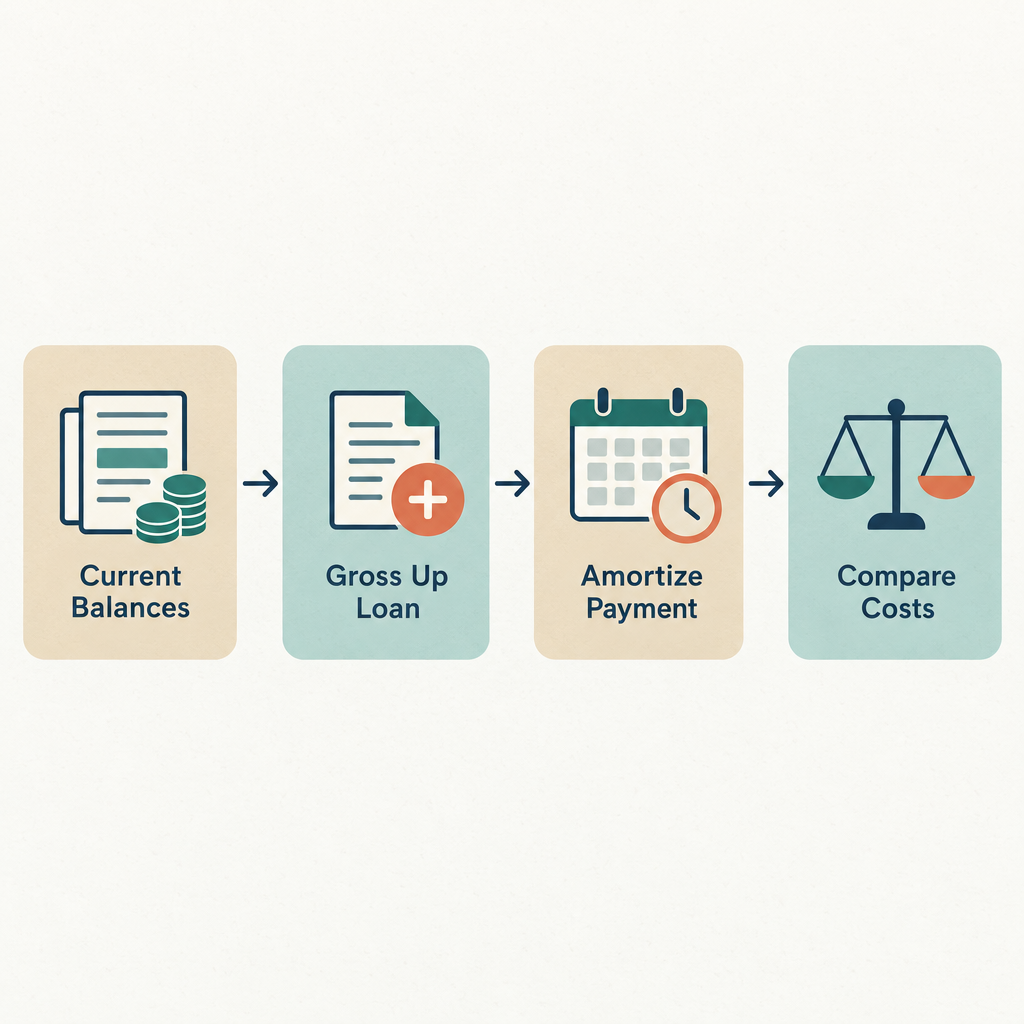
The result rests on two separate calculations, then a subtraction.
Your current path. The calculator pays your balance down one month at a time. Each month it charges interest equal to balance × APR ÷ 12 ÷ 100, adds that to the balance, and subtracts your payment. It repeats until the balance hits zero, counting the months and the total interest along the way.
The new loan. First it works out how big the loan must be so that, after the fee is taken out, enough money is left to pay off your debt in full:
Loan amount = Debt ÷ (1 − fee ÷ 100)
Then it calculates the fixed payment using the standard amortization formula, where r is the monthly rate (APR ÷ 12 ÷ 100) and n is the number of months:
Payment = Loan amount × r ÷ (1 − (1 + r)^−n)
Total cost of the new loan = all payments made − the debt you paid off. That total includes both the interest and the fee, because the fee was borrowed too.
Savings = interest on your current path − total cost of the new loan.
The default example, step by step
Inputs: $15,000 of debt at 24%, paying $450 a month now. Offer: 13% APR, 48 months, 4% origination fee.
- Loan amount: $15,000 ÷ (1 − 0.04) = $15,000 ÷ 0.96 = $15,625.00. The lender keeps $625 as the fee and sends $15,000 to your creditors.
- Monthly rate r: 13 ÷ 12 ÷ 100 = 0.010833.
- Payment: $15,625 × 0.010833 ÷ (1 − 1.010833^−48) = $419.18.
- Total payments: $419.18 × 48 = $20,120.62 (using the unrounded payment).
- Total cost of the new loan: $20,120.62 − $15,000 = $5,120.62. That is roughly $4,496 of interest plus the $625 fee.
- Paid off in: 4 years.
- Current path: $450 a month against $15,000 at 24%. The first month charges $300 interest and only $150 goes to principal. Month by month the principal share grows. The balance clears in 4 years 8 months with $9,966.26 in interest.
- You save: $9,966.26 − $5,120.62 = $4,845.64, and you are debt-free eight months sooner for a payment $31 lower.
| Line | Keep paying as now | New loan |
|---|---|---|
| Monthly payment | $450.00 | $419.18 |
| Payoff time | 4 years 8 months | 4 years |
| Interest paid | $9,966.26 | about $4,496 |
| Origination fee | $0 | $625.00 |
| Total cost above the $15,000 | $9,966.26 | $5,120.62 |
| Difference | $4,845.64 saved |
A second example with smaller numbers
Say you owe $8,000 across two cards at an average 22%, and you pay $250 a month. A credit union offers 10% APR over 36 months with a 2% origination fee.
- Loan amount: $8,000 ÷ (1 − 0.02) = $8,000 ÷ 0.98 = $8,163.27. The fee is $163.27.
- Monthly rate: 10 ÷ 12 ÷ 100 = 0.008333.
- Payment: $8,163.27 × 0.008333 ÷ (1 − 1.008333^−36). The factor 0.008333 ÷ (1 − 0.74174) works out to 0.032267, so the payment is $8,163.27 × 0.032267 = $263.41.
- Total payments: $263.41 × 36 = $9,482.60.
- Total cost of the new loan: $9,482.60 − $8,000 = $1,482.60 ($1,319.33 interest plus the $163.27 fee).
- Current path: $250 a month on $8,000 at 22%. First-month interest is $8,000 × 22 ÷ 12 ÷ 100 = $146.67. The balance clears after 48 full payments and one small final payment of about $158, so 4 years 1 month, with roughly $4,158 in interest.
- You save: about $4,158 − $1,482.60 = about $2,675.
Here the payment goes up by $13 a month, but you finish 13 months sooner and keep roughly $2,700. That is the pattern to look for: a shorter or similar term at a much lower rate.
Quick reference: cost of the $15,000 example at other rates and terms
All rows use the default $15,000 debt and 4% fee, so the loan amount is $15,625 every time. “Savings” compares against the $9,966.26 of interest on the current $450-a-month path.
| New APR | 36 months | 48 months | 60 months |
|---|---|---|---|
| 9% | $496.88/mo, cost $2,888, saves $7,079 | $388.83/mo, cost $3,664, saves $6,303 | $324.34/mo, cost $4,461, saves $5,506 |
| 13% | $526.47/mo, cost $3,953, saves $6,013 | $419.18/mo, cost $5,121, saves $4,846 | $355.52/mo, cost $6,331, saves $3,635 |
| 18% | $564.88/mo, cost $5,336, saves $4,631 | $458.98/mo, cost $7,031, saves $2,935 | $396.77/mo, cost $8,806, saves $1,160 |
| 24% | $613.02/mo, cost $7,069, saves $2,898 | $509.41/mo, cost $9,452, saves $515 | $449.50/mo, cost $11,970, loses $2,004 |
Two things jump out. Going from 48 to 60 months at 13% cuts the payment by $64 but costs an extra $1,210. And a loan at the same 24% you already pay, stretched to five years with a fee, costs $2,004 more than doing nothing, even though the payment looks nearly identical.
The fee alone moves the result more than most people expect. Holding 13% and 48 months fixed:
| Origination fee | Loan amount | Monthly payment | Total cost of new loan |
|---|---|---|---|
| 0% | $15,000.00 | $402.41 | $4,316 |
| 2% | $15,306.12 | $410.62 | $4,710 |
| 4% | $15,625.00 | $419.18 | $5,121 |
| 6% | $15,957.45 | $428.10 | $5,549 |
| 8% | $16,304.35 | $437.41 | $5,995 |
Every two points of fee adds roughly $400 to $450 to the total on this loan. A lender charging 8% with a 13% rate is more expensive than one charging 0% at about 15.5%.
Reading your result
A good result shows all three at once: a lower total cost, a payoff date that is the same or earlier, and a payment you can sustain. The default example passes on all three.
A mixed result is a lower payment with a later payoff date and a small saving, or none. The 18% row at 60 months above is the classic case: $53 less per month, but you pay for one extra year and save only $1,160. That can still be the right call if the current payment is causing missed bills, but understand that you are buying breathing room, not a discount.
A bad result is a negative savings line. The calculator will show it. If the new loan costs more than your current path, the only reasons to proceed are a genuine cash-flow emergency or simplification, and both have cheaper fixes.
Checks to run before you decide:
- Is the “now” payment honest? If you entered $450 but usually send $300, rerun it. The saving will shrink because the current path gets longer and costlier, which makes the loan look better than it is.
- Can you shorten the term? Try 36 months. If the payment is affordable, the saving rises sharply.
- Is the fee negotiable or avoidable? Credit unions and some banks charge none.
- Will the paid-off cards stay at zero? The calculator assumes they do. If you run them up again, you carry both the loan and new card debt.
Lenders also look at how the new payment fits your income. Running the numbers through a “debt to income ratio calculator” first tells you whether the payment you are hoping for is one a lender is likely to approve.
Cheaper options first
Call each card issuer and ask about a hardship plan: many will drop the rate for 6 to 12 months with no new loan at all.
A nonprofit credit counseling agency’s debt management plan typically negotiates lower card rates for one monthly payment, with a modest monthly fee.
Federal credit unions cannot charge more than the NCUA’s 18% ceiling on most loans, and many offer consolidation loans with no origination fee.
A 0% balance transfer card with a 3% to 5% fee can beat any loan here if you can clear the balance before the promotional rate ends.
If you are deciding between consolidating and just attacking the balances harder, a “debt payoff calculator” lets you compare avalanche and snowball payoff schedules with the money you have. Sometimes a $100 bump to your current payment beats a loan with a fee.
Before you borrow
The saving on screen assumes you make every payment on time and never touch the paid-off cards again. Research on consolidation outcomes consistently finds that re-running balances after consolidating is the most common way people end up with more debt than they started with, not less.
The rules that protect you when you consolidate
Truth in Lending Act and Regulation Z (12 CFR 1026). Before you sign a closed-end loan, the lender must give you a written disclosure of the APR, the finance charge, the amount financed and the total of payments. The disclosed APR includes the origination fee as a prepaid finance charge. If the APR on the form is a lot higher than the “rate” you were quoted, the gap is the fee. Compare the disclosure’s “total of payments” against the calculator’s total payments; they should match closely.
State rate caps. Personal loan rates are regulated state by state. Several states cap rates on smaller loans well below the levels some online lenders charge elsewhere, and some lenders simply do not offer loans in states with strict caps. A lender must be licensed in your state; you can confirm that through NMLS Consumer Access or your state regulator’s license lookup before sharing documents.
Military Lending Act (32 CFR Part 232). If you are an active-duty servicemember or a dependent, most consumer loans, including consolidation loans, are capped at a 36% Military Annual Percentage Rate, which includes fees. Lenders also cannot require arbitration or a payroll allotment. The Servicemembers Civil Relief Act separately caps interest at 6% on debts you took on before active duty, if you ask.
Equal Credit Opportunity Act and Fair Credit Reporting Act. A lender cannot deny you based on race, sex, age, marital status or receipt of public assistance. If you are denied, you are entitled to the specific reasons. If the decision used your credit report, you are entitled to a free copy of that report. Most prequalification checks are soft inquiries and do not affect your score; the formal application is a hard inquiry.
Fair Debt Collection Practices Act. Consolidating does not erase a collector’s obligations. If some of the debt is already with a “debt collector,” you have the right to written validation before paying, and a payoff letter stating the exact amount that closes the account.
IRS treatment if you sell crypto to pay debt. Some readers consider selling cryptocurrency instead of borrowing. Under IRS Notice 2014-21 the IRS treats crypto as property, so a sale is a taxable event: you owe capital gains tax on any increase over your cost basis, and the sale goes on Form 8949. Crypto-backed loans avoid the sale but carry liquidation risk if prices drop, and nothing in crypto is FDIC or SIPC insured. A “crypto profit calculator” can show the tax hit before you decide.
Make the lenders compete on the same math
Ask every lender for the Regulation Z disclosure and enter their rate, term and fee into the calculator above. Rank offers by “total cost of the new loan,” not by payment or by rate alone. A 2-point lower rate with a 6% fee often loses to a slightly higher rate with none.
FAQ
How does a debt consolidation loan calculator decide what I save?
It runs two scenarios. One keeps your current payment going against your current APR until the balance is gone and totals the interest. The other prices a fixed-payment loan large enough to cover your debt plus the origination fee, and totals every payment. Savings is the first total minus the second. If the result is negative, the loan costs more than your current path.
Why is the new loan amount bigger than my debt?
Because the fee comes out of the proceeds. If you borrow exactly $15,000 with a 4% fee, you only receive $14,400 and cannot pay everything off. The calculator uses debt ÷ (1 − fee) so that $15,625 borrowed leaves $15,000 after the $625 fee.
What is a good APR on a personal consolidation loan?
Lower than the weighted average on the debts you are replacing, after accounting for the fee, and low enough that the total cost beats your current path. There is no single good number; a 13% loan is excellent against 24% cards and pointless against a 9% car loan. The quick reference table shows how the saving shrinks as the rate climbs toward your current APR.
Does a longer term always cost more?
Yes, at the same rate and fee. On $15,000 at 13% with no fee, 36 months costs about $3,111 in interest (payment about $503) and 60 months costs about $5,476 (payment about $341), a difference of about $2,365 for a payment about $162 lower. Pick the shortest term whose payment you can make without missing other bills.
Can I use this loan calculator for debt consolidation with a balance transfer card instead?
Partly. Enter the transfer fee (commonly 3% to 5%) in the origination fee field, 0 for the APR, and the length of the promotional period as the term. The payment shown is what you must pay each month to clear the balance before the promotional rate ends. The calculator does not model what happens if a balance remains when the regular rate kicks in, so treat that result as a target, not a forecast.
Will consolidating hurt my credit score?
The hard inquiry and the new account can trim a few points at first. Paying the cards to zero lowers your credit utilization, which often helps more than the inquiry hurts, as long as you keep the cards open and unused. Closing them raises utilization on any remaining balances. The bigger long-term factor is paying the new loan on time every month.
What does the calculator leave out?
Late fees, prepayment penalties, rate changes on variable debts, interest already accrued but not yet posted, and any new spending on the paid-off cards. It also assumes your current payment stays fixed, so if you pay only minimums that fall over time, your real current path is longer and costlier than shown. For a single new loan on its own terms, a “personal loan calculator” gives the same payment math without the comparison.
Comments are closed