Runs in your browser. Nothing you type is sent or saved.
This emergency fund calculator takes your essential monthly costs, how many months you want covered, what you have saved already and what you can put away each month, then shows your savings target, how much is still missing, how long it will take and how many months of essentials you could cover today. Have your last bank statement, your rent or mortgage figure and a recent pay stub nearby before you start. The math is simple multiplication and division, so you can check every number by hand.
How to use the calculator
- Add up your essential monthly costs from your bank or credit card statement: rent or mortgage, utilities, groceries, insurance, minimum debt payments, transport, childcare and medicine. Enter the total in Essential monthly costs.
- Choose Months to cover. Pick 1 month if you are starting from zero, 3 months for a two-income household with stable work, 6 months for a single earner or variable income, 9 months for self-employed or specialized careers.
- Enter the balance of money you could use for an emergency without penalty in Already saved. Use your savings or checking balance, not retirement accounts.
- Check your pay stub against your statement and enter a realistic surplus in You can save each month. Use the amount you actually had left over last month, not what you hope to save.
- Read the four outputs, then change Months to cover to see how a smaller starter goal shortens the timeline.
What each field means and the mistakes that skew the result
The calculator only knows what you type, so the most common problem is not the formula. It is the inputs. Here is what belongs in each box and where people go wrong.
Essential monthly costs ($)
This is what you would still have to pay if your income stopped tomorrow. Housing, utilities, groceries, insurance premiums, prescriptions, car payment and fuel, phone, childcare, and the minimum payments on every loan and card. The default is $2,500.
The mistake that runs in both directions: entering your full take-home pay (too high) or only rent (too low). Streaming subscriptions, restaurant meals and gym fees would get cut in a real emergency, so leave them out. Minimum debt payments stay in, because missing them during a job loss creates late fees and credit damage on top of the original problem.
Costs that arrive once or twice a year trip people up too. Car insurance billed every six months, property tax, annual renewals. Divide them by 12 and add the monthly share.
Months to cover
The options are 1 month (starter fund), 3 months, 6 months and 9 months. There is no single correct answer because the number is really a guess about how long a disruption would last and how likely one is. A government employee with a working spouse faces a different risk than a freelance contractor with a child.
The mistake here is picking 9 months on day one, seeing a timeline of several years and giving up. Set the first target at 1 month. Reach it, then move the selector.
Already saved ($)
Count only money you could withdraw tomorrow without a penalty or a tax bill: savings accounts, a money market account, cash in checking above what next week’s bills need. The default is $1,000.
Do not count your 401(k), IRA, a Series I savings bond bought less than 12 months ago (the Treasury does not allow redemption in the first year) or cryptocurrency, which can lose value on the exact day you need it. A credit card limit is not savings either. It is borrowing capacity, and the lender can cut it without notice.
You can save each month ($)
This is the honest surplus after essentials and the non-essentials you will not actually give up. The default is $250. The usual error is entering an aspirational figure, which makes the timeline look shorter than it will be. If last month’s bank statement shows your balance grew by $140, enter $140.
The emergency fund calculator formula, worked twice
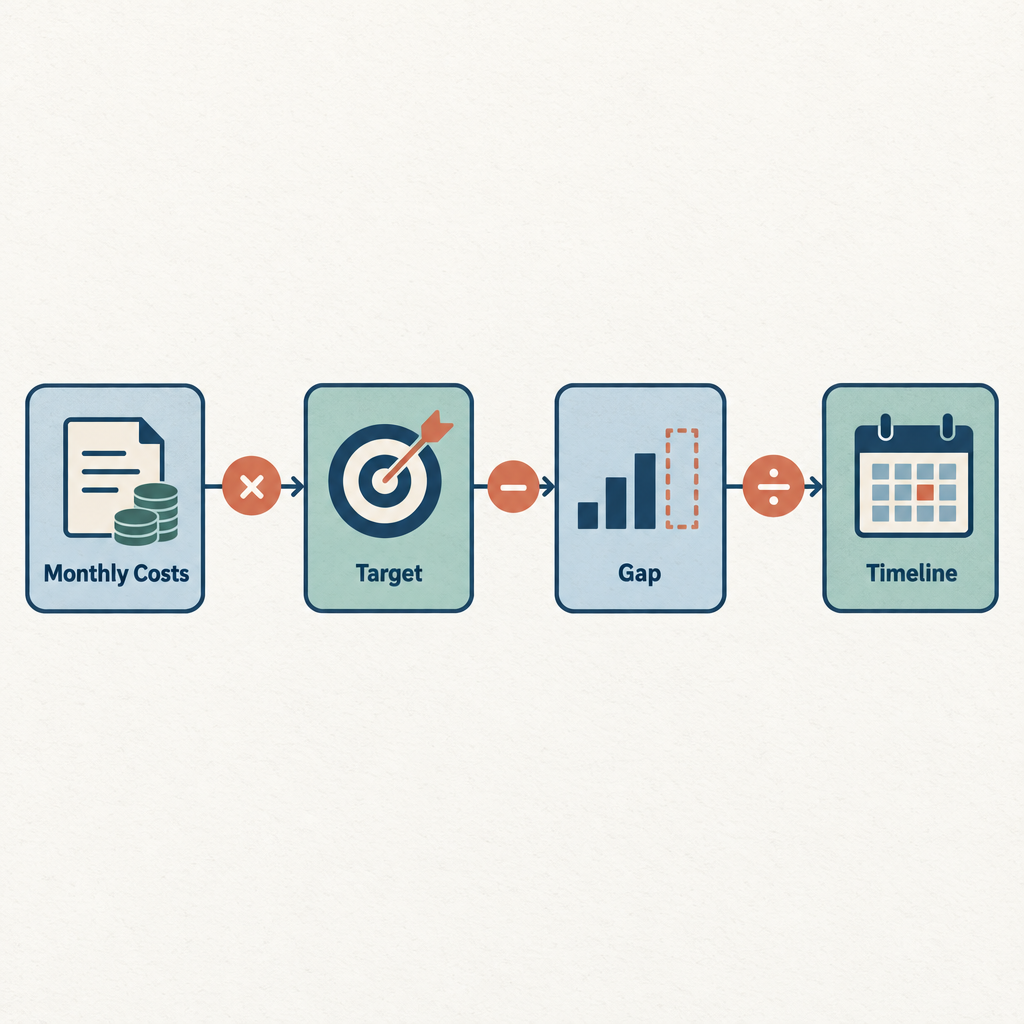
Four lines of arithmetic produce every output on this page:
- Target = Essential monthly costs × Months to cover
- Still to save = Target − Already saved
- Time to reach it = Still to save ÷ You can save each month, rounded up to whole months
- Covered today = Already saved ÷ Essential monthly costs
The rounding matters. If the division gives 8.2 months, you need a ninth deposit to cross the line, so the calculator shows 9 months. If Already saved is bigger than the target, Still to save is $0 and the timeline is zero months.
Worked example with the default inputs
Essential monthly costs $2,500, Months to cover 3, Already saved $1,000, You can save each month $250.
- Target: $2,500 × 3 = $7,500
- Still to save: $7,500 − $1,000 = $6,500.00
- Time to reach it: $6,500 ÷ $250 = 26 months, which is 2 years 2 months
- Covered today: $1,000 ÷ $2,500 = 0.4 months of essentials
That last figure is the one to look at first. With $1,000 saved and $2,500 in essential bills, you could cover about 12 days without income. A three-month cushion is more than two years away at $250 a month.
Second worked example: single earner, bigger bills
Say your essential costs are $3,800, you are the only income in the household so you pick 6 months, you have $4,000 in savings and you can put away $400 a month.
- Target: $3,800 × 6 = $22,800
- Still to save: $22,800 − $4,000 = $18,800
- Time to reach it: $18,800 ÷ $400 = 47 months, which is 3 years 11 months
- Covered today: $4,000 ÷ $3,800 = 1.05, so about 1.1 months of essentials
Four years is a long horizon. Drop Months to cover to 3 and the target becomes $11,400, the gap $7,400, and the timeline $7,400 ÷ $400 = 18.5, rounded up to 19 months. The six-month fund is still the long-run goal, but the three-month milestone arrives in a year and a half instead of four years.
Quick reference: targets and timelines at a glance
The first table shows the target for common cost levels. The second shows how long the default $6,500 gap takes at different savings rates. All figures use the same formula as the calculator.
| Essential monthly costs | 1 month | 3 months | 6 months | 9 months |
|---|---|---|---|---|
| $1,500 | $1,500 | $4,500 | $9,000 | $13,500 |
| $2,500 | $2,500 | $7,500 | $15,000 | $22,500 |
| $3,500 | $3,500 | $10,500 | $21,000 | $31,500 |
| $5,000 | $5,000 | $15,000 | $30,000 | $45,000 |
Time to close a $6,500 gap (the default example):
| You can save each month | Months (rounded up) | In years and months |
|---|---|---|
| $100 | 65 | 5 years 5 months |
| $250 | 26 | 2 years 2 months |
| $500 | 13 | 1 year 1 month |
| $750 | 9 | 9 months |
| $1,000 | 7 | 7 months |
Doubling the monthly saving from $250 to $500 cuts the timeline in half because the formula is linear. Nothing compounds here, which is the next point.
What the formula leaves out
The calculator ignores interest. At a high-yield savings rate of 4% APY, $6,500 earns roughly $260 a year, which would shave about a month off the default timeline. It also ignores inflation pushing your essential costs up while you save, tax refunds or bonuses that could close the gap faster, and any change in your pay. If you want to see how interest changes the picture, an interest calculator handles that math separately.
How to read your result
Covered today below 1.0 month is the red zone. One missed paycheck means borrowing. The priority is a starter fund of one month of essentials, and the research from the Federal Reserve’s annual Survey of Household Economics and Decisionmaking consistently shows that a large share of American adults could not cover an unexpected $400 expense from cash or savings, so being in this zone is common rather than unusual.
Covered today between 1 and 3 months handles most single shocks: a car repair, a dental bill, a short gap between jobs. You can usually manage a problem without a high-cost loan.
Covered today at 3 to 6 months is the range most financial counselors treat as a full fund for a stable two-income household. Beyond 6 months starts to make sense for self-employed workers, single earners with dependents, and anyone whose job search would take a long time.
Time to reach it over 3 years is a sign to change something rather than wait. Three levers move it: lower the Months to cover selector to set a nearer milestone, raise the monthly saving by cutting a specific line in the budget, or add a one-time deposit from a tax refund or the sale of something you do not use.
Saving while carrying debt
If you have credit card balances at 20% to 30% APR, a dollar paid toward that debt saves more than a dollar in a savings account earns. The reasonable middle path is a one-month starter fund first, then aggressive debt payoff, then the rest of the fund. A debt payoff calculator or a credit card payoff calculator will show how fast each balance clears once the starter fund is in place.
Shorten the timeline without earning more
Move the deposit to the day after payday with an automatic transfer so the money never sits in checking.
Put the whole of any tax refund, bonus or rebate into the fund until the one-month milestone is hit.
Re-shop one recurring bill (auto insurance, phone plan) and redirect the saving to the transfer.
Where to keep the money
The account should be insured, liquid and separate from your spending account. An FDIC-insured savings account or an NCUA-insured credit union share account covers up to $250,000 per depositor, per institution, per ownership category. The Federal Reserve suspended the six-per-month withdrawal limit in Regulation D in April 2020, but individual banks may still impose their own limits or fees on frequent transfers, so read the account disclosure.
Money market mutual funds held at a brokerage are not FDIC insured. SIPC protection covers a brokerage failure, not a loss in value. Certificates of deposit usually charge an early withdrawal penalty, and Series I bonds cannot be redeemed in the first 12 months and lose three months of interest if cashed before five years. Those products can hold a second tier of savings, but the first month or two of essentials belongs somewhere you can reach instantly.
Interest earned in a savings account is taxable as ordinary income. Your bank reports it to the IRS on Form 1099-INT once it reaches $10 in a year.
If the emergency arrives before the fund does
This is where the real cost of a small cushion shows up. The table below prices a $1,000 shortfall three ways. Figures are illustrative using standard amortization math; your own offer will differ.
| Option | Cost structure | Term | Total repaid | Cost of borrowing |
|---|---|---|---|---|
| Credit union Payday Alternative Loan | 28% APR cap plus application fee up to $20 (NCUA rules) | 6 months | about $1,103 | about $103 |
| Credit card purchase at 24% APR | Interest on declining balance | 12 months | about $1,135 | about $135 |
| Storefront payday loan | $15 per $100 every 14 days (about 391% APR) | Rolled over 4 times, 10 weeks | $1,750 | $750 |
The APR on the payday line is the fee divided by the amount borrowed, multiplied by the number of 14-day periods in a year: $150 ÷ $1,000 × 26.07 = 391%. The CFPB describes two-week payday fees of $10 to $30 per $100 borrowed and notes that a typical $15 fee works out to an APR of almost 400%. Compare that with the PAL, where NCUA regulations cap the APR at 28% and limit PAL I loans to $200 to $1,000 for one to six months, with PAL II allowing up to $2,000 for up to 12 months.
Before you borrow
A payday loan rolled over a few times can cost more than the emergency itself, and each rollover makes the next paycheck shorter. Exhaust fee-free options and hardship plans before any loan with an APR above 36%.
Cheaper options first
Ask the biller for a hardship plan or payment arrangement; utilities, hospitals and landlords often have one.
Check whether your employer offers an earned-wage advance with no fee, or a credit union Payday Alternative Loan.
Dial 211 for local assistance programs, or contact a nonprofit credit counselor approved by the Department of Justice’s trustee list.
If you are weighing a fixed-rate personal loan instead, a personal loan calculator shows the monthly payment and total interest before you sign anything.
US rules that apply here
Truth in Lending Act and Regulation Z (12 CFR 1026). Any lender you turn to during an emergency must disclose the APR, finance charge, amount financed and total of payments before you are bound. If a cash advance app or lender will not state an APR, treat that as a warning sign rather than a convenience.
State rate caps. Payday lending is effectively banned or capped near 36% in a number of states, including New York, New Jersey, Pennsylvania, Georgia, North Carolina, Arkansas and Illinois under its Predatory Loan Prevention Act. Other states allow triple-digit APRs. Your state regulator’s license lookup and the NMLS Consumer Access database show whether a lender is licensed where you live.
Military Lending Act (32 CFR 232). Active-duty servicemembers and their dependents cannot be charged a Military APR above 36% on most consumer credit, including payday loans, vehicle title loans and credit cards. A lender who skips that check is breaking federal law.
NCUA Payday Alternative Loan rules (12 CFR 701.21). These set the 28% APR cap and loan limits described above. You must be a credit union member, and some credit unions require a month of membership before the first PAL.
Retirement accounts. Withdrawing from a 401(k) or traditional IRA before age 59½ generally triggers income tax plus a 10% additional tax. The SECURE 2.0 Act added a penalty-free emergency withdrawal of up to $1,000 per year for plans that choose to offer it, with repayment rules that limit how often you can use it. Even without the penalty, the money leaves the market and stops growing, so it is a last resort rather than part of Already saved.
Cryptocurrency. The IRS treats crypto as property under IRS Notice 2014-21, so selling it to cover an emergency is a taxable event with a capital gain or loss to report. Crypto is not FDIC or SIPC insured and can lose all of its value. Keep it out of the Already saved field; a crypto profit calculator is the right tool for that balance, not this one.
FAQ
How much should an emergency fund be?
Multiply your essential monthly costs by the number of months you want covered. For $2,500 in essentials, that is $2,500 for a starter fund, $7,500 for three months and $15,000 for six months. The calculator above does this instantly and shows how long each target takes at your savings rate.
Should I count my credit card limit as part of my emergency fund?
No. A credit limit is borrowing capacity that the issuer can reduce or close at any time, and using it adds interest at 20% to 30% APR to the cost of the emergency. Enter only cash and insured deposits in Already saved.
Is three months enough, or do I need six?
Three months fits a household with two stable incomes and no dependents. Six months fits single earners, parents, people with variable commissions or freelance income, and anyone in a field where job searches run long. Nine months is for the self-employed and specialized careers. Set the selector to the lower number first and move it up after you hit the milestone.
Why does the calculator show more months than my own division?
It rounds up. If Still to save divided by You can save each month gives 18.5, the calculator shows 19, because you need a nineteenth deposit to finish. Partial months do not reach the target.
Does the result include interest on my savings?
No. The formula assumes the balance grows only by your deposits. Interest at current high-yield savings rates shortens a two-year timeline by about a month, so the calculator’s answer is slightly conservative, which is the safer side to be on.
What if my essential costs change while I am saving?
Rerun the calculator whenever rent, insurance or a loan payment changes. A $200 rise in essentials adds $600 to a three-month target and $1,200 to a six-month one, so the fund should track your real bills rather than the number you entered a year ago.
Where should I keep an emergency fund?
In an FDIC-insured savings account or NCUA-insured credit union account, separate from your checking account, with no early withdrawal penalty. Keep the first month or two instantly accessible and consider CDs or Series I bonds only for money beyond that layer.
Is it better to pay off debt or build the fund first?
Build a one-month starter fund first so a small emergency does not go on a card, then focus on high-interest debt, then finish the fund. Carrying balances at 25% APR while holding six months of cash at 4% costs you money every month.
Comments are closed