


General information, not legal advice. Laws change, so confirm with the official statute, your state regulator or a licensed attorney before you act.
Payday loans are legal in Kentucky, where the law calls them “deferred deposit transactions,” and only lenders licensed by the Department of Financial Institutions (DFI) can make them. Since July 2026, all your open payday loans together can’t exceed $600. The fee is capped at $15 per $100 and must cover 14 to 60 days, you can’t have more than two loans open, and a statewide database checks these limits every time you borrow.
Run the numbers
Key takeaways
- All your open Kentucky payday loans together can’t exceed $600 in proceeds, under KRS 286.9-100 as amended by 2026 Acts Ch. 98.
- The fee is capped at $15 per $100. It must cover at least 14 days, and a lender can’t hold your check for more than 60 days. On a two-week loan, that works out to an APR of roughly 391% to 460%.
- You can’t have more than two payday loans open at once, and no lender may charge a fee to roll over, renew or consolidate one.
- Not repaying a payday loan is a civil debt, not a crime. A lender has to sue and win a judgment before it can garnish your wages.
- Before you share bank details with a lender, check that it holds a Kentucky DFI license.
In this guide
- Kentucky payday loan laws at a glance
- What changed in 2026: SB 219
- How much a payday loan really costs
- Borrowing limits, loan terms and the database
- Car title and installment loans
- Licensing, storefronts and online lenders
- What happens if you can’t pay
- Kentucky’s statute of limitations
- Federal rules that also apply
- Kentucky vs. neighboring states
- Cheaper options and debt help
- How to check a license and file a complaint
- FAQ
Fact-checked
We checked these key facts against the sources named, on November 20, 2026:
- At 14 days, 365 ÷ 14 is about 26.07, so 15% × 26.07 ≈ 391% (source: consumerfinance.gov)
- At the face-amount ceiling, $105.88 ÷ $600 is 17.65%, and 17.65% × 26.07 ≈ 460% (source: moneylion.com)
- On a $100 check written at the maximum fee, $15 is the fee and $85 is your cash (source: kfi.ky.gov)
- 2025: House Bill 202. As filed, it would have capped the APR on deferred deposit transactions at 36% (source: apps.legislature.ky.gov)
- 2026: Senate Bill 219. It raised the cap to $600, set the $850 ceiling and fixed the database fee at $3 (source: apps.legislature.ky.gov)
Kentucky payday loan laws at a glance (updated for 2026)
Kentucky’s payday rules are in Subtitle 9 of KRS Chapter 286, which covers check cashing and deferred deposit businesses. Senate Bill 219 in 2026 raised the borrowing cap and set a flat database fee. The fee cap, the loan-count limit, the term range and the rollover ban didn’t change.
| Rule | Before SB 219 | After SB 219 (2026 Acts Ch. 98) | Statute |
|---|---|---|---|
| Total proceeds across all open payday loans | $500 | $600, adjusted every year, never above $850 | KRS 286.9-100 |
| Maximum fee | $15 per $100 of the check’s face amount | Unchanged | KRS 286.9-100 |
| Minimum period the fee must cover | 14 days | Unchanged | KRS 286.9-100 |
| Longest a lender may hold your check | 60 days | Unchanged | KRS 286.9-100 |
| Open loans allowed at once | 2 | Unchanged | KRS 286.9-100 |
| Fee to roll over, renew or consolidate | Banned | Banned | KRS 286.9-100 |
| Database fee per transaction | Set by the DFI commissioner within a statutory range | Flat $3 | KRS 286.9-140 |
| License required | Yes, from DFI | Yes, from DFI | KRS 286.9 |
SB 219 became law on April 12, 2026, and the new limits took effect July 15, 2026. Any payday loan you take out today falls under the 2026 version of the law.
What changed in 2026: the $600 cap and SB 219
SB 219 raised the most you can hold in Kentucky payday loans from $500 to $600. It also requires the cap to rise with prices each year up to a hard ceiling of $850, and it replaced the old database fee range with a flat $3 per transaction. The General Assembly passed it as “AN ACT relating to debts.” The legislature’s bill record shows Governor Andy Beshear neither signed nor vetoed it, so it became law on its own as 2026 Acts Ch. 98.
Under the enacted text, the new limits apply only to loans made on or after the Act’s effective date. A loan signed in spring 2026 for the full $500 stays under the old rules until it’s repaid. That’s also why many older guides, law firm pages and policy articles still say Kentucky’s maximum is $500. They were written before July 2026.
Did you know?
At SB 219’s flat $3 database fee, the 1,043,566 deferred deposit transactions that the 808 KAR 9:010 regulatory impact analysis reports for 2025 would come to about $3.1 million a year in fees paid by licensees.
Timeline: how Kentucky’s payday law reached its current form
Payday lending bills were filed in each of Kentucky’s 2024, 2025 and 2026 sessions. Only some became law.
- 2024: House Bill 495. It amended KRS 286.9-100 and KRS 286.9-140, the sections on lender operations and the state database. Governor Beshear signed it on April 4, 2024, and it became Acts Ch. 38.
- 2024: House Bill 726. This overhaul of the financial services code repealed Kentucky’s title pledge lending subtitle (KRS 286.10). It was signed on April 9, 2024.
- 2025: House Bill 202. As filed, it would have capped the APR on deferred deposit transactions at 36%. It didn’t pass.
- 2026: Senate Bill 219. It raised the cap to $600, set the $850 ceiling and fixed the database fee at $3. It became Acts Ch. 98 on April 12, 2026.
- 2026: House Bill 656. This separate bill on deferred deposit fees went to the House Banking and Insurance Committee on February 25, 2026, and went no further.
The Kentucky Center for Economic Policy (KCEP) and the Kentucky Coalition for Responsible Lending have pushed for tighter limits for years. The industry argued that the old $500 cap had fallen behind prices. In 2026, the legislature sided with a higher cap.
Will the cap keep rising? How the $850 ceiling works
Yes, slowly. Under Acts Ch. 98, the DFI commissioner must adjust the $600 total-proceeds cap every year based on the Consumer Price Index, and no adjustment can push it above $850. Each new figure applies to loans made after it takes effect. Before you borrow, ask the lender for the current cap or check with DFI. Don’t assume $600 will still be the number in 2027.
How much a Kentucky payday loan really costs
At the legal maximum, a Kentucky payday loan costs about $15 to $17.65 for every $100 of cash you get. For a two-week loan, that’s an APR of roughly 391% to 460%. The range exists because KRS 286.9-100 measures the $15 cap against the face amount of your postdated check, and that face amount includes the fee.
Here’s how that works. On a $100 check written at the maximum fee, $15 is the fee and $85 is your cash. Measured against cash received, that’s about $17.65 per $100. A lender that charges $15 per $100 of cash instead (for example, $90 on $600) is still under the ceiling.
| Cash you receive | Check face amount at the legal maximum | Maximum fee | Total repaid | APR at 14 days | APR at 30 days | APR at 60 days |
|---|---|---|---|---|---|---|
| $100 | $117.65 | $17.65 | $117.65 | about 460% | about 215% | about 107% |
| $300 | $352.94 | $52.94 | $352.94 | about 460% | about 215% | about 107% |
| $500 | $588.24 | $88.24 | $588.24 | about 460% | about 215% | about 107% |
| $600 | $705.88 | $105.88 | $705.88 | about 460% | about 215% | about 107% |
| $600 (fee of $15 per $100 of cash) | $690.00 | $90.00 | $690.00 | about 391% | about 183% | about 91% |
The APR math in plain words. Divide the fee by the cash you receive to get the cost for one period. For $90 on $600, that’s 15%. Then multiply by the number of those periods in a year. At 14 days, 365 ÷ 14 is about 26.07, so 15% × 26.07 ≈ 391%. At the face-amount ceiling, $105.88 ÷ $600 is 17.65%, and 17.65% × 26.07 ≈ 460%. The 30-day and 60-day columns assume one fee covers the whole term. Kentucky law allows any term from 14 days up to the 60-day maximum, so those are the lowest APRs a single maximum fee can produce. A longer term lowers the APR, but the dollars you pay stay the same.
The Truth in Lending Act and Regulation Z (12 CFR 1026) require the lender to show the finance charge and the APR in writing before you sign. Compare the APR on that disclosure with the table above. If it’s higher, ask why.
Check the fee against the check
Divide the fee by the face amount of the check you’re writing. If the result is above 15%, the fee is over Kentucky’s limit under KRS 286.9-100, and you can report the lender to DFI.
Why the $15 fee isn’t called “interest”
Kentucky treats the charge on a deferred deposit transaction as a service fee set by KRS 286.9, not as interest under the state’s general lending laws. That’s how a product with an APR in the hundreds is legal in a state whose installment lenders work under much lower caps. The label changes nothing about what you pay, and the federal APR disclosure counts the fee as a finance charge.
The cost of borrowing again and again
Payday loans get expensive when you borrow repeatedly. In its 2014 data research, the Consumer Financial Protection Bureau (CFPB) found that most payday loans were renewed or followed by another loan within 14 days. Kentucky bans rollover fees, but nothing stops you from repaying one loan and taking a new one. That’s what this pattern looks like in practice.
Worked example: you keep $600 borrowed by taking a new two-week loan each time the old one comes due, paying $90 each cycle.
| Time kept borrowed | Cycles | Fees paid | Cash you still owe |
|---|---|---|---|
| 1 month | 2 | $180 | $600 |
| 3 months | 6 or 7 | $540 to $630 | $600 |
| 6 months | 13 | $1,170 | $600 |
| 1 year | 26 | $2,340 | $600 |
After six months, you’ve paid nearly twice what you borrowed and still owe all of it. Getting out usually starts with a payment plan or a cheaper loan, both covered below.
Borrowing limits, loan terms and the statewide database
The limits in the table above apply across every licensed lender in the state, not store by store. A real-time database run for DFI checks them before each loan is made, which is why a lender can turn you down because of a loan you took elsewhere.
Can I have two payday loans at once in Kentucky?
Yes, up to two, provided they add up to $600 or less. Under KRS 286.9-100, a licensee can’t make a new deferred deposit transaction with a customer who already has two open. Kentucky limits you to two open deferred deposit transactions with an aggregate amount of no more than $500, so a $400 loan plus a $200 loan would exceed that limit.
That answers a common question: why did a store say you can’t borrow when you only have one loan with them? Usually you have an open loan elsewhere, the new loan would push your total over the cap, or a repaid loan hasn’t been marked closed. If you’ve repaid and still get turned down, ask the lender that made the old loan to close it in the system.
How the database works
KRS 286.9-140 requires a common, real-time database of deferred deposit transactions. DFI contracts with Veritec Solutions, LLC to run it at kydpp.com. Before making a loan, a licensee must check that you’re eligible. It records the new transaction and records it again when the loan closes. Under SB 219, the licensee pays $3 for each transaction it submits. The borrower is not charged this fee by statute.
Can a lender roll over my loan?
Not for a fee. KRS 286.9-100 says a licensee or its affiliate may not, for a fee, renew, roll over or otherwise consolidate a deferred deposit transaction. A lender can give you more time for free. It can’t charge a new $15 per $100 to push the due date back. If a lender offers a paid “extension,” write down what was said and report it to DFI.
How long do you have to repay?
Between 14 and 60 days, as set in your written agreement. KRS 286.9-100 requires the fee to cover at least 14 days and bars a licensee from agreeing to hold your check for more than 60 days. The disclosure must show the exact date the lender will deposit your check or debit your account.
That range gives you room to negotiate before you sign. If your payday falls just after the proposed date, ask for a due date that matches it. A loan of 28 or 30 days costs the same fee as a 14-day loan, so a later date lowers your real cost of borrowing and cuts the number of times you’d need to borrow again. Changing the date after the loan is open is much harder.
Car title and installment loans in Kentucky
Neither is a payday loan, and both fall under different licenses with different price limits. In short, Kentucky no longer licenses high-cost title pledge lending, and consumer installment lenders work under tiered rate caps.
Car title loans
HB 726 repealed the title pledge lending subtitle, KRS 286.10, in 2024, so Kentucky no longer has a license for 30-day title pledges. A licensed consumer lender, bank or credit union can still make a loan secured by your vehicle, but only within the rate rules for its own license. Many websites advertising “Kentucky title loans” are lead-generation pages or lenders licensed in other states. A title loan made across the state line can still cost you your car, because the lender holds a lien on the title. If a company wants your title, a spare key or a GPS tracker on your car, check its license with DFI before you sign.
Installment loans, including loans for bad credit
Consumer loan companies licensed by DFI under the Kentucky Consumer Loan Act (KRS 286.4) must stay within tiered maximum rates in KRS 286.4-530, with lower caps on larger loans.
| Feature | Payday loan (KRS 286.9) | Consumer installment loan (KRS 286.4) |
|---|---|---|
| Repayment | One lump sum on the due date | Scheduled payments over months |
| Price limit | $15 per $100 fee | Tiered maximum rates under KRS 286.4-530 |
| Amount | $600 total open cap (2026) | Larger amounts allowed |
| Security | Postdated check or debit authorization | Often unsecured; sometimes a vehicle or property |
| License | DFI deferred deposit license | DFI consumer loan license |
Ads for “ky loans for bad credit” that promise “guaranteed approval” or “no credit check” are marketing. Lenders that skip a hard pull from Experian, Equifax or TransUnion usually run a soft check or review your bank history, then charge more. Compare the APR on the Truth in Lending disclosure, not the monthly payment, and ask about add-ons such as credit insurance.
Who can lend: licensing, storefronts and online lenders
Any company in the deferred deposit business with Kentucky customers needs a DFI license under KRS 286.9, whether it lends from a storefront or online. DFI’s license count has been declining, from 236 check casher and deferred deposit licenses at the end of 2024 to roughly 222 at the end of 2025, and a moratorium on new licenses remains in effect. Each storefront location can hold its own license, so the count of licenses is higher than the count of companies.
| Measure | Figure | Period | Source |
|---|---|---|---|
| Deferred deposit transactions in Kentucky | 1,043,566 | Jan to Dec 2025 | 808 KAR 9:010 regulatory impact analysis |
| Licensed deferred deposit entities | 214 | 2025 | 808 KAR 9:010 regulatory impact analysis |
| Check casher / deferred deposit licenses | about 222 | Dec 31, 2025 | DFI January 2026 legislative presentation |
| Same licenses a year earlier | 236 | Dec 31, 2024 | DFI legislative presentation |
| Total open payday proceeds cap | $600 (ceiling $850) | From July 15, 2026 | KRS 286.9-100, 2026 Acts Ch. 98 |
| Database fee per transaction | $3 | 2026 | KRS 286.9-140, 2026 Acts Ch. 98 |
Did you know?
Dividing the 808 KAR 9:010 analysis figures shows Kentucky’s 214 licensed deferred deposit entities averaged about 4,900 payday transactions each in 2025.
How to verify a lender with the Kentucky DFI
How to check a lender in Kentucky
- Write down the lender’s full legal name and address from the agreement or website footer.
- Search DFI’s licensee lookup for that name and confirm the license type: deferred deposit for payday loans, consumer loan for installment loans.
- Check NMLS Consumer Access if the lender says it’s licensed through NMLS.
- If you can’t find a license, or the name doesn’t match, don’t share your bank login, routing number or Social Security number.
- Report unlicensed lending to DFI and keep screenshots of the website and any messages.
Online payday loans in Kentucky
An online lender making payday loans to Kentucky residents without a DFI license is a red flag. The license requirement covers the business, whatever channel it uses. Some online lenders claim ties to Native American tribes and say tribal sovereign immunity exempts them from state law. Courts have rejected that claim in a number of cases. Even when it holds up for a time, you lose Kentucky’s cap, fee limit and database check.
Can you get money back from an illegal online payday loan? Sometimes. Start with a written complaint to DFI and the CFPB, and contact a Kentucky legal aid office. Recovery depends on the facts and the lender, so get advice on your case instead of simply stopping payment and hoping.
Before you share your bank details
Check that any storefront or online lender holds a Kentucky DFI license first. Once a lender has your account and routing numbers, stopping its withdrawals takes real effort.
What happens if you can’t pay back a payday loan in Kentucky
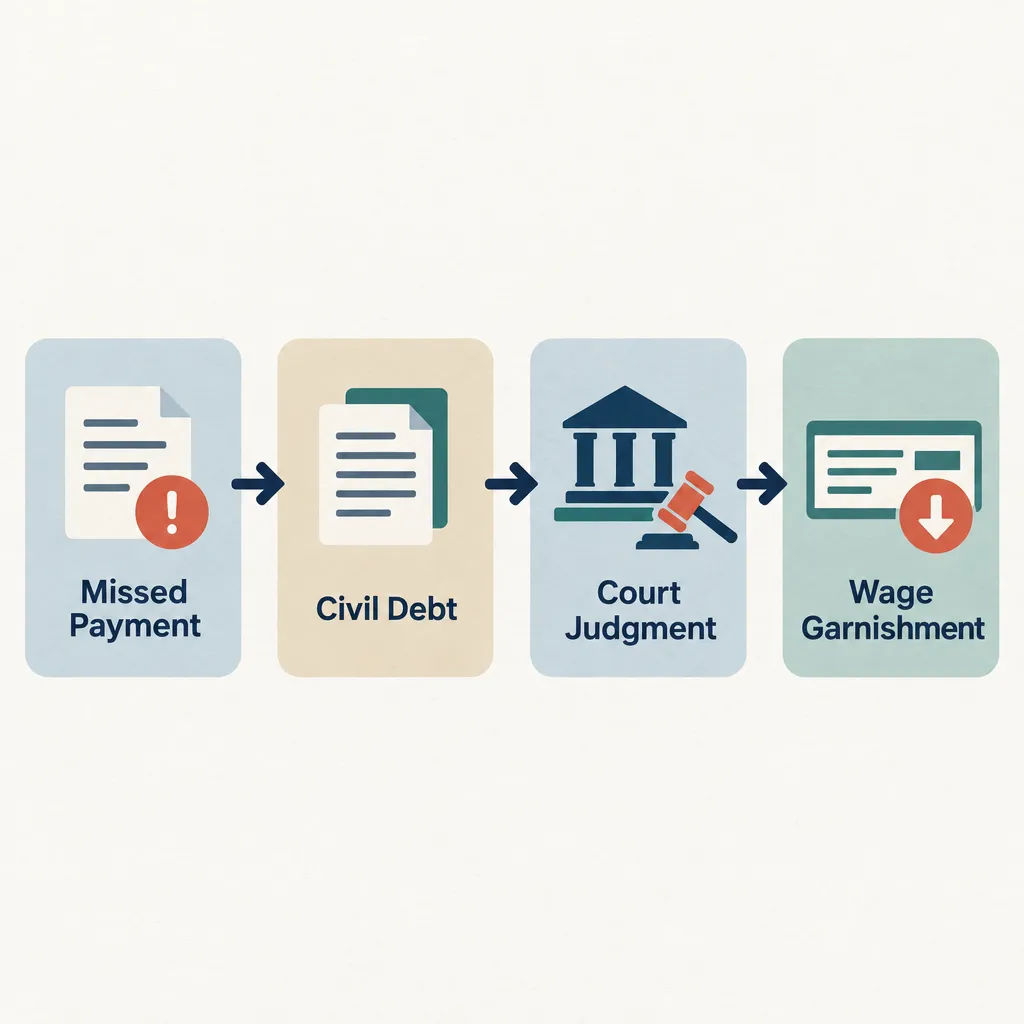
The lender can deposit your check or debit your account, collect on its own or through a collector, and sue you. Only after winning a court judgment can it garnish your wages. It can’t have you jailed, can’t charge you to roll the loan over, and is limited in how often it can retry failed withdrawals.
| Action | Allowed? | Rule / source |
|---|---|---|
| Deposit your check or debit your account on the due date | Yes | Your agreement; KRS 286.9 |
| Charge a fee to roll over or extend the loan | No | KRS 286.9-100 |
| Keep retrying withdrawals after two failed attempts in a row | No, not without your new authorization | CFPB Payday Rule, 12 CFR part 1041 |
| Call or write to collect | Yes, within debt collection rules | Fair Debt Collection Practices Act (third-party collectors) |
| Threaten arrest or jail | No | Fair Debt Collection Practices Act bars false threats |
| Report a collection account to credit bureaus | Yes, for up to 7 years from delinquency | Fair Credit Reporting Act |
| Sue you in court | Yes, within the limitation period | KRS 413.160, KRS 413.120 |
| Garnish wages without a judgment | No | KRS 427.010 limits apply after judgment |
Can they have you arrested?
No. Not repaying a payday loan is a civil debt, not a crime. A lender or collector that threatens to “press charges for a bad check” is leaning on the fact that you wrote a check. But the lender agreed to hold that check knowing you didn’t have the money that day. That’s how a deferred deposit transaction works. The Fair Debt Collection Practices Act bars third-party collectors from falsely threatening arrest or prosecution.
If you’re threatened, write down the date, the caller’s name, the company and the exact words, then complain to DFI and the CFPB. A real court summons is different: if you’re sued, show up. Ignoring a civil suit leads to a default judgment, and that judgment is what allows garnishment.
Can they keep debiting my bank account?
Only within limits. Under the CFPB’s Payday Rule (12 CFR part 1041), once two withdrawal attempts in a row fail, the lender needs your new authorization before trying again. Those payment provisions have been in effect since March 30, 2025. Under Regulation E, you can also stop preauthorized electronic transfers by telling your bank at least three business days before the scheduled date.
If repeated attempts are triggering overdraft fees, take three steps. Revoke the debit authorization with the lender in writing. Give your bank a stop-payment order. File a complaint if the attempts continue. Stopping the debits doesn’t cancel the debt, but it stops the overdraft fees while you work out a plan.
Wage garnishment limits in Kentucky
Garnishment requires a court judgment. Even then, KRS 427.010 limits it to the lesser of 25% of your weekly disposable earnings or the amount by which those earnings exceed 30 times the federal minimum hourly wage. At the federal minimum of $7.25, that protected floor is $217.50 a week.
| Weekly disposable earnings | 25% of earnings | Amount above $217.50 | Maximum garnishment |
|---|---|---|---|
| $200 | $50.00 | $0 | $0 |
| $300 | $75.00 | $82.50 | $75.00 |
| $500 | $125.00 | $282.50 | $125.00 |
| $800 | $200.00 | $582.50 | $200.00 |
Federal rules also protect Social Security and certain other federal benefits that are directly deposited into a bank account, generally up to two months of benefits.
How to ask for a payment arrangement (script)
Contact the lender before the due date, ask in writing, and keep copies. Many licensed lenders will set up a payment plan, and Kentucky law bars them from charging a rollover fee instead. You can adapt this letter:
[Date]
[Lender name]
[Lender address]Re: Deferred deposit transaction, account [Account number]
I am writing about my loan dated [Loan date] for [Amount]. I cannot pay the full balance on [Due date]. I am asking for a payment arrangement of [Payment amount] every [Pay period], starting [Start date], until the balance is paid.
Please confirm in writing that you will not deposit my check or attempt any electronic withdrawal while I keep to this plan. I understand Kentucky law (KRS 286.9-100) does not allow a fee to renew or roll over this loan.
[Your full name]
[Your phone number]
If the lender refuses or pushes you to take a new loan to cover the old one, file a complaint with DFI and describe exactly what you were offered.
I’m stuck in a cycle of payday loans. How do I get out?
Stop using new loans to pay off old ones, because that’s what keeps the cycle going. Pay off one loan with a cheaper source, such as a credit union payday alternative loan or an employer advance, then ask the other lender for a payment plan. A nonprofit credit counselor can build a budget and look at your other debts at little or no cost. Once a loan is paid, make sure it shows as closed in the database.
Does bankruptcy wipe out payday loans? Chapter 7 vs. Chapter 13
Usually, yes. Payday loans are generally unsecured debt. A lender may object if you borrowed right before filing and can argue fraud. Filing triggers an automatic stay that halts collection calls, deposits and lawsuits while the case is open, and federal law requires credit counseling from an approved agency before you file.
| Feature | Chapter 7 | Chapter 13 |
|---|---|---|
| How it works | Eligible unsecured debts are wiped out, usually within months | Repayment plan over 3 to 5 years, then remaining eligible debt is discharged |
| Who it suits | Lower income, few assets to protect | Steady income, assets to keep, or a mortgage or car to catch up on |
| Payday loans | Generally discharged | Paid what the plan allows, rest discharged |
| Means test | Yes | Determines plan payments |
If payday loans are your only problem debt, bankruptcy is usually more than you need: it stays on your credit report for years and costs filing and attorney fees. When payday loans sit alongside medical bills, credit cards or a pending lawsuit, a free consultation with legal aid or a bankruptcy attorney is worth having.
How long can a lender come after you? Kentucky’s statute of limitations
A lender generally has 10 years to sue on a written contract signed after July 15, 2014 (KRS 413.160), and 5 years on a contract not in writing (KRS 413.120). Nearly every payday loan has a written agreement, so the 10-year period is the one most likely to apply. A claim based on the check itself can fall under different rules, so ask legal aid before relying on one number.
The clock usually starts at default, typically the missed due date or the date the check bounced. A partial payment or a written promise to pay on an old debt can affect when the period runs out, so get advice before paying on a debt that’s several years old.
Two other clocks run separately:
- Credit reporting. Under the Fair Credit Reporting Act, a collection account can stay on your report for up to seven years from the original delinquency.
- Time-barred debt. Once the limitation period passes, Regulation F bars a debt collector from suing you or threatening to. The debt may still exist, and collectors can still ask you to pay.
Many storefront lenders don’t report on-time payments to Experian, Equifax or TransUnion, so a payday loan rarely helps your credit. A defaulted loan sent to collections can be reported, and a court judgment can show up in public records searches.
Federal rules that also apply in Kentucky
Federal law adds disclosure rules, a 36% cap for service members, debt collection limits and limits on repeated withdrawals. These apply in every state. The CFPB has stepped back from some enforcement, but the rules remain in place.
- Truth in Lending Act / Regulation Z (12 CFR 1026). The lender must give you the finance charge, APR, amount financed and payment schedule in writing before you sign.
- Military Lending Act. Active-duty service members and their dependents can’t be charged more than a 36% Military Annual Percentage Rate on covered loans, including payday loans, and mandatory arbitration clauses are banned. Kentucky’s $15 per $100 fee is far above 36%, so covered borrowers can’t legally get a standard payday loan.
- Fair Debt Collection Practices Act and Regulation F. These bar third-party collectors from false threats and harassment, require a validation notice, and limit call frequency and timing.
- Electronic Fund Transfer Act / Regulation E. These give you the right to stop preauthorized transfers through your bank.
- CFPB Payday Rule (12 CFR part 1041). The 2017 rule’s ability-to-repay requirements were repealed in 2020. Its payment provisions took effect March 30, 2025.
Just before that date, the CFPB said it would not prioritize enforcement or supervision over penalties tied to the payment withdrawal and disclosure provisions. That statement isn’t a repeal, and it doesn’t stop state officials or private parties from acting. The CFPB’s 2026 regulatory agenda lists a proposal to reconsider what’s left of the rule. As of mid-October 2026, no proposed rule had been published in the Federal Register and 12 CFR part 1041 was unchanged.
What the “two failed withdrawals” rule means for you
After two withdrawal attempts in a row fail for lack of funds, a covered lender can’t try a third time without new, specific authorization from you. Lenders must also send notice before the first withdrawal and before any unusual one, such as a different amount or date. If a lender keeps trying, keep the bank statements showing each attempt and attach them to your complaint.
Kentucky vs. other states
Kentucky sits in the middle nationally: it allows payday loans with a fee cap, a dollar cap and a database, but doesn’t impose the 36% APR cap a growing group of states use. Its seven neighbors range from Missouri’s higher-cost rules to West Virginia, which has no payday license at all.
Payday loan laws in Kentucky’s bordering states
Payday loans are legal in some form in Kentucky, Indiana, Ohio, Tennessee, Missouri and Illinois. Virginia now allows only longer short-term installment loans, and West Virginia doesn’t license payday lenders.
| State | Payday loans allowed? | Max loan and term | Fee or APR cap | Regulator |
|---|---|---|---|---|
| Kentucky | Yes, as deferred deposit | $600 total open; 14 to 60 days | $15 per $100 of the check’s face amount | Kentucky DFI |
| Indiana | Yes, as small loans | Inflation-adjusted principal cap set in state code | Tiered fee, 15% on the first tier and lower above it | Indiana Department of Financial Institutions |
| Ohio | Yes, as short-term loans | $1,000; term up to one year | 28% yearly interest plus a capped monthly maintenance fee; all fees and charges capped at 60% of the loan amount | Ohio Division of Financial Institutions |
| West Virginia | No payday license | No payday product licensed | General consumer loan rate limits too low for payday pricing | West Virginia Division of Financial Institutions |
| Virginia | Not as two-week loans; short-term installment loans only | $2,500; up to 24 months | 36% simple interest plus a monthly fee of the lesser of 8% of the loan or $25 | Virginia SCC Bureau of Financial Institutions |
| Tennessee | Yes, as deferred presentment | $500 total face value of outstanding checks; up to 31 days | 15% of the check’s face amount | Tennessee Department of Financial Institutions |
| Missouri | Yes | $500; 14 to 31 days, up to six renewals | Interest and fees capped at 75% of the initial loan over the loan and all renewals | Missouri Division of Finance |
| Illinois | Yes, under a rate cap | Set by the Payday Loan Reform Act | 36% all-in APR under the Predatory Loan Prevention Act | Illinois Department of Financial and Professional Regulation |
A few points stand out. Tennessee’s fee formula matches Kentucky’s (15% of the check), but its dollar cap is lower and its term is shorter. Missouri allows renewals that Kentucky bans, which is why its cap is written as a share of the whole loan’s life. Virginia’s 2020 Fairness in Lending Act replaced two-week payday loans with installment loans that must have a monthly payment structure. Indiana moved its consumer credit code from IC 24-4.5 to IC 37 on July 1, 2026, so older citations to its small loan chapter now point to the new title. Our articles on Indiana payday loan laws and Illinois payday loan laws walk through those states’ rules in detail.
If you live near a border, the rules that protect you depend on where the loan is made and which state licensed the lender. A Kentucky resident who crosses into Tennessee or Missouri to borrow gets that state’s limits for that loan, not Kentucky’s.
Why some states effectively ban payday loans
Few states ban payday loans outright. Most “bans” come from rate caps low enough that a two-week loan at $15 per $100 can’t legally be made. Arkansas has a 17% constitutional cap. New York, New Jersey, North Carolina, Georgia, Pennsylvania and West Virginia rely on long-standing usury or small-loan limits. Illinois, Nebraska and New Mexico adopted 36% APR caps in recent years, and Rhode Island has passed legislation ending deferred deposit lending.
Help that costs less: Kentucky debt relief and cheaper options
Before borrowing at payday rates, check options that cost a fraction as much. For most Kentuckians, the cheapest realistic choices are a credit union payday alternative loan, an employer advance, a payment plan with the bill you’re trying to cover, or free help from a nonprofit or legal aid.
- Credit union payday alternative loans (PALs). Under NCUA rules, federal credit unions can make PAL I loans of $200 to $1,000 for one to six months, with the APR capped at 28% and the application fee at $20. PAL II loans go up to $2,000 for up to 12 months and don’t require a one-month membership wait. A $400 PAL at 28% repaid over three months costs about $19 in interest, compared with $60 to $70 for a single two-week payday loan of the same size.
- Employer or payroll advances. Some employers advance earned wages for free. Earned-wage apps vary: some charge expedite fees or ask for tips, which can add up to a high effective APR.
- Payment plans with the original creditor. Utilities, hospitals and landlords often agree to installment plans. Kentucky utilities offer budget billing and payment arrangements, and LIHEAP energy assistance runs through local community action agencies across the state.
- Nonprofit credit counseling. Agencies affiliated with the National Foundation for Credit Counseling can build a budget and, where it fits, a debt management plan with reduced creditor interest. This is generally safer than for-profit debt settlement, which charges fees and often leaves accounts in default while it negotiates.
- Legal aid. Kentucky’s four regional programs (the Legal Aid Society in Louisville, Kentucky Legal Aid, Legal Aid of the Bluegrass and AppalReD Legal Aid) handle consumer debt cases, including lawsuits and garnishments, for eligible residents at no charge.
- Community help. Local charities, churches and 211 referral lines can cover a one-time gap, such as a utility shutoff or a prescription.
Cheaper options first
Ask a local credit union about a PAL, capped at 28% APR under NCUA rules.
Ask the company you owe for a payment plan before you borrow to pay it.
Call a nonprofit credit counselor or legal aid office for free advice.
How to check a lender’s license and file a complaint
The Kentucky Department of Financial Institutions licenses and examines payday lenders, consumer loan companies and check cashers, and it takes complaints against them. The CFPB takes federal complaints and forwards them to the company for a response. The Kentucky Attorney General’s Office of Consumer Protection handles scams and deceptive practices.
| Problem | Where to go | What to include |
|---|---|---|
| Licensed lender broke KRS 286.9 (fee over cap, third loan, rollover fee, hold over 60 days) | Kentucky DFI | Agreement, receipts, check copy, database denial or approval |
| Unlicensed online lender | Kentucky DFI and the CFPB | Website screenshots, emails, bank debits |
| Threats of arrest, harassment by a collector | CFPB and the Kentucky Attorney General | Dates, names, exact words, call log |
| Repeated failed withdrawals, overdraft fees | CFPB and your bank | Bank statements showing each attempt |
| Scam or identity theft | FTC ReportFraud; FBI IC3 for internet fraud | Payment records, contact details used |
| Lawsuit or garnishment | Kentucky legal aid | Summons, court papers, deadlines |
A third payday loan while you have two open, or a loan that pushes your total over the cap, means a lender skipped or ignored the database check. That’s exactly what DFI’s examiners look for.
Your most useful step now is to check every open payday loan you have against four numbers: total balance, fee per $100 of the check, number of open loans and days between the loan date and the due date. Anything outside the limits gives you grounds to complain to DFI.
Before you borrow
A two-week Kentucky payday loan costs roughly 391% to 460% APR at the legal maximum. Borrowing again to repay the last loan is how $90 in fees turns into more than $2,000 a year.
FAQ
Are payday loans legal in Kentucky?
Yes. Under KRS 286.9 they’re legal as deferred deposit transactions, and only DFI-licensed lenders can make them. The limits are $600 in total open proceeds, a $15 per $100 fee, two open loans and a term of 14 to 60 days.
What is the maximum payday loan amount in Kentucky in 2026?
$600 across all your open payday loans combined, for loans made on or after July 15, 2026, under KRS 286.9-100 as amended by 2026 Acts Ch. 98. The DFI commissioner adjusts the cap each year, but it can never go above $850.
What is the maximum term for a Kentucky payday loan?
60 days. KRS 286.9-100 bars a licensee from agreeing to hold your check for more than 60 days, and the fee must cover at least 14 days. A longer term doesn’t let the lender charge more than one $15 per $100 fee.
Can you get in trouble for not paying back a payday loan?
Not criminal trouble. Default is a civil matter, so no jail. The civil consequences are real: collection calls, possible credit reporting of a collection account, a lawsuit and, after a judgment, wage garnishment within the KRS 427.010 limits.
Can a payday lender garnish my wages in Kentucky?
Only after it sues you and wins a judgment. Even then, KRS 427.010 limits garnishment to the lesser of 25% of weekly disposable earnings or the amount above $217.50 a week (30 times the $7.25 federal minimum wage).
What is the statute of limitations on a payday loan in Kentucky?
For a written contract signed after July 15, 2014, Kentucky generally allows 10 years to sue (KRS 413.160). For a contract not in writing, it’s 5 years (KRS 413.120). The period usually starts at default, and a claim based on the check itself may follow different rules.
How long can they come after you for a payday loan?
A lender can try to collect for as long as the debt is unpaid, but it can only sue within the limitation period. A collection account can stay on your credit report for up to seven years from the original delinquency under the Fair Credit Reporting Act. After the limitation period ends, Regulation F bars collectors from suing or threatening to sue.
Are payday loans legal in Virginia?
Not in the two-week form Kentucky allows. Since Virginia’s Fairness in Lending Act of 2020, lenders there make short-term installment loans of up to $2,500 for up to 24 months, at no more than 36% simple interest plus a monthly fee of the lesser of 8% of the loan or $25. The SCC’s Bureau of Financial Institutions licenses them.
Which states have banned payday loans?
Most states don’t use the word “ban.” Arkansas, New York, New Jersey, North Carolina, Georgia, Pennsylvania and West Virginia keep rate caps too low for payday lending to work. Illinois, Nebraska and New Mexico adopted 36% APR caps in recent years. Among Kentucky’s neighbors, only West Virginia has no payday license.
Can payday loans be discharged in bankruptcy?
Usually, yes. In Chapter 7 they’re generally wiped out as unsecured debt. In Chapter 13 they’re paid through the plan, and any balance left is discharged. A lender can object to a loan taken just before filing, and filing stops collection while the case is open.
Laws and regulations referenced
- Kentucky Revised Statutes 286.9-100 (Procedures to be followed by licensees, deferred deposit and check cashing)
- Truth in Lending Act, 15 U.S.C. 1601
- Regulation Z, 12 CFR Part 1026
- Fair Debt Collection Practices Act, 15 U.S.C. 1692
- Regulation F (debt collection), 12 CFR Part 1006
- Fair Credit Reporting Act, 15 U.S.C. 1681
- Electronic Fund Transfer Act, 15 U.S.C. 1693
- Regulation E (electronic transfers), 12 CFR Part 1005
- Military Lending Act, 10 U.S.C. 987
- CFPB payday lending rule, 12 CFR Part 1041
Links go to the official text on government sites.
Check, verify or complain
Sources
- KRS 286.9-100 Procedures to be followed by licensees (Kentucky General Assembly) apps.legislature.ky.gov · official source
- 2026 Acts Chapter 98 (SB 219) apps.legislature.ky.gov · official source
- 26RS SB 219 bill record apps.legislature.ky.gov · official source
- 808 KAR 9:010 (Kentucky Administrative Regulations) apps.legislature.ky.gov · official source
- Kentucky DFI 2025 Annual Report kfi.ky.gov · official source
- Kentucky DFI deferred deposit database information kfi.ky.gov · official source
- 24RS HB 495 bill record apps.legislature.ky.gov · official source
- 26RS HB 656 bill record apps.legislature.ky.gov · official source
- KRS 286.10-205 Repealed, 2024 apps.legislature.ky.gov · official source
- 24RS HB 726 enrolled bill apps.legislature.ky.gov · official source
- 25RS HB 202 original bill apps.legislature.ky.gov · official source
- KRS Chapter 427 (Kentucky General Assembly) apps.legislature.ky.gov · official source
- KRS 286.9-100 apps.legislature.ky.gov · official source
- 2014 Kentucky Acts Ch. 142 (limitation periods) apps.legislature.ky.gov · official source
- NCLC: Rule on bounced payday and high-cost loan payments now in effect library.nclc.org
- CFPB Payday Rule Relief Is Not a Repeal fintechlaw.ai
- CFPB's 2026 Regulatory Agenda Tees Up NPRM to Reconsider Payday Lending Rule natlawreview.com
- KY SB219 2026 – LegiScan legiscan.com
- CFPB Releases 2026 Regulatory Agenda consumerfinancialserviceslawmonitor.com
- KRS 413.120 – Justia law.justia.com
- NerdWallet – Can't Repay a Payday Loan? nerdwallet.com
- NCLC 2025 APR Annual Report nclc.org
- State of Small-Dollar Lending in Colorado – PIRG pirg.org
- 'This Cycle Is Destroying My Mental Health' – AOL aol.com
- Can I get my money back from an illegal on-line payday loan? freeadvice.com
- Federal Payday Lending Rule a Win for Kentuckians – KCEP kypolicy.org

Elena writes about getting through a money emergency, assistance programs, budgeting on a tight income, banking basics and borrower rights. Her guides list the cheaper options first and link the agency or program that can actually help.
Ruth is US Financer's standards editor. Every article goes through her checks before and after it is published: each rate, fee, cap, deadline and rule is matched against its primary source, every law named is linked to its official text, and anything that cannot be…
What changed
- Nov 20, 2026 First published.
Comments are closed