


General information, not legal advice. Laws change, so confirm with the official statute, your state regulator or a licensed attorney before you act.
Payday loans are legal in Oregon, but only from lenders licensed by the Oregon Division of Financial Regulation (DFR), and only within some of the tightest limits in the West. Under ORS 725A.064, a licensed payday lender can charge no more than 36% a year in interest, plus a one-time origination fee of $10 per $100 borrowed, capped at $30. The loan term has to run at least 31 days. DFR says that puts the highest legal APR, fees included, at 153.77%.
WARNINGRelated consumer alert, Nov 21, 2026
FTC and Oregon DFR warn holiday shoppers that scam sites can hide in search adsRun the numbers
Key takeaways
- Licensed payday and title lenders can charge 36% a year in interest plus one origination fee of no more than $30 (ORS 725A.064).
- Terms run 31 to 60 days, and a loan can be renewed no more than twice.
- If you earn $60,000 a year or less, a lender can’t lend you more than 25% of your monthly net income (OAR 441-735-0272).
- Since June 5, 2026, HB 4116 has made out-of-state, state-chartered banks follow Oregon’s 36% cap on consumer finance loans of $50,000 or less.
- Tribal lenders are outside Oregon’s payday limits, so check a lender’s license before you give it any bank details.
Fact-checked
We checked these key facts against the sources named, on November 21, 2026:
- Interest: $300 × 36% × (31 ÷ 365) = $9.17 (source: dfr.oregon.gov)
- Total cost: $9.17 + $30 = $39.17, so you repay $339.17 (source: dfr.oregon.gov)
- Origination fee: $10 per $100 × 3 = $30, which is already at the $30 cap (source: dfr.oregon.gov)
- On a $300 two-week Washington loan, a $45 fee is about 391% APR, compared with Oregon’s 153.77% ceiling (source: dfi.wa.gov)
- That’s $9.17 in interest and the $30 maximum fee, which works out to DFR’s published 153.77% maximum APR (source: dfr.oregon.gov)
Oregon payday loan laws at a glance (updated November 2026)
You can get a payday loan in Oregon, but only from a lender that DFR has licensed, and it must follow ORS Chapter 725A and the rules in Oregon Administrative Rules chapter 441, division 735. DFR is part of the Oregon Department of Consumer and Business Services. It licenses payday and title lenders, takes complaints and enforces the caps.
Oregon’s rules come from a political fight about twenty years ago. Oregon’s 36% cap on payday loan interest was enacted in 2007, and the state’s payday lending statutes also cover qualifying loans made online and certain vehicle-title loans. Before that, Oregon storefronts could charge the triple-digit rates still legal in many states. The rules have barely changed since. The big 2026 change came from a separate law: HB 4116 targets online installment lenders that partnered with out-of-state banks to charge more than Oregon allows.
Oregon payday and title loan limits (ORS 725A / OAR 441-735, November 2026)
| Rule | Limit | Legal source | What it means for you |
|---|---|---|---|
| Interest rate | 36% per year | ORS 725A.064 | About $0.99 per $100 for each 10 days |
| Origination fee | $10 per $100, max $30, new loans only | ORS 725A.064 | No fee on renewals, and no other fees allowed |
| Minimum term | 31 days | ORS 725A.064; DFR | No two-week loans from licensed lenders |
| Maximum term | 60 days | ORS 725A.010, 725A.064 | Anything longer is regulated as a different product |
| Renewals | Two at most | ORS 725A.064; OAR 441-735-0272 | A third extension is not allowed |
| Wait for a new loan | 7 days after the last one expires | ORS 725A.064; OAR 441-735-0272 | No same-day re-borrowing after payoff |
| Income limit | 25% of monthly net income if you earn $60,000 a year or less | OAR 441-735-0272 | Caps how much you can be offered |
| Proof of repayment | Pay stubs, bank statements or similar | OAR 441-735-0272 | Lenders must check how you will repay |
| Maximum APR with fees | 153.77% | DFR | Anything higher from a licensed lender breaks the law |
The limits, rule by rule
Every limit above is in the statute or the DFR rule. Each one closes a specific trap that payday borrowers fell into before 2006. The sections below explain what each rule does in practice and where to find it if a lender argues with you.
Interest and the one-time fee
ORS 725A.064 says a lender may not make or renew a payday loan at more than 36% per annum, excluding a one-time origination fee on a new loan. The Oregon Legislative Policy and Research Office describes that fee as $10 per $100 borrowed, never more than $30, charged in addition to interest of up to 36% a year, with other fees restricted. The fee is capped at $30, so a $300 loan already pays the full fee. A $500 loan pays the same $30, which is why the APR falls as the loan gets bigger.
The ban on other fees matters. If you see an application fee, a “membership” fee, a processing charge or a fee for each renewal on top of the 36% interest and the single origination fee, a licensed Oregon payday lender is charging something the statute doesn’t allow. Keep the contract and report it to DFR.
Loan length: 31 to 60 days
Oregon sets a minimum 31-day term, not the two-week cycle typical in other states, and the definition in ORS 725A.010 caps a payday loan’s term at 60 days. The 31-day minimum works in your favor, because a two-week loan with a flat fee carries a much higher APR than the same fee spread over a month. It also gives you two paychecks, not one, to put the repayment together.
That 60-day limit is part of the legal definition. ORS 725A.010 defines a payday loan as a loan of up to $50,000, made mainly for personal, family or household purposes, with a term of 60 days or less, and usually secured by a check or an electronic repayment authorization. A lender counts as a payday lender under the statute if at least 10% of its loans are payday loans.
Did you know?
ORS 725A.010 defines a payday loan as a loan of $50,000 or less with a term of 60 days or less. In practice, for borrowers earning $60,000 a year or less, the 25% income rule in OAR 441-735-0272 keeps most loans far smaller.
Renewals and the seven-day wait
Under ORS 725A.064 and OAR 441-735-0272, a licensed lender can renew a payday loan no more than twice. It also can’t make you a new payday loan within seven days after your previous one expires. A renewal carries interest but no new origination fee, because the fee applies to a new loan only.
The seven-day wait targets the “pay off on Friday, re-borrow on Friday” pattern. The same pattern shows up in the community question “I have more than 20 payday loans with biweekly payments, how do I get out of this cycle?” If those loans come from Oregon-licensed lenders, the 31-day minimum, the two-renewal limit and the seven-day wait make biweekly payday payments hard to square with the rules. A stack of biweekly debits usually means the loans come from online lenders operating outside Oregon’s system, a point covered below.
How much you can borrow: the 25% income rule
If you earn $60,000 a year or less, OAR 441-735-0272 says a licensed lender can’t lend you more than 25% of your monthly net income. The lender also has to get proof of how you will repay, such as pay stubs or bank statements. The rule is a ceiling, not a target: a lender can always offer less.
Here is how the math works. Say you take home $2,400 a month after taxes, which is below the $60,000 gross threshold for most single earners. Then 25% is $600, and that’s the most a licensed lender can lend you. If you earn above $60,000, the 25% rule in the regulation doesn’t apply, but the lender still has to follow every other cap.
Work out your own limit
If you earn $60,000 a year or less, multiply your monthly take-home pay by 0.25. A licensed Oregon lender can’t lend you more than that, so a bigger offer is a red flag.
What lenders must disclose and give you
Licensed Oregon payday lenders are covered by the federal Truth in Lending Act and Regulation Z (12 CFR 1026). Before you sign, they must show you the finance charge in dollars and the annual percentage rate. Check that the APR on your disclosure isn’t above 153.77% and that the total finance charge matches 36% interest plus no more than $30. Get a written payoff statement when you repay, and keep it with the contract, because that’s your proof the debt is closed if a collector contacts you later.
What a payday loan really costs in Oregon: worked examples
A $300 payday loan for 31 days from a licensed Oregon lender costs at most $39.17. That’s $9.17 in interest and the $30 maximum fee, which works out to DFR’s published 153.77% maximum APR. Every figure below uses the statutory caps, so a legal loan should never cost more.
$300 for 31 days
- Interest: $300 × 36% × (31 ÷ 365) = $9.17.
- Origination fee: $10 per $100 × 3 = $30, which is already at the $30 cap.
- Total cost: $9.17 + $30 = $39.17, so you repay $339.17.
- APR: $39.17 ÷ $300 = 13.06% for 31 days. Multiply by 365 ÷ 31 (about 11.77) and you get roughly 153.7%. DFR publishes it as the 153.77% maximum.
What a legal Oregon payday loan costs
| Amount borrowed | Term | Interest at 36% | Origination fee | Total cost | APR (approx.) |
|---|---|---|---|---|---|
| $100 | 31 days | $3.06 | $10 | $13.06 | 153.7% |
| $300 | 31 days | $9.17 | $30 | $39.17 | 153.7% (DFR: 153.77%) |
| $500 | 31 days | $15.29 | $30 | $45.29 | 106.6% |
| $300 | 60 days | $17.75 | $30 | $47.75 | 96.8% |
Two patterns stand out. Up to $300, the fee is a flat 10%, so the APR stays at the ceiling. Above $300, the fee stays at $30 and the APR drops. A 60-day term costs more in dollars but less in APR, because the $30 fee is spread over twice as many days.
What renewing adds
Each renewal adds interest and no new fee, and you get at most two. The timeline below assumes you pay nothing toward principal, each renewal runs another 31 days, and interest stays at 36% on the $300 balance.
| Stage | Days | New fee? | Interest added | Running total cost |
|---|---|---|---|---|
| Original loan | 1 to 31 | Yes, $30 | $9.17 | $39.17 |
| Renewal 1 | 32 to 62 | No | $9.17 | $48.34 |
| Renewal 2 | 63 to 93 | No | $9.17 | $57.51 |
| Third renewal | Not allowed | N/A | N/A | Loan must be repaid |
If you borrowed $300 and kept it about three months, $57.51 is the most it can legally cost from a licensed Oregon lender. It’s expensive next to a credit card or a credit union loan, but nothing like what you pay in states without caps.
Get the payoff in writing
Before each due date, ask the lender for the exact payoff amount in writing. If it’s more than the running totals above for your loan size, ask the lender to explain each line, then contact DFR.
Legal Oregon loan vs. a typical unlicensed online offer
DFR’s consumer brochure on payday loans is titled “Would you pay $1000 for a $300 loan?” That kind of cost comes from lenders working outside Oregon’s caps. Many online lenders in uncapped states charge about $15 per $100 every two weeks, which is roughly 390% APR ($15 × 26 two-week periods). On a $300 loan, that’s $45 every two weeks. Roll it over ten times, about five months, and you have paid $450 in fees and still owe the $300.
An Oregon-licensed lender couldn’t charge that, because two renewals is the limit and the most it can collect is $57.51 on $300. So if an online lender shows you an APR over 300%, it isn’t operating under an Oregon license. It’s tribal, offshore, unlicensed or relying on a bank partnership. That’s the answer to the reader question “Is this online lender even legal in Oregon? The APR is over 300%.”
Did you know?
DFR’s June 4, 2026 release on HB 4116 says more than 31,000 loans totaling at least $61 million were made to Oregonians since 2020 at rates above the state cap, some above 100% APR, through partnerships with banks chartered in higher-rate states.
Title loans in Oregon
Car title loans are legal in Oregon under the same ORS Chapter 725A caps as payday loans: 36% annual interest, a one-time origination fee of no more than $30, and a term of 31 to 60 days. You pledge your vehicle’s title as collateral. If you default, the lender can repossess the vehicle under the contract and Oregon’s secured-transaction rules.
ORS 725A.010 also treats sale-and-leaseback deals as title loans. In those deals, a company “buys” your car and leases it back to you. The statute covers them so lenders can’t avoid the caps by calling the loan a sale. If someone offers to buy your car title for cash and rent the car back, the same limits and the same licensing requirement apply.
The cost math is the same as for payday loans, but the risk is bigger. If you default on a $300 payday loan, you face collection. If you default on a $1,000 title loan, you can lose a car worth several times the debt, and with it the way you get to work. The Legislature amended the title loan provisions in 2019 (HB 2089), so check your contract’s renewal and new-loan terms against the current statute. If you think a title lender broke a limit, DFR is the agency to call.
Installment and personal loans in Oregon
Personal and installment loans of $50,000 or less from non-bank lenders are “consumer finance loans” under ORS Chapter 725. The lender needs a DFR consumer finance license. DFR’s licensing page says the annual percentage rate, interest and fees included, can’t exceed 36%. ORS 725.340 sets that finance charge limit.
That 36% is an all-in APR, which makes it stricter than the payday rule. A payday lender can add the $30 fee on top of 36% interest, while a consumer finance lender has to fit everything inside 36% APR. DFR’s 2026 consumer notice defines consumer finance loans as small-dollar loans with terms of 60 days or more and says rates above 36% are likely unlawful.
Here’s a worked example. A $1,500 installment loan at the 36% APR cap, repaid in 12 equal monthly payments, costs about $150.70 a month and roughly $308 in total finance charges. The same loan at 160% APR, which some bank-partner online lenders charged before 2026, costs about $242 a month and over $1,400 in finance charges.
| Loan | APR | Term | Approx. monthly payment | Approx. total repaid |
|---|---|---|---|---|
| $1,500 consumer finance loan at Oregon cap | 36% | 12 months | $150.70 | $1,808 |
| $1,500 loan at a typical pre-2026 bank-partner rate | 160% | 12 months | $242 | $2,905 |
Banks and credit unions are chartered and regulated differently, and Oregon-chartered credit unions and federal credit unions follow their own rules. The 2026 change discussed below is about out-of-state state-chartered banks that partner with online lenders.
Is your lender legal? Licensed, tribal, bank-partner or unlicensed
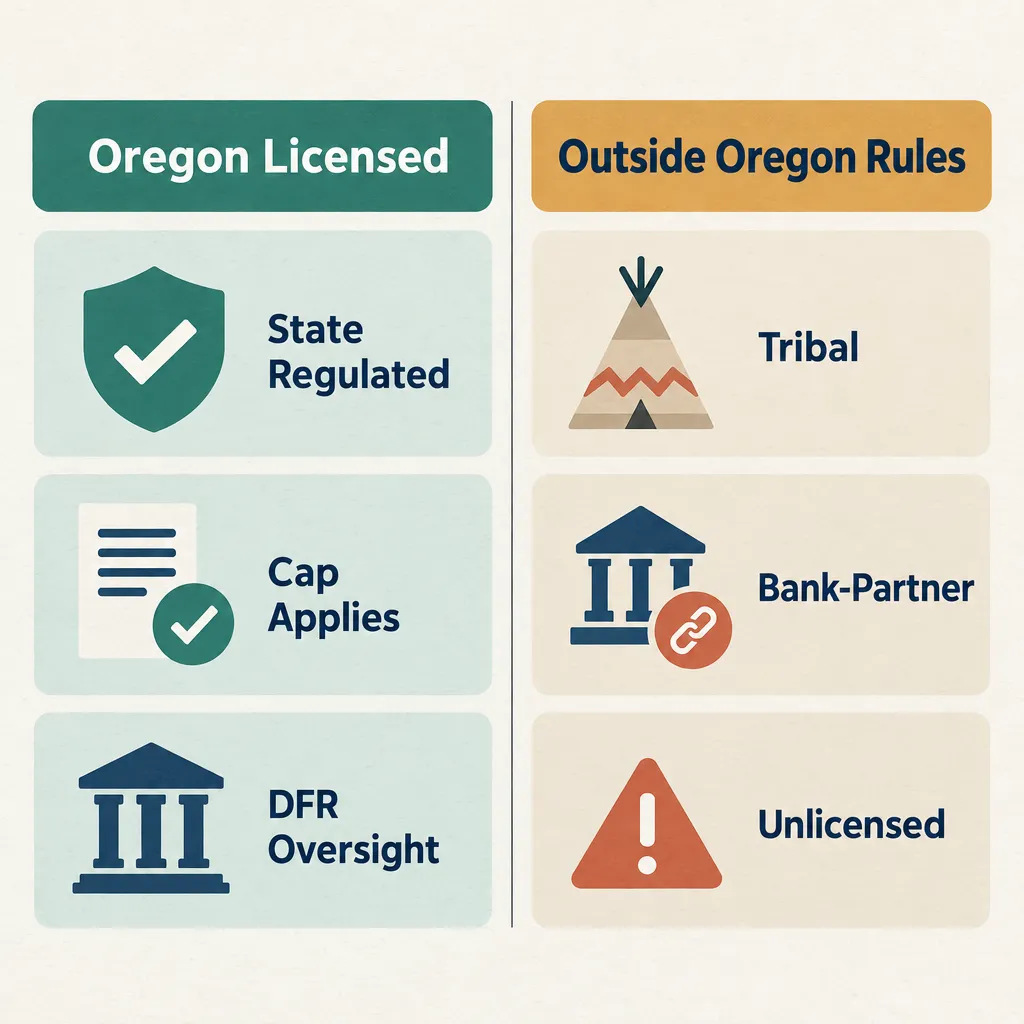
To find out whether Oregon’s caps protect you, check who made the loan. There are four possibilities: a DFR-licensed lender, a tribal lender, a bank partnership, or an unlicensed or offshore operator. Your contract names the lender of record. It may not be the brand on the website.
Who’s covered by Oregon’s caps?
| Lender type | Bound by Oregon 36% cap? | Notes |
|---|---|---|
| DFR-licensed payday or title lender | Yes | Full ORS 725A and OAR 441-735 limits apply |
| DFR-licensed consumer finance lender | Yes, 36% APR | ORS Chapter 725, loans of $50,000 or less |
| Out-of-state, state-chartered bank (direct or via partner) | Yes, since June 5, 2026, for consumer finance loans of $50,000 or less | HB 4116 opt-out from DIDMCA Section 521 |
| National bank | No, not through HB 4116 | Federal National Bank Act rules on rate exportation |
| Tribal lender | No, per DFR | Claims tribal sovereign immunity; federal law still applies |
| Unlicensed or offshore lender | Required to be, but ignoring the law | Lending without a license breaks Oregon law |
| Washington-licensed storefront in Vancouver, WA | No, Washington law applies | Loan made in Washington under Washington rules |
Licensed Oregon storefront and online lenders
A lender licensed in Oregon, storefront or online, appears on DFR’s list of licensed payday and title lenders. You can also confirm a license by calling DFR at 866-814-9710 or going to stopunlicensedloans.com, the state’s verification site. Many Oregon licensees also appear in NMLS Consumer Access, the Nationwide Multistate Licensing System’s public search, but DFR’s own records are the authority.
Check before you share bank details
Look up the exact lender name on DFR’s licensed payday and title lender list, or call 866-814-9710, before you give out your bank account or Social Security number. If you can’t find the name, treat the offer as unlicensed.
Tribal lenders
DFR says tribal lenders aren’t bound by Oregon’s payday and title lending laws, including the limits. Some online lenders are owned by, or claim affiliation with, federally recognized tribes and argue that tribal sovereign immunity keeps state regulators out. Federal laws such as the Truth in Lending Act, the Electronic Fund Transfer Act and the CFPB’s payment rules still apply, but you lose Oregon’s 36% cap, the renewal limit and DFR’s direct enforcement.
If you already have a tribal loan, you can still revoke electronic withdrawal authorization with your bank, file a CFPB complaint and get legal help. Watch for contracts that require arbitration under tribal law. A legal aid lawyer can tell you whether such a clause is enforceable.
Out-of-state bank partnerships and HB 4116
In a “rent-a-bank” arrangement, an online lender markets and services the loan, while a bank chartered in a state with no rate cap is named as the lender. Under DIDMCA Section 521, state-chartered, FDIC-insured banks can “export” their home-state rates. Until June 5, 2026, these partnerships let loans reach Oregonians at rates above 100% APR. HB 4116 ended that for consumer finance loans of $50,000 or less from state-chartered banks.
Signs a loan offer is illegal
These are signs a loan offer may break Oregon law:
- The APR is above 153.77% on a payday or title loan, or above 36% on an installment loan.
- The term is shorter than 31 days, for example “due on your next payday” in 14 days.
- A fee shows up on renewal, or there are fees beyond the one-time origination fee.
- The lender wants an upfront fee, gift cards or a wire transfer before releasing the loan. That’s a hallmark of advance-fee scams, not lending.
- The lender won’t give a physical address or license number, or its name isn’t on DFR’s list.
- It promises “guaranteed approval” or “no credit check.” Oregon licensees must verify how you will repay under OAR 441-735-0272.
What changed in 2026: HB 4116 and the rent-a-bank loophole
Gov. Tina Kotek signed HB 4116 on April 7, 2026. It took effect June 5, 2026, and since then state-chartered banks from other states must follow Oregon’s 36% limit on consumer finance loans of $50,000 or less, secured or unsecured. The law uses Oregon’s right under DIDMCA Section 521 to opt out of federal rate exportation for loans made in Oregon.
The bill, backed by Rep. Nathan Sosa, passed the House and then the Oregon Senate, 17 to 12, on March 5, 2026. DFR’s June 4, 2026 release gave the reason in numbers: more than 31,000 loans totaling at least $61 million made to Oregonians since 2020 at rates above the state cap, some above 100% APR, through banks chartered in higher-rate states. Consumer advocates, including the Center for Responsible Lending, which tracks state rate caps nationally, have long pushed states to use the DIDMCA opt-out. Oregon joined a small group of states that have done so.
What HB 4116 covers and what it doesn’t:
- Covered: consumer finance loans of $50,000 or less made in Oregon by state-chartered banks from other states, directly or through a fintech partner.
- Not covered: national banks, which export rates under a different federal law, and tribal lenders, which DFR says sit outside Oregon’s lending laws.
- Already capped: payday and title loans from DFR licensees, which were under ORS 725A.064 before 2026.
- Timing: the opt-out applies from June 5, 2026. If you have an older bank-partner loan, ask DFR or a lawyer how the change affects your balance, because loans made before the effective date can be treated differently.
Federal rules that also protect Oregon borrowers
Federal law adds a layer of protection everywhere in the United States, including for loans from tribal and out-of-state lenders. Four federal rules matter most for small-dollar borrowers.
- Truth in Lending Act and Regulation Z: the lender must disclose the APR and the finance charge in dollars before you sign.
- Military Lending Act (32 CFR Part 232): active-duty service members and their covered dependents can’t be charged more than a 36% Military Annual Percentage Rate, which counts most fees and add-on products. That makes most payday and title loans illegal for them.
- Fair Debt Collection Practices Act and Regulation F (12 CFR 1006): third-party debt collectors can’t threaten arrest, lie about what you owe or harass you. Regulation F presumes it’s harassment to call more than seven times in seven days about one debt.
- CFPB Payday Lending Rule payment provisions (12 CFR 1041): in effect since March 30, 2025. After two consecutive failed attempts to pull a payment from your account, a lender covered by the rule needs your new, specific authorization before it tries again.
The CFPB has done little to enforce the payment provisions, and its July 2026 regulatory agenda lists a planned proposal to reconsider what remains of the 2017 rule. That’s only a plan on an agenda, not a rule change, and the two-failure limit stays in force until a final rule says otherwise.
How to stop repeated withdrawals
A reader question comes up often: “The lender keeps trying to pull money from my bank account and I’m getting overdraft fees, can I make them stop?” You can. Under the Electronic Fund Transfer Act and Regulation E (12 CFR 1005.10), you can stop a preauthorized electronic transfer by telling your bank at least three business days before the scheduled date. Your bank may ask you to confirm in writing within 14 days.
- Write to the lender that you revoke your ACH or debit card authorization. Keep a copy.
- Tell your bank or credit union you’re revoking authorization and ask for a stop payment on the lender’s debits.
- Ask the bank to refund any debit made after you revoked authorization.
- If debits keep coming after two failed attempts, file a CFPB complaint and cite the payment rule.
Stopping withdrawals doesn’t erase the debt. It gives you control over when and how you pay, so you can cover rent and food first.
Revoke in writing
If a lender keeps retrying withdrawals that bounce, tell both your bank and the lender, in writing, that you revoke authorization. Under the CFPB rule, a third attempt after two consecutive failures needs your consent.
Can’t repay? What can happen and what you can do
If you stop paying a payday or title loan in Oregon, the lender can try to collect, sell or assign the debt, sue you in civil court and, after winning a judgment, garnish part of your wages or bank account. With a title loan, it can repossess the vehicle. It can’t have you arrested for the debt itself. And within the six-year period in ORS 12.080, it has time to act.
Can you get in trouble for not paying back a payday loan?
Not paying a loan is a civil matter, not a crime. A lender or collector who threatens arrest, jail or criminal charges just to pressure you to pay violates the FDCPA’s ban on false threats (for third-party collectors) and Oregon’s Unlawful Debt Collection Practices Act, ORS 646.639. That answers the reader question “Can a payday lender have me arrested or press charges if I can’t pay?” The one exception is a court order. If you’re sued, respond. Ignoring a summons can lead to a default judgment, and ignoring later court orders creates separate problems.
Oregon also requires collection agencies to register with DFR under ORS Chapter 697. You can check a collector the same way you check a lender. Ask any collector for written validation of the debt. Under Regulation F, the collector must send it, and you have the right to dispute the debt during the validation period.
How long can they come after you?
ORS 12.080 gives creditors six years to sue on a contract. For most loans, the clock starts when you default, not when you signed. After six years, the debt is generally “time-barred.” Collectors can still ask you to pay, but Regulation F bars a debt collector from suing or threatening to sue on a time-barred debt.
Don’t make a “good faith” payment on an old debt before you get legal advice. A payment can affect how the limitation period is counted. Under the Fair Credit Reporting Act, a collection account generally can stay on your credit report for seven years from the original delinquency, which is a separate clock from the deadline to sue.
Wage and bank garnishment limits
A creditor needs a court judgment before it can garnish wages or a bank account in Oregon. Under ORS 18.385, 75% of your disposable earnings are exempt from garnishment for ordinary debts, or a minimum amount tied to Oregon’s minimum wage, whichever is greater. The Oregon Department of Revenue notes that the minimum amount generally changes each July 1. SB 1595, passed in 2024, raised these protections. Federal law (the Consumer Credit Protection Act) sets a separate 25% ceiling, and directly deposited federal benefits such as Social Security are protected in your bank account by federal rule. Read the exemption claim form that comes with any garnishment notice and file it on time.
Steps to take this week
If you’re behind on one or several loans, or stuck re-borrowing every pay period, do these things in order:
- List every loan: lender name, balance, due date, and whether it’s licensed, tribal or bank-partner.
- Check each lender against DFR’s list at 866-814-9710 or stopunlicensedloans.com. Unlicensed loans are a matter for DFR.
- Stop automatic debits you can’t afford, using the steps above, so you don’t pile up overdraft fees on top of the debt.
- Ask each lender for a payment plan, in writing. Licensed lenders are capped at two renewals, so a repayment plan is the usual way out.
- Call a nonprofit credit counselor for a budget and possibly a debt management plan.
- Get legal help if you’ve been sued or threatened. The Oregon State Bar Lawyer Referral Service and Oregon Law Help, the statewide legal aid information site, can point you to free or low-cost help.
How to file a complaint with Oregon DFR
To complain about a payday, title or installment lender, contact the Oregon Division of Financial Regulation through dfr.oregon.gov or the financial services line at 866-814-9710. You can also file at the same time with the CFPB at consumerfinance.gov/complaint or 855-411-2372. The Oregon Department of Justice Consumer Hotline, 1-877-877-9392, takes complaints about collection and unfair practices.
How to file a lender complaint in Oregon
- Gather the contract, the TILA disclosure, receipts and your bank statements showing debits.
- Write down the lender’s exact legal name, website address and any license number it gave you.
- Note what went wrong: the fees charged, the term, renewals or collection conduct.
- File with DFR, and with the CFPB if the lender is out of state, tribal or a bank partner.
- Keep copies of everything and note the complaint numbers.
DFR’s enforcement tools under ORS 725A.080 through ORS 725A.990 include examinations, cease-and-desist orders, license suspension or revocation, and civil penalties. A complaint doesn’t guarantee you a refund, but DFR uses complaints to start investigations. A pattern of complaints against one lender is often what leads to an order.
Oregon vs. Washington and other states
A payday loan made at a storefront in Vancouver, Washington, falls under Washington law, not Oregon’s. Portland-area residents who cross the Columbia River to borrow give up Oregon’s protections in exchange for Washington’s very different rules. That answers the reader question “Can I just go to Vancouver and get a payday loan there?” You can, but a two-week Washington loan usually has a higher APR than a legal Oregon loan.
| Rule | Oregon | Washington |
|---|---|---|
| Rate or fee | 36% interest + one fee up to $30 | 15% fee on first $500, 10% above |
| Max loan | 25% of net monthly income if earning $60,000 or less | $700 or 30% of gross monthly income, whichever is less |
| Term | 31 to 60 days | Up to 45 days |
| Volume limit | Two renewals; 7-day wait | No more than 8 loans in 12 months |
| Regulator | Oregon DFR | Washington DFI |
The Washington Department of Financial Institutions sets those limits under RCW 31.45.073 and its rules. On a $300 two-week Washington loan, a $45 fee is about 391% APR, compared with Oregon’s 153.77% ceiling. Washington’s eight-loan annual limit applies across all its licensees combined.
Among other states, Idaho, Oregon’s eastern neighbor, sets no interest rate cap on payday loans (see our Idaho payday loan laws guide). Nevada also has no rate cap and limits loan size by income. At the other end, several states effectively shut out high-cost payday lending with strict usury or small-loan caps. Arkansas caps consumer rates in its constitution. New Jersey’s criminal usury limit makes storefront payday loans unlawful. Maryland caps small consumer loans at 33% APR. Colorado voters adopted a 36% APR cap in 2018. Our guides to Arkansas payday loan laws, New Jersey payday loan laws and Maryland payday loan laws cover each in detail.
Lower-cost alternatives in Oregon
Before you take any loan near the 153.77% ceiling, check options that cost far less, especially for financial assistance in Oregon that doesn’t have to be repaid. Each option below is compared with the maximum legal payday APR. None is endorsed, and eligibility varies.
| Option | Typical cost | Who it fits | Main weakness |
|---|---|---|---|
| Federal credit union PAL I (12 CFR 701.21) | Max 28% APR, up to $20 application fee | Members needing $200 to $1,000 over 1 to 6 months | You must be a member; not every credit union offers it |
| Federal credit union PAL II | Max 28% APR | Members needing up to $2,000 over 1 to 12 months | Same availability limits |
| ODHS emergency help | No repayment | Eligible low-income households in a crisis | Strict eligibility; limited funds |
| 211info referrals | Free | Anyone in Oregon or Southwest Washington | Referrals only; the programs set eligibility |
| Creditor hardship plans | Often no added fee | Anyone behind on utilities, rent or medical bills | Must be negotiated; terms vary |
| Nonprofit credit counseling | Free session; small DMP fees | People juggling several debts | Plans usually take 3 to 5 years |
Credit unions and payday alternative loans
Federal credit unions can offer payday alternative loans under NCUA rules at 12 CFR 701.21(c)(7). PAL I loans run $200 to $1,000 for one to six months. PAL II loans go up to $2,000 for one to twelve months. Both are capped at 28% APR with an application fee of no more than $20. A $400 PAL at 28% APR repaid over three months costs about $19 in interest. A legal Oregon payday loan of the same size for 62 days, with one renewal, costs about $54.
Oregon-chartered credit unions, including large ones such as OnPoint Community Credit Union, set their own small-loan products. Ask any credit union you’re eligible to join whether it offers a small-dollar or emergency loan and what the APR is.
State and local help that really exists
The Oregon Department of Human Services runs emergency assistance through its local offices for eligible low-income families facing a crisis such as a past-due rent or utility bill. Dialing 211 connects you to 211info, which lists rent, utility, food and energy assistance by county, including community action agencies that run federal energy assistance programs. These are the most direct answer to “Where can I get emergency money in Oregon without a payday loan?”
Debt relief programs in Oregon
Nonprofit credit counseling agencies can set up a debt management plan that combines unsecured debts into one monthly payment, often at reduced interest. Oregon requires debt management service providers to register with DFR under ORS Chapter 697, so check registration first. Be wary of for-profit debt settlement. The FTC’s Telemarketing Sales Rule bars companies that sell debt relief by phone from charging fees before they actually settle a debt, so an upfront-fee demand is a red flag.
Cheaper options first
Ask your credit union about a payday alternative loan, capped at 28% APR. Dial 211 for rent and utility help by county. Ask the creditor you owe for a hardship plan before you borrow to pay it.
What the state’s own data shows
DFR collects detailed numbers from every licensee and publishes them. That gives Oregonians a better view of this market than most states offer. Payday and title licensees must file annual reports by March 31 covering the previous calendar year, and DFR posts consumer finance annual activity reports for 2020 through 2025.
The licensee report form, DFR Form 440-4817, collects the number and dollar value of payday and title loans, the maximum and average APR charged, how many borrowers filed for bankruptcy, and how many customers took 5 or fewer, 6 to 10, or 11 or more loans during the year. Those borrower groups measure repeat borrowing, the pattern the 31-day minimum, the renewal limit and the seven-day wait were written to reduce. The 2026 bank-partner findings, 31,000 loans and at least $61 million above the cap, show where high-cost lending moved after the 2006 and 2007 caps: online installment loans, not storefronts.
The practical next step
The most useful thing you can do before borrowing in Oregon takes about two minutes: confirm the lender’s license with DFR at 866-814-9710 or stopunlicensedloans.com, then check that the contract shows a term of at least 31 days, a single fee of no more than $30 and an APR no higher than 153.77%. If any of those fail, you’re looking at a loan outside Oregon’s protections. Call 211, your credit union or a nonprofit counselor before you sign anything.
Before you borrow
The biggest risk in Oregon isn’t the licensed 153.77% loan. It’s the online offer from a tribal, offshore or unlicensed lender that ignores Oregon’s caps and can debit your account repeatedly. Check the license before you share any bank details.
FAQ
Are online payday loans legal in Oregon?
Yes, if the online lender holds a DFR license and follows the same ORS 725A limits as storefronts: 36% interest, a fee of no more than $30, a 31 to 60 day term and two renewals at most. Lending to Oregonians without a license is illegal. “Same day payday loans” in Oregon from licensed lenders still have to follow the 31-day minimum term, so fast funding never means a shorter loan.
Do tribal lenders have to follow Oregon payday loan laws?
DFR says tribal lenders aren’t bound by Oregon’s payday and title lending laws, including the 36% cap and the renewal limit. Federal laws, including the Truth in Lending Act, the Electronic Fund Transfer Act and the CFPB payment rule, still apply. You can still revoke withdrawal authorization with your bank and file complaints with the CFPB.
Do Oregon payday lenders check your credit?
Licensed lenders must verify how you will repay under OAR 441-735-0272, usually with pay stubs or bank statements. Many also check specialty consumer reporting databases rather than a traditional FICO pull. “No credit check” advertising usually means no hard inquiry with the three major bureaus, not that the lender doesn’t look into you at all, and it often comes with higher prices from lenders outside Oregon’s caps.
Can you get in trouble for not paying back a payday loan?
Not paying a loan isn’t a crime in Oregon, and threatening arrest to collect a debt is illegal under the FDCPA and ORS 646.639. The lender can sue you, and if it wins a judgment it can garnish part of your wages or bank account within the limits in ORS 18.385. A title lender can repossess your vehicle under the contract.
How long can they come after you for a payday loan?
ORS 12.080 gives creditors six years to sue on a contract debt in Oregon, usually counted from default. After that, collectors can still ask you to pay, but they can’t sue or threaten to sue. A collection account generally drops off your credit report seven years after the original delinquency under the Fair Credit Reporting Act.
Which states have banned payday loans?
No federal law bans payday loans, but several states effectively prohibit them through low rate caps or usury laws, including Arkansas, New Jersey and New York, while others such as Colorado cap rates at 36% APR. Oregon allows payday loans but caps them at 36% interest plus a $30 fee. Its neighbors Idaho and Nevada set no rate cap, and Washington allows fees of 15% on the first $500.
Laws and regulations referenced
- Oregon Revised Statutes Chapter 725A (Short-Term Loans, including payday and title loans)
- Oregon Revised Statutes Chapter 725 (Consumer Finance)
- Truth in Lending Act, 15 U.S.C. 1601
- Regulation Z, 12 CFR Part 1026
- Fair Debt Collection Practices Act, 15 U.S.C. 1692
- Regulation F (debt collection), 12 CFR Part 1006
- Fair Credit Reporting Act, 15 U.S.C. 1681
- Electronic Fund Transfer Act, 15 U.S.C. 1693
- Regulation E (electronic transfers), 12 CFR Part 1005
- Military Lending Act, 10 U.S.C. 987
- Military Lending Act rule, 32 CFR Part 232
- CFPB payday lending rule, 12 CFR Part 1041
- FDIC deposit insurance
Links go to the official text on government sites.
Check, verify or complain
Sources
- Oregon DFR: Payday loans dfr.oregon.gov · official source
- Oregon DFR: Payday and title lending licensing dfr.oregon.gov · official source
- ORS Chapter 725A: Short-Term Loans and Student Loan Servicing oregonlegislature.gov · official source
- Oregon Legislative Policy and Research Office: Short-Term Loans (2016) oregonlegislature.gov · official source
- Oregon Legislative Policy and Research Office: Short-Term Loans oregonlegislature.gov · official source
- Oregon DFR news release, June 4, 2026: HB 4116 high-interest loans dfr.oregon.gov · official source
- Oregon DCBS newsroom: High-interest loans apps.oregon.gov · official source
- Oregon Senate: State Senate Tightens Protections Against Predatory Lenders oregonlegislature.gov · official source
- Oregon DFR brochure: Would you pay $1000 for a $300 loan? dfr.oregon.gov · official source
- Oregon DFR: Consumer finance annual activity reports dfr.oregon.gov · official source
- Oregon DFR Form 440-4817: Payday/Title Licensee Annual Report dfr.oregon.gov · official source
- Oregon DFR: Consumer finance licensing dfr.oregon.gov · official source
- ORS Chapter 725: Consumer Finance oregonlegislature.gov · official source
- ORS Chapter 12: Limitations of Actions and Suits oregonlegislature.gov · official source
- Oregon Department of Revenue: Garnishee information oregon.gov · official source
- Oregon Laws 2024, Chapter 100 (SB 1595) oregonlegislature.gov · official source
- Washington DFI: Payday loans dfi.wa.gov · official source
- Washington DFI payday loan brochure dfi.wa.gov · official source
- ORS Chapter 725A — Short-Term Loans and Student Loan Servicing (2025 edition) oregonlegislature.gov · official source
- Oregon DFR: Would you pay $1,000 for a $300 loan? Payday loans dfr.oregon.gov · official source
- OAR 441-735-0272: Requirements for Licensees law.cornell.edu
- Oregon Opts-Out of Federal Preemption, Consumer Loan Products (HB 4116) alstonconsumerfinance.com
- ORS 725A.064 Prohibited conduct for payday loan lender oregonlaws.org
- NCLC: Rule on bounced payday and high-cost loan payments now in effect library.nclc.org
- ABA Banking Journal: CFPB will not enforce small-dollar rule bankingjournal.aba.com
- CFPB releases 2026 regulatory agenda detailing planned rulemakings consumerfinancialserviceslawmonitor.com
- Oregon Law Help: If you're having trouble paying your bills oregonlawhelp.org

Elena writes about getting through a money emergency, assistance programs, budgeting on a tight income, banking basics and borrower rights. Her guides list the cheaper options first and link the agency or program that can actually help.
Ruth is US Financer's standards editor. Every article goes through her checks before and after it is published: each rate, fee, cap, deadline and rule is matched against its primary source, every law named is linked to its official text, and anything that cannot be…
What changed
- Nov 21, 2026 First published.
Comments are closed