


General information, not legal advice. Laws change, so confirm with the official statute, your state regulator or a licensed attorney before you act.
Since February 1, 2019, a Colorado payday loan (a “deferred deposit loan” in state law) cannot cost more than 36% APR, with every fee included. As of November 2026, these loans are capped at $500 and must run at least six months. Car title loans and larger personal loans fall under the state’s Uniform Consumer Credit Code, which sets its own rate caps and licensing rules.
Run the numbers
Key takeaways
- Colorado payday loans top out at $500 and 36% APR all-in, with a six-month minimum term.
- Non-bank lenders charging more than 12% a year need a Colorado supervised lender license.
- The 2023 law applying Colorado’s rate caps to out-of-state banks is still blocked while the Tenth Circuit rehears the case.
- Unless you owe support or taxes, a creditor with a judgment can usually take only the lesser of 20% of your weekly disposable pay or the amount above 40 times the minimum wage.
- In August 2026 the Attorney General sued EarnIn, alleging its earned wage access app is really a high-cost payday loan.
How Colorado got here: two big reforms
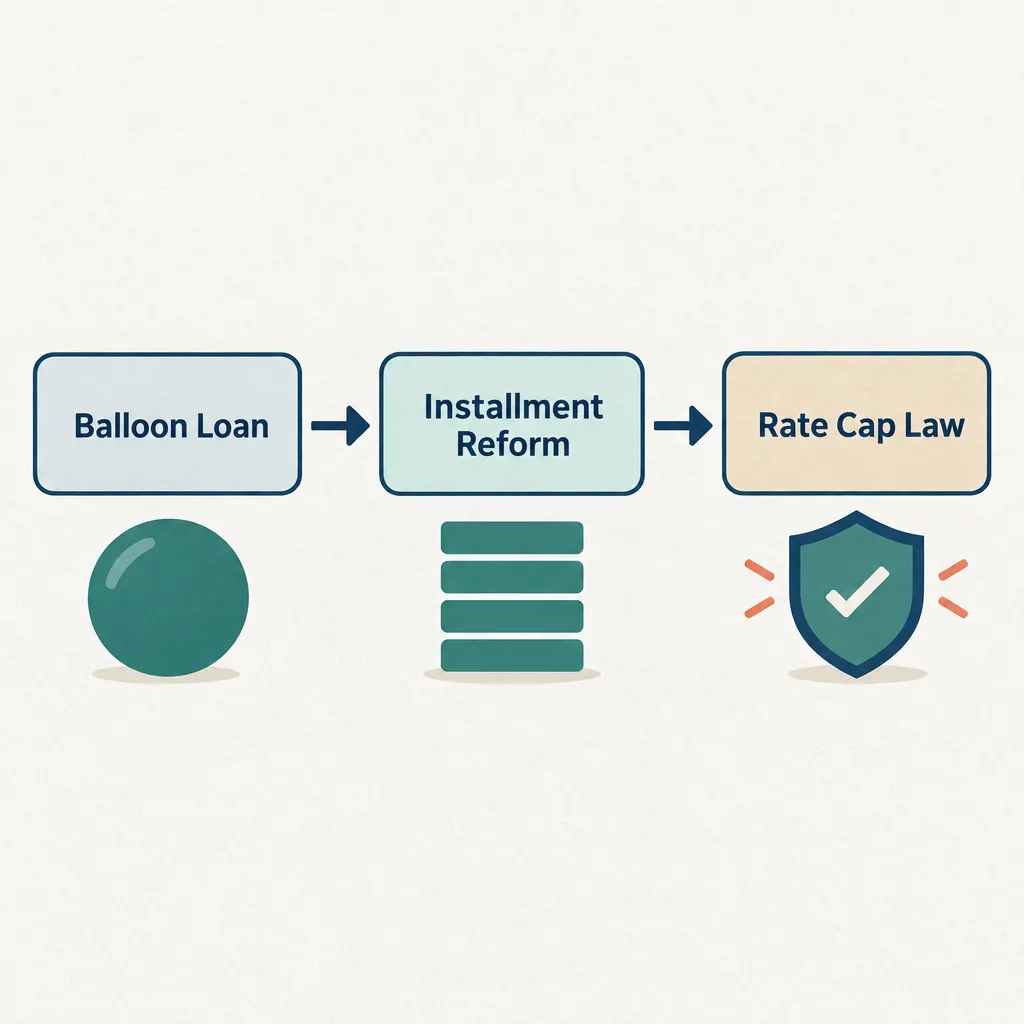
Colorado rewrote its payday loan rules twice in under a decade. Both changes made the product cheaper and slower to repay, and both drove storefront lenders out of the state.
The first reform was House Bill 10-1351 in 2010. It rewrote the Deferred Deposit Loan Act, C.R.S. § 5-3.1-101 et seq. Before then, a Colorado payday loan was the usual two-week loan repaid in one balloon payment. After 2010, every payday loan had to be an installment loan with a minimum term of six months, and borrowers could pay early without a penalty.
The second reform came from voters. Proposition 111 passed in November 2018 with more than three-quarters of the vote and took effect February 1, 2019. It amended C.R.S. § 5-3.1-105 so the total finance charge on a deferred deposit loan cannot exceed 36% APR. The old law let lenders stack an origination fee, a monthly maintenance fee and interest, which pushed average APRs well above 100%. Proposition 111 replaced all of that with one all-in cap.
Proposition 111 also made it a deceptive trade practice for anyone to offer, arrange or help make a payday loan to a Colorado consumer above the cap. That wording now matters most for online lenders and app-based advances, covered below.
Payday and short-term loans in Colorado
The core rules
As of November 2026, a Colorado payday loan has to meet six rules. Each one has a home in the statutes, so you can cite it if a lender pushes back.
| Rule | What Colorado law says | Where it comes from |
|---|---|---|
| Rate cap | 36% APR, all finance charges included | C.R.S. § 5-3.1-105 (as amended by Proposition 111, effective Feb. 1, 2019) |
| Maximum loan | $500 total principal | C.R.S. § 5-3.1-106 |
| Minimum term | Six months | Deferred Deposit Loan Act, C.R.S. § 5-3.1-101 et seq. (2010 amendments) |
| Prepayment | Allowed, no penalty | Deferred Deposit Loan Act (2010 amendments) |
| Licensing | Lender must hold a Colorado supervised lender license | Uniform Consumer Credit Code, C.R.S. § 5-2-301 |
| Other fees | No charges beyond the capped finance charge | C.R.S. § 5-3.1-105 |
The two-week rollover model used in other states doesn’t exist in Colorado. Every loan lasts at least six months and is repaid in installments, so there is no “pay the fee, roll it over” cycle. If a lender offers to refinance or renew your loan, ask for the new total of payments in writing and compare it with your current payoff amount.
What a Colorado payday loan costs
Because of the 36% cap, a Colorado payday loan costs a fraction of what an uncapped one does. The table compares a $500 Colorado loan with two other loans: a two-week loan priced at $15 per $100 borrowed, which is a common fee in states that allow traditional payday lending, and a federal credit union payday alternative loan.
| Loan | Amount | Fee or APR | Term | Payment | Total repaid |
|---|---|---|---|---|---|
| Colorado deferred deposit loan | $500 | 36% APR | 6 months | $92.30 a month | $553.80 |
| Two-week payday loan (uncapped state) | $500 | $75 fee (about 391% APR) | 14 days | $575 in one payment | $575.00 |
| Credit union PAL I | $500 | 28% APR plus $20 application fee | 6 months | $90.27 a month | $561.62 |
Here is the math behind each row:
- Colorado loan. 36% a year is 3% a month on the remaining balance. A $500 loan paid down over six equal payments comes to $92.30 a month. Six payments of $92.30 total $553.80, so you pay $53.80 in interest.
- Two-week loan. A $75 fee on $500 is 15% for 14 days. A year holds about 26.07 two-week periods (365 divided by 14). 15% times 26.07 is roughly 391% APR. You repay $500 plus $75, or $575, in one lump.
- Credit union PAL I. 28% a year is about 2.33% a month. Six payments of $90.27 total $541.62, which is $41.62 in interest. Add the maximum $20 application fee and the total is $561.62.
The surprise is how close the Colorado payday loan and the credit union loan end up. On a small six-month loan, the $20 application fee pushes the PAL’s total above the payday loan’s. The PAL is still the safer choice. Federal rules limit how many PALs you can take in a row, and a credit union doesn’t depend on repeat borrowing to make money. Our payday loan calculator lets you run the numbers for a different amount or term.
Why fewer payday lenders operate in Colorado
A 36% cap on a $500 loan earns a lender only about $54 over six months, which is often less than it costs to underwrite and collect the loan. After Proposition 111, the number of licensed payday lenders and storefronts in Colorado dropped sharply, according to the Attorney General’s annual reports on deferred deposit lending. If you see “Colorado payday loans” advertised at triple-digit rates, the lender is either unlicensed or claims an exemption from state law. Treat that as a red flag.
Earned wage access apps and the EarnIn lawsuit
Colorado has no law written for earned wage access (EWA) apps, and the Attorney General argues that some of them are payday lenders. On August 27, 2026, Attorney General Phil Weiser and the state’s UCCC Administrator sued EarnIn (legal name Activehours, Inc.). The suit claims that EarnIn’s direct-to-consumer “Cash Out” product is high-cost lending that breaks the Deferred Deposit Loan Act and the UCCC.
The state argues that EarnIn’s tips and expedited-transfer fees are really finance charges. Its complaint says EarnIn made more than 3.1 million advances worth about $300 million to nearly 57,000 Coloradans between January 2023 and July 2025. Colorado wants restitution, civil penalties and an injunction. Weiser said the suit does not target EWA products that work through an employer. EarnIn has said it firmly disagrees with the state’s description of Cash Out. These are allegations, and as of November 2026 no court has ruled on them.
Did you know?
According to the Colorado Attorney General’s August 2026 lawsuit, EarnIn’s Colorado advances carried an average APR of 387.69% once tips and fast-transfer fees are counted as finance charges, a figure the company disputes.
Lawmakers also considered licensing these apps. House Bill 26-1046 would have required EWA providers to get a license and would have banned tip solicitation. It cleared the House Finance Committee 6 to 5 and was sent to Appropriations in February 2026, but it did not become law. A 2025 version, House Bill 25-1020, was postponed indefinitely.
Car title loans in Colorado
Colorado law does not treat “car title loans” as a separate legal category the way some states like Texas or Tennessee do. A loan secured by your car title is still a consumer loan under the Uniform Consumer Credit Code (UCCC), C.R.S. Title 5, Article 1 through Article 9. That means the lender needs a supervised lender license and must stay within the UCCC’s rate caps.
Those caps make the typical 300% title loan illegal in Colorado, and licensed title lenders are almost absent from the state. Texas payday loan laws work differently: there, title lenders operate as credit access businesses and their fees are not capped the same way.
If you have a loan secured by your car, the UCCC gives you protections when you fall behind. Under C.R.S. §§ 5-5-110 and 5-5-111, a creditor generally has to send a notice of your right to cure before it can accelerate the loan or take the collateral, which gives you time to catch up on missed payments. There are exceptions, such as repeat defaults, so read any notice carefully and respond before its deadline.
A lender also cannot breach the peace when it repossesses a car. If someone threatens you, breaks into a locked garage or takes the car while you object on the spot, write down what happened and report it to the Attorney General’s office.
Supervised loans and personal loans in Colorado
Most Colorado consumer loans larger than a payday loan are “supervised loans” under the UCCC. Under C.R.S. § 5-2-301, any non-bank company that makes consumer loans with a finance charge above 12% a year must hold a supervised lender license from the Consumer Credit Unit in the Colorado Department of Law.
The tiered rate cap
C.R.S. § 5-2-201 caps supervised loan finance charges in tiers based on the unpaid balance. As of November 2026 the tiers are:
| Portion of the unpaid balance | Maximum annual rate |
|---|---|
| First $1,000 | 36% |
| Over $1,000 up to $3,000 | 21% |
| Over $3,000 | 15% |
| Alternative single rate on whole balance | 21% |
The lender can use whichever method gives the higher charge. That means the blended tiers matter most on small and mid-size loans, and the flat 21% matters on large ones. The table below shows one year of interest on a constant balance. It is a simplified ceiling, because a real loan’s balance falls as you pay it down.
| Balance | Tiered interest for one year | Blended rate | Higher of tiered or 21% |
|---|---|---|---|
| $1,000 | $1,000 × 36% = $360 | 36.0% | 36.0% |
| $2,000 | $360 + ($1,000 × 21%) = $570 | 28.5% | 28.5% |
| $5,000 | $360 + $420 + ($2,000 × 15%) = $1,080 | 21.6% | 21.6% |
| $10,000 | $360 + $420 + ($7,000 × 15%) = $1,830 | 18.3% | 21.0% |
Loans of $1,000 or less have one more wrinkle. Under C.R.S. § 5-2-214, a supervised lender can charge “alternative charges” on these loans in place of the § 5-2-201 rates. The Attorney General’s 2025 administrative opinion on small installment lending explains how those charges work. If a small-loan contract lists an acquisition charge or monthly handling fee, ask the Consumer Credit Unit whether the charges are allowed before you sign.
Here is what the 36% top tier means on a $1,000 loan:
| Loan | Amount | APR | Term | Monthly payment | Total repaid |
|---|---|---|---|---|---|
| Supervised loan | $1,000 | 36% | 12 months | $100.46 | $1,205.52 |
Twelve payments of $100.46 add up to $1,205.52, which is $205.52 in interest. At 36% a year you pay 3% a month on the balance you still owe, so each month’s interest is smaller than the last.
Banks and the 2023 interest rate opt-out
Banks are the big exception to Colorado’s caps, and as of November 2026 that is still the case. Under federal law, a state-chartered bank has generally been able to “export” the interest rates of its home state to borrowers in other states. House Bill 23-1229 tried to change that for Colorado. It uses Section 525 of the Depository Institutions Deregulation and Monetary Control Act to opt Colorado out of the federal rate preemption in Section 521, effective July 1, 2024.
The law has been tied up in court ever since:
- June 2024. Industry trade groups, led by the National Association of Industrial Bankers, won a preliminary injunction in federal district court. It barred Colorado from applying its caps to loans made by state banks located outside Colorado.
- November 10, 2025. A 2-1 panel of the U.S. Court of Appeals for the Tenth Circuit reversed the injunction. It held that a loan is “made in” Colorado if either the lender or the borrower is located there.
- April 2, 2026. The Tenth Circuit granted rehearing en banc and vacated the panel decision. The district court’s injunction stays in effect while the full court decides the case.
- Mid-2026. The two sides and outside groups filed supplemental en banc briefs. As of November 2026, the full court has not ruled.
What this means for you right now: Colorado’s caps do not reach loans from out-of-state state-chartered banks while the injunction stands. They never applied to national banks, which export rates under the National Bank Act. Before you take a high-rate loan through an app or website, find out which bank actually makes it, and check with the Attorney General’s office if you aren’t sure whether Colorado’s caps apply.
Personal loans for bad credit in Colorado
Ads for personal loans for bad credit in Colorado often promise “guaranteed approval” or “no credit check.” Neither phrase is accurate. Most lenders do a soft credit pull or look at alternative data such as your bank account history, and borrowers with weak credit get the highest rates the law allows. No matter how low your score, a licensed non-bank lender in Colorado cannot go above the UCCC caps. If an offer quotes more than 36% APR on a small loan, ask who the lender is and whether it holds a Colorado license.
“Same day loans” in Colorado describe how fast the money arrives. They are not a separate type of loan, and they follow the same rate caps and licensing rules as any other.
Online and tribal lenders
Colorado law applies to online lenders. Under the UCCC’s territorial rules, a lender that solicits Colorado residents and lends to them is generally treated as making those loans in Colorado. It needs a Colorado license and must follow Colorado’s caps. Proposition 111 adds a second layer by targeting anyone who offers or arranges a payday loan above 36% to a Colorado consumer.
Colorado has a long track record of enforcing these rules. In Cash Advance & Preferred Cash Loans v. State (2010), the Colorado Supreme Court ruled on online payday lenders that claimed tribal sovereign immunity. The court held that immunity covers only lenders that are truly arms of a tribe, and that the lender has to prove that relationship. In 2020, the Attorney General settled a “true lender” case with online lenders Avant and Marlette and their partner banks, WebBank and Cross River Bank. The settlement limited the rates on their Colorado loans and included refunds for borrowers.
Tribal lenders still advertise online and still claim Colorado law doesn’t apply to them. You don’t need to settle that legal question to protect yourself. An online lender that isn’t licensed in Colorado and charges more than the state caps gives you good reason to walk away and to report it.
Debt collection and wage garnishment limits in Colorado
What Colorado collectors can and cannot do
Debt collectors in Colorado must follow both the federal Fair Debt Collection Practices Act and the Colorado Fair Debt Collection Practices Act, C.R.S. § 5-16-101 et seq. Collection agencies must be licensed through the Colorado Collection Agency Board, which the Attorney General’s office runs.
Under these laws, a debt collector cannot:
- Threaten arrest, jail or violence over a consumer debt
- Lie about how much you owe, or pretend to be an attorney
- Call at unreasonable hours or call repeatedly to harass you
- Tell your employer, family or neighbors about your debt, apart from narrow exceptions
- Keep contacting you after you send a written request to stop, except to confirm that it will stop or to tell you about a specific step such as a lawsuit
House Bill 23-1126 bars medical debt from appearing on Colorado consumer credit reports. If a medical bill shows up on your Colorado report, dispute it under the Fair Credit Reporting Act and cite the state law.
Statute of limitations
Under C.R.S. § 13-80-103.5, collectors generally have six years to sue over liquidated debts, which include most loans and credit card balances. They can still call or write about older debt. If you are sued on a debt you believe is too old, raise the statute of limitations in your written answer to the court. If you don’t answer at all, the court can enter a default judgment against you, even on old debt.
Wage garnishment and protected money
For an ordinary consumer debt such as a payday loan or credit card, a creditor needs a court judgment before it can garnish your wages, and Colorado limits how much it can take.
| Type of debt | Garnishment limit | Source |
|---|---|---|
| Consumer debt judgment (payday, credit card, personal loan) | The lesser of 20% of weekly disposable earnings or the amount above 40 times the state or federal minimum hourly wage | C.R.S. § 13-54-104 |
| Federal student loans (administrative) | Up to 15% of disposable pay, no court order needed | 20 U.S.C. § 1095a |
| Child support | Up to 50% to 65% of disposable earnings, depending on circumstances | Consumer Credit Protection Act, 15 U.S.C. § 1673 |
| Federal benefits in a bank account | Two months of directly deposited benefits protected | 31 CFR Part 212 |
The 20% limit and the 40-times floor came from House Bill 19-1189, which was signed in May 2019 and took effect in 2020. Colorado’s minimum wage is $15.16 an hour in 2026, well above the federal $7.25, so it sets the floor. As of November 2026, 40 times $15.16 means the first $606.40 of your weekly disposable earnings is protected. The state minimum wage is adjusted for inflation every January 1, so this figure will change in 2027.
Two worked examples using the 2026 floor:
| Weekly disposable earnings | 20% of earnings | Amount above $606.40 | Most a creditor can take |
|---|---|---|---|
| $700 | $140.00 | $93.60 | $93.60 |
| $1,000 | $200.00 | $393.60 | $200.00 |
At $700 a week, the 40-times rule protects more of your pay. At $1,000, the 20% rule does. The ordinary cap does not apply to support orders, Chapter 13 plan payments or tax debts, which have their own limits in C.R.S. § 13-54-104(3). Colorado overhauled its child support rules under House Bill 25-1159, with changes taking effect March 1, 2026.
Social Security, SSI and veterans’ benefits are generally protected from private creditors. When those benefits are directly deposited, your bank must automatically protect two months’ worth. C.R.S. § 13-54-102 lists other exempt property. If money you need to live on gets frozen, ask the court for an exemption hearing right away, because the deadlines are short.
Debt relief in Colorado: what the law requires
Colorado regulates debt management and debt settlement companies under its Uniform Debt-Management Services Act, C.R.S. § 5-19-201 et seq. Any provider serving Colorado residents must register with the Attorney General’s office. The act limits the fees these companies can charge and requires a written agreement.
Federal law adds another layer. Under the FTC’s Telemarketing Sales Rule, 16 CFR 310.4(a)(5), debt relief companies that sell by phone cannot collect a fee until they have actually settled or changed at least one of your debts.
Debt settlement has real costs. Your accounts usually fall behind while you save, your credit score drops, creditors can still sue you, and forgiven debt of $600 or more may be reported to the IRS as income. A nonprofit credit counseling agency will review your budget for free or a low fee. It may also offer a debt management plan that lowers your interest rates while you keep making payments.
Help that costs less than a loan
Before you borrow, see whether you can close the gap another way. Several real programs serve Coloradans.
Cheaper options first
Ask your utility, landlord or medical provider for a payment plan before you take a loan. Call 2-1-1 Colorado to find local rent, food and utility help. Ask a credit union about a payday alternative loan capped at 28% APR.
Credit union payday alternative loans. Under NCUA rules at 12 CFR 701.21(c)(7), federal credit unions can offer two kinds of payday alternative loans (PALs). PAL I loans range from $200 to $1,000, with a minimum term of one month and a maximum term of six months. PAL II loans go up to $2,000 with terms of one to 12 months. Both are capped at 28% APR, plus an application fee of no more than $20. Some state-chartered credit unions in Colorado offer similar small loans under their own rules.
Energy and utility help. The Colorado Department of Human Services runs the Low-income Energy Assistance Program (LEAP), which helps eligible households with winter heating costs. Applications open during the heating season. Energy Outreach Colorado, a nonprofit, also funds bill assistance through partner agencies.
Food, cash and health coverage. You can apply for SNAP, Colorado Works (the state’s cash assistance program) and Health First Colorado (Medicaid) through the state’s PEAK online portal or at your county human services office.
Housing. Colorado Housing Connects is a statewide helpline for renters and homeowners facing eviction, foreclosure or trouble paying rent. 2-1-1 Colorado can point you to local emergency rent and deposit funds, which open and close during the year.
Employer and app advances. Some employers give paycheck advances at no cost. Earned wage access apps can be cheap if you skip optional tips and instant-transfer fees. If you use them every pay period, though, those small fees can add up to triple-digit effective APRs, which is the core of Colorado’s case against EarnIn.
How to check a lender’s license and file a complaint
The Colorado Department of Law licenses payday lenders and other supervised lenders through the Attorney General’s Consumer Credit Unit, under the UCCC and the Deferred Deposit Loan Act. The same office also handles collection agency licenses and debt management registrations.
How to check a Colorado lender
- Get the lender’s full legal name, not just its brand or website name.
- Search the Colorado Attorney General’s list of UCCC supervised lender licensees.
- Search NMLS Consumer Access if the company lists an NMLS ID.
- Confirm the APR and total of payments on the Truth in Lending disclosure before signing.
- Walk away if the lender is unlicensed or the APR tops Colorado’s caps.
If something goes wrong, you can complain in several places. Our guide to financial dispute resolution explains what happens after you file.
- Colorado Attorney General. File a consumer complaint through StopFraudColorado, or contact the Consumer Credit Unit directly about an unlicensed lender, illegal fees or a collector.
- CFPB. The Consumer Financial Protection Bureau’s complaint portal sends your complaint to the company, which generally has 15 days to respond.
- FTC. Report scams and fake lenders to the FTC through ReportFraud.
- FBI IC3. Report online fraud, such as advance-fee loan scams that demand a gift card or wire transfer before “approval.”
A real lender never asks for an upfront fee by gift card, crypto or wire transfer before releasing a loan. That request alone tells you it’s a scam.
Federal rules that apply everywhere
Some protections apply in every state, Colorado included.
- Truth in Lending Act and Regulation Z (12 CFR 1026). Before you sign, lenders must disclose the APR, finance charge, amount financed and total of payments.
- Military Lending Act (32 CFR Part 232). Active-duty service members and covered dependents cannot be charged more than a 36% Military Annual Percentage Rate on most consumer credit, including payday loans, title loans and many other loans.
- Fair Debt Collection Practices Act and Regulation F (12 CFR 1006). Third-party collectors must send a validation notice and cannot harass you, deceive you or use unfair practices.
- Equal Credit Opportunity Act. Lenders cannot deny or price credit based on race, sex, marital status, age or receipt of public assistance.
If you’ve moved from another state, its rules may be very different. Our guides to Illinois payday loan laws and Missouri payday loan laws show how much the caps vary across the country.
Before you borrow
Even a capped 36% loan is a fixed monthly bill for six months or more, and missed payments can lead to collection, a lawsuit and garnishment. A lender charging Coloradans more than the state caps is likely unlicensed, and you will find your protections against it much harder to enforce.
FAQ
Are payday loans legal in Colorado?
Yes, within the limits of the Deferred Deposit Loan Act. Since February 1, 2019, C.R.S. § 5-3.1-105 has capped the all-in cost at 36% APR. Loans are generally capped at $500, must have a minimum term of six months and must come from a licensed or otherwise authorized lender.
How much can you borrow on a Colorado payday loan?
The maximum is $500 in total principal under C.R.S. § 5-3.1-106. For more, you would need a supervised loan, which falls under the tiered UCCC rate caps in C.R.S. § 5-2-201, or a credit union loan such as a PAL II of up to $2,000.
Can an online lender charge more than 36% in Colorado?
A licensed non-bank lender cannot go above Colorado’s caps on payday-size loans. Some tribal lenders claim state law doesn’t apply to them, and Colorado has fought those claims in court. Loans made by out-of-state state-chartered banks are a separate case: as of November 2026, the 2023 law applying Colorado’s caps to them is blocked while the Tenth Circuit rehears the case en banc.
Are earned wage access apps legal in Colorado?
They operate in Colorado, but there is no specific law for them, and the state is challenging at least one in court. In August 2026 the Attorney General sued EarnIn, alleging that its direct-to-consumer advances are illegal high-cost loans. EarnIn disputes the claims. A 2026 bill to license EWA providers, House Bill 26-1046, did not pass.
Can a payday lender garnish your wages in Colorado?
Only after winning a court judgment. Even then, C.R.S. § 13-54-104 generally limits the garnishment to the lesser of two amounts: 20% of your disposable earnings for the pay period, or the amount by which those earnings exceed 40 times the federal or Colorado minimum hourly wage, whichever wage is greater. In 2026 that protects the first $606.40 a week. Directly deposited Social Security and other federal benefits are protected under 31 CFR Part 212.
Are car title loans legal in Colorado?
No Colorado law authorizes high-rate title loans. A lender can take a car title as collateral only if it holds a supervised lender license and stays within the UCCC rate caps. That rules out the triple-digit title loans sold in many other states.
Where can you get debt relief in Colorado without paying a big fee?
Start with a nonprofit credit counseling agency, which can review your budget and may offer a debt management plan. Any debt management or settlement company serving Colorado must register with the Attorney General under C.R.S. § 5-19-201 et seq. Under the FTC’s Telemarketing Sales Rule, debt relief companies that sell by phone cannot charge fees until they settle a debt.
Laws and regulations referenced
- Colorado Revised Statutes 2024, Title 5 (Consumer Credit Code), including Article 3.1 (Deferred Deposit Loan Act), full title PDF
- Truth in Lending Act, 15 U.S.C. 1601
- Regulation Z, 12 CFR Part 1026
- Fair Debt Collection Practices Act, 15 U.S.C. 1692
- Regulation F (debt collection), 12 CFR Part 1006
- Fair Credit Reporting Act, 15 U.S.C. 1681
- Equal Credit Opportunity Act, 15 U.S.C. 1691
- Military Lending Act, 10 U.S.C. 987
- Military Lending Act rule, 32 CFR Part 232
Links go to the official text on government sites.
Check, verify or complain
Sources
- coag.gov › licensing › uniform consumer credit code › sales finance notification fre… coag.gov · official source
- ecfr.gov › current › title 12 › chapter VII › subchapter A › part 701 › section 701.21 ecfr.gov · official source
- content.leg.colorado.gov › sites › default › files › images › olls › crs2024 title 05.pdf content.leg.colorado.gov · official source
- ballotpedia.org › Colorado Proposition 111, Limits on Payday Loan Charges Initiative (2… ballotpedia.org
- news.ballotpedia.org › 2019 › 01 › 30 › colorado proposition 111 limiting payday loan interest rat… news.ballotpedia.org
- usfinancecalculators.com › blog › payday loan apr calculator true cost guide usfinancecalculators.com
- law.justia.com › codes › colorado › title 5 › consumer credit code › article 3 1 › section 5 3 1… law.justia.com
- gazette.com › 2010 › 06 › 04 › new law targets payday lenders 379981ca cbe7 5dff 92f8 cca… gazette.com

Elena writes about getting through a money emergency, assistance programs, budgeting on a tight income, banking basics and borrower rights. Her guides list the cheaper options first and link the agency or program that can actually help.
Ruth is US Financer's standards editor. Every article goes through her checks before and after it is published: each rate, fee, cap, deadline and rule is matched against its primary source, every law named is linked to its official text, and anything that cannot be…
What changed
- Nov 13, 2026 Facts re-checked against official sources and updated; sources and links refreshed.
- Oct 25, 2026 First published.
Comments are closed