


We do not lend money or arrange loans. Rates and rules change and differ by state, so check the lender's own disclosure before you sign.
Yes, you can borrow from your 401k if your plan allows it. Federal tax law caps the loan at 50% of your vested balance or $50,000, whichever is less, and you generally must repay it within five years through payroll deductions. A 401k loan has no credit check and the interest goes back into your account, but leaving your job or missing payments can turn it into a taxable distribution.
PROPOSEDRelated consumer alert, Oct 27
NJ Assemblyman Onyema proposes state rules for buy now, pay later plansRun the numbers
Before you borrow
The biggest risk is losing your job. If you leave or are laid off with a balance outstanding, the unpaid amount can be taxed as income, plus a 10% additional tax if you are under 59½, unless you roll it over by your tax filing deadline.
How a 401k loan works
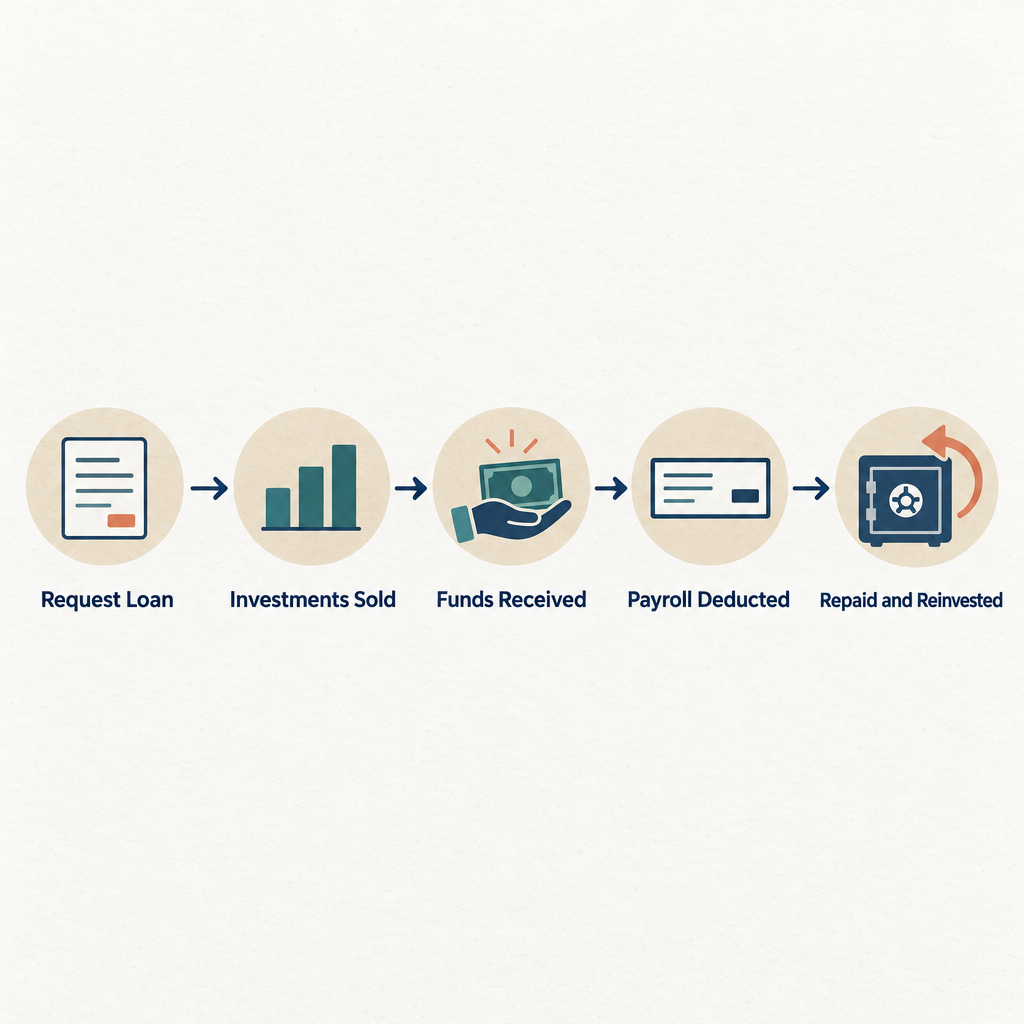
A 401k loan lets you take money out of your own retirement account and pay it back with interest. There is no bank or outside lender. You are borrowing from yourself, and the plan holds your account as security.
Here is the basic sequence:
- You request a loan through your plan’s website or administrator.
- The plan sells investments in your account to raise the cash.
- You receive the money, often within a few days to two weeks.
- Your employer deducts payments from each paycheck.
- Each payment, principal and interest, goes back into your 401k and gets reinvested.
Because the loan comes from your own savings, no credit check is required and the loan does not appear on your credit report. Missing payments will not hurt your credit score either. The consequences show up on your tax return instead.
Employers do not have to offer loans. The plan document decides whether loans exist, how many you can have at once, the minimum amount and the fees. Many plans set a minimum loan of $1,000 and limit you to one or two outstanding loans. Your summary plan description spells out the details.
The federal rules behind it
Two sets of rules govern borrowing from a 401k. Section 72(p) of the Internal Revenue Code sets the dollar limits and the repayment schedule. The IRS explains these in its “Retirement Topics: Plan Loans” guidance. If a loan breaks these rules, the IRS treats it as a taxable distribution.
The Employee Retirement Income Security Act (ERISA) and a Department of Labor regulation at 29 CFR 2550.408b-1 add borrower-side protections. Under that regulation, plan loans must carry a reasonable interest rate and be adequately secured. They must also be available to all participants on a reasonably equivalent basis.
How much you can borrow from your 401k
The maximum loan amount is the lesser of:
- 50% of your vested account balance, or
- $50,000.
There is one exception. If half your vested balance is under $10,000, the law lets a plan lend up to $10,000. Plans do not have to include this exception, though. The Department of Labor rule also limits the account security to 50% of your vested balance. So plans that allow the extra amount usually need other collateral, and most simply skip it.
Only your vested balance counts. Your own contributions are always 100% vested. Employer matching money may vest over several years under your plan’s schedule.
| Vested balance | 50% of vested | Maximum loan |
|---|---|---|
| $8,000 | $4,000 | $4,000 (up to $10,000 only if plan allows the exception) |
| $30,000 | $15,000 | $15,000 |
| $80,000 | $40,000 | $40,000 |
| $150,000 | $75,000 | $50,000 |
| $400,000 | $200,000 | $50,000 |
The 12-month look-back rule
The $50,000 cap shrinks if you had another loan recently. The law reduces it by your highest outstanding loan balance in the past 12 months, minus the balance you owe today.
Say you have a $200,000 vested balance. Last spring you owed $30,000 on a plan loan. Today you owe $10,000. Your new limit is $50,000 minus ($30,000 minus $10,000), which equals $30,000. Then you subtract the $10,000 you still owe. That leaves $20,000 of new borrowing.
This rule stops people from paying off a loan for a day and borrowing the full $50,000 again.
Repayment periods and rules
Section 72(p) requires a plan loan to be repaid within five years. Payments must be “substantially level,” with principal and interest paid at least quarterly. In practice, most plans take payments from every paycheck.
There is one main exception. A loan used to buy your principal residence can run longer than five years. The tax code sets no fixed maximum for these loans, so your plan picks the term. Some plans allow 10 years or more. Others allow none of it. Check your plan before you count on it.
You can usually prepay the loan in full at any time without penalty. Some plans also allow partial prepayments.
Leaves of absence and military service
IRS regulations at 26 CFR 1.72(p)-1 allow two kinds of payment suspensions:
- Unpaid leave. A plan may suspend payments for up to one year during an unpaid leave of absence. The loan still has to be paid off by the end of the original five-year term, so your later payments rise.
- Military service. A plan may suspend payments for the whole period of uniformed service. The repayment deadline is extended by the length of that service. The Servicemembers Civil Relief Act (SCRA) also caps interest at 6% on debts taken out before active duty, and the IRS regulation recognizes that cap for plan loans.
What a 401k loan really costs
The cost of borrowing money from a 401k has three parts: the stated interest, the plan fees and the investment growth you give up. The first is mostly a wash. The other two are real money out of your pocket.
The rate and the fees
Plans set their own interest rate. A common formula is the prime rate plus 1 or 2 percentage points. Fees vary by plan. Many charge a one-time setup fee and some add a yearly maintenance fee. The Department of Labor’s participant fee disclosure rule (29 CFR 2550.404a-5) requires your plan to tell you these individual fees, so you will find them in your fee notice.
The table below uses an illustrative 8% rate, a $75 setup fee and a $25 yearly maintenance fee. Your plan’s numbers will differ.
| Loan amount | Interest rate | Term | Monthly payment | Interest (back to your account) | Plan fees (gone) | Total repaid |
|---|---|---|---|---|---|---|
| $5,000 | 8% | 2 years | $226 | $427 | $125 | $5,552 |
| $10,000 | 8% | 5 years | $203 | $2,166 | $200 | $12,366 |
| $20,000 | 8% | 5 years | $406 | $4,332 | $200 | $24,532 |
The APR math in plain words
APR folds fees into the yearly cost of borrowing. On the $10,000 loan, $200 in fees is 2% of the amount borrowed. You are paying down the balance as you go, so the average amount owed over five years is roughly $5,300. Spreading $200 across that smaller average balance for five years adds about 0.7 points. The effective cost lands near 8.7% a year.
That is cheap next to most borrowing. But there is a twist. The $2,166 in interest is not a cost in the usual sense, because it goes into your own account. The $200 in fees is a true cost. So is any market growth you miss.
Note that a 401k loan does not come with a Truth in Lending Act disclosure. Regulation Z exempts loans from employer retirement plans that meet tax code rules (12 CFR 1026.3(g)). You will not get the standard federal box showing APR and finance charge. You have to do this math yourself or ask the plan.
The real cost: money out of the market
When you take a loan, your plan sells investments. That cash stops growing and earns only the interest you pay back. If the market rises 12% in a year while your loan pays you 8%, your account ends up smaller than it would have been. If the market falls, the loan may leave you better off. Nobody can tell you in advance which will happen.
The bigger damage usually comes from what people do next. Many borrowers cut or stop their regular contributions to afford the loan payment. That is where the long-term hit lives.
Here is a simple example. You earn $50,000 and contribute 6%, which is $3,000 a year. Your employer matches 50% of that, adding $1,500. If you stop contributing for five years to cover loan payments, you give up $7,500 in matching money alone. That is free money you never get back. On top of it, you lose $15,000 of your own contributions and whatever growth all of that would have earned.
If you can keep contributing at least enough to get the full match while repaying, a 401k loan does far less harm.
The “double taxation” argument
You may hear that 401k loans get taxed twice. This is partly true, and smaller than it sounds.
Your loan payments come from after-tax pay. Later, when you withdraw that money in retirement from a traditional 401k, it gets taxed again. But the principal you borrowed was never taxed going out, so repaying it with taxed dollars just evens things out. Only the interest portion is taxed twice. On the $10,000 loan above, that is $2,166 of interest. At a 22% tax rate, the extra tax works out to about $477 over the life of your retirement.
The interest you pay on a 401k loan is generally not tax-deductible either.
Leaving your job with a 401k loan outstanding
Most 401k loan horror stories start here. When you leave your employer, for any reason, payroll deductions stop. Many plans then require the remaining balance to be repaid. Some let you keep making payments directly. Many do not.
If you cannot repay, the plan reduces your account by the unpaid balance. This is called a loan offset. It is treated as a distribution for tax purposes.
The rollover lifeline
The Tax Cuts and Jobs Act of 2017 gave borrowers more time. If the offset happens because you left your job or the plan ended, it counts as a “qualified plan loan offset.” You can roll that amount into an IRA or a new employer’s plan by your tax return due date, including extensions, for the year of the offset.
You must come up with the cash from somewhere else to do this. The plan already used your account to cover the loan.
What it costs if you cannot roll it over
Say you leave in March with $6,000 still owed. You are 40 and in the 22% federal bracket.
| Item | Amount |
|---|---|
| Unpaid loan treated as income | $6,000 |
| Federal income tax at 22% | $1,320 |
| 10% additional tax (under 59½) | $600 |
| Total federal cost | $1,920 |
State income tax comes on top in most states. You will receive Form 1099-R showing the offset, generally with distribution code M for a qualified plan loan offset.
Before you borrow against your 401k, ask yourself one blunt question. If you lost this job next month, could you repay or roll over the balance within the deadline? If the answer is no, the loan is riskier than it looks.
What happens if you default while still employed
If you stop making payments while you still work there, the loan goes into default. IRS rules let plans offer a cure period that lasts until the end of the calendar quarter after the quarter in which you missed a payment. If you catch up within that window, nothing happens.
If you do not, the entire outstanding balance becomes a “deemed distribution.” It is taxed as ordinary income for that year. If you are under 59½, the 10% additional tax under Section 72(t) usually applies too. A deemed distribution while employed cannot be rolled over.
There is a strange catch. Even after the tax hit, the plan may still consider the loan outstanding. That can block you from taking another loan until you repay it.
Which plans allow loans: 401(a), 403(b), 457(b) and IRAs
The same Section 72(p) limits apply to every type of employer plan that offers loans.
- 401(k) plans. Loans are allowed if the plan document permits them. Most large plans do.
- 401(a) plans. These are common at government agencies, public universities and some nonprofits. A 401a loan follows the same $50,000 and 50% rules, but many 401(a) plans do not offer loans at all, especially those funded mainly by employer contributions.
- 403(b) plans. These cover teachers, hospital staff and nonprofit workers. Loans often work much like 401k loans.
- Governmental 457(b) plans. These may offer loans under the same limits.
- IRAs. You cannot take a loan from an IRA. Borrowing from your own IRA is a prohibited transaction that can disqualify the whole account.
Some people try to use the IRA 60-day rollover as a short-term loan. You withdraw the money and put it back within 60 days. IRS rules allow only one of these indirect rollovers per 12-month period across all your IRAs. Miss the deadline by a day and the full amount becomes taxable. It is a fragile plan for anyone in a cash crunch.
401k loan vs. withdrawal and other ways to tap retirement
A loan is one of several ways to get money out of a retirement plan. Each works differently.
| Option | Amount | Taxed? | 10% penalty under 59½? | Must repay? |
|---|---|---|---|---|
| 401k loan | Up to $50,000 or 50% vested | No, if repaid | No, if repaid | Yes, usually 5 years |
| Hardship withdrawal | Amount of the need | Yes | Usually yes | No, cannot repay |
| Emergency personal expense distribution | Up to $1,000 per year | Yes | No | Optional, within 3 years |
| Domestic abuse victim distribution | Up to $10,000 (indexed) or 50% | Yes | No | Optional, within 3 years |
| Regular withdrawal after leaving job | Full balance | Yes | Usually yes | No |
The emergency and domestic abuse distributions come from the SECURE 2.0 Act of 2022. They became available starting in 2024. Plans choose whether to offer them, so check yours. With the emergency distribution, you cannot take another one for three years unless you repay the first or contribute an equal amount.
A hardship withdrawal is permanent. The money leaves your account for good and you owe tax on it. A loan, if repaid, puts everything back. For most people who will stay at their job, a loan beats a hardship withdrawal on cost.
When borrowing from your 401k can make sense
A 401k loan is a better choice than high-cost debt in some situations. It tends to work when all of these are true:
- Your job feels secure for the next few years.
- You can afford the payment and still contribute enough to get your employer match.
- The alternative is a payday loan, a title loan or credit card debt above 20%.
- The need is a one-time expense, not a gap that will come back every month.
Paying off a credit card at 24% with a loan charging around 8% can save real money, as long as you do not run the card back up. Covering a large, unavoidable bill, like a car repair you need to get to work, is another case where the math can hold up.
When it usually does not
- Your job is shaky. Layoff risk turns a cheap loan into a tax bill.
- You are covering ongoing shortfalls. If your monthly budget does not balance, a loan delays the problem and adds a payment.
- You want to invest, speculate or buy wants. Pulling money out of a diversified retirement account to chase crypto or other high-risk bets compounds the risk.
- You are close to retirement. Less time remains to recover lost growth.
- You are already in bankruptcy or serious debt trouble. Retirement accounts are generally protected from creditors in bankruptcy. Draining one to pay debts that could be discharged can mean losing money you would have kept.
That last point matters. Federal law shields most 401k money from creditors. Once you borrow it and hand it to a lender, that protection is gone.
Cheaper options first
Cheaper options first
Call your creditors and ask for a hardship plan or payment deferral.
Check a credit union payday alternative loan, capped at 28% APR.
Talk to a nonprofit credit counselor before tapping retirement savings.
A 401k loan is cheaper than many alternatives, but it is not free. Try these first:
- Creditor hardship programs. Utilities, medical providers, landlords and lenders often offer payment plans or deferrals. Ask before you borrow.
- Credit union payday alternative loans. National Credit Union Administration rules cap these at 28% APR with an application fee of no more than $20. PAL I loans run $200 to $1,000 for one to six months. PAL II loans go up to $2,000 for up to 12 months. You must be a credit union member.
- Employer help. Some employers run hardship funds or offer earned wage access with no fee.
- Nonprofit credit counseling. Agencies affiliated with the National Foundation for Credit Counseling can review your budget and may set up a debt management plan.
- Public assistance. Dial 211 to find local help with rent, utilities and food. The Low Income Home Energy Assistance Program helps with heating and cooling bills.
- Short-term income. Selling unused items or picking up extra shifts are among the ways to make money fast without borrowing.
Avoid a payday loan as the fallback. These typically carry APRs in the hundreds of percent. Lenders that advertise no credit check loans make up for the missing check with much higher prices. A personal installment loan from a bank or credit union may cost more than a 401k loan in interest. In exchange, it leaves your retirement invested and creates no tax risk if you change jobs.
State rules and availability
Unlike payday or title loans, 401k loans are governed by federal law, ERISA and the Internal Revenue Code. No state bans them or caps their rate. Availability depends only on whether your employer’s plan offers loans.
State law does show up in two places:
- State income tax. If your loan defaults or is offset and you do not roll it over, most states tax that amount as income. States with no broad income tax, such as Texas, Florida and Washington, do not.
- Public employee plans. Government 401(a) and 457(b) plans are not covered by ERISA. State law and the plan’s own rules govern them, and loan features vary widely from state to state.
Your rights when you borrow from your 401k
You have more protection than with most loans, but you have to ask for it.
- Equal access. Under 29 CFR 2550.408b-1, an ERISA plan must make loans available to all participants on a reasonably equivalent basis. It cannot reserve loans for executives or set terms that shut out lower earners.
- A reasonable rate. The same rule requires a reasonable interest rate, similar to what a commercial lender would charge for a comparable secured loan.
- Written plan rules. Your summary plan description must explain loan terms. You can request the full plan document in writing. ERISA lets a court impose a penalty of up to $110 a day if the plan administrator fails to provide requested documents within 30 days.
- Fee disclosure. Your plan must disclose loan setup and maintenance fees in advance under 29 CFR 2550.404a-5.
- Spousal consent. Plans subject to the joint and survivor annuity rules must get your spouse’s written consent before lending. Many 401k plans are exempt, but some require it.
- Military protections. The Servicemembers Civil Relief Act caps interest at 6% on loans taken before active duty. IRS rules let plans suspend payments during uniformed service.
If your plan refuses a loan the documents allow, charges fees it never disclosed or mishandles your payments, contact the Department of Labor’s Employee Benefits Security Administration. Its benefits advisors take calls at 1-866-444-3272 and through the agency’s website. Tax questions about a deemed distribution or loan offset go to the IRS. For government plans not covered by ERISA, start with the plan administrator and then your state’s retirement system or attorney general.
How to take a 401k loan
How to request a 401k loan
- Read your summary plan description for loan rules and fees.
- Check your vested balance and your maximum loan.
- Choose the smallest amount and shortest term you can afford.
- Confirm you can keep contributing enough for your match.
- Ask what happens to the loan if you leave your job.
- Submit the request online or through the administrator.
- Verify the first payroll deduction is correct.
Keep your loan paperwork and statements. If you change jobs, you will need the exact balance and offset date to complete a rollover before the deadline.
FAQ
Can I borrow from my 401k for any reason?
In most plans, yes. Federal law does not require a specific reason for a 401k loan. Your plan can add restrictions, and loans used to buy a home may qualify for a longer repayment term if you document the purchase.
Does a 401k loan affect my credit score?
No. There is no credit check to borrow against your 401k, and plans do not report loans or late payments to the credit bureaus. A mortgage lender may still count your loan payment when it calculates your debt-to-income ratio.
How long does it take to get the money?
Many plans deliver funds within a few days to two weeks after approval. Direct deposit is usually faster than a paper check. Ask your plan administrator for its current processing time.
Can I keep contributing while I repay?
Usually yes. Your plan cannot force you to stop contributing because you have a loan. Keeping contributions going, at least up to the employer match, is the best way to limit long-term damage.
What happens to my 401k loan if I die?
The unpaid balance is generally treated as a distribution and subtracted from what your beneficiaries receive. The amount may be taxable to your estate or beneficiaries, depending on how the plan handles it.
Can I have more than one 401k loan at a time?
The law allows it, as long as the combined total stays within the $50,000 and 50% limits. Many plans cap you at one or two outstanding loans.
Is a 401k loan better than a hardship withdrawal?
For most people who expect to stay at their job, yes. A loan avoids income tax and the 10% penalty as long as you repay it. A hardship withdrawal is taxed, often penalized and can never be put back into the account.
Can you borrow from your 401k after you leave your employer?
Generally no. Plans typically offer loans only to current employees. Once you leave, you can withdraw or roll over your balance, but a withdrawal is taxable and may carry the 10% additional tax if you are under 59½.
Laws and regulations referenced
- Truth in Lending Act, 15 U.S.C. 1601
- Regulation Z, 12 CFR Part 1026
- Servicemembers Civil Relief Act, 50 U.S.C. 3901
Links go to the official text on government sites.
Sources
- irs.gov › retirement plans › 401k plan fix it guide participant loans dont confor… irs.gov · primary source
- irs.gov › retirement plans › deemed distributions participant loans irs.gov · primary source
- irs.gov › retirement plans › 401k plan qualification requirements irs.gov · primary source
- irs.gov › pub › irs tege › epche12a03.pdf irs.gov · primary source
- sofi.com › learn › content › 401a vs 401k sofi.com
- fidelity.com › viewpoints › financial basics › taking money from 401k fidelity.com

Elena writes about getting through a money emergency, assistance programs, budgeting on a tight income, banking basics and borrower rights. Her guides list the cheaper options first and link the agency or program that can actually help.

Ruth is US Financer's standards editor. Every article goes through her checks before and after it is published: each rate, fee, cap, deadline and rule is matched against its primary source, every law named is linked to its official text, and anything that cannot be…
Comments are closed