


Crypto can lose all of its value and is not protected by FDIC or SIPC insurance. This is education, not investment advice.
A black swan event is a rare, unexpected shock with extreme consequences that people explain away as obvious only after it happens. The term comes from Nassim Nicholas Taleb, and crypto markets have produced several, from the Mt. Gox collapse in 2014 to the FTX bankruptcy in 2022. This guide explains the idea, walks through real examples in stocks and crypto, and covers what US rules and taxes mean for you when one hits.
NEW RULERelated consumer alert, Oct 21
OCC final rule keeps issuer yield ban, reviews stablecoin rewards case by caseRun the numbers
What is a black swan event?
A black swan event is an outlier. Nothing in the recent past points to it, it hits hard, and afterward everyone builds a neat story about why it “had” to happen.
Taleb laid out the idea in his 2007 book The Black Swan: The Impact of the Highly Improbable. He had touched on it earlier in Fooled by Randomness (2001). His central point was simple. Financial models built on normal patterns tend to ignore the rare events that do the most damage.
Taleb’s three tests
Taleb gives three attributes. An event needs all of them to count:
- It is an outlier. It sits outside regular expectations, because nothing in the past convincingly pointed to its possibility.
- It carries an extreme impact. The consequences reshape a market, a sector or the wider economy.
- It is predictable only in hindsight. After the fact, people explain it as if it were obvious and could have been anticipated.
The third test matters most for investors. Hindsight stories make you feel the next shock will be easier to spot. Usually it isn’t.
Where the name comes from
For centuries, Europeans used “black swan” as shorthand for something impossible. The Roman poet Juvenal called a rare thing a “rare bird, very like a black swan.” The belief held because every swan anyone in Europe had seen was white.
Then, in 1697, the Dutch explorer Willem de Vlamingh’s expedition recorded black swans in Western Australia. One observation overturned a “fact” built on thousands of years of evidence. Taleb borrowed the story to show how fragile knowledge based only on past observation can be.
Black swan, grey swan and white swan
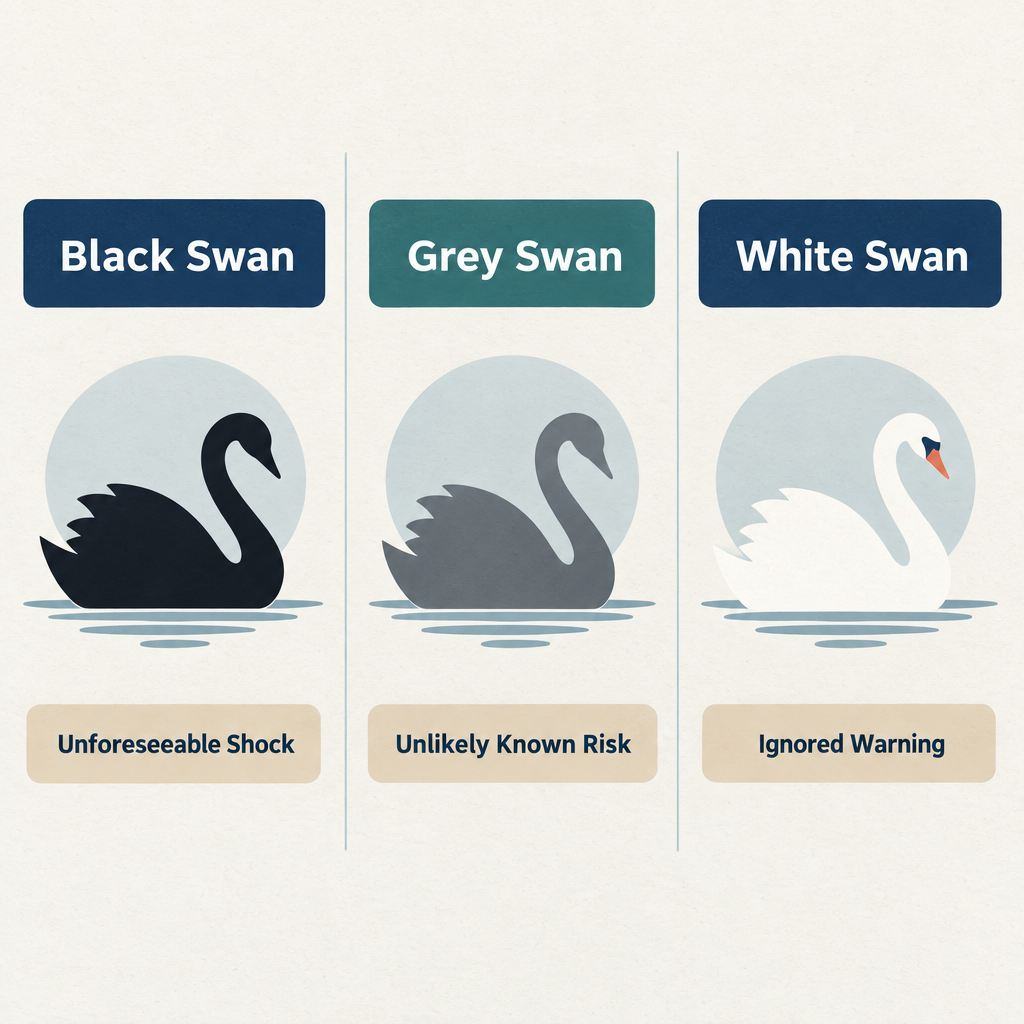
People use “the black swan event” loosely for any bad day. That dilutes the term. Analysts often split shocks into three types.
| Type | What it means | Example |
|---|---|---|
| Black swan | Unforeseeable outlier with massive impact | Taleb’s classic cases, like the 1987 crash for most traders |
| Grey swan | Known possibility judged unlikely, then it happens | A major exchange hack |
| White swan | Predictable and warned about, but ignored | A global pandemic, in Taleb’s view |
The physicist Didier Sornette adds a fourth idea, the “dragon king.” These are extreme events that grow out of visible feedback loops, such as bubbles, and can sometimes be spotted in advance. Many crypto blowups fit that description better than a true black swan.
Black swan events in traditional markets
Stock markets offer the cleanest record, since prices go back decades. These are the shocks most often cited.
| Event | Date | What happened |
|---|---|---|
| Black Monday | October 19, 1987 | Dow Jones Industrial Average fell 22.6% in one day |
| September 11 reopening | September 17, 2001 | Dow fell about 7.1% when markets reopened |
| Global financial crisis | October 2007 to March 2009 | S&P 500 fell about 57% peak to trough |
| Flash Crash | May 6, 2010 | Dow dropped nearly 1,000 points within minutes, then mostly recovered |
| COVID-19 crash | February 19 to March 23, 2020 | S&P 500 fell about 34% |
The 2008 crisis is the textbook case for the financial sector. Risk models at major banks assumed housing prices would not fall nationwide at the same time. When they did, Lehman Brothers filed for bankruptcy on September 15, 2008, and credit markets froze.
The COVID-19 crash is more debated. Taleb himself has said the pandemic was a white swan, not a black one. Epidemiologists had warned for years that a global outbreak would happen. What was unexpected was how unprepared markets and governments were. That distinction is worth remembering: a shock can feel like a black swan to you even when experts saw it coming.
Black swan events in crypto
Crypto is young, volatile and lightly regulated in places. That mix produces frequent extreme events. Some fit Taleb’s definition. Others were grey swans that the market chose to ignore.
| Event | Date | What happened |
|---|---|---|
| Mt. Gox collapse | February 2014 | Once the largest bitcoin exchange; halted withdrawals and filed for bankruptcy with about 850,000 BTC missing |
| “Black Thursday” | March 12, 2020 | Bitcoin fell close to 40% in a day as COVID-19 panic hit all markets |
| Terra/LUNA collapse | May 2022 | UST stablecoin lost its dollar peg; roughly $40 billion in value was wiped out |
| Celsius and 3AC failures | June and July 2022 | Celsius froze withdrawals June 12 and filed for Chapter 11 July 13 |
| FTX bankruptcy | November 2022 | FTX halted withdrawals November 8 and filed for Chapter 11 November 11 |
| USDC depeg | March 2023 | USDC briefly fell to about 87 cents after Circle disclosed $3.3 billion held at failed Silicon Valley Bank |
| Bybit hack | February 21, 2025 | About $1.5 billion in ether stolen; the FBI attributed it to North Korea |
| Liquidation cascade | October 10, 2025 | More than $19 billion in leveraged positions liquidated in about a day, per CoinGlass data |
Exchange failures
Mt. Gox and FTX share a pattern. Customers believed their coins sat safely on the platform. In both cases, customer assets were missing when people tried to withdraw.
FTX unraveled in about a week. A CoinDesk report on November 2, 2022, raised questions about the balance sheet of Alameda Research, FTX’s sister trading firm. Withdrawals surged, and the exchange could not meet them. Founder Sam Bankman-Fried was convicted of fraud in November 2023 and sentenced to 25 years in prison in March 2024.
Stablecoin breaks
Terra’s UST was an “algorithmic” stablecoin. It relied on arbitrage with its sister token, LUNA, instead of cash reserves. Once confidence cracked, selling fed on itself and both tokens collapsed. A federal jury found Terraform Labs and its co-founder Do Kwon liable for fraud in an SEC case in 2024. Kwon later pleaded guilty to US criminal fraud charges.
The USDC scare was different. USDC was backed by reserves, but some sat in a bank that failed. It recovered after federal regulators announced on March 12, 2023, that all Silicon Valley Bank depositors would be protected. The lesson: even a reserve-backed coin depends on where the reserves are kept.
Liquidation cascades
The October 10, 2025 sell-off followed President Trump’s announcement of planned 100% tariffs on Chinese imports. Prices dropped, which triggered forced selling of leveraged positions, which pushed prices lower, which triggered more forced selling. CoinGlass counted it as the largest single liquidation event in crypto history.
Why crypto is extra exposed
Several features of the crypto market turn ordinary bad news into extreme moves.
- It never closes. Stocks have trading hours and circuit breakers. Most crypto trades 24/7 with no market-wide pause, so a weekend shock plays out in real time.
- Leverage is easy to get. Offshore platforms have offered leverage of 50x or more. Small price moves wipe out leveraged traders and force sales.
- Assets are concentrated on a few platforms. When a big exchange fails, a large share of the market’s coins can be frozen at once.
- There is no lender of last resort. Banks can borrow from the Federal Reserve in a panic. Crypto platforms cannot.
- Prices move together. In a panic, most coins fall at the same time, so holding many tokens gives less protection than you might expect.
How leverage turns a dip into a wipeout
This worked example shows why leverage matters so much during a black swan event. It ignores fees and funding rates, which make the outcome worse.
| Your cash | Leverage | Position size | Price drop that wipes out your cash |
|---|---|---|---|
| $1,000 | 1x (no leverage) | $1,000 | 100% |
| $1,000 | 2x | $2,000 | 50% |
| $1,000 | 10x | $10,000 | 10% |
| $1,000 | 50x | $50,000 | 2% |
The math is plain division. At 10x, you control $10,000 with $1,000. A 10% fall equals a $1,000 loss, which is all your money. Exchanges usually liquidate before that point to protect themselves, so the real threshold is lower. On March 12, 2020, bitcoin fell close to 40% in one day. Any position above roughly 2.5x leverage would have been wiped out.
Normal crypto crashes are not black swans
This point gets lost in headlines. Bitcoin has fallen more than 75% several times. Those drops hurt, but they are part of a known pattern, so they fail Taleb’s first test.
| Bear market | Approximate peak | Approximate low | Approximate drop |
|---|---|---|---|
| 2011 | About $32 (June 2011) | About $2 (November 2011) | About 93% |
| 2013 to 2015 | About $1,150 (December 2013) | About $170 (January 2015) | About 85% |
| 2017 to 2018 | About $19,700 (December 2017) | About $3,200 (December 2018) | About 84% |
| 2021 to 2022 | About $69,000 (November 2021) | About $15,500 (November 2022) | About 77% |
Figures are rounded from widely cited exchange prices and vary slightly by source.
If a 75% fall has happened four times, it is a white swan for anyone holding crypto. You should expect it. The phase at the bottom of these falls, when sellers give up en masse, is what traders mean by capitulation. That is a market cycle, not an outlier.
Calling every crash “a black swan” also lets platforms and promoters off the hook. FTX was not a random act of nature. Prosecutors proved that customer money had been misused.
Before you invest in crypto
Crypto can lose all of its value, and coins held on an exchange are not protected by FDIC or SIPC insurance. If the platform fails, you may wait years to recover part of your money, or get nothing.
The risks a black swan exposes
Black swans rarely create new risks. They reveal ones that were there all along. These are the ones that matter most for US investors.
Total loss
LUNA fell more than 99% in days. Plenty of tokens have gone to zero and never come back. No rule or regulator guarantees that any coin keeps value.
No deposit insurance
FDIC insurance covers deposits at insured banks, up to $250,000 per depositor, per insured bank, for each ownership category. It does not cover crypto, even if you bought it through an app that also offers a bank account. SIPC protects customers of failed brokerage firms that hold securities and cash. SIPC states that digital assets that are not securities are not protected. A platform that claims “FDIC insured” crypto is misleading you, and the FDIC has warned about exactly this kind of claim.
Custody and bankruptcy risk
When you leave coins on a platform, you are often an unsecured creditor if it fails. In January 2023, the bankruptcy judge in the Celsius case ruled that coins in its “Earn” accounts belonged to Celsius under its terms of use, not to customers. Read a platform’s terms before assuming the coins are “yours.”
Even good outcomes can disappoint. The FTX estate said most customers would get back about 119% of their claims. But those claims were valued in dollars on the November 2022 filing date, when bitcoin traded around $17,000. Customers did not get the later rebound.
Holding coins in a cold wallet removes exchange risk, though it adds your own risk of losing keys or falling for a phishing scam.
Stablecoin risk
A stablecoin is only as safe as its reserves and the institutions holding them. Terra had no real reserves. USDC had reserves that were briefly trapped. Both events showed that “stable” describes a goal, not a guarantee.
How investors think about preparing
No one can predict a black swan. Research and history point instead to limiting how much any single shock can hurt you. This is education, not advice to buy or sell anything.
- Size positions to survive a zero. Many financial planners suggest putting into crypto only money you could lose entirely without changing your life.
- Skip leverage. The table above shows how fast borrowed money turns a sharp drop into a total loss.
- Separate your emergency fund. Cash you might need in a crisis belongs somewhere insured and stable, not in crypto.
- Check counterparties. Before trusting a platform with money, confirm it is registered and licensed.
- Run a “pre-mortem.” Ask what would happen to your money if your exchange froze withdrawals tomorrow. If the answer is unacceptable, the setup is fragile.
Taleb describes a “barbell” approach: keep most money in very safe assets and a small slice in high-risk ones, avoiding the middle. The idea is that your worst case stays limited. He is also, notably, a critic of bitcoin. He wrote the foreword to The Bitcoin Standard in 2018, then published a 2021 paper arguing bitcoin is fragile and worth zero under his framework. Smart people disagree sharply about crypto, which is itself a reason for caution.
Safer places for money you might need
Keep emergency cash in an FDIC-insured bank or NCUA-insured credit union account.
Short-term US Treasury bills are backed by the federal government.
If a crash leaves you short, a nonprofit credit counselor can help with bills before you sell at a loss.
How to check a crypto company
- Search FinCEN’s MSB registrant search to see if the company is registered as a money services business.
- Look up the company on NMLS Consumer Access for state money transmitter licenses.
- Check your state financial regulator’s license lookup; New York, for example, issues its own BitLicense.
- For anything sold as an investment product, check SEC and FINRA BrokerCheck.
- Search the CFPB’s complaint database for patterns of frozen accounts or unpaid withdrawals.
Registration is a minimum bar, not a seal of safety. FTX’s US arm held state licenses, and that did not stop the collapse.
Scams that follow a crash
Black swan events bring a second wave of harm: fraud aimed at people who just lost money.
- Recovery scams. Someone contacts you claiming they can retrieve funds lost on a collapsed exchange, for an upfront fee. Legitimate bankruptcy claims run through court-appointed administrators and do not require you to pay a stranger.
- “Rescue” tokens and high-yield offers. Promises of guaranteed returns to “make back” losses are a classic sign of a Ponzi scheme. These collapse the moment withdrawals outrun new deposits.
- Crypto ATM pressure. Scammers posing as government agents or bank staff tell victims to move cash into a crypto ATM “for safety.” No real agency asks for this.
- Fake support accounts. After a hack or outage, impostors on social media offer “help” and ask for your seed phrase. No real support team ever needs it.
Report fraud to the FTC at ReportFraud, to the FBI’s Internet Crime Complaint Center (IC3), and to the CFPB complaint portal if a financial company is involved. Desperation after a loss is exactly what scammers count on. Be just as wary of anyone offering money fast to cover your losses.
US rules and IRS treatment after a crash
Taxes
Under IRS Notice 2014-21, the IRS treats crypto as property, not currency. Selling, trading or spending it is a taxable event, and you report a capital gain or loss.
A black swan crash often leaves you with losses. Under current federal rules:
- Capital losses first offset capital gains.
- If losses exceed gains, you can deduct up to $3,000 of net capital loss against other income per year ($1,500 if married filing separately).
- Unused losses carry forward to future years.
- The wash sale rule in Section 1091 of the Internal Revenue Code applies to stocks and securities. Proposals to extend it to crypto have been introduced, but as of early 2026 they have not become law.
Losses on a collapsed platform are harder. If you never sold, you may not have a deductible loss yet. Personal theft loss deductions have been largely unavailable since 2018. Talk to a tax professional before claiming one.
Reporting is changing too. Brokers must report gross proceeds from crypto sales made on or after January 1, 2025, on the new Form 1099-DA. Cost basis reporting starts with assets acquired on or after January 1, 2026. Keep your own records anyway, since a crypto profit calculator is only as accurate as the basis figures you feed it.
Regulation: what is law and what is not
The GENIUS Act, signed in July 2025, created the first federal framework for payment stablecoins. It requires issuers to back coins one-for-one with reserves such as cash and short-term Treasury bills and to publish monthly reserve disclosures. It also gives holders priority if an issuer goes insolvent. That directly targets the kind of failure Terra caused.
Broader rules for crypto markets are a different story. The CLARITY Act, a market structure bill, passed the House in July 2025. At the time of writing it was still a bill, not law. Check its current status before relying on any protection it promises.
FAQ
What does black swan event mean?
It means a rare, unexpected event with severe consequences that people rationalize afterward as predictable. Nassim Nicholas Taleb popularized the term in his 2007 book. All three traits must be present: rarity, extreme impact and hindsight explanation.
When was the last black swan event?
There is no official list, and people disagree about labels. In crypto, the October 10, 2025 liquidation cascade is the most recent shock widely described this way, with more than $19 billion in leveraged positions wiped out in about a day. The February 2025 Bybit hack, at about $1.5 billion, is another candidate. Many analysts would call both grey swans, since hacks and leverage blowups are known risks.
What are real life examples of black swan events?
Commonly cited examples include the 1987 Black Monday crash, the September 11 attacks, the 2008 financial crisis and the 2010 Flash Crash. In crypto, examples include the Mt. Gox collapse in 2014, the Terra/LUNA collapse in 2022 and the FTX bankruptcy in 2022. COVID-19 is often listed, though Taleb argues it was a predictable white swan.
Can a black swan event be positive?
Yes. Taleb stresses that black swans can be good surprises, such as the rise of the internet or an unexpected scientific breakthrough. For an investor, a positive black swan is an outsized gain nobody forecast. The catch is that you cannot plan for one either, so it should not be part of your strategy.
Is a crypto crash always a black swan event?
No. Bitcoin has fallen more than 75% four times since 2011, so deep crashes are an expected part of crypto market cycles. A true black swan sits outside what history suggests is possible. Treating routine crashes as surprises can lead you to take more risk than you realize.
Laws and regulations referenced
- IRS Notice 2014-21 (virtual currency is property)
- IRS Form 1099-DA, Digital Asset Proceeds From Broker Transactions
- Wash sale rule, 26 U.S.C. 1091
- GENIUS Act (stablecoins), Public Law 119-27 (S. 1582)
- Digital Asset Market Clarity Act, H.R. 3633 (a bill, check its current status)
- FDIC deposit insurance
Links go to the official text on government sites.
Check, verify or complain
Sources
- mofo.com › resources › insights › 250721 the genius act a new federal regulatory mofo.com
- coindesk.com › research › market spotlight the 19 billion liquidation that shook crypto coindesk.com
- greenbacktaxservices.com › knowledge center › form 1099 da digital asset reporting greenbacktaxservices.com
- cnbc.com › 2021 › 07 › 13 › black swan author nassim taleb says bitcoin is worth zero cnbc.com
- vespertool.com › blog › biggest black swan events trading history vespertool.com
- coingecko.com › learn › october 10 crypto crash explained coingecko.com

Nadia covers crypto taxes, scams and the rules around digital assets: IRS guidance, broker reporting, federal and state regulation, and how to spot and report fraud. She separates what is law from what is only proposed and links the official text.

Ruth is US Financer's standards editor. Every article goes through her checks before and after it is published: each rate, fee, cap, deadline and rule is matched against its primary source, every law named is linked to its official text, and anything that cannot be…
Comments are closed