


Crypto can lose all of its value and is not protected by FDIC or SIPC insurance. This is education, not investment advice.
The Clarity Act passed the House by 160 votes in July 2025. Fourteen months later it failed in the Senate by one vote. The Digital Asset Market Clarity Act of 2025 (H.R. 3633) is a federal bill that would split oversight of US crypto markets between the Commodity Futures Trading Commission (CFTC) and the Securities and Exchange Commission (SEC). As of November 2026 it is not law: a Senate cloture vote failed 49-50 on September 15, 2026, and no new vote has been scheduled.
SCAM ALERTRelated consumer alert, Nov 14, 2026
FBI disrupts North Korean FaceStealer scheme that stole over $400 million in cryptoRun the numbers
Key takeaways
- The Clarity Act is a bill, not a law. As of November 2026 it has not passed the Senate.
- The Senate Banking Committee approved its version 15-9 on May 14, 2026, but the Senate fell 11 votes short of the 60 needed to begin debate.
- If Congress does not pass it before the 119th Congress ends on January 3, 2027, the bill dies and a new one would have to start over.
- Even if it became law, crypto would still not be FDIC or SIPC insured, and your crypto taxes would not change.
Before you act on crypto news
The Clarity Act protects none of your money today, because it is not law. Crypto can lose all of its value, and it is not covered by FDIC deposit insurance or SIPC protection.
What is the Clarity Act, in plain terms?
The Clarity Act is a “market structure” bill. It would write into federal law which agency regulates which crypto assets and which businesses must register. For more than a decade, US crypto rules came mostly from enforcement actions and court cases, not from a statute written for digital assets.
The central question never changed: is a given token a security, which falls to the SEC, or a commodity, which falls to the CFTC? Regulators, companies and judges reached different answers in different cases. The Clarity Act tries to settle that question in law.
What is market structure?
Market structure is the rulebook for how a market runs. It covers who regulates which assets, which businesses must register (exchanges, brokers, dealers, custodians), what they must disclose and how they must hold customer money. Stock markets have had this framework since the Securities Exchange Act of 1934.
Spot crypto markets, where people buy and sell actual tokens rather than futures contracts, never got an equivalent federal framework. The Clarity Act is Congress’s attempt to write one.
How the Clarity Act would work
The House-passed bill would make the CFTC the main regulator of spot trading in “digital commodities”, keep the SEC in charge of token fundraising, and require crypto exchanges to register and keep customer assets separate from their own.
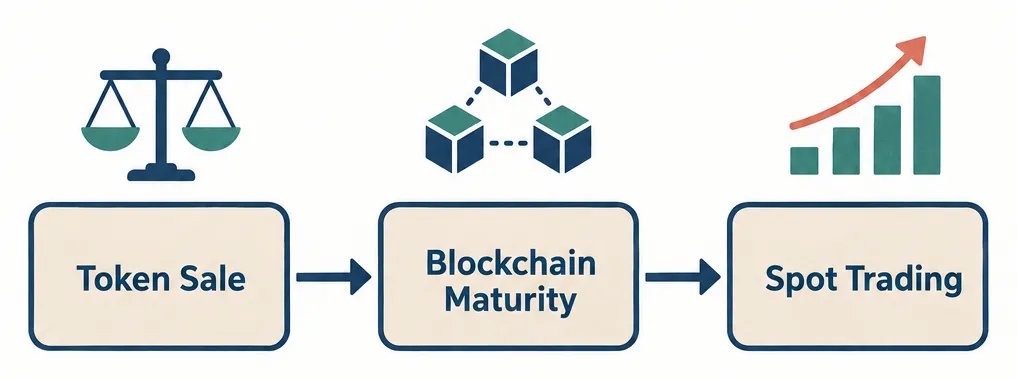
House Financial Services Committee Chairman French Hill introduced the bill on May 29, 2025. It builds on FIT21, which passed the House 279-136 in May 2024 but died in the Senate. The House text works like this:
It creates a “digital commodity” category. A digital commodity is a digital asset whose value is tied to the use of a blockchain. Spot trading in these assets would fall under the CFTC. Payment stablecoins covered by the GENIUS Act and assets that are clearly securities are carved out.
It keeps the SEC in charge of fundraising. When a project sells tokens to raise money, the SEC still oversees that sale and its disclosures. Under the House text, issuers that meet disclosure requirements get an exemption to sell up to $75 million in digital commodities in a 12-month period.
It introduces the idea of a “mature” blockchain. A blockchain is mature when no single person or group under common control runs it. Once a network reaches that point, its token is treated as a digital commodity, not an investment that depends on a company’s efforts. Insiders face limits on selling their tokens before maturity.
It requires crypto businesses to register. Exchanges, brokers and dealers handling digital commodities would register with the CFTC. They would have to keep customer assets apart from company assets, manage conflicts of interest and give disclosures. These rules respond directly to the FTX collapse, where customer funds were mixed with the firm’s own money.
It applies anti-money-laundering rules. Registered firms would be treated as financial institutions under the Bank Secrecy Act.
It protects self-custody and some software developers. The House text affirms that individuals can hold their own crypto and transact peer to peer. It also shields developers who write code but never control users’ funds.
Who would regulate what
| Activity | Regulator under the House bill |
|---|---|
| Spot trading of digital commodities (exchanges, brokers, dealers) | CFTC |
| Token sales used to raise money, issuer disclosures | SEC |
| Payment stablecoins | Bank and state regulators, under the GENIUS Act (already law) |
| Anti-money-laundering compliance | FinCEN rules, via the Bank Secrecy Act |
| Taxes on crypto gains | IRS (unchanged) |
How the Senate version differs
The Senate did not pass the House text as written. The Senate Banking Committee reported H.R. 3633 with an amendment, meaning it replaced the House text with its own 309-page version, first released on May 12, 2026. Senate Agriculture, which oversees the CFTC, advanced a separate bill on its side, the Digital Commodity Intermediaries Act. If the Senate ever passes its version, the House must approve the same text before it can go to the president.
Where the bill stands as of November 2026
H.R. 3633 sits on the Senate legislative calendar (Calendar No. 423) after failing a cloture vote 49-50 on September 15, 2026. As of November 2026 the Senate has not scheduled another vote.
The timeline below follows the official record on Congress.gov and GovInfo, plus committee announcements.
| Date | Step |
|---|---|
| May 29, 2025 | H.R. 3633 introduced in the House |
| June 10, 2025 | House Financial Services approves it 32-19; House Agriculture approves it 47-6 |
| June 23, 2025 | Both House committees formally report the bill |
| July 17, 2025 | Full House passes it 294-134, with 78 Democrats voting yes |
| July 18, 2025 | GENIUS Act (stablecoins), a separate bill, signed into law |
| July 2025 | Senate Banking releases a discussion draft, the Responsible Financial Innovation Act |
| September 18, 2025 | Senate receives H.R. 3633 and refers it to the Banking Committee |
| November 2025 | Senate Agriculture releases a bipartisan discussion draft |
| January 2026 | Senate Banking postpones its markup after Coinbase withdraws support |
| January 29, 2026 | Senate Agriculture advances the Digital Commodity Intermediaries Act 12-11, on party lines |
| May 12, 2026 | Senate Banking releases a 309-page compromise text |
| May 14, 2026 | Senate Banking votes 15-9 to advance the bill; Democrats Ruben Gallego and Angela Alsobrooks join all 13 Republicans |
| June 1, 2026 | Senate Banking Chairman Tim Scott formally reports H.R. 3633 with an amendment |
| September 15, 2026 | Cloture on the motion to proceed fails 49-50; Sen. Thom Tillis enters a motion to reconsider |
| January 3, 2027 | 119th Congress ends; unpassed bills expire |
What the September 15 vote means
The September 15 vote was on cloture on the motion to proceed. That is a procedural vote to let the Senate start debating the bill, and it needs 60 votes. The Senate never voted on the bill itself.
Here is how the numbers add up. Republicans hold 53 of 100 seats. Four Republicans (Susan Collins, Josh Hawley, Jerry Moran and Thom Tillis) voted no, so 53 minus 4 left 49 yes votes. No Democrat or independent voted yes, and one senator did not vote. That gives 49 yes + 50 no + 1 not voting = 100. Getting from 49 to 60 would take 11 more votes.
Tillis cast his no vote so that he could enter a motion to reconsider. That procedure lets Majority Leader John Thune bring the same cloture vote back without starting the bill over. Tillis said afterward, “This is not the end for the Clarity Act.”
What happens next
There are three possible outcomes before the deadline:
- A second cloture vote in the lame-duck session. The Senate would need 60 votes to proceed and then pass the bill, and the House would have to accept the Senate text, all before January 3, 2027.
- The bill expires. Every pending bill dies when a Congress ends. A market structure bill would then have to be reintroduced, referred to committee and marked up again in the 120th Congress.
- Pieces move in other legislation. This happens sometimes in Congress, but only the enacted text would count, and it would be a new law, not H.R. 3633.
The election raised the bar further. On November 11, 2026, Forbes reported that Democrats won control of both chambers in the midterms. Forbes also reported that the bill is effectively tabled until January, because there is little reason to settle a bipartisan deal in the lame-duck session. American Banker, which covers banking policy, wrote after the vote that the push for market structure legislation this Congress had most likely ended.
Why the Senate stalled
Three disputes slowed the bill in the Senate, and the ethics fight decided the floor vote.
- Ethics rules. Many Senate Democrats demanded limits on senior officials, including the president, profiting from crypto ventures, given the president’s family’s crypto businesses. CNBC and NPR both tied the failed vote to this dispute.
- Stablecoin rewards. The GENIUS Act bars stablecoin issuers from paying interest. Banking groups argue that exchanges paying “rewards” on stablecoin balances is a loophole that could pull deposits out of banks, while crypto firms want rewards kept. This fight helped delay the Banking Committee markup in January 2026.
- DeFi and illicit finance. Lawmakers disagree on how far anti-money-laundering obligations should reach into decentralized finance.
Is it law? Separating law from proposals
As of November 2026, the only federal crypto statute among these is the GENIUS Act. Everything else on this page is a bill, a committee text or a proposed rule.
| Item | Status as of November 2026 | What it means for you |
|---|---|---|
| GENIUS Act | Law since July 18, 2025 | Takes effect on the earlier of January 18, 2027 or 120 days after final regulations |
| Treasury rules under the GENIUS Act | Proposed (April and August 2026) | Not final; details can still change |
| Clarity Act, House text | Passed House only | No legal effect |
| Clarity Act, Senate Banking text | Reported by committee | No legal effect |
| Digital Commodity Intermediaries Act | Approved by Senate Agriculture | No legal effect |
| Crypto as property for taxes | IRS guidance in effect (Notice 2014-21) | Applies to you now |
The GENIUS Act stablecoin rules are where federal law is actually changing in the near term. Treasury published its first proposed rule in April 2026 on when state oversight of smaller issuers counts as “substantially similar” to federal rules. FinCEN and the Office of Foreign Assets Control (OFAC) followed with an anti-money-laundering proposal, and Treasury issued a broader proposal on issuing, offering and selling stablecoins in August 2026.
Did you know?
The Senate never debated the Clarity Act itself. According to the Senate record, the September 15, 2026 vote was only on whether to proceed to the bill, and it fell 11 votes short of the 60 needed.
What it would and would not change for you
If enacted, the Clarity Act would bring federal registration, segregation of customer funds and disclosure rules to US crypto exchanges. That could lower the risk of an FTX-style collapse, where customer money disappeared into the company’s own accounts.
It would not:
- Make crypto safe or stable. Prices can still drop sharply, and a token can still go to zero.
- Add insurance. No version of the bill gives crypto holdings FDIC or SIPC coverage.
- Change your taxes. The IRS treats crypto as property under IRS Notice 2014-21, so selling, swapping or spending it can trigger a capital gain or loss. Separately, brokers began reporting gross proceeds on Form 1099-DA for sales made from January 1, 2025. Starting with 2026 sales, they must also report cost basis for “covered” assets, generally those acquired on or after January 1, 2026 and held at the same broker. The first forms with basis will arrive in early 2027.
- Erase fraud. Scammers already pitch “Clarity Act approved” or “government regulated” tokens. No law approves an investment, and promised guaranteed returns are a classic sign of a Ponzi scheme.
Keep your own cost records
Basis reporting does not cover crypto you bought before 2026 or moved in from an outside wallet. Keep your own purchase dates and prices, or you may not be able to prove your gain or loss.
Protect yourself while the law is pending
Until a market structure law takes effect, crypto platforms are overseen by a patchwork: state money transmitter licenses, FinCEN registration as a money services business, and SEC or CFTC rules for specific products. That leaves gaps, so it is up to you to check who you are dealing with.
How to check a crypto platform today
- Search the company in FinCEN’s MSB registration search.
- Check your state financial regulator’s license lookup or NMLS Consumer Access.
- For anyone selling investments, check SEC and FINRA BrokerCheck.
- Read the terms on who holds your keys and whether customer assets are kept separate.
- Report fraud to the FTC at ReportFraud, to the FBI’s IC3 and to the CFPB.
Some red flags apply whatever happens in Congress: someone claims a token is “approved” under a federal law, you are promised fixed or guaranteed returns, you are pushed to move funds fast, or a platform has no license you can find in any of the searches above.
FAQ
What is the Clarity Act in crypto?
It is a federal bill, the Digital Asset Market Clarity Act of 2025 (H.R. 3633), that would set rules for US crypto markets. It would give the CFTC oversight of spot trading in digital commodities and keep token fundraising under the SEC.
Is the Clarity Act law yet?
No. The House passed it on July 17, 2025, and the Senate Banking Committee approved its version on May 14, 2026. A Senate cloture vote then failed 49-50 on September 15, 2026. As of November 2026 the Senate has scheduled no new vote. The bill’s Congress.gov page lists every official action.
What happens if the Clarity Act does not pass by January 2027?
It expires when the 119th Congress ends on January 3, 2027. Lawmakers would have to introduce a new bill in the 120th Congress and take it through committees and floor votes again.
Why did the Senate vote fail?
It got 49 votes and needed 60. Every Democrat who voted said no, along with four Republicans. Reporting from CNBC and NPR points mainly to the dispute over ethics rules limiting officials’ profits from crypto ventures.
What is the difference between the Clarity Act and the GENIUS Act?
The GENIUS Act covers payment stablecoins. It became law on July 18, 2025, and takes effect by January 18, 2027 at the latest. The Clarity Act covers the wider crypto market, including exchanges, brokers and how tokens are classified, and it has not passed.
Does the Clarity Act change how crypto is taxed?
No. The IRS treats crypto as property, and you report gains and losses whether or not the bill passes. Broker reporting of proceeds and cost basis comes from Treasury and IRS rules, not from this bill.
Would the Clarity Act insure my crypto?
No. It would add registration and fund segregation rules for platforms. Crypto would still not be FDIC or SIPC insured, and its value could still fall to zero.
Why is it called a market structure bill?
Market structure means the rules for a market’s participants: which agency regulates which assets, who must register and how customer money is held. The Clarity Act writes those rules for crypto.
What to watch next
The next real signal is whether Thune schedules a second cloture vote before January 3, 2027. If that date passes without one, H.R. 3633 dies. Any new market structure bill in 2027 would start from scratch under a different Congress. Until then, crypto rules that already exist are the ones that protect you: state licensing, FinCEN registration, IRS reporting and, from January 2027, the GENIUS Act’s stablecoin rules.
Laws and regulations referenced
- IRS Notice 2014-21 (virtual currency is property)
- IRS Form 1099-DA, Digital Asset Proceeds From Broker Transactions
- Bank Secrecy Act, 31 U.S.C. 5311
- GENIUS Act (stablecoins), Public Law 119-27 (S. 1582)
- Digital Asset Market Clarity Act, H.R. 3633 (a bill, check its current status)
Links go to the official text on government sites.
Check, verify or complain
Sources
- congress.gov › bill › 119th congress › house bill › 3633 › all info congress.gov · official source
- lummis.senate.gov › press releases › lummis boozman scott release final clarity act text lummis.senate.gov · official source
- congress.gov › crs product › R49351 congress.gov · official source
- govtrack.us › congress › votes › 119 2025 › h199 govtrack.us
- govtrack.us › congress › bills › 119 › hr3633 govtrack.us
- publiclawtracker.com › bills › 119 hr 3633 publiclawtracker.com
- cryptoticker.io › en › clarity act explained cryptoticker.io
- defirate.com › clarity act fact sheet defirate.com

Nadia covers crypto taxes, scams and the rules around digital assets: IRS guidance, broker reporting, federal and state regulation, and how to spot and report fraud. She separates what is law from what is only proposed and links the official text.
Ruth is US Financer's standards editor. Every article goes through her checks before and after it is published: each rate, fee, cap, deadline and rule is matched against its primary source, every law named is linked to its official text, and anything that cannot be…
What changed
- Nov 12, 2026 Facts re-checked against official sources and updated; sources and links refreshed.
- Oct 24, 2026 First published.
Comments are closed