


Payday lending is legal in Nevada, and the state sets no cap on interest rates. What limits a lender is NRS Chapter 604A. Any loan above 40% APR counts as a “high-interest loan,” a payday loan can’t exceed 25% of your expected gross monthly income, and if you default on a qualifying loan the lender must offer an extended repayment plan. This guide was last reviewed November 12, 2026, against the current Nevada Revised Statutes and Financial Institutions Division materials.
BLOCKEDRelated consumer alert, Nov 9
FinCEN, Fed pull crypto Travel Rule proposal to seek new public inputRun the numbers
Key takeaways
- Nevada has had no interest-rate cap since 1984, so 300% to 600% APRs on short-term loans are legal.
- A payday loan generally runs up to 35 days, or up to 90 days if you repay in installments. A title loan runs 30 days, or up to 210 days in installments.
- If you default, NRS 604A.5083 gives you a repayment plan of at least 90 days, and the first payment can’t be more than 20% of what you owe.
- Not repaying is a civil matter. The lender can sue you, but you can’t be arrested for the debt.
- Before you borrow, check the lender’s license with the Nevada Financial Institutions Division.
Fact-checked
We checked these key facts against the sources named, on November 12, 2026:
- Sahara Ave., Suite 250, phone (702) 486-4120 (source: fid.nv.gov)
- The Carson City licensing office is at (775) 684-2970 (source: fid.nv.gov)
- If you earn $3,200 a month before taxes, your payday borrowing is limited to $800 across all lenders combined (source: leg.state.nv.us)
- 987).** For active-duty service members and covered dependents, the all-in military APR on most consumer credit is capped at 36% (source: consumerfinance.gov)
- Illinois adopted a 36% APR cap in 2021, as our guide to Illinois payday loan laws explains (source: ilga.gov)
Which loans Nevada’s NRS Chapter 604A covers
NRS Chapter 604A covers four main products: deferred deposit (payday) loans, high-interest loans, title loans and check-cashing services. The Legislature calls the chapter’s core the Payday Lender Best Practices Act. What triggers the chapter is the price of the loan. Any loan with an APR above 40% is a high-interest loan under the chapter. Companies that make these loans need a license from the Nevada Financial Institutions Division (FID), which is part of the Nevada Department of Business and Industry.
Deferred deposit (payday) loans
With a deferred deposit loan, you write a postdated check or authorize an electronic debit, and you get cash now. The lender agrees to hold the check or debit until your next payday. Storefront chains such as Dollar Loan Center and Moneytree, plus many smaller operators across Las Vegas, Reno and the rural counties, offer these loans.
High-interest installment loans
A high-interest loan is any loan above 40% APR that isn’t structured as a deferred deposit or title loan. Most of these are installment loans repaid in several scheduled payments. Many of them are marketed as “installment loans in Nevada” or “loans for bad credit in Nevada.”
Title loans
A title loan is secured by the title to a vehicle you own. You keep driving the car, but the lender holds a lien on it and can repossess it if you default. Title lenders such as TitleMax fall under the same chapter, plus extra title-loan rules.
What falls outside 604A
Loans at or below 40% APR from banks, credit unions or lenders licensed under Nevada’s installment-loan chapter, NRS Chapter 675, are not “high-interest loans.” Different rules cover them. Mortgages, credit cards and pawn transactions also fall outside the payday framework. Out-of-state banks that lend under federal preemption are a separate question, covered in the online-lender section below.
Payday and short-term loan rules: amount, term and cost
Nevada controls payday loans through income tests and time limits, not price caps. The 25% income rule and the term limits protect you most, and the lack of an APR ceiling is what makes these loans so expensive.
How much you can borrow
Nevada sets no flat dollar maximum on payday loans. Under NRS 604A.5017, a deferred deposit loan can’t exceed 25% of your expected gross monthly income. Since February 1, 2022, when the statewide loan database began operating, the lender must also check that this loan, combined with your other outstanding loans, stays under that 25% limit. If you earn $3,200 a month before taxes, your payday borrowing is limited to $800 across all lenders combined.
High-interest installment loans use a different test. NRS 604A.5045 says no monthly payment under the loan agreement may exceed 25% of your expected gross monthly income. The total balance can therefore be larger than 25% of your income, as long as each monthly payment stays under that limit.
How long the loan can run
A payday loan’s original term can’t exceed 35 days. It can run up to 90 days if you repay it in installments. Chapter 604A allows extensions only within strict limits. The Nevada Supreme Court has treated workarounds that stretch a loan’s life, such as “grace periods” and refinances, as prohibited extensions (see the title loan section below).
Is there an interest cap in Nevada?
No. Nevada has no usury ceiling for these loans. The 40% APR figure only decides which loans fall under Chapter 604A. It doesn’t limit what a lender can charge. That is why triple-digit APRs are legal for loans that meet the chapter’s term, income and disclosure rules.
Did you know?
According to reporting by The Nevada Independent, Nevada had some form of interest cap from 1913 until 1984. That year a special legislative session repealed the 18% cap to attract a Citicorp credit-card center to Las Vegas.
| Rule | Deferred deposit (payday) | Title loan | High-interest installment loan | NRS section |
|---|---|---|---|---|
| What triggers the rules | Postdated check or debit authorization | Vehicle title as security | APR above 40% | NRS Chapter 604A |
| Size limit | Loan can’t exceed 25% of expected gross monthly income, including other outstanding loans | Can’t exceed the vehicle’s fair market value | Monthly payment can’t exceed 25% of gross monthly income | 604A.5017, 604A.5076, 604A.5045 |
| Original term | 35 days, or up to 90 days with installments | 30 days, or up to 210 days with installments | 35 days, or up to 90 days with installments | 604A.5074 (title); Chapter 604A |
| Extensions | Strictly limited | Up to six 30-day extensions on a 30-day loan; none on a 210-day loan | Strictly limited | 604A.5074 |
| APR cap | None | None | None | Chapter 604A |
| Default rights | Reduced rate and repayment plan | Reduced rate and repayment plan; no repossession during plan | Reduced rate and repayment plan | 604A.5083 |
What a Nevada payday loan really costs
Fees aren’t capped, so the figures below are realistic examples, not legal maximums. To get the APR, divide the fee by the amount borrowed, divide by the number of days, then multiply by 365.
| Product | Amount | Fee or APR | Term | Total repaid | APR math |
|---|---|---|---|---|---|
| Payday loan | $300 | $45 fee | 14 days | $345 | $45 ÷ $300 = 15%; 15% × (365 ÷ 14) ≈ 391% APR |
| Payday loan | $500 | $75 fee | 14 days | $575 | Same ratio, ≈ 391% APR |
| Title loan | $1,000 | $200 finance charge | 30 days | $1,200 | 20% × (365 ÷ 30) ≈ 243% APR |
| High-interest installment loan | $1,000 | 200% APR | 6 monthly payments of $276.20 | $1,657.20 | 16.67% monthly rate, amortized |
| Credit union PAL I | $500 | 28% APR (+ up to $20 fee) | 6 monthly payments of about $90.27 | About $541.62 + fee | 2.33% monthly rate, amortized |
The installment row also shows the income test at work. A $276.20 monthly payment needs at least $1,104.80 in gross monthly income to stay within NRS 604A.5045.
What lenders must do, and what they can’t
Chapter 604A requires lenders to give you written disclosures and receipts, apply your payments properly, and avoid a list of banned practices. A lender that breaks these rules can face FID discipline, and in some cases the loan becomes unenforceable.
Required disclosures in your loan agreement
The Truth in Lending Act and Regulation Z (12 CFR 1026) require the lender to disclose the APR, the finance charge, the amount financed and the total of payments before you sign. Chapter 604A adds Nevada-specific terms: the loan’s length, your right to rescind, how payments are applied and how to reach FID. You must get a receipt for each payment. You can prepay all or part of the loan, and the lender can’t charge you for paying early.
Banned practices
Under Chapter 604A, a Nevada licensee can’t:
- charge late fees or build in balloon payments
- take an assignment of your wages
- take more than one check or electronic debit authorization for a single loan
- charge you to cash the loan proceeds check it hands you
- threaten criminal prosecution, or use or threaten violence, to collect.
Did you know?
A 2018 Nevada legislative audit, reported by The Nevada Independent, found that nearly a third of the state’s payday lenders had violated state rules during the previous five years.
“The lender keeps pulling from my bank account even though I can’t pay. Can I stop it?”
Yes. Under the Electronic Fund Transfer Act and its Regulation E, you can stop a recurring debit by telling your bank at least three business days before the scheduled withdrawal. You can also revoke your authorization with the lender in writing. The debt still exists after you do this, but you decide when and how to pay it, and you avoid stacked overdraft and returned-payment fees.
Your right to cancel by the next business day
You can cancel a Nevada payday or title loan at no cost if you act by close of business on the next business day. The Legal Aid Center of Southern Nevada describes the process, which works like this:
How to cancel a Nevada payday or title loan
- Return to the same location where you took out the loan before it closes on the next business day.
- Bring back the full amount you borrowed in cash or the original loan check.
- Ask for a written receipt showing the loan was cancelled at no charge.
- Keep your copy of the agreement and receipt in case a debit or collection notice follows.
If you can’t repay: your rights after default
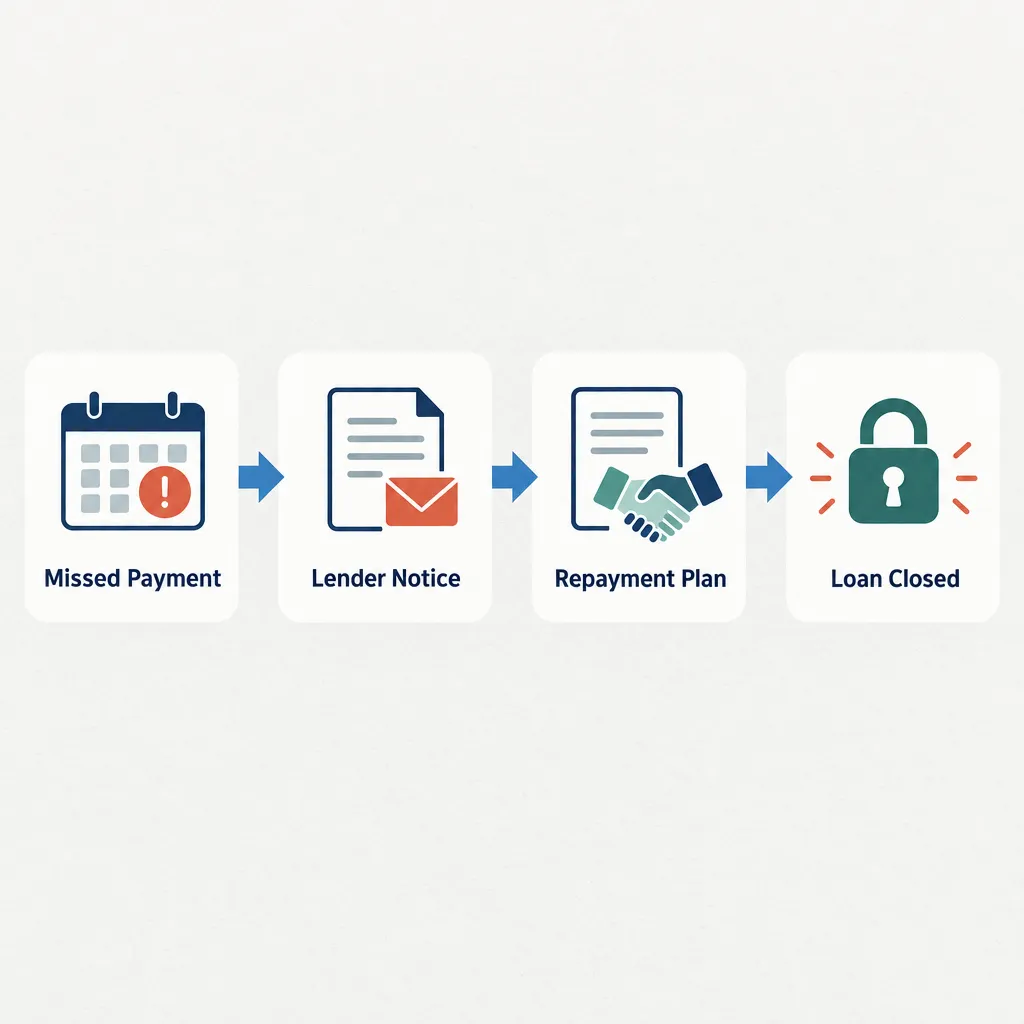
For a borrower in trouble, this is the most useful part of Nevada law. After you default, the interest rate drops sharply, and you can enter a repayment plan that stops the lender from suing you or taking your car while you keep up with the payments. Many borrowers never use it because nobody tells them it exists. NRS 604A.588 requires certain licensees to tell customers who can’t pay that a plan is available.
The reduced default interest rate
After default, the lender can charge no more than the prime rate plus 10 percentage points, for up to 90 days. This is a formula, so the dollar amount moves with the prime rate. If prime were 7%, for example, the ceiling would be 17% APR, a fraction of a typical 391% payday APR. Check the current bank prime loan rate in the Federal Reserve’s H.15 Selected Interest Rates release before you do the math.
How to request a repayment plan
Under NRS 604A.5083, you must enter the plan no later than 30 days after default, unless the lender allows longer. The plan must last at least 90 days, and the first payment can’t exceed 20% of the total amount due.
Ask for the plan in writing
Tell the lender in writing, before or right after the due date, that you can’t pay and are requesting a repayment plan under NRS 604A.5083. Keep a dated copy, because the 30-day window counts from default.
Worked example: a $500 payday loan
Say you borrowed $500 with a $75 fee, and you default owing $575.
| Step | Calculation | Amount |
|---|---|---|
| Total due at default | $500 principal + $75 fee | $575.00 |
| Maximum first plan payment | 20% × $575 | $115.00 |
| Remaining balance | $575 − $115 | $460.00 |
| Spread over at least 90 days | e.g., three monthly payments | about $153.33 each |
| Interest at a 17% post-default rate for 90 days | $575 × 17% × 90 ÷ 365 | about $24.10 at most |
Compare that with paying only the $75 fee every two weeks wherever an extension is allowed. Six fee payments over roughly 90 days cost $450, and you would still owe the original $500. That is how “I’m stuck paying interest every two weeks and the balance never goes down” happens. The repayment plan breaks that cycle.
Know your number before you call
Work out 20% of your total balance before you phone the lender. If someone asks for a larger first payment, you can point to NRS 604A.5083.
What lenders can’t do while you’re on a plan
While you keep to the plan, NRS 604A.5083 bars the lender from collecting more than the plan amount, filing a lawsuit or repossessing your vehicle. Those remedies come back only if you default on the plan itself. On credit: many storefront payday lenders don’t report on-time payments to the three nationwide credit bureaus, but a debt sold or placed with a collection agency can appear on your report. Completing the plan keeps the account out of collections.
| Right | What the law says | Deadline | Source section |
|---|---|---|---|
| Reduced interest | No more than prime + 10% after default | Up to 90 days | NRS Chapter 604A default provisions |
| Repayment plan | Lender must offer a written plan | Enter within 30 days of default unless the lender allows more | NRS 604A.5083 |
| Plan length | At least 90 days | Set at plan start | NRS 604A.5083 |
| First payment | No more than 20% of total due | First plan installment | NRS 604A.5083 |
| No suit or repossession | Barred while you’re current on the plan | Duration of plan | NRS 604A.5083 |
| Notice of plan | Certain licensees must tell you it exists | When you can’t repay | NRS 604A.588 |
Can you go to jail or be sued for an unpaid payday loan?
You can’t be jailed for failing to repay a payday loan in Nevada. Unpaid consumer debt is a civil matter. The lender’s legal options are a civil lawsuit, a court judgment and court-ordered collection such as wage garnishment.
Is not paying a payday loan a felony?
No. A collector who says “you’ll be arrested for check fraud” is making a threat that both state and federal law prohibit. Chapter 604A bars licensees from threatening criminal prosecution. The Fair Debt Collection Practices Act (15 U.S.C. 1692e) forbids third-party collectors from falsely suggesting that nonpayment will lead to arrest. A postdated check you gave a payday lender is part of a loan agreement, not a bad check written to cheat someone. Write down the caller’s name, company and the date, and report it to FID and the CFPB.
How long can a lender sue in Nevada?
NRS 11.190 sets the limits. Payday and title loans come with written agreements, so the six-year period usually applies.
| Debt type | Limit | NRS |
|---|---|---|
| Written contract (most loan agreements) | 6 years | NRS 11.190 |
| Unwritten contract or open account | 4 years | NRS 11.190 |
| Court judgment | 6 years, renewable | NRS 11.190 and renewal rules |
Can a lender come after you after 7 or 10 years?
A collector can still ask you to pay a debt that is past the limitations period. Under the CFPB’s Regulation F (12 CFR 1006.26), however, it can’t sue you or threaten to sue on a time-barred debt. Be careful: a new written acknowledgment or promise to pay can restart or extend the clock under Nevada law. If the lender already won a judgment, a different timeline applies, and the judgment can be renewed. Before you pay anything on a very old account, ask for written validation of the debt.
Debt collection and wage garnishment limits in Nevada
A lender has to sue and win a judgment before it can garnish your wages. Chapter 604A also bans wage assignments in the loan contract. Once a creditor has a judgment, NRS 31.295 limits ordinary garnishment to the smallest of three amounts:
- 18% of disposable earnings, if your gross weekly pay is $770 or less
- 25% of disposable earnings, if your gross weekly pay is above $770
- the amount by which your weekly disposable earnings exceed 50 times the federal minimum hourly wage.
Federal benefits such as Social Security get extra protection. When they are deposited directly, banks must protect up to two months of those benefits from a garnishment order. Nevada’s bank-account exemption was the subject of SB142 in 2025. That bill would have protected $5,000 in a personal account. It passed the Legislature on party lines, but Gov. Joe Lombardo vetoed it on June 2, 2025, writing that it could unintentionally encourage debt evasion. The earlier exemption rules remain in force.
Title loans in Nevada: extra rules and repossession
Title loans carry the most risk of any product in Chapter 604A because you can lose your car. Under Nevada’s title-loan provisions in Chapter 604A, a title loan can run 30 days with no more than six 30-day extensions, or up to 210 days if repaid in installments, and the 210-day version can’t be extended. Under NRS 604A.5076, the loan can’t exceed the vehicle’s fair market value. You must also own the vehicle and sign an affidavit about your ability to repay.
“Can they take my car if I’m only a little late?” Technically, default can lead to repossession. But if you enter a repayment plan under NRS 604A.5083 and keep to it, the lender can’t repossess. If repossession does happen, the Uniform Commercial Code, adopted in Nevada as NRS Chapter 104, says the lender can’t breach the peace, for example by breaking into a locked garage. It must also handle any sale of the car in a commercially reasonable way.
The TitleMax cases at the Nevada Supreme Court
TitleMax and FID have fought two significant cases at the Nevada Supreme Court:
- 2019, grace periods. FID found TitleMax’s “Grace Period Payments Deferment Agreement” during a 2014 exam. The court held that the product was not a real grace period under NRS 604A.210 but an unlawful extension of 210-day loans. Because TitleMax’s reading of the law was reasonable, the court found the violation was not willful.
- 2021, refinancing. In State, Department of Business and Industry v. TitleMax of Nevada (September 23, 2021), the court held that refinancing 210-day title loans violated the ban on extensions. It also held that the fair-market-value limit applies to the loan principal.
On “Can the title loan company sell my loan to another company and start over?”: a loan can be sold, but the buyer takes on the same contract and the same Nevada limits. Selling the loan doesn’t create a fresh 210-day term or reset the limitations clock.
Skip the "buyout" and the "grace period"
Refinances, buyouts and grace-period offers usually add interest without reducing what you borrowed. Ask instead for the statutory repayment plan.
Installment and personal loans, including loans for bad credit
Nevada also sets no cap on installment loans above 40% APR. They fall under Chapter 604A as high-interest loans, with the 25%-of-monthly-income payment limit in NRS 604A.5045. Loans at or below 40% APR from installment lenders licensed under NRS Chapter 675, banks or credit unions fall outside that framework.
Loans advertised as “guaranteed approval” or “no credit check” usually still involve a soft credit pull, a check of specialty databases or bank-account data, and the statewide loan database for products covered by Chapter 604A. When a lender can approve almost anyone, the price usually covers the expected losses. Compare the APR and the total of payments, not just the size of each payment.
Nevada’s statewide loan database
Since February 1, 2022, Nevada has run a statewide database that tracks every outstanding payday, title and high-interest loan, and lenders must check it before making a new loan. SB201 of 2019 created it, now codified at NRS 604A.303. The Legislative Commission gave final approval to FID’s regulations on December 28, 2020, despite industry objections. Those rules let lenders charge up to $3 per loan to fund the system. The database was first supposed to be running by July 2020. The Nevada Current reported that it went live more than 18 months late, and FID staff said lenders would not be penalized right away while the system ramped up.
For borrowers, the effect is practical. “I have loans at three different places in Las Vegas. Is that even legal?” It can be, but only if all of them together stay within the 25% income test. Lenders have had to check that combined figure against the database since February 1, 2022. A lender that ignores your existing loans is breaking NRS 604A.5017.
FID now publishes an annual lending report built from the database. The 2024 edition was prepared for the Division by Catalis, the vendor associated with the Veritec Solutions loan-tracking system. When The Nevada Independent covered the database plan in 2019, about 95 businesses held high-interest lending licenses in Nevada, with roughly 300 branches.
Online, tribal and out-of-state lenders
An online lender that makes payday, title or high-interest loans to Nevada residents generally needs an FID license, the same as a storefront. Some lenders claim tribal sovereign immunity or a bank partnership to avoid state rules. Courts have treated those claims inconsistently, and you get weak protection if something goes wrong.
Red flags include:
- no Nevada license number on the website
- upfront “insurance” or “processing” fees before the loan is funded
- payment demanded by gift card or crypto
- pressure to give your online-banking password
- a lender that won’t give its physical address.
How to check a lender in Nevada
- Get the company’s exact legal name and any license number from its website or contract.
- Search the Licensee Search on fid.nv.gov for that name.
- Confirm the license type matches the product (deferred deposit, high-interest or title loan).
- Check NMLS Consumer Access if the company says it holds NMLS registration.
- Search the CFPB complaint database for the company’s complaint history.
Federal protections that apply in Nevada
Federal law sets a minimum level of protection for borrowers in every state. In Nevada, four federal rules matter most:
- Truth in Lending Act / Regulation Z. The lender must disclose the APR and total cost in writing before you sign.
- Military Lending Act (10 U.S.C. 987). For active-duty service members and covered dependents, the all-in military APR on most consumer credit is capped at 36%. That makes typical payday and title loans unlawful for this group.
- Fair Debt Collection Practices Act. Third-party collectors can’t harass you, lie or threaten arrest. You can demand validation of the debt.
- CFPB payday rule, 12 CFR Part 1041. Its payment provisions took effect March 30, 2025. They require new authorization after two failed withdrawal attempts. On March 28, 2025, the Consumer Financial Protection Bureau said it would not prioritize enforcing them, so they exist on paper with little active enforcement.
Help that costs less
Several options cost far less than a payday or title loan:
- Credit union payday alternative loans (PALs). Under National Credit Union Administration rules (12 CFR 701.21), federal credit unions can offer PAL I loans of $200 to $1,000 over one to six months. PAL II loans go up to $2,000 over up to 12 months. Both have a maximum 28% APR and an application fee of no more than $20. Not every Nevada credit union offers them, so ask.
- Cash advance apps. Cash advance apps in Nevada, and employer earned-wage-access programs, can be free if you skip the optional tips and instant-transfer fees. If you pay a $5 fee on a $100 advance due in 7 days, the effective APR is about 260%.
- Nonprofit credit counseling and debt relief. For debt relief in Nevada, a nonprofit counselor can set up a debt management plan. Debt-management companies must be licensed under NRS Chapter 676A, and the FTC’s Telemarketing Sales Rule bars upfront fees for debt-settlement services sold by phone.
- Assistance programs. Dialing 211 connects you to Nevada 211’s directory of rent, utility and food help. The Division of Welfare and Supportive Services runs the Energy Assistance Program and SNAP, which can free up cash for other bills.
Cheaper options first
Ask your utility or landlord for a hardship plan before borrowing.
A credit union PAL at 28% APR costs far less than a 391% payday loan.
If you’re behind on several loans, a nonprofit credit counselor’s review is free or low-cost.
How to check a lender’s license and file a complaint
FID regulates payday, title and high-interest lenders in Nevada and takes complaints against them. Its Las Vegas office is at 3300 W. Sahara Ave., Suite 250, phone (702) 486-4120. The Carson City licensing office is at (775) 684-2970. The complaint form is on fid.nv.gov, and FID will also send you one if you call. You can file a federal complaint through the CFPB’s complaint portal at the same time. Report suspected fraud to the FTC’s ReportFraud site, and report online scams to the FBI’s Internet Crime Complaint Center (IC3).
The full text of every section cited here, including NRS 604A.5017, 604A.5045, 604A.5074, 604A.5076, 604A.5083, 604A.588 and 604A.303, plus NRS 11.190 and NRS 31.295, is published free on the Nevada Legislature’s website. Print the section that applies and bring it to any call with the lender.
For free legal help, contact the Legal Aid Center of Southern Nevada in Las Vegas, Nevada Legal Services statewide, or Washoe Legal Services in Reno. Bring:
- your loan agreement and any extension or refinance papers
- payment receipts and bank statements showing debits
- collection letters, voicemails or texts
- any court papers, especially a summons, with the date you received them.
If you are served with a lawsuit, respond by the deadline on the summons. If you don’t, the lender can get a default judgment and then garnish your wages.
Reform timeline: 1984 to 2026
Nevada has tightened the rules on how payday loans work several times but has never brought back a price cap. Most of today’s Chapter 604A, including the default rate drop and the repayment plan, comes from two bills sponsored by Barbara Buckley of Las Vegas in 2005 and 2007.
| Year | Event | Outcome |
|---|---|---|
| 1984 | Special session repeals the 18% cap to attract Citicorp | No general rate cap since |
| 1997 | First payday law requires lenders to register with the state and adds some consumer protections | Lawmakers and industry later called it vague and ineffective |
| 2005 | AB 384, sponsored by Assemblywoman Barbara Buckley, signed by Gov. Kenny Guinn in June 2005 | Posted fees, contracts in English and Spanish, and a required rate drop when a borrower can’t repay |
| 2007 | AB 478, sponsored by Speaker Buckley, signed by Gov. Jim Gibbons in June 2007 | Rules extended to title and installment lenders; 35-day/90-day terms; 210-day title-loan limit with equal payments and no balloon |
| 2017 | 79th Legislative Session considers new payday rules and a database | Database bill did not pass that year |
| 2018 | Legislative audit reviews 2013–2018 | Nearly a third of lenders had violations |
| 2019 | SB201 requires a statewide loan database | Enacted |
| 2019 | Nevada Supreme Court rules on TitleMax grace periods | Ruled to be unlawful extensions |
| 2020 | Legislative Commission approves FID database rules on December 28 | Up to $3 fee per loan |
| 2021 | Nevada Supreme Court rules on TitleMax refinancing | Refinances of 210-day loans barred |
| 2022 | Statewide database goes live on February 1 | Lenders must check combined loans against the 25% income test |
| 2024 | Stop Predatory Lending NV’s 36% cap initiative | Died after signature gathering stopped |
| 2025 | SB142 bank-account exemption bill | Vetoed by Gov. Lombardo |
| 2026 | Initiative backers confirm no 2026 ballot attempt | No cap pending |
The next regular legislative session convenes in 2027, and any new payday bill would start there.
How Nevada compares with other states
Nevada is one of the most permissive states for short-term lending. In much of the country a 391% payday loan would be illegal, and a growing group of states caps small loans at about 36% APR or doesn’t allow payday lending at all.
Which states have banned payday loans?
As of November 2026, 20 states plus the District of Columbia either prohibit payday lending or cap small-loan rates at about 36% APR, according to the Center for Responsible Lending’s count. Rhode Island becomes the 21st on January 1, 2027, when its 36% cap takes effect.
| Region | States that ban payday loans or cap them near 36% APR |
|---|---|
| Northeast | Connecticut, Massachusetts, New Hampshire, New Jersey, New York, Pennsylvania, Vermont, plus Rhode Island from January 1, 2027 |
| Mid-Atlantic and South | District of Columbia, Maryland, West Virginia, North Carolina, Georgia, Arkansas |
| Midwest | Illinois, Minnesota, Nebraska, South Dakota |
| West and Southwest | Arizona, Colorado, Montana, New Mexico |
Several of these caps are recent or came from voters. Nebraska voters approved a 36% cap in November 2016. Illinois adopted a 36% APR cap in 2021, as our guide to Illinois payday loan laws explains. Minnesota’s 2023 law set a 36% APR cap for covered small consumer loans. Rhode Island’s law, signed by Gov. Dan McKee in July 2025, closes the carve-out that had let lenders charge about 260% APR. Alaska went the other way: Gov. Mike Dunleavy vetoed a 36% cap bill in June 2025.
Nevada sits on the other side of that line. Its 40% figure only decides which loans Chapter 604A covers and doesn’t cap anything, and the 2024 attempt to bring a 36% cap to the ballot never qualified.
Permissive states like Nevada
Most other states allow payday loans but limit them differently. California limits payday loans to $300 with a capped fee, as our guide to California payday loan laws covers. Texas payday loan laws resemble Nevada’s in that triple-digit costs are legal. If you live near a state line, the law of the state where you live and borrow generally governs the loan.
Before you borrow
In Nevada, nothing caps what a short-term loan can cost, and a title loan can cost you the car you need to get to work. If you can’t repay the full balance on time, the statutory repayment plan under NRS 604A.5083 is the cheapest way out. A rollover or refinance is the most expensive.
FAQ
Is there an interest rate cap on payday loans in Nevada?
No. Nevada has had no general interest cap since 1984. A loan above 40% APR is classed as a high-interest loan under NRS Chapter 604A and must follow the chapter’s rules on income, term and default, but no ceiling limits the APR itself. The loan amount is capped at 25% of your expected gross monthly income, and the only rate limit applies after default, when interest is limited to the lesser of the contract rate or the prime rate plus 10 percentage points.
How much can you borrow with a payday loan in Nevada?
Nevada sets no flat dollar maximum. Under NRS 604A.5017, your payday borrowing, counting all outstanding loans recorded in the state database, can’t exceed 25% of your expected gross monthly income. Someone earning $2,400 a month gross is therefore limited to $600 in total payday loans at any one time.
When did Nevada’s payday loan database start?
The statewide database went live on February 1, 2022, under NRS 604A.303. From that date, lenders have had to check your outstanding payday, title and high-interest loans before lending, so the 25% income limit applies across all lenders combined.
Can you get in trouble for not paying back a payday loan in Nevada?
You can be sued, and a judgment can lead to wage garnishment within the NRS 31.295 limits. You can’t be arrested or charged with a crime for the debt itself. A threat of jail or a “check fraud” charge is illegal under Chapter 604A and the Fair Debt Collection Practices Act, so report it to FID and the CFPB.
What happens if I default on a payday loan in Nevada?
Your rate drops to no more than prime plus 10% for up to 90 days. You have 30 days after default to enter a repayment plan under NRS 604A.5083. The plan runs at least 90 days, and the first payment can’t exceed 20% of what you owe. While you keep to the plan, the lender can’t sue you or repossess.
It’s an old payday loan from years ago and now a collector is calling. Do I still have to pay?
The debt may still exist, but under NRS 11.190 a lawsuit on a written loan agreement generally must be filed within six years. After that, Regulation F bars collectors from suing or threatening to sue. Before you pay or sign anything, ask for written validation, because a new written acknowledgment can restart the clock.
Which states have banned payday loans?
According to the Center for Responsible Lending, 20 states plus the District of Columbia ban payday lending or cap rates near 36% APR. The list includes New York, New Jersey, Pennsylvania, Georgia, North Carolina, Arkansas, Illinois, Minnesota, Colorado and Arizona, and Rhode Island joins on January 1, 2027. Nevada is not one of them.
Can I cancel a payday loan in Nevada?
Yes. Return to the same location by close of business on the next business day, repay the amount you borrowed, and the loan is cancelled with no fee. Get a written receipt confirming the cancellation.
Laws and regulations referenced
- Truth in Lending Act, 15 U.S.C. 1601
- Regulation Z, 12 CFR Part 1026
- Fair Debt Collection Practices Act, 15 U.S.C. 1692
- Regulation F (debt collection), 12 CFR Part 1006
- Electronic Fund Transfer Act, 15 U.S.C. 1693
- Regulation E (electronic transfers), 12 CFR Part 1005
- Military Lending Act, 10 U.S.C. 987
- CFPB payday lending rule, 12 CFR Part 1041
Links go to the official text on government sites.
Check, verify or complain
Sources
- FID Nevada Annual Report 2024 fid.nv.gov · primary source
- Governor's veto message on SB142 gov.nv.gov · primary source
- FID Contact Us fid.nv.gov · primary source
- Nevada Financial Institutions Division fid.nv.gov · primary source
- Nevada FID Resources and Complaints fid.nv.gov · primary source
- Indy Explains: Lawmakers push for additional rules on high-interest payday loans thenevadaindependent.com
- Payday/Title Loans FAQ - Legal Aid Center of Southern Nevada lacsn.org
- NRS 604A.5083 - Justia law.justia.com
- NRS 604A.588 Certain licensees required to offer repayment plan d1tvxue8o4w0fl.cloudfront.net
- Lawmakers grant final approval to payday lending database plans over industry concerns thenevadaindependent.com
- Nevada payday lending ballot initiative won't return in 2026 thenevadaindependent.com
- With Just 2 Days to Spare, CFPB Provides Enforcement Reprieve hklaw.com
- NRS 11.190 nevada.public.law
- Audit finds nearly a third of Nevada payday lenders violated rules over last five years thenevadaindependent.com
- NRS 604A.5017 nevada.public.law
- NRS 604A.5045 nevada.public.law
- NRS 604A.5074 nevada.public.law

Elena writes about getting through a money emergency, assistance programs, budgeting on a tight income, banking basics and borrower rights. Her guides list the cheaper options first and link the agency or program that can actually help.
Ruth is US Financer's standards editor. Every article goes through her checks before and after it is published: each rate, fee, cap, deadline and rule is matched against its primary source, every law named is linked to its official text, and anything that cannot be…
Comments are closed