

General information, not legal advice. Laws change, so confirm with the official statute, your state regulator or a licensed attorney before you act.
Payday loans are legal in New Hampshire. They are also among the most tightly capped in the country. Under RSA 399-A:17, a licensed payday lender can charge no more than 36% APR, can collect interest and nothing else, and can’t make a payday loan larger than $500. Title loans follow a different and much more expensive rule: up to 25% interest per month. This guide explains both, plus installment loans, collection limits and where to complain. Rules last checked November 27, 2026.
Run the numbers
Your money, in brief
- A New Hampshire payday loan can’t cost more than 36% APR, and fees on top of interest aren’t allowed.
- You can’t owe one payday lender more than $500 in principal, and payday loans can’t be rolled over.
- Title loans can charge up to 25% a month, last one month, and can be renewed up to 9 times.
- Every lender making small loans to New Hampshire residents needs a state license, online lenders included.
- An unlicensed lender loses the right to collect any interest or charges under RSA 399-A:23.
Fact-checked
We checked these key facts against the sources named, on November 27, 2026:
- A $500 PAL over three months at 28% costs about $23 in interest (source: consumerfinance.gov)
- On $300, that fee is $45, and the APR works out to about 391% ($45 ÷ $300 = 15% for 14 days; 15% × 365 ÷ 14 ≈ 391%) (source: gencourt.state.nh.us)
- A $5 fee on a $100 advance repaid in a week works out to an APR above 250%, even though the app may not call it interest (source: consumerfinance.gov)
- If your loan paperwork shows $45 in charges on a $300, two-week loan, you’re looking at a likely violation of RSA 399-A:17 (source: gencourt.state.nh.us)
- Name the rule you think was broken, for example “APR above 36% in violation of RSA 399-A:17” or “unlicensed lender, RSA 399-A:23.” 4 (source: gencourt.state.nh.us)
Are payday loans legal in New Hampshire?
Yes, but only on terms most payday lenders won’t accept. New Hampshire licenses payday lenders under RSA 399-A, the chapter titled “Regulation of Small Loans, Title Loans, and Payday Loans,” and it has capped them at 36% APR since January 1, 2009. A two-week loan at that rate earns the lender a few dollars, so the usual storefront model doesn’t work here.
That is why the state looks payday-free while the law still allows these loans. If you search “is it true payday loans are basically illegal in New Hampshire,” you’ll find pages saying exactly that. They’re wrong about the law and right about the market. A licensed lender can legally make a payday loan in New Hampshire. Very few choose to, because the price ceiling is so low.
What counts as a payday loan under RSA 399-A
A payday loan is a short-term small loan where the lender takes your personal check, dated for later, or your permission to debit your bank account, and gets repaid from your next paycheck. RSA 399-A:1 sets out the definitions. It covers payday loans, title loans and other “small loans” under one chapter. The New Hampshire Banking Department’s licensing page describes a small loan as a title, payday, open-end or closed-end loan of $10,000 or less with an APR of 10% or more.
The label on the product doesn’t decide the matter. A lender might call it a “cash advance,” a “deferred deposit” or an “online installment loan.” If it’s $10,000 or less, carries an APR of 10% or more and goes to a New Hampshire consumer, it falls under RSA 399-A, and the specific payday rules apply when the loan is built around a check or account debit tied to your next payday.
Why you rarely see payday storefronts in NH
Payday lenders usually charge a flat fee, often around $15 for every $100 borrowed over two weeks. Converted to an annual rate, that comes to about 391% APR. New Hampshire’s 36% cap allows roughly one-eleventh of that, and RSA 399-A:17 adds a rule that interest is the only charge allowed. No origination fee, no “service charge,” no “membership.”
Lenders that rely on fees can’t make the numbers work under those limits. That explains the empty storefronts. It also explains why some online lenders ignore New Hampshire law entirely, a problem covered further down.
Claims online that get New Hampshire law wrong
Three mistakes show up again and again on lender and loan-matching pages:
| Claim you may see | What the law actually says |
|---|---|
| “Payday loans are illegal in New Hampshire” | Legal for licensed lenders, capped at 36% APR (RSA 399-A:17) |
| “NH payday loans run 400% to 700% APR” | Any APR above 36% on a NH payday loan breaks RSA 399-A:17 |
| “Title loans are capped at 36% in NH” | That was briefly true; since SB 57 (2011), title loans can charge up to 25% per month (RSA 399-A:18) |
So if an online lender quoted you 600% APR and you live in New Hampshire, that loan doesn’t meet the state’s payday rules. If the lender isn’t licensed, you also have rights under RSA 399-A:23, explained below.
The payday loan rules lenders must follow (RSA 399-A:17)
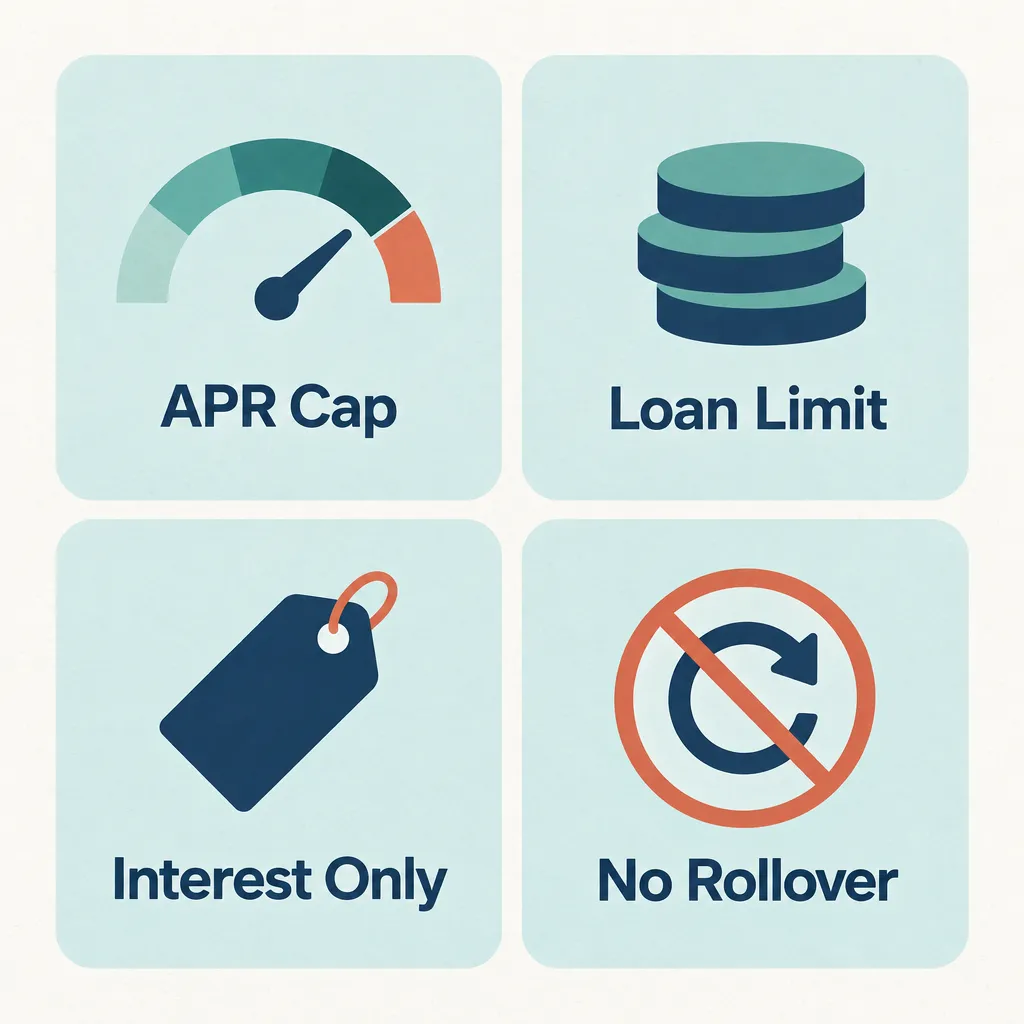
RSA 399-A:17 is the core of New Hampshire payday loan law. It sets the price, the size, the repeat-borrowing limits and your right to back out. Each rule below is in the current statute posted by the New Hampshire General Court.
36% APR cap and no extra fees
A payday loan’s annual percentage rate can’t exceed 36%. The statute also says payday loans may carry interest only, and that no other charges or fees may be applied to or collected on them.
What this means for you: look at the Truth in Lending disclosure box on your loan agreement. If the APR is above 36%, or you see a separate line for a “fee,” “service charge,” “processing fee” or “late fee,” the loan doesn’t comply with RSA 399-A:17. That also answers a common question: a New Hampshire payday lender can’t add late fees or bounced-check fees as a loan charge, because interest is the only charge the statute permits.
The $500 limit on what you can owe
A payday lender may not let any one person owe it more than $500 in principal at any time. The limit covers everything you owe that lender, so splitting $900 into two loans of $450 isn’t allowed.
What this means for you: if one lender offers you more than $500 on payday terms, or lets you take a second loan while the first is unpaid, it’s breaking the rule.
No rollovers, renewals or extensions
A payday loan may not be refinanced, renewed or extended. The “rollover” trap, where you pay only the fee and push the balance to the next payday, is banned in New Hampshire.
What this means for you: the loan has to be repaid on its terms. A lender can’t sell you an “extension” for a fee. If you truly can’t pay, the realistic options are to talk to the lender about a payment arrangement on the existing balance (with no added charges) or to get help from the sources listed in the cheaper-options section.
The 60-day cooling-off rule
A lender can’t make you a new payday loan while you have a payday or title loan outstanding, or if you repaid one within the previous 60 days. This rule closes the “pay it off Friday, borrow again Monday” loophole that keeps borrowers in a cycle in other states.
Here’s how the dates work. Say you repay a payday loan on March 3, 2026. From March 4 through March 31 is 28 days, all of April adds 30 and the first two days of May add 2, so the 60-day window ends around May 2. A lender that makes you a new payday loan in April is breaking RSA 399-A:17. Count 61 days to be safe.
Write down your payoff date
Note the date you repay any payday or title loan. In New Hampshire, a new payday loan within 60 days of that date isn’t allowed, and having the date written down makes a violation easy to prove.
One check only, and your right to cancel
Check the loan agreement for any cancellation right and how to use it, and ask the lender to explain it before you sign.
Did you know?
Under RSA 399-A:17, a payday lender can’t make you a new loan while a payday or title loan is outstanding, or within 60 days after you had one.
The posted rate schedule
Ask for the dollar cost in writing before you sign. The Truth in Lending disclosure must show the finance charge and the APR, and on a New Hampshire payday loan the APR can’t be above 36%.
What a legal NH payday loan actually costs
At 36% APR, a legal two-week payday loan in New Hampshire costs only a few dollars in interest. The math is simple interest: amount borrowed, times 0.36, times the number of days, divided by 365.
| Amount borrowed | Term | Max interest at 36% APR | Total repaid |
|---|---|---|---|
| $300 | 14 days | $4.14 | $304.14 |
| $300 | 30 days | $8.88 | $308.88 |
| $500 | 14 days | $6.90 | $506.90 |
| $500 | 30 days | $14.79 | $514.79 |
Take the first row: $300 × 0.36 = $108 a year in interest. Divide by 365 and you get about 29.6 cents a day. Over 14 days, that’s $4.14.
Now compare a typical out-of-state payday price of $15 per $100 for two weeks. On $300, that fee is $45, and the APR works out to about 391% ($45 ÷ $300 = 15% for 14 days; 15% × 365 ÷ 14 ≈ 391%). That’s roughly eleven times what New Hampshire allows. If your loan paperwork shows $45 in charges on a $300, two-week loan, you’re looking at a likely violation of RSA 399-A:17.
These numbers are illustrations of the legal ceiling. A lender can charge less, and the exact figure on your loan depends on how it computes days. The Truth in Lending disclosure on your agreement must show the APR and the total finance charge, so check those figures against the table.
Title loan laws in New Hampshire (RSA 399-A:18 and :19)
Title loans are legal in New Hampshire and cost far more than payday loans. A licensed title lender may charge up to 25% interest per month under RSA 399-A:18, I(f). That works out to about 300% a year on a simple-interest basis. The lender holds the title to your car as security, and if you default the car can be repossessed.
Where the 25% monthly cap came from
When New Hampshire capped payday loans at 36% a year, starting in 2009, title loans fell under the same cap. That didn’t last. SB 57, passed in 2011, replaced the 36%-per-year limit for title loans with a ceiling of 25% per month. When the chapter was repealed and reenacted by 2015 Chapter 73 (HB 644), effective January 1, 2016, the title-loan cap was carried into RSA 399-A:18.
On top of interest, RSA 399-A:18 lets title lenders pass through certain actual costs permitted by RSA 399-A:15, XI. Anything beyond those listed costs isn’t allowed.
Did you know?
New Hampshire title loans were briefly held to 36% a year, the same cap as payday loans, until SB 57 of 2011 raised the limit to 25% per month, according to the bill text in the 2011 legislative record.
How renewals work
RSA 399-A:19 sets the term and renewal rules. A title loan’s original term is one month or less. It can be renewed for no more than 9 additional periods. At each renewal you must pay at least 10% of the original principal. Unpaid interest can’t be added to the principal when the loan renews.
Here’s what that means on a $1,000 title loan at the full 25% monthly cap, with only the minimum principal paid at each renewal:
| Period | Principal at start | Interest at 25% | Minimum 10% principal payment | Principal after |
|---|---|---|---|---|
| Original month | $1,000 | $250 | $100 | $900 |
| Renewal 1 | $900 | $225 | $100 | $800 |
| Renewal 2 | $800 | $200 | $100 | $700 |
| Renewal 3 | $700 | $175 | $100 | $600 |
| Renewal 4 | $600 | $150 | $100 | $500 |
| Renewal 5 | $500 | $125 | $100 | $400 |
| Renewal 6 | $400 | $100 | $100 | $300 |
| Renewal 7 | $300 | $75 | $100 | $200 |
| Renewal 8 | $200 | $50 | $100 | $100 |
| Renewal 9 | $100 | $25 | $100 (final payoff) | $0 |
| Total | $1,375 | $1,000 |
After ten months, you’d repay $2,375 on a $1,000 loan, with $1,375 of that as interest. The 10% rule does help: without it, a borrower paying interest only would hand over $250 a month and owe the full $1,000 at the end. Still, the cheapest title loan is the one you pay off in the first month, which here costs $250.
Ask for the renewal schedule in writing
Before you renew a title loan, ask for a written schedule that shows the 10% principal payment and the new balance. Don’t accept any renewal that adds unpaid interest to the principal, because RSA 399-A:19 bans it.
What happens if you default
Under RSA 399-A:19, interest stops accruing 60 days after a default unless you cure it. That limits how far the balance can grow, but it doesn’t protect the car.
“Can a title company take my car in New Hampshire after one missed payment?” The loan contract defines what counts as default, and a missed payment usually does. New Hampshire’s version of the Uniform Commercial Code (RSA 382-A, Article 9) generally lets a secured lender repossess after default, as long as it doesn’t breach the peace. That means no threats, no force and no entering a locked garage. After a sale, the lender has to account for the proceeds. If the car sells for more than you owe plus allowed costs, the surplus belongs to you. If you’re behind, call the lender before the due date, and get any payment arrangement in writing.
Installment and personal loans in New Hampshire
Small installment loans in New Hampshire are capped at 36% APR, the same number as payday loans, but with some fee room. RSA 399-A:16 covers small loans other than payday and title loans. For the 36% calculation, the finance charge leaves out one application fee of up to $100 per borrower per year and one participation or membership fee of up to $100 per borrower per year.
How the 36% installment cap works in practice
The fee carve-out matters most on small, short loans. Take a $1,000 installment loan over 12 months at the full 36% APR. Using a standard amortizing payment, the monthly payment is about $100.46, and you’d pay about $205.50 in interest, for a total of about $1,205.50. If the lender also charges a $100 application fee, which RSA 399-A:16 excludes from the cap calculation, your real cost rises to about $305.50.
| Amount | Rate | Term | Interest | Excluded fee (if charged) | Total repaid |
|---|---|---|---|---|---|
| $1,000 | 36% APR | 12 months | about $205.50 | up to $100 application fee | about $1,305.50 |
| $2,000 | 36% APR | 24 months | about $834 | up to $100 application fee | about $2,934 |
Your disclosure may show 36% APR while the effective cost, counting the fee, runs higher. When comparing offers, add up every dollar you’ll pay and compare that total.
Licensing and who has to be licensed
Small loan, payday and title lenders must be licensed by the Banking Department (RSA 399-A:2). The Banking Department’s page for these licensees says the definition of “lender” is broad. It includes lead generators, brokers and servicers, so a company that only finds borrowers for another lender, or only collects payments, still needs a license to deal with New Hampshire consumers.
Licensing runs through the Nationwide Multistate Licensing System (NMLS), which the Conference of State Bank Supervisors runs for many states. That’s useful for you: a lender’s status shows up in a public database.
Loans above $10,000 and bank loans
RSA 399-A’s small-loan rules stop at $10,000. Larger personal loans, and loans from banks and credit unions, fall under other rules. Federally chartered banks and credit unions are mainly regulated at the federal level, and a bank chartered in another state may be able to charge the rate its home state allows. If a larger loan or a bank loan seems out of line, the Banking Department or the CFPB can tell you which regulator oversees that lender.
Payday, title and other small loans side by side
| Rule | Payday loan | Title loan | Other small loan (up to $10,000) | RSA section |
|---|---|---|---|---|
| Rate cap | 36% APR | 25% per month | 36% APR | 399-A:17, 399-A:18, 399-A:16 |
| Other fees | None, interest only | Certain actual costs under 399-A:15, XI | One application fee and one membership fee, each up to $100 a year, excluded from APR | 399-A:17, :18, :16 |
| Maximum size | $500 owed to one lender | Set by the loan and vehicle | $10,000 | 399-A:17, 399-A:1 |
| Term | Short term, tied to payday | One month or less | Set by contract | 399-A:19 |
| Renewals | Banned | Up to 9, with 10% principal each time | Not limited by these sections | 399-A:17, :19 |
| Cooling-off | 60 days after repaying | None stated | None stated | 399-A:17 |
| License needed | Yes | Yes | Yes | 399-A:2 |
Online, out-of-state and tribal lenders
New Hampshire law covers online loans made to New Hampshire residents, wherever the lender is located. The Banking Department says internet loans to New Hampshire consumers are small loans under RSA 399-A. A lender in Utah, Delaware or offshore needs a New Hampshire license to lend to you, and must follow the 36% payday cap.
So why do online lenders still approve you? Some are licensed and follow the rules. Others ignore the state entirely and count on borrowers not knowing their rights. The Banking Department has issued cease-and-desist orders against web-based lenders that never got a license.
Tribal lenders
Some online lenders say they’re owned by Native American tribes and claim tribal sovereign immunity shields them from state law. Those claims are contested. Courts and regulators in several states have rejected some of these arrangements, especially where a non-tribal company does most of the work and keeps most of the profit, while other cases have gone the lenders’ way. Don’t assume either outcome for your loan. If a tribal lender is pulling money from your account, file complaints with the Banking Department and the CFPB, and talk to New Hampshire Legal Assistance or a consumer attorney about your specific contract.
You don’t need to settle the sovereignty question to protect your bank account. Your right to stop automatic payments comes from federal law and applies to every lender.
How to check a license on NMLS Consumer Access
Checking takes about five minutes, and you should do it before you borrow, not after.
How to check a New Hampshire lender
- Find the lender’s exact legal name in the loan agreement or the website’s footer, not just its brand name.
- Search that name or its NMLS ID on NMLS Consumer Access.
- Open the company record and look for an active New Hampshire license for small loan, payday or title lending.
- Make sure the license status reads “approved” or “active,” and that the address matches the lender you’re dealing with.
- If you can’t find a New Hampshire license, contact the Banking Department before you sign or pay anything more.
If your lender isn’t licensed in NH
RSA 399-A:23 is one of the strongest borrower protections in New Hampshire law. Anyone who makes a small, payday or title loan without the required license is denied the right to receive any charges, interest or other compensation.
In practical terms, if an unlicensed online lender charged you 600% APR, state law says it has no right to that interest. Whether you owe back the principal, and how to get back money already paid, can depend on the facts. Get advice before you make any agreement with the lender. Here’s a sensible order of steps:
- Save everything: the agreement, emails, texts, bank statements showing each debit and any screenshots of the lender’s website.
- Send the lender a written notice that you’re revoking your authorization for electronic debits. Keep a copy.
- Tell your bank or credit union to stop the recurring payments. Under the Electronic Fund Transfer Act and its Regulation E (12 CFR 1005.10), you can stop a preauthorized transfer by notifying your bank at least three business days before it’s scheduled. The bank may ask you to confirm in writing within 14 days.
- Ask the bank whether it can treat later debits as unauthorized once you’ve revoked permission.
- File a written complaint with the Banking Department, mention RSA 399-A:23, and file one with the CFPB too.
Revoking a debit doesn’t cancel a debt you may legally owe. It does stop a lender from taking money on its own schedule while the dispute is being sorted out.
Debt collection and wage garnishment limits in New Hampshire
Collectors in New Hampshire have to follow two sets of rules: the federal Fair Debt Collection Practices Act and New Hampshire’s own law on unfair, deceptive or unreasonable collection practices, RSA 358-C. A key difference is that the federal law mostly covers third-party debt collectors, while RSA 358-C also reaches creditors collecting their own debts, which includes payday and title lenders.
What collectors cannot do
Both laws ban harassment, threats and lies. A collector can’t threaten arrest or jail over an unpaid payday loan. Failing to repay a loan is a civil matter, not a crime. Collectors also can’t call at unreasonable hours, use abusive language, pretend to be attorneys or government officials, or tell your employer or family about your debt beyond the narrow contacts the law allows. Under the FDCPA, you can send a written request for the collector to stop contacting you. The collector can still sue, though.
What happens if you stop paying
“What happens if I just stop paying a payday loan, will they take me to court?” A lender or debt buyer can sue you for what you legally owe. On a licensed New Hampshire payday loan, that’s the principal plus interest at no more than 36% APR. Before it can take your wages or bank money, a creditor generally needs a court judgment. Ignoring a court summons is the worst choice, because it usually leads to a default judgment. If you’re sued, respond by the deadline and raise any RSA 399-A violation as a defense. The general limit for most contract lawsuits in New Hampshire is three years under RSA 508:4.
Wage garnishment limits
New Hampshire uses a process called trustee process to reach wages, and it protects workers more than most states do. Under RSA 512:21, wages you earn after the writ is served on your employer are exempt, so a single writ reaches only wages already earned and not yet paid when it’s served. For those earlier wages, RSA 512:21, II exempts 50 times the federal minimum hourly wage per week. At the current $7.25 federal minimum, that’s $362.50 a week.
The federal Consumer Credit Protection Act sets a nationwide floor too. A creditor can take no more than 25% of your disposable earnings, or the amount above 30 times the federal minimum wage, whichever is less. When state and federal limits differ, the one that protects you more applies. Certain income, such as Social Security benefits deposited directly, is generally protected from ordinary creditors under federal law.
Federal rules that apply everywhere
Federal law stacks on top of New Hampshire’s caps. It can’t lower state protections, but it adds some of its own.
- Truth in Lending Act and Regulation Z (12 CFR 1026). Lenders must disclose the APR, finance charge, amount financed and total of payments before you sign. RSA 399-A’s rate caps are separate state-law requirements.
- Military Lending Act. Active-duty service members and their dependents can’t be charged more than a 36% Military Annual Percentage Rate, a broader measure that includes most fees. The law also bans mandatory arbitration clauses in covered loans. The Servicemembers Civil Relief Act separately caps interest at 6% on debts taken on before active duty.
- Fair Debt Collection Practices Act. It covers third-party collectors, as described above.
- Electronic Fund Transfer Act. It gives you the right to stop preauthorized debits from your account.
- CFPB Payday Lending Rule (12 CFR part 1041). The payment provisions of the Consumer Financial Protection Bureau’s 2017 rule took effect March 30, 2025. Lenders making covered loans must notify you before the first withdrawal attempt and before unusual ones. After two failed withdrawal attempts in a row, they can’t try again without your new, specific authorization. That protects you from repeated bounced debits and the bank fees they trigger. The CFPB said in 2025 that it would deprioritize enforcement, but the payment provisions remain in force.
Timeline: how NH payday and title loan law changed
New Hampshire’s current rules came from three state bills, and one federal rule adds payment protections. If you find an older article that seems to contradict this page, check its date against this table.
| Year | Law or action | What changed | Source |
|---|---|---|---|
| 2008 | HB 267 | 36% annual cap on payday and title loans, effective January 1, 2009 | New Hampshire General Court, 2008 session |
| 2011 | SB 57 | Title-loan cap changed from 36% a year to 25% a month | 2011 bill text |
| 2015 | HB 644 (2015 Chapter 73) | RSA 399-A repealed and reenacted effective January 1, 2016; sections renumbered | 2015 chaptered bill |
| 2025 | CFPB Payday Lending Rule | Payment provisions of 12 CFR part 1041 in effect from March 30, 2025 | CFPB |
The 2016 renumbering explains a lot of confusion. A 2008 article citing “RSA 399-A:13” for payday rules is pointing to a section that now covers something else. The payday rules are now in RSA 399-A:17, title loans in :18 and :19, and unlicensed lending in :23.
Help that costs less
Before taking a title loan at up to 25% a month, look at options that cost a fraction of that. None of these is right for everyone, and each has its own limits.
Cheaper options first
Ask a credit union about a payday alternative loan, capped at 28% APR.
Call the creditor you’re behind on and ask for a hardship plan before you borrow to pay it.
A nonprofit credit counselor can review your budget at little or no cost.
Credit union payday alternative loans
Federal credit unions can offer payday alternative loans (PALs) under National Credit Union Administration rules (12 CFR 701.21). PAL I loans run $200 to $1,000 over one to six months. PAL II loans go up to $2,000 over one to twelve months. The APR is capped at 28%, and the application fee at $20. A $500 PAL over three months at 28% costs about $23 in interest. The catch: not every credit union offers PALs, and PAL I requires you to have been a member for at least a month. Many New Hampshire credit unions also make small personal loans on their own terms.
Hardship plans and payment arrangements
“Does the lender have a hardship option if I can’t pay this month?” Many do, even though New Hampshire law doesn’t require payday or title lenders to offer one. For a payday loan, any arrangement must stay within RSA 399-A:17: no new fees, and no “extension” sold as a separate product. Utilities, landlords, medical providers and card issuers often have formal hardship programs. Getting one of those bills reduced can do more than a new loan.
Cash advance apps and earned wage access
Cash advance and earned wage access apps advance part of your paycheck before payday. Many advertise no interest, but costs can come from monthly subscriptions, instant-transfer fees or “tips” the app nudges you to leave. A $5 fee on a $100 advance repaid in a week works out to an APR above 250%, even though the app may not call it interest. Read the app’s own fee schedule and compare the dollar cost with the options above.
Nonprofit credit counseling and local assistance
Nonprofit credit counseling agencies, many of them members of the National Foundation for Credit Counseling, offer budget reviews and debt management plans. New Hampshire’s 2-1-1 line (211 NH) connects residents with local rent, food and utility help. The state’s Fuel Assistance Program, run through community action agencies, helps with heating costs. New Hampshire Legal Assistance and 603 Legal Aid offer free civil legal help to people who qualify, including help with lawsuits from lenders.
How to check a lender’s license and file a complaint
The New Hampshire Banking Department, led by the Bank Commissioner, licenses and examines payday, title and small loan lenders and takes consumer complaints about them. Formal complaints must be in writing.
Filing with the Banking Department
- Gather your loan agreement, the Truth in Lending disclosure, your payment history and bank statements showing each debit.
- Get the department’s written consumer complaint form from its consumer complaints page.
- Describe what happened in date order. Name the rule you think was broken, for example “APR above 36% in violation of RSA 399-A:17” or “unlicensed lender, RSA 399-A:23.”
- Attach copies, not originals.
- Send it the way the complaints page directs, or mail it to the New Hampshire Banking Department, 53 Regional Drive, Suite 200, Concord, NH 03301.
- Keep a copy of everything you send, along with the date you sent it.
The department can investigate and can order a lender to stop violating the law. That’s the tool it has used against unlicensed web lenders. It also can’t act as your lawyer or sue on your behalf.
Banking Department, Attorney General or CFPB?
“Who do I complain to in NH, the Banking Department or the Attorney General?” For a lender’s license, rates, fees, rollovers or renewals, start with the Banking Department. Those are its rules. The New Hampshire Attorney General’s Consumer Protection and Antitrust Bureau handles broader fraud and deceptive practices and runs a consumer hotline at 1-888-468-4454. It’s the better choice for scams, fake lenders asking for upfront fees and abusive collection that doesn’t fit the Banking Department’s role. The CFPB accepts complaints about payday lenders, title lenders, debt collectors and banks nationwide and forwards them to the company for a response. Filing with both a state agency and the CFPB is allowed and often useful. If someone stole money from you or impersonated a lender, report it to the FTC at ReportFraud and to the FBI’s IC3.
Rules differ a lot from state to state. If you borrowed while living elsewhere, the Michigan payday loan laws or Indiana payday loan laws that applied there follow their own caps, so check the state where you lived when you signed.
Before you borrow
A New Hampshire title loan at the 25% monthly cap costs $250 a month for every $1,000, and missing payments can cost you your car. Check the lender’s license on NMLS Consumer Access first, and compare the total dollar cost against a credit union loan or a hardship plan.
FAQ
What is the maximum interest rate on a payday loan in New Hampshire?
36% APR, under RSA 399-A:17. Interest is the only charge allowed, so the lender can’t add origination, service or late fees. On a $300 loan for 14 days, the most a licensed lender can charge is about $4.14.
How much can you borrow with a payday loan in New Hampshire?
No more than $500 in principal owed to a single payday lender at any time, under RSA 399-A:17. The limit covers all your loans with that lender combined, so splitting a larger amount into several loans isn’t allowed.
Can you roll over a payday loan, and how long do you wait between loans?
No. RSA 399-A:17 bans refinancing, renewing or extending a payday loan. A lender also can’t make you a new payday loan while you have a payday or title loan outstanding, or within 60 days after you repay one.
Are title loans legal in New Hampshire, and what can they charge?
Yes. Under RSA 399-A:18, I(f), a licensed title lender can charge up to 25% interest per month, plus certain actual costs allowed by RSA 399-A:15, XI. RSA 399-A:19 limits the original term to one month, allows no more than 9 renewals, and requires you to pay at least 10% of the original principal at each one.
Do online payday lenders have to follow New Hampshire law?
Yes. The Banking Department treats internet loans to New Hampshire residents as small loans under RSA 399-A, and lenders, brokers, lead generators and servicers all need a state license. An online loan at 600% APR made to a New Hampshire resident doesn’t meet the state’s payday rules.
Do I have to repay a loan from an unlicensed lender in New Hampshire?
RSA 399-A:23 denies an unlicensed lender any right to charges, interest or other compensation. Before you stop paying or agree to a settlement, file a complaint with the Banking Department and get free legal advice, because the details of your loan affect what happens to the principal. Keep a written record of every debit, every message and every date: in New Hampshire, the statute makes a strong case for you, and your records prove it.
Laws and regulations referenced
- New Hampshire RSA Chapter 399-A (Regulation of Small Loans, Title Loans, and Payday Loans)
- Truth in Lending Act, 15 U.S.C. 1601
- Regulation Z, 12 CFR Part 1026
- Fair Debt Collection Practices Act, 15 U.S.C. 1692
- Electronic Fund Transfer Act, 15 U.S.C. 1693
- Regulation E (electronic transfers), 12 CFR Part 1005
- Military Lending Act, 10 U.S.C. 987
- Servicemembers Civil Relief Act, 50 U.S.C. 3901
- CFPB payday lending rule, 12 CFR Part 1041
Links go to the official text on government sites.
Check, verify or complain
Sources
- RSA 399-A:17 Payday Loan Lenders (New Hampshire General Court) gc.nh.gov · official source
- RSA 399-A:16 Small Loans Other Than Payday Loans or Title Loans gc.nh.gov · official source
- RSA 399-A:18 Title Loan Lenders gc.nh.gov · official source
- RSA 399-A:19 Title Loan Renewals gc.nh.gov · official source
- RSA 399-A:23 Unlicensed Lenders gc.nh.gov · official source
- RSA 399-A:15 gc.nh.gov · official source
- RSA 399-A table of contents gencourt.state.nh.us · official source
- RSA 512:21 Exemptions from trustee process gc.nh.gov · official source
- NH Banking Department: Small Loan, Payday Loan, Title Loan Lenders banking.nh.gov · official source
- NH Banking Department: Consumer Complaints banking.nh.gov · official source
- NH DOJ Consumer Protection Hotline doj.nh.gov · official source
- RSA Chapter 399-A full text gc.nh.gov · official source
- NH Banking Department Complaint Form 2023 banking.nh.gov · official source
- H.R.9330 Earned Wage Access Consumer Protection Act congress.gov · official source
- NH SB57 2011 bill text legiscan.com
- NH HB644 2015 chaptered bill text legiscan.com
- New legislation re: payday loans (2008) nhfamilylawblog.com
- NHBR reporting on Banking Department orders against web lenders nhbr.com
- CFPB's 2026 Regulatory Agenda and the Payday Lending Rule natlawreview.com
- CFPB Releases 2026 Regulatory Agenda consumerfinancialserviceslawmonitor.com
- CFPB Plans Limited Enforcement of Payday Lending Rule legal500.com
- NCLC: How Well Do the States Protect Consumers (2024) nclc.org
- NCLC: Rule on Bounced Payday and High-Cost Loan Payments Now in Effect library.nclc.org
- CFPB Payday Rule Relief Is Not a Repeal fintechlaw.ai
- NCSL: Earned Wage Access 2025 Legislation ncsl.org
- MoneyLion: Online Payday Loans in NH moneylion.com

Elena writes about getting through a money emergency, assistance programs, budgeting on a tight income, banking basics and borrower rights. Her guides list the cheaper options first and link the agency or program that can actually help.
Ruth is US Financer's standards editor. Every article goes through her checks before and after it is published: each rate, fee, cap, deadline and rule is matched against its primary source, every law named is linked to its official text, and anything that cannot be…
What changed
- Nov 27, 2026 First published.
Comments are closed