

Payday lending is legal in Michigan, with limits. The Deferred Presentment Service Transactions Act caps each loan at $600 and sets the fee by tiers starting at 15% of the first $100. That works out to a 391% APR on a $100 loan repaid in two weeks. You can hold no more than two payday loans at once, they must be with different lenders, and no loan can run longer than 31 days.
UPDATEDRelated consumer alert, Oct 20
Treasury expects stablecoin issuers to need a license from Jan. 18, 2027Run the numbers
Key takeaways
- A $600 Michigan payday loan can cost up to $76 in fees plus a $2.40 database fee, about 341% APR over 14 days.
- Lenders cannot roll over a loan for a fee, cannot charge for an extension and cannot use criminal process to collect.
- If you have had 8 or more payday loans in 12 months, you can ask for a 3-payment plan for $18.69.
- In Michigan, an unpaid loan is a civil debt: the lender has 6 years to sue, and a collection can stay on your credit report for 7 years.
- No 36% cap has passed. SB 632 cleared the Senate in 2024 but expired, and the 2025–2026 bills are still in committee.
Fact-checked
We checked these key facts against the sources named, on November 09, 2026:
- HB 4581 would lower the Credit Reform Act ceiling from 25% to 10% (source: capitol.legislature.mi.gov)
- If it denies the complaint or doesn’t answer, file with DIFS online or at 877-999-6442 (source: michigan.gov)
- A “regulated lender” under the Credit Reform Act can charge up to 25% a year (MCL 445.1854) (source: ombudsman.legislature.mi.gov)
- Search the name in the DIFS licensee lookup on michigan.gov/difs, or call DIFS at 877-999-6442 (source: michigan.gov)
- The fee is $76, plus $2.40 for the database, so $78.40 in total. $78.40 divided by $600 is 13.07% for two weeks (source: michigan.gov)
What Michigan law calls a payday loan
In Michigan, a payday loan is a “deferred presentment service transaction.” You write a check or authorize a debit, and the lender agrees to hold it until a set date before cashing it. The Deferred Presentment Service Transactions Act, Act 244 of 2005 (MCL 487.2121 and following), covers every licensed lender offering this product. That includes storefronts in Detroit, Lansing, Warren, Kalamazoo and Taylor, and licensed online lenders.
Lenders call the product a cash advance, a check advance or a deferred deposit. The name does not matter. If you get cash now in exchange for a check or debit held until payday, the Act applies. Cities and counties have no separate payday rate rules, so a loan in Detroit follows the same caps as one in Marquette.
Some products look similar but fall outside the Act:
| Product | Covered by Act 244? | Main rules that apply instead |
|---|---|---|
| Storefront or licensed online payday loan | Yes | $600 cap, fee tiers, 31-day term |
| Cash advance apps (earned wage access) | No | The app’s own terms, federal consumer law |
| Installment or personal loans | No | Credit Reform Act, Regulatory Loan Act |
| Tribal or unlicensed online loans | Disputed | Lender claims tribal law; Michigan protections are hard to enforce |
| Car title loans with the lender holding your title | No | Not permitted in Michigan |
Who regulates payday lenders in Michigan
The Michigan Department of Insurance and Financial Services (DIFS) licenses deferred presentment providers, runs the statewide loan database and takes consumer complaints. The Michigan Attorney General’s Consumer Protection Division publishes the fee table for consumers and can sue lenders that break state law. DIFS takes complaints at 877-999-6442.
How to check that a lender is licensed
Every company making payday loans to Michigan residents must hold a DIFS deferred presentment license. That rule covers online lenders too. Check the license before you share bank details.
How to check a Michigan lender
- Write down the company’s exact legal name and any license or NMLS number from its website or contract.
- Search the name in the DIFS licensee lookup on michigan.gov/difs, or call DIFS at 877-999-6442.
- Confirm the license type is deferred presentment (payday) or the right consumer lending license for the product.
- If the company has an NMLS number, look it up on NMLS Consumer Access as well.
- If you can’t find a license, do not borrow. Report the company to DIFS and the Attorney General.
How much a payday loan can cost in Michigan
A Michigan payday lender can charge 15% of the first $100 you borrow, then a lower percentage on each $100 after that. Lenders can also pass on the state database fee of $2.40 per loan. On a 14-day loan, the total cost ranges from about 341% to 454% APR, depending on the amount.
The fee tiers explained
The Act sets the service fee tier by tier. Each slice of the loan has its own maximum rate:
- First $100: 15%
- Second $100: 14%
- Third $100: 13%
- Fourth $100: 12%
- Fifth and sixth $100: 11% each
For a $300 loan, that means $15 + $14 + $13 = $42. The Attorney General’s fee table, updated December 11, 2025, lists these maximums: $50 = $7.50, $100 = $15, $200 = $29, $250 = $35.50, $300 = $42, $400 = $54, $475 = $62.25, $500 = $65 and $600 = $76.
| Loan amount | Max service fee | Database fee | Total cost | Total repaid | APR (14 days, fee only) | APR incl. database fee |
|---|---|---|---|---|---|---|
| $100 | $15.00 | $2.40 | $17.40 | $117.40 | 391% | 454% |
| $200 | $29.00 | $2.40 | $31.40 | $231.40 | 378% | 409% |
| $300 | $42.00 | $2.40 | $44.40 | $344.40 | 365% | 386% |
| $400 | $54.00 | $2.40 | $56.40 | $456.40 | 352% | 368% |
| $500 | $65.00 | $2.40 | $67.40 | $567.40 | 339% | 351% |
| $600 | $76.00 | $2.40 | $78.40 | $678.40 | 330% | 341% |
Service fees from the Michigan Attorney General’s table. The APR columns are calculated from those official figures for a 14-day term. A shorter term gives a higher APR.
The $2.40 database fee and what you can’t be charged
DIFS lets the database provider charge $2.40 for each approved and registered loan, starting September 1, 2025. Licensees may pass that fee on to you. It cannot be charged on a loan you cancel or the lender rescinds. DIFS also collects a separate $1.00 per-transaction fee from licensees every month. That fee is the lender’s cost, not a line on your contract.
Did you know?
According to DIFS, Michigan’s payday database fee rose from $1.35 to $2.40 per loan on September 1, 2025, and lenders may pass it on to borrowers.
Why $15 on $100 equals 391% APR
APR spreads a loan’s cost over a full year, so you can compare it with other credit. The Attorney General’s math: a $15 fee on $100 for 14 days costs about $1.071 per day. Multiply that by 365 days and you get $391 per $100 a year, or 391% APR.
Worked example for the largest legal loan: you borrow $600 for 14 days. The fee is $76, plus $2.40 for the database, so $78.40 in total. $78.40 divided by $600 is 13.07% for two weeks. Divide by 14 and multiply by 365, and you get roughly 341% APR. You repay $678.40 on your next payday.
Check the fee before you sign
A $300 loan can’t carry more than $42 in service fees, plus up to $2.40 for the database check. If your contract shows more, don’t sign. Ask the lender to explain the charge, and report it to DIFS.
Borrowing limits and the state database
Michigan allows two open payday loans at a time, and never two with the same lender. Before every loan, the lender must check the statewide deferred presentment database. If you already have two loans, or one with that lender, it must turn you down.
The database exists to enforce the two-loan rule across all licensed lenders in the state. If the database is unavailable, the lender may make the loan based on your signed statement that you don’t have loans that would break the limit. Signing a false statement does not protect you. It also gives up the safeguard the system was built to provide.
The database also tracks how often you borrow, and that count unlocks a repayment option. Once you have taken 8 or more payday loans in 12 months, you can request an installment plan (covered below). That threshold matters because repeat borrowing is the norm. A 2018 Center for Responsible Lending study, cited in Bridge Michigan’s coverage, found that 70% of Michigan payday loans were taken out the same day a previous loan was repaid, and 86% within two weeks.
Your contract rights
Act 244 requires a written contract, clear disclosures and a few rights many borrowers never hear about. The contract must show the amount, the fee, the APR and the due date, and must explain how to complain. You can take the loan proceeds in cash instead of a check. The lender must also post a sign warning that a third party may charge a fee to cash a check.
Other rules in the contract:
- Term: the repayment date can be no later than 31 days after the loan date.
- No paid rollovers: a lender cannot charge you a fee to renew or roll over a loan.
- One loan per lender: a lender cannot give you a second loan while you owe it on the first.
Did you know?
According to the Michigan Attorney General, payday borrowers have the right to receive their loan in cash rather than a check, so you don’t need to pay a check-cashing fee to get your money.
Cancelling a loan and getting the fee back
You can cancel a Michigan payday loan before the close of business on the next business day by returning the full amount you received. The lender then returns your check or cancels the debit authorization, and you pay no service fee. The database fee also cannot be charged on a rescinded transaction, according to DIFS. If you borrowed in a panic and found a cheaper option the next morning, use this right.
If you can’t repay on time
You have no automatic right to more time. If the lender does give you more time, it cannot charge for it. Borrowers with 8 or more loans in a year can also ask for a low-cost installment plan. If you do nothing and the check bounces, you will owe up to three charges.
Asking for an extension
An extension is up to the lender. If it agrees, it cannot charge a fee or raise the balance, and the new date cannot be more than 31 days from the original loan date, according to the Attorney General.
Get any extension in writing
Ask for the extension by email or letter, and keep the lender’s reply showing the new date and no added fee. Michigan law bars charging for an extension, so a written record makes any later dispute easy to prove.
The $18.69 installment repayment plan
If you have had 8 or more payday loans in the past 12 months and can’t repay, you can request a repayment plan. The fee is $18.69. The balance is split into 3 equal installments, due on your next 3 regular paydays. You cannot take a new payday loan while the plan is active.
Worked example: you owe $378.40 on a $300 loan that has started to spiral. With the $18.69 plan fee, the total is $397.09, so each of the three payments is about $132.36. The lender only has to set up the plan if you ask for it, so put the request in writing.
Bounced check: what you’ll owe
If your check or debit is returned for insufficient funds, you can owe three separate amounts:
| Situation | What the law allows | Cost | Source |
|---|---|---|---|
| Loan due, not paid | Lender collects the face amount of the check | Loan plus service fee | Act 244 |
| Check or debit returned | One returned-check fee per transaction | Up to $31.14 | DIFS Bulletin 2021-06-CF; AG page |
| Your bank’s charge | Your bank charges its own NSF or overdraft fee | Set by your bank | Your account agreement |
| Lender asks for more time | Extension at lender’s choice | $0 | Act 244; AG page |
| 8+ loans in 12 months | Installment plan on request | $18.69 | AG page |
| Unpaid debt | Civil collection only, no criminal process | Possible court costs if sued | Act 244; AG page |
DIFS set the $31.14 returned-check cap as a CPI-adjusted figure, and the Attorney General’s page still lists it as the current maximum.
What happens if you never pay back a payday loan in Michigan
An unpaid Michigan payday loan is a civil debt, not a crime. The lender or a debt collector can call, write, report the debt and sue you. A court judgment can lead to wage or bank garnishment. Jail is not one of the options, and the Act bars lenders from using criminal process to collect.
The usual sequence:
- The lender tries to collect, often by re-presenting the check or retrying the debit.
- It charges the returned-check fee, and your bank may add its own fee.
- The account goes to an in-house collector or is sold to a debt buyer.
- The debt may be reported to credit bureaus as a collection.
- The lender or the debt buyer can sue. If it wins and you don’t pay, it can ask the court to garnish your wages or bank account.
Can a payday lender come after you after 7 years?
Two clocks run, and readers often mix them up. Michigan’s statute of limitations for contract claims is 6 years (MCL 600.5807). After that, a collector who sues you on the debt can be defeated if you raise the time limit as a defense. The time limit only works if you raise it: if you ignore a lawsuit, the court can still enter a default judgment.
The second clock is your credit report. Under the Fair Credit Reporting Act, a collection account can generally stay on your report for 7 years from the original delinquency. A collector can still contact you about an old debt after that, but it cannot sue on time-barred debt or threaten to. A judgment is different: in Michigan it lasts 10 years and can be renewed (MCL 600.5809).
Can you go to jail?
No, not for failing to repay. The Act bars lenders from using criminal process to collect a payday loan, and the Attorney General says so on its consumer page. If a lender or collector threatens arrest, that threat is itself a problem. For third-party collectors, it is a false or misleading claim under the Fair Debt Collection Practices Act. A court can only get involved if you ignore a court order in a civil case, such as a summons to a debtor examination.
On garnishment, Michigan follows the federal limit under Michigan Court Rule 3.101. An ordinary creditor can take the lesser of 25% of your disposable earnings or the amount above 30 times the federal minimum wage ($217.50 a week at $7.25). Federal benefits such as Social Security that are deposited directly into your account get extra protection: under 31 CFR Part 212, your bank must protect two months of those deposits.
Document any threats
If a lender or collector threatens arrest or criminal charges over a Michigan payday loan, write down the date, the caller’s name and what was said. Report it to DIFS and the Attorney General’s Consumer Protection Division.
Stopping repeated bank debits (CFPB rule status)
The payment section of the CFPB’s 2017 Payday Rule bars a third debit attempt after two failed attempts in a row unless you give new authorization. It took effect March 30, 2025. Two days earlier, on March 28, 2025, the CFPB said it would not prioritize enforcement or supervision of those provisions. The rule is on the books, but federal enforcement is weak. Your own tools are what protect you.
Under the Electronic Fund Transfer Act and Regulation E, you can stop a preauthorized recurring debit by telling your bank at least 3 business days before the scheduled date. Also send the lender a written revocation of the ACH authorization. Revoking the debit does not cancel the debt, and the lender can still charge the returned-check fee or sue. It does stop repeated debit attempts from piling up bank fees. Closing your account is a bigger step: it can leave unpaid fees with the bank and affect your ability to open an account elsewhere. For most people, a stop-payment order and a written revocation come first.
How to file a complaint against a payday lender
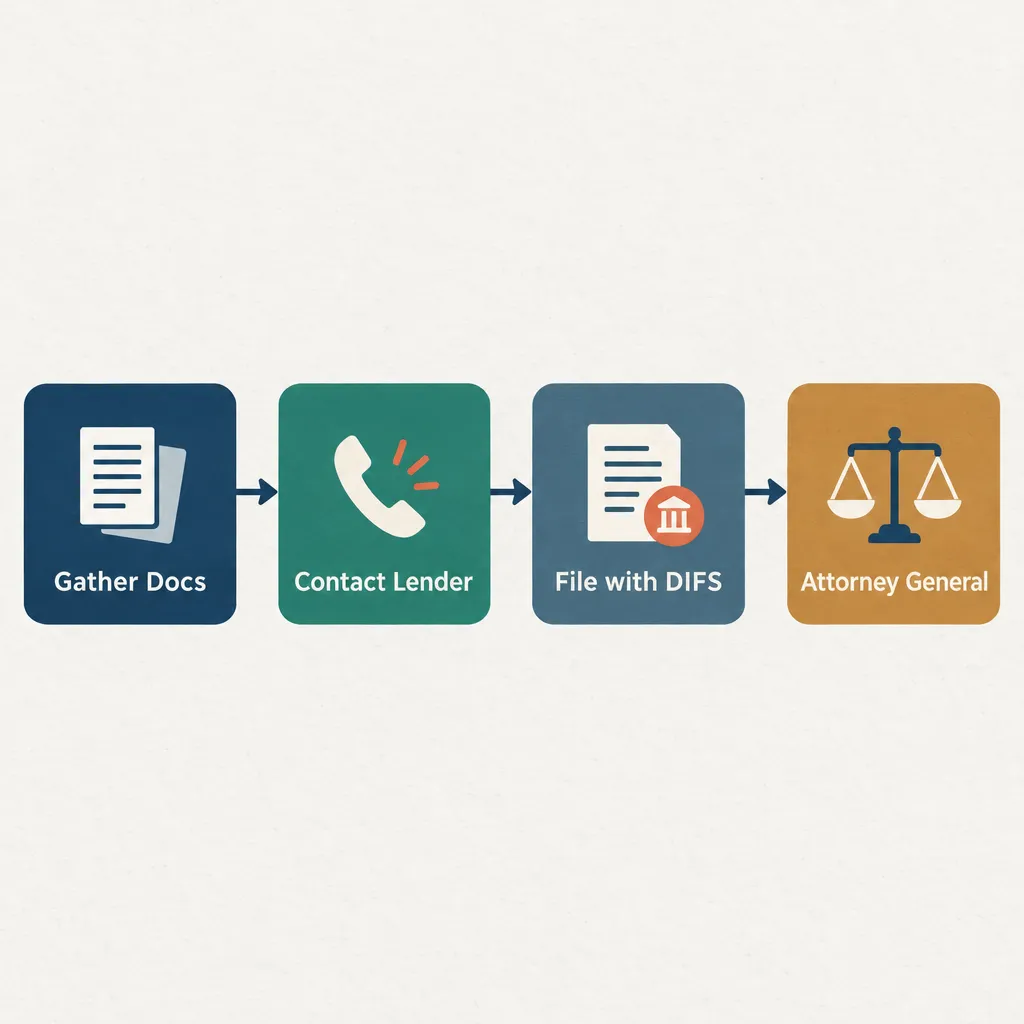
Michigan gives payday borrowers a two-step complaint process. First complain in writing to the lender, which has 3 business days to respond. If it finds it broke the law, it must refund the fee and return your check. If you’re not satisfied, take it to DIFS.
- Write to the lender with your name, loan date, amount and what went wrong. Keep a copy.
- Wait 3 business days for a written response.
- If the lender admits a violation, it must give back your check and refund the fees.
- If it denies the complaint or doesn’t answer, file with DIFS online or at 877-999-6442. Include the contract and your letter.
- For threats, unlicensed lending or deceptive ads, also report to the Attorney General’s Consumer Protection Division at 877-765-8388.
- You can also file with the CFPB’s complaint portal, which forwards complaints to the company and tracks responses.
The Act also lets a borrower who is harmed by a violation sue for actual damages and reasonable attorney fees.
Car title loans in Michigan
Car title loans where the lender holds your vehicle title are not permitted in Michigan, according to the Attorney General. Michigan has no title lending law, so these loans would fall under the general rate limits. Lenders not authorized by law to charge more cannot exceed 7% a year (MCL 438.31). Charging more than 25% a year without legal authority is criminal usury (MCL 438.41).
The Attorney General has enforced this. In a case against Liquidation LLC and eight related companies, a circuit court judge barred them from collecting on title loans with triple-digit rates. The AG alleged rates of up to 251% on more than 400 loans. If an online company offers a Michigan title loan, treat it as unlicensed. Ads for title loans in Michigan are not a sign the product is legal.
Installment and personal loans in Michigan
Installment loans are legal in Michigan and much more tightly capped than payday loans. A “regulated lender” under the Credit Reform Act can charge up to 25% a year (MCL 445.1854). That group includes companies licensed under the Regulatory Loan Act. Under MCL 493.13, those licensees are limited to the rate the Credit Reform Act allows.
| Loan type | Governing law | Rate limit | Typical size |
|---|---|---|---|
| Payday (deferred presentment) | Act 244 of 2005 | Tiered fees, about 330%–391% APR on 14 days | Up to $600 |
| Licensed installment / personal loan | Credit Reform Act; Regulatory Loan Act | 25% a year | Set by lender |
| Unlicensed lender | MCL 438.31 / 438.41 | 7% a year; above 25% is criminal | Not applicable |
| Credit union PAL (federal) | NCUA rules | 28% APR | $200–$2,000 |
| Credit cards from banks | Federal and Credit Reform Act carve-out | No state cap for depository institutions | Credit line |
Two caveats matter if you search for personal loans or installment loans for bad credit in Michigan. First, national banks and out-of-state banks can charge their home-state rates under federal law. Some online lenders partner with those banks, so you can see APRs well above 25% on loans offered to Michigan residents. Second, “no credit check” marketing usually means a soft pull or alternative data, priced with a higher rate. Compare the APR and total repaid on the Truth in Lending disclosure, not the monthly payment.
Pending bills could change these caps. HB 5161, introduced October 29, 2025, would amend MCL 493.13 and includes a 36% annual figure. HB 4581 would lower the Credit Reform Act ceiling from 25% to 10%. Neither had passed as of November 2026.
Online and tribal lenders
State law applies to online payday lenders that lend to Michigan residents. They need a DIFS license, and the $600 cap, fee tiers and 31-day term apply. “Same day” online payday loans from licensed lenders follow exactly the same rules. A lender that skips Michigan licensing is not offering you a better product. It is taking you outside the protections described above.
Tribal online lenders say they are governed by tribal law, not Michigan’s. Those loans often carry installment terms, larger amounts and rates well above anything the Act allows. If a dispute comes up, you may be pushed into tribal arbitration instead of a Michigan court. That makes complaints, refunds and the fee caps harder to enforce. The practical rule: if the lender isn’t in the DIFS licensee lookup, don’t give it access to your bank account. If you already have such a loan and the terms were unclear, file complaints with DIFS, the Attorney General and the CFPB.
Look up the license first
Before you borrow online, search the lender’s name with DIFS. Unlicensed and tribal online lenders may not follow the $600 cap or the fee tiers, and getting money back from them is much harder.
Debt collection and wage garnishment limits in Michigan
Michigan borrowers are covered by the federal Fair Debt Collection Practices Act when a third-party collector or debt buyer contacts them. Michigan’s own collection laws reach further: the Occupational Code covers licensed collection agencies, and the Regulation of Collection Practices Act (MCL 445.251 and following) covers many creditors that collect their own debts.
Collectors cannot threaten arrest, misstate what you owe or harass you with repeated calls. You can ask a third-party collector in writing to stop contacting you. The debt still exists, but the collector’s remaining options are to confirm it is stopping or to take formal legal action. Wages can only be garnished after a court judgment, within the limits in Michigan Court Rule 3.101 described above.
If your question is “I keep taking a new loan to pay off the old one, how do I get out?”, these are the levers, in order:
- Request the $18.69 installment plan if you qualify.
- Use the 3-payment structure to stop borrowing again.
- Replace the next payday loan with a credit union small-dollar loan.
- Call a nonprofit credit counselor about the rest of your budget.
Federal rules that apply everywhere
Three federal laws apply on top of Michigan’s. The Truth in Lending Act and Regulation Z require every lender to disclose the APR and finance charge before you sign. The Military Lending Act caps loans to active-duty service members and their dependents at a 36% military APR, including most fees, so a standard Michigan payday loan to a covered borrower is not allowed. The Fair Debt Collection Practices Act limits how third-party collectors can pursue you.
Will Michigan cap payday loans at 36%?
Not yet. As of November 2026, Michigan’s tiered fee system is still the law. The last 36% cap bill passed the Senate in 2024 and expired without a House vote. Bills in the current session are still in committee.
| Date | Event | Outcome |
|---|---|---|
| 2022 | Ballot drive for a 36% cap | Did not gather enough signatures |
| March 14, 2024 | Senate passes SB 632 (Sen. Sarah Anthony), 24-13 | Sent to the House |
| March 22, 2024 | Detroit City Council adopts a resolution on SB 632 | Local support on record |
| April 2024 | House Insurance and Financial Services Committee hears SB 632 and HB 5290 (co-sponsored by Rep. Abraham Aiyash) | No House passage found |
| 2023–2024 | HB 4343 (Rep. Jennifer Conlin), annual DIFS payday reports through 2030 | Passed the Senate unanimously |
| End of 2024 | Session ends | SB 632 and HB 5290 expire |
| March 10, 2026 | SB 830 introduced to let licensed payday providers make certain small loans | Referred to Senate Finance, Insurance, and Consumer Protection |
| Item | Current Michigan law | Under SB 632 (2024) |
|---|---|---|
| Rate limit | Tiered fees, 391% APR on $100 for 14 days | 36% APR, fees included |
| Cost of $100 for two weeks | $115 (plus database fee) | $101.40 |
| Cost of $600 for two weeks | $76 fee (plus database fee) | About $8.28 at 36% (calculated) |
| Status | In force | Expired at end of 2023–2024 session |
The arguments are clear on both sides. The Center for Responsible Lending, the Michigan League for Public Policy and the Michigan Catholic Conference backed the cap, pointing to the repeat-borrowing data. The Regulated Lenders Association of Michigan said a 36% cap would cut payday lenders’ revenue by 90%, and the industry warned lenders would leave the state. Purpose Financial, parent of Advance America and its 77 Michigan locations, opposed the bill. The fair counter-argument: if storefronts close, some borrowers with poor credit will lose a legal option and may turn to unlicensed online lenders. States that capped rates have relied on credit unions and installment lenders to fill the gap.
What to watch: SB 830 and HB 4004 in the 2025–2026 session. In testimony on HB 4004, the Michigan Poverty Law Program warned it would let payday lenders make $2,500 loans at triple-digit rates. Bills not passed by the end of 2026 expire.
How Michigan compares with other states
Michigan uses a middle model: payday lending is legal, but capped by loan size and fee tiers. About 20 states plus the District of Columbia, a count cited during the 2024 Michigan debate, either ban storefront payday lending or cap rates near 36%. Others, such as Texas, allow much more expensive loans with few limits on fees.
| Approach | Example states | Effect on a $100 two-week loan |
|---|---|---|
| 36% cap or effective ban | New York, New Jersey, Pennsylvania, North Carolina, Colorado, Illinois | Roughly $1.40 in interest, so storefront payday loans mostly disappear |
| Tiered fees, size cap | Michigan | Up to $15 plus database fee |
| Higher fees or few limits | Texas, Missouri | Often well above Michigan’s cost |
In what states are payday loans illegal?
In states with a 36% cap, storefront payday loans effectively don’t exist. Examples include New York, New Jersey, Pennsylvania, Arkansas, Georgia and North Carolina. Colorado, South Dakota, Nebraska, Illinois and New Mexico have adopted 36% caps more recently. For neighboring rules, see Illinois payday loan laws and Wisconsin payday loan laws. Our guides to Texas, Missouri and Florida payday loan laws cover higher-cost models.
Lower-cost options before a payday loan
Michigan has no state “debt relief” program that forgives payday loans. It does have real emergency help and cheaper credit, and these usually cost far less than a $78 fee on $600.
- Credit union payday alternative loans (PALs): federal credit unions can lend $200 to $1,000 (PAL I) or up to $2,000 (PAL II) at no more than 28% APR, with an application fee of up to $20. Membership rules apply.
- State Emergency Relief (SER): the Michigan Department of Health and Human Services helps with utility shutoffs, eviction and other emergencies. You apply through MI Bridges.
- Michigan 211: connects you to local rent, food and utility assistance in every county.
- Payment plans: utilities, landlords and medical billers often accept a hardship plan with no interest. Ask before you borrow to pay them.
- Employer advances: some employers offer a no-fee paycheck advance through payroll.
- Nonprofit credit counseling: an NFCC-affiliated agency can review your budget and set up a debt management plan for card debt.
- Cash advance apps: these are not covered by Act 244. Small fees and “tips” can still add up to a high effective APR, so compare the dollar cost.
Before you borrow
The biggest risk is not one $76 fee. It is the cycle: most Michigan payday loans are taken out the same day the last one is repaid. If you can’t repay in full in 31 days without borrowing again, start with a credit union loan, State Emergency Relief or a payment plan.
FAQ
Are there any payday loans available in Michigan?
Yes. Licensed storefront and online lenders can offer payday loans up to $600 under the Deferred Presentment Service Transactions Act. You can have at most two at a time, each with a different lender. Check the DIFS license before borrowing.
What happens if I never pay back a payday loan?
The lender can charge a returned-check fee of up to $31.14, send the debt to collections, report it and sue. A court judgment can lead to wage garnishment within the 25% federal limit. You can’t be arrested or criminally charged for not paying.
Can a payday loan come after you after 7 years?
A collector can still contact you, but in Michigan the lawsuit window for contract debts is 6 years (MCL 600.5807), and the collection generally leaves your credit report after 7. If the lender already won a judgment, that judgment lasts 10 years and can be renewed.
Can you go to jail for not paying a payday loan in Michigan?
No. Michigan law bars payday lenders from using criminal process to collect. Report any threat of arrest to DIFS and the Attorney General’s Consumer Protection Division.
Did Michigan pass a 36% cap on payday loans?
No. SB 632 passed the Senate 24-13 in March 2024 but never got a House vote and expired when the session ended. As of November 2026, the 2025–2026 bills on small-dollar lending, including SB 830, remain in committee.
In what states are payday loans illegal?
Storefront payday lending is effectively banned in states with a 36% cap or lower. Examples include New York, New Jersey, Pennsylvania, North Carolina, Georgia, Arkansas and Colorado. Michigan allows them with fee and size limits.
Laws and regulations referenced
- Truth in Lending Act, 15 U.S.C. 1601
- Regulation Z, 12 CFR Part 1026
- Fair Debt Collection Practices Act, 15 U.S.C. 1692
- Fair Credit Reporting Act, 15 U.S.C. 1681
- Electronic Fund Transfer Act, 15 U.S.C. 1693
- Regulation E (electronic transfers), 12 CFR Part 1005
- Military Lending Act, 10 U.S.C. 987
- CFPB payday lending rule, 12 CFR Part 1041
Links go to the official text on government sites.
Check, verify or complain
Sources
- Payday Loans: Know Your Rights - Michigan Attorney General michigan.gov · primary source
- Overview of Deferred Presentment Fees - DIFS michigan.gov · primary source
- DIFS Bulletin 2021-06-CF michigan.gov · primary source
- DIFS Deferred Presentment FAQ michigan.gov · primary source
- Resolution on SB 632 concerning Payday Loans - City of Detroit detroitmi.gov · primary source
- Senate Bill 830 of 2026 - Michigan Legislature legislature.mi.gov · primary source
- Testimony of Lorray S.C. Brown, Michigan Poverty Law Program house.mi.gov · primary source
- MCL 600.5807 zeus-milenia.legislature.mi.gov · primary source
- Senate Fiscal Agency analysis of HB 4343 hercules-milenia.legislature.mi.gov · primary source
- Auto Title Loans - Michigan Attorney General michigan.gov · primary source
- Liquidation LLC Complaint - Michigan Attorney General michigan.gov · primary source
- MCL 493.13 zeus-milenia.legislature.mi.gov · primary source
- MCL 445.1854 zeus-milenia.legislature.mi.gov · primary source
- House Insurance and Financial Services Committee Hears Testimony on Sen. Anthony's and Rep. Aiyash's Bills senatedems.com
- Michigan Senate moves to crack down on payday lending - Bridge Michigan bridgemi.com
- Payday lenders say they will leave Michigan if bill passes - Crain's Detroit crainsdetroit.com
- Michigan lawmakers advance bills to combat predatory payday loans - Gander Newsroom gandernewsroom.com
- Michigan Senate approves cap on payday loan interest rates - Michigan Advance michiganadvance.com
- CFPB Plans Limited Enforcement of Payday Rule - JD Supra jdsupra.com
- Lawsuit Aims to Block Title Lender from Illegal Collections - American Banker americanbanker.com
- Bill Text: MI HB5161 2025-2026 legiscan.com
- 2025 House Bill 4581 - MichiganVotes michiganvotes.org
- Michigan Wage Garnishment Law - Nolo nolo.com
- Michigan Legal Help michiganlegalhelp.org
- Michigan Senate Passes Anthony Predatory Lending Reform senatedems.com

Elena writes about getting through a money emergency, assistance programs, budgeting on a tight income, banking basics and borrower rights. Her guides list the cheaper options first and link the agency or program that can actually help.
Ruth is US Financer's standards editor. Every article goes through her checks before and after it is published: each rate, fee, cap, deadline and rule is matched against its primary source, every law named is linked to its official text, and anything that cannot be…
Comments are closed