

Results are estimates for comparison, not financial advice. Your lender's or card issuer's own disclosure shows the exact cost.
Runs in your browser. Nothing you type is sent or saved.
A bankruptcy means test calculator answers the first question every Chapter 7 filer faces: is your income at or below the Census Bureau median for your state and household size? To run it, you need three things: the state you live in, how many people count in your household, and your total gross income from all sources for each of the last six full calendar months.
Your money, in brief
- At or below your state median, the presumption of abuse does not arise and you skip Form 122A-2.
- The test uses gross income from the six full calendar months before the month you file, not take-home pay.
- The U.S. Trustee Program updates its median table periodically, and the table in effect on your filing date applies.
- Above the median, you can still pass if allowed expenses leave disposable income below the statutory thresholds.
- The means test compares income with allowed expenses, not your savings. Your savings are handled separately, under exemptions.
How to use it
- Pick your state of residence in State you live in. Use the state where you have lived most of the last 180 days, because that usually decides where you file.
- Count your household for People in your household. Use your last federal tax return (Form 1040 dependents) as a starting point, then adjust for who actually lives with you and shares expenses.
- Pull gross pay for the six full calendar months before your filing month from your pay stubs. Use the “gross” or “total earnings” line, not net pay.
- Add your other income for the same months: bank statements for child support, rent or family contributions, profit and loss records for self-employment, and benefit statements for unemployment or pension income.
- Divide the six-month total by 6 and enter the result in Average gross monthly income, last 6 months ($).
- Read the result, then check the table date shown with it against your planned filing date.
Fact-checked
We checked these key facts against the sources named, on November 27, 2026:
- Disposable income: $5,800 − $5,579 = $221 a month (source: justice.gov)
- The $10,275 and $17,150 thresholds next adjust on April 1, 2028 (source: law.cornell.edu)
- The one-car ownership allowance is $703 in the July 15, 2026 data, up from $662 in the April 2026 table (source: justice.gov)
The three fields in this means test calculator, and the mistakes that skew them
The calculator needs only three inputs, but each one carries a legal definition. Get the definition wrong and the result is wrong, even if the math is perfect.
State you live in
This field picks the row of the U.S. Trustee Program’s median family income table. It has 55 choices because the table covers the 50 states plus the District of Columbia and U.S. territories, some of which share a figure. The default is California.
Use the state where you live now and expect to file. If you moved recently, the federal venue rule generally points to where you lived for the greater part of the 180 days before filing. For a recent mover, a state with a higher median does not automatically apply.
People in your household
This field sets the household size column. The table lists figures for one to four people. Above four, the calculator adds $11,100 for each extra person to the four-person figure.
Official Form 122A-1 does not define “household,” and courts have split. Three approaches show up in bankruptcy decisions:
| Approach | Who counts | Effect |
|---|---|---|
| “Heads on beds” | Everyone living in the home, related or not | Largest count, but roommates’ contributions become your income |
| IRS dependent test | You, a spouse, and people you could claim as dependents | Narrower, ties to your tax return |
| Economic unit | People who share income and expenses as one unit | Most common middle ground; looks at real finances |
Shared custody is the hardest case. Some courts count a child who lives with you about half the time as a full member. Others count a fraction, or count the child only with the parent who has the child most nights. A girlfriend, boyfriend or roommate usually counts only if your finances are combined. There is a trade-off here: adding that person raises your median, but any money they regularly pay toward household expenses goes on Form 122A-1 as your income.
Average gross monthly income, last 6 months ($)
This is your “current monthly income” under 11 U.S.C. § 101(10A): the average of all income you received in the six full calendar months before the month you file. The word “received” matters. A paycheck dated in a month counts in that month, even if you earned it earlier.
The test uses gross income, before taxes, Social Security and Medicare withholding, insurance premiums or retirement contributions. If your take-home pay is well under the median but your gross is over, the gross figure counts.
| Income type | Counted in CMI? | Form 122A-1 line |
|---|---|---|
| Wages, salary, tips, bonuses, overtime, commissions | Yes, gross | Line 2 |
| Alimony and maintenance | Yes | Line 3 |
| Regular contributions to household expenses (including a partner’s or a non-filing spouse’s share) | Yes | Line 4 |
| Business or self-employment income | Yes, net of ordinary business expenses | Line 5 |
| Rental income | Yes, net of ordinary expenses | Line 6 |
| Interest, dividends, royalties | Yes | Line 7 |
| Unemployment compensation | Yes, though the form lets you argue it is a Social Security Act benefit | Line 8 |
| Pension and retirement income (not Social Security) | Yes | Line 9 |
| Social Security benefits (retirement, SSDI, SSI) | No | Excluded |
| Payments to victims of war crimes, crimes against humanity or terrorism | No | Excluded |
| U.S. government disability or death compensation tied to uniformed service | No | Excluded |
If you are married and your spouse is not filing, the spouse’s gross income still goes into the step-one total unless you are legally separated or living apart for reasons other than dodging the test. Form 122A-2 then lets you subtract, as a marital adjustment, the part of the spouse’s income that does not go to household expenses. If your spouse covers only their own car loan or their own debts, that money comes back out at step two.
Common input mistakes
- Entering net pay. Take-home pay can run 20% to 30% below gross, which can hide a failed screen.
- Entering one month instead of the average. A month with three biweekly paychecks overstates income. Average all six months.
- Leaving out irregular income. A bonus, tax-free family help paid every month, or side income all count when received in the window.
- Including Social Security. It is excluded by statute. Leave it out.
- Using the wrong window. The six months are the full calendar months before the filing month, not the last 180 days.
Count the window from your filing month
Count back six full calendar months from the month you file. A January 2027 filing looks at July 1 through December 31, 2026, so a December bonus lands inside it. File in July 2027 and that bonus is out.
How the Chapter 7 means test calculation works
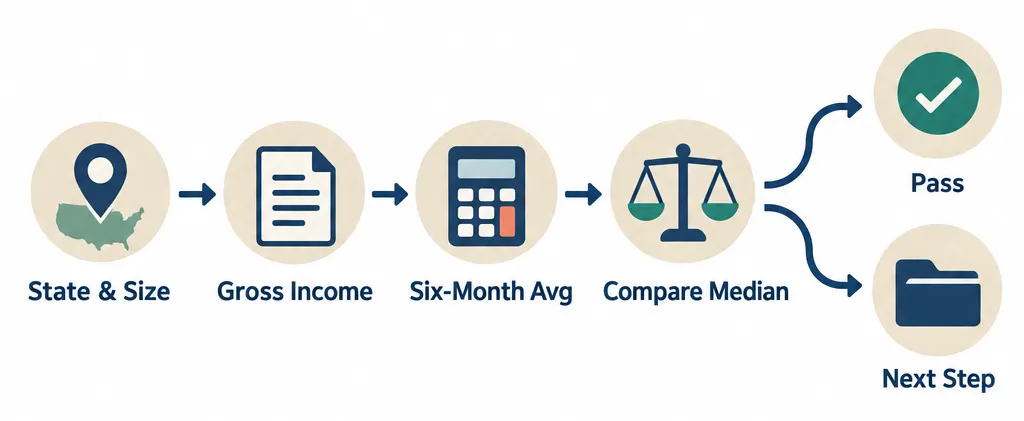
The first step of the Chapter 7 means test is one comparison. Your six-month average gross income, multiplied by 12, is set against the median family income for your state and household size. If you are at or below the median, you pass step one.
The rule written out
- Add all gross income received in the six full calendar months before your filing month.
- Divide by 6. That is your current monthly income (Form 122A-1, line 11).
- Multiply by 12. That is your annualized income (line 12b).
- Find the median for your state and household size in the U.S. Trustee table for your filing date. For households above four, add $11,100 per extra person to the four-person figure.
- If your annual figure is at or below the median, the presumption of abuse does not arise and you do not file Form 122A-2. If it is above, you complete Form 122A-2.
Worked example: the default inputs
The calculator opens with California, a household of 2, and $5,000 a month. As of November 27, 2026, that is the result for a case filed before December 1, 2026:
- Yearly income: $5,000 × 12 = $60,000.
- Median for a California household of 2: $102,797 (U.S. Trustee table for cases filed on or after April 1, 2026, reissued July 15, 2026).
- Room under the median: $102,797 − $60,000 = $42,797.
- Result: Below the median. You pass the first step of the means test.
For a case filed on or after December 1, 2026, the calculator switches to the November 17, 2026 table and the California figure changes. With $42,797 of room, this household passes under either table. A filer close to the line should rerun the numbers after the switch.
Second worked example: a family of five in Alabama
Say a household of five in Alabama files in December 2026. Over June through November 2026, the couple received $57,600 in gross wages.
- Six-month average: $57,600 ÷ 6 = $9,600 a month.
- Yearly income: $9,600 × 12 = $115,200.
- Median: the Alabama four-person figure for cases filed on or after December 1, 2026 is $109,489. Add $11,100 for the fifth person: $109,489 + $11,100 = $120,589.
- Room under the median: $120,589 − $115,200 = $5,389.
- Result: below the median. No Form 122A-2.
Now flip it. An Alaska couple filing on or after December 1, 2026 averages $9,800 a month. Their yearly figure is $117,600, against an Alaska two-person median of $112,922. They are $4,678 over, so they move on to step two. Step two is covered below.
Which median table applies to your filing date
The table that applies is the one in effect on the day your petition is filed. It is not the date you met a lawyer or began gathering documents.
| Filing date range | Table | Alabama 1-person median |
|---|---|---|
| April 1 to July 14, 2026 | Spring 2026 Census data | $64,321 |
| July 15 to November 30, 2026 | Spring 2026 data, reissued July 15, 2026 | $64,321 |
| December 1, 2026 or later | Fall 2026 data (notice of November 17, 2026) | $64,039 |
Did you know?
According to the U.S. Trustee Program’s notice of November 17, 2026, the fall median update applies to cases filed on or after December 1, 2026. Past fall updates took effect November 1, so a case filed November 30, 2026 uses a different table than one filed a day later.
Chapter 7 income limits by state: quick-reference figures
There is no fixed dollar cap for Chapter 7. The “income limit” is the state median for your household size. The table below shows the medians for cases filed on or after December 1, 2026, computed with the calculator’s rule, along with the monthly income that lands exactly on the median (annual figure ÷ 12).
| State (filing date) | 1 person | 2 people | 3 people | 4 people | Each additional person |
|---|---|---|---|---|---|
| Alabama (Dec 1, 2026 on) | $64,039 | $78,144 | $93,610 | $109,489 | +$11,100 |
| Alaska (Dec 1, 2026 on) | $80,856 | $112,922 | $117,696 | $126,552 | +$11,100 |
| California (through Nov 30, 2026) | $79,253 | $102,797 | $116,541 | $139,071 | +$11,100 |
| Household | Alabama monthly break-even (Dec 1 on) | Alaska monthly break-even (Dec 1 on) | California monthly break-even (through Nov 30) |
|---|---|---|---|
| 1 | $5,336.58 | $6,738.00 | $6,604.42 |
| 2 | $6,512.00 | $9,410.17 | $8,566.42 |
| 3 | $7,800.83 | $9,808.00 | $9,711.75 |
| 4 | $9,124.08 | $10,546.00 | $11,589.25 |
| 5 | $10,049.08 | $11,471.00 | $12,514.25 |
| 6 | $10,974.08 | $12,396.00 | $13,439.25 |
If your six-month average sits at or below the monthly break-even for your row, you pass step one. For any other state, select it in the calculator, which carries the full U.S. Trustee table for your filing date.
Did you know?
Medians do not only go up. In the U.S. Trustee Program’s December 1, 2026 table, the Alabama one-person median fell to $64,039, from $64,321 under the spring 2026 table.
Check the table date first
Before you trust any calculator, look for the table date. A filing on or after December 1, 2026 should use the November 17, 2026 data. A tool that cites April 2026 or July 15, 2026 figures is out of date for that filing.
Reading your result: what it means and what to do next
A “below the median” result means the presumption of abuse does not arise and you skip Form 122A-2. An “above the median” result does not mean you are barred from Chapter 7. It means you have to do the expense calculation.
Below the median
You file Form 122A-1, check the box saying the presumption does not arise, and stop there. The court can still dismiss a case for bad faith or under the “totality of the circumstances” in 11 U.S.C. § 707(b)(3). Under the safe harbor in § 707(b)(7), though, nobody can bring a means test motion against a below-median filer.
Above the median: the step-two math on Form 122A-2
Form 122A-2 (Chapter 7 Means Test Calculation) starts from your current monthly income and subtracts expenses the statute allows. What is left is your monthly disposable income. That figure is multiplied by 60, then compared with two thresholds.
Allowed expenses on Form 122A-2
- IRS National Standards for food, clothing, housekeeping supplies, personal care and miscellaneous items, allowed in full for your household size. The U.S. Trustee data for cases filed on or after July 15, 2026 puts one person at $867 a month, including $496 for food.
- Out-of-pocket health care per the IRS standard for each age group.
- IRS Local Standards for housing and utilities and for vehicle operating and ownership costs, by county or region. The one-car ownership allowance is $703 in the July 15, 2026 data, up from $662 in the April 2026 table. The IRS uses Local Standards as a cap: you generally get the lesser of what you spend or the standard, and the form’s instructions say how each line works.
- Taxes actually withheld, plus mandatory payroll deductions such as required retirement contributions and union dues.
- Health insurance, disability insurance and term life insurance premiums, plus court-ordered payments and some child care and education costs.
- Secured debt payments, such as a mortgage or car loan, averaged over the 60 months after filing.
- Priority debts, such as recent taxes or support arrears, divided by 60.
The $10,275 and $17,150 thresholds
Under § 707(b)(2)(A)(i), as adjusted on April 1, 2025 (the next adjustment is due April 1, 2028):
- If 60 months of disposable income is under $10,275 (about $171.25 a month), the presumption does not arise.
- If it is $17,150 or more (about $285.83 a month), the presumption arises.
- In between, the presumption arises if the 60-month figure would cover at least 25% of your nonpriority unsecured debt, such as credit cards, medical bills and personal loans.
| Monthly disposable income | × 60 | Result |
|---|---|---|
| $100 | $6,000 | No presumption |
| $171 | $10,260 | No presumption (under $10,275) |
| $221 | $13,260 | Presumption only if nonpriority unsecured debt is $53,040 or less |
| $250 | $15,000 | Presumption only if nonpriority unsecured debt is $60,000 or less |
| $286 | $17,160 | Presumption arises |
| $500 | $30,000 | Presumption arises |
Worked example: a single filer just over the median
A single filer in Alabama files in December 2026 with a six-month average of $5,800, or $69,600 a year. That is $5,561 over the $64,039 one-person median, so she completes Form 122A-2. The National Standards and vehicle figures below are the published U.S. Trustee amounts. The other lines are example amounts for her county and situation.
| Deduction | Monthly amount |
|---|---|
| National Standards (1 person) | $867 |
| Out-of-pocket health care | $84 |
| Housing and utilities | $1,750 |
| Vehicle operating costs | $300 |
| Vehicle ownership plus car loan payment | $703 |
| Taxes withheld | $1,250 |
| Health insurance | $380 |
| Term life insurance | $45 |
| Optional telephone and internet | $50 |
| Priority debt ($9,000 back taxes ÷ 60) | $150 |
| Total | $5,579 |
The car line works like this. Her $560 loan payment is deducted on the secured debt line, and the $703 ownership allowance is reduced by the same $560, which leaves $143. Together the two lines come to $703.
Disposable income: $5,800 − $5,579 = $221 a month. Over 60 months: $221 × 60 = $13,260, which falls in the middle band.
- With $48,000 of credit card and medical debt, 25% is $12,000. Her $13,260 covers that, so the presumption arises.
- With $60,000 of that debt, 25% is $15,000. Her $13,260 falls short, so the presumption does not arise.
The same income can pass or fail depending on how much unsecured debt you carry. The first screen cannot show that.
Who doesn’t have to take the means test
Official Form 122A-1Supp lets you claim an exemption if any of these apply:
- Your debts are primarily business debts rather than consumer debts. The means test applies only to individuals with primarily consumer debts.
- You are a disabled veteran whose debts were incurred mainly while on active duty or performing a homeland defense activity.
- You are a reservist or member of the National Guard called to active duty or homeland defense for at least 90 days after September 11, 2001. The exemption generally applies during the active duty period and for 540 days after it.
Cheaper and safer options to look at first
Chapter 7 costs a $338 filing fee, and the case can stay on your credit reports for up to 10 years under the Fair Credit Reporting Act. That makes it worth checking cheaper routes first, even if you pass the means test.
| Chapter 7 fee component | Amount |
|---|---|
| Filing fee | $245 |
| Administrative fee | $78 |
| Trustee surcharge | $15 |
| Total due to the court | $338 |
You can ask the court to let you pay in installments. You can also ask for a full waiver if your household income is below 150% of the federal poverty guidelines and you cannot pay in installments. Attorney fees are separate and set by each lawyer.
Cheaper options first
Ask each creditor about a hardship plan before you file. A nonprofit credit counseling agency approved by the U.S. Trustee Program can review a debt management plan, and you need its briefing within 180 days before filing anyway.
If a debt payoff calculator or a credit card payoff calculator shows you could clear your balances in three to five years under a reduced-rate plan, compare that with bankruptcy’s long credit impact before you decide.
Timing, special circumstances and other legitimate ways to pass
The legitimate ways to pass are: pick an honest filing date, count your household correctly, claim every deduction the form allows, and document any special circumstances. Inventing figures is not one of them.
Filing date and the six-month look-back
Because the window is fixed by the calendar, timing changes the result. A $12,000 bonus received three months ago adds $2,000 to your monthly average and $24,000 to your annualized figure. Once it falls outside the six months, it drops out entirely.
The same goes for overtime. If overtime pushed you over the median, waiting until those months leave the window is lawful. Waiting has costs, though. Garnishments, lawsuits and interest keep running until you file. The U.S. Trustee can also still argue abuse under the totality of the circumstances if your real income stays high.
A job loss works in reverse. If you lost your job last month, the window still includes your old paychecks. Waiting a few months lets the lower income show up. If you cannot wait, a documented drop in income can support an argument under § 707(b)(3) or a special circumstances claim.
Special circumstances
Under 11 U.S.C. § 707(b)(2)(B), you can rebut the presumption by showing special circumstances, such as a serious medical condition or a call to active military duty. You must have no reasonable alternative. You also have to itemize each extra expense or income adjustment, document it, and explain under oath why it is necessary and reasonable. The claim succeeds only if it brings your 60-month figure below the thresholds.
Before you file
Form 122A-1 and Form 122A-2 are signed under penalty of perjury. Making up income or expense figures is bankruptcy fraud under 18 U.S.C. § 152, punishable by up to five years in prison. The U.S. Trustee reviews pay stubs, tax returns and bank statements against the forms.
After the meeting of creditors, the U.S. Trustee files a statement saying whether the presumption arises in your case. If it does, the trustee then either files a motion to dismiss or explains why not.
If you fail the means test: Chapter 13 and other options
Failing means the presumption of abuse arises. The court can dismiss the case or, only with your consent, convert it to Chapter 13 (or Chapter 11). Failing does not bar you from bankruptcy.
In Chapter 13, Official Form 122C-1 sets your plan length, called the applicable commitment period. Below the median it is three years. Above it, five years. An above-median filer also completes Form 122C-2 to calculate how much disposable income goes to unsecured creditors. A five-year plan is not automatic for everyone who failed the Chapter 7 test: the median comparison is rerun on the Chapter 13 forms with the table in effect on that filing date. In Hamilton v. Lanning (2010), the Supreme Court held that Chapter 13 courts can account for income changes that are known or virtually certain when the plan is confirmed.
Other paths include rebutting the presumption with special circumstances, waiting for the window to roll past high-income months, or skipping bankruptcy for a negotiated settlement or a nonprofit debt management plan. Chapter 13 can also help you keep a house or car you are behind on, which Chapter 7 does not do.
Means test myths: savings, a $100k salary and take-home pay
“Too much money in the bank fails the means test.” The means test measures income, not savings. Cash on hand when you file becomes part of the bankruptcy estate. Whether you keep it depends on the federal or state exemptions available to you. A large balance can cost you money in Chapter 7 even if you pass the means test easily.
“Six figures means no Chapter 7.” Under the December 1, 2026 table, $100,000 is below the Alabama median for a household of four ($109,489) and the Alaska median for a household of two ($112,922). It is also below the California four-person figure of $139,071 for cases filed through November 30, 2026.
“Take-home pay is what counts.” It is not. Taxes come back in at step two as a deduction, but step one uses gross income.
Which calculator to trust, and the official forms
An online calculator is a screen. The official forms are the filing. When a free calculator says you pass and a lawyer says you don’t, the lawyer has usually looked at something the screen leaves out. That might be a spouse’s income, a household member your district wouldn’t count, a bonus in the window, or an outdated table.
| Document | What it does | Who files it |
|---|---|---|
| Official Form 122A-1 | Chapter 7 Statement of Your Current Monthly Income; the median comparison | Every Chapter 7 filer with primarily consumer debts |
| Official Form 122A-1Supp | Claims an exemption from the presumption | Business debtors, qualifying veterans, reservists and Guard members |
| Official Form 122A-2 | Chapter 7 Means Test Calculation; expenses and the 60-month test | Above-median filers |
| Official Form 122C-1 | Chapter 13 income and commitment period | Every Chapter 13 filer |
| Official Form 122C-2 | Chapter 13 disposable income | Above-median Chapter 13 filers |
The Judicial Conference of the United States approves these forms, and Form 122A-2 was revised to the current $10,275 and $17,150 amounts effective April 1, 2025. Before filing, gather six months of pay stubs, your last two tax returns, bank statements, benefit award letters, business profit and loss figures, your spouse’s pay records if you are married, and statements for every secured and unsecured debt.
To keep a calculator result honest, enter the same income you would swear to on the form. Then rerun it if your filing date crosses December 1, 2026 or a new month changes the window.
The official rules that apply
- Bankruptcy Abuse Prevention and Consumer Protection Act of 2005 (BAPCPA): created the means test.
- 11 U.S.C. § 707(b): dismissal for abuse, the presumption formula, special circumstances in § 707(b)(2)(B) and the below-median safe harbor in § 707(b)(7).
- 11 U.S.C. § 101(10A): defines current monthly income and the Social Security exclusion.
- 11 U.S.C. § 104: inflation adjustments to the dollar thresholds, published by the Judicial Conference of the United States in the Federal Register.
- 11 U.S.C. § 1325(b): Chapter 13 disposable income and the three- or five-year commitment period.
- 11 U.S.C. § 109(h): the credit counseling requirement before filing.
- 28 U.S.C. § 1930: bankruptcy filing fees, with fee schedules from the Administrative Office of the U.S. Courts.
- U.S. Trustee Program means-testing data: Census Bureau median family income tables and the IRS National and Local Standards, by filing date.
FAQ
Is the Chapter 7 means test based on gross or net income?
Gross. Step one uses income before taxes and payroll deductions. Taxes and mandatory deductions are subtracted only at step two, on Form 122A-2, if you are above the median.
How do I pass the means test for Chapter 7 bankruptcy?
Either your annualized six-month income is at or below your state median, or your disposable income after allowed expenses is under $10,275 over 60 months (or in the middle band, below 25% of your nonpriority unsecured debt). An honest filing date and a correct household count are legitimate ways to get there.
How much money can I have in the bank if I file Chapter 7?
The means test sets no savings limit because it measures income only. Cash you hold on the filing date is protected only up to the exemptions available in your state or under federal law. Anything above that can go to the trustee.
Can I file Chapter 7 if I make $100,000 a year?
Often, yes. For cases filed on or after December 1, 2026, $100,000 is under the Alabama four-person median of $109,489 and the Alaska two-person median of $112,922. Even above the median, high allowed expenses can let you pass step two.
What are the Chapter 7 income limits for 2026?
The limits are your state’s median family income for your household size. For cases filed on or after December 1, 2026, Alabama runs from $64,039 for one person to $109,489 for four, and Alaska from $80,856 to $126,552. Add $11,100 for each person beyond four.
What happens if I fail the means test?
The presumption of abuse arises. You can rebut it with special circumstances, let the court dismiss the case, convert to Chapter 13 with your consent, or wait until your six-month window reflects lower income.
Is there a Chapter 13 means test calculator, and how is it different?
Chapter 13 uses Form 122C-1 with the same median comparison, but the result sets your plan length rather than your eligibility. Below the median you get a three-year plan. Above it, the plan runs five years, and Form 122C-2 sets your payment to unsecured creditors.
Does Social Security count in the means test?
No. Social Security retirement, disability and SSI benefits are excluded from current monthly income under § 101(10A). Leave them out of the Average gross monthly income, last 6 months ($) field.
Does my spouse’s income count if only I am filing?
Yes, at step one, unless you are legally separated or living apart. On Form 122A-2 you can subtract the part your spouse spends only on their own expenses as a marital adjustment.
Shared custody of my kids: do they count as household members?
It depends on your court. Some districts count a child who lives with you about half the time as a full member, others count a fraction, and others count the child only in the home where they spend most nights. Check how your district handles it before you enter the number.
When do the means test numbers change?
Median tables usually change twice a year. The fall 2026 update applies to cases filed on or after December 1, 2026. The IRS expense standards were last updated for cases filed on or after July 15, 2026. The $10,275 and $17,150 thresholds next adjust on April 1, 2028. Run the calculator again in the week you plan to file, using the table for that date.
Guides that use this calculator
Laws and regulations referenced
Links go to the official text on government sites.
Sources
- U.S. Trustee Program: Updated Census Bureau Median Family Income Data (Fall 2026) justice.gov · official source
- U.S. Trustee Program: Median Family Income Table, cases filed on or after December 1, 2026 justice.gov · official source
- U.S. Trustee Program: Median Family Income Table, cases filed on or after April 1, 2026 justice.gov · official source
- U.S. Trustee Program: Means Testing justice.gov · official source
- U.S. Trustee Program: Means Testing data, December 1, 2026 justice.gov · official source
- U.S. Trustee Program: Means Testing data, April 1, 2026 justice.gov · official source
- U.S. Trustee Program: Notices justice.gov · official source
- U.S. Trustee Program: IRS National Standards, cases filed on or after July 15, 2026 justice.gov · official source
- U.S. Trustee Program: IRS Local Transportation Expense Standards, July 15, 2026 justice.gov · official source
- Federal Register: Revision of Certain Dollar Amounts in the Bankruptcy Code (Feb. 4, 2025) govinfo.gov · official source
- U.S. Bankruptcy Court C.D. Cal.: Official Form 122A-2 revised effective April 1, 2025 cacb.uscourts.gov · official source
- U.S. Courts: Bankruptcy Filings Increase 11.4 Percent uscourts.gov · official source
- Bankruptcy Means Test Figures Updated April 1, 2026 debtlawyer.com
- California Bankruptcy Means Test (2026) alllawsdecoded.com
- Household Size and the Chapter 7 Means Test (Nolo) nolo.com

Dana writes US Financer's guides to payday loans, personal and installment loans, bad credit borrowing and cash advance apps. Every piece starts from what a loan really costs, works the numbers in a table, and checks what the lender's own disclosure and your state's rules…
Ruth is US Financer's standards editor. Every article goes through her checks before and after it is published: each rate, fee, cap, deadline and rule is matched against its primary source, every law named is linked to its official text, and anything that cannot be…
What changed
- Nov 27, 2026 First published.
Comments are closed