Runs in your browser. Nothing you type is sent or saved.
This payday loan calculator turns a lender’s “$15 per $100” quote into the numbers that matter: the real APR, the fee you owe on the due date, and what every rollover adds. You need four figures from the loan paperwork: the amount borrowed, the fee per $100, the term in days, and an honest guess at how many times you might extend or reborrow.
How to use the calculator
- Enter the Amount borrowed ($). Use the cash you actually receive, not the face value of the check or ACH authorization if those differ.
- Enter the Fee per $100 borrowed ($). Find it on the loan agreement or the lender’s fee schedule; if the lender quotes a flat dollar fee, divide it by the amount borrowed and multiply by 100.
- Enter the Loan term (days). Count the days from funding to the due date on the agreement. Most payday loans are due on your next pay date, so check your pay stub for the exact date.
- Set Times you roll it over or reborrow. Start at 0 to see the single-loan cost, then raise it to see what happens if you cannot clear the balance on payday.
- Read the APR, the fee for one period, the total to repay on the due date, total fees, weeks in debt, and the principal you still owe at the end.
What each field means and the mistakes that skew the result
Amount borrowed ($). This is the principal. Lenders may describe the loan by the size of the post-dated check or the ACH debit they will pull, which already includes the fee. If a lender says “a $345 loan” and hands you $300, your amount borrowed is $300. Entering $345 understates the APR.
Fee per $100 borrowed ($). Payday lenders rarely quote interest rates. They quote fees, and research from the Consumer Financial Protection Bureau puts the typical range at $10 to $30 per $100 borrowed. A few states define the fee as a percentage of the check amount rather than the cash received, which produces a higher per-$100 figure than the headline suggests. California is the clearest example: under california payday loan laws, the fee can be up to 15% of a $300 check, which leaves you with $255 in hand and a $45 fee. That is $17.65 per $100 borrowed, not $15.
Loan term (days). Enter the actual number of days between funding and the due date. People get paid every two weeks far more often than every 14 calendar days exactly, but the gap matters at these rates. A loan due in 10 days carries a higher APR than the same fee over 14 days, because you pay the same money for less time. Do not enter “2” for two weeks; the field expects days.
Times you roll it over or reborrow. A rollover means paying only the fee on the due date and extending the same principal for another term. A reborrow means paying the loan in full and then taking a new loan within days because the repayment left you short. The calculator treats both the same way, because the cost is the same: a new fee on an unchanged principal. CFPB research published in 2014 found that more than 80% of payday loans were rolled over or followed by another loan within 14 days, so leaving this field at 0 describes the minority outcome.
Two other mistakes show up constantly. Readers sometimes enter the APR they saw on the agreement into the fee field, which produces nonsense. And readers borrowing from a lender that calls the product an “installment loan” with a 90-day or 180-day term should know this tool assumes one lump-sum repayment; a multi-payment loan needs an amortizing tool like our loan calculator instead.
The payday loan calculator formula, with two worked examples
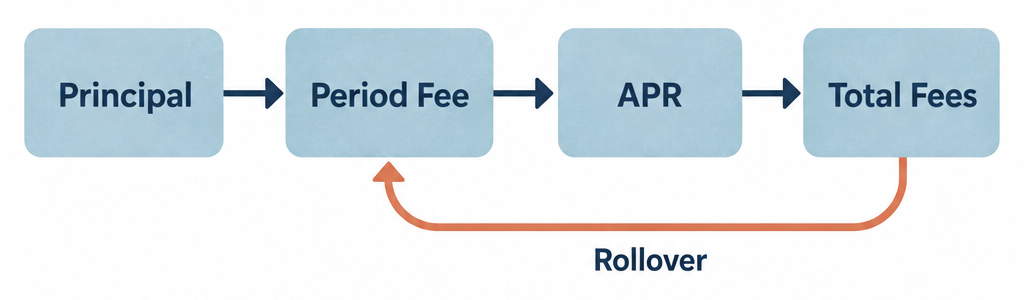
Every number on this page comes from four lines of arithmetic. There is nothing hidden, which is the point.
Fee for one period = amount borrowed × (fee per $100 ÷ 100)
APR = (fee ÷ amount borrowed) × (365 ÷ loan term in days) × 100
Total fees = fee × (1 + number of rollovers)
Weeks in debt = (1 + number of rollovers) × term in days ÷ 7
The APR line is the one that surprises people. An annual percentage rate asks: if you kept paying this fee at this pace for a full year, what share of the principal would you hand over? A two-week loan repeats about 26 times in a year (365 ÷ 14 = 26.07). So a 15% fee, repeated 26 times, is roughly 391%. The fee feels small because the term is short, and the APR exposes that.
Example one: the calculator’s defaults
Inputs: $400 borrowed, $15 per $100, 14 days, 0 rollovers.
Fee for one period: $400 × (15 ÷ 100) = $400 × 0.15 = $60.00.
APR: ($60 ÷ $400) = 0.15. Then 365 ÷ 14 = 26.07. Multiply: 0.15 × 26.07 = 3.91, and × 100 gives 391%.
Total to repay on the due date: $400 + $60 = $460.00.
Total fees: $60 × (1 + 0) = $60.00.
Weeks in debt: (1 + 0) × 14 ÷ 7 = 2.0 weeks.
You still owe at the end: $400.00. Because the loan is a single balloon payment, the principal is never reduced until the day you pay the whole thing. Pay only the fee and the full $400 remains.
Example two: a $300 loan at Alabama’s maximum fee, rolled three times
Alabama’s Deferred Presentment Services Act allows a fee of up to 17.5% of the amount advanced on loans of up to $500 with terms of 10 to 31 days. Suppose you borrow $300 for 14 days and roll it three times before clearing it.
Inputs: $300 borrowed, $17.50 per $100, 14 days, 3 rollovers.
Fee for one period: $300 × (17.50 ÷ 100) = $300 × 0.175 = $52.50.
APR: $52.50 ÷ $300 = 0.175. Multiply by 26.07: 0.175 × 26.07 = 4.5625, so about 456%.
Total to repay on the first due date: $300 + $52.50 = $352.50.
Total fees across all four periods: $52.50 × (1 + 3) = $52.50 × 4 = $210.00.
Weeks in debt: (1 + 3) × 14 ÷ 7 = 4 × 2 = 8.0 weeks.
You still owe at the end: $300.00, plus the final $52.50 fee if the fourth period is the one you finally pay off. Over eight weeks you paid $210 in fees on a $300 loan, which is 70% of the principal, and the lender still has the principal coming.
Quick reference: APR by fee and term
The APR depends only on the fee per $100 and the term in days. The amount borrowed does not change it. This table uses the calculator’s formula and rounds to the nearest whole percent.
| Fee per $100 | 14-day term | 30-day term |
|---|---|---|
| $10 | 261% | 122% |
| $15 | 391% | 183% |
| $20 | 521% | 243% |
| $25 | 652% | 304% |
| $30 | 782% | 365% |
Notice that stretching the same fee over 30 days instead of 14 cuts the APR roughly in half. Some lenders present a longer term as a favor. It is only a favor if the fee does not rise with it.
Quick reference: what rollovers do to a $400 loan
Same loan as the default example, $15 per $100 for 14 days, with the rollover count moved up.
| Rollovers | Total fees | Weeks in debt | Total paid to close the loan |
|---|---|---|---|
| 0 | $60 | 2 | $460 |
| 1 | $120 | 4 | $520 |
| 2 | $180 | 6 | $580 |
| 3 | $240 | 8 | $640 |
| 5 | $360 | 12 | $760 |
| 8 | $540 | 18 | $940 |
At eight rollovers you have paid more in fees than you borrowed, and the $400 is still due in full. That is the shape of the debt trap the CFPB describes in its payday lending research: the fee alone fits a tight budget, so people pay it, and the principal never moves.
Quick reference: cost of common amounts for one 14-day period
| Amount borrowed | Fee at $15 per $100 | Due at $15 | Fee at $20 per $100 | Due at $20 |
|---|---|---|---|---|
| $200 | $30 | $230 | $40 | $240 |
| $300 | $45 | $345 | $60 | $360 |
| $400 | $60 | $460 | $80 | $480 |
| $500 | $75 | $575 | $100 | $600 |
| $1,000 | $150 | $1,150 | $200 | $1,200 |
How to read your result
The APR is the comparison number. Credit card cash advances usually carry APRs in the high 20s to mid 30s. Federal credit unions that offer payday alternative loans under National Credit Union Administration rules charge no more than 28% APR plus an application fee capped at $20. The Military Lending Act caps most consumer credit to active-duty servicemembers and their dependents at 36%. Any result from this calculator will be ten times those figures, so a “low” payday APR means little; 261% is low only relative to 782%.
The fee for one period is the number lenders want you to focus on. It is a real cost, and you should know it, but on its own it tells you nothing about whether this is a reasonable price. Compare it to what the same money would cost from the alternatives below for the same two weeks.
Weeks in debt is the number to be honest about. If your budget cannot absorb a $460 hit on the next payday without creating a new shortfall, set the rollover field to the number of pay cycles it will realistically take you to come up with the full amount. Then look at total fees. That is your true price.
“You still owe at the end” never falls. This line exists to make one fact impossible to miss: fees do not reduce the balance. Only a full payment does.
Before you borrow
The single biggest risk is not the fee on the first loan but the second loan. CFPB research found that most payday loans are rolled over or quickly followed by a new one, and every repeat charges the full fee again while the principal stays untouched.
Cheaper and safer options to check first
Run the alternatives through the same logic. What does it cost, in dollars, to cover this shortfall for the time you need?
Cheaper options first
A federal credit union payday alternative loan (PAL) runs no more than 28% APR; on $400 for a month that is about $9 in interest.
Many employers and payroll providers offer earned-wage access with no fee, or a small flat fee, for an advance on hours already worked.
Ask the biller first. Utilities, landlords, hospitals and most lenders have hardship or payment plans that cost nothing to request.
A few more worth a phone call before any payday storefront: a 0% emergency hardship loan from a local nonprofit or community action agency, a negotiated due date on the bill that caused the shortfall, a credit card purchase (not cash advance) if you have one with room, and nonprofit credit counseling through an agency approved by the Department of Justice’s Trustee Program if the shortfall is a pattern rather than a one-off. For loans you will repay over months rather than one paycheck, compare offers with a personal loan calculator, which handles amortizing payments correctly.
If you hold cryptocurrency and are weighing a sale to cover the gap, know that the IRS treats virtual currency as property under IRS Notice 2014-21. Selling it to raise cash is a taxable event, and any gain is reportable on your return. A sale can still beat a 391% loan by a wide margin, but factor in the tax and any exchange withdrawal fees.
The rules behind the numbers
Truth in Lending Act and Regulation Z. Federal law requires payday lenders to disclose the finance charge and the APR in writing before you sign. Under Regulation Z (12 CFR 1026), the APR disclosure for a closed-end loan must be accurate within a narrow tolerance, so the figure on your agreement should match what this calculator produces. If the lender’s paperwork shows only a fee and no APR, that is a red flag worth reporting to the CFPB.
State rate caps and loan limits. Payday lending is governed state by state, and the same product is legal in one state, capped in the next and banned across the border. Roughly a third of states plus the District of Columbia either prohibit payday loans outright or cap rates at or near 36%, which makes the traditional two-week product unprofitable. Illinois joined that group in 2021 under its Predatory Loan Prevention Act, so illinois payday loan laws now cap consumer loans at 36% APR. Other states set a maximum fee and loan size instead: tennessee payday loan laws allow up to 15% of the face amount on loans up to $500, and alabama payday loan laws allow 17.5% of the amount advanced on loans up to $500. Texas takes a different path; texas payday loan laws place no cap on the fees that credit access businesses charge, which is why Texas APRs routinely run above 500%. Always check your own state regulator’s site before trusting a lender’s description of what is “allowed.”
Military Lending Act. If you are on active duty, or a dependent of someone who is, the Military Lending Act (32 CFR Part 232) caps the Military Annual Percentage Rate on most consumer credit, including payday loans, at 36%. Lenders are required to check your status against the Defense Department database before extending credit. A covered borrower who is quoted 391% has been quoted an illegal rate.
CFPB Payday Lending Rule payment protections. Under 12 CFR Part 1041, which took effect for compliance on March 30, 2025 after years of litigation, a payday lender that has had two consecutive withdrawal attempts fail against your bank account must stop trying and get a new authorization from you. Lenders must also give you advance notice before pulling a payment. These rules do not cap what you pay, but they limit the cascade of bank fees that failed debits used to trigger.
Fair Debt Collection Practices Act. If a payday loan goes to a third-party collector, the FDCPA restricts when they can contact you, bars threats and misrepresentation, and gives you the right to dispute the debt in writing. Threats of arrest for an unpaid payday loan are a common violation and should be reported to the CFPB and your state attorney general.
What the calculator leaves out
The result is the contract price if everything goes to plan. Real payday loans often cost more, for reasons the formula cannot see:
- Returned-payment or late fees charged by the lender when a debit bounces, where state law permits them.
- Your bank’s own NSF or overdraft fee on each failed withdrawal, listed in your account’s fee schedule.
- Prepaid card fees if the lender funds the loan onto a card instead of your bank account.
- Rollover or extension fees that some states let lenders add on top of the regular finance charge.
- Collection costs written into the agreement if the loan defaults.
Read the fee schedule on the agreement and mentally add anything there to the calculator’s total fees line.
Make the lender do the math with you
Before signing, ask for the total dollar amount that will be debited on the due date and the APR. Regulation Z requires both to be disclosed. Enter them here and confirm they match; a mismatch usually means a fee you were not told about.
FAQ
How much would a $1,000 payday loan cost?
At $15 per $100 for 14 days, the fee is $150 and you repay $1,150. At $30 per $100 it is $300 and $1,300. Two cautions: many states cap payday loans at $500, so a $1,000 offer is often a high-cost installment loan with a different fee structure, and the APR stays at 391% or 782% regardless of the amount because the formula divides the fee by the principal.
How do you calculate a payday loan?
Multiply the amount by the fee per $100 divided by 100 to get the fee. Divide the fee by the amount, multiply by 365 divided by the term in days, and multiply by 100 for the APR. For $400 at $15 per $100 over 14 days: $60 fee, and (60 ÷ 400) × (365 ÷ 14) × 100 = 391%. Multiply the fee by one plus the number of rollovers to get total fees.
How much is 26.99% APR on $5,000?
That rate belongs to a credit card or personal loan, not a payday loan, so the math differs. Held for a full year with no payments, $5,000 at 26.99% accrues about $1,350 in interest. Repaid over 36 equal monthly payments, the payment is roughly $204 and total interest comes to about $2,350. For 14 days, the same $5,000 costs about $52, which is less than the $60 fee on a $400 payday loan. Use a personal loan calculator for amortizing loans like this.
How much would a $200 payday loan cost?
At $15 per $100 the fee is $30 and you repay $230 on the due date. At $20 per $100 it is $40 and $240. Roll a $200 loan at $15 per $100 three times and, counting the original $30 fee plus three $30 rollover fees across four periods, total fees reach $120, which is 60% of what you borrowed.
Why is the APR so high when the fee is only $15?
Because the loan lasts two weeks, not a year. APR annualizes the cost so that loans of different lengths can be compared. Paying 15% of the principal every 14 days, 26 times a year, works out to 391%. A credit card at 25% APR charges that 15% over roughly seven months, not two weeks.
Does a rollover count the same as paying off and reborrowing?
For cost purposes, yes. In both cases you pay a full new fee and the principal is unchanged at the end. Some states ban rollovers but permit a new loan after a short cooling-off period, which lenders and borrowers often treat as the same thing. The calculator’s rollover field covers both.
What is a payday loan, exactly?
A payday loan is a small, short-term loan, usually $100 to $500, due in a lump sum on your next payday, secured by a post-dated check or an authorization to debit your bank account. Lenders typically do not run a traditional credit check and charge a flat fee per $100 rather than interest. Our explainer on what a payday loan is covers how it differs from installment and title loans.
Can a payday lender legally charge 391% APR?
In many states, yes, as long as the APR is disclosed under the Truth in Lending Act and the fee stays within the state’s cap. In states with a 36% cap, such as Illinois since 2021, no. For active-duty servicemembers and their dependents, the Military Lending Act caps the rate at 36% in every state. Check your state regulator’s license lookup and fee rules before assuming a quoted fee is lawful.
Guides that use this calculator
- What a payday loan is and how it differs from other small loans
- Illinois Loan Laws: Payday, Title and Installment Rules
- Tennessee Loan Laws: Payday, Title and Installment Rules
- Delaware Loan Laws: Payday, Title and Installment Rules
- Ohio Loan Laws: Payday, Title and Installment Rules
- Florida Loan Laws: Payday, Title and Installment Rules
Comments are closed