Payday lending is legal in Indiana, but only under the state’s small loan rules in Indiana Code 24-4.5-7. Licensed lenders can charge a tiered finance charge that starts at 15% of the first $250 you borrow. On a two-week loan, that works out to an annual percentage rate (APR) of roughly 390%.
PROPOSEDRelated consumer alert, Oct 19
Ways and Means advances bill easing penalties for crypto holders who missed reportingRun the numbers
How Indiana regulates borrowing in the first place
Indiana’s consumer lending law is built on the Indiana Uniform Consumer Credit Code (UCCC), found in Indiana Code Title 24, Article 4.5. It covers most consumer loans, sets the rate ceilings, and decides who needs a license. The Indiana Department of Financial Institutions (DFI) enforces it through its Consumer Credit Division. That is the agency you contact if a lender breaks the rules.
There are three layers to understand.
- Small loans (payday loans). IC 24-4.5-7 is a separate chapter just for short-term loans made against a check or a bank debit. It allows fees that would be illegal on any other consumer loan.
- Consumer and supervised loans (installment and personal loans). IC 24-4.5-3 governs these. The cap is far lower, topping out at 36% a year on the smallest balances.
- The criminal loansharking law. Under IC 35-45-7-2, it is a crime to lend at more than twice the 36% rate set in the UCCC. That puts the line at 72% APR. Licensed small loan lenders are exempt when they follow IC 24-4.5-7, which is the only reason triple-digit payday loans are legal in the state.
Many dollar figures in the UCCC are not frozen. IC 24-4.5-1-106 directs DFI to adjust certain dollar amounts for inflation on a set schedule. The base figures in the statute and the amounts DFI currently enforces can differ. In this guide we give the statutory base and point out where an adjustment applies. Before you rely on an exact dollar ceiling, check DFI’s latest published adjustment notice.
Payday and short-term loans in Indiana
Indiana payday loans are legally called “small loans.” Before Indiana’s 2002 small loan law, these lenders often worked through out-of-state bank partnerships. The current chapter turned them into state-licensed businesses with fee caps, amount limits and a statewide database. The rules are stricter than in states with almost no limits, which our guide to “texas payday loan laws” covers. They are looser than in states that cap all consumer loans at 36%.
Maximum loan amount
Under IC 24-4.5-7-402, a lender cannot make a small loan larger than the lower of two figures:
- $550, as adjusted. The statute sets $550 as the base, and DFI adjusts it under IC 24-4.5-1-106.
- 20% of your gross monthly income. On a $2,000-a-month paycheck, that limits you to $400 no matter what the dollar cap is.
The minimum small loan is $50. A lender that lends you more than either limit is breaking the law, and you can report it to DFI.
What lenders can charge
IC 24-4.5-7-201 sets the finance charge as a percentage of the amount borrowed, in tiers. The dollar bands below are the statutory base. DFI’s adjustments can shift them.
| Portion of the loan | Maximum finance charge |
|---|---|
| First $250 | 15% |
| More than $250, up to $400 | 13% of that portion |
| More than $400, up to $550 | 10% of that portion |
Lenders can also charge a fee if your payment bounces. IC 24-4.5-7-202 allows one returned-payment (NSF) fee of $25 per loan. Your own bank will likely charge you a separate overdraft or NSF fee on top of that, and Indiana law does not control what your bank charges.
What a payday loan really costs in Indiana
Indiana caps the dollar fee but not the APR. That’s why the APR on a legal Indiana payday loan runs into the hundreds. Here is the math in plain words. Divide the fee by the amount borrowed to get the cost for the term. Then multiply by the number of terms that fit in a year (365 divided by the number of days).
| Amount borrowed | Finance charge | Term | Total repaid | APR |
|---|---|---|---|---|
| $250 | $37.50 | 14 days | $287.50 | about 391% |
| $400 | $57.00 | 14 days | $457.00 | about 372% |
| $550 | $72.00 | 14 days | $622.00 | about 341% |
Take the $250 loan. $37.50 divided by $250 is 15% for two weeks. A year holds about 26 two-week periods (365 ÷ 14 = 26.07). Multiply 15% by 26.07 and you get about 391%. The calculation uses the statutory base bands. If DFI’s adjusted bands apply when you borrow, your exact dollar fee will differ slightly, but the APR stays in the same range.
Under the Truth in Lending Act and Regulation Z (12 CFR 1026), the lender must show you the APR and the finance charge in dollars before you sign. If the contract does not show both clearly, that’s a violation worth reporting.
Loan term
IC 24-4.5-7-401 requires a small loan to have a term of at least 14 days. A lender can’t write you a seven-day loan to collect fees more often. If you’re paid weekly, the loan still has to run at least two weeks.
Consecutive loans, the extended payment plan and the cooling-off period
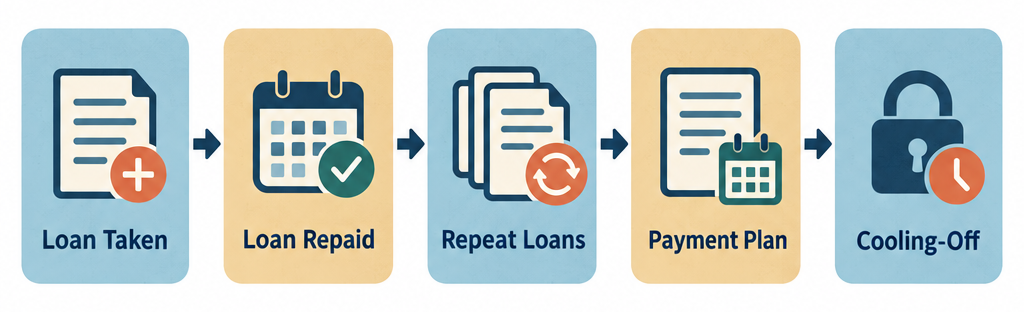
The worst outcome with a payday loan is the cycle: you repay on payday, come up short, and borrow again right away. Indiana does not ban repeat borrowing, but IC 24-4.5-7-401 puts several brakes on it.
- Extended payment plan. After a set number of back-to-back small loans (three, under the statute), the lender has to offer you an extended payment plan. It spreads what you owe over installments instead of requiring the full balance on one payday. Ask for it by name. Some borrowers don’t know it exists.
- Cooling-off period. After six consecutive small loans, you must wait seven days before you can take another one. “Consecutive” means a new loan made within days of paying off the old one, so you can’t get around it by paying off and re-borrowing the same afternoon.
These brakes help, but the fees still pile up quickly. If you took out six back-to-back $400 loans at the maximum fee, you would pay $57 six times, or $342 in fees, and still owe nothing less than the original $400 at the end of the run.
| Consecutive $400 loans | Fees paid so far | Principal still owed |
|---|---|---|
| 1 | $57 | $400 |
| 3 | $171 | $400 |
| 6 | $342 | $400 |
The state database
IC 24-4.5-7-404 requires licensed lenders to check a statewide database before making a small loan. The database tracks your open loans and your consecutive-loan count, which is how the cooling-off rule and the limits on outstanding loans are enforced. A storefront or website that says it doesn’t need to check the database is either unlicensed or ignoring the law.
Collection limits on small loans
Indiana’s small loan chapter limits how a lender can collect. A lender can’t use a bounced check to threaten you with criminal prosecution. Writing a postdated check or authorizing a debit for a payday loan isn’t check fraud when the lender knew you didn’t have the money at the time you wrote it. If a payday lender or its collector threatens arrest or jail, write down the date, the name and what was said, and report it to DFI and the CFPB.
Reform efforts and where they stand
Consumer and faith groups in Indiana, including the Indiana Institute for Working Families and Prosperity Indiana, have spent years pushing to cap small loans at 36% APR. That is the same limit the federal government already applies to loans to active-duty service members. Bills along those lines have been filed in several recent General Assembly sessions, and none has become law as of this writing. The groups have also published polling that they say shows broad Hoosier support for a cap. Treat any claim that “payday loans are now banned in Indiana” with suspicion until you see a signed bill. You can track bills through the Indiana General Assembly’s official bill tracker.
Neighboring states have gone different ways. Illinois capped most consumer loans, payday included, at 36% APR in 2021 (see our “illinois payday loan laws” guide). Missouri still allows some of the most expensive payday loans in the region, as our “missouri payday loan laws” page explains.
Car title loans in Indiana
Indiana title loans, in the form you see advertised in Tennessee, Missouri or Texas, are not legal. A typical title loan charges around 25% a month against your car title, which works out to about 300% APR. Indiana has no licensing category that allows that.
The reasoning works like this:
- The small loan chapter (IC 24-4.5-7) is the only route to triple-digit pricing, and it covers short-term loans repaid from your bank account. It doesn’t authorize loans secured by a vehicle title.
- A loan secured by your car falls under the general consumer loan rules in IC 24-4.5-3, where the supervised lender cap is 36% on the smallest balances.
- Anything above 72% APR crosses into criminal loansharking under IC 35-45-7-2 unless an exemption applies.
So if you search “title loans Indiana” and find a lender offering a $1,000 title loan due in 30 days for a $250 fee, that offer doesn’t follow Indiana law. Three situations come up often:
- Online title lenders. Some claim to be licensed in another state or to be governed by tribal law. Indiana’s UCCC applies to loans made to Indiana residents when the lender solicits business in the state (see the territorial rules in IC 24-4.5-1-201). Check the license before you hand over a title.
- Driving across the state line. An Indiana resident who signs a title loan in person in another state is generally governed by that state’s law. If you default, repossession can still happen in your Indiana driveway. Our “tennessee payday loan laws” guide covers how title pledges work there.
- Car-secured installment loans at legal rates. Credit unions and licensed consumer finance companies can make loans secured by your car at rates within the UCCC caps. These are not title loans in the usual sense, and they cost far less.
A pawnshop is a different product. Indiana pawnbrokers are licensed by DFI, and pawning an item means you lose it if you don’t repay, with no effect on your credit report. Pawning a car while keeping the right to drive it is not how Indiana pawn law works.
Installment and personal loans in Indiana
Indiana installment loans are where most borrowers with damaged credit end up once they need more than a payday loan allows. These loans are governed by IC 24-4.5-3. Any company that makes them regularly at rates above the basic consumer loan rate has to hold a supervised lender license from DFI (IC 24-4.5-3-502).
Rate caps for supervised loans
IC 24-4.5-3-508 lets a licensed supervised lender choose between two ways of pricing a loan:
| Pricing method | Maximum annual rate |
|---|---|
| Tiered: on the lowest band of the unpaid balance | 36% |
| Tiered: on the next band | 21% |
| Tiered: on the balance above that | 15% |
| Alternative: flat rate on the whole unpaid balance | 25% |
The dollar boundaries between the tiers are adjusted under IC 24-4.5-1-106, so we haven’t printed them here. The structure is what matters: the smaller the loan, the higher the legal rate. For a typical loan of a few thousand dollars, the blended rate lands somewhere between the low 20s and 36%. The law also allows a limited nonrefundable prepaid finance charge (an origination-type fee) on some loans. That fee counts toward the APR the lender has to disclose under Regulation Z.
Here is a worked example at the top of the range.
| Loan | APR | Term | Monthly payment | Total repaid | Interest |
|---|---|---|---|---|---|
| $1,500 installment loan | 36% | 12 months | $150.69 | $1,808.28 | $308.28 |
The math: 36% a year is 3% a month. Spread over 12 equal payments, $1,500 at 3% a month comes to $150.69 a payment. Twelve payments add up to $1,808.28. Compare that with payday pricing. Borrowing $400 six times in a row costs $342 in fees, more than this entire $1,500 loan costs over a year.
“Indiana loans for bad credit” and “no credit check” offers
If you search for Indiana loans for bad credit, you’ll see ads for “guaranteed approval” and “no credit check.” Neither phrase describes a legal or financial right.
- “No credit check” usually means the lender skips a hard pull at the three major bureaus. It still checks something: a specialty consumer reporting agency for payday borrowers, your bank account history, or your income. Those reports are covered by the Fair Credit Reporting Act, so you can request them and dispute errors.
- “Guaranteed approval” is a marketing line. No licensed lender approves everyone, and Indiana’s own small loan rules (the 20% of income limit and the database check) make guaranteed approval impossible on a legal payday loan.
- Higher price for higher risk is the real trade. Lenders that approve low scores charge rates near the legal ceiling. Any rate above Indiana’s caps from a company lending to you in Indiana means it is unlicensed or claiming an exemption that may not hold up.
The Equal Credit Opportunity Act protects you from denial based on race, sex, marital status, age, national origin, religion, or because your income comes from public assistance. If you’re turned down, the lender must give you the reasons or tell you how to get them.
Online and tribal lenders: does Indiana law apply?
Indiana’s rules apply to loans made to Indiana residents, including online loans. Under the UCCC’s territorial provisions (IC 24-4.5-1-201), a lender that solicits Indiana consumers and makes loans to them is subject to the Indiana caps and licensing requirements, even if its servers and offices are in another state. An online payday lender making Indiana loans needs an Indiana license, has to stay within the IC 24-4.5-7 fee tiers, and has to check the state database.
Three business models try to work around this.
- Tribal lenders. Some online lenders say they’re owned by a Native American tribe and governed only by tribal law, then charge 400% to 700% APR or more. Courts and federal regulators have pushed back on these claims, especially when the tribe is a front for a non-tribal operator. Even where sovereign immunity protects the tribe, the loan may still be unenforceable in Indiana, and the companies behind the lender can face enforcement. In practice, suing one of these lenders is hard. Your best protection is to avoid them.
- Offshore lenders. Websites based abroad with no license anywhere. These are also where most fake-loan scams operate.
- Lead generators. Many “Indiana payday loans” websites aren’t lenders. They collect your Social Security number and bank details and sell them to whoever pays the most, sometimes including unlicensed lenders.
Red flags that you’re dealing with an unlicensed or fake lender:
- It asks for an upfront fee, “insurance” or “processing” payment before releasing the loan. Licensed lenders deduct fees from the loan or bill them later. They don’t ask for gift cards, wire transfers or crypto.
- It offers more than Indiana’s small loan cap as a short-term payday loan.
- It won’t name the state that licensed it, or the name on the license doesn’t match the name on the website.
- The contract says disputes go only to a tribal or foreign forum.
- It promises approval before seeing any information.
If you already took a loan from an unlicensed online lender, you have options. You can revoke your authorization for electronic debits. Under the Electronic Fund Transfer Act and Regulation E, you can stop future preauthorized transfers by notifying your bank at least three business days before the scheduled debit. Then file complaints with DFI and the CFPB. Don’t ignore a real debt from a licensed lender, but don’t keep paying an illegal one without getting advice first. Indiana Legal Services can help.
Debt collection and wage garnishment in Indiana
Who can collect, and how
Third-party debt collectors are covered by the federal Fair Debt Collection Practices Act and the CFPB’s Regulation F (12 CFR 1006). Indiana also requires collection agencies to be licensed under the state’s Collection Agency Act (IC 25-11), administered by the Indiana Secretary of State. An unlicensed collector working Indiana accounts is a red flag, and you can check a collector’s license with the Secretary of State’s office.
Under the FDCPA and Regulation F, a collector:
- Must send you a validation notice with the amount owed, the creditor’s name and your dispute rights.
- Must stop collecting until it sends verification, if you dispute in writing within the validation period (about 30 days after you receive the notice).
- Is presumed to be harassing you if it calls more than seven times in seven days about one debt, or within seven days after a phone conversation about it.
- Can’t threaten arrest, lie about the amount, call before 8 a.m. or after 9 p.m. your time, or discuss your debt with your employer or neighbors.
How long a creditor has to sue
Under IC 34-11-2-9, an action on a promissory note or other written contract for the payment of money generally has to be filed within six years. Most loan and credit card debts fall under that rule. Once the deadline passes, the debt is “time-barred.” A collector can’t sue or threaten to sue on it, and under Regulation F, a collector that sues or threatens to sue on a time-barred debt breaks the law. Making a payment can complicate your position, so get advice before paying on a very old debt.
Wage garnishment limits
A creditor can garnish your wages only after it sues you and wins a court judgment. Indiana’s limit, in IC 24-4.5-5-105, follows the federal Consumer Credit Protection Act. Garnishment can’t take more than the lower of:
- 25% of your disposable earnings for the week, or
- the amount by which your weekly disposable earnings exceed 30 times the federal minimum wage. At $7.25 an hour, that protected floor is $217.50 a week.
“Disposable earnings” means what’s left after legally required deductions such as taxes. Here is how the limit works at different weekly incomes.
| Weekly disposable earnings | 25% test | Amount above $217.50 | Maximum garnishment |
|---|---|---|---|
| $217.50 or less | $54.38 or less | $0 | $0 |
| $250 | $62.50 | $32.50 | $32.50 |
| $300 | $75.00 | $82.50 | $75.00 |
| $600 | $150.00 | $382.50 | $150.00 |
Child support, federal student loans and tax debts follow different, higher garnishment limits. Your bank account has protections too. Under federal rules at 31 CFR Part 212, your bank has to automatically protect two months of directly deposited federal benefits, such as Social Security and VA payments, from garnishment. Indiana also has personal property exemptions under IC 34-55-10-2, which you can claim in court.
Debt relief in Indiana
If you’re juggling several debts, debt relief in Indiana comes in three forms, and they differ sharply.
- Nonprofit credit counseling and debt management plans. A counselor reviews your budget, and in many cases sets up a plan where you make one monthly payment and creditors agree to lower interest rates. Indiana requires debt management companies to be licensed by DFI under IC 28-1-29. Look for an agency that is licensed in Indiana and accredited by a national body such as the National Foundation for Credit Counseling.
- Debt settlement. A company tells you to stop paying creditors and save money in an account, then tries to negotiate lump-sum payoffs. It can badly damage your credit, and your creditors can sue in the meantime. Under the FTC’s Telemarketing Sales Rule (16 CFR 310.4), companies that sell debt relief by phone can’t charge fees until they’ve settled at least one of your debts.
- Bankruptcy. Chapter 7 or Chapter 13 stops garnishment and collection through the automatic stay. Federal law requires a credit counseling session from an approved agency before you file.
Help that costs less than a payday loan
Cheaper options first
A credit union Payday Alternative Loan caps APR at 28% with no more than a $20 application fee.
Your township trustee can help with rent, utilities and other basic needs in an emergency.
Ask your utility, landlord or lender for a hardship plan before you borrow to pay them.
Credit union Payday Alternative Loans
Federal credit unions can offer Payday Alternative Loans (PALs) under NCUA rules at 12 CFR 701.21(c)(7). There are two versions:
| Feature | PAL I | PAL II |
|---|---|---|
| Loan amount | $200 to $1,000 | Up to $2,000 |
| Term | 1 to 6 months | 1 to 12 months |
| Maximum APR | 28% | 28% |
| Application fee | Up to $20 | Up to $20 |
| Membership wait | At least 1 month | None required |
Compare the cost. A $1,000 PAL I at 28% over six months has payments of about $180.54 a month and about $83.24 in interest. With the $20 application fee, the total cost is about $103. Borrowing $550 for two weeks at Indiana’s maximum payday fee costs $72, and you’d have to repay all of it in 14 days. Not every credit union offers PALs, and state-chartered credit unions may have their own small loan products under different terms. Call before assuming.
Indiana assistance programs that exist
Financial assistance in Indiana is spread across several offices. Here are the ones we can confirm:
- Township trustee assistance. This one is specific to Indiana. Under Indiana’s township assistance law (IC 12-20), each township trustee has to provide emergency help with basic needs like rent, utilities and food for residents who qualify. Your township trustee’s office is often the fastest local source of help with a shutoff notice or an eviction filing. Each township sets its own standards, and the trustee must give you a written decision.
- Energy Assistance Program (EAP). Indiana’s version of the federal LIHEAP program is run by the Indiana Housing and Community Development Authority (IHCDA) through local community action agencies. It helps with heating and cooling bills, and applications open seasonally.
- SNAP and TANF. The Family and Social Services Administration’s Division of Family Resources handles food and cash assistance.
- Indiana 211. Dial 211 to reach a referral line for local rent, utility, food and medical help.
- Indiana Legal Services. Free civil legal help for eligible low-income residents, including debt collection lawsuits, garnishment and problems with unlicensed lenders.
If you’re reading this from another state, the details change, but most states have 211 and a LIHEAP program. Searches for financial assistance in NJ or financial assistance in PA lead to those states’ own agencies and 211 lines. Indiana’s township trustee system has no direct match in either state.
Ask before you borrow
Before you take a payday loan to pay a bill, call the company you owe. Utilities often offer budget billing or payment arrangements. Medical providers often have charity care or interest-free plans. Many lenders, including credit card issuers, have hardship programs. Some employers offer pay advances at no cost through payroll. Any of these is cheaper than a 391% APR loan.
Federal rules that apply in Indiana and everywhere
Some protections apply no matter where you live.
- Truth in Lending Act / Regulation Z (12 CFR 1026). Lenders have to disclose the APR, finance charge, amount financed and total of payments before you sign.
- Military Lending Act (10 U.S.C. 987, 32 CFR Part 232). Active-duty service members and their dependents can’t be charged more than a 36% Military Annual Percentage Rate on most consumer credit, including payday, title and installment loans. Fees and add-on products count toward that rate. A standard Indiana payday loan is illegal to make to a covered borrower.
- Servicemembers Civil Relief Act. Debts taken on before active duty can be capped at 6% interest during service.
- Fair Debt Collection Practices Act. Covered in the collection section above: validation rights, harassment limits and a right to sue collectors who break the law.
- Electronic Fund Transfer Act / Regulation E. You can stop preauthorized debits from your bank account.
Payday rules in other states you may be searching
Readers often compare states, or check the rules for a family member elsewhere. The table below covers the states that come up most in searches alongside Indiana. Rules change, so confirm with each state’s regulator.
| State | Storefront payday loans | Notes |
|---|---|---|
| Indiana | Allowed with limits | Tiered fees under IC 24-4.5-7 |
| Tennessee | Allowed | Also permits title pledge loans; see our “tennessee payday loan laws” guide |
| Illinois | Capped at 36% APR | Predatory Loan Prevention Act, 2021 |
| Massachusetts | Not available at payday rates | Small loan rate limits apply |
| New Hampshire | Capped at 36% APR | Covers payday and title loans |
| New Jersey | Not available | Criminal usury law blocks payday pricing |
| Pennsylvania | Not available | No payday license category |
People searching for loans for bad credit in TN will find payday and title lenders operating legally. Searches for loans for bad credit in MA or loans for bad credit in NH mostly turn up installment lenders and credit unions, because those states don’t allow triple-digit short-term loans. A lender that offers payday-style pricing to residents of a capped state is breaking that state’s law, just as it would be in Indiana.
How to check a lender’s license and file a complaint
How to check an Indiana lender
- Get the lender’s full legal name and any license number from its website or contract.
- Search DFI’s licensee lookup and NMLS Consumer Access for that exact name.
- Confirm the license type matches the product: small loan for payday, supervised lender for installment loans.
- For a debt collector, check the Indiana Secretary of State’s collection agency licenses.
- If you can’t find a matching license, don’t give the company your bank or Social Security details.
Where to complain:
- Indiana Department of Financial Institutions, Consumer Credit Division. For licensed payday lenders, installment lenders, pawnbrokers and debt management companies. DFI can investigate, order refunds and act against licenses.
- Indiana Attorney General, Consumer Protection Division. For deceptive practices, scams and unlicensed businesses.
- Indiana Secretary of State. For licensing problems with collection agencies.
- Consumer Financial Protection Bureau. The CFPB’s online complaint portal forwards your complaint to the company and tracks its response. It covers payday lenders, debt collectors, banks and credit reporting.
- FTC ReportFraud and the FBI’s IC3. For advance-fee loan scams, fake lenders and identity theft.
Keep copies of everything: the contract, payment records, screenshots of the website, and notes on calls with dates and names. A short written complaint with documents gets better results than a phone call.
Before you borrow
A legal Indiana payday loan of $250 costs $37.50 for two weeks, about 391% APR, and the real danger is rolling it into back-to-back loans that cost more in fees than you borrowed. Check a credit union PAL, your township trustee and a hardship plan with the company you owe first.
FAQ
Are payday loans legal in Indiana?
Yes. Licensed lenders can make small loans under IC 24-4.5-7. The finance charge is limited to 15% of the first $250, 13% of the next portion and 10% of the portion above that. The loan can’t exceed the inflation-adjusted cap based on $550, or 20% of your gross monthly income, and the term has to be at least 14 days.
How many payday loans can I have in Indiana?
Indiana limits outstanding and back-to-back small loans and enforces the limits through a statewide database that lenders must check under IC 24-4.5-7-404. After six consecutive loans, IC 24-4.5-7-401 requires a seven-day cooling-off period. After a shorter run of consecutive loans, the lender has to offer an extended payment plan.
Can I get a car title loan in Indiana?
Not at the triple-digit rates title lenders charge in other states. Indiana has no title loan license. A loan secured by your car falls under the general consumer loan caps, which top out at 36% a year on small balances, and pricing above 72% APR can count as criminal loansharking under IC 35-45-7-2.
Can a payday lender have me arrested in Indiana?
No. Not repaying a payday loan is a civil debt, not a crime. Indiana’s small loan law bars lenders from using bounced checks to pursue criminal charges, and the FDCPA bars collectors from threatening arrest. A lender can sue you, and with a court judgment it can garnish part of your wages within the limits of IC 24-4.5-5-105.
Do Indiana payday loan laws apply to online lenders?
Yes, for lenders that market to and lend to Indiana residents. They need an Indiana license and have to follow the same fee and amount limits. Lenders that claim tribal or offshore status often charge far more, so check DFI’s license lookup before sharing any banking information.
Where can I get emergency money help in Indiana without a loan?
Start with your township trustee, who has to provide emergency assistance to eligible residents under IC 12-20. Also look into the Energy Assistance Program through your local community action agency, SNAP through the Division of Family Resources, and Indiana 211 for local referrals. Indiana Legal Services offers free help with collection lawsuits and garnishment.
Laws and regulations referenced
- Truth in Lending Act, 15 U.S.C. 1601
- Regulation Z, 12 CFR Part 1026
- Fair Debt Collection Practices Act, 15 U.S.C. 1692
- Regulation F (debt collection), 12 CFR Part 1006
- Fair Credit Reporting Act, 15 U.S.C. 1681
- Equal Credit Opportunity Act, 15 U.S.C. 1691
- Electronic Fund Transfer Act, 15 U.S.C. 1693
- Regulation E (electronic transfers), 12 CFR Part 1005
- Military Lending Act, 10 U.S.C. 987
- Military Lending Act rule, 32 CFR Part 232
- Servicemembers Civil Relief Act, 50 U.S.C. 3901
Links go to the official text on government sites.
Check, verify or complain
Sources
- ncua.gov › support services › access ncua.gov · primary source
- ecfr.gov › current › title 32 › subtitle A › chapter I › subchapter M › part 232 ecfr.gov · primary source
- usfinancer.com › loans › personal loans › installment loan usfinancer.com
- lendingtree.com › personal › payday alternative loan lendingtree.com
- cashcompasspro.com › loan laws › indiana cashcompasspro.com
- finanso.com › us › loans › payday › indiana finanso.com
- debthammer.org › indiana payday loan laws debthammer.org
- finder.com › short term loans › short term loans illinois finder.com

Elena writes about getting through a money emergency, assistance programs, budgeting on a tight income, banking basics and borrower rights. Her guides list the cheaper options first and link the agency or program that can actually help.

Ruth is US Financer's standards editor. Every article goes through her checks before and after it is published: each rate, fee, cap, deadline and rule is matched against its primary source, every law named is linked to its official text, and anything that cannot be…
Comments are closed