SCAM ALERTConsumer alert, published October 19, 2026
The FBI’s Internet Crime Complaint Center (IC3) warned on 17 Sep 2026 that scammers are posing as police and government officials to take people’s money and personal information. One common version claims you missed jury duty and must pay now or be arrested. Federal courts in Arkansas and Tennessee have posted their own warnings about the same calls.
What is happening
The IC3 notice, PSA I-091726-PSA, is titled “Scammers Impersonating Law Enforcement and Government Officials in Fraud Schemes.” It updates an FBI alert first issued on 7 Mar 2022.
The FBI says IC3 received nearly 61,000 complaints about law enforcement or government impersonation between January 2025 and July 2026. Reported losses topped $1.6 billion.
The jury duty version is a big part of that. According to the PSA’s text as reproduced by the Bee News, IC3 logged 6,833 complaints of this kind over the same period, with losses of nearly $36 million.
The U.S. District Court for the Eastern District of Arkansas posted a “Juror Scam Alert” on 28 Aug 2026. It says the calls and messages are fraudulent and not connected with the U.S. Courts. In Tennessee, the U.S. District Court for the Middle District of Tennessee issued its own jury scam warning on 21 Aug 2023, and the Tennessee Attorney General’s Division of Consumer Affairs described the same scheme in a 14 Aug 2024 alert (PR24-63).
This is not new. The U.S. Marshals Service warned of a nationwide jury duty phone scam in March 2016.
How the scam works
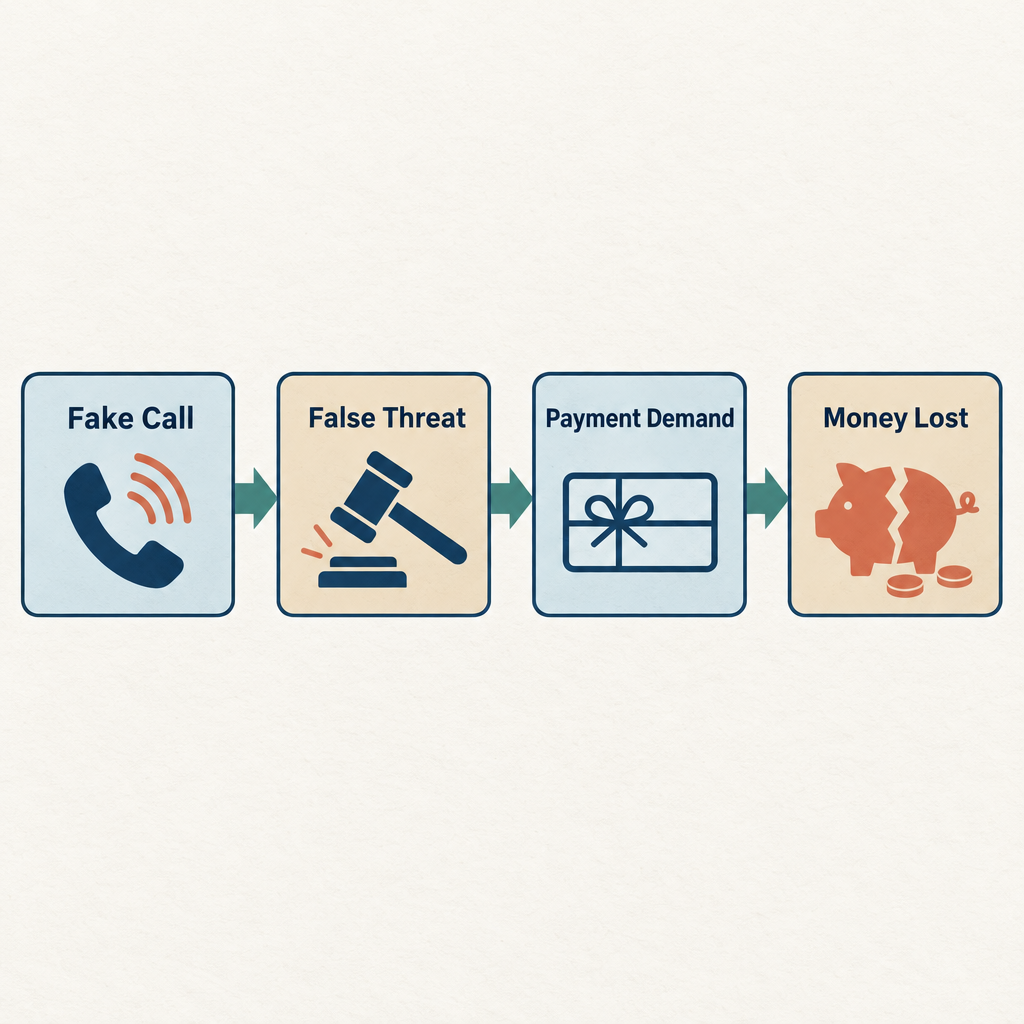
A caller says they are a deputy, a marshal or a court officer. They tell you that you skipped jury duty or missed a court date. Then they say a fine or an arrest warrant is waiting unless you pay right away.
The FBI says scammers often fake real phone numbers, email addresses, employee names and credentials of well-known agencies, including IC3 itself. An older alert from the FBI’s East Tennessee office, which is undated, says callers may cite real badge numbers, judges’ names and courtroom addresses. The Tennessee Attorney General says they may know personal details such as your birthday or past addresses.
The FBI says payment demands come as prepaid cards, couriers, bank wires, cryptocurrency, or cash fed into cryptocurrency kiosks. The Middle District of Tennessee and the FBI’s East Tennessee office both mention prepaid or gift cards.
How to spot it
The FBI lists these red flags:
- An urgent, aggressive tone
- The caller will only speak to you and will not leave a message with anyone else
- They keep you on the phone for the whole scam
- They tell you not to tell family, friends, your bank or the police
- They want payment by gift card, prepaid card, wire, courier, crypto or a crypto kiosk
Courts add one more. The Eastern District of Arkansas says federal courts do not require sensitive information by phone or email, and most contact with prospective jurors comes by U.S. mail. The FBI’s East Tennessee office says that if you actually miss jury duty, you will be contacted by mail, not by phone or email.
A court will not take gift cards
No real court or police agency will ask you to pay a fine over the phone with gift cards, crypto or a courier to avoid arrest. The U.S. Marshals Service has said it does not call people to arrange fine payments. If someone asks, it is a scam.
If you were targeted
- Hang up and stop all contact. Do not call back the number they gave you.
- If you paid or shared bank details, call your bank or card issuer using the number on the back of your card. The FBI says to notify your financial institutions.
- If you gave out your Social Security number or other personal details, go to IdentityTheft.gov and consider freezing your credit with the three credit bureaus.
- Save everything: phone numbers, emails, texts, receipts, gift card numbers and any crypto transaction records.
- If you worry you really missed jury service, contact the court clerk using contact details from the court’s official website or a mailed summons, not from the caller.
- If you believe you have a real legal problem, talk to a lawyer.
How to report it
The FBI asks victims to file a complaint at ic3.gov and include the scammers’ contact details and financial records, especially for cryptocurrency.
The Eastern District of Arkansas court asks people to report suspicious contact to the court through the phone line and email link posted on its website. It also says to report scams to the Federal Trade Commission at ReportFraud.ftc.gov. The court notes that falsely claiming to be a federal court official is a crime.
You can also report to your state attorney general’s consumer protection office. In Tennessee, that is the Attorney General’s Division of Consumer Affairs.
Check, verify or complain
Sources
- FBI IC3 (ic3.gov) PSA, 17 Sep 2026 ic3.gov · primary source
- U.S. District Court, Eastern District of Arkansas (uscourts.gov) are.uscourts.gov · primary source
- U.S. District Court, Eastern District of Arkansas (uscourts.gov) are.uscourts.gov · primary source
- FBI Richmond/Knoxville field office page (fbi.gov) fbi.gov · primary source
- Tennessee Attorney General's Office (tn.gov) tn.gov · primary source
- U.S. District Court, Middle District of Tennessee (uscourts.gov) tnmd.uscourts.gov · primary source

Leah writes US Financer's Consumer Alerts: scam warnings and money rule changes issued by federal agencies, state attorneys general, regulators and courts. Each alert starts from the official notice, says what is confirmed and what is not known yet, and lists the agency's own page…

Ruth is US Financer's standards editor. Every article goes through her checks before and after it is published: each rate, fee, cap, deadline and rule is matched against its primary source, every law named is linked to its official text, and anything that cannot be…
Comments are closed