
PROPOSEDConsumer alert, published October 18, 2026
The Senate voted 49-50 on September 15, 2026 and did not advance H.R. 3633, the Digital Asset Market Clarity Act, according to the official U.S. Senate roll call record for Vote 234 and the Congress.gov action record for the bill. The vote was on cloture on the motion to proceed, a procedural step that needed three fifths of senators. The bill would set federal rules for how crypto and stablecoins are sold and overseen, so anyone who buys, holds or earns rewards on digital assets through a US platform is affected by the delay.
What changed
On September 15, 2026 at 2:19 PM, the Senate held Roll Call Vote 234, cloture on the motion to proceed to H.R. 3633. The official Senate record lists the result as “Cloture on the Motion to Proceed Rejected.” Congress.gov records the tally as 49-50 and notes that the Senate did not invoke cloture.
This was not a vote on the bill itself. Final passage was never put to a vote. Some headlines said the Senate rejected the CLARITY Act, and a Hunton law firm blog post reported the tally as 50 in favor and 49 against. The Senate roll call, the Congress.gov record and the Senate Daily Press Gallery log all show 49 yeas and 50 nays.
The Senate Daily Press Gallery log for September 15, 2026 says Sens. Collins, Hawley, Moran and Tillis voted no, and that Sen. Tillis voted no in order to make a motion to reconsider. Sen. Coons did not vote. Congress.gov shows Tillis entered that motion to reconsider the same day.
The 49-50 cloture failure is confirmed by multiple official and independent sources.
Who it affects
The bill is a market structure measure that would divide oversight of digital assets between the SEC and the CFTC. For consumers, the practical point is simple. No new federal law from the CLARITY Act restricts or permits yield on stablecoins held at an exchange. The rules in force before the vote are still the rules today.
One law already applies. The GENIUS Act, signed into law in July 2025, bars stablecoin issuers from paying interest or yield to holders, but it does not explicitly bar exchanges or other third parties from paying yield to their customers. The CLARITY Act’s yield provisions would have addressed third-party platforms such as exchanges. That part remains unsettled.
Reports about the bill’s stablecoin yield text should be read as reports, not law. In April 2026, The Block, citing an unnamed “source familiar with the discussions,” said the draft kept a ban on rewards for idle stablecoin balances while allowing activity-based or transaction-based yield. The Block is an established crypto outlet, but this detail is not confirmed in any official document, it is about six months old, and it is not tied to the September vote. Politico reported the delay of that text and quoted Sen. Tillis. The official bill text on Congress.gov is the only reliable version.
The yield dispute was one of several. The Cryptonomist lists stablecoin rewards among issues that blocked progress, along with DeFi, financial-crime prevention and ethics rules. The April yield delay and the September cloture failure are separate events.
What happens next
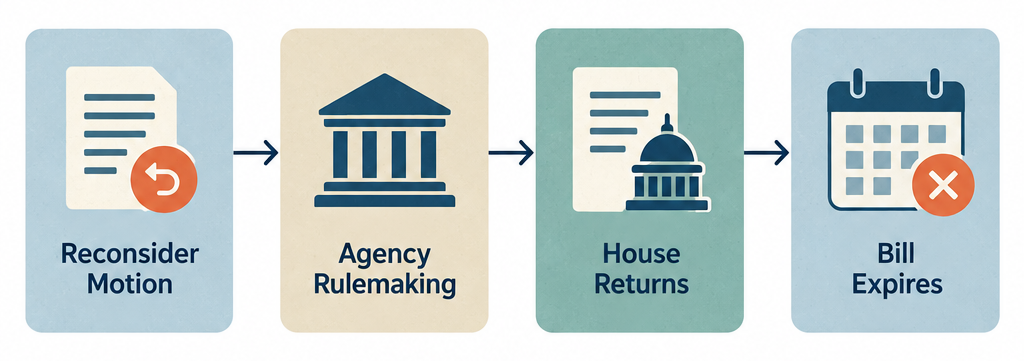
The bill is not formally dead. Tillis’s motion to reconsider is pending in the Congress.gov record. The Cryptonomist reported on October 15, 2026 that no further vote had taken place as of October 14. DLA Piper notes the House adjourned the day after the vote and is due back in November 2026 after the midterms.
Some outlets have called the push over. Crypto outlets including CryptoSlate and CryptoBriefing reported that Polymarket odds of the bill becoming law in 2026 fell to roughly 5% to 7% after the vote, and CoinDesk wrote that the failure “essentially ends market structure legislative work in the Senate for 2026.” These are market and outlet judgments, not official findings. GovTrack labels the bill “provisionally dead.”
Axios reports that SEC Chairman Paul Atkins said the agency will keep advancing crypto policy with or without the legislation. Stocktwits, a retail social and news platform, ran a headline about an industry “Plan B” of agency rulemaking; that article was not retrieved or verified. Law firms Hunton and Orrick separately point to SEC and CFTC rulemaking as the near-term path.
What you should do now
Do not change how you hold or use stablecoins because of this vote. Nothing took effect. If a platform tells you a new law now requires you to move funds, verify your identity again or claim a reward by a deadline, check the platform’s own official channels before you act.
If you earn yield on a stablecoin today, read your platform’s terms to understand what you are being paid for and what protections apply. For questions about your own taxes or legal exposure, talk to a tax professional or a lawyer. A nonprofit credit counselor can help if crypto losses are affecting your debts.
Headlines are not laws
A failed cloture vote changes nothing in your accounts. Be suspicious of any message, post or call that uses the CLARITY Act, the GENIUS Act or “new SEC rules” to pressure you into sending funds, sharing seed phrases or logging in through a link. No official notice from any agency requires consumer action because of this vote.
What we don’t know yet
Whether the Senate will take up the motion to reconsider, and when, is not set. The final shape of any stablecoin yield rule for exchanges is unknown, because only drafts have been reported and none has passed. Which Republican senators opposed the bill on the merits is also unclear: the Daily Press log lists four no votes, Tillis’s was procedural, and Axios and DLA Piper count three opponents. Until the Senate acts again, the federal rules for crypto markets and stablecoin rewards remain undecided.
For the background, see our crypto scams and regulation guides.
Laws and regulations referenced
- GENIUS Act (stablecoins), Public Law 119-27 (S. 1582)
- Digital Asset Market Clarity Act, H.R. 3633 (a bill, check its current status)
Links go to the official text on government sites.
Sources
- U.S. Senate (senate.gov) official roll call record senate.gov · primary source
- Congress.gov, H.R.3633 All Actions congress.gov · primary source
- Senate Democrats floor wrap-up (democrats.senate.gov) democrats.senate.gov · primary source
- U.S. Senate Daily Press Gallery (dailypress.senate.gov) dailypress.senate.gov · primary source

Leah writes US Financer's Consumer Alerts: scam warnings and money rule changes issued by federal agencies, state attorneys general, regulators and courts. Each alert starts from the official notice, says what is confirmed and what is not known yet, and lists the agency's own page…

Ruth is US Financer's standards editor. Every article goes through her checks before and after it is published: each rate, fee, cap, deadline and rule is matched against its primary source, every law named is linked to its official text, and anything that cannot be…
Comments are closed