
SCAM ALERTConsumer alert, published October 17, 2026
The FBI’s Internet Crime Complaint Center issued a public service announcement on October 15, 2026, warning that scammers are using the 2026 midterm election to run financial fraud schemes. The alert, titled “Scammers Exploit 2026 U.S. Midterm Election to Perpetrate Multiple Fraud Schemes,” says the schemes target people across the United States. It updates a similar FBI warning from October 29, 2024.
What is happening
The FBI says criminals are borrowing the names, images, logos and slogans of real candidates. They use them to ask for campaign contributions, to sell merchandise that never arrives, or to collect personal information for later fraud.
The agency also warns that scammers now use artificial intelligence tools. These produce realistic voices, images and written messages that impersonate candidates, campaigns, government offices and people you trust.
The October 15 alert describes three named schemes, plus the broader pattern of impersonation and fake merchandise sales. Some news outlets count that as four scam types. The FBI says these schemes are not new. The same tactics appeared in state and local elections and in its 2024 general election warning.
The scams alert was one of three election-related notices the FBI released on October 15, 2026. The others covered election crimes and threats to election workers. The next day, October 16, 2026, the FBI and the Cybersecurity and Infrastructure Security Agency published a joint alert on phishing and text message scams aimed at election and campaign officials. That notice urges the public to look closely at where their emails and mobile messages really come from.
The FBI’s page states no dollar loss figures.
How the scam works
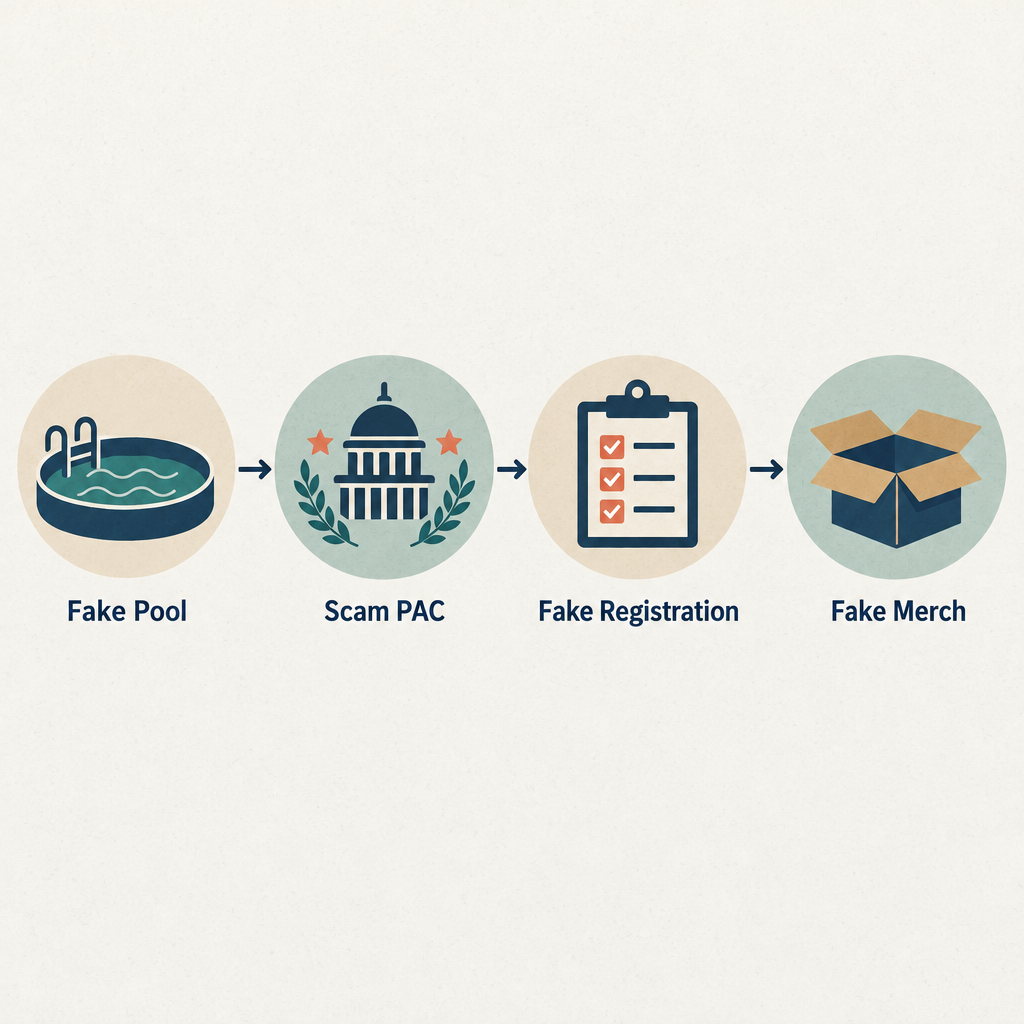
Campaign investment pool. The FBI says scammers promise a guaranteed return on your contribution. The pitch is that your money goes into a “pool” tied to a candidate, and the pool pays out after the candidate wins. Victims are also pushed to recruit friends and family, with the promise of a larger share. The FBI’s 2024 guidance was blunt on this point: a donation to a political campaign will not act as an investment. It will not grow in value and it will not be returned.
Scam PACs. Scammers pose as a legitimate political action committee, such as a Super PAC or a candidate’s own campaign committee. They have no connection to the real group. The FBI says they simply keep the money.
Fake voter registration. You get a text or email claiming you are not registered to vote in your state. It tells you to click a link to fix it. The link leads to a fraudulent registration page that collects your personal information.
Impersonation and fake merchandise. Scammers use a candidate’s branding to sell hats, shirts or other items that are never shipped. Others use the same branding to harvest personal data for identity theft.
How to spot it
The FBI’s alerts point to these warning signs:
- Any promise that a political donation will earn a return, pay out later or come back to you.
- Pressure to recruit other people to “invest” alongside you.
- An unsolicited call, text, email or survey asking for money or personal details.
- A message saying you are not registered to vote, with a link to click. Check your registration through your state’s official election office instead.
- A PAC or Super PAC that reports high spending on fundraising, consulting, compliance or other administrative costs. The FBI notes that some scam PACs may appear registered, so registration alone is not proof.
- Voices, videos or images of a candidate that arrive in a personal message asking you to act fast.
The FBI’s 2024 guidance recommends checking the registration status of a political action or party committee on the Federal Election Commission website before you give.
A donation is not an investment
No real campaign or committee will promise you a payout if a candidate wins. The FBI says contributions do not increase in value and are not returned. If anyone offers you a share of a “candidate pool,” it is a scam.
If you were targeted
- Stop all contact. Do not reply to the message, click any link or send more money.
- If you paid by card or bank transfer, call your bank or card issuer right away using the number on the back of your card and ask about reversing the charge.
- If you entered personal information on a fake registration or donation page, go to IdentityTheft.gov to start a recovery plan.
- Consider placing a credit freeze with the three nationwide credit bureaus so no new accounts can be opened in your name.
- Change passwords on any account that shares the login details you typed into the fake site.
- Save screenshots of the message, the website and any payment records. You will need them when you report.
How to report it
Report election-related fraud to the FBI at ic3.gov. The FBI uses these reports to track and investigate schemes across states.
You can also file a report with the Federal Trade Commission at ReportFraud.ftc.gov. If your personal information was taken, use IdentityTheft.gov.
Contact your state attorney general’s consumer protection office, especially if the scam used a fake state voter registration page. Your state election office can confirm your actual registration status.
If you lost money, call your bank or card issuer using the number on the back of your card. If the loss is large or your identity has been misused, talk to a lawyer or a nonprofit credit counselor about your next steps.
Check, verify or complain
Sources
- FBI / Internet Crime Complaint Center (IC3) – official PSA page ic3.gov · primary source
- FBI / IC3 official 2024 PSA page ic3.gov · primary source
- FBI / IC3 official PSA index ic3.gov · primary source
- CISA / FBI IC3 official pages cisa.gov · primary source

Leah writes US Financer's Consumer Alerts: scam warnings and money rule changes issued by federal agencies, state attorneys general, regulators and courts. Each alert starts from the official notice, says what is confirmed and what is not known yet, and lists the agency's own page…

Ruth is US Financer's standards editor. Every article goes through her checks before and after it is published: each rate, fee, cap, deadline and rule is matched against its primary source, every law named is linked to its official text, and anything that cannot be…
Comments are closed