Runs in your browser. Nothing you type is sent or saved.
This APR calculator takes the interest rate a lender quotes you, adds the upfront fees, and shows the annual percentage rate you are really paying, along with the monthly payment, total interest and total finance charge. You need four numbers from the loan offer: the amount borrowed, the interest rate, the term in months and the fees charged to get the loan.
How to use the APR calculator
- Enter the Loan amount ($) from the offer or contract. For an existing loan, use the original principal on the first statement.
- Enter the Interest rate (%) as the nominal annual rate the lender quotes, not an APR you have already seen.
- Enter the Loan term (months). A five-year loan is 60, a six-year car loan is 72.
- Enter the Upfront fees ($): origination, processing, administrative or document preparation fees that exist only because you are borrowing.
- Read the APR, then the Total finance charge. The second number is what the loan costs you in dollars.
- Change one field at a time and watch the APR move. That shows you which part of the offer is driving the cost.
What each field means and where people go wrong
Loan amount ($)
This is the principal the lender uses to set your payment. On a personal loan it is the number on the approval letter. On a car loan it is the amount financed after your down payment and trade-in, so do not enter the sticker price. Default: $10,000.
The common mistake is subtracting the fee here. If a lender charges a $400 origination fee out of a $10,000 loan, you still enter $10,000, because your payment is calculated on $10,000. The calculator handles the fee separately. If instead the lender adds the fee on top and finances it, enter the full financed balance as the Loan amount and the fee as Upfront fees. The math works either way because it compares what you pay back with the cash you actually received.
Interest rate (%)
Enter the simple annual interest rate from the offer. Lenders usually label it “interest rate” or “note rate.” Default: 10.
Do not type in a monthly rate. A credit card or short-term lender quoting 2% per month is quoting 24% per year, and that is the number this field wants. Also do not enter a rate that already includes fees. If the document only shows an APR and a payment, you can still use the calculator by setting fees to zero and entering the APR as the rate, which gives you the payment and interest but not a second, higher APR.
Loan term (months)
The number of scheduled monthly payments. Default: 60.
Many offers quote the term in years. Multiply by 12. Watch for loans with a shorter contract term and a balloon payment at the end, which this calculator does not model. Short payday or title loans with terms of two weeks or one month do not fit this field either, since payments are not monthly installments.
Upfront fees (origination, processing, etc.) ($)
Any charge you pay to get the credit that you would not pay in a cash transaction. Default: $400. That is 4% of the default loan, which is a realistic origination fee on an online personal loan, where fees commonly run from 1% up to 8% or more of the amount borrowed.
Two mistakes show up here. The first is leaving the field at zero because the fee “comes out of the loan.” It still counts. The second is entering fees that are not finance charges. Under Regulation Z (12 CFR 1026.4), charges you would pay in a comparable cash purchase, such as a dealer’s documentation fee or state title and registration, are not part of the APR. Optional products like GAP coverage or a warranty are also excluded when they are genuinely optional and disclosed in writing. Required credit insurance, by contrast, counts.
The APR formula, explained in plain words
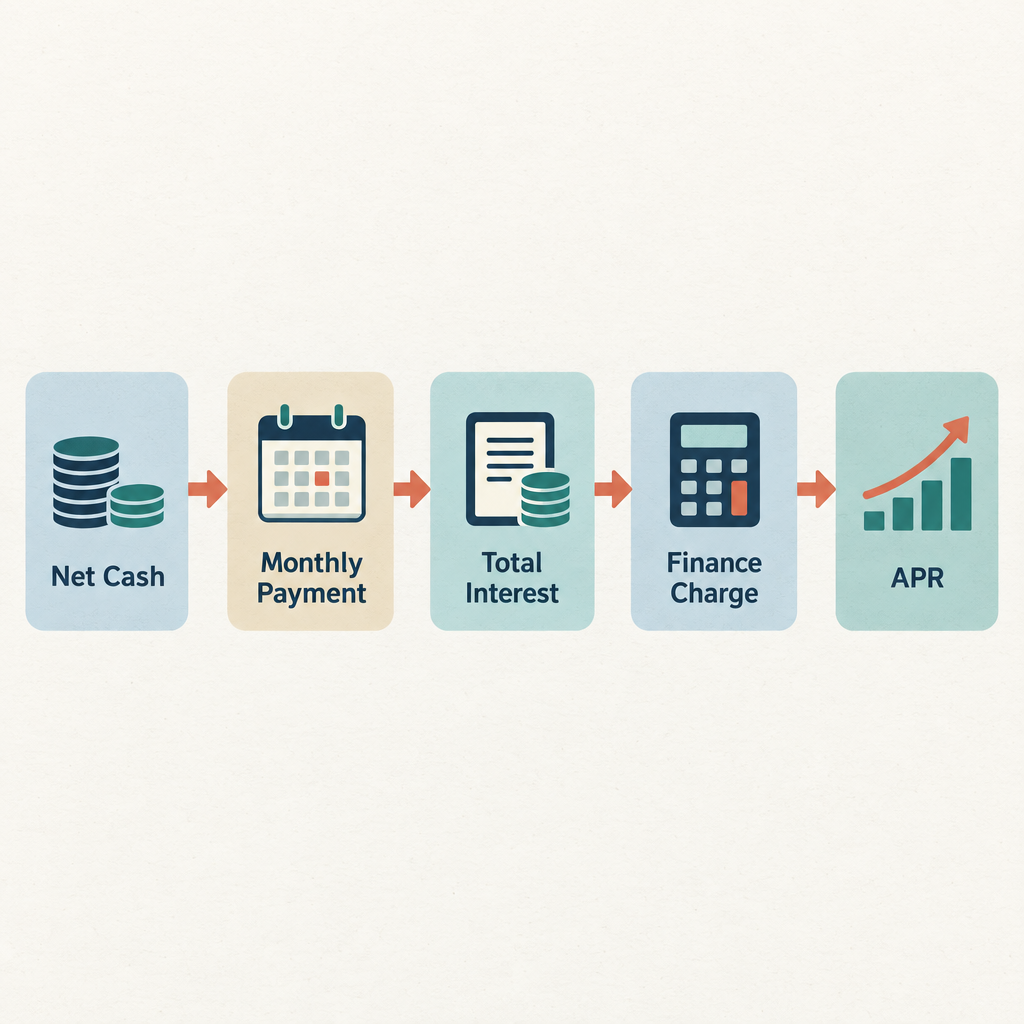
The calculator does two things in order.
First, it computes a standard amortizing monthly payment on the full Loan amount at the Interest rate. That is the same payment a basic loan calculator produces: the balance earns interest at the monthly rate, and a fixed payment pays the balance to zero by the end of the term.
Second, it asks a different question. Given those fixed payments, what annual rate would make them exactly pay off a loan equal to the Loan amount minus the Upfront fees? In other words, what rate are you really paying on the cash that reached your hands? There is no formula that spits this out directly, so the calculator solves for it numerically, testing rates until the present value of the payments equals the net amount. That is the definition the Truth in Lending Act uses, and Regulation Z requires closed-end lenders to disclose an APR computed that way, accurate to within one-eighth of one percentage point.
The Total finance charge is simpler. It is every dollar of interest over the life of the loan plus the upfront fees.
Worked example with the default inputs
Loan amount $10,000, Interest rate 10%, Loan term 60 months, Upfront fees $400.
Step 1, the monthly rate. 10% divided by 12 is 0.8333% per month.
Step 2, the payment. Amortizing $10,000 at 0.8333% per month over 60 payments gives $212.47.
Step 3, total interest. 60 payments of $212.47 total $12,748.23. Subtract the $10,000 principal and total interest is $2,748.23.
Step 4, the finance charge. $2,748.23 of interest plus $400 of fees is $3,148.23.
Step 5, the APR. You received $9,600 in usable cash ($10,000 minus $400) and you repay $212.47 a month for 60 months. The annual rate that makes 60 payments of $212.47 worth exactly $9,600 today is 11.78%.
Step 6, the gap. 11.78% minus 10.00% is 1.78 percentage points. That is the $400 fee expressed as a rate, spread over a balance that shrinks every month for five years.
A second worked example: a six-year car loan
Loan amount $25,000, Interest rate 7%, Loan term 72 months, Upfront fees $600 (a lender origination fee, not the dealer’s doc fee).
Monthly rate: 7% divided by 12 is 0.5833%.
Payment: $25,000 amortized at 0.5833% over 72 payments is $426.22.
Total paid: 72 times $426.22 is $30,688.19. Total interest is $30,688.19 minus $25,000, or $5,688.19.
Finance charge: $5,688.19 plus $600 is $6,288.19.
APR: the cash you effectively received is $24,400. Solving for the annual rate at which 72 payments of $426.22 are worth $24,400 today gives about 7.87%.
Gap: roughly 0.87 percentage points above the 7% note rate. The fee here is a smaller share of the loan (2.4%) and it is spread over a longer term, so it moves the APR less than the $400 fee did on the $10,000 loan.
Here are the two examples side by side.
| Personal loan | Car loan | |
|---|---|---|
| Loan amount | $10,000 | $25,000 |
| Interest rate | 10% | 7% |
| Term | 60 months | 72 months |
| Upfront fees | $400 | $600 |
| Monthly payment | $212.47 | $426.22 |
| Total interest | $2,748.23 | $5,688.19 |
| Total finance charge | $3,148.23 | $6,288.19 |
| APR | 11.78% | 7.87% |
How fees move the APR on the default loan
Everything below keeps $10,000, 10% and 60 months. Only the fee changes, so the payment stays at $212.47.
| Upfront fees | Fee as % of loan | Total finance charge | APR |
|---|---|---|---|
| $0 | 0% | $2,748.23 | 10.00% |
| $200 | 2% | $2,948.23 | 10.88% |
| $400 | 4% | $3,148.23 | 11.78% |
| $600 | 6% | $3,348.23 | 12.71% |
| $1,000 | 10% | $3,748.23 | 14.65% |
A useful rule of thumb from this table: on a five-year loan, every 1% of origination fee adds roughly 0.45 percentage points to the APR.
How the term moves the APR
Same $10,000 at 10% with a $400 fee, different terms.
| Term | Monthly payment | Total interest | Total finance charge | APR |
|---|---|---|---|---|
| 24 months | $461.45 | $1,074.78 | $1,474.78 | 14.11% |
| 36 months | $322.67 | $1,616.19 | $2,016.19 | 12.83% |
| 48 months | $253.63 | $2,174.05 | $2,574.05 | 12.17% |
| 60 months | $212.47 | $2,748.23 | $3,148.23 | 11.78% |
Notice the two columns pull in opposite directions. A shorter term cuts the finance charge by more than half but raises the APR, because the same $400 fee is recovered over fewer months. That is why APR alone can mislead you when comparing loans of different lengths. Compare APR between loans of similar term, and compare the finance charge when the terms differ.
Reading your result
What counts as a high or low APR
There is no single benchmark, but a few regulatory and market reference points help.
Federal credit unions cannot charge more than 18% APR on most loans under the ceiling set by the NCUA board, and their Payday Alternative Loans are capped at 28% APR plus an application fee of no more than $20. The Military Lending Act caps the “Military APR” on most consumer credit to active-duty servicemembers and dependents at 36%. Many consumer advocates and a growing number of states treat 36% as the line between mainstream and high-cost credit. Above that, you are in the territory of installment lenders, and at several hundred percent, payday and title lenders. The CFPB has noted that a typical two-week payday loan charging $15 per $100 borrowed works out to an APR near 400%.
Within those bands, the calculator’s most useful output is the gap between the APR and the interest rate. A gap under half a point means fees are minor. A gap of two or more points on a multi-year loan means the fee is doing real work, and you should ask the lender whether it can be reduced or whether a no-fee offer at a slightly higher rate is cheaper overall.
What to compare between offers
Line up each offer with the same term and run it through the calculator. Compare three numbers in this order:
- Total finance charge, because that is the dollar cost.
- APR, for offers with the same term.
- Monthly payment, last, because a lower payment on a longer term usually means a higher total cost.
If one lender charges a 5% origination fee at 9% and another charges nothing at 11%, the calculator settles it. On $10,000 over 60 months, the 5% fee at 9% gives a finance charge of roughly $2,955 and an APR near 11.2%, while the no-fee 11% loan costs about $3,055 in interest. The fee loan is cheaper in dollars but only by about $100, and if you pay it off early the no-fee loan wins because the fee is sunk on day one.
Cheaper options first
Ask your credit union about a Payday Alternative Loan (capped at 28% APR) or a signature loan before taking a fee-heavy online loan.
Check for an employer advance, a hardship plan from the creditor you are trying to pay, or a 0% payment plan with a nonprofit credit counseling agency.
Run a no-fee offer at a higher rate through the calculator. It is often cheaper if you expect to pay the loan off early.
Before you borrow
The APR shown here assumes you make every payment on time for the full term. One missed payment on a high-cost loan can add late fees and, on some products, trigger default interest that no calculator can predict.
Where cheaper or safer credit usually comes from
Credit union loans, secured loans against a savings account, and federal student loans typically have low or no origination fees. Buy now, pay later plans with four equal payments carry no interest if you pay on time, though late fees apply. Cash advance apps charge “tips” and instant transfer fees that look small but can produce triple-digit APRs on a two-week advance. If you are weighing a small, short loan, run the same fee through the calculator with a longer term to see how much of the cost is really the fee.
For revolving debt the picture is different. Credit cards have no amortization schedule, so a “credit card apr explained” guide and a credit card payoff calculator serve you better than this page.
US rules that apply to APR
Truth in Lending Act and Regulation Z
The Truth in Lending Act requires lenders to disclose the APR and the finance charge before you are obligated on a closed-end loan. Regulation Z (12 CFR 1026) spells out the method: the finance charge includes interest plus any charge imposed as a condition of the credit, such as origination, points and required credit insurance, and the APR is the rate that equates the payments to the amount financed. Section 1026.22 allows a tolerance of one-eighth of one percentage point for regular loans. If a lender’s disclosed APR is lower than what this calculator produces from the same inputs, either a fee has been left out of your inputs or the disclosure is wrong, and you can ask for an explanation in writing.
Mortgages have extra rules. Discount points and origination charges go into the APR, while third-party fees such as appraisal, title and credit report charges are excluded if they are bona fide and reasonable. That is why a mortgage APR sits only a little above the note rate even when closing costs are high.
State rate caps
States set their own ceilings, and they vary widely. Roughly 20 states plus the District of Columbia cap small-dollar consumer loans at or near 36% APR, which effectively bans traditional payday lending. Others license payday lenders under specific fee schedules, and a few, including Texas, allow lenders to operate through credit access business structures that produce very high APRs. Our guide to “texas payday loan laws” walks through that state’s rules in detail. Before signing with any lender, confirm it holds a license from your state regulator and check its record on NMLS Consumer Access.
Military Lending Act
Under the Military Lending Act (10 U.S.C. 987, implemented at 32 CFR 232), covered borrowers cannot be charged a Military APR above 36%. The MAPR is broader than the TILA APR: it folds in credit insurance premiums, add-on products and most application fees. If you are on active duty, or a dependent of someone who is, the result from this calculator will understate the MAPR when those extras exist. The Servicemembers Civil Relief Act separately lets you cut the rate on pre-service debt to 6% during active duty.
Crypto-backed loans
Lenders that advance dollars against cryptocurrency collateral are still subject to state lending laws, and if they extend credit primarily for personal purposes, TILA disclosures apply. The IRS treats cryptocurrency as property under IRS Notice 2014-21, so borrowing against it is not a sale, but a forced liquidation of your collateral when the price drops is a taxable disposition. Any crypto you pledge can lose all of its value and is not FDIC or SIPC insured.
Spotting a fee in disguise
Compare the “amount financed” on the TILA disclosure with the amount you asked to borrow. Any difference is a prepaid finance charge and belongs in the Upfront fees field.
FAQ
Is this a loan APR calculator for any kind of loan?
It works for any fixed-rate installment loan with equal monthly payments: personal loans, auto loans, student loans and fixed-rate mortgages. It does not model adjustable rates, interest-only periods, balloon payments or revolving credit like credit cards.
How do I use this as an apr calculator for a car loan?
Enter the amount financed after your down payment and trade-in, the dealer or lender’s quoted interest rate, the term in months, and only those fees that exist because you are borrowing. A $600 lender origination fee belongs in Upfront fees. The dealer’s documentation fee and state registration generally do not, because you would pay them in a cash sale too. Pair the result with a car payment calculator if you want to test different down payments.
Why is my APR higher than the interest rate?
Because fees are part of the cost of credit. In the default example, a $400 fee on a $10,000, 60-month loan at 10% raises the APR to 11.78%. With fees set to zero, the APR equals the interest rate.
Can the APR be lower than the interest rate?
Not on this calculator, and not on a normal loan. The APR can only equal the rate (no fees) or exceed it. A lender advertising an APR below its interest rate is either describing a promotional rebate or making an error worth questioning.
Does paying a loan off early change the APR?
Yes, in practice. The disclosed APR assumes the full term. If you repay the $10,000 default loan after one year, the $400 fee was spread over 12 months instead of 60, so your effective annual cost is well above 11.78%. That is the main argument for a no-fee loan at a slightly higher rate when you expect to prepay.
What is the difference between APR and the finance charge?
The finance charge is a dollar amount: all interest plus all fees, $3,148.23 in the default example. The APR converts that cost into a yearly rate so loans of the same length can be compared regardless of size. Use the finance charge to compare loans of different terms.
How accurate is the result compared with the lender’s disclosure?
If you enter the same fees the lender counts as prepaid finance charges, the result should match the TILA disclosure within the one-eighth of a percentage point tolerance that Regulation Z allows. Larger differences usually mean a fee was left out, the lender uses daily rather than monthly accrual, or the first payment is due more or less than one month after funding.
Where do I complain if the disclosed APR looks wrong?
Start with the lender in writing. If that fails, file a complaint with the CFPB complaint portal and your state’s financial regulator. For suspected fraud, report to the FTC at ReportFraud and, for online schemes, the FBI’s IC3.
Guides that use this calculator
- How credit card APR and interest work
- Illinois Loan Laws: Payday, Title and Installment Rules
- Tennessee Loan Laws: Payday, Title and Installment Rules
- Delaware Loan Laws: Payday, Title and Installment Rules
- Ohio Loan Laws: Payday, Title and Installment Rules
- Florida Loan Laws: Payday, Title and Installment Rules
Comments are closed