Payday loans are legal in Florida, but only from lenders licensed by the Florida Office of Financial Regulation under the Deferred Presentment Act, Part IV of Chapter 560, Florida Statutes. A single-payment payday loan is capped at $500, the fee cannot exceed 10% of the amount borrowed plus a small verification fee, and you may hold only one such loan at a time anywhere in the state. This page covers those rules plus car title loans, installment loans, online and tribal lenders, debt collection limits and where to complain.
Run the numbers
Payday and short-term loans in Florida
Florida does not use the words “payday loan” in its statutes. The legal name is a deferred presentment transaction: you write a check or authorize an electronic debit, the lender gives you cash now and agrees to hold the check until a later date. Every company offering this product must hold a money services business license under Part II or Part III of Chapter 560 and must declare its deferred presentment activity to the state under s. 560.403, F.S. Operating without that license is a crime under Chapter 560, and the state keeps a public list of who is licensed.
Since July 1, 2019, Florida has had two legal payday products, both governed by s. 560.404, F.S. The first is the traditional single-payment loan. The second, created by Chapter 2018-26, Laws of Florida (the 2018 bill signed by Governor Scott and often called the “2019 legislation”), is a deferred presentment installment transaction that can run larger and longer. The rules differ, so the table below separates them.
| Rule | Single-payment deferred presentment | Deferred presentment installment |
|---|---|---|
| Statute | s. 560.404, F.S. | s. 560.404, F.S. (added 2018, effective 2019) |
| Maximum amount | $500, excluding fees | $1,000, excluding fees |
| Term | 7 to 31 days | 60 to 90 days |
| Fee cap | 10% of the amount advanced | 8% of the outstanding balance every two weeks |
| Verification fee | Up to $5, set by OFR rule | Up to $5, set by OFR rule |
| Rollovers | Prohibited | Prohibited |
| Loans at once | One, statewide | One, statewide |
| Cooling-off | 24 hours after paying off | 24 hours after paying off |
| Prepayment penalty | None allowed | None allowed |
What the fee cap means in dollars
A 10% fee sounds modest until you convert it to an annual percentage rate, which federal law under the Truth in Lending Act and Regulation Z (12 CFR 1026) requires the lender to disclose in writing before you sign. The worked examples below use the maximum fee and the $5 verification fee that Florida Administrative Code Rule 69V-560.801 permits.
| Loan | Fee | Term | Total repaid | APR (plain math) |
|---|---|---|---|---|
| $500 single-payment | $50 + $5 verification | 14 days | $555 | $55 ÷ $500 = 11%; 11% × (365 ÷ 14) ≈ 287% |
| $500 single-payment | $50 + $5 verification | 31 days | $555 | 11% × (365 ÷ 31) ≈ 130% |
| $300 single-payment | $30 + $5 verification | 14 days | $335 | $35 ÷ $300 = 11.7%; × 26.07 ≈ 304% |
| $1,000 installment | 8% biweekly on balance + $5 | 6 biweekly payments (84 days) | about $1,303 | 8% × 26 periods ≈ 208% |
The installment figure assumes six equal biweekly payments of roughly $216 on a declining balance, which is how the statute requires the 8% charge to work. Shorter single-payment loans carry the highest APR because the same flat fee is spread over fewer days. Lenders quote the fee, consumer advocates quote the APR, and both are legally accurate descriptions of the same transaction.
Rollovers, the database and the 24-hour rule
Florida bans rollovers outright. A licensed provider cannot renew, extend, refinance or “roll” a deferred presentment loan into a new one, and cannot accept a new check to pay off an old one. To enforce this, s. 560.404 requires every provider to check a statewide database, operated by a vendor under contract with OFR, before each transaction. The database records whether you already have an open deferred presentment loan, single-payment or installment, with any lender in Florida. If you do, the provider must refuse.
After you pay off a loan, the database also enforces a 24-hour waiting period before any provider can make you a new one. The Center for Responsible Lending’s analysis of OFR database data has long argued that this gap is too short to break the cycle, finding that the large majority of Florida payday loans went to borrowers taking seven or more loans per year. Florida’s Legislature has not lengthened the cooling-off period, and no bill to do so was moving as of late 2025.
The 60-day grace period you can claim
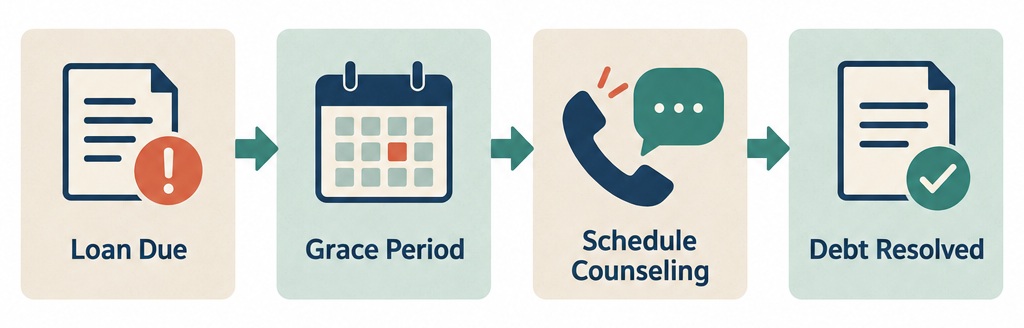
Section 560.404 gives you a right that most states do not. If you cannot redeem your check at the end of the term, the provider must grant a 60-day grace period with no additional charges, on two conditions. You must make an appointment with a consumer credit counseling agency within 7 days after the loan’s end date, and you must complete the counseling within the 60 days. The provider cannot deposit your check, charge a fee or pursue collection during the grace period as long as you meet those conditions. Ask the lender for its written grace-period notice; the statute requires one.
Criminal threats and bounced checks
Florida’s deferred presentment statute bars a provider from using your check as the basis for a worthless-check prosecution and from threatening criminal action over an unpaid loan. A payday debt in Florida is a civil debt. Anyone who tells you that the sheriff will arrest you for a payday loan is either a rogue lender or, far more often, a scammer, which the section on complaints below addresses.
Same-day loans and “bad credit” offers
Licensed storefront providers in Florida routinely fund single-payment loans the same day, and licensed online providers typically send an ACH credit by the next business day. The speed does not change the law: the $500 or $1,000 cap, the fee cap and the database check apply to every licensed deferred presentment loan regardless of how fast it is funded. Nothing in Chapter 560 requires a credit score, and most providers rely on your income and the state database rather than a traditional credit report. “No credit check” advertising in Florida usually means exactly that, but the price you pay for skipping the credit check is the APR in the table above, not a lower one.
Car title loans in Florida
Title lending in Florida is governed by the Florida Title Loan Act, Chapter 537, Florida Statutes, enacted in 2000 after years of complaints about 264% APR title loans under an earlier pawn-style law. The Act limits what a licensed title lender can charge, and the limits are strict enough that the licensed title loan industry in Florida is now tiny compared with Georgia, Alabama or Texas. Several national chains have no Florida title loan license at all.
| Rule | Florida Title Loan Act requirement | Citation |
|---|---|---|
| Who may lend | Only a title loan lender licensed by OFR | s. 537.004, F.S. |
| Interest cap | 30% per year on the first $2,000; 24% on $2,000.01 to $3,000; 18% above $3,000 | s. 537.011, F.S. |
| Term | 30 days, extendable in 30-day periods by written agreement | s. 537.011, F.S. |
| Possession | You keep driving the car; the lender holds the title | Chapter 537 generally |
| Repossession and sale | Written notice before sale, right to redeem, surplus returned to you | s. 537.012, F.S. |
A $1,000 title loan at the 30% cap set by s. 537.011, F.S., costs about $24.66 in interest for 30 days ($1,000 × 0.30 × 30 ÷ 365), for a total of roughly $1,025. That is the figure a licensed Florida title lender can lawfully charge. If a storefront quotes you $250 a month on a $1,000 title loan, which would be common in a state with no cap, the loan is either unlicensed or is not actually a Chapter 537 title loan.
Why many Florida “title loans” are something else
Because Chapter 537 caps interest at 30%, some lenders instead make a consumer finance loan under Chapter 516 and take your car title as collateral. That is legal if the lender holds a Chapter 516 consumer finance license, and the loan then follows Chapter 516’s interest tiers and repossession rules rather than Chapter 537’s. Read the contract heading. If it says “consumer finance loan” or “installment loan secured by motor vehicle,” the title loan protections in s. 537.012 do not apply, and the lender’s default and repossession rights come from the Uniform Commercial Code as adopted in Chapter 679, Florida Statutes.
Repossession in Florida does not require a court order for either product, but the lender cannot breach the peace. Breaking into a locked garage, threatening you or lying about having legal authority are breaches of the peace that can make the lender liable. After repossession, you are entitled to written notice of the sale and to any surplus the sale brings in above what you owe plus reasonable costs. Any personal property left in the car remains yours.
Installment and personal loans in Florida
For loans larger than a payday loan or longer than 90 days, the governing statute is the Florida Consumer Finance Act, Chapter 516, Florida Statutes. It covers loans of $25,000 or less made by nonbank lenders, from storefront finance companies to most online installment lenders that market to Florida residents. Banks and credit unions follow their own federal and state charters and are not Chapter 516 licensees.
Chapter 516 sets tiered maximum rates in s. 516.031, F.S. For decades the tiers were 30% per year on the first $3,000 of principal, 24% on the portion between $3,000 and $4,000, and 18% on the portion above $4,000. The 2024 Legislature passed HB 1347, effective July 1, 2024, which raised the tiers substantially: 36% per year on the first $10,000, 30% on the portion between $10,000 and $20,000, and 24% on the portion between $20,000 and $25,000. Because the change is recent and the published statute text is the only authoritative version, confirm the current s. 516.031 on the Florida Legislature’s website before relying on any figure in a lender’s advertisement.
Other Chapter 516 rules that matter to you:
- A lender may charge one delinquency fee on an installment only after it is 10 or more days late, in an amount fixed by s. 516.031 (the 2024 amendment raised it as well).
- Interest must be computed on the unpaid principal balance, not added up front, and you may prepay at any time without penalty.
- The lender must be licensed by OFR for each location, and s. 516.02 states that a loan made in violation of the chapter is void and the lender has no right to collect principal, interest or charges.
- Credit insurance may be sold but cannot be required as a condition of the loan.
| Loan | Rate | Term | Monthly payment | Total repaid |
|---|---|---|---|---|
| $2,000 consumer finance loan | 36% (current first-tier cap) | 12 months | about $201 | about $2,411 |
| $2,000 consumer finance loan | 30% (pre-2024 cap) | 12 months | about $195 | about $2,338 |
| $5,000 consumer finance loan | 36% | 24 months | about $295 | about $7,084 |
The 36% figure matches the Military Lending Act ceiling and is the rate most consumer groups treat as the upper boundary of “affordable” small-dollar credit. It is still expensive. On the $5,000 example, more than $2,000 of your payments go to interest.
Installment loans for bad credit in Florida
Chapter 516 lenders are the main source of installment loans for borrowers with scores below 600 in Florida, and they typically report to at least one credit bureau, which a payday lender usually does not. Pricing clusters at or near the cap for subprime applicants, so you should expect the 36% tier rather than the single-digit rates banks advertise. Loans above $25,000, or loans from lenders that are not Chapter 516 licensees, fall under Florida’s general usury law in Chapter 687, which caps simple interest at 18% per year under s. 687.02, F.S. and treats anything over 25% as criminal usury under s. 687.071, F.S. Our article on usury laws explains how those two statutes interact with licensed-lender exemptions.
Online and tribal lenders
Florida law applies to any lender that makes loans to Florida residents, regardless of where the lender’s servers or offices sit. An online company offering deferred presentment loans must hold the same Chapter 560 license as a storefront, and an online installment lender must hold a Chapter 516 license. OFR has stated this position repeatedly in consumer alerts and has issued cease-and-desist orders against unlicensed online lenders. Loans that violate Chapter 516’s licensing requirement are void under s. 516.02, F.S., which gives you a strong defense if an unlicensed lender sues.
Tribal lenders are the exception that causes the most confusion. A lender owned by a federally recognized tribe will claim sovereign immunity from Florida law and will quote APRs of 400% to 700% that no Florida licensee could charge. Courts have split on whether that immunity extends to loans made to consumers off tribal land, and the Consumer Financial Protection Bureau and several state attorneys general have sued tribal lending operations over the years. The practical reality for you is that OFR cannot license, examine or easily discipline a tribal lender, so its only remedy may be a public warning. Federal law still applies: the Truth in Lending Act requires an APR disclosure, the Electronic Fund Transfer Act (and Regulation E, 12 CFR 1005) bars conditioning the loan on preauthorized electronic repayment, and the Military Lending Act caps the rate for covered service members at 36%.
How to check a lender's Florida license
- Open the Florida Office of Financial Regulation’s online license verification search at flofr.gov and search by company name.
- Confirm the license type: “money services business” with deferred presentment authority for payday loans, “consumer finance” for installment loans, “title loan lender” for Chapter 537 loans.
- Check that the licensed name matches the name on your contract and that the license is active, not surrendered or revoked.
- For any lender claiming to be a bank, search the FDIC’s BankFind; for a credit union, search the NCUA’s Credit Union Locator.
- Search the CFPB’s public complaint database for the company name to see what other borrowers have reported.
If a lender does not appear in OFR’s search and is not a chartered bank or credit union, treat every promise it makes as unenforceable against you and probably illegal for it to make. Florida’s deferred presentment database also will not contain the loan, which means an unlicensed lender cannot see your other loans and will happily stack a fourth and fifth one on top.
Debt collection and wage garnishment limits in Florida
Florida gives you two layers of protection against abusive collection. The federal Fair Debt Collection Practices Act covers third-party collectors and debt buyers everywhere. Florida’s own law, the Florida Consumer Collection Practices Act (FCCPA), ss. 559.55 to 559.785, Florida Statutes, goes further by covering original creditors, including the payday lender, title lender or finance company that made your loan.
What collectors in Florida cannot do
Section 559.72, F.S., lists the prohibited practices. Among them, no person collecting a consumer debt in Florida may:
- Contact you between 9 p.m. and 8 a.m. in your time zone without your prior consent.
- Communicate with your employer about the debt before obtaining a judgment, except to verify employment.
- Contact you directly once they know you are represented by an attorney on the debt.
- Threaten force, violence, arrest or criminal prosecution, or claim to be an attorney or government agent when they are not.
- Simulate legal process, use profane language, or disclose the debt to anyone who does not have a legitimate business need for it.
- Attempt to collect a debt they know is not legitimate, or assert the existence of a legal right they know does not exist.
A collector that violates s. 559.72 is liable under s. 559.77, F.S., for your actual damages, statutory damages of up to $1,000 per lawsuit, punitive damages where warranted and your attorney’s fees. You must sue within two years. Separately, every consumer collection agency doing business in Florida must register with OFR under s. 559.553, F.S., and you can look up a registration the same way you look up a lender.
Statute of limitations on loan debt
Under s. 95.11(2)(b), F.S., a creditor has five years from the date of breach to sue on a written contract, which covers nearly every loan agreement. An oral contract or open account gets four years under s. 95.11(3). Once a creditor wins a judgment, that judgment can be enforced for 20 years. The limitations period is a defense you must raise in court; a collector can still call, write and request payment on a time-barred debt, although it cannot sue or threaten to sue. Making a payment or a written acknowledgment of the debt can restart the clock, so get advice before paying anything on an old account.
Wage garnishment limits
A creditor needs a court judgment before it can garnish wages in Florida, and the exemptions in s. 222.11, F.S., are among the most generous in the country for anyone who supports a dependent.
| Your status | Disposable earnings | What a judgment creditor can take |
|---|---|---|
| Head of family | $750 per week or less | Nothing |
| Head of family | More than $750 per week | Nothing, unless you agreed to garnishment in writing; then the federal limit applies |
| Not head of family | Any amount | Federal limit under 15 U.S.C. 1673: the lesser of 25% of disposable earnings or the amount above 30 times the federal minimum wage ($217.50 per week at $7.25) |
“Head of family” means you provide more than half the support for a child or other dependent. Section 222.11(3) extends the exemption to wages deposited into your bank account for six months, as long as you can trace them. To use the exemption you must file a claim of exemption with the court within the deadline on the garnishment notice, usually 20 days, so do not ignore court papers. Social Security, SSI, veterans’ benefits and most public assistance are exempt under federal law regardless of your family status, and banks must protect two months of directly deposited federal benefits automatically under 31 CFR Part 212.
Florida’s homestead exemption in Article X, Section 4 of the Florida Constitution protects your primary residence from most judgment creditors without a dollar limit, subject to acreage limits. That protection is a major reason unsecured lenders in Florida push hard for voluntary payment plans rather than lawsuits.
Federal rules that apply everywhere
Three federal laws sit on top of every Florida rule above. The Truth in Lending Act and Regulation Z (12 CFR 1026) require a written disclosure of the APR, finance charge, amount financed and total of payments before you become obligated, for payday, title and installment loans alike. The Military Lending Act (10 U.S.C. 987, implemented at 32 CFR Part 232) caps the Military Annual Percentage Rate at 36% for active-duty service members and their dependents, bars mandatory arbitration and bars taking a vehicle title as security, which effectively prohibits standard payday and title loans to that group. The Fair Debt Collection Practices Act (15 U.S.C. 1692 and following) governs third-party collectors and debt buyers, and the CFPB’s Regulation F (12 CFR 1006) limits them to seven call attempts per week per debt and requires a validation notice. The Fair Credit Reporting Act gives you the right to dispute any inaccurate loan or collection account on your credit report.
Help that costs less
Every product above costs more than the alternatives in this section. Florida’s rules make payday loans less dangerous than in Texas or Missouri, but a 287% APR is still a last resort.
Cheaper options first
Federal credit union payday alternative loans cost no more than 28% APR under NCUA rules.
Your creditors’ hardship plans and a nonprofit credit counseling agency cost little or nothing.
Florida’s Temporary Cash Assistance, LIHEAP and 2-1-1 referrals are free if you qualify.
Credit union payday alternative loans
Federal credit unions may offer Payday Alternative Loans under NCUA regulation 12 CFR 701.21(c)(7). A PAL I is $200 to $1,000 for one to six months; a PAL II is up to $2,000 for up to 12 months. The APR cannot exceed 28%, the application fee cannot exceed $20, and no rollovers are permitted. You generally need to have been a member for one month (PAL II has no waiting period). Florida has dozens of community-chartered credit unions whose membership is open to anyone living or working in a county or region, and many state-chartered credit unions offer a similar small loan at under 36%. A $500 PAL for three months costs around $20 in interest plus the application fee, against $55 for a two-week payday loan.
Employer and app advances
Earned wage access apps and employer advance programs are not regulated as loans under Chapter 560 in Florida, and the Legislature has not enacted a specific earned wage access statute as of late 2025. Many charge nothing if you accept standard delivery and ask for an optional tip; the expedite fees and tips can still add up to a triple-digit APR on a small amount, so decline both when you can wait a day or two. Your employer’s payroll department may also offer a one-time advance against earned hours at no cost.
Nonprofit credit counseling and debt management
If the problem is a pile of existing debts rather than a one-time shortfall, a nonprofit credit counseling agency can set up a debt management plan that consolidates unsecured payments and often lowers interest rates. Florida regulates credit counseling and debt management organizations under ss. 817.801 to 817.806, Florida Statutes, which caps the fees they can charge and requires that your payments be held in trust. Look for agencies accredited by the Council on Accreditation and approved by the U.S. Trustee Program. For-profit debt settlement is a different business: the FTC’s Telemarketing Sales Rule (16 CFR 310.4(a)(5)) bars those companies from charging any fee before they settle a debt and you make a payment on the settlement, and settlement often damages your credit for years. Chapter 7 or Chapter 13 bankruptcy, with Florida’s homestead and head-of-family exemptions, can be cheaper than years of settlement fees; a consultation with a Florida bankruptcy attorney or Legal Services of Florida is usually free.
Florida financial assistance programs that exist
These programs are run by Florida agencies or their contracted local partners. None of them charge fees, and none require a credit check.
| Program | What it provides | Who runs it |
|---|---|---|
| Temporary Cash Assistance (TCA) | Monthly cash for low-income families with children, time-limited | Florida Department of Children and Families, through the ACCESS Florida portal |
| SNAP (food assistance) | Monthly benefits on an EBT card for groceries | Florida Department of Children and Families, ACCESS Florida |
| LIHEAP | Help with electric and gas bills, including crisis assistance for disconnection notices | Florida Department of Commerce, delivered by local community action agencies |
| EHEAP | Energy bill help for households with a member age 60 or older | Florida Department of Elder Affairs, through Area Agencies on Aging |
| Weatherization Assistance Program | Free energy-efficiency repairs to cut utility bills | Florida Department of Commerce, local agencies |
| Florida KidCare and Medicaid | Low-cost or free health coverage for children and eligible adults | Florida Healthy Kids Corporation and the Agency for Health Care Administration |
| 2-1-1 | Referrals to local rent, utility, food and prescription help | Regional 2-1-1 providers, by phone or text |
Florida’s county governments also run emergency assistance offices (Miami-Dade Community Action and Human Services, Hillsborough County Social Services, Orange County Family Services and others) that pay a one-time rent or utility bill for residents facing eviction or disconnection, funded partly by federal Community Services Block Grant money. Utility companies including FPL, Duke Energy Florida and TECO partner with the Salvation Army or Catholic Charities on bill assistance funds. A phone call to 2-1-1 is the fastest route to whatever is open in your county this month.
How to check a lender and file a complaint
The Florida Office of Financial Regulation, headquartered in Tallahassee, is the licensing agency for payday lenders, title lenders, consumer finance companies, collection agencies, money transmitters and check cashers. Its official website is flofr.gov, and its Division of Consumer Finance handles licensing and examinations. OFR’s consumer helpline is (850) 487-9687, and the online complaint form is on the same site. OFR investigates licensees and unlicensed activity, can revoke licenses and refer criminal cases to the state attorney, but it cannot represent you in a lawsuit or order a refund in a private dispute.
For federal remedies, file with the Consumer Financial Protection Bureau at consumerfinance.gov/complaint or by phone at (855) 411-2372. The CFPB forwards the complaint to the company, which must respond within 15 days, and publishes the complaint (without your identity) in its public database. Payday, title and installment lenders, collectors and credit bureaus are all within its jurisdiction. Complaints about deceptive advertising or scams can also go to the Florida Attorney General’s Consumer Protection Division at 1-866-9-NO-SCAM (1-866-966-7226) and the FTC at ReportFraud.ftc.gov. Online lending fraud involving a fake company goes to the FBI’s Internet Crime Complaint Center at ic3.gov.
Payday loan scams that target Floridians
OFR and the Florida Attorney General both warn about a specific fraud that follows people who have ever applied for a payday loan online. A caller claiming to be a collector, process server or “pre-litigation” officer says you owe on an old payday loan and will be arrested or served at work unless you pay immediately by gift card, wire or prepaid debit. The caller often has your Social Security number and bank details, harvested from a lead-generation site you once filled out. Red flags:
- Threats of arrest, jail or “criminal charges” for a loan. Florida law bars this even for real payday debts.
- Demand for payment by gift card, cryptocurrency, wire transfer or payment app.
- Refusal to mail a written validation notice, which the FDCPA requires within five days of first contact.
- A company name that does not appear in OFR’s collection agency registry.
- Pressure to pay a “settlement” within the hour.
Hang up, pull your credit reports at the free federally authorized site to see whether any such account exists, and report the call to the Attorney General and the FTC. If you did have a real loan from a licensed lender, call that lender directly using the number on your contract, never the number the caller gives you.
Before you borrow
A Florida payday loan at the legal maximum costs 11% of the amount borrowed in two weeks, close to 287% APR, and the 24-hour cooling-off period does little to stop a chain of back-to-back loans that OFR data shows most borrowers fall into. Exhaust the credit union, employer and assistance options above first, and never borrow from a company you cannot find in OFR’s license search.
How Florida compares to other states
Florida sits in the middle of the national range. The caps are real and enforced through a statewide database, which puts the state ahead of Texas, where the “credit access business” model leaves fees effectively uncapped, and Missouri, which permits fees adding up to 75% of principal over a loan’s life. Florida is far more permissive than the states that cap all small loans at 36% APR and effectively ban payday lending. Readers comparing our coverage of texas payday loan laws, california payday loan laws, alabama payday loan laws, missouri payday loan laws and wisconsin payday loan laws will notice that Florida is the only state in that group with a mandatory 60-day no-cost grace period tied to credit counseling, and one of the few with a statewide real-time database.
| State | Max single-payment loan | Fee or rate cap | Database |
|---|---|---|---|
| Florida | $500 | 10% + $5 verification | Yes, statewide |
| California | $300 | 15% of face amount | No statewide database |
| Alabama | $500 | 17.5% of amount advanced | Yes, statewide |
| Missouri | $500 | Fees up to 75% of principal over the loan | No |
| Texas | No statutory cap via CAB model | No effective cap | No |
Where Florida law has changed or could change
The last major change was Chapter 2018-26, which added the $1,000 installment product in 2019 in anticipation of a federal CFPB underwriting rule that was later rescinded. The 2024 amendment to Chapter 516 raised consumer finance loan rates, as discussed above. Bills to cap all small loans at 36% APR have been filed in several Florida sessions and have not advanced out of committee. At the federal level, the CFPB’s Payday Lending Rule’s payment-withdrawal provisions (12 CFR Part 1041) took effect in March 2025 after years of litigation, barring lenders from making more than two consecutive failed debit attempts on your account without new authorization; that protection applies to Florida payday and short-term title loans. If you reach a dead end with a lender or collector, our guide to financial dispute resolution covers arbitration, small claims and regulator complaints in more detail.
FAQ
How many payday loans can I have at once in Florida?
One. Section 560.404, F.S., limits you to a single open deferred presentment transaction statewide, and licensed lenders must confirm that through the OFR database before funding. After you pay it off, you must wait 24 hours before taking another. If a lender gives you a second loan while the first is open, it is either unlicensed or breaking the law, and OFR wants to know.
Can a payday lender in Florida garnish my wages?
Only after suing you and winning a judgment, and then only within the limits of s. 222.11, F.S. If you are head of family earning $750 or less per week in disposable pay, your wages cannot be garnished at all. The lender also cannot contact your employer about the debt before judgment under the Florida Consumer Collection Practices Act.
Is it legal for a title loan company in Florida to charge 25% a month?
No. The Florida Title Loan Act caps interest at 30% per year on the first $2,000, which is 2.5% per month, with lower rates above that. A lender quoting 25% per month is either unlicensed or is making a consumer finance loan under Chapter 516 with your title as collateral, and the Chapter 516 caps are also far below that figure. Check the license at flofr.gov and report the lender if it does not appear.
What happens if I cannot pay my Florida payday loan on time?
You are entitled to a 60-day grace period with no added fees, as long as you schedule credit counseling within 7 days after the due date and complete it within the 60 days. The lender cannot threaten arrest or criminal prosecution over the check. If the loan goes to collection, both the FDCPA and Florida’s FCCPA limit how collectors may contact you, and the lender has five years to sue under s. 95.11.
Can I get a loan with bad credit in Florida without using a payday lender?
Yes, though the rate will still be high. Chapter 516 consumer finance companies lend to subprime borrowers at up to the statutory tiers, and federal credit union payday alternative loans cap out at 28% APR regardless of score. Secured credit cards, credit-builder loans from community development credit unions and employer advances are also open to borrowers with damaged credit and cost far less than deferred presentment.
Where do I report an unlicensed online lender that gave me a loan in Florida?
File with the Florida Office of Financial Regulation at flofr.gov or (850) 487-9687, the CFPB at consumerfinance.gov/complaint, and the Florida Attorney General at 1-866-9-NO-SCAM. Keep copies of the loan agreement, every email and your bank statements showing the debits. Under s. 516.02, F.S., a loan made in violation of the Consumer Finance Act’s licensing rules is void, which is your defense if the lender or a collector ever sues.
Laws and regulations referenced
- Truth in Lending Act, 15 U.S.C. 1601
- Regulation Z, 12 CFR Part 1026
- Fair Debt Collection Practices Act, 15 U.S.C. 1692
- Regulation F (debt collection), 12 CFR Part 1006
- Fair Credit Reporting Act, 15 U.S.C. 1681
- Electronic Fund Transfer Act, 15 U.S.C. 1693
- Regulation E (electronic transfers), 12 CFR Part 1005
- Military Lending Act, 10 U.S.C. 987
- Military Lending Act rule, 32 CFR Part 232
- CFPB payday lending rule, 12 CFR Part 1041
- Bankruptcy Code, Chapter 13, 11 U.S.C. 1301
Links go to the official text on government sites.
Check, verify or complain
Sources
- flsenate.gov › Session › Bill › 2024 › 1347 › Analyses › h1347z1.IBS.PDF flsenate.gov · primary source
- flsenate.gov › Laws › Statutes › 2022 › Chapter687 › All flsenate.gov · primary source
- wmnf.org › florida governor signs bill for higher interest rates consumer loans wmnf.org

Elena writes about getting through a money emergency, assistance programs, budgeting on a tight income, banking basics and borrower rights. Her guides list the cheaper options first and link the agency or program that can actually help.

Ruth is US Financer's standards editor. Every article goes through her checks before and after it is published: each rate, fee, cap, deadline and rule is matched against its primary source, every law named is linked to its official text, and anything that cannot be…
Comments are closed