

We do not lend money or arrange loans. Rates and rules change and differ by state, so check the lender's own disclosure before you sign.
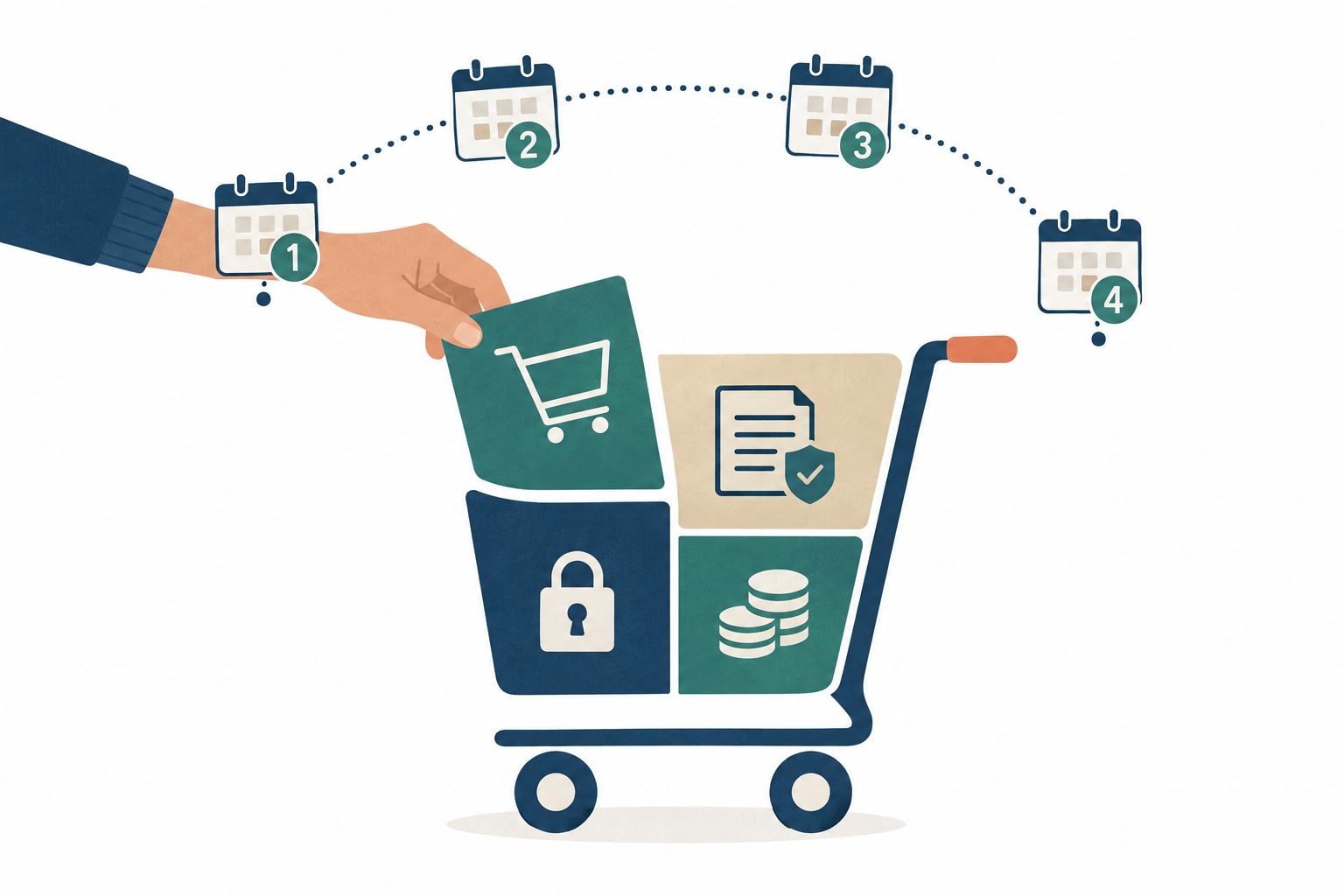
Pay in 4 splits a purchase into four equal payments. You pay the first at checkout and the other three every two weeks, so you finish in six weeks. Most pay in 4 apps charge no interest if you pay on time, so the real costs are late fees, installment fees in some states, and the risk of running several plans at once.
WARNINGRelated consumer alert, Oct 17
FTC warns 97 auto dealer groups to advertise the total price car buyers payRun the numbers
Before you borrow
Every pay in 4 plan pulls money from your account automatically. If several plans hit the same week as rent or a bill, you can face late fees from the provider and overdraft fees from your bank.
How pay in 4 works
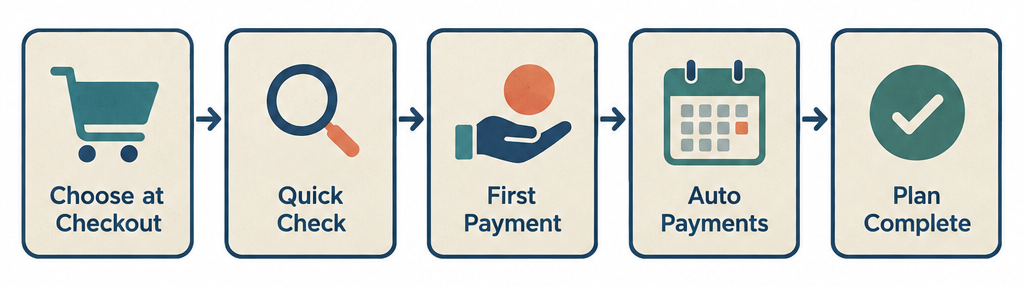
Pay in 4 is a form of buy now, pay later (BNPL). It is a short-term loan, even though checkout pages rarely use that word. Here is how a typical plan runs:
- You choose the option at checkout. You pick it online or in the provider’s app. Some apps also issue a virtual card for stores that don’t partner with them directly.
- The provider runs a quick check. This is usually a soft credit inquiry plus a look at your history with the app. A soft check does not lower your score, but it can still lead to a denial.
- You pay 25% up front. On a $200 order, that is $50 today.
- The rest is charged automatically. Three more $50 payments come out every two weeks from your debit card, bank account or, with some providers, a credit card.
- The store gets paid in full right away. The merchant pays the BNPL company a fee, which is how interest-free plans make money.
Approval amounts vary by purchase, store and your record with the app. New users often get small limits that rise after several on-time plans.
Why it is always “4”
The number comes from federal law. Under Regulation Z (12 CFR 1026), which carries out the Truth in Lending Act, a “creditor” is someone who regularly offers credit that has a finance charge or is repayable in more than four installments. A plan with four or fewer payments and no finance charge falls outside that definition. That is why most split payment plans stop at four and charge no interest.
The practical result is that pay in 4 plans usually don’t come with the standard Truth in Lending disclosures. You won’t see the APR box you get with a credit card or an installment loan. The CFPB tried to close part of that gap in May 2024 with an interpretive rule that treated BNPL lenders like credit card issuers for disputes and refunds. In May 2025, it said it would not prioritize enforcing that rule and moved to withdraw it. Don’t count on card-style dispute rights from a BNPL provider unless its own terms promise them.
What the major pay in 4 apps charge
Fees separate one app from another more than interest does. The table below summarizes the providers’ published US terms as of 2025. Terms change often and can differ by state, so check the provider’s current terms page before you use it.
| Provider | Payment schedule | Interest on pay in 4 | Late fees | Credit check |
|---|---|---|---|---|
| Affirm | Every 2 weeks | 0% | None | Soft check |
| Klarna | Every 2 weeks | 0% | Up to $7 per missed payment | Soft check |
| Afterpay | Every 2 weeks | 0% | Capped at 25% of order value | No hard check |
| PayPal Pay in 4 | Every 2 weeks | 0% | None | Soft check |
| Zip | Every 2 weeks | Installment fees vary by state | Vary by state | Soft check |
| Sezzle | Every 2 weeks | 0% | Fees for rescheduling and failed payments | Soft check |
Each option has trade-offs. Affirm and PayPal charge no late fees, but a missed payment can still hurt your standing with the app and, in Affirm’s case, your credit file. Affirm began reporting its pay in 4 loans to Experian in 2025. Klarna and Afterpay charge flat late fees that add up quickly on small orders. Zip’s per-order fees mean “interest-free” is not the same as “free.” Sezzle and some others also sell paid subscription tiers, which add a monthly cost to what looks like a no-cost product.
Apple also left this market. Apple Pay Later shut down in 2024. Apple now offers installment plans from outside lenders such as Affirm inside Apple Pay, so the loan terms are the lender’s, not Apple’s.
What pay in 4 really costs: worked examples
Interest-free is only true if every payment clears on time. The examples below are illustrations built from the fee types in the table above. They are not quotes from any one provider.
| Scenario | Amount | Fee or APR | Term | Total repaid |
|---|---|---|---|---|
| Pay in 4, all on time | $200 | $0 (0% APR) | 6 weeks | $200 |
| Pay in 4, one late fee | $200 | $7 late fee | 6 weeks | $207 |
| Pay in 4 with installment fees | $400 | $1 per payment ($4) | 6 weeks | $404 |
| Credit card, same payoff schedule | $400 | About 22% APR | 6 weeks | About $405 |
| Monthly installment loan | $1,000 | 30% APR | 12 months | About $1,170 |
The APR math, in plain words. On a $200 plan, you don’t owe $200 for the full six weeks. After the first payment you owe $150, then $100, then $50, which averages about $100 over the period. A $7 late fee is 7% of that $100. A year holds about 8.7 six-week periods. Multiply 7% by 8.7 and one missed payment works out to roughly 61% on an annual basis. The $4 installment fee on a $400 plan works the same way: 2% of a $200 average balance over six weeks comes to about 17% a year.
The credit card row shows that a card paid off on the same schedule can cost about the same as a fee-charging pay in 4 plan. Our guide to credit card APR explains how that interest builds when you don’t pay in full.
The last row shows what happens when “pay in installments” becomes a monthly plan. Many providers offer longer loans at 0% to 36% APR. At 30% over 12 months, a $1,000 purchase costs about $97.49 a month, or about $1,170 in total. Those longer loans do come with Truth in Lending disclosures, and they work much like any other installment loan.
Who pay in 4 can make sense for
Pay in 4 works best for a planned purchase you could afford today but prefer to spread across two or three paychecks. It suits you if you have steady income, a single plan open at a time, and a buffer in your account for each payment date. Choosing a provider with no late fees lowers the cost of a mistake.
It is a poor fit if you need the money for essentials like groceries or utilities, or if you already have other split pay apps running. The CFPB’s January 2025 report on BNPL borrowers found that 63% had more than one loan open at the same time. A third had loans from more than one BNPL lender.
Risks to weigh
- Loan stacking. Each app sees only its own loans. Four small plans can quietly turn into a payment due almost every week.
- Late fees and overdrafts. The CFPB’s 2022 market report found that 10.5% of borrowers at the five largest lenders were charged at least one late fee in 2021. A failed autopay can also trigger a fee from your bank.
- Credit reporting is uneven. Some providers report on-time and late payments, and some report only defaults or collections. FICO announced scores that include BNPL data in 2025, but lenders adopt new scores slowly. Don’t use pay in 4 as a way to build credit.
- Returns get messy. You usually have to keep paying while a return is processed, and refunds go back through the provider.
- Credit card funding. If you pay installments with a credit card and carry a balance, you add card interest to a plan that was supposed to be free.
Pay in 4 is sometimes marketed next to no credit check loans. It isn’t the same product. A soft check still screens you, and a denial is common for new or thin credit files.
Cheaper options first
Wait and save for two or three paychecks, then buy outright.
For a real emergency, a federal credit union payday alternative loan costs at most 28% APR plus a fee of up to $20.
Ask the creditor or utility for a hardship plan before you borrow to pay it.
How pay in 4 compares with other short-term options
| Option | Typical cost | Term | Key protections |
|---|---|---|---|
| Pay in 4 | $0 if on time; late or installment fees | 6 weeks | Provider’s terms; limited federal disclosure |
| Credit card | About 22% APR if balance carried | Revolving | Truth in Lending Act, Fair Credit Billing Act disputes |
| Credit union PAL I | Up to 28% APR plus fee of up to $20 | 1 to 6 months, $200 to $1,000 | NCUA rules, full APR disclosure |
| Cash advance app | Optional tips, fast-funding fees | Next payday | Varies by app and state |
A cash advance app can cover a cash gap that pay in 4 can’t, because pay in 4 plans pay a store, not you. Our comparison of cash advance apps covers their express fees and limits.
State availability and licensing
Pay in 4 is not offered the same way in every state. Some providers exclude residents of certain states, cap purchase amounts, or charge different fees depending on where you live. Check the provider’s state disclosures before you assume a plan is available to you.
Rules for lenders vary too. California requires BNPL lenders to hold a license under the California Financing Law, overseen by the Department of Financial Protection and Innovation. New York enacted a BNPL licensing law in 2025, which takes effect once the Department of Financial Services finishes its rules.
How to check a pay in 4 provider
- Read the provider’s terms for your state, including fees and late-payment rules.
- Look up its license in NMLS Consumer Access or on your state regulator’s site.
- Search the CFPB complaint database for the company’s name.
- Note every payment date in your calendar before you confirm checkout.
Your rights with pay in 4 plans
Pay in 4 may skip Truth in Lending disclosures, but other federal laws still apply:
- Equal Credit Opportunity Act. Providers can’t deny you based on race, sex, marital status, age or receipt of public assistance. If you’re turned down, you have a right to the reasons.
- Electronic Fund Transfer Act. Under Regulation E, you can tell your bank to stop recurring automatic debits. Give notice at least three business days before the scheduled date. Stopping a debit doesn’t cancel what you owe, so contact the provider too.
- Fair Credit Reporting Act. If a provider reports a payment wrongly, you can dispute it with the credit bureau, which must investigate.
- Fair Debt Collection Practices Act. If an unpaid plan goes to a third-party collector, the collector cannot harass you or misstate what you owe.
- Fair Credit Billing Act. If you paid with a credit card, your card’s billing dispute rights cover those charges.
If a provider won’t fix a problem, file a complaint with the CFPB or your state financial regulator. For scams, report to the FTC at ReportFraud.
FAQ
Is pay in 4 a loan?
Yes. It is short-term credit, even with no interest. The provider pays the store and you repay the provider over six weeks.
Does pay in 4 affect your credit score?
Applying usually triggers only a soft check, which doesn’t affect your score. Payments may be reported, depending on the provider. Late payments or a plan sent to collections can hurt your score.
Can you pay a pay in 4 plan off early?
Most providers let you pay early at no charge through the app. Paying early is an easy way to keep plans from piling up.
What happens if you return something bought with pay in 4?
The store processes the return and the provider adjusts or refunds your plan. Keep making scheduled payments until the provider confirms the refund. Many providers let you pause payments while a return is pending.
Can you use pay in 4 for cash or bills?
Generally no. Pay in 4 apps fund purchases at merchants, not cash in hand. For a cash shortfall, compare credit union loans, hardship plans and fee-free employer advances first.
Laws and regulations referenced
- Truth in Lending Act, 15 U.S.C. 1601
- Regulation Z, 12 CFR Part 1026
- Fair Debt Collection Practices Act, 15 U.S.C. 1692
- Fair Credit Reporting Act, 15 U.S.C. 1681
- Equal Credit Opportunity Act, 15 U.S.C. 1691
- Electronic Fund Transfer Act, 15 U.S.C. 1693
- Regulation E (electronic transfers), 12 CFR Part 1005
- Fair Credit Billing Act, 15 U.S.C. 1666
Links go to the official text on government sites.
Check, verify or complain
Sources
- files.consumerfinance.gov › f › documents › cfpb buy now pay later market trends consumer impacts rep… files.consumerfinance.gov · primary source
- consumerfinance.gov › archive › newsroom › cfpb research reveals heavy buy now pay later use am… consumerfinance.gov · primary source
- calculatorsoup.com › calculators › financial › loan calculator simple calculatorsoup.com
- badcredit.org › how to › credit union payday alternative loans badcredit.org
- finsights.cooley.com › bnpl market remains strong per cfpb report finsights.cooley.com

Dana writes US Financer's guides to payday loans, personal and installment loans, bad credit borrowing and cash advance apps. Every piece starts from what a loan really costs, works the numbers in a table, and checks what the lender's own disclosure and your state's rules…

Ruth is US Financer's standards editor. Every article goes through her checks before and after it is published: each rate, fee, cap, deadline and rule is matched against its primary source, every law named is linked to its official text, and anything that cannot be…
Comments are closed