NEW RULEConsumer alert, published October 21, 2026
The Office of the Comptroller of the Currency has finalized its first rule under the GENIUS Act, the federal law for payment stablecoins. In news release NR 2026-92, issued Oct. 21, 2026, the OCC said the rule takes effect January 18, 2027. It matters to anyone who holds stablecoins or earns rewards on them.
What changed
OCC Bulletin 2026-50, titled “GENIUS Act Regulations: Final Rule,” sets out how stablecoin issuers under OCC jurisdiction must operate. Most of the rules sit in a new section of federal regulations, 12 CFR 15. It covers permitted activities, the reserve assets backing the coins, redemption, risk management, audits and supervision, custody, applications and registrations, and examination of foreign issuers. The rule also revises 12 CFR parts 3, 6, 8 and 19.
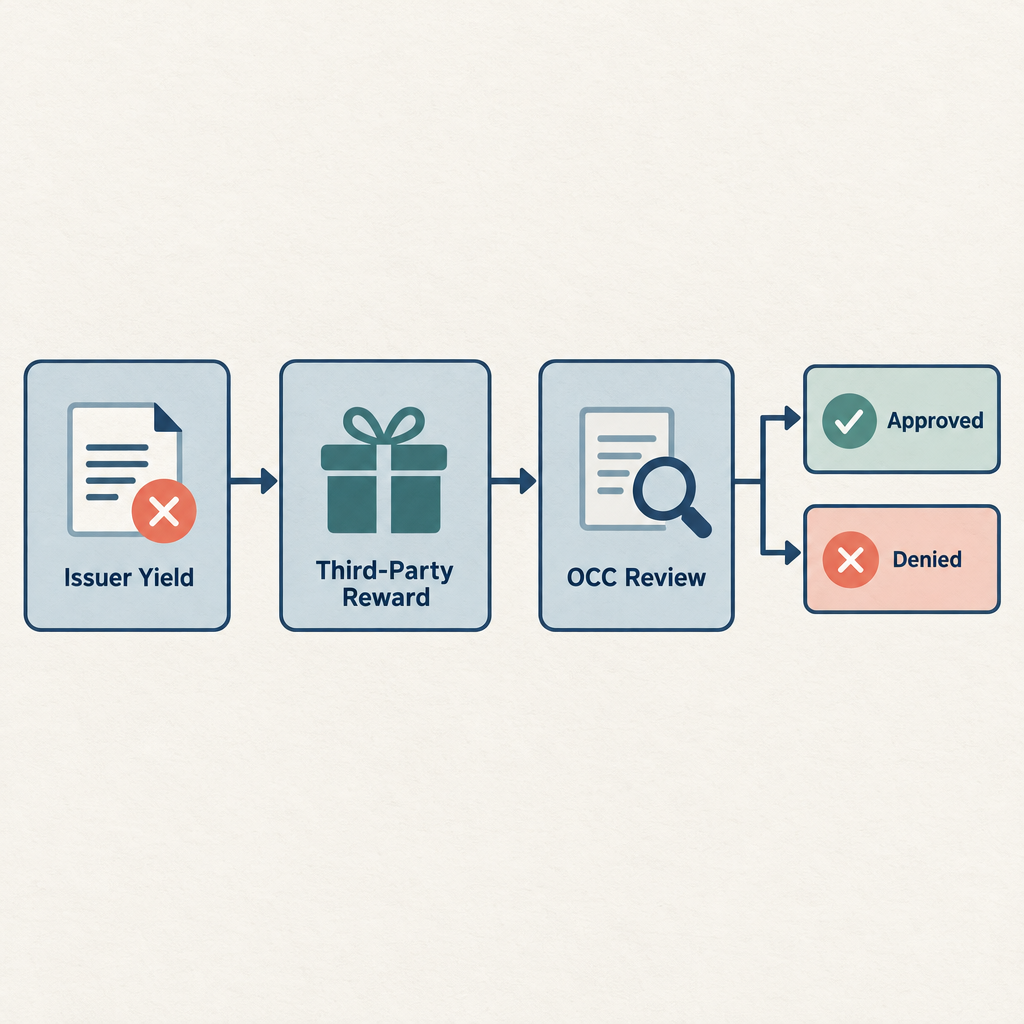
On rewards, American Banker reported on Oct. 21, 2026 that the OCC kept the ban on issuers paying yield directly to customers. The OCC dropped a presumption against yield paid by third parties. Instead, it will judge each yield or rewards arrangement case by case, based on the “facts and circumstances.”
That does not mean rewards are now legal. Some headlines said the OCC “tightened” rewards oversight. Others suggested rewards were approved. Neither matches the reporting. Issuer-paid yield is still banned. Other rewards face review one at a time.
The OCC news release says the rule covers every GENIUS Act regulation the OCC must issue except those on the Bank Secrecy Act, anti-money laundering and OFAC sanctions. Those will come in a separate rulemaking with Treasury.
Who it affects
The bulletin says the rule applies to national banks, federal savings associations, federal branches and their subsidiaries, federal qualified payment stablecoin issuers, and state qualified issuers under OCC authority. It includes a note for community banks.
For consumers, the effect is indirect but real. If you hold a stablecoin from one of these issuers, the reserve, redemption, audit and custody rules shape how your coin is backed and how you get your money back. If you earn rewards through a platform, that program could be reviewed under the case-by-case approach.
When it takes effect
The OCC says the final rule and the GENIUS Act both take effect January 18, 2027. The bulletin notes the GENIUS Act was enacted July 18, 2025.
The OCC has not yet said when it will begin accepting applications and waiver requests from companies that want to become permitted payment stablecoin issuers. It says it will announce that date in a separate news release.
Coinpedia, a crypto news site, wrote around Oct. 20, 2026 that the rule had not been published and the January date could slip to about March 2027. That article came out before the OCC release. The OCC’s own documents show the rule was issued Oct. 21, effective January 18, 2027.
What you should do now
- Check the terms of any stablecoin rewards program you use. Note who pays the reward: the coin’s issuer or the platform.
- Do not assume a reward will continue. The OCC says it will judge each arrangement on its own facts.
- Watch for the OCC’s announcement on when applications open.
- If you earn rewards, ask a tax professional how to report them.
- If you have a problem with a stablecoin product, you can file a complaint at consumerfinance.gov/complaint or contact your state attorney general’s consumer protection office.
Be wary of "licensed" claims
The OCC has not announced when it will start taking applications from stablecoin issuers, and it says it will review rewards arrangements case by case. Be skeptical of any company that says it is already licensed under the new rule or that its rewards are OCC approved.
What we don’t know yet
Whether current rewards programs comply. Crypto in America, a trade newsletter, relayed a remark from an unnamed OCC official on a press call: “We will just let the market develop and address it as it comes.” The official reportedly declined to say whether existing exchange rewards programs comply. We grade this report D. It rests on an unnamed source, cannot be verified, and the quote is not in the rule text.
Whether there is a grace period. Crypto News Flash, a trade outlet we grade C, reads the rule as giving programs launched before 2027 no presumption of compliance, with no safe harbor, cure period or approved list. That is plausible, but we could not check it against the rule itself.
Reserve details. Bitcoin Magazine, also graded C, reported that the rule drops a 20-day weighted average maturity limit on reserve assets, letting issuers hold longer-dated Treasuries. That detail is not in the OCC excerpts we reviewed.
Anti-money laundering rules. The OCC says separate Bank Secrecy Act, anti-money laundering and sanctions rules will come later in coordination with Treasury. No date has been set.
For the background, see our crypto scams and regulation guides.
Laws and regulations referenced
Links go to the official text on government sites.
Sources
- OCC Bulletin 2026-50 (occ.gov) occ.gov · primary source
- OCC news release NR 2026-92 (occ.gov) occ.gov · primary source

Leah writes US Financer's Consumer Alerts: scam warnings and money rule changes issued by federal agencies, state attorneys general, regulators and courts. Each alert starts from the official notice, says what is confirmed and what is not known yet, and lists the agency's own page…

Ruth is US Financer's standards editor. Every article goes through her checks before and after it is published: each rate, fee, cap, deadline and rule is matched against its primary source, every law named is linked to its official text, and anything that cannot be…
Comments are closed