Payday lending is legal in Mississippi. The Mississippi Check Cashers Act (Miss. Code Ann. § 75-67-501 et seq.) caps a payday check at $500 including fees, limits the loan to 30 days and bans rollovers, but it allows fees that work out to annual rates above 240 percent and often above 500 percent. Car title loans and high-cost installment loans are legal too, each under its own statute, and one state agency licenses all three.
Run the numbers
Payday and short-term loans in Mississippi
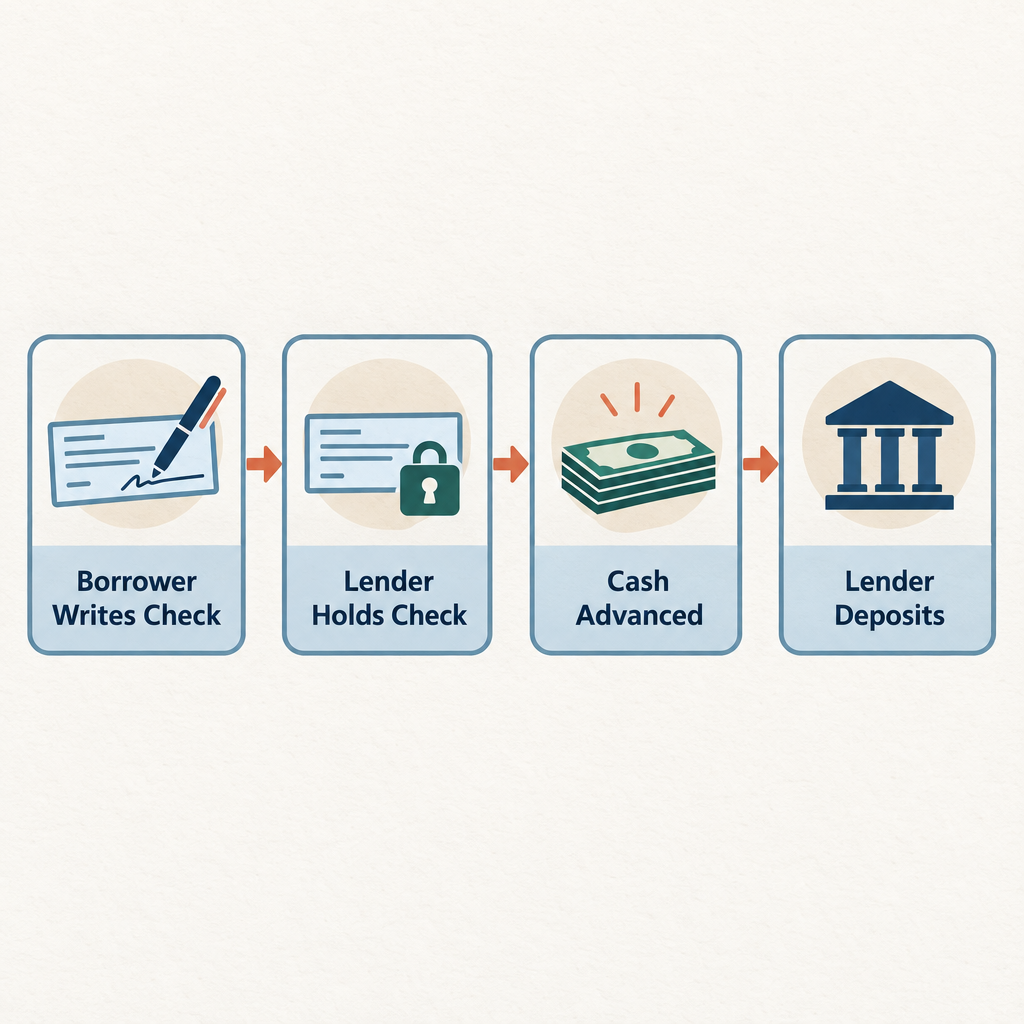
Mississippi does not use the phrase “payday loan” in its statutes. The product is a “delayed deposit transaction” under the Check Cashers Act, which means we hand the lender a personal check (or an electronic equivalent), the lender gives us cash minus its fee, and the lender agrees to hold the check until an agreed date. The Act has been on the books since 1998, was amended most significantly in 2011 to create a two-tier fee structure, and carries a sunset date that the Legislature has extended more than once rather than letting the industry’s authorization lapse.
The rules that matter to a borrower all sit in § 75-67-519. That section sets the maximum check amount, the fee ceilings, the term limits and the prohibition on renewing a check. Everything else in the Act concerns licensing, bonding, record-keeping and the powers of the Department of Banking and Consumer Finance, which we will shorten to DBCF.
What a licensed payday lender can charge
The face amount of a delayed deposit check cannot exceed $500, and that figure includes the fee. Mississippi then splits fees into two tiers by check size. For checks of $250 or less, the lender may charge up to $20 per $100 advanced. For checks between $250.01 and $500, the lender may charge up to $21.95 per $100 advanced. Because the fee is folded into the $500 ceiling, the most cash a borrower can actually walk out with is about $410, since $410 plus a $21.95-per-$100 fee of just under $90 lands right at the $500 limit.
Mississippi’s statute does not express these fees as an annual percentage rate, but federal law does. Under the Truth in Lending Act and Regulation Z (12 CFR 1026), every payday lender must disclose the finance charge and the APR in writing before we sign. The APR math is simple: divide the fee by the amount borrowed, then multiply by 365 and divide by the number of days in the term. A $20 fee on $100 for 14 days is 20 percent times 365 divided by 14, which is 521 percent. Stretch the same loan to the 30-day maximum and the APR falls to 243 percent, which is why the term a lender writes on the agreement changes the disclosed rate even though the dollar cost stays the same.
| Amount borrowed | Fee tier (§ 75-67-519) | Fee | Check written for | Term | APR (TILA method) | Total repaid |
|---|---|---|---|---|---|---|
| $100 | $20 per $100 | $20.00 | $120.00 | 14 days | 521% | $120.00 |
| $200 | $20 per $100 | $40.00 | $240.00 | 14 days | 521% | $240.00 |
| $200 | $20 per $100 | $40.00 | $240.00 | 30 days | 243% | $240.00 |
| $300 | $21.95 per $100 | $65.85 | $365.85 | 28 days | 286% | $365.85 |
| $410 | $21.95 per $100 | $89.99 | $499.99 | 28 days | 286% | $499.99 |
These figures reflect the statutory maximums. A licensee may charge less, and the DBCF does not set a floor, but Mississippi storefronts generally charge the ceiling. The comparison that matters is cost per $100 against the alternatives later in this article: a credit union payday alternative loan costs roughly $2 to $4 per $100 over a comparable period.
Term, rollovers and repeat borrowing
The Check Cashers Act limits every delayed deposit check to a maximum of 30 days. For the larger tier, checks above $250, the 2011 amendments also added a minimum term of 28 days, so a $400 loan cannot be written as a one-week transaction with a fee that would otherwise annualize above 1,000 percent. For checks of $250 or less there is no statutory minimum term, and a two-week term matched to a paycheck is common.
Rollovers are prohibited. Section 75-67-519 bars a licensee from renewing, extending or otherwise refinancing a delayed deposit check, and it bars the lender from accepting a new check to pay off an old one at the same store. In practice this means the loan is due in full on the date written, and the lender either deposits the check, accepts cash to redeem it, or lets us pay cash and immediately write a new check for a new loan. That last pattern, known as a back-to-back transaction, is what the no-rollover rule does not stop, because the first loan is technically paid off before the second begins.
The Act also limits how much a single licensee can hold from one customer. A lender cannot hold checks from the same borrower whose combined face amounts exceed $500 including fees. The restriction is store by store, not statewide.
What Mississippi’s payday law does not do
Several protections that appear in other states’ payday statutes are absent from Mississippi’s. There is no statewide database tracking open payday loans, so nothing prevents a borrower from holding a $500 check at one store and another at a competitor across the parking lot. There is no cooling-off period between loans. There is no mandatory extended payment plan that a borrower can invoke before default, a feature that exists in states such as Illinois, Florida and Alabama. Readers comparing notes with relatives across the state line may find our articles on “alabama payday loan laws” and “tennessee payday loan laws” useful, because both neighbors allow payday lending but with a database that Mississippi lacks.
What the Act does provide is a ban on criminal threats. A licensee may not threaten or pursue criminal prosecution over a delayed deposit check that bounces, and the DBCF treats a bounced delayed deposit check as a civil debt. A lender may charge a returned-check fee if the written agreement discloses it, and may sue in justice court for the amount owed, but a payday lender in Mississippi who threatens arrest is violating state law and, if a third-party collector makes the threat, the Fair Debt Collection Practices Act as well.
Mississippi title loans
Car title loans are governed by the Mississippi Title Pledge Act (Miss. Code Ann. § 75-67-401 et seq.). The Act is drafted on a pawn model: we deliver the certificate of title and a set of keys to a “title pledge lender,” receive a loan, and keep driving the car during the loan term. The lender holds a lien and the title. If we do not redeem the title by paying everything owed, ownership of the vehicle passes to the lender after a grace period set in the statute.
Section 75-67-413 caps the loan at $2,500 and caps the title pledge service charge at 25 percent of the principal per month. Twenty-five percent a month is a 300 percent annual rate, and that figure is the single most important number in Mississippi title lending. The initial agreement runs 30 days. The Act permits extensions in 30-day increments by mutual agreement, and after the first several extensions it requires the borrower to pay down a share of the original principal at each further extension, so that the loan cannot be carried at interest-only forever. Lenders may also charge fees that the statute specifically allows, such as the actual cost of recording the lien with the Mississippi Department of Revenue, but they may not add interest or charges beyond the 25 percent service charge.
| Loan amount | Monthly service charge (25%, § 75-67-413) | Term | Months carried | Interest paid | Total repaid to redeem title |
|---|---|---|---|---|---|
| $500 | $125 | 30 days | 1 | $125 | $625 |
| $1,000 | $250 | 30 days | 1 | $250 | $1,250 |
| $1,000 | $250 | 30 days, extended | 3 | $750 | $1,750 |
| $2,500 | $625 | 30 days | 1 | $625 | $3,125 |
| $2,500 | $625 | 30 days, extended | 4 | $2,500 | $5,000 |
The last row explains why title loans produce more complaints per dollar than any other product the DBCF licenses. A borrower who carries a $2,500 title loan for four months has paid as much in service charges as the original principal and still owes the principal. Nothing in the Act requires the lender to evaluate whether we can repay in 30 days; the car’s wholesale value is the underwriting.
What happens if you default on a Mississippi title loan
The Title Pledge Act does not require a lender to sue, obtain a judgment or hold a public auction before taking the vehicle. Because the structure is a pledge rather than a secured loan under the Uniform Commercial Code, the Act allows the lender to take ownership of the vehicle after the borrower fails to redeem within the period the statute allows after maturity. Repossession agents may not breach the peace, meaning they cannot break into a locked garage or use force, and that limit comes from general Mississippi law rather than the Title Pledge Act.
Two features of the pawn model cut in opposite directions for borrowers. On one hand, the Act treats the vehicle as full satisfaction of the debt, so the lender generally cannot chase us for a deficiency if the car sells for less than we owed. On the other hand, the Act does not impose a duty to return surplus proceeds if the car sells for more than the balance. A borrower who pledges a $9,000 truck for a $2,000 loan and defaults can lose the entire equity. Anyone considering a title loan should read the agreement’s default section and ask the lender in writing how it handles surplus, because the statute leaves that to the contract.
Installment loans in Mississippi
Mississippi has two very different legal tracks for installment lending, and the price gap between them is enormous. Lenders licensed under the Small Loan Regulatory Law operate under rate tiers that top out at 36 percent. Lenders licensed under the Mississippi Credit Availability Act may charge a monthly handling charge of up to 25 percent of the outstanding principal, which is the same 300 percent annual rate the Title Pledge Act allows, but without a car as collateral. Both kinds of lender are licensed by the DBCF, both may operate from the same strip mall, and both advertise “installment loans,” so the license type is the thing to ask about.
Credit Availability Act loans
The Mississippi Credit Availability Act (Miss. Code Ann. § 75-67-601 et seq.) became law in 2016 and took effect on July 1 of that year. It was passed with support from the payday and title industries after the Consumer Financial Protection Bureau announced plans to regulate short-term lending, and it created a product that falls outside the federal payday rule because the loan runs longer than 45 days and is repaid in installments.
A credit availability loan must be between $500 and $2,500. Terms range from four to twelve months for smaller loans and six to twelve months for larger ones. The lender may charge a monthly handling charge of up to 25 percent of the outstanding principal balance, plus an origination fee and a late fee in the amounts the Act specifies. Because the handling charge applies to the declining balance, a loan paid on schedule costs less than a title loan carried at interest only, but it still roughly doubles the amount borrowed over six months.
| Loan amount | Handling charge (max 25%/month) | Term | Approx. monthly payment | Approx. total repaid | Approx. cost of credit |
|---|---|---|---|---|---|
| $500 | 25% of outstanding principal | 4 months | $212 | $847 | $347 |
| $1,000 | 25% of outstanding principal | 6 months | $339 | $2,033 | $1,033 |
| $1,000 | 25% of outstanding principal | 12 months | $268 | $3,221 | $2,221 |
| $1,500 | 25% of outstanding principal | 12 months | $403 | $4,832 | $3,332 |
| $2,500 | 25% of outstanding principal | 12 months | $671 | $8,053 | $5,553 |
The payment figures above use standard amortization at a 25 percent monthly rate and exclude the origination fee, so a real agreement will show slightly higher totals. Notice that a longer term lowers the payment but raises total cost sharply: the same $1,000 costs about $1,033 in handling charges over six months and about $2,221 over twelve. Lenders have every incentive to offer the twelve-month version. The Regulation Z disclosure on the agreement will show an APR of about 300 percent, and that number is the fastest way to confirm you are looking at a Credit Availability Act loan rather than a small loan company loan.
The Act also carries a sunset clause. The Legislature has extended the repeal date rather than let the authorization expire, so we recommend confirming the current repeal date in § 75-67-601 et seq. before relying on any summary, including ours.
Small Loan Regulatory Law lenders
Traditional consumer finance companies in Mississippi are licensed under the Small Loan Regulatory Law (Miss. Code Ann. § 75-67-101 et seq.) and pay a privilege tax under the Small Loan Privilege Tax Law (§ 75-67-201 et seq.). Their permitted finance charges are set in § 75-17-21, which uses a tiered structure: 36 percent per year on the portion of unpaid principal up to $1,000, 33 percent on the portion from $1,000.01 to $2,500, 24 percent on the portion from $2,500.01 to $5,000, and 14 percent on any portion above $5,000. The statute also permits specific closing fees and allows the lender to sell credit insurance, which is where many borrowers’ costs quietly climb.
A $1,000 loan over 12 months at 36 percent costs about $205 in interest, with a payment near $100 a month. That is roughly one tenth of the handling charges on the same loan under the Credit Availability Act. Small loan companies do pull credit reports and decline more applicants, which is the trade-off: the lower price comes with real underwriting.
Outside the licensed small loan system, Mississippi’s general usury statute (§ 75-17-1) sets a legal rate of 8 percent when no rate is agreed and permits parties to contract for up to 10 percent per year or five percentage points above the Federal Reserve discount rate, whichever is greater. Banks and credit unions operate under their own federal and state charters, and federal credit unions are capped at 18 percent on most loans by NCUA rule.
“Installment loans no credit check” in Mississippi
The phrase appears constantly in Mississippi search results and in the window signs along Highway 49 and Highway 80. It is a marketing description of Credit Availability Act and title loans. These lenders typically do not pull a FICO score from Equifax, Experian or TransUnion, but “no credit check” does not mean no check at all. Most pull a report from an alternative data vendor such as Clarity Services or Teletrack, verify income with a pay stub or bank statements, and require an active checking account. A past bounced payday check can still disqualify an applicant.
The absence of a traditional credit check is exactly what the 300 percent price pays for. The lender is not underwriting our ability to repay in the usual sense; it is pricing the loan so that even high default rates leave a profit. Nothing in Mississippi law requires these lenders to report on-time payments to the major bureaus either, so a “no credit check” loan rarely helps rebuild a score, while a default can still be sold to a collector who does report it.
| Product | Statute | Max amount | Price cap | Term | Collateral | Typical APR at cap |
|---|---|---|---|---|---|---|
| Payday (delayed deposit) | § 75-67-501 et seq. | $500 check incl. fee (about $410 cash) | $20 or $21.95 per $100 | Up to 30 days | Personal check | 243% to 521% |
| Car title | § 75-67-401 et seq. | $2,500 | 25% of principal per month | 30 days, extendable | Vehicle title | 300% |
| Credit Availability Act installment | § 75-67-601 et seq. | $2,500 | 25% of outstanding principal per month | 4 to 12 months | None | About 300% |
| Small loan company | § 75-67-101 et seq.; § 75-17-21 | No statutory cap | 36% to 14% tiered | Set by contract | Often none | 24% to 40% with fees |
| Pawn | § 75-67-301 et seq. | Value of item | 25% per month | 30 days, extendable | Pledged goods | 300% |
| Federal credit union PAL | 12 CFR 701.21(c)(7) | $1,000 (PAL I) or $2,000 (PAL II) | 28% APR plus $20 app fee | 1 to 12 months | None | About 28% to 35% incl. fee |
Online and tribal lenders
Mississippi’s licensing statutes apply to lending to Mississippi residents, and the DBCF takes the position that a company making payday, title or credit availability loans to people in the state needs the corresponding Mississippi license. The Check Cashers Act is built around licensed physical locations, which is why nearly all legal payday lending in Mississippi happens in storefronts rather than online. Online lenders that are licensed in Mississippi generally hold a Credit Availability Act or Small Loan Regulatory Law license and must follow the same caps as a storefront.
Many sites advertising to Mississippians hold no Mississippi license at all. Some are chartered under tribal law and claim sovereign immunity from state regulation; others are offshore or operate through “bank partnership” models in which a state-chartered bank in another state nominally makes the loan. Mississippi law does not clearly void an unlicensed loan the way some states’ statutes do, so a borrower should not assume an unlicensed debt is uncollectible. What the DBCF can do is deny the unlicensed lender access to Mississippi courts in some circumstances and refer the matter to the Attorney General’s Consumer Protection Division, which enforces the Mississippi Consumer Protection Act (§ 75-24-1 et seq.).
The practical protections are federal. An online lender that debits a checking account must follow Regulation E (12 CFR 1005), which gives us the right to stop payment on a preauthorized electronic transfer by notifying the bank at least three business days before the scheduled debit, and the right to revoke the authorization with the lender. Since March 30, 2025, the payment provisions of the CFPB’s payday lending rule (12 CFR Part 1041) also bar a covered lender from making a third withdrawal attempt after two consecutive failed attempts without a fresh, specific authorization. Tribal lenders argue the rule does not reach them, but the banks that process their debits must still honor stop-payment orders.
The quickest test is to search the lender’s name in the DBCF’s licensee lookup at dbcf.ms.gov and in NMLS Consumer Access. A lender that appears in neither, lists no Mississippi license number on its website, and shows only a post office box or a tribal reservation address is operating outside the system described in this article. Any lender that asks for an upfront “processing” or “insurance” fee before funding a loan is running a scam; licensed Mississippi lenders deduct their fees from the proceeds or collect them with the payments, never in advance by gift card or wire.
Debt collection and wage garnishment in Mississippi
Mississippi does not license debt collection agencies and has no state-level counterpart to the Fair Debt Collection Practices Act. Third-party collectors operating in the state are governed by the federal FDCPA (15 U.S.C. § 1692 et seq.) and the CFPB’s Regulation F (12 CFR 1006), which since November 30, 2021 has limited collectors to seven call attempts per debt in a seven-day period and required a validation notice with an itemized balance. Original creditors collecting their own debts, including payday and title lenders, are not covered by the FDCPA but remain subject to the Mississippi Consumer Protection Act’s ban on unfair or deceptive practices.
The statute of limitations for a lawsuit on an unpaid loan in Mississippi is three years under § 15-1-49, which applies to written and oral contracts and open accounts alike. The clock generally runs from the missed payment or default, and a partial payment or a written acknowledgment can restart it, so we urge caution before sending a collector a token payment on a debt that is nearly three years old. A judgment, once entered, is enforceable for seven years under § 15-1-43 and can be renewed.
Wage garnishment requires a court judgment. A payday or title lender cannot garnish wages on the strength of a bounced check alone; it must sue, win and obtain a writ of garnishment served on the employer. Section 85-3-4 of the Mississippi Code then does two things. It exempts all wages from garnishment for the first 30 days after the writ is served, and after that it exempts 75 percent of disposable earnings, matching the federal limit in the Consumer Credit Protection Act (15 U.S.C. § 1673). Federal law adds a second test: the garnishment cannot take earnings that fall below 30 times the federal minimum wage per week, which at $7.25 is $217.50. The lesser of the two limits applies.
| Weekly disposable earnings | 25% of disposable earnings | Amount above $217.50 | Maximum weekly garnishment |
|---|---|---|---|
| $200 | $50 | $0 | $0 |
| $280 | $70 | $62.50 | $62.50 |
| $400 | $100 | $182.50 | $100 |
| $600 | $150 | $382.50 | $150 |
| $1,000 | $250 | $782.50 | $250 |
These limits apply to ordinary consumer judgments. Child support, federal taxes and defaulted federal student loans follow different rules and can take more. Social Security, SSI, VA and most other federal benefits are protected from garnishment, and under 31 CFR Part 212 a bank receiving a garnishment order must automatically protect two months’ worth of directly deposited federal benefits before freezing an account.
Mississippi also has no law requiring a court to approve a wage assignment, so some lenders include a voluntary wage assignment clause in their agreements. Under the FTC’s Credit Practices Rule (16 CFR Part 444), a lender may not take a wage assignment in a consumer loan unless it is revocable at will or applies only to wages already earned, which makes most such clauses in payday and installment agreements unenforceable as written.
Federal rules that apply in Mississippi and everywhere else
The Truth in Lending Act and Regulation Z require every lender in this article to disclose the amount financed, the finance charge in dollars, the APR and the payment schedule before we are bound. If a payday agreement shows a fee but no APR, that is a violation we can report. The Military Lending Act (10 U.S.C. § 987; 32 CFR Part 232) caps the Military Annual Percentage Rate at 36 percent for active-duty service members and their dependents on payday, title and installment loans, which means legally compliant Mississippi payday and title lenders cannot lend to them at all at their standard prices. Service members at Keesler Air Force Base, Camp Shelby and Naval Construction Battalion Center Gulfport should also know the Servicemembers Civil Relief Act caps interest on pre-service debts at 6 percent on request.
The Fair Debt Collection Practices Act governs third-party collectors as described above. The Fair Credit Reporting Act gives us the right to dispute inaccurate collection accounts with the bureaus and requires furnishers to investigate. The Electronic Fund Transfer Act and Regulation E protect our checking account from unauthorized debits and give us the stop-payment right. The Equal Credit Opportunity Act bars discrimination in lending on the basis of race, sex, age, national origin, marital status or receipt of public assistance, and it requires a lender that denies an application to tell us why.
Help that costs less than a Mississippi payday or title loan
The cheapest regulated small loan available to most Mississippians is a payday alternative loan from a federal credit union. Under NCUA rules at 12 CFR 701.21(c)(7)(iii) and (iv), a PAL I loan runs from $200 to $1,000 over one to six months, a PAL II loan runs up to $2,000 over one to twelve months, the interest rate may not exceed 28 percent APR, and the application fee is capped at $20. A $1,000 PAL over six months costs about $82 in interest plus the $20 fee, against roughly $1,033 in handling charges on the same amount under the Credit Availability Act. PAL I requires one month of membership; PAL II has no waiting period. Not every credit union offers them, so the question to ask is whether the credit union makes “PAL” or “payday alternative” loans.
Hope Credit Union, headquartered in Jackson and certified as a community development financial institution, has branches across the Delta and the Gulf Coast and makes small-dollar consumer loans designed as payday alternatives. BankPlus has for years run its CreditPlus program, which pairs a short financial education class with a small fixed-rate loan, half of which goes into a savings account. Terms for both programs change, so we describe them rather than quote prices, but each has historically priced small loans at a fraction of the statutory caps described above.
Public assistance in Mississippi runs mostly through the Mississippi Department of Human Services, which administers SNAP, TANF cash assistance and the Low Income Home Energy Assistance Program. LIHEAP and the Weatherization Assistance Program are delivered locally through Community Action Agencies, and a utility shutoff notice is often enough to qualify for an emergency payment that would otherwise be the reason for a payday loan. Dialing 2-1-1 connects to the United Way referral line, which maintains current lists of county-level rent, utility and food programs. Hospitals in Mississippi that are nonprofit must offer financial assistance policies under the Affordable Care Act, and a medical bill is one of the most common reasons borrowers cite for a first payday loan.
For legal help, Mississippi has two Legal Services Corporation grantees: North Mississippi Rural Legal Services and the Mississippi Center for Legal Services, divided roughly along the state’s midline. The Mississippi Center for Justice, a nonprofit law firm with offices in Jackson, Biloxi and Indianola, has litigated and lobbied on payday and title lending for over a decade and handles consumer cases. Nonprofit credit counseling agencies accredited by the National Foundation for Credit Counseling can set up a debt management plan with interest concessions from most creditors; payday and title lenders rarely participate, but a plan can free up the monthly cash flow that keeps us out of their stores.
Cheaper options first
Ask a federal credit union about a payday alternative loan: 28% APR cap, $20 fee cap, up to $2,000 under PAL II.
Call 2-1-1 or your Community Action Agency before paying a utility bill with a payday loan; LIHEAP crisis payments exist for exactly this.
Ask your employer about an earned-wage advance or paycheck advance with no fee, and ask the biller about a hardship plan before borrowing at all.
How to check a lender’s license and file a complaint
Every payday lender, title pledge lender, credit availability lender, small loan company and pawnbroker in Mississippi must hold a license from the DBCF, and the license certificate must be displayed at the location. The Department publishes a searchable list of licensees on its website and accepts written consumer complaints against any licensee. It can order refunds of unlawful charges, fine licensees and revoke licenses, and its examiners review loan files for compliance with the fee and term limits in each statute. The Department’s offices are in the Woolfolk State Office Building in Jackson.
The CFPB accepts complaints about any consumer lender, including tribal and online lenders the state cannot reach, and forwards them to the company for a response within 15 days. CFPB complaint data is public, which makes the database a useful place to look up a lender’s track record before borrowing. The Mississippi Attorney General’s Consumer Protection Division takes complaints about unlicensed lenders and deceptive advertising. For outright fraud, such as advance-fee loan scams or fake collectors threatening arrest, the FTC’s ReportFraud portal and the FBI’s IC3 are the right destinations.
How to check a Mississippi lender
- Search the lender’s exact legal name and street address in the DBCF licensee lookup at dbcf.ms.gov and note the license type, because a credit availability license means a 300% APR product.
- Search the same name in NMLS Consumer Access and confirm the Mississippi entry matches.
- Read the Regulation Z box on the agreement and compare the fee to the caps in this article before signing anything.
- If the lender is unlicensed or the fee exceeds the cap, file a written complaint with the DBCF and a second one with the CFPB, and keep copies of the agreement and every receipt.
Recent changes and pending bills
Mississippi has not lowered its payday, title or installment caps since the Check Cashers Act was amended in 2011 and the Credit Availability Act was adopted in 2016. Bills to impose a 36 percent all-in rate cap, modeled on the Military Lending Act and on measures adopted by voters in Nebraska and by legislatures in Illinois and New Mexico, have been filed in recent sessions and have died in committee without a floor vote. Readers who want to see what a capped market looks like can compare our pieces on “illinois payday loan laws” and “california payday loan laws“, both of which cover states that have sharply restricted triple-digit lending.
The live legislative question in Jackson is usually the sunset date on the Credit Availability Act and the Check Cashers Act rather than the rate itself. Each time a repeal date approaches, the Legislature has extended it. We treat the caps above as current, but the repeal dates in § 75-67-539 and the Credit Availability Act’s final section should be checked directly for any reader relying on this article more than a few months after publication.
At the federal level, the Supreme Court upheld the CFPB’s funding structure in May 2024, which cleared the way for the payment provisions of the payday rule to take effect on March 30, 2025. The rule’s ability-to-repay underwriting requirements were rescinded in 2020 and are not in force, so Mississippi lenders still have no federal obligation to assess whether a borrower can afford the loan.
Before you borrow
Mississippi caps the size of payday, title and credit availability loans but not their effective price, so a $1,000 loan can legally cost another $1,000 within six months. The lender does not have to check whether you can repay, and a title loan can cost you the entire value of your car, not just the balance.
FAQ
Is payday lending legal in Mississippi?
Yes. Licensed check cashers may make delayed deposit loans under Miss. Code Ann. § 75-67-501 et seq. The check cannot exceed $500 including the fee, the fee is capped at $20 per $100 on checks of $250 or less and $21.95 per $100 on larger checks, the term cannot exceed 30 days and rollovers are prohibited. The APR at those caps ranges from about 243 percent to 521 percent depending on the term.
How many payday loans can I have at once in Mississippi?
A single licensee cannot hold checks from one customer totaling more than $500 including fees, but Mississippi has no statewide database and no law limiting the number of lenders a borrower uses. Multiple loans at different stores are legal and common, and the lack of a database is one of the main criticisms consumer advocates raise against the current law.
Can a payday lender in Mississippi have me arrested if my check bounces?
No. The Check Cashers Act prohibits a licensee from threatening or pursuing criminal prosecution over a delayed deposit check. The lender may charge a disclosed returned-check fee and sue civilly, and it must obtain a judgment before any wage garnishment. A collector who threatens jail is violating the FDCPA, and the threat should be reported to the DBCF and the CFPB.
What is the maximum title loan in Mississippi and how much can it cost?
The Title Pledge Act caps the loan at $2,500 and the service charge at 25 percent of principal per month, a 300 percent annual rate. A $2,500 loan carried for four 30-day periods costs $2,500 in service charges on top of the principal. If you default, the lender takes ownership of the vehicle after the statutory period and is not required to return any surplus value.
Are installment loans in Mississippi really 300 percent APR?
Loans made under the Credit Availability Act are, because the Act permits a handling charge of 25 percent of outstanding principal every month on loans from $500 to $2,500 over four to twelve months. Loans from companies licensed under the Small Loan Regulatory Law are capped at 36 percent on the first $1,000 and lower tiers above that. The Regulation Z disclosure on the agreement tells you which kind you have.
How much of my paycheck can be garnished in Mississippi?
After a creditor wins a judgment and serves a writ, § 85-3-4 exempts all wages for the first 30 days and then protects 75 percent of disposable earnings. Federal law also protects any amount below $217.50 a week. The most a consumer creditor can take is the lesser of 25 percent of disposable earnings or the amount above that floor, and Social Security and other federal benefits cannot be garnished for consumer debts at all.
Laws and regulations referenced
- Truth in Lending Act, 15 U.S.C. 1601
- Regulation Z, 12 CFR Part 1026
- Fair Debt Collection Practices Act, 15 U.S.C. 1692
- Regulation F (debt collection), 12 CFR Part 1006
- Fair Credit Reporting Act, 15 U.S.C. 1681
- Equal Credit Opportunity Act, 15 U.S.C. 1691
- Electronic Fund Transfer Act, 15 U.S.C. 1693
- Regulation E (electronic transfers), 12 CFR Part 1005
- Military Lending Act, 10 U.S.C. 987
- Military Lending Act rule, 32 CFR Part 232
- Servicemembers Civil Relief Act, 50 U.S.C. 3901
- CFPB payday lending rule, 12 CFR Part 1041
Links go to the official text on government sites.
Check, verify or complain
Sources
- ecfr.gov › current › title 12 › chapter VII › subchapter A › part 701 ecfr.gov · primary source
- law.justia.com › codes › mississippi › title 75 › chapter 17 › general provisions › section 75 1… law.justia.com
- ustatesloans.org › law › ms ustatesloans.org
- debthammer.org › mississippi payday loan laws debthammer.org

Elena writes about getting through a money emergency, assistance programs, budgeting on a tight income, banking basics and borrower rights. Her guides list the cheaper options first and link the agency or program that can actually help.

Ruth is US Financer's standards editor. Every article goes through her checks before and after it is published: each rate, fee, cap, deadline and rule is matched against its primary source, every law named is linked to its official text, and anything that cannot be…
Comments are closed