Payday lending is legal in Missouri, and the state permits some of the most expensive small loans in the country. Chapter 408 of the Revised Statutes of Missouri caps a payday loan at $500 and limits total interest and fees to 75 percent of the original principal over the life of the loan, renewals included, but it sets no ceiling on the interest rate itself. Title loans and consumer installment loans are legal too, licensed by the Missouri Division of Finance, with no rate cap on either.
Run the numbers
Payday and short-term loans in Missouri
Missouri regulates payday loans under Sections 408.500 to 408.506, RSMo, which the statute calls “unsecured loans of five hundred dollars or less.” A lender must hold a license from the Division of Finance for each location, and the Division publishes a biennial report on the industry as required by Section 408.506. Those reports have consistently shown average APRs in the hundreds of percent, well above 400 percent in every edition we have read.
The rules that matter to a borrower are these. The principal may not exceed $500. The term must run between 14 and 31 days under Section 408.500. The lender may charge interest and fees at whatever rate the contract states, because Section 408.100 lets parties agree in writing to any rate, but Section 408.505 limits the total of all interest and fees to 75 percent of the original loan amount across the initial term and every renewal combined.
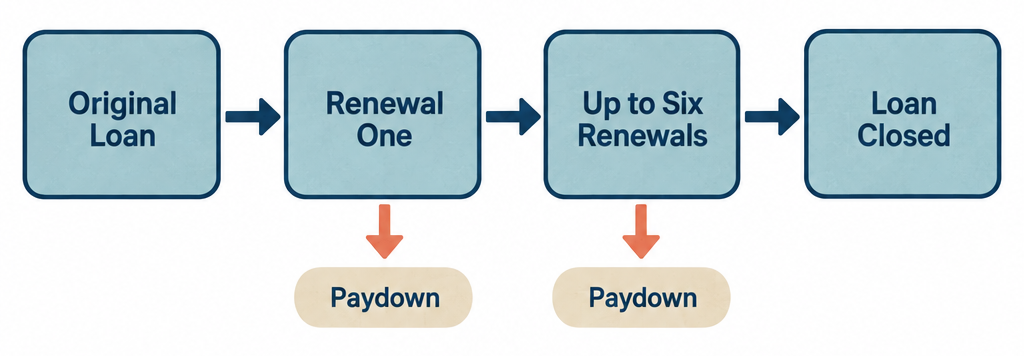
Renewals are where Missouri departs from stricter states. Section 408.500 allows up to six renewals, and each renewal requires the borrower to pay down at least 5 percent of the principal. There is no cooling-off period between loans, no statewide database tracking how many loans a person has open, and no limit on borrowing from a second lender the same day. Section 408.505 does bar a licensed lender from pursuing or threatening criminal bad-check charges over a payday loan that bounces.
Here is what the math looks like on a $500 loan. The fee rates in the first two rows are illustrative, not a quote from any lender, and the third row shows the statutory ceiling.
| Scenario | Principal | Fee | Term | APR | Total repaid |
|---|---|---|---|---|---|
| Typical 14-day loan at $17.50 per $100 | $500 | $87.50 | 14 days | 456% | $587.50 |
| Same loan at $15 per $100 | $500 | $75 | 14 days | 391% | $575 |
| Maximum fees under Section 408.505 | $500 | $375 | Up to 7 periods | Varies | $875 |
The APR math is plain: divide the fee by the principal, then multiply by 365 and divide by the days in the term. For the first row, $87.50 divided by $500 is 17.5 percent for two weeks, and 17.5 percent times 365 divided by 14 comes to roughly 456 percent a year. A borrower who renews six times pays principal down by 5 percent each time, so the balance drops to about $368 by the sixth renewal, yet fees can still total the full $375.
A “payday loan” in Missouri is nearly always structured as a single-payment loan with a post-dated check or an electronic debit authorization. If you are weighing one against a “payday advance” from an employer or app, the difference is usually hundreds of dollars.
Car title loans in Missouri
Title loans in Missouri fall under the Missouri Title Loan Law, Sections 367.500 to 367.533, RSMo. A title lender needs a Division of Finance license and must take the vehicle title as security while you keep driving the car. Section 367.512 sets the loan term at 30 days and allows renewals, but beginning with the third renewal the borrower must reduce the principal by at least 10 percent each time.
There is no interest rate cap on Missouri title loans. The same Section 408.100 freedom-of-contract language applies, so the rate is whatever you sign. Lenders must disclose the APR under the Truth in Lending Act, and the state statute requires the lender to tell you plainly that it is a title loan and what happens on default. Section 367.527 governs repossession and sale after default, including notice to the borrower.
One Missouri-specific wrinkle: the Division of Finance has acknowledged for years that some lenders make loans secured by car titles under a consumer installment lender license (Section 408.510) or a small loan license rather than under the Title Loan Law. Those loans escape the 30-day term and the principal-reduction rule. Ask which statute the loan is made under before signing, and read the contract header, which must name the lender’s license type.
| Feature | Payday loan (408.500) | Title loan (367.500) | Consumer installment loan (408.510) |
|---|---|---|---|
| Max principal | $500 | No statutory cap | No statutory cap |
| Rate cap | None; fees capped at 75% of principal | None | None |
| Term | 14 to 31 days | 30 days, renewable | At least 4 equal installments over 120 days or more |
| Renewals | Up to 6, each paying 5% of principal | Allowed; 10% paydown from third renewal | Not applicable |
| Collateral | None (post-dated check or debit) | Vehicle title | Varies |
| Licensing | Division of Finance | Division of Finance | Division of Finance |
Installment and personal loans in Missouri
Installment loans in Missouri are made under Section 408.510, which creates the consumer installment lender license. A consumer installment loan must be repayable in at least four substantially equal payments over a period of not less than 120 days. Beyond that, the statute leaves pricing to the contract. Missouri’s general usury ceiling in Section 408.030 does not reach these loans because Section 408.100 permits any agreed rate for consumer loans made by licensed or exempt lenders. In practical terms, Missouri has no working interest cap for licensed lenders.
Permitted extra charges live in Section 408.140, which lists what a lender may add on top of interest, including an origination fee and a late charge on past-due installments. The Division of Finance publishes the current dollar figures, which the legislature adjusts from time to time, so check the Division’s fee schedule rather than relying on an older article.
An installment loan from a licensed Missouri lender can cost anywhere from under 36 percent APR to several hundred percent. Banks and credit unions sit at the low end. Storefront and online installment lenders that advertise “online installment loans no credit check Missouri” sit at the high end, and the phrase itself is marketing. Most of those lenders run a soft inquiry or pull alternative data such as bank transaction history, then price the loan high enough to absorb defaults. If you are unsure how an installment loan differs from a payday product, the core difference is amortization: each payment covers interest plus some principal, so the balance actually shrinks.
Online and tribal lenders
Missouri law applies to any lender making payday or consumer installment loans to Missouri residents, regardless of where the company sits. An online lender needs the same Division of Finance license as a storefront, and the Division’s licensee search at finance.mo.gov lets you confirm it. Lenders claiming an out-of-state license only, or no license at all, are operating illegally in Missouri.
Tribal lenders are the hard case. Companies owned by federally recognized tribes argue that sovereign immunity shields them from state licensing and state caps, and Missouri has no statute that voids an unlicensed online loan outright. The CFPB has sued several tribal lending operations under federal law, and borrowers have won individual cases, but recovering money is slow and uncertain. Our position is simple: an unlicensed lender gives you no Missouri protections, no state complaint process, and no guarantee it follows the 75 percent cap. Verify the license before you give out a bank login.
Missourians near the border sometimes shop across state lines, and the rules differ sharply. Our “texas payday loan laws” article covers a state with similarly loose pricing, while “california payday loan laws” shows a state with a much lower loan cap and fee limit. Arkansas, directly south, bans payday lending through its constitution.
Debt collection and wage garnishment limits in Missouri
Missouri does not license collection agencies, so complaints about collectors go to the Attorney General’s Consumer Protection Division under the Missouri Merchandising Practices Act (Chapter 407, RSMo) and to the CFPB under the Fair Debt Collection Practices Act. The FDCPA bans calls before 8 a.m. or after 9 p.m., threats of arrest, and contacting your employer about the debt beyond locating you.
A lender or debt buyer must sue and win a judgment before garnishing wages. Missouri’s garnishment limits in Section 525.030 are 25 percent of disposable earnings for most people, or 10 percent if you are the head of a family, and never more than the amount by which weekly disposable earnings exceed 30 times the federal minimum wage. That federal floor comes from 15 U.S.C. 1673 and currently equals $217.50 a week at the $7.25 federal rate.
| Weekly disposable earnings | Standard limit (25%) | Head of family (10%) | Amount above $217.50 | Maximum garnishment |
|---|---|---|---|---|
| $300 | $75 | $30 | $82.50 | $75 (or $30 head of family) |
| $600 | $150 | $60 | $382.50 | $150 (or $60 head of family) |
| $1,000 | $250 | $100 | $782.50 | $250 (or $100 head of family) |
Bank account garnishments are subject to Missouri’s exemptions in Sections 513.430 and 513.440, which protect a set dollar amount of general property plus an additional head-of-family allowance that grows with each dependent. Claim those exemptions in writing with the court; they are not applied automatically.
Time limits matter too. Missouri’s statute of limitations is 10 years for a written promise to pay money under Section 516.110 and five years for other contract claims under Section 516.120. Which one applies depends on the loan paperwork, and a collector who sues on time-barred debt can be challenged in court. If you dispute a debt, our guide to “financial dispute resolution” walks through the written-dispute process.
Help that costs less
Cheaper options first
A federal credit union payday alternative loan runs $200 to $2,000 at no more than 28% APR under NCUA rules.
Missouri 211 and your county Community Action Agency can connect you with utility, rent and food help.
Many Missouri hospitals, utilities and landlords offer hardship payment plans if you ask before you fall behind.
Federal credit unions can offer payday alternative loans under 12 CFR 701.21(c)(7). PALs I run $200 to $1,000 with terms of one to six months; PALs II go up to $2,000 for up to 12 months. The APR cap is 28 percent and the application fee cannot exceed $20. A $500 PAL repaid over six months costs roughly $42 in interest, against $87.50 for a single two-week payday loan. In the St. Louis area, the nonprofit Prosperity Connection has operated RedDough Money Center storefronts as a lower-cost alternative, tied to St. Louis Community Credit Union.
Financial assistance in Missouri that actually exists includes the Low Income Home Energy Assistance Program and the Energy Crisis Intervention Program, both run through the Department of Social Services Family Support Division, along with SNAP and Temporary Assistance cash benefits for families with children. Missouri’s 19 Community Action Agencies handle LIHEAP applications locally and often have weatherization and emergency funds. Catholic Charities, the Salvation Army and United Way 211 fill gaps for rent and prescriptions.
Nonprofit credit counseling agencies approved by the U.S. Trustee Program can put you on a debt management plan that lowers card interest without a new loan. Employer-based earned wage access, if your employer offers it with no fee, costs nothing to take a few hundred dollars early.
How to check a lender’s license and file a complaint
How to check a Missouri lender
- Go to finance.mo.gov and open the licensee search under Consumer Credit.
- Search the exact legal name on the loan contract, not the brand name on the website.
- Confirm the license type matches the loan: payday (408.500), title (367.500) or consumer installment (408.510).
- Cross-check online lenders on NMLS Consumer Access at nmlsconsumeraccess.org.
- Save a copy of the contract and all payment records before you complain.
The Missouri Division of Finance, part of the Department of Commerce and Insurance in Jefferson City, licenses and examines every payday, title and consumer installment lender in the state. It accepts consumer complaints online and by mail, and Section 408.500 requires lenders to post the Division’s contact information in every store. The CFPB complaint portal at consumerfinance.gov forwards complaints to the company and tracks responses, and its public database lets you see a lender’s record before you borrow. For collectors and unlicensed lenders, the Missouri Attorney General’s Consumer Protection Division takes complaints under the Merchandising Practices Act. Report outright fraud to the FTC at ReportFraud.ftc.gov.
Federal rules that apply everywhere
The Truth in Lending Act and Regulation Z (12 CFR 1026) require every Missouri lender to disclose the APR, finance charge and total of payments before you sign. The Military Lending Act and 32 CFR 232 cap the Military Annual Percentage Rate at 36 percent for active-duty service members and dependents, and they bar lenders from taking a vehicle title or a check as security from covered borrowers. The Electronic Fund Transfer Act forbids making a loan conditional on repayment by preauthorized electronic debit. Since March 30, 2025, the CFPB’s payday lending rule at 12 CFR 1041 also stops a lender from trying a third debit after two consecutive attempts fail without a fresh authorization from you.
Before you borrow
Missouri lets a payday lender collect up to $375 in fees on a $500 loan and renew it six times, and the state has no rate cap, no cooling-off period and no database stopping you from taking a second loan elsewhere. The typical outcome is a loan that costs more than it borrowed.
FAQ
How many payday loans can I have at once in Missouri?
State law caps a single loan at $500 but does not limit the number of lenders you can borrow from, and Missouri has no database to enforce a limit. Taking two loans the same week is legal and common. It is also how fees compound past what you can repay.
Can a Missouri payday lender have me arrested for a bounced check?
No. Section 408.505, RSMo bars a licensed payday lender from using criminal bad-check prosecution over a defaulted payday loan. A collector who threatens arrest is also violating the FDCPA. Report it to the Division of Finance and the CFPB.
Is there an interest rate cap on title loans in Missouri?
There is none. The Missouri Title Loan Law sets a 30-day term and a 10 percent principal paydown from the third renewal onward, but the rate is whatever the contract says. Missouri’s “usury laws” in Section 408.030 do not reach licensed lenders because Section 408.100 allows any agreed rate.
Has Missouri tried to cap payday loan rates at 36 percent?
Yes, repeatedly. A 2012 ballot initiative for a 36 percent cap never reached voters after court challenges and industry interference derailed the petition, and Governor Jay Nixon vetoed an earlier payday lending bill. In 2019, a bill that would have undermined city regulations on high-interest lenders reached Governor Mike Parson’s desk. Sections 408.500 to 408.506 have been amended since, including changes to Section 408.500 in 2015 and again in 2023, but none of those changes added a rate cap.
Can my wages be garnished for a payday loan in Missouri?
Only after the lender sues and wins a judgment. Section 525.030 then limits garnishment to 25 percent of disposable earnings, or 10 percent if you support a family, subject to the federal 30-times-minimum-wage floor. Federal benefits such as Social Security are exempt.
Do Missouri laws apply to online lenders based in another state?
Yes, if they lend to Missouri residents. They need a Division of Finance license, and you can check it at finance.mo.gov. Tribal lenders claiming sovereign immunity are the exception in practice, which is why we treat any unlicensed online lender as a no.
Laws and regulations referenced
- Truth in Lending Act, 15 U.S.C. 1601
- Regulation Z, 12 CFR Part 1026
- Fair Debt Collection Practices Act, 15 U.S.C. 1692
- Electronic Fund Transfer Act, 15 U.S.C. 1693
- Military Lending Act, 10 U.S.C. 987
- Military Lending Act rule, 32 CFR Part 232
- CFPB payday lending rule, 12 CFR Part 1041
Links go to the official text on government sites.
Check, verify or complain
Sources
- finance.mo.gov › consumer credit licensing › payday lenders finance.mo.gov · primary source
- ncua.gov › newsroom › press release › 2019 › payday alternative loan rule will create … ncua.gov · primary source
- ustatesloans.org › law › mo ustatesloans.org
- moconsumers.org › personal finance › missouri lenders find ways to avoid title loan regul… moconsumers.org

Elena writes about getting through a money emergency, assistance programs, budgeting on a tight income, banking basics and borrower rights. Her guides list the cheaper options first and link the agency or program that can actually help.

Ruth is US Financer's standards editor. Every article goes through her checks before and after it is published: each rate, fee, cap, deadline and rule is matched against its primary source, every law named is linked to its official text, and anything that cannot be…
Comments are closed