

Payday lending is legal in South Carolina, but only from licensed lenders and only within tight limits. State law calls these loans “deferred presentment services.” A lender can advance you no more than $550 at one time and can charge a fee of no more than 15% of the amount advanced, so the most it can charge on a $550 loan is $82.50. The larger installment and car title loans that many of the same storefronts now offer have no APR cap at all.
BLOCKEDRelated consumer alert, Nov 9
FinCEN, Fed pull crypto Travel Rule proposal to seek new public inputRun the numbers
Key takeaways
- SC Code §34-39-180 caps a payday loan at $550 and the fee at 15%. On a 14-day loan that works out to about 391% APR.
- You can have only one payday loan at a time. Every licensed lender checks a statewide database run by Catalis.
- If you can’t repay, §34-39-280 gives you a free extended payment plan of at least four equal installments, once every 12 months.
- Supervised installment and title lenders have no APR cap. State regulators have seen rate filings as high as 850%.
- Not repaying a payday loan is a civil debt, not a crime. A caller who threatens a “felony charge” is a red flag.
Fact-checked
We checked these key facts against the sources named, on November 10, 2026:
- A PAL I loan runs $200 to $1,000 over one to six months (source: consumerfinance.gov)
- Bill S.379, which would have repealed the chapter, has not become law as of November 2026 (source: scstatehouse.gov)
- On a 14-day loan that works out to about 391% APR. – You can have only one payday loan at a time (source: debthammer.org)
- A $500 PAL repaid over three months at 28% APR costs about $23 in interest, plus the application fee (source: consumerfinance.gov)
- The extended payment plan under SC Code §34-39-280 costs nothing extra, but you get only one every 12 months (source: law.justia.com)
South Carolina payday loan laws at a glance (2026)
All of South Carolina’s payday rules sit in one place: the South Carolina Code of Laws, Title 34, Chapter 39 (Deferred Presentment Services). Every rule below was checked against the current code text and the regulator’s own postings in November 2026.
Quick answer: are payday loans legal in SC?
Yes. A business may make a payday loan in South Carolina only if it holds a deferred presentment license under Chapter 39. In the deal, you write a check (or authorize a debit), and the lender agrees to hold it until a set date before cashing it. The statute limits the size of the loan, the fee, the term and how often you can borrow.
| Rule | What the law says | Code section | What it means for you |
|---|---|---|---|
| Maximum loan | Total advanced to one customer at one time can’t exceed $550, not counting fees | §34-39-180 | You can’t get more than $550 in payday credit at once |
| Fee cap | Fee can’t exceed 15% of the amount advanced, charged once per agreement | §34-39-180 | $82.50 is the most you can be charged on $550 |
| Maximum term | Lender may hold the check no later than 31 days from the date it’s accepted | §34-39-180 | Payday loans in SC run 31 days at most |
| No renewals | Lender may not renew or extend presentment past the date in the written agreement | §34-39-180 | Legal “rollovers” don’t exist here |
| No refinancing with another loan | A loan can’t be repaid with the proceeds of another loan from the same lender or its affiliate | §34-39-180 | The lender can’t flip one loan into a new one |
| One loan at a time | No new loan if you already have one outstanding with any licensee | §34-39-270 | A second lender has to turn you down |
| Statewide database | Lenders must check eligibility in a common database before lending | §34-39-175 | Your loans are tracked across every lender |
| Cooling-off rules | No new loan on the same business day you repaid; from the 8th loan in a calendar year, not on that day or the next business day | §34-39-270 | Short forced breaks between loans |
| Extended payment plan | At least four substantially equal installments, no added interest or fees, one plan per 12 months | §34-39-280 | A free way out if you can’t pay on the due date |
| Annual report | Board reports loan counts, fees and repeat borrowing to the General Assembly | §34-39-290 | The state publishes how heavily these loans are used |
| Willful violations | Penalties for licensees who willfully break the chapter | §34-39-240 | Lenders face consequences for ignoring the rules |
Chapter 39 also gives you the right to cancel (rescind) a payday loan at no cost if you do it by the close of the following business day. If you take a loan and then regret it, return the money quickly.
Who regulates them
Payday lenders are licensed and examined by the Consumer Finance Division of the South Carolina State Board of Financial Institutions. By law the Board is chaired by the State Treasurer, currently Curtis M. Loftis, Jr. Licensing goes through the Nationwide Multistate Licensing System (NMLS), and every storefront location needs its own license.
The SC Department of Consumer Affairs plays a separate role. It oversees supervised (installment) lenders, collects their maximum-rate filings and publishes the yearly State of Credit Report. If a lender’s product isn’t a payday loan, the Department of Consumer Affairs is usually the agency that covers it.
How much you can borrow and what it costs
A payday loan in South Carolina can’t exceed $550, and the fee can’t exceed 15% of what you borrow. The Consumer Finance Division’s fee posting, dated May 29, 2025, sums up the rule as “max $550 at 15% of the amount borrowed.”
The $550 limit
The cap under §34-39-180 counts everything you owe in payday credit at one time, across all lenders, and leaves out the fee. A lender can’t get around it by writing two $300 loans, and a second lender can’t top you up, because the database shows the first loan.
If a storefront offers you $800 or “anything over $550,” the product is not a payday loan. It’s a supervised installment loan with different rules, covered in detail below.
The 15% fee and what it means as an APR
The fee is a flat 15% of the amount advanced, charged once per written agreement. That sounds modest until you turn it into an annual percentage rate, which is the measure the Truth in Lending Act and Regulation Z (12 CFR 1026) require lenders to disclose.
Here’s the math in plain words. Divide the fee by the amount borrowed (15%). Then multiply by the number of loan periods that fit into a year: 365 divided by the number of days in the term. A 14-day term gives 26.07 periods a year, so 15% × 26.07 = about 391% APR. The full 31-day term gives 11.77 periods, so about 177% APR.
| Amount borrowed | Maximum fee (15%) | Total due | APR if 14-day term | APR if 31-day term |
|---|---|---|---|---|
| $100 | $15.00 | $115.00 | 391% | 177% |
| $300 | $45.00 | $345.00 | 391% | 177% |
| $550 | $82.50 | $632.50 | 391% | 177% |
The APR stays the same at every loan size because the fee is a fixed percentage. What changes it is the term: the shorter the loan, the higher the APR. Ask for the full 31 days if your payday schedule allows it.
Example: borrowing $550 four times a year
The one-time cost is not where payday loans do the damage. Repeat borrowing is.
| Loans of $550 per year | Total fees paid | Fees as a share of one loan |
|---|---|---|
| 1 | $82.50 | 15% |
| 4 | $330.00 | 60% |
| 8 | $660.00 | 120% |
| 12 | $990.00 | 180% |
At eight loans a year, you pay more in fees than you ever had in hand at one time. Lawmakers know this pattern, which is why §34-39-290 requires the Board’s annual report to break out how many borrowers took one, two, three or more loans.
Did you know?
According to the SC Department of Consumer Affairs’ State of Credit Report 2026, state law sets no APR limit for supervised lenders beyond a general ban on unconscionable terms. The Department contacted supervised lenders that filed an 850% APR, because the next-highest filing was about 300%.
One loan at a time: the statewide database
Every licensed payday lender in South Carolina has to check a statewide database before making a loan. If you already have a payday loan outstanding with anyone, the next lender must say no.
Section 34-39-175 created this common database. The Consumer Finance Division says the current vendor is Catalis, and licensees register with Catalis for access and training once they’re licensed. Each loan is logged when it’s made and closed when it’s repaid, so the system knows in real time whether you’re eligible.
The same data feeds the annual report. Catalis presented its yearly report on South Carolina deferred presentment transactions to the State Board of Financial Institutions at the Board’s April 1, 2026 meeting.
Rollovers and renewals
South Carolina bans rollovers. Under §34-39-180, a licensee “shall not renew or otherwise extend presentment of a check or withhold the check from deposit” for any period beyond the date in your written agreement. A lender also can’t let you pay off one loan with the proceeds of another loan from the same company or an affiliate.
In practice, if you can’t pay, the lender’s legal options are to deposit your check, collect the debt, or put you on the extended payment plan if you ask for it. “Just pay the fee and we’ll extend it” is not a lawful option for a South Carolina licensee.
Waiting periods between loans
Section 34-39-270 sets two cooling-off rules:
- No lender may make you a new loan on the same business day you repaid a previous payday loan with any licensee.
- If the new loan would be your eighth or later in a calendar year, no lender may make it on the same business day or the previous business day you repaid the last one.
These breaks are short. They slow down back-to-back borrowing, but they won’t stop it. The real protection is the extended payment plan.
If you can’t repay: the extended payment plan
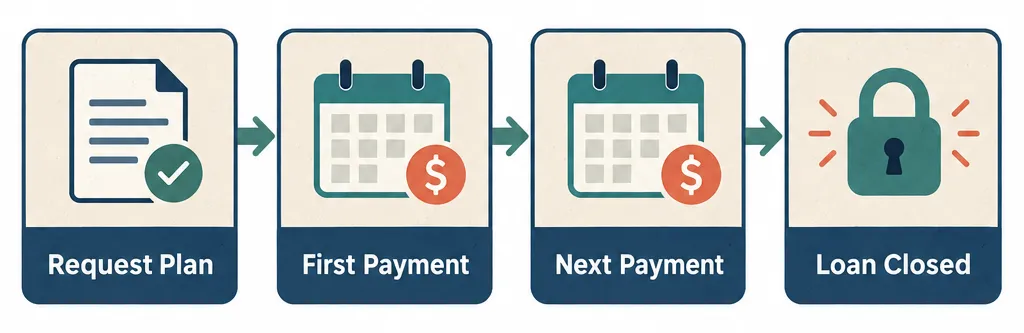
If you can’t pay a payday loan on the due date, South Carolina law lets you convert it into at least four equal installments with no added interest or fees. You can use this plan once in any 12-month period, under §34-39-280.
On a $550 loan, the plan covers the whole $632.50 balance, fee included. Four installments come to about $158.13 each, and the plan can’t cost you anything extra.
| Item | Without the plan | With the extended payment plan |
|---|---|---|
| Amount owed | $632.50 due in one payment | $632.50 split into at least 4 payments |
| Payment size | $632.50 | About $158.13 each |
| Added interest or fees | Depends on what happens next (bounced check, collection) | None allowed |
| How often available | n/a | Once per 12 months |
How to ask for it
Lenders don’t always offer the plan, so ask for it.
How to request a payday extended payment plan in SC
- Ask before your due date, while the loan is still current.
- Make the request in writing (email, the lender’s form, or a signed letter) and keep a copy.
- Name the law: “I am requesting an extended payment plan under SC Code §34-39-280.”
- Read the plan agreement and check that it has at least four substantially equal installments and adds no fees.
- Ask what happens to your original check or debit authorization once the plan starts.
- Put every installment date on your calendar and set a reminder two days before each one.
A sample request: “I can’t repay my deferred presentment transaction due on [date]. Under South Carolina Code §34-39-280, I am requesting an extended payment plan of at least four substantially equal installments with no additional fees. Please send the plan in writing.”
Ask in writing, before the due date
The extended payment plan under SC Code §34-39-280 costs nothing extra, but you get only one every 12 months. Save it for a real emergency, and get the terms on paper before your due date.
What happens if you miss an installment
If you miss a payment under the plan, the lender may accelerate the debt, which means the whole remaining balance becomes due at once. After that, the lender can pursue normal civil collection. Because you’ve used your one plan for the year, you can’t start another one.
If you can see a missed installment coming, call the lender before the date and ask for a short delay in writing. They don’t have to agree, but it costs less than a default.
Your bank account and repeated withdrawal attempts (CFPB two-attempt rule)
Federal rules limit how many times a lender can hit your bank account. The payment provisions of the Consumer Financial Protection Bureau’s 2017 Payday Lending Rule took effect on March 30, 2025. They bar a lender from trying again to withdraw money after two straight failed attempts, unless you give new, specific permission.
The CFPB said in 2025 that it would not prioritize penalties or fines under those provisions. That is not a repeal. The rule (12 CFR part 1041) is still on the books, and complaints still create a record.
You also have a separate right under the Electronic Fund Transfer Act and Regulation E: you can stop a preauthorized recurring debit by telling your bank at least three business days before the scheduled transfer. Stopping the debit doesn’t cancel the debt, but it does stop the overdraft spiral while you set up a plan.
Keep the bank records
If a lender keeps trying to debit your account after two failed attempts, save your bank statements and overdraft notices. Cite the CFPB payment provisions when you file a complaint.
Can you be arrested or sued over a payday loan in SC?
You can be sued over an unpaid payday loan, but you can’t be arrested just for being unable to pay it. A payday loan is a civil debt. The lender took your check knowing it would hold it until a later date, and its remedy is civil collection, which can mean a lawsuit and a court judgment.
That answers a question people ask often in legal Q&A forums: can a payday loan default be treated as an attempt to commit fraud and prosecuted as a crime? Falling behind on a loan you meant to repay is not fraud. Collectors who say otherwise are breaking federal law.
Under the Fair Debt Collection Practices Act, a debt collector may not falsely threaten arrest or imprisonment, or threaten action it can’t legally take or doesn’t intend to take. South Carolina adds two protections of its own:
- No wage garnishment for consumer debts. SC Code §37-5-104 bars garnishment of wages to collect debts from consumer loans and consumer credit sales. Even a creditor that wins a judgment can’t take your paycheck for a payday debt while you live in South Carolina, though it may pursue other collection remedies a court allows.
- A three-year lawsuit deadline. Under SC Code §15-3-530, most contract actions must be filed within three years. Old payday debts are often past this deadline. The debt may still exist, but a collector that sues on it can lose if you raise the time limit in court.
Signs of a payday debt collection scam
One reader posted on Avvo, a legal Q&A site, about calls threatening criminal action over a payday debt from 2009. That pattern is common. These are the red flags:
- Threats of a “felony charge,” “check fraud warrant” or arrest at your workplace.
- A “court filing charge” or “processing fee” added to the balance. No court bills you by phone before you’ve been served.
- Pressure to pay today by prepaid card, gift card, wire or app transfer.
- Refusal to send anything in writing, or to give the original lender’s name and the amount owed.
- Knowing your Social Security number, which can come from leaked loan applications and doesn’t prove the debt is real.
When a caller makes these threats, use this script: “Send me written validation of this debt by mail. I will not make any payment over the phone. Do not contact me at work.” Then hang up, don’t confirm bank details, and report the call to the CFPB at (855) 411-2372.
What to do if you’re actually served
A real lawsuit arrives as a summons and complaint from a South Carolina court (often magistrate court for small amounts), served on you in person or as the court rules allow. It is never a phone call. Check the case with the clerk of the court named on the papers, note the deadline to answer, and file your answer on time. If you don’t respond, the creditor can win a default judgment.
South Carolina Legal Services offers free civil legal help to eligible low-income residents. Raise any defenses you have, such as the three-year limit or fees the law doesn’t allow.
Online, tribal and out-of-state payday lenders
Any lender making payday loans to South Carolina residents needs a South Carolina deferred presentment license, whether it operates online or from a storefront. Several large national chains don’t offer online payday loans in the state at all. ACE Cash Express, for example, shows South Carolina visitors that the loan type is not available in the state.
Online lenders that claim to operate under tribal law or another state’s law and lend to South Carolinians anyway are on shaky ground. Their legal claims have been widely disputed. Reddit-style advice that “tribal loans are flat out illegal and you don’t have to pay” oversimplifies it. Don’t assume you owe nothing, and don’t assume you owe every dollar they claim. A legal aid lawyer can look at the actual contract and tell you where you stand.
How to look up a lender’s license
- Search the company’s legal name in NMLS Consumer Access, since SC deferred presentment licenses are issued through NMLS.
- Check that the license is a South Carolina deferred presentment license, not just a license from another state.
- Contact the Consumer Finance Division to confirm, especially for an online lender with no SC address.
- For installment lenders, check with the SC Department of Consumer Affairs, which keeps supervised lenders’ filings.
Look before you hand over a check
Look up any lender with the Consumer Finance Division or NMLS before you give it a check or your bank login. If an online lender isn’t licensed in South Carolina, file a complaint.
Stopping unauthorized debits
If an unlicensed lender is pulling money from your account:
- Write to the lender revoking its permission to debit your account (ACH authorization), and keep a copy.
- Tell your bank in writing to stop the payments, at least three business days before the next one (Regulation E).
- Dispute any debit made after you revoked permission. Banks have to investigate unauthorized electronic transfers.
- If the debits keep coming, ask your bank about closing the account and opening a new one.
- File complaints with the Consumer Finance Division and the CFPB.
The bigger risk: installment and title loans with no rate cap
In South Carolina, the payday loan is the high-cost product with the tightest rules. Supervised installment loans and car title loans can cost far more, because the law sets no APR ceiling on them above $600.
Under the South Carolina Consumer Protection Code (Title 37), small consumer loans of $600 or less face rate limits, but supervised lenders making larger loans can charge whatever rate they file with the Department of Consumer Affairs. The only general backstop is the ban on unconscionable terms in §37-5-108. The State of Credit Report 2026 found supervised lender filings at 850% APR. In 2022-2023 data from the 2024 report, supervised lenders made up 43% of all maximum-rate filings.
Payday vs. supervised installment vs. title loan
| Feature | Payday (deferred presentment) | Supervised / consumer finance installment | Title loan |
|---|---|---|---|
| Governing law | SC Code Title 34, Ch. 39 | SC Consumer Protection Code, Title 37 | Title 37 (supervised lending) |
| Loan size | Up to $550 | Commonly over $600 | Commonly over $600, based on car value |
| Price cap | 15% fee | No APR cap above $600; unconscionability ban | No APR cap above $600; unconscionability ban |
| Highest rates reported | About 391% APR on 14 days | 850% APR filings | Same supervised-lender rules |
| Statewide database | Yes (Catalis) | No | No |
| Free payment plan | Yes, once per 12 months | No statutory equivalent | No statutory equivalent |
| Collateral | Your check | Usually unsecured or personal property | Your car title |
| Regulator | Consumer Finance Division | Dept. of Consumer Affairs | Dept. of Consumer Affairs |
On car title loans, the biggest risk is your car. Short-term vehicle-secured loans with a term under 120 days require a specific borrower notice under SC Code §37-3-413, so many title lenders write loans that are longer and larger than that. If you default, the Consumer Protection Code’s notice-of-right-to-cure rules (§37-5-110 and §37-5-111) generally require the lender to send you a notice and give you a chance to catch up before it can accelerate or repossess. Read every notice the day it arrives.
Why storefronts may offer an installment loan instead
When payday volume fell after the database and $550 cap took hold, many lenders adapted. The State of Credit Report 2025 and 2026 both note that deferred presentment license holders have moved to supervised lending licenses. A shop with the same sign and the same staff may now steer you to a $700 or $1,000 installment loan, which carries none of the payday protections.
Know which loan you're being offered
If a storefront offers you more than $550 or a loan “over $600,” it’s a supervised installment loan with no APR cap, not a payday loan. Ask for the APR, the finance charge and the total of payments in writing (the Truth in Lending Act requires all three) before you sign.
SC payday lending by the numbers
South Carolina’s own reports show payday lending falling sharply and then leveling off, while installment lending grew. The figures below come from the Board’s reports and the Department of Consumer Affairs’ State of Credit Reports. Each has its own data year.
| Data year | Finding | Source report |
|---|---|---|
| 2018 | 687,855 deferred presentment transactions | State Board of Financial Institutions, 2019 board materials |
| 2022 | 52% drop in transactions, amount advanced and fees, year over year | State of Credit Report 2024 |
| 2023 | 36% drop in transactions, 35% in amount advanced, 36% in fees | State of Credit Report 2025 |
| 2024 | Activity “seemingly leveled out”; licensees moving to supervised licenses | State of Credit Report 2026 |
For scale, the 2026 report says consumer lenders, pawnbrokers and other lenders filing with the Department advanced nearly $2.4 billion through more than 1.3 million transactions. Payday loans are now a small share of high-cost credit in the state. If you’re comparing options, look hardest at the products that aren’t capped.
Did you know?
According to the SC Department of Consumer Affairs’ State of Credit Report 2025, payday lenders saw a 36% year-over-year drop in transactions in 2023, and the state’s reports show license holders shifting to supervised lending licenses as payday volume fell.
What’s changing: bills and federal rules to watch
As of November 2026, South Carolina’s payday rules are unchanged. Chapter 39 is still in force, and no repeal or rate-cap bill has become law.
South Carolina legislature
- S.379 (2025-2026 session). Filed February 25, 2025, this bill would have banned new payday loans and renewals after June 30, 2025, revoked all deferred presentment licenses on December 31, 2025, and repealed Chapter 39 on January 1, 2026. Those dates have passed with no enactment, and the Board was still receiving the annual database report in April 2026.
- 36% cap bills. Bills to replace the 15% fee with a 36% APR cap (S.62 in 2019, H.3462 in 2021-22, H.3572 and S.67 in 2023-24) did not pass. S.518, a 36% cap on consumer loans, stalled in the Senate Labor, Commerce and Industry Committee.
- S.910 (2024). Sen. Tom Davis’s bill targeted predatory lending marketing and practices rather than rates, after senators and advocates called a hard cap a “non-starter.”
- S.532 (earned wage access). This bill would have required employer-based earned wage access providers to register with the SC Department of Consumer Affairs. It has not been enacted.
Federal: CFPB and Congress
The CFPB’s 2026 regulatory agenda, released in July, lists a proposal to reconsider what remains of the 2017 payday, vehicle title and high-cost installment rule, and labels it deregulatory. As of October 2026, no proposed rule had been published, and the payment provisions described above remain in the Code of Federal Regulations. In Congress, the Predatory Lending Elimination Act was introduced in February 2026. It is a bill, not law.
Federal rules that apply everywhere
Three federal laws protect you in South Carolina no matter which lender you use:
- Truth in Lending Act and Regulation Z. Lenders must disclose the APR, finance charge and total of payments before you sign.
- Military Lending Act. Active-duty service members and their covered dependents can’t be charged more than a 36% Military Annual Percentage Rate on covered loans, including payday, title and many installment loans. Service members also have separate protections under the Servicemembers Civil Relief Act.
- Fair Debt Collection Practices Act. Third-party collectors can’t threaten arrest, lie about the amount owed or harass you. You can demand written validation of the debt.
Borrowers in neighboring states face different rules. North Carolina’s payday loan regulations effectively shut storefront payday lending out, while Tennessee’s payday loan laws allow it under their own fee schedule.
Lower-cost alternatives in South Carolina
Before you take a payday or title loan, try these options. Each one costs less than a 391% APR loan, and some cost nothing.
Cheaper options first
Ask a credit union about a payday alternative loan (capped at 28% APR).
Call 2-1-1 for local rent, utility and food help.
Ask your utility or current lender for a hardship plan before the bill is late.
Credit union small-dollar loans
Federal credit unions can offer payday alternative loans under NCUA rules (12 CFR 701.21). A PAL I loan runs $200 to $1,000 over one to six months. PAL II loans go up to $2,000 over up to 12 months. Both are capped at 28% APR, with an application fee of no more than $20. South Carolina Appleseed Legal Justice Center has published guides to small-dollar options from credit unions and banks. Some banks also offer small-dollar loans to existing customers at far lower prices than payday lenders.
Here’s how that compares. A $500 PAL repaid over three months at 28% APR costs about $23 in interest, plus the application fee. The payday fee on the same amount, for one month or less, is $75.
Earned wage access: when it helps and when it doesn’t
Earned wage access apps advance pay you’ve already earned before payday. Employer-based programs that take the money straight from your next paycheck and charge nothing can be a reasonable bridge.
Ask whether an early pay app works like a payday loan and can trap you the same way. It can. Optional “tips,” instant-transfer fees and a habit of advancing every pay period add up, and a $5 fee on a $100 advance repaid in a week works out to an APR above 250%. Use these apps for a one-off gap, not every payday. South Carolina has no specific earned wage access law yet, since S.532 has not passed.
Help that isn’t a loan
For financial assistance in South Carolina, start with 2-1-1, run by United Way, which connects you to local rent, utility and food programs. Local community action agencies handle Low Income Home Energy Assistance Program (LIHEAP) help with power bills. The SC Department of Social Services runs SNAP. Nonprofit credit counseling agencies can set up debt management plans. South Carolina Legal Services helps eligible residents with collection lawsuits and lender disputes.
Lenders advertising “no credit check installment loans in South Carolina” usually do run soft checks or alternative-data checks, and they set prices to match the risk. That usually means the uncapped supervised-loan rates described above.
How to file a complaint
Where you file depends on the product. If you’re not sure, file with the agency that seems closest, since South Carolina agencies say they forward misdirected complaints.
| Problem | Where to file |
|---|---|
| Licensed payday (deferred presentment) lender | Office of the Commissioner of Consumer Finance (Consumer Finance Division), 1205 Pendleton Street, Suite 306, Columbia; [email protected] |
| Supervised installment, title or consumer loan; earned wage access | SC Department of Consumer Affairs |
| Collector threats, bank debits, any lender | CFPB, online or at (855) 411-2372 |
| Scam calls or fraud | FTC ReportFraud; FBI IC3 for online scams |
Have these ready: the loan agreement, receipts, the dates of each transaction, the amount in dispute, bank statements showing debits, and notes or recordings of calls (with dates, times and names). Leave your Social Security and driver’s license numbers off the Division’s complaint form, as it asks.
Before you borrow
The biggest risk in South Carolina isn’t the capped $550 payday loan. It’s the uncapped installment or title loan you may be offered instead. If you borrow, take only what you can repay in one payment, and save your once-a-year extended payment plan for a real emergency.
FAQ
Are payday loans legal in South Carolina?
Yes. Payday loans are legal only from lenders licensed under SC Code Title 34, Chapter 39, which caps the loan at $550 and the fee at 15%. Bill S.379, which would have repealed the chapter, has not become law as of November 2026.
How much can a payday lender charge in South Carolina?
No more than 15% of the amount advanced, charged once per agreement, under §34-39-180. That’s $82.50 on a $550 loan, or about 391% APR on a 14-day term and 177% APR on a 31-day term.
Can I have two payday loans at once in South Carolina?
No. Section 34-39-270 bars a new loan while you have one outstanding with any licensee, and lenders check the Catalis statewide database before lending.
Can you go to jail for not paying a payday loan in South Carolina?
No. An unpaid payday loan is a civil debt. A lender can sue you, but under §37-5-104 it can’t garnish your wages for a consumer debt. Threats of a felony charge or a “court filing charge” are red flags, and you should report them to the CFPB.
What happens if I can’t pay my payday loan in SC?
Ask the lender in writing, before the due date, for the extended payment plan under §34-39-280: at least four equal installments with no added fees, once every 12 months. If you miss an installment, the lender can demand the full remaining balance.
Is there an interest rate cap on loans in South Carolina?
Only partly. Payday loans are capped by the 15% fee. Supervised installment and title loans above $600 have no APR cap beyond the ban on unconscionable terms, and regulators have seen filings as high as 850%. Active-duty service members are protected by the 36% Military Lending Act cap.
Laws and regulations referenced
- Truth in Lending Act, 15 U.S.C. 1601
- Regulation Z, 12 CFR Part 1026
- Fair Debt Collection Practices Act, 15 U.S.C. 1692
- Electronic Fund Transfer Act, 15 U.S.C. 1693
- Regulation E (electronic transfers), 12 CFR Part 1005
- Military Lending Act, 10 U.S.C. 987
- Servicemembers Civil Relief Act, 50 U.S.C. 3901
- CFPB payday lending rule, 12 CFR Part 1041
Links go to the official text on government sites.
Check, verify or complain
Sources
- South Carolina Code of Laws Title 34, Chapter 39 - Deferred Presentment Services scstatehouse.gov · primary source
- Consumer Finance Division DP fee posting, May 29, 2025 consumerfinance.sc.gov · primary source
- Consumer Finance Division - Deferred Presentment consumerfinance.sc.gov · primary source
- Consumer Finance Division - Complaints consumerfinance.sc.gov · primary source
- SC Department of Consumer Affairs State of Credit Report 2026 consumer.sc.gov · primary source
- SC Department of Consumer Affairs State of Credit Report 2025 consumer.sc.gov · primary source
- SC Department of Consumer Affairs State of Credit Report 2024 consumer.sc.gov · primary source
- SC Board of Financial Institutions supplemental materials, April 2019 bofi.sc.gov · primary source
- S.379 Payday Loans, 2025-2026 session scstatehouse.gov · primary source
- CFPB – What can I do if I can't repay my payday loan? consumerfinance.gov · primary source
- SC Code §34-39-180 (Justia) law.justia.com
- 2021 SC Code §34-39-180 (Justia) law.justia.com
- 2023 SC Code §34-39-270 (Justia) law.justia.com
- SC Code §34-39-280 extended payment plan (Justia) law.justia.com
- Catalis presents annual report on deferred presentment transactions to State Board citizenportal.ai
- Post and Courier: predatory lending bills in South Carolina postandcourier.com
- Statehouse Report: Compromise in sight for predatory lending reform statehousereport.com
- National Law Review: CFPB plans limited enforcement of payday lending rule natlawreview.com
- National Law Review: CFPB 2026 regulatory agenda and payday rule reconsideration natlawreview.com
- CFPB Payday Rule Relief Is Not a Repeal fintechlaw.ai
- SC Code §37-3-413 short-term vehicle secured loans (Justia) law.justia.com
- SC Appleseed: Auto Title Loans and the Law scjustice.org

Elena writes about getting through a money emergency, assistance programs, budgeting on a tight income, banking basics and borrower rights. Her guides list the cheaper options first and link the agency or program that can actually help.
Ruth is US Financer's standards editor. Every article goes through her checks before and after it is published: each rate, fee, cap, deadline and rule is matched against its primary source, every law named is linked to its official text, and anything that cannot be…
Comments are closed