

General information, not legal advice. Laws change, so confirm with the official statute, your state regulator or a licensed attorney before you act.
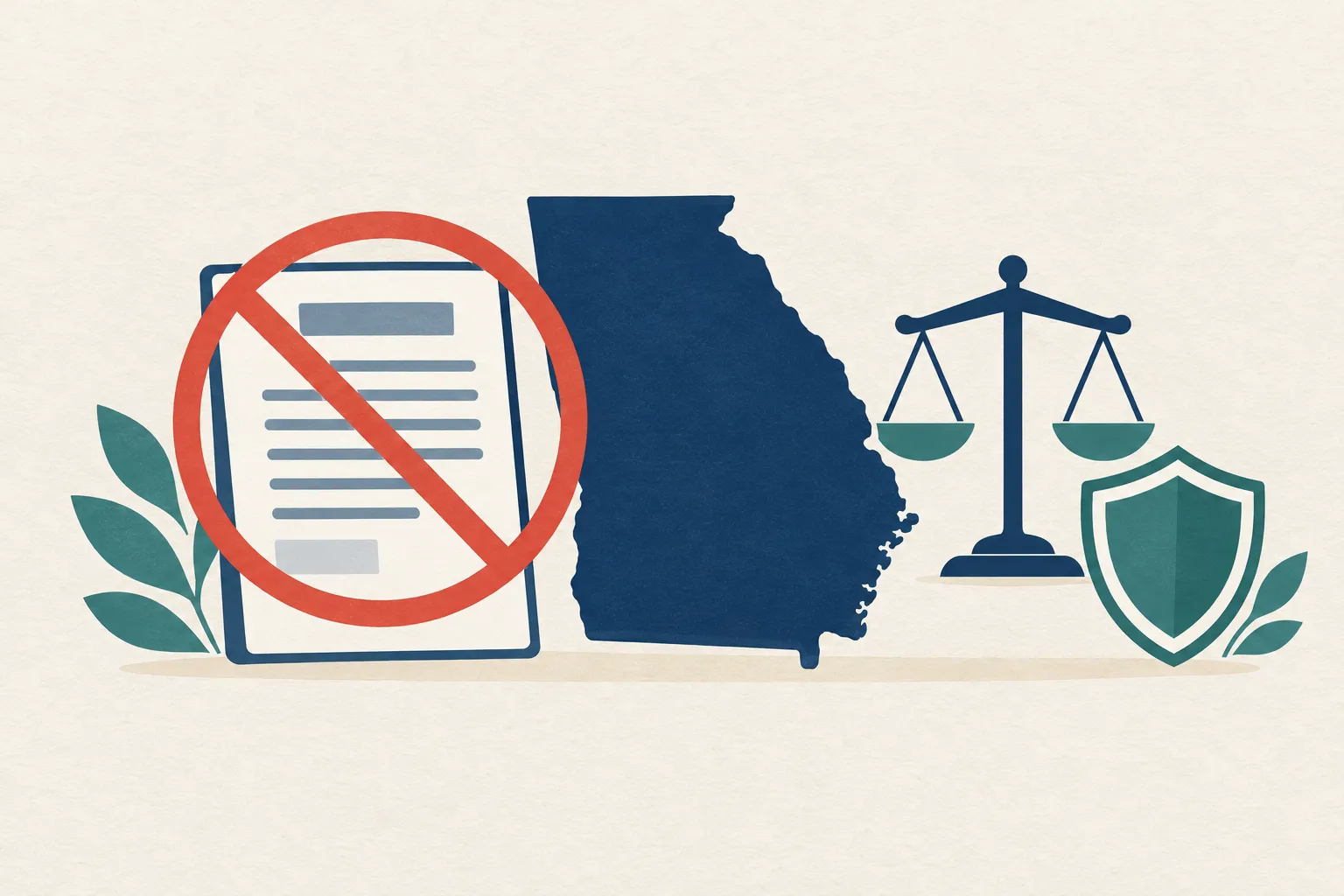
Payday lending is illegal in Georgia. The Payday Lending Act, O.C.G.A. § 16-17-1 et seq., makes it unlawful to make loans of $3,000 or less unless one of the statute’s exceptions applies. The exceptions include a loan at no more than 16% simple interest and a loan from a licensed installment lender, bank or credit union. That rules out the typical two-week, $15-per-$100 payday loan. Car title pawns and licensed installment loans are legal, and each has its own separate limits.
Run the numbers
Key takeaways
- Making a payday loan in Georgia is a crime, but taking one out is not.
- An illegal small loan is void, and the lender can owe you three times the interest and charges.
- Title pawns can charge 25% of the principal every 30 days for the first 90 days. That works out to about 304% APR.
- Since July 1, 2020, the Department of Banking and Finance has licensed installment lenders making loans of $3,000 or less.
- A federal credit union payday alternative loan is capped at 28% APR.
Payday and short-term loans in Georgia
Georgia bans payday lending outright. A lender that makes a small loan without a license, or above the state’s interest limits, commits a crime. A borrower who takes the loan commits no crime.
The General Assembly passed the Payday Lending Act in 2004. In O.C.G.A. § 16-17-1, its legislative findings describe payday lending as harmful to Georgia consumers. O.C.G.A. § 16-17-2 makes it unlawful to make, offer or arrange loans of $3,000 or less unless an exception listed in the statute applies. The exceptions cover loans at no more than 16% simple interest under § 7-4-2, licensees under the Georgia Installment Loan Act, and banks, credit unions and other lenders the statute names. A violation is a misdemeanor of a high and aggravated nature, and the statute also treats it as racketeering activity.
The protection still applies after the loan is made. Under O.C.G.A. § 16-17-3, a loan made in violation of the chapter is void. The lender cannot collect principal, interest or charges, and it owes the borrower three times the interest and charges. Because the product is banned, Georgia has none of the fee schedules, rollover limits, cooling-off periods or loan databases found in states that license payday lenders. Florida payday loan laws, Alabama payday loan laws and Tennessee payday loan laws all allow storefront payday lending under caps. Georgia does not.
The table compares a typical payday loan from another state with the most an unlicensed lender may charge in Georgia under O.C.G.A. § 7-4-2. That section caps loans of $3,000 or less at 16% simple annual interest.
| $300 loan, 14 days | Fee or interest | APR | Total repaid |
|---|---|---|---|
| Typical payday loan elsewhere ($15 per $100) | $45.00 | about 391% | $345.00 |
| Georgia unlicensed cap (16% simple, § 7-4-2) | $1.84 | 16% | $301.84 |
The math:
- Payday fee: $45 divided by $300 is 15% for 14 days. Multiply 15% by 365 and divide by 14 to get about 391.1% APR.
- Georgia cap: $300 × 16% × 14 ÷ 365 = $1.84.
You can also run your own numbers through our payday loan calculator.
Separately, O.C.G.A. § 7-4-18 makes it a criminal offense to charge more than 5% a month on a loan, which is 60% a year.
Georgia title loans
Georgia allows title loans only as “title pawns” under the pawnbroker laws, O.C.G.A. § 44-12-130 et seq. The charges are steep. Your car can be repossessed and sold if you do not pay or renew.
Pawnbrokers get their licenses from the county or city where they operate. The Department of Banking and Finance publishes consumer guidance on title pawns, including the written disclosure ticket a pawnbroker must give you. Under O.C.G.A. § 44-12-131:
- First 90 days: Interest plus pawnshop charges can total up to 25% of the principal for each 30-day period, with a minimum charge of $10.
- After 90 days: The limit drops to 12.5% of the principal for each 30-day period, with a minimum charge of $5.
- Vehicle fees: The statute permits certain extra fees on motor vehicle pawns, so the real cost can run higher than the charge alone.
- Overcharges: Charges above these limits cannot be collected, and the pawn transaction is void.
| $1,000 title pawn | Charges paid | Still owed | Total paid out |
|---|---|---|---|
| Repaid after 30 days | $250 | $0 | $1,250 |
| Charges only for 90 days | $750 (3 × $250) | $1,000 | $750 so far |
| Charges only for 6 months | $1,125 ($750 + 3 × $125) | $1,000 | $1,125 so far |
A 25% charge every 30 days equals about 304.2% APR (25% × 365 ÷ 30). After day 90, the 12.5% rate equals about 152.1% APR. After six months of renewals in the example, you have paid $1,125 and still owe the full $1,000.
In the 2026 session, the House passed HB 1134 on March 4, 2026. The bill dealt with notice requirements for vehicle repossessors and with when a repossession counts as complete. The Senate tabled it on March 27, 2026, and again on March 31. It did not reach final passage, so the existing repossession rules still apply as of November 2026.
Installment loans in Georgia
Most Georgia installment loans of $3,000 or less come from consumer finance companies licensed under the Georgia Installment Loan Act, O.C.G.A. § 7-3-1 et seq. Loans under the Act cannot exceed $3,000, and terms are limited to 36 months and 15 days.
Did you know?
Georgia’s Industrial Loan Act became the Georgia Installment Loan Act under SB 462, signed June 30, 2020. The same law moved oversight of these lenders from the Industrial Loan Commissioner, part of the Insurance Commissioner’s office, to the Department of Banking and Finance.
Who regulates installment lenders
The Georgia Department of Banking and Finance has licensed and supervised installment lenders since July 1, 2020. Lenders apply for the license through NMLS, so you can look one up on NMLS Consumer Access. The department adopts rules for these lenders and finalized its most recent rule package in June 2026.
What licensed lenders can charge
The Act limits the interest and fees a licensee can collect, under O.C.G.A. § 7-3-14:
- Interest: The Attorney General’s Consumer Protection Division states that a licensed lender cannot charge more than 10% interest on a loan of $3,000 or less. That rate is applied to the face amount of the loan, so the APR comes out higher than 10%.
- Loan fee: An origination fee of up to 8% of the first $600 plus 4% of the rest.
- Maintenance charge: A monthly maintenance charge for each month of the loan.
- Credit insurance: Add-ons are limited by the Act.
All of these charges count toward the APR that appears on your Truth in Lending disclosure. For loans above $3,000, O.C.G.A. § 7-4-2 lets the parties agree in writing on a rate expressed as simple interest, still subject to the criminal usury limit in § 7-4-18. For a general guide to how these loans work, see our explainer on the installment loan.
A 2026 House bill, HB 1314, proposed requiring Installment Loan Act licensees to tell borrowers whether a loan is reported to credit bureaus. It cleared a House committee, and it is not part of the Act unless it was enacted.
Worked example: $1,000 over 12 months
The table shows illustrative rates, not offers. Your rate depends on the lender and your credit. Each monthly payment uses the standard amortization formula, and each total equals the payment times 12.
| $1,000 for 12 months | APR | Monthly payment | Total repaid | Extra fee |
|---|---|---|---|---|
| Credit union PAL II | 28% | $96.51 | $1,158.12 | Up to $20 application fee |
| Example finance company rate | 36% | $100.46 | $1,205.52 | Depends on lender |
| Example at the 5%-a-month usury line | 60% | $112.83 | $1,353.96 | Depends on lender |
For the PAL row, $96.51 × 12 = $1,158.12, so the interest is $158.12. Add the maximum $20 application fee and the loan costs $178.12 in total. At 60%, interest alone comes to $353.96, which is more than twice the PAL’s cost.
Be cautious with ads for loans no credit check Georgia. These lenders still screen you, usually with a soft credit check, a review of your bank account or alternative data, and they charge more to cover the extra risk.
Online and tribal lenders
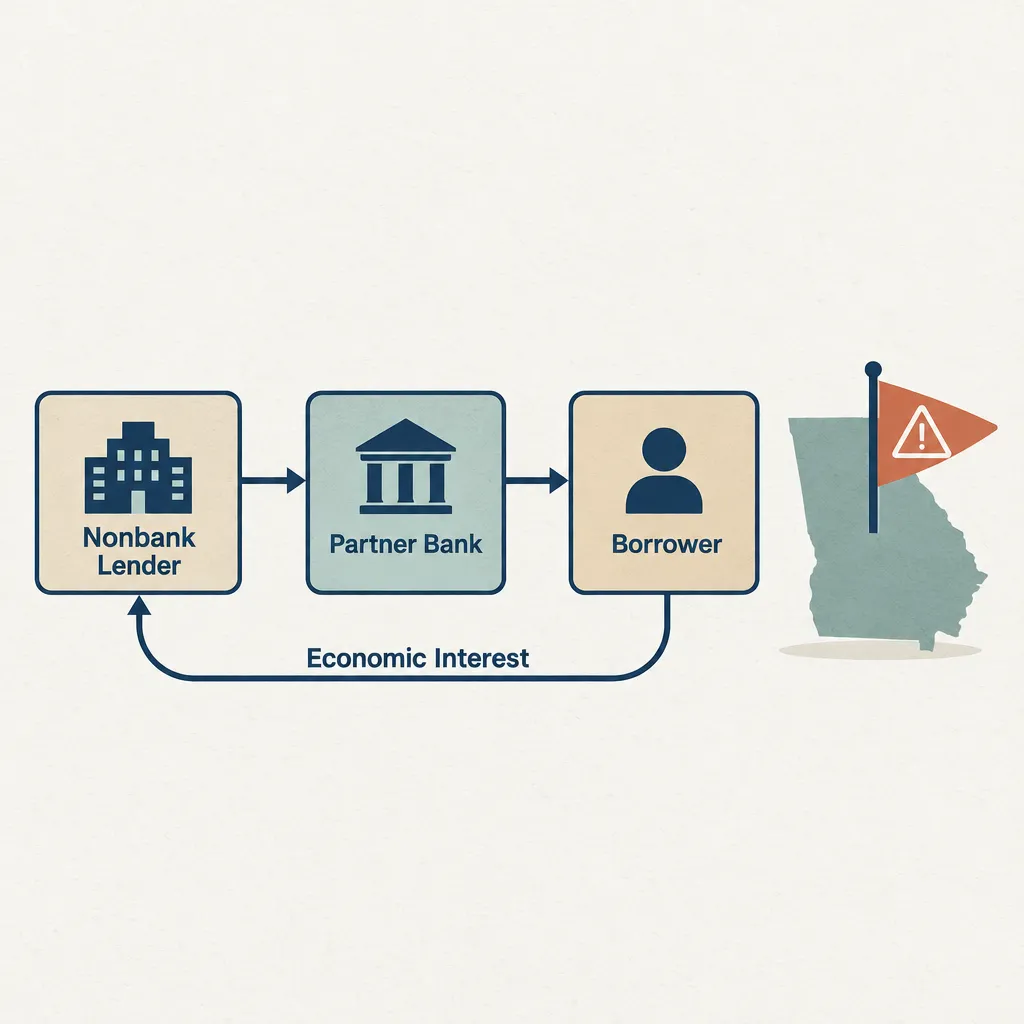
Georgia law follows the borrower, wherever the lender is based. Section 16-17-2 covers lenders that reach Georgia residents online or by mail. It also targets “rent-a-bank” setups, where a nonbank partners with an out-of-state bank but keeps most of the economic interest in the loans. A website offering same-day loans to Georgians at triple-digit APRs is very likely operating outside Georgia law.
Some online lenders say tribal sovereign immunity exempts them from state law. Georgia’s position is that its law applies to loans made to Georgia residents. Before you deal with any lender, check its license with the Department of Banking and Finance or on NMLS Consumer Access.
Debt collection and wage garnishment
Collectors must follow the federal Fair Debt Collection Practices Act and Georgia’s Fair Business Practices Act, O.C.G.A. § 10-1-390 et seq. Our guide to dealing with a debt collector explains your federal rights in more detail.
Under O.C.G.A. § 18-4-5, wage garnishment for ordinary consumer debt is limited to the lesser of two amounts. Different limits apply to garnishments for child support, alimony and certain other debts such as taxes.
- 25% of your disposable earnings for a week, or
- the amount by which your disposable earnings exceed 30 times the federal minimum hourly wage. At $7.25 an hour, the federal rate as of November 2026, that threshold is $217.50 a week.
Worked example: You take home $500 a week. 25% of $500 is $125. $500 minus $217.50 is $282.50. The lesser amount is $125, so that is the most a creditor can garnish. Social Security and many other federal benefits are generally exempt.
The statute of limitations is six years for written contracts under O.C.G.A. § 9-3-24 and four years for open accounts under O.C.G.A. § 9-3-25.
Federal rules that apply everywhere
Federal law adds protections on top of Georgia’s rules:
- Truth in Lending Act and Regulation Z (12 CFR 1026): The lender must disclose the APR and the total cost before you sign.
- Military Lending Act: Most credit to active-duty service members and their dependents is capped at a 36% military annual percentage rate. That covers families at Fort Stewart, Naval Submarine Base Kings Bay and Georgia’s other installations.
- Electronic Fund Transfer Act and Regulation E: A lender cannot require automatic debits as a condition of a loan, and you can revoke a debit authorization.
- Regulation F: A debt collector is presumed to break the rules if it makes more than seven call attempts in seven days about a single debt.
Help that costs less
Cheaper options first
Federal credit union PAL loans cost no more than 28% APR. Call 211 for Georgia help with rent, utilities and food. Ask your creditors for a hardship plan before you borrow.
Federal credit union payday alternative loans are the closest legal substitute for a payday loan. NCUA rules cover PAL I loans at 12 CFR 701.21(c)(7)(iii) and PAL II loans at 12 CFR 701.21(c)(7)(iv). Both types carry a maximum 28% interest rate and an application fee of no more than $20, and their loan amounts and terms differ. You also cannot be required to repay a PAL in a single balloon payment.
| PAL type | Amount | Term | Membership wait |
|---|---|---|---|
| PAL I | $200 to $1,000 | 1 to 6 months | At least 1 month |
| PAL II | Up to $2,000 | 1 to 12 months | None |
Several public and nonprofit programs can also help:
- Food, cash and health coverage: Georgia’s Division of Family and Children Services handles SNAP, TANF and Medicaid through Georgia Gateway.
- Utility bills: Local community action agencies run LIHEAP energy assistance.
- Legal help: Georgia Legal Services Program and the Atlanta Legal Aid Society give free advice on illegal loans and collection lawsuits.
- Debt management: Nonprofit credit counselors can set up debt management plans that lower interest and fees.
- Pay advances: Some employers offer advances on wages you have already earned. As of November 2026, Georgia has no law specific to earned wage access. SB 282, which would have added rules under the Fair Business Practices Act, was referred to a Senate committee on February 27, 2025, and went no further.
For emergency loans in Georgia, ask your employer or your credit union about small-dollar options before you turn to a pawnbroker.
How to check a lender and complain
How to check a Georgia lender
- Confirm an installment lender license with the Georgia Department of Banking and Finance.
- Search NMLS Consumer Access for the lender’s license number and record.
- Ask a pawnbroker for its county or city license and the written disclosure ticket.
- Report illegal payday lending to the Attorney General’s Consumer Protection Division.
- File a federal complaint with the CFPB.
You can also report fraud to the FTC at ReportFraud and report online scams to the FBI’s IC3. Our guide to financial dispute resolution explains how to escalate a complaint the company has not fixed.
Before you borrow
In Georgia, the biggest risk is a title pawn that keeps renewing. You can pay more than the loan amount in charges and still lose your car.
FAQ
Is it illegal to take out a payday loan in Georgia?
No. The law targets the lender. Making the loan is a crime under O.C.G.A. § 16-17-2, but borrowing is not.
Do I have to repay an illegal payday loan?
Under O.C.G.A. § 16-17-3, a loan that breaks the Payday Lending Act is void. The lender cannot collect principal, interest or charges, and you can recover three times the interest and charges. Talk to legal aid before you stop paying so you understand how to raise these rights.
Can a payday lender have me arrested in Georgia?
Not for failing to repay a loan. Unpaid debt is a civil matter. The Fair Debt Collection Practices Act bars debt collectors from falsely threatening arrest. Report any lender or collector that makes this threat to the Attorney General and the CFPB.
Are same day loans legal in Georgia?
Speed is not the issue. A same-day loan is legal when a licensed lender makes it within Georgia’s rate limits. A same-day loan of $3,000 or less from an unlicensed lender is not.
How much can a title pawn charge in Georgia?
O.C.G.A. § 44-12-131, which governs pawn transactions, lets a pawnshop charge up to 25% of the principal per 30-day period for the first 90 days and up to 12.5% per 30-day period after that. On a $1,000 pawn, that is $250 a month at first and $125 a month after day 90.
Who regulates installment lenders in Georgia?
The Georgia Department of Banking and Finance, since July 1, 2020. Before that, the Industrial Loan Commissioner in the Insurance Commissioner’s office supervised these lenders. The Attorney General’s Consumer Protection Division enforces the payday lending ban.
Laws and regulations referenced
- Truth in Lending Act, 15 U.S.C. 1601
- Regulation Z, 12 CFR Part 1026
- Fair Debt Collection Practices Act, 15 U.S.C. 1692
- Regulation F (debt collection), 12 CFR Part 1006
- Electronic Fund Transfer Act, 15 U.S.C. 1693
- Regulation E (electronic transfers), 12 CFR Part 1005
- Military Lending Act, 10 U.S.C. 987
Links go to the official text on government sites.
Check, verify or complain
Sources
- dbf.georgia.gov › pawnshops title pawn dbf.georgia.gov · official source
- ncua.gov › files › agenda items › AG20190919Item4b.pdf ncua.gov · official source
- law.justia.com › codes › georgia › 2020 › title 7 › chapter 4 › article 1 › section 7 4 18 law.justia.com
- jgwentworth.com › resources › what is the 7 7 7 rule in collections jgwentworth.com
- opploans.com › oppu › payday loans › what is a payday alternative loan how can you get o… opploans.com
- codes.findlaw.com › ga › title 44 property › ga code sect 44 12 131 codes.findlaw.com
- unicourt.github.io › cic code ga › transforms › ga › ocga › r81 › gov.ga.ocga.title.07 unicourt.github.io
- americascreditunions.org › blogs › compliance › comparing pals i and pals ii loans americascreditunions.org

Elena writes about getting through a money emergency, assistance programs, budgeting on a tight income, banking basics and borrower rights. Her guides list the cheaper options first and link the agency or program that can actually help.
Ruth is US Financer's standards editor. Every article goes through her checks before and after it is published: each rate, fee, cap, deadline and rule is matched against its primary source, every law named is linked to its official text, and anything that cannot be…
What changed
- Nov 13, 2026 Facts re-checked against official sources and updated; sources and links refreshed.
- Oct 23, 2026 First published.
Comments are closed