We are not a credit repair, debt relief or debt collection company and offer no services. Rules differ by state, so confirm with the agency or a nonprofit counselor before you act.
You can get a credit card with a FICO score under 580, and the cheapest route is almost always a secured card with no annual fee and a $200 deposit. Unsecured cards marketed to people with bad credit usually cost $75 to $200 or more in first-year fees for a $300 limit, and the fees eat part of that limit before you spend a dollar. This ranking puts the lowest-cost options first and explains what each one really charges, what the law caps, and how to use any of them to move your score up.
Before you apply
The biggest risk with a bad-credit card is paying for credit you barely get: a card with a $300 limit and $170 in year-one fees leaves you $130 to spend and a new bill to miss. A missed payment on a card meant to rebuild your credit does more damage than having no card at all.
What “bad credit” means to a card issuer
Issuers do not use the phrase “bad credit” in their underwriting. They use score bands and the details inside your credit reports. FICO, whose scores most card issuers pull, publishes these ranges on its own site. VantageScore, used by many free score apps, labels the bands differently, which is why your “free score” and the score an issuer sees can land in different categories.
| Score band | FICO 8 range | VantageScore 4.0 range | What card issuers typically offer |
|---|---|---|---|
| Poor / Very Poor | 300 to 579 | 300 to 600 | Secured cards, high-fee unsecured cards |
| Fair | 580 to 669 | 601 to 660 | Secured cards, some no-fee unsecured starter cards |
| Good | 670 to 739 | 661 to 780 | Most mainstream cards |
| Very Good / Excellent | 740 to 850 | 781 to 850 | Premium rewards cards, lowest APRs |
The score is only half the story. Two people with a 560 can get very different answers. A 560 caused by a single charged-off account from four years ago reads differently from a 560 with three accounts 60 days late right now. Issuers also look at recent inquiries, open collections, bankruptcy dates and whether you have any history at all. Someone with no credit file is a different case from someone with damaged credit, even though both get pushed toward the same cards.
Under Regulation Z (12 CFR 1026.51), an issuer must also consider your ability to make the required minimum payments before opening the account. That is why every application asks for income. You can include income you have “reasonable expectation of access to,” which for most adults means wages, benefits, retirement income and, if you are 21 or older, a spouse’s or partner’s income you regularly use.
The ranking, cheapest first
We ranked by total first-year cost for a cardholder who pays in full, then by what happens if you carry a balance, then by how the card helps you move on to something better. Every option below reports to all three national credit bureaus. If a card does not report to Equifax, Experian and TransUnion, it cannot rebuild your credit, no matter what the marketing says.
1. Secured cards with no annual fee
A secured card holds a cash deposit as collateral. Your deposit normally becomes your credit limit. Put down $200, get a $200 limit. The deposit sits in an account at the bank and comes back to you when you close the card in good standing or when the issuer “graduates” you to an unsecured card.
Discover’s published terms for the Discover it Secured list no annual fee, a $200 minimum deposit, 2% cash back at gas stations and restaurants on up to $1,000 in combined purchases each quarter, 1% on everything else, and automatic account reviews beginning at seven months to see if you qualify to get your deposit back. Capital One’s Quicksilver Secured, by the issuer’s disclosure, carries no annual fee, a $200 deposit and 1.5% cash back on purchases. Both carry variable purchase APRs near 30% at the time of writing, which only matters if you carry a balance.
Strengths: zero fees if you pay in full, a deposit you get back, rewards on a card that most people with a 520 can qualify for, and a built-in path to an unsecured card from the same issuer.
Weaknesses: you need $200 in cash you can live without, the APR is high, and Discover and Capital One still check your credit report. A recent bankruptcy that has not been discharged, or an unpaid balance owed to the same issuer from a prior charged-off card, can get you declined even for a secured product.
2. Secured cards with a reduced deposit
Capital One’s Platinum Secured is the main card in this category. Capital One’s disclosure states that, depending on your creditworthiness, a deposit of $49, $99 or $200 gets you an initial $200 credit limit. You can add deposits up to a $1,000 limit before the account is opened. There is no annual fee, and the issuer says it automatically considers you for a higher limit after six months.
Strengths: the lowest cash outlay of any mainstream secured card, no annual fee, no foreign transaction fee.
Weaknesses: no rewards, and the smaller deposit tiers are assigned by the issuer, not chosen by you. Many applicants with scores below 550 are assigned the full $200 deposit anyway.
3. Credit union secured cards
Credit unions are nonprofit, member-owned, and regulated by the National Credit Union Administration, which caps the interest rate federal credit unions can charge at 18% (the NCUA board has extended that temporary ceiling repeatedly; it is scheduled through at least September 2026 under the most recent extension). Many federal credit unions offer secured cards with APRs in the 12% to 18% range and no annual fee, roughly 10 to 15 percentage points below the big banks’ secured cards.
Strengths: the lowest APR you will find anywhere in this category, plus a relationship with a lender that also offers payday alternative loans and small personal loans later.
Weaknesses: you must qualify for membership, which can require living in a county, working for an employer, or joining an association. Credit union secured cards often have smaller rewards programs or none, and some require a $250 or $500 deposit instead of $200. Online application systems at smaller credit unions can be clunky.
4. Deposit-free builder cards tied to a checking account
Chime’s Credit Builder Visa works differently from a classic secured card. There is no credit check and no annual fee, and Chime states the card has no interest because you can only spend money you have already moved into the Credit Builder account. The card is issued by Stride Bank, N.A., Member FDIC. The catch is that you need a Chime Checking Account with a qualifying direct deposit of at least $200 to open it.
Strengths: no fees, no interest, no hard inquiry, reports to all three bureaus, no fixed $200 deposit upfront.
Weaknesses: utilization reporting is unusual. Chime reports the balance but does not report a traditional credit limit, which some scoring models treat as a zero limit and some ignore. You have to move your banking to a fintech, and if your employer’s direct deposit setup changes, so does your eligibility.
5. No-credit-check secured cards with a small annual fee
OpenSky’s Secured Visa does not pull your credit report at all. The issuer’s disclosure lists a $35 annual fee and a $200 minimum deposit. OpenSky also offers a Plus version with no annual fee but a $300 minimum deposit. First Progress secured cards from Synovus Bank charge annual fees in the $29 to $49 range depending on the version, with the higher-fee versions paired with lower APRs.
Strengths: approval does not depend on your score, so these work for people with a bankruptcy that was discharged recently, a fresh charge-off, or an active collection that would block a Discover or Capital One application.
Weaknesses: $35 to $49 a year for a card that is otherwise identical to a free secured card. You are paying the fee to skip the credit check, so only do that if you have actually been declined for the no-fee options or know your report has a recent bankruptcy.
6. Unsecured “starter” cards with a $0 to $59 annual fee
Mission Lane’s Visa is the clearest example here. Its published terms list an annual fee of $0 to $59, set at the time of approval based on your profile, and a variable APR in the high 20s to mid 30s. Initial limits run $300 to $1,000, and the issuer reviews accounts for limit increases after as little as seven months of on-time payments. Similar cards exist from several fintech partners of Celtic Bank, Sutton Bank and WebBank.
Strengths: no deposit, limits that can start above $300, and some versions with no annual fee at all.
Weaknesses: you have no control over which fee tier you get until after approval. The APR is punishing if you carry a balance, and many of these cards offer no rewards. These issuers decline more applicants in the 500 to 550 range than the secured cards do.
7. High-fee unsecured cards for terrible credit
This is the category where the ads say “$1,000 credit limit” and “instant approval.” The cards include Indigo and Milestone (Celtic Bank, serviced by Concora Credit), PREMIER Bankcard (First PREMIER Bank), Fortiva and Aspire (The Bank of Missouri), and Reflex, FIT and Surge (Celtic Bank, serviced by Continental Finance). Every one of them is a legitimate, licensed bank product. Every one of them is also the most expensive way to get a credit card.
A representative fee stack, drawn from these issuers’ published cardholder agreements, looks like this:
| Fee type | Typical range disclosed | When it is charged |
|---|---|---|
| Program or processing fee | $55 to $95 one time | Before the account opens, so not counted in the 25% cap |
| Annual fee, year one | $75 to $175 | Charged to the card on opening, reduces available credit |
| Annual fee, year two onward | $45 to $125 | Billed on the anniversary |
| Monthly servicing or maintenance fee | $6.25 to $12.50 per month | Often waived in year one, then charged monthly |
| Credit limit increase fee | Up to 25% of the increase | When the issuer raises your limit |
| Purchase APR | 29.99% to 36% | On any balance carried past the due date |
Strengths: these issuers approve people the other six categories reject, including applicants with multiple active collections, a score in the 400s, or a bankruptcy in the past year.
Weaknesses: the fees. A $300 limit with $170 in combined first-year fees is $130 of usable credit at a cost that, expressed as a percentage, would embarrass a payday loan storefront. Limit increases cost money. Customer service complaints about these issuers, in the CFPB’s public complaint database, cluster around fees the cardholder says were not clear and difficulty closing the account.
If you are considering one of these, read the fee table in the Schumer box on the application page, add the program fee to the first-year annual fee, and subtract the total from the credit limit. That number is what the card actually lets you spend in month one.
What a bad-credit card really costs
The APR on these cards only bites if you carry a balance, and the fees only bite if you choose a card that has them. The table below shows four realistic first-year scenarios. The APRs are stated rates used for illustration, not a quote from any issuer.
| Scenario | Amount used | Fees | APR and payment | Interest paid | Total repaid | Cost of credit |
|---|---|---|---|---|---|---|
| No-fee secured card, paid in full monthly | $300 per month | $0 | 29.99%, paid in full | $0 | $300 per month | $0 |
| No-fee secured card, balance carried | $500 once | $0 | 29.99%, $50 per month | about $83 | about $583 over 12 months | $83 |
| Unsecured starter card with $75 annual fee, balance carried | $200 once | $75 | 35.99%, $25 per month | about $32 | about $307 over 10 months plus $75 fee | $107 |
| High-fee unsecured card, paid in full monthly | $130 per month (what is left of a $300 limit) | $95 program fee plus $75 annual fee | 36%, paid in full | $0 | $130 per month plus $170 in fees | $170 |
Here is the plain-words math on the second row. A 29.99% APR means the issuer charges roughly 2.5% of your balance each month (29.99 divided by 12). On $500, that is about $12.50 in the first month. As you pay the balance down, the monthly interest shrinks, which is why the total comes to around $83 rather than $150. If you only paid the minimum, usually $25 or 3% of the balance, the payoff would stretch past three years and the interest would top $200. We walk through the full calculation in “credit card apr explained.”
The fourth row is the one that matters for anyone searching for a credit card for the worst credit. You pay $170 to get $130 of spending room, with zero interest because you paid in full. Expressed as a percentage of the credit you actually received, that is a 131% charge in year one. A secured card gives you $300 of room for $0, and your deposit comes back.
Cheaper options first
A no-fee secured card from Discover, Capital One or a credit union costs nothing if you pay in full.
Becoming an authorized user on a relative’s long-standing, low-balance card adds history for free.
A credit union payday alternative loan, capped at 28% APR by the NCUA, covers a cash need without a fee-heavy card.
The federal fee cap and what it leaves out
The Credit Card Accountability Responsibility and Disclosure Act of 2009, implemented in Regulation Z at 12 CFR 1026.52(a), limits the fees an issuer can charge during the first year after an account opens to 25% of the initial credit limit. On a $300 limit, that is $75. The cap covers annual fees, monthly maintenance fees and similar account charges.
Two gaps make the cap weaker than it sounds. First, late fees, over-the-limit fees and returned payment fees are excluded. Second, the CFPB amended the rule in 2013, after litigation brought by First Premier Bank, so that fees paid before the account opens do not count. That is why “program fees” and “processing fees” are collected before your card is issued: a $95 program fee plus a $75 annual fee on a $300 limit is legal because only the $75 lands inside the capped window.
Late fees have their own federal rule. Regulation Z limits penalty fees to a “safe harbor” amount the CFPB adjusts for inflation, long set at $30 for a first late payment and $41 for another within six billing cycles; in March 2024 the CFPB issued a final rule cutting that safe harbor to a flat $8 for larger card issuers. The CFPB’s 2024 rule that would have cut large issuers’ late fees to $8 never took effect; a federal court in Texas vacated it in April 2025. So expect the $30 and $41 figures to apply, and expect a late payment to also raise your APR to a penalty rate on many subprime cards.
If you or your spouse is on active duty, the Military Lending Act caps the total cost of consumer credit, including most fees, at a 36% Military Annual Percentage Rate. Several of the high-fee cards in category seven cannot be sold to covered borrowers on their standard terms. Issuers check the Defense Department’s database at application, but it never hurts to ask.
The credit limit you will actually get
Advertised limits are ceilings, not promises. In practice:
- Secured cards: your deposit, usually $200 to $1,000, with some issuers allowing up to $2,500 or $5,000 if you can fund it.
- Unsecured starter cards: $300 to $1,000 at opening, with $300 to $500 most common for scores under 580.
- High-fee unsecured cards: $300 to $700 at opening. The “$1,000 credit limit” in the card’s name is a maximum reached after fee-paid increases and on-time history.
The limit matters for your score because of utilization, the share of your available credit you are using. Scoring models reward balances under about 30% of the limit, and the best outcomes show up under 10%. On a $300 limit, that means keeping the reported balance under $90, and ideally under $30. The reported balance is whatever shows on your statement date, not what you owe at the due date. Paying most of the balance a few days before the statement closes keeps the reported number low even if you use the card heavily during the month.
Graduation is the other reason limits matter. Discover reviews secured accounts from month seven. Capital One reviews Platinum Secured accounts at six months. Mission Lane reviews at seven months. An unsecured graduation from the same issuer gets you a higher limit without a new hard inquiry, and it keeps the account’s age, which is worth more to your score than a brand-new card.
Using the card to raise your score
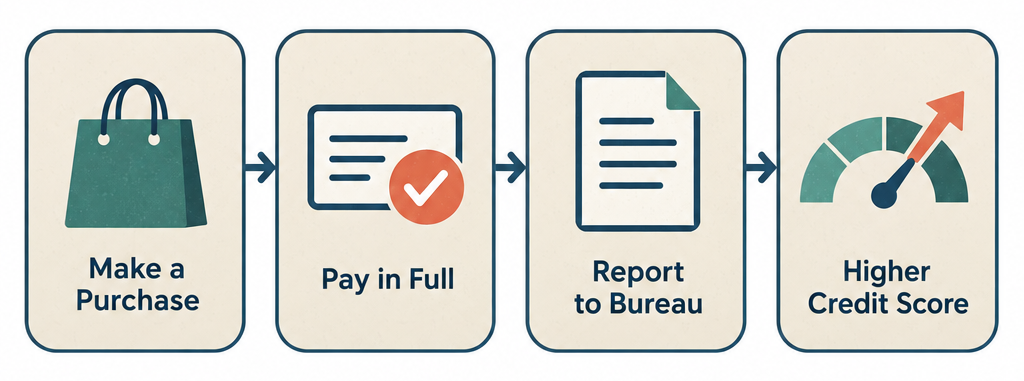
Payment history is 35% of a FICO score and utilization is about 30%, so a rebuilding card has exactly two jobs: pay on time every month, and keep the balance low. Everything else is optional.
A rebuilding routine that works
- Set up autopay for at least the minimum the day the account opens, so a forgotten due date can never create a late mark.
- Put one small recurring charge on the card, such as a $15 streaming subscription, and nothing else for the first three months.
- Pay the full statement balance each month. Interest on these cards runs 25% to 36%, so carrying a balance costs more than any reward earns.
- Pull your free reports at AnnualCreditReport.com, which the Fair Credit Reporting Act entitles you to weekly, and confirm the new account appears at all three bureaus with the correct limit.
- At month six or seven, ask the issuer about a limit increase or graduation before applying anywhere else.
Do not apply for three or four cards in a week hoping one sticks. Each application creates a hard inquiry, and FICO says a single inquiry typically costs fewer than five points, but a cluster of them on a thin, damaged file reads as desperation to the next underwriter. Pick the one card you are most likely to get, usually a secured card, and stop there.
State availability and where to look
Secured cards from Discover, Capital One and the big banks are offered in all 50 states and the District of Columbia. Credit union cards depend on the credit union’s field of membership, which can be a single county. Fintech-partnered cards sometimes exclude a handful of states; the exclusions appear in fine print on the application page, and they shift as issuers change bank partners, so check the current page rather than a review.
The high-fee unsecured issuers in category seven route their cards through banks chartered in Utah, South Dakota and Missouri, states with no usury cap, which under federal law lets the bank export its home-state rate nationwide. That is why a 36% APR card can be sold to you in a state that caps small loan rates at 18%. Your state’s cap on a payday loan does not apply to a bank-issued credit card.
If you were turned down everywhere, your state regulator’s license lookup, the FDIC’s BankFind tool and NMLS Consumer Access are the right places to confirm that any issuer you have not heard of is a real, supervised bank or a licensed partner before you share a Social Security number.
Your rights as a bad-credit cardholder
The same federal laws cover a $300 subprime card and a $30,000 premium card.
Under the Truth in Lending Act and Regulation Z (12 CFR 1026), the issuer must give you the Schumer box before you apply, 45 days’ notice before raising your APR or fees on an existing account, and the right to reject a rate increase and pay off the balance under the old terms. The issuer cannot raise the APR on an existing balance in the first year unless you are 60 days late, and it must apply payments above the minimum to the highest-rate balance first.
Under the Equal Credit Opportunity Act, a denial must come with a written adverse action notice within 30 days that states the specific reasons, such as “delinquent past or present credit obligations” or “insufficient income.” Under the Fair Credit Reporting Act, that notice must also tell you which bureau’s report was used, give you the score the issuer saw, and remind you that you can get a free copy of that report within 60 days. Read those reasons. They tell you exactly what to fix.
Under the Electronic Fund Transfer Act and Regulation E, if you set up autopay from a checking account, you can stop a recurring debit by notifying your bank at least three business days before the scheduled date, and the issuer cannot condition approval on autopay.
If an account charges off and goes to a debt collector, the Fair Debt Collection Practices Act controls how that collector can contact you, what it must disclose, and your right to dispute the debt in writing within 30 days of its first notice. We cover the details in “debt collector.”
Complaints go to the CFPB’s consumer complaint portal, which forwards them to the issuer and requires a response within 15 days in most cases. For a suspected scam, the FTC’s ReportFraud site and the FBI’s IC3 portal take reports.
Red flags that separate a card from a scam
Every legitimate card for low credit scores is issued by an FDIC-insured bank or an NCUA-insured credit union, and that name appears in the Schumer box. Watch for these signs that something is wrong:
- Any request for a fee paid by gift card, wire, cash app or crypto before approval. Real issuers charge program fees to the card or to a debit card after approval.
- “Guaranteed approval” paired with a request for your Social Security number before you see any terms. The same language shows up in “urgent loans guaranteed approval” marketing for a reason.
- A card that does not name its issuing bank, or names a bank you cannot find in FDIC BankFind.
- A “card” that only works at one online store, sometimes called a merchandise or catalog card. These rarely report to the bureaus in a way that helps.
- A monthly “credit repair” subscription bundled with the application. Under the Credit Repair Organizations Act, a credit repair firm cannot collect payment before it has performed the service.
FAQ
What is the easiest card to get with bad credit?
A no-credit-check secured card is the easiest, because approval depends on your deposit rather than your score. OpenSky and Chime’s Credit Builder fall into that group, and OpenSky charges $35 a year for the privilege. The easiest card with a credit check is usually a secured card from Capital One or Discover, which approve many applicants in the 500 to 580 range who do not have a pending bankruptcy or a prior charge-off with the same bank.
Can I get a $1,000 credit card with bad credit?
Yes, through a secured card where you deposit $1,000; Capital One’s Platinum Secured allows deposits up to that amount before opening. Some unsecured cards that put “$1,000 credit limit” in their name, such as the Milestone Mastercard $1,000 Credit Limit, open at the full $1,000 for approved applicants, while others, such as the Surge Mastercard, open anywhere from $300 to $1,000 and carry an annual fee that can equal 25% of the minimum $300 limit. If you need $1,000 of credit on day one with a score under 580, the deposit route is the only reliable one.
What credit card can I get with a 500 score?
A 500 FICO score sits at the low end of the “poor” band. Realistic options are secured cards (Discover it Secured, Capital One Platinum Secured, a credit union secured card), no-credit-check secured cards (OpenSky), deposit-free builder cards (Chime Credit Builder), and the high-fee unsecured cards from issuers such as First PREMIER Bank and Celtic Bank. Mainstream unsecured cards and most no-fee starter cards decline at 500. If there is a recent bankruptcy or an unpaid charge-off on your report, start with the no-credit-check secured options.
How to get $2,000 dollars fast with bad credit?
A credit card is the wrong tool for this. No bad-credit card opens with a $2,000 limit unless you deposit $2,000, and cash advances on these cards carry fees of 3% to 5% plus interest from day one. Safer routes for a cash need: a credit union payday alternative loan ($200 to $2,000, APR capped at 28% by NCUA rule, membership required), a hardship plan or advance from your employer, a no-fee earned wage access app, a nonprofit credit counseling agency’s hardship referral, or local assistance through 211. A payday loan will produce $2,000 only in a handful of states and at APRs near 400%, so it belongs at the bottom of the list.
Will a secured card hurt my score when I open it?
The hard inquiry can shave a few points for a few months, and a brand-new account lowers your average account age. Both effects are small and fade. Within six months of on-time payments and low reported balances, most people with damaged credit see a net gain, because the new positive history and lower utilization outweigh the inquiry.
Should I close a high-fee card once I qualify for something better?
Usually yes, once the better card is open and you have confirmed it is reporting. The high-fee card’s annual and monthly fees will keep arriving, and the account’s age, typically a year or two at that point, is not worth $100 or more a year to preserve. Pay the balance to zero, call to close, get the closure confirmed in writing, and check your reports 60 days later to make sure it shows as “closed by consumer” with a zero balance.
Laws and regulations referenced
- Truth in Lending Act, 15 U.S.C. 1601
- Regulation Z, 12 CFR Part 1026
- Fair Debt Collection Practices Act, 15 U.S.C. 1692
- Fair Credit Reporting Act, 15 U.S.C. 1681
- Equal Credit Opportunity Act, 15 U.S.C. 1691
- Electronic Fund Transfer Act, 15 U.S.C. 1693
- Regulation E (electronic transfers), 12 CFR Part 1005
- Military Lending Act, 10 U.S.C. 987
- FDIC deposit insurance
Links go to the official text on government sites.
Check, verify or complain
Sources
- experian.com › blogs › ask experian › how much should you deposit for secured card experian.com
- badcredit.org › how to › 1000 credit limit credit cards for bad credit badcredit.org
- experian.com › blogs › ask experian › what is a payday alternative loan experian.com
- lendingtree.com › personal › payday alternative loan lendingtree.com
- nerdwallet.com › credit cards › reviews › capital one secured nerdwallet.com

Marcus covers credit scores, credit reports and getting out of debt: consolidation, nonprofit counseling, settlement and what debt collectors may and may not do. He works from the federal laws that apply, CFPB guidance and the credit bureaus' published rules.