

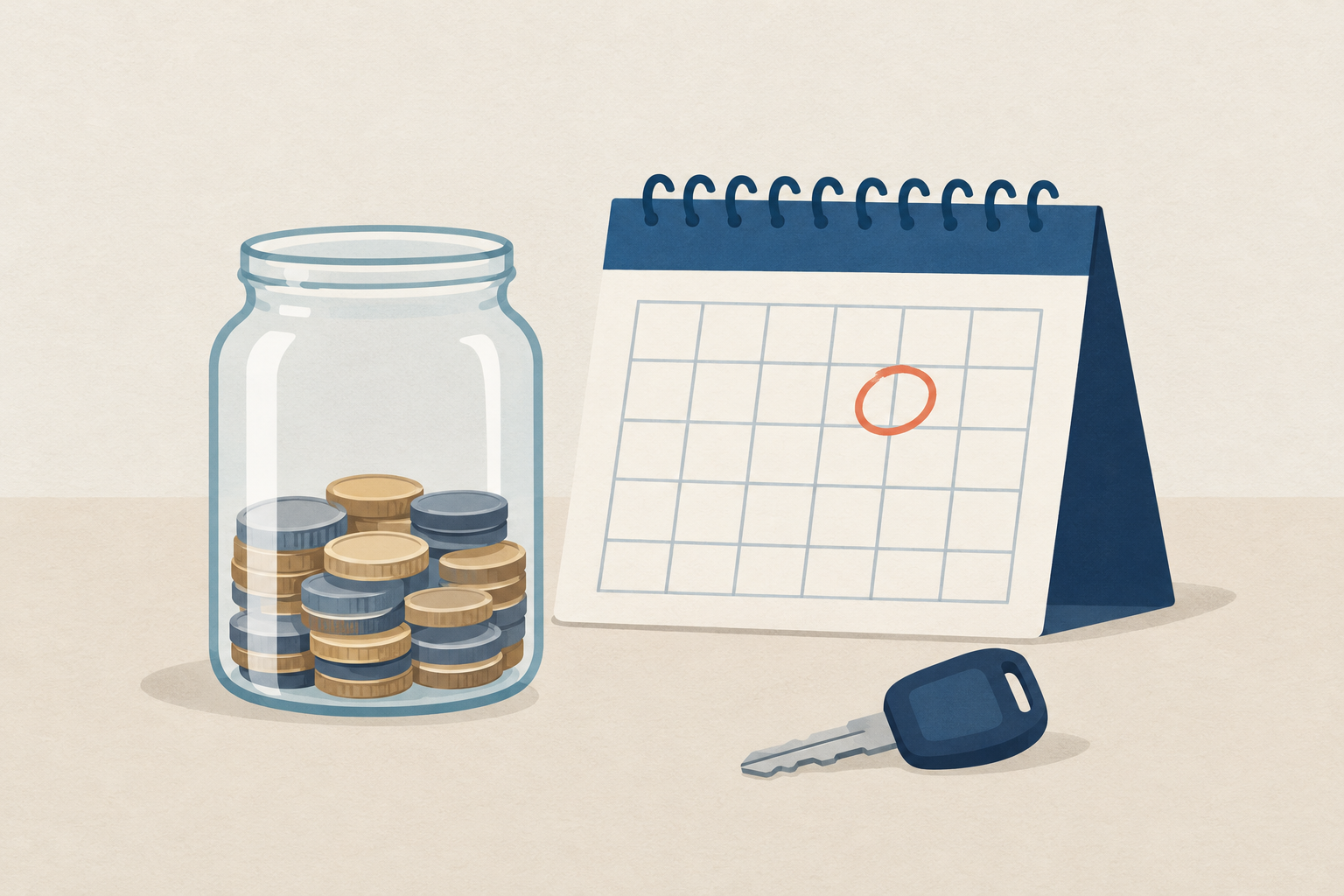
A $1,000 emergency fund will not cover a layoff. It will cover the car repair, urgent care copay or late paycheck that would otherwise push you toward a payday loan or an overdraft. This guide shows you how to reach $500 first, then $1,000, using numbered steps, real timelines, and the actual cost of borrowing when you have no cushion.
SCAM ALERTRelated consumer alert, Oct 27
Indiana Toll Road officials warn of fake toll texts and what to do if you clickedRun the numbers
Why start with $500 or $1,000
Most emergencies are not disasters. They are bills with bad timing. A tire blows out. A child needs a prescription the insurance won’t fully cover. A landlord wants a repair deposit. Expenses like these typically land somewhere between a few hundred dollars and about $1,000.
The Federal Reserve tracks this every year in its Survey of Household Economics and Decisionmaking (SHED). In the 2023 survey, 63% of adults said they would cover a hypothetical $400 emergency expense using cash or its equivalent. The rest said they would borrow, carry a card balance, sell something, or could not cover it at all. A $500 fund moves you into the first group. A $1,000 fund keeps you there when the bill turns out to be larger.
Financial planners usually recommend three to six months of expenses as a full emergency fund. That target is right. For someone earning $35,000 a year and living paycheck to paycheck, though, saving $9,000 to $18,000 feels impossible, and goals that feel impossible get abandoned. A starter fund is small enough to finish in weeks or months, and finishing it changes how you handle the next surprise.
$500 or $1,000: which number fits you
You can start at either number. Here is how to choose:
- Start at $500 if your take-home pay is low, you have little room in your budget, or you’ve tried to save before and stalled. Reaching $500 quickly is worth more than stalling at $340 on the way to $1,000.
- Start at $1,000 if you own a car (repairs regularly run past $500), have kids, carry a high health insurance deductible, or rent in an older building where you may get stuck with costs.
- Go above $1,000 sooner if you’re self-employed, paid on commission, or work in a seasonal job. Irregular income makes a cash buffer more important.
Treat $500 as a checkpoint, not the finish line. Once you have a $500 emergency fund, you should keep the automatic transfer running until you hit $1,000. You don’t need a new plan or a new account, only more weeks of the same habit.
Dave Ramsey’s Baby Step 1 and the starter emergency fund
The $1,000 figure comes largely from Dave Ramsey, whose seven Baby Steps are one of the most widely followed debt-payoff plans in the country. Baby Step 1 is to save $1,000 as a starter emergency fund, as fast as you can.
| Baby Step | What it asks you to do |
|---|---|
| 1 | Save $1,000 for a starter emergency fund |
| 2 | Pay off all debt except the house using the debt snowball |
| 3 | Save 3 to 6 months of expenses in a fully funded emergency fund |
| 4 | Invest 15% of household income for retirement |
| 5 | Save for your children’s college |
| 6 | Pay off your home early |
| 7 | Build wealth and give |
The logic behind Baby Step 1 holds up. If you start paying off debt with zero savings, the first emergency goes on a credit card and undoes your progress. A $1,000 buffer breaks that cycle.
Where the Dave Ramsey emergency fund advice gets debated
The Ramsey approach has real weaknesses, and you should know them before adopting it wholesale.
The $1,000 figure hasn’t moved in years. Prices have risen a lot since the Baby Steps became popular, and the same $1,000 buys less car repair today. If you need a cushion that covers your actual exposure, $1,000 may now be the floor.
It asks you to pause retirement savings. Ramsey advises stopping retirement contributions during Baby Steps 1 and 2 so all extra money goes to savings and debt. Many planners disagree when an employer offers a 401(k) match. A match is extra pay you forfeit if you don’t contribute. Pausing for a month or two to finish a starter fund costs little. Pausing for two years while paying down debt can cost thousands in lost match.
It treats all debt the same. The debt snowball pays off balances from smallest to largest, regardless of interest rate. That builds motivation, but paying the highest-rate debt first (the avalanche method) costs less in total. Our explainer on how credit card APR and interest work shows how much the rate difference adds up over a year.
The starter fund itself is not controversial. Almost every planner agrees you need some cash before tackling debt. The debate is mostly about what comes after.
What you need before you start
You don’t need much to begin. Gather these first:
- A list of your monthly take-home income. Use the amount that actually lands in your account, not your salary.
- Your last 30 to 60 days of bank and card statements. These show where your money goes, which is often different from where you think it goes.
- A list of fixed bills with due dates. Rent, utilities, phone, insurance, car payment, minimum debt payments.
- Access to a second account, or the ability to open one. Most online banks and credit unions let you open a savings account with a small deposit or none at all.
- A specific number and a date. “$1,000 by June 30” works. “Save more” doesn’t.
If you have an overdue bill that’s about to go to collections or cause a shutoff, deal with that first. Call the company and ask for a payment arrangement. A starter fund won’t help if you’re paying late fees every month.
7 steps to build your first $1,000
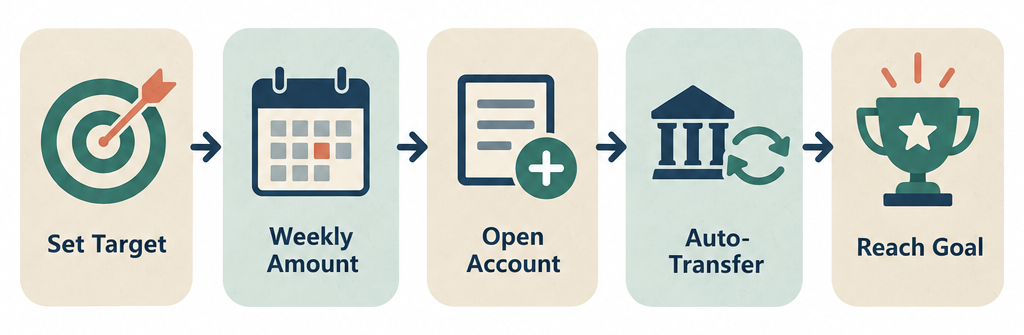
1. Pick your target and work backward to a weekly amount
Choose $500 or $1,000, choose a deadline, then divide. Saving $1,000 in 20 weeks means $50 a week. Saving $500 in 20 weeks means $25 a week.
Weekly numbers are easier to find than monthly ones. Fifty dollars a week sounds manageable in a way that “$217 a month” doesn’t, even though they’re roughly the same.
| Weekly savings | Time to reach $500 | Time to reach $1,000 |
|---|---|---|
| $10 | 50 weeks | 100 weeks |
| $20 | 25 weeks | 50 weeks |
| $25 | 20 weeks | 40 weeks |
| $40 | 13 weeks | 25 weeks |
| $50 | 10 weeks | 20 weeks |
| $100 | 5 weeks | 10 weeks |
If the timeline in the table is longer than you can live with, don’t give up. Pair the weekly transfer with the lump sums in step 5. Most people who reach $1,000 fast do it by combining a steady small amount with one or two windfalls.
2. Open a separate, insured account
Keep your emergency fund out of your checking account. Money that sits next to your spending money gets spent. A separate savings account, ideally at a different bank from your checking, adds one day of friction to every withdrawal. That delay gives you time to ask whether it’s really an emergency.
Make sure the account is insured. Deposits at FDIC-insured banks and NCUA-insured credit unions are protected up to $250,000 per depositor, per institution, per ownership category. A $1,000 fund is well inside that limit.
Some apps and fintech companies hold your money through partner banks rather than being banks themselves. If one of them fails, getting your money back can take time, because deposit insurance covers the failure of the partner bank and not the failure of the app company. For an emergency fund, a direct account at an insured bank or credit union is the safer choice. Our guide on what a credit union is and how to become a member explains eligibility, which is often broader than people expect.
Look for these features:
- No monthly maintenance fee and no minimum balance
- Free transfers to your checking account
- An interest rate above the national average (the FDIC publishes a national average savings rate, which has been under 1% while many online savings accounts have paid several times that)
Don’t chase the highest rate. On $1,000, the difference between 3% and 4% is $10 a year. No fees and easy access matter more.
The Federal Reserve dropped the federal six-withdrawal limit on savings accounts in 2020, but many banks still cap withdrawals or charge for extra ones. Check the account disclosure before you open it.
3. Find the money in your budget
This is where most plans stall. You probably don’t need a full budget overhaul to find $25 to $50 a week. Go through your statements with these questions:
- Subscriptions. Streaming, apps, gym memberships, cloud storage, delivery memberships. Cancel the ones you haven’t used in 30 days. You can resubscribe after you hit $1,000.
- Phone plan. Prepaid and lower-cost carriers often charge much less than major carriers’ unlimited plans. If you’re paying over $60 a month for one line, look at alternatives.
- Insurance. Get a new quote on auto and renters insurance. Raising your deductible lowers your premium, but only do that once your emergency fund can cover the higher deductible.
- Food delivery and convenience spending. Take a hard look at this category on your statements. It’s often the biggest and most flexible one.
- Bank fees. Overdraft, monthly maintenance and out-of-network ATM fees. Switching to a no-fee account can free up money immediately.
- Minimum debt payments you’re overpaying. During Baby Step 1, Ramsey advises paying only the minimums on debt so every extra dollar goes to savings. That makes sense for a few weeks or months, as long as you never miss a minimum.
You don’t have to cut everything. Pick two or three changes that you can sustain. Then make the amount you save from those cuts your weekly transfer.
4. Automate the transfer on payday
Set up an automatic transfer from checking to savings the day your paycheck lands, not the day before rent is due. Money moved on payday never gets the chance to look available.
Even better, ask your employer to split your direct deposit. Most payroll systems let you send a fixed dollar amount or percentage to a second account. The money never touches your checking account.
If your income is irregular, use a percentage instead of a fixed amount. Moving 5% of every deposit works whether a week brings $300 or $1,100.
5. Add lump sums to finish faster
Regular transfers build the habit. Lump sums finish the job. Common sources:
- Your tax refund. IRS Form 8888 lets you split a refund by direct deposit into up to three accounts. You can send part of it straight to your emergency savings without it ever hitting checking.
- Unclaimed property. Every state runs an unclaimed property program holding forgotten deposits, utility refunds and uncashed checks. Searching is free through your state treasurer or comptroller. Never pay a company to search for you.
- Old savings bonds. The Treasury Department’s Treasury Hunt tool lets you check for matured savings bonds in your name.
- Selling things you don’t use. Electronics, furniture, baby gear, tools and gym equipment sell well locally.
- Extra shifts or side work. Our guide on legit ways to make money fast covers gig and same-day pay options, along with the fees some of them charge.
- Rebates, bonuses and cash-back balances. Redeem credit card rewards as a statement credit or deposit, then move the equivalent amount to savings.
A single $600 tax refund deposit can turn a 40-week plan into a 16-week one.
6. Check for emergency savings tools at work
The SECURE 2.0 Act of 2022 created two features aimed at people without much savings. Both are optional for employers, so ask HR whether yours offers them.
Pension-linked emergency savings accounts (PLESAs). Starting in 2024, employers can offer an emergency savings account linked to their retirement plan for non-highly compensated employees. Contributions are made after tax, and the balance attributable to your contributions is capped at $2,500, a figure indexed for inflation. You can withdraw at least once a month, and the first four withdrawals in a plan year can’t carry fees.
Emergency withdrawals from retirement accounts. Also starting in 2024, plans can let you take one emergency withdrawal of up to $1,000 per calendar year for a personal or family emergency expense without the 10% early-withdrawal penalty. The money is still taxable as income. You generally can’t take another such withdrawal for three years unless you repay it or make new contributions that cover it.
The second option is a backstop, not a savings plan. Pulling from retirement means losing that money’s future growth. It’s still far cheaper than a payday loan, which is why it belongs on your list of fallback options.
Some employers also offer no-fee earned wage access through payroll, letting you draw pay you’ve already earned before payday. It’s not savings, but a free employer advance beats a high-fee app.
7. Write down what counts as an emergency
Decide your rules before an emergency hits, when you can think clearly. Write them on a note in your phone or on the inside of a cabinet door. A good rule set:
- It’s necessary (health, safety, housing, getting to work).
- It’s urgent (it can’t wait until next paycheck).
- It’s unexpected (you didn’t know it was coming).
If something fails any of the three, it doesn’t come from the emergency fund.
When to use your emergency fund
Here’s how common expenses usually sort out:
Usually an emergency:
– Car repair you need to get to work
– Urgent medical, dental or vet care
– A furnace, water heater or plumbing failure
– A security deposit or moving cost if you’re forced to move
– Covering essential bills during a short gap in income
– An insurance deductible after an accident
Usually not an emergency:
– Holiday gifts, birthdays and back-to-school shopping (these are predictable)
– Annual bills like car registration or insurance premiums (predictable, so save for them separately)
– A sale on something you want
– Concert tickets, travel or a weekend away
– Upgrading a working phone
Predictable irregular expenses are the biggest drain on new emergency funds. Set up a small second savings bucket for those, often called a sinking fund, so your emergency money stays for real surprises.
Refill before you resume anything else
When you use the fund, rebuild it first. Pause any extra debt payments and send that money back to savings until you’re at your target again. This is the part of the plan people skip, and it’s the reason so many funds never get back to $1,000.
What it costs when you don’t have $500
The best argument for a starter fund is the price of not having one. Below is what a $500 emergency costs to cover with common borrowing options. These are worked examples, not quotes from any lender. Your actual cost depends on your state, your credit and the lender’s terms.
How the APR math works: Annual percentage rate shows the cost of borrowing as a yearly rate. For a short loan, divide the fee by the amount borrowed, then multiply by how many times that loan term fits into a year. A $75 fee on $500 is 15%. Over two weeks, that 15% repeats about 26 times a year, which works out to roughly 391% APR.
| Option | Amount | Fee or APR | Term | Total repaid |
|---|---|---|---|---|
| Your own emergency fund | $500 | $0 | None | $500 (then refill) |
| Credit union payday alternative loan (PAL I) | $500 | 28% APR + up to $20 application fee | 3 months | About $523 + up to $20 = $543 |
| Credit card purchase | $500 | 22% APR (example rate) | 3 months | About $518 |
| Credit card cash advance | $500 | 5% fee ($25) + 29% APR (example) | 3 months | About $549 |
| Payday loan | $500 | $15 per $100 ($75), about 391% APR | 2 weeks | $575 |
| Payday loan rolled over twice | $500 | $75 per rollover | 6 weeks | $725 ($225 in fees, principal still owed until final payment) |
| Car title loan | $500 | 25% monthly fee ($125), about 304% APR | 30 days | $625 |
A few notes on these numbers:
- Payday loans: The CFPB says a typical two-week payday loan with a $15-per-$100 fee carries an APR of almost 400%. The real danger is rolling over. The CFPB has found that most payday loan volume comes from borrowers who take out repeated loans in a row, so the fee is paid again and again.
- Title loans: The CFPB describes a typical title loan fee as 25% per month, about 300% APR. You also put your car up as collateral, and losing it can cost you your job.
- Credit cards: The Federal Reserve’s consumer credit data has put the average rate on card accounts that pay interest above 21% since 2023. Cash advances usually carry a higher APR than purchases, an upfront fee, and no grace period, so interest starts the day you take the cash.
- Cash advance apps: Many charge optional “tips” or express fees. A $5 fee on a $100 advance repaid in 10 days works out to about 183% APR. That’s the math: $5 is 5% of $100, and a 10-day term fits into a year about 36.5 times.
- Overdrafts: The average overdraft fee is about $27 per transaction (Bankrate, 2024), and some banks still charge $35 per item. A $35 fee to cover a $100 shortfall for two weeks is far more expensive than any credit card. In 2025, Congress overturned the CFPB rule that would have capped overdraft fees at large banks, so fees depend on your bank’s own policy.
Before you borrow for an emergency
A two-week payday loan for $500 typically costs $75, and rolling it over twice adds another $150 before you’ve repaid a dollar of principal. If you can’t repay the full amount on the due date, you’re likely to pay more in fees than you borrowed.
What to do if an emergency hits before your fund is ready
You may be at $180 when the car breaks down. That’s normal. Work through these options in order, cheapest first.
Cheaper options first
Ask the company you owe for a payment plan or hardship arrangement before you borrow.
Credit union payday alternative loans cap the APR at 28%.
Call 211 for local help with rent, utilities, food and car repairs.
Ask for time before you ask for credit
Hospitals, utilities, landlords, auto shops and phone carriers often agree to payment plans if you call before the bill is overdue. Nonprofit hospitals are required by federal tax rules to have written financial assistance policies, so ask for a financial assistance application on any large hospital bill. Most utilities offer hardship programs, and the federal Low Income Home Energy Assistance Program (LIHEAP) helps with heating and cooling bills through state agencies.
Use what you’ve saved, then fill the gap
Spend your partial emergency fund first. Then cover only the shortfall with the cheapest credit you can get. Borrowing $300 costs less than borrowing $500.
Look at credit union payday alternative loans
Federal credit unions can offer payday alternative loans under NCUA rules. PAL I loans run from $200 to $1,000, with terms of one to six months, and you need to have been a member for at least one month. PAL II loans go up to $2,000 with terms up to 12 months and no waiting period after joining. Both carry a maximum APR of 28%, and application fees can’t exceed $20. Not every credit union offers them, so ask.
Consider a personal loan or 0% card carefully
A small personal loan from a bank or credit union, or a credit card with a 0% introductory APR, can cost far less than a payday loan. Both require decent credit, and both can backfire if you can’t repay. Our guide to 0% APR credit cards explains how long offers last and what happens when the promotional period ends. To check what a loan will really cost, run the numbers through our personal loan calculator before you sign.
Know what “no credit check” really means
Lenders advertising “no credit check” or “guaranteed approval” are not lending for free. Most still run a soft check or pull data from specialty consumer reporting agencies that track bank account history and past payday loans. They price for the risk with higher fees. Our guide to emergency loans walks through how these products work and how to borrow responsibly if you have no other choice.
How to check a lender before you borrow
How to check a lender
- Search the lender’s name in NMLS Consumer Access or your state regulator’s license lookup.
- Confirm the lender is licensed in your state, not only in another state.
- Read the Truth in Lending disclosure for the APR, finance charge and total of payments.
- Search the CFPB’s consumer complaint database for the company’s name.
- Walk away if anyone asks for an upfront fee before you receive the loan.
State rules on high-cost loans
Where you live decides which emergency loans are even legal. Payday lending is not available nationwide.
More than a dozen states and the District of Columbia either ban storefront payday loans or cap rates low enough that payday lenders don’t operate. They include New York, New Jersey, Pennsylvania, Georgia, North Carolina, Arkansas and Arizona. Several others have passed 36% rate caps in recent years, including Colorado (by ballot measure in 2018), South Dakota, Nebraska, Illinois and New Mexico. Other states allow payday loans but limit loan size, rollovers or the number of loans you can carry at once.
Texas is a notable exception on the permissive side. Payday and title lenders there commonly operate as credit access businesses, which lets them charge fees that push APRs far above what many other states allow. Our guide to Texas loan laws covers the payday, title and installment rules in detail.
Car title loans are legal in only some states. Online lenders sometimes offer loans to residents of states where those loans are banned, often through arrangements with out-of-state or tribal entities. If a loan breaks your state’s rate cap, contact your state attorney general or financial regulator.
Rules change often. Check your state banking or financial regulator’s website for the current limits before borrowing.
Your rights if you do borrow
Federal law gives you protections no matter which state you live in.
Truth in Lending Act and Regulation Z (12 CFR 1026). Lenders must disclose the APR, the finance charge, the amount financed and the total of payments in writing before you’re committed. Compare these numbers across offers. If a lender won’t show you the APR, walk away.
Electronic Fund Transfer Act and Regulation E. A lender generally can’t require you to repay through automatic electronic withdrawals as a condition of getting a loan. If you have authorized recurring withdrawals, you can stop a scheduled payment by telling your bank at least three business days before it’s due. Also notify the lender in writing that you’re revoking authorization. Stopping a payment doesn’t cancel the debt, but it can keep repeated withdrawal attempts from triggering overdraft fees.
Military Lending Act. Active-duty servicemembers and their dependents are protected by a 36% cap on the military annual percentage rate, which includes most fees, on payday loans, title loans, most installment loans and credit cards. Lenders can’t require a military borrower to give up legal rights through mandatory arbitration. If you’re in the military, your installation’s financial counselors and relief societies (Army Emergency Relief, Navy-Marine Corps Relief Society, Air Force Aid Society) often provide no-interest emergency loans or grants.
Equal Credit Opportunity Act. Lenders can’t discriminate based on race, color, religion, national origin, sex, marital status, age, or because your income comes from public assistance. If you’re denied, you have the right to know why.
Fair Debt Collection Practices Act and Regulation F (12 CFR 1006). If a debt goes to a third-party collector, the collector can’t threaten arrest, use abusive language, or misrepresent what you owe. Regulation F presumes a collector is violating the law if it calls more than seven times within seven days about a particular debt. You can dispute the debt in writing and ask the collector to stop contacting you.
Fair Credit Reporting Act. You can get free copies of your credit reports and dispute errors. If a lender denies you based on a credit report, including a specialty report, it must tell you which agency supplied it.
Where to complain: the CFPB’s consumer complaint portal, your state financial regulator or attorney general, and the FTC at ReportFraud for scams. Report online fraud involving wire transfers or impersonation to the FBI’s Internet Crime Complaint Center (IC3).
How to balance a starter fund with other money goals
You’ll probably be juggling a few goals at once. Here’s a practical order of operations for tight budgets:
- Stay current on essentials and minimum payments. Missed payments add late fees and hurt your credit.
- Build a $500 starter fund. This is your protection against the most common surprises.
- Capture any employer retirement match. If your employer matches contributions, contribute at least enough to get the full match once your $500 is in place. Ramsey’s plan would pause this, but the match is part of your pay.
- Finish the $1,000 starter fund.
- Pay down high-interest debt. Credit cards, payday loans and other high-rate debt cost more than any savings account earns.
- Build toward one month of expenses, then three to six months.
If you’re already in a payday loan cycle, getting out of it takes priority over growing savings past $500. Each rollover costs more than a starter fund earns in a decade.
After $1,000: building the full fund
Once high-interest debt is gone, redirect those former debt payments to your emergency fund. The money is already missing from your budget, so you won’t feel the change. Aim first for one month of essential expenses, then three months. If you’re single with stable income, three months is usually enough. If you’re the only earner in your household, self-employed or work in a volatile industry, aim for six or more. Our emergency fund calculator helps you set a target based on your actual monthly costs.
Common mistakes and how to fix them
Keeping the fund in checking. It disappears into everyday spending. Fix: move it to a separate savings account, ideally at a different institution.
Waiting until you “have extra.” You rarely will. Fix: automate a small transfer on payday, even $10.
Saving and carrying high-rate card debt indefinitely. A $5,000 balance at 22% costs roughly $1,100 a year in interest, while $5,000 in savings at 4% earns about $200. Fix: stop at your starter fund and attack the debt, then come back to savings.
Using the fund for predictable costs. Car registration and holidays aren’t emergencies. Fix: create a separate sinking fund for annual and seasonal expenses.
Not refilling after an emergency. Fix: make refilling your top financial priority until you’re back to your target.
Investing your emergency fund. Stocks and crypto can fall sharply right when you need the cash, and crypto is not covered by FDIC or SIPC insurance. Fix: keep emergency money in an insured savings account, credit union share account or money market deposit account.
Setting the goal too high to start. A $5,000 target with no progress feels worse than a finished $500 one. Fix: start with $500 and raise the target only after you hit it.
Forgetting about taxes on interest. Interest is taxable income. Banks send Form 1099-INT if you earn $10 or more in a year. On a $1,000 fund, the tax is a few dollars, but report it.
What to expect once you’re there
With $500 to $1,000 in an insured account, the next ordinary emergency stops being a crisis. You’ll pay a mechanic or urgent care clinic in full, skip the payday lender, and avoid the overdraft fees that usually follow a short month. You’ll also have proof that you can save, which makes the next goal easier.
A starter fund won’t protect you from a job loss or a major medical bill. That’s what the three-to-six-month fund is for. But the habits you build now (separate account, automatic transfer, clear rules for using the money) are exactly the ones that build the bigger fund later.
FAQ
Is $1,000 enough for an emergency fund?
It’s enough for a starter fund, not a full one. A $1,000 emergency fund covers many common expenses like car repairs and medical copays. For job loss or serious illness, most planners recommend three to six months of essential expenses once your high-interest debt is paid off.
Once you have a $500 emergency fund, you should do what next?
Keep your automatic transfers going until you reach $1,000, and make sure you’re getting any employer 401(k) match. After that, focus extra money on high-interest debt. Only stop at $500 if you’re stuck in a payday loan cycle, in which case paying that off should come first.
What is Dave Ramsey’s Baby Step 1?
Baby Step 1 is saving $1,000 as a starter emergency fund as quickly as possible. In Ramsey’s plan, you then move to Baby Step 2, paying off all non-mortgage debt using the debt snowball, before building a full three-to-six-month emergency fund in Baby Step 3.
Should I save $1,000 or pay off debt first?
Save a starter fund first, then pay off debt. Without any savings, the next emergency usually lands on a credit card or payday loan, undoing your debt progress. Once you have $500 to $1,000, put extra money toward debt, highest interest rate first if you want to pay the least overall.
Where should I keep my emergency fund?
Keep it in a savings account at an FDIC-insured bank or NCUA-insured credit union, separate from your checking account. Look for no monthly fees, free transfers and a competitive interest rate. Avoid stocks, crypto and accounts with withdrawal penalties.
How fast can I save a $500 emergency fund?
Saving $50 a week gets you to $500 in 10 weeks. Saving $25 a week takes 20 weeks. Adding a lump sum, like part of a tax refund sent directly to savings with IRS Form 8888, can shorten that to a few weeks.
Can I take money out of my 401(k) for an emergency?
If your plan allows it, the SECURE 2.0 Act lets you take one emergency withdrawal of up to $1,000 per year without the 10% early-withdrawal penalty, though the amount is still taxed as income. Treat it as a last resort, since it reduces your retirement savings.
Laws and regulations referenced
- Truth in Lending Act, 15 U.S.C. 1601
- Regulation Z, 12 CFR Part 1026
- Fair Debt Collection Practices Act, 15 U.S.C. 1692
- Regulation F (debt collection), 12 CFR Part 1006
- Fair Credit Reporting Act, 15 U.S.C. 1681
- Equal Credit Opportunity Act, 15 U.S.C. 1691
- Electronic Fund Transfer Act, 15 U.S.C. 1693
- Regulation E (electronic transfers), 12 CFR Part 1005
- Military Lending Act, 10 U.S.C. 987
- FDIC deposit insurance
Links go to the official text on government sites.
Check, verify or complain
Sources
- consumerfinance.gov › archive › newsroom › cfpb finalizes rule stop payday debt traps consumerfinance.gov · primary source
- files.consumerfinance.gov › f › documents › 201710 cfpb final rule payday loans rule.pdf files.consumerfinance.gov · primary source
- fool.com › money › credit cards › articles › heres the annual cost of carrying a 5000 … fool.com
- ramseysolutions.com › saving › quick guide to your emergency fund ramseysolutions.com
- ramseysolutions.com › dave ramsey 7 baby steps ramseysolutions.com

Elena writes about getting through a money emergency, assistance programs, budgeting on a tight income, banking basics and borrower rights. Her guides list the cheaper options first and link the agency or program that can actually help.

Ruth is US Financer's standards editor. Every article goes through her checks before and after it is published: each rate, fee, cap, deadline and rule is matched against its primary source, every law named is linked to its official text, and anything that cannot be…
Comments are closed