We are not a credit repair, debt relief or debt collection company and offer no services. Rules differ by state, so confirm with the agency or a nonprofit counselor before you act.
Most 0% APR credit cards keep the intro rate for 12 to 21 months, and a few run as long as 24 billing cycles. Federal law requires any promotional rate to last at least six months. Before you rely on one, check four things: what the 0% covers, the balance transfer fee and deadline, the APR that replaces the intro rate, and whether the deal is deferred interest instead of true 0%.
Run the numbers
Before you borrow
A 0% card only stays cheap if the balance is gone before the intro period ends. Whatever is left then starts collecting interest at the card’s regular APR, which for most people is above 20%.
How long 0% APR offers last
Intro periods fall into a few predictable tiers. Issuers move cards between tiers often, sometimes several times a year, so treat any specific number as a snapshot.
| Intro length | How common it is | Typical card type |
|---|---|---|
| 6 to 9 months | Less common on new offers | Some rewards and travel cards, store cards |
| 12 months | Very common | Flat-rate cash back cards, business cards, co-branded travel cards |
| 15 months | The most common length for no-annual-fee rewards cards | Chase, Capital One, Discover and American Express cash back cards |
| 18 months | Common on balance transfer cards | Cards marketed for paying down debt |
| 21 months | The longest standard offer from big issuers in 2025 | Cards with few or no rewards |
| 24 billing cycles | Rare | At least one major-bank card in 2025 |
People searching for a “0% APR for a year” card usually mean one of two things. Some want exactly 12 months, often because a planned expense fits in a year. Others want the longest 0% period they can find. The 12-month tier is the easiest to qualify for in practice because so many card types carry it. The longest offers usually come on cards that pay little or nothing in rewards. The issuer gives up interest income in exchange for your balance.
Months versus billing cycles
Read the unit. Chase, Wells Fargo, Citi, Capital One and American Express generally state intro periods in months “from account opening.” Bank of America and U.S. Bank often use billing cycles instead.
The difference is small but real. Billing cycles usually run 28 to 31 days, and the clock can start with the first statement instead of the day the account opens. On a “21 billing cycle” offer, the exact end date depends on your statement schedule. Your monthly statement must show when the promotional rate expires, so you never have to guess. Put that date on your calendar the day the card arrives.
The legal floor is six months
The Credit CARD Act of 2009 added rules to Regulation Z (12 CFR 1026) that govern promotional rates on consumer credit cards. Under 12 CFR 1026.55(b)(1), a promotional rate has to last at least six months. The card’s disclosures must say how long the intro rate lasts and which APR replaces it.
The same rule protects the promo itself. An issuer can’t cut your 0% period short and apply a higher rate to the promotional balance unless your minimum payment is more than 60 days late. A single late payment can still trigger a late fee, and some cards have a penalty APR for new transactions. The 0% on the existing balance survives unless you fall more than two months behind.
0% APR cards with a year or more, compared
The table below lists cards from large national issuers and the intro terms those issuers published during 2025. We include them to show what each tier looks like in practice, not to recommend any of them. Issuers change these offers without much warning. Confirm the current terms in the card’s pricing table, often called the Schumer box, before you rely on any number here.
| Card | 0% intro on purchases | 0% intro on balance transfers | Annual fee | Main trade-off |
|---|---|---|---|---|
| U.S. Bank Shield Visa | 24 billing cycles | 24 billing cycles | $0 | Limited everyday rewards |
| Wells Fargo Reflect | 21 months | 21 months (transfers within 120 days) | $0 | No rewards program |
| Citi Simplicity | 12 months | 21 months (transfers within 4 months) | $0 | No rewards program |
| Chase Slate Edge | 18 months | 18 months | $0 | No cash back program |
| Citi Double Cash | None | 18 months | $0 | No 0% on new purchases |
| Chase Freedom Unlimited | 15 months | 15 months | $0 | Shorter intro than balance transfer cards |
| Chase Freedom Flex | 15 months | 15 months | $0 | Top rewards rotate by quarter |
| Discover it Cash Back | 15 months | 15 months | $0 | Top rewards rotate by quarter |
| Capital One Quicksilver | 15 months | 15 months | $0 | Higher fee on transfers after the intro window |
| American Express Blue Cash Everyday | 15 months | 15 months | $0 | Bonus categories capped each year |
| Wells Fargo Active Cash | 12 months | 12 months | $0 | Shorter intro period |
| Chase Ink Business Unlimited | 12 months | None | $0 | Business card with fewer federal protections |
| United Gateway | 12 months | None | $0 | Travel rewards tied to one airline |
All of these cards have weaknesses beyond the column above. Every one of them switches to a variable APR when the intro ends, and that rate depends on your credit. Every one charges a balance transfer fee if you move debt onto it. None of them treat cash advances as 0%.
Cards with 12-month intro periods
A 12-month intro rate is common on flat-rate cash back cards and on business and co-branded travel cards. Wells Fargo Active Cash paired 12 months of 0% on purchases and qualifying balance transfers with 2% cash rewards on purchases. Several American Express and Chase business cards carried 12-month purchase offers.
A one-year card fits a known expense you can divide by 12 comfortably. A $2,400 furniture purchase is $200 a month. If $200 a month would strain your budget, a longer intro period buys you breathing room that the rewards on a 12-month card can’t make up for.
Cards with 15 to 18 months
Fifteen months is where most no-annual-fee rewards cards cluster. Chase Freedom Unlimited, Chase Freedom Flex, Capital One Quicksilver, Discover it Cash Back and American Express Blue Cash Everyday all sat at 15 months for both purchases and balance transfers in 2025.
These cards mix a usable intro period with ongoing value: cash back on dining, groceries or travel, plus a sign-up bonus on some. The catch is that the rewards don’t matter if you carry a balance after month 15. A 1.5% cash back rate earns $1.50 on every $100 you spend. A 24% APR costs about $2 per month on every $100 you carry.
Eighteen-month offers usually come on cards built for balance transfers, such as Chase Slate Edge. Citi Double Cash gave 18 months on transfers but no 0% on purchases. That suits someone moving debt over who plans to stop using the card for new spending.
Cards with 21 months and 24 billing cycles
Searches for a “0% APR 24 months credit card” are common, but true 24-month offers are rare. In 2025, the longest standard offers from the big national issuers mostly topped out at 21 months. Wells Fargo Reflect offered that on both purchases and qualifying transfers. Citi Simplicity offered it on transfers only. U.S. Bank’s Shield Visa was an exception with 24 billing cycles on purchases and balance transfers.
Long-intro cards share three traits:
- Rewards are thin or absent. The issuer recovers its cost from transfer fees and from people who still carry a balance when the promo ends.
- The transfer window is short. You often have to move balances within 60 days or four months of opening the account to get the intro rate.
- Approval usually takes good credit. FICO describes scores of 670 to 739 as “good.” Most long-intro cards look for scores in that range or higher, plus a manageable debt load.
Business and travel cards: a gap in protection
Business cards such as Chase Ink Business Unlimited and Ink Business Cash often advertise 12 months of 0% on purchases. Many readers don’t realize that most consumer protections in the Truth in Lending Act and Regulation Z don’t apply to credit extended mainly for business purposes (12 CFR 1026.3(a)).
The six-month promo minimum, the 45-day notice before rate increases and the limits on raising rates on existing balances are written for consumer cards. Some issuers apply similar practices to business cards voluntarily, but that’s a company policy and not a legal right. Read the business card agreement carefully. You usually remain personally liable for the debt, even though the card is in your company’s name.
Co-branded travel cards like United Gateway sometimes carry a 12-month purchase intro. They make the most sense for someone who already flies that airline and would use the card after the promo. They make little sense as a standalone financing tool.
What a 0% card really costs: worked examples
Here is what “interest-free” costs in practice. The first table follows a $3,000 purchase under four payment plans. Where a regular rate applies, we used 24% APR, which works out to about 2% per month. That’s close to the average rate on cards that were charged interest, according to the Federal Reserve’s G.19 consumer credit data for 2025.
| Plan | Amount | Rate | Term | Monthly payment | Total repaid |
|---|---|---|---|---|---|
| 12-month 0% card, paid on schedule | $3,000 | 0% | 12 months | $250 | $3,000 |
| 15-month 0% card, paid on schedule | $3,000 | 0% | 15 months | $200 | $3,000 |
| 12-month 0% card, underpaid, then 24% APR | $3,000 | 0%, then 24% | About 21 months | $150 | About $3,121 |
| Regular card at 24% APR, no promo | $3,000 | 24% | About 26 months | $150 | About $3,870 |
Here’s how the third row works. Paying $150 a month for 12 months clears $1,800 and leaves $1,200. At 24% APR, that $1,200 costs about $24 in interest the first month. Paying $150 a month, it takes roughly nine more months to clear and adds about $120 in interest. That’s still far cheaper than the fourth row, where interest runs from day one and costs about $870.
The lesson: a 0% card forgives a modest shortfall, but the cost grows quickly the longer you carry the leftover balance. If you want to model your own numbers, our credit card payoff calculator does the month-by-month math.
Balance transfers: the fee is your real interest rate
When you move existing debt to a 0% card, you pay a balance transfer fee up front, usually 3% to 5% of the amount moved. Some issuers charge a lower intro fee, often 3%, for transfers made in the first 60 days or first few months. The fee then rises to 4% or 5%. The fee is added to your balance and counts against your credit limit.
| Option | Balance | Fee | Rate | Term | Monthly payment | Total repaid |
|---|---|---|---|---|---|---|
| Stay on current card | $5,000 | None | 24% APR | About 27 months | $245.24 | About $6,490 |
| Transfer, 3% fee, 21-month 0% | $5,000 | $150 | 0% | 21 months | $245.24 | $5,150 |
| Transfer, 5% fee, 21-month 0% | $5,000 | $250 | 0% | 21 months | $250.00 | $5,250 |
| Transfer, 3% fee, 15-month 0% | $5,000 | $150 | 0% | 15 months | $343.33 | $5,150 |
Here’s the APR math in plain words. On the 21-month, 3% transfer, you pay $150 to borrow an average of about $2,700 for 21 months, since the balance shrinks as you pay. That works out to a bit over 3% a year. It’s a real cost, but a small one next to the roughly $1,490 in interest you’d pay by staying put at 24%.
A transfer only pays off if you stop adding to the debt. If the old card gets run up again, you’ve doubled the problem. Two more rules catch people: most issuers won’t let you transfer a balance between two of their own cards, and your transfer can’t exceed the credit limit you’re given, fee included.
Mixing purchases and transfers
If you use one card for both a balance transfer and new purchases, payment rules start to matter. Under 12 CFR 1026.53, any amount you pay above the minimum goes to the balance with the highest APR first. The minimum payment itself can go to the lowest-rate balance.
That works in your favor once a promo ends on one balance but not another. It can work against you if you buy things after the purchase intro has expired while the transfer is still at 0%. The cleanest approach is one job per card: one card for the transfer, and no new spending on it. Our guide credit card APR explained walks through how each balance on a card can carry its own rate.
Deferred interest is not 0% APR
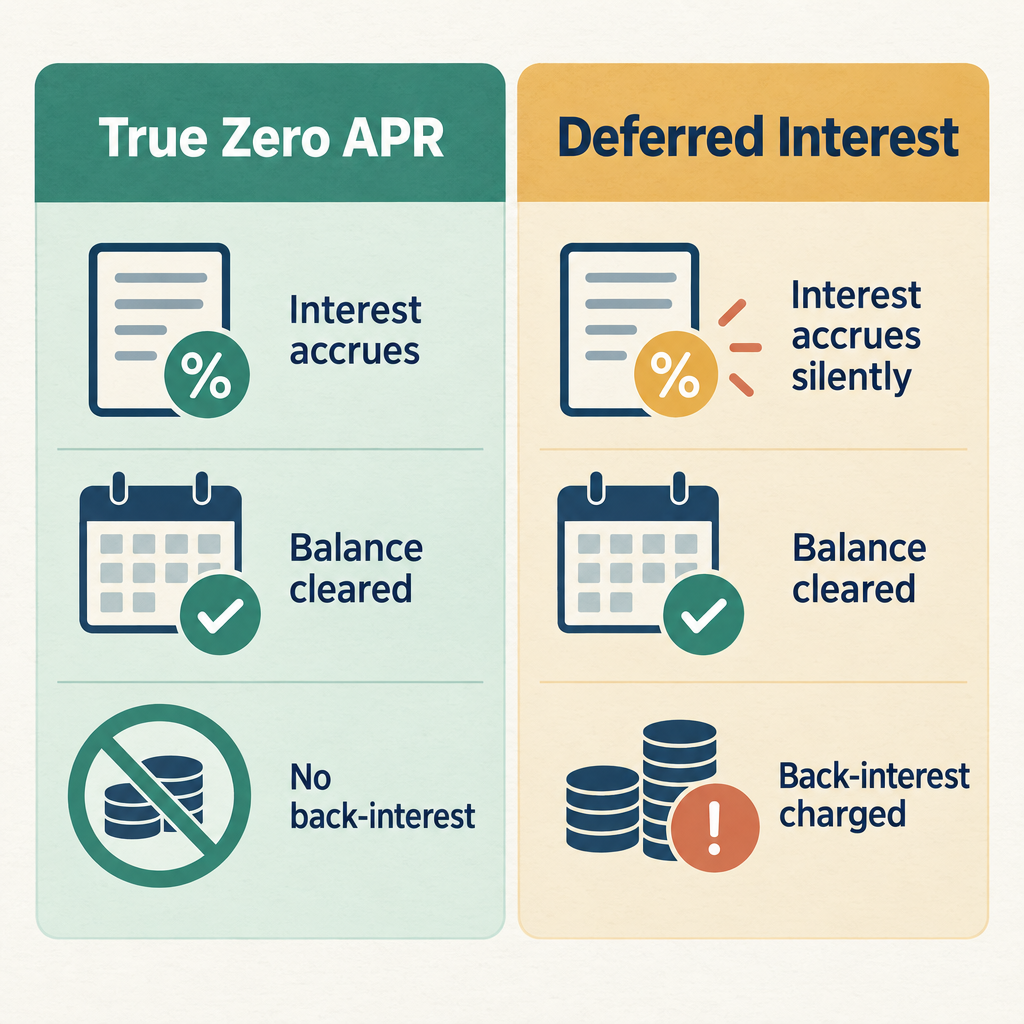
Store cards and medical financing often advertise “no interest if paid in full in 12 months.” That’s deferred interest, which is a different product. On a true 0% card, interest starts only on whatever balance remains after the promo ends. On a deferred interest plan, interest builds quietly from the purchase date. If even a dollar of the promo balance is left at the deadline, the full amount is charged to your account.
Regulation Z requires deferred interest ads to use the phrase “if paid in full” and to state the deadline. Many shoppers still miss the difference. Here is the same $3,000 purchase with $240 monthly payments, leaving $120 unpaid at the 12-month mark:
| Feature | True 0% intro APR card | Deferred interest store card (29.99% APR) |
|---|---|---|
| Purchase | $3,000 | $3,000 |
| Paid in 12 months | $2,880 | $2,880 |
| Left at deadline | $120 | $120 |
| Interest charged at month 12 | $0 | About $504, back-dated to purchase |
| Interest going forward | Regular APR on $120 only | Regular APR on the full remaining balance, now including the $504 |
| Total cost if cleared soon after | About $3,000 to $3,005 | About $3,504 |
The roughly $504 comes from applying a 29.99% APR to the declining balance month by month across the full year. There’s one federal protection here. In the last two billing cycles before a deferred interest period ends, Regulation Z directs extra payments to the deferred balance first, so your money goes where it’s needed most.
If you already have a deferred interest plan, divide the original balance by the number of months in the promo, minus one, and pay that amount. Finishing a month early protects you from a late-posting payment.
What to check before you pick a 0% card
Every consumer card application has to show the key terms in a standard table under 12 CFR 1026.60. That table is your best tool. Skip the marketing headline and read these lines.
| Line in the pricing table | What to look for | Why it matters |
|---|---|---|
| Intro APR for purchases | Length, and “months” or “billing cycles” | Sets your real payoff deadline |
| Intro APR for balance transfers | Length and the transfer deadline (for example, “within 120 days”) | Transfers after the window may get the regular APR |
| APR for purchases after intro | The variable range, such as 19% to 28% | You’ll get one rate within that range, based on your credit |
| Balance transfer fee | Intro fee, regular fee and the minimum dollar amount | It’s charged up front, even at 0% |
| Cash advance APR and fee | Usually higher than the purchase APR, with a fee around 5% | Cash advances are almost never part of a 0% offer |
| Penalty APR | Whether one exists and what triggers it | Can apply to new purchases after a late payment |
| Late fee | Often “up to $40” | Charged even during a 0% period |
| Foreign transaction fee | Commonly 0% or 3% | Matters for travel spending |
| Annual fee | Usually $0 on 0% cards | A fee cuts into what the 0% saves you |
How to vet a 0% offer before applying
- Find the pricing table on the issuer’s own site and note the intro length and its unit.
- Write down the balance transfer deadline and the fee that applies inside and outside it.
- Divide your planned balance, plus any fee, by the intro months minus one to get a safe monthly payment.
- Check whether that payment fits your budget with room left for emergencies.
- Use the issuer’s prequalification tool, if offered, which runs a soft inquiry that doesn’t affect your score.
- Confirm the offer says “intro APR” and not “deferred interest” or “no interest if paid in full.”
Prequalification isn’t approval. The final decision uses a hard inquiry and may come with a lower credit limit than you hoped for. A $1,500 limit doesn’t help if you planned to transfer $5,000.
How a 0% card affects your credit score
Opening a new card touches your credit in several ways at once. The effects are mostly small and temporary if you manage the account well.
- Hard inquiry. A hard inquiry stays on your report for two years, but FICO scoring counts it for only 12 months. One inquiry typically costs a few points.
- Average account age. A brand-new account lowers the average age of your accounts, which matters more if your credit history is short.
- Credit utilization. This is the share of your available card credit you’re using, and it often moves your score the most. A new limit can lower your overall utilization. A large transfer that nearly maxes out the new card can push that card’s own utilization high.
- Payment history. This is the biggest scoring factor. A payment reported 30 or more days late can do far more damage than anything above.
Under the Fair Credit Reporting Act, you can check your reports from Equifax, Experian and TransUnion. The three bureaus permanently made free weekly reports available at AnnualCreditReport.com. Pull them before you apply so a mistake on your report doesn’t lead to a denial.
If your score is below the good range, most long 0% offers will be out of reach. Our guide on credit cards for bad credit explains which cards approve lower scores and what they cost.
Who a 0% card can make sense for
A 0% intro APR can be a useful tool if most of these describe you:
- You have a specific, planned expense, such as a car repair or a needed appliance, and a realistic plan to pay it off within the intro period.
- You’re carrying high-interest card debt and can stop adding to it while you pay down the transferred balance.
- Your credit is in the good range or better, so you’re likely to get a limit large enough to matter.
- Your income is steady enough to cover the monthly payoff amount, not only the minimum.
It’s a poor fit if you’d pay only the minimum, if your income is unpredictable, or if past card balances kept growing after a transfer. In those cases, the card often delays a debt problem instead of shrinking it. The minimum payment on a 0% card can be as low as 1% of the balance. Paying that leaves almost all of the debt in place when the intro rate ends.
Cheaper options first
A real 0% offer is one of the cheapest forms of short-term credit available, if you qualify and pay it off on time. Even so, a few options are safer or easier to get.
Cheaper options first
Paying cash from savings costs nothing and adds no debt.
Call your current card issuer about a hardship plan or a lower rate before opening a new card.
A nonprofit credit counselor can set up a debt management plan, often at reduced interest.
Credit union cards and loans. Federal credit unions can’t charge more than 18% APR on most loans and cards under the NCUA’s current interest rate ceiling. Some also run their own 0% or low intro offers. If you can’t get a 0% card, a credit union Payday Alternative Loan (PAL) is far cheaper than storefront lending. Under NCUA rules, PAL I loans run $200 to $1,000, PAL II loans go up to $2,000, the APR is capped at 28% and the application fee is capped at $20. Our guide to credit union membership covers how to join.
Hardship programs. Many issuers have unadvertised hardship plans that lower your APR or payment for six to 12 months after a job loss or medical problem. Ask your issuer directly. A hardship plan usually means the card is frozen or closed while you’re enrolled.
Nonprofit credit counseling. Agencies affiliated with groups like the National Foundation for Credit Counseling can review your budget and may set up a debt management plan. These plans often cut card interest and involve a modest monthly fee. Treat them differently from for-profit “debt settlement” companies, which can damage your credit and charge large fees.
What to avoid. If you’re turned down for a 0% card, don’t swing to the most expensive credit available. A payday loan commonly carries an APR near 400%, and our guide to no credit check loans explains why those products cost so much more than a card.
State availability
Most 0% cards from national banks are available to residents of all 50 states. National banks can generally charge rates allowed by their home state to borrowers anywhere, so card pricing doesn’t change much by state.
A few limits still apply:
- Credit union cards are open only to members, and membership may depend on where you live, work or worship, or on an association you join.
- Applicants under 21 must show independent income or add a co-signer, under Regulation Z’s ability-to-pay rule (12 CFR 1026.51). Not every issuer accepts co-signers.
- Residents of US territories such as Puerto Rico or Guam may not be eligible for some cards, depending on the issuer.
- Some smaller state banks and regional issuers market cards only in their footprint states.
The issuer’s application will say if you’re outside its service area. If an offer claims nationwide 0% financing from a company you can’t find a bank or credit union charter for, treat that as a red flag.
Your rights with a 0% APR card
Several federal laws protect you before, during and after an intro period on a consumer card.
Truth in Lending Act and Regulation Z. These require the pricing table, the six-month promo minimum and the statement disclosure of when your promo ends. They also require 45 days’ written notice before most rate increases or significant changes to your terms (12 CFR 1026.9). Except in limited cases, issuers can’t raise the rate on an existing balance unless you’re more than 60 days late. Issuers must also check your ability to pay before opening the account or raising your limit.
Equal Credit Opportunity Act. Under Regulation B, a lender can’t discriminate based on race, color, religion, national origin, sex, marital status, age or receipt of public assistance. If you’re denied, you’re entitled to an adverse action notice stating the specific reasons or how to request them, generally within 30 days.
Fair Credit Reporting Act. If a denial was based on your credit report, the notice must name the bureau and tell you how to get a free copy. You can dispute errors with the bureau and with the company that reported them. You can also opt out of prescreened card offers at 1-888-5-OPT-OUT.
Fair Credit Billing Act. If a charge on your card is wrong, you can dispute it in writing within 60 days of the statement that first showed the error. The issuer must investigate, and you can withhold payment on the disputed amount while it does.
Military Lending Act and Servicemembers Civil Relief Act. Active-duty servicemembers and covered dependents are protected by a 36% cap on the Military Annual Percentage Rate on credit cards, which includes most fees. The Servicemembers Civil Relief Act caps interest at 6% on debts taken on before active duty, if you request it in writing.
Where to complain
If an issuer ignores its own terms, ends a promo early or mishandles a dispute, start with the issuer’s complaint line and keep records. If that fails, file with the CFPB’s complaint portal, which forwards complaints to the company and tracks responses. For deceptive “0% financing” offers from someone other than a bank, report to the FTC at ReportFraud.ftc.gov. Your state attorney general’s consumer protection office also takes complaints.
FAQ
Is there a 0% APR card for exactly one year?
Yes. Twelve-month intro periods are common on flat-rate cash back cards, business cards and some airline cards. In 2025, Wells Fargo Active Cash, Chase Ink Business Unlimited and United Gateway all carried 12-month 0% offers on purchases. Many no-annual-fee rewards cards offer 15 months, which gives you extra room on the same budget.
Can I find a 0% APR card for 24 months?
It’s rare. Most major-bank offers in 2025 topped out at 21 months. U.S. Bank’s Shield Visa advertised 24 billing cycles on purchases and balance transfers. Long offers change often, so confirm the current term in the issuer’s pricing table.
What happens when the 0% intro period ends?
Any remaining balance starts accruing interest at the card’s regular variable APR from that point on. On a true intro APR card, you’re not charged interest for the months already passed. That back-dating only happens with deferred interest plans, which are mostly store cards.
Does one late payment cancel my 0% rate?
On a consumer card, federal rules bar the issuer from taking away the promo rate on your existing balance unless your minimum payment is more than 60 days late. A late payment can still bring a late fee, and some cards apply a penalty APR to new purchases. Business cards don’t carry the same legal protection.
Do balance transfers count toward a 0% purchase offer?
Only if the card offers 0% on both. Some cards, such as Citi Double Cash, offered 0% only on balance transfers. Others, such as Chase Ink Business Unlimited, offered it only on purchases. Check both lines in the pricing table.
Will applying for a 0% card hurt my credit?
The hard inquiry usually lowers a score by a few points, and FICO stops counting it after 12 months. Paying on time and keeping balances low can improve your score over the following months. Missing a payment or maxing out the card has a bigger negative effect.
What credit score do I need for the best 0% APR cards?
Issuers don’t publish cutoffs. The longest offers generally go to applicants with good to excellent credit, roughly FICO 670 and up, along with steady income and a moderate amount of existing debt. Approval also depends on factors beyond your score.
Laws and regulations referenced
- Truth in Lending Act, 15 U.S.C. 1601
- Regulation Z, 12 CFR Part 1026
- Fair Credit Reporting Act, 15 U.S.C. 1681
- Equal Credit Opportunity Act, 15 U.S.C. 1691
- Regulation B (equal credit), 12 CFR Part 1002
- Fair Credit Billing Act, 15 U.S.C. 1666
- Military Lending Act, 10 U.S.C. 987
- Servicemembers Civil Relief Act, 50 U.S.C. 3901
- Credit CARD Act of 2009 (Public Law 111-24)
Links go to the official text on government sites.
Check, verify or complain
Sources
- experian.com › blogs › ask experian › what is payday loan alternative experian.com
- bankrate.com › credit cards › balance transfer › best balance transfer cards bankrate.com
- servicememberscivilreliefact.com › blog › military lending act servicememberscivilreliefact.com

Marcus covers credit scores, credit reports and getting out of debt: consolidation, nonprofit counseling, settlement and what debt collectors may and may not do. He works from the federal laws that apply, CFPB guidance and the credit bureaus' published rules.

Ruth is US Financer's standards editor. Every article goes through her checks before and after it is published: each rate, fee, cap, deadline and rule is matched against its primary source, every law named is linked to its official text, and anything that cannot be…
Comments are closed