Runs in your browser. Nothing you type is sent or saved.
Our crypto profit calculator takes the amount you invested, your buy and sell prices, and the trading fee on each side, then shows your profit, your return on investment, your cost basis for taxes, and whether the gain is short-term or long-term. Have three numbers ready from your exchange: what you paid in dollars, the price per coin when you bought, and the fee percentage your exchange charges. The default example (buy at $50,000, sell at $60,000, 1% fees each way on $1,000) returns a profit of $176.12, or 17.61%.
How to use the calculator
- Enter Amount invested ($): the dollar total you sent into the trade, before any fee. Find it in your exchange’s order history or the trade confirmation email.
- Enter Buy price per coin ($): the fill price shown on the order, not the chart price you saw at the time.
- Enter Sell price per coin ($): your actual fill price if you already sold, or a target price if you are planning an exit.
- Enter Buy fee (%) and Sell fee (%): check your exchange’s fee schedule. Taker fees on a market order are usually higher than maker fees on a limit order. If the fee is a flat dollar amount, divide it by the trade size to get a percentage.
- Set Held for: choose More than one year only if you will sell at least one full year and one day after the purchase date.
- Read Profit after fees, Return on investment and the tax line. Change one input at a time to see what moves the result most.
What each field means and the mistakes that skew the result
Amount invested ($) is the cash you put in, fee included. If you deposited $1,000 and the exchange took $10 before buying, you still enter $1,000. The calculator removes the fee for you. Entering $990 here double-counts the fee and understates your cost.
Buy price per coin ($) should be your fill price. Market orders on thin trading pairs often fill a little worse than the quoted price. Your order history shows the real average fill, and that is the number to use.
Sell price per coin ($) is where guesses creep in. A target price is fine for planning, but label it as a plan in your own mind. The quick-reference table below shows how far a change in this field swings the result.
Buy fee (%) and Sell fee (%) cover the exchange’s trading fee as a percentage of the trade. Many centralized exchanges charge somewhere between a fraction of a percent and about 1.5% for small retail orders, and spread-based platforms bury the fee in the price. On a decentralized exchange, the stated swap fee is only part of the cost. Network gas and slippage come on top. For a memecoin bought through a swap aggregator, adding your expected slippage to the fee percentage gets you a far more honest answer.
Held for decides the tax line. The IRS counts your holding period from the day after you acquire the asset. Selling on the one-year anniversary is still a short-term sale. You need to hold for more than one year, meaning at least a year and a day.
Common input errors we see in reader questions:
- Mixing coin counts with dollar amounts. The calculator asks for dollars invested, not the number of coins.
- Using a percentage fee from the wrong tier. Fee schedules drop as your 30-day volume rises; a new account pays the top tier.
- Forgetting the sell side. People often remember the fee to buy and assume selling is free. It almost never is.
- Entering a price target pulled from social media as if it were a fill price.
The formula, written out, with two worked examples
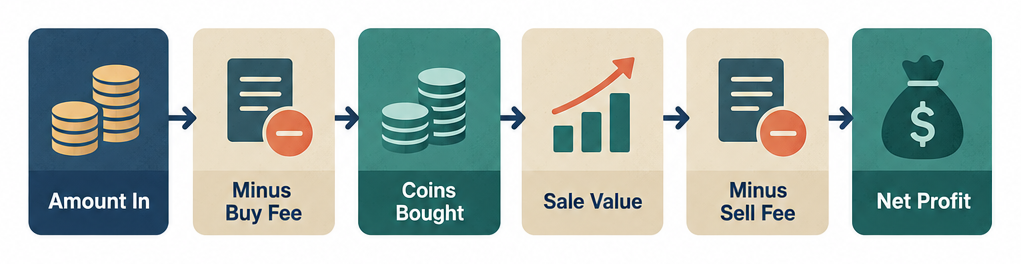
The calculator runs exactly this math:
- Buy fee = Amount invested × Buy fee %
- Coins bought = (Amount invested − Buy fee) ÷ Buy price per coin
- Sale value = Coins bought × Sell price per coin
- Sell fee = Sale value × Sell fee %
- You receive = Sale value − Sell fee
- Profit = You receive − Amount invested
- ROI = Profit ÷ Amount invested × 100
For taxes, your cost basis is the full amount you paid, including the buy fee. The sell fee reduces your proceeds. That means the calculator’s profit figure is also your taxable gain or deductible loss, because both fees are already inside the numbers.
Example 1: the default inputs (Bitcoin-style prices)
Amount invested $1,000, buy price $50,000, sell price $60,000, 1% fee each side.
- Buy fee: $1,000 × 1% = $10.00
- Coins bought: ($1,000 − $10) ÷ $50,000 = 0.01980000 coins
- Sale value: 0.0198 × $60,000 = $1,188.00
- Sell fee: $1,188 × 1% = $11.88
- You receive: $1,188 − $11.88 = $1,176.12
- Profit: $1,176.12 − $1,000 = $176.12
- ROI: $176.12 ÷ $1,000 × 100 = 17.61%
- Fees paid: $10 + $11.88 = $21.88
- Cost basis for taxes: $1,000.00
- Tax treatment: Short-term, taxed as ordinary income
Notice that a 20% price rise became a 17.61% return. The two 1% fees cost you $21.88, or 2.39 percentage points of return.
Example 2: an Ethereum-style loss held long-term
Amount invested $2,500, buy price $3,200, sell price $2,900, 0.5% fee each side, held more than one year.
- Buy fee: $2,500 × 0.5% = $12.50
- Coins bought: ($2,500 − $12.50) ÷ $3,200 = 0.77734375 coins
- Sale value: 0.77734375 × $2,900 = $2,254.30
- Sell fee: $2,254.30 × 0.5% = $11.27
- You receive: $2,254.30 − $11.27 = $2,243.03
- Profit: $2,243.03 − $2,500 = −$256.97
- ROI: −$256.97 ÷ $2,500 × 100 = −10.28%
- Fees paid: $12.50 + $11.27 = $23.77
- Cost basis for taxes: $2,500.00
- Tax treatment: Long-term capital loss
The price fell 9.375%, but after fees the realized loss is 10.28%. That $256.97 is a long-term capital loss you can use against gains, and up to $3,000 of net capital loss per year against ordinary income under Internal Revenue Code Section 1211, with the rest carried forward.
Quick reference: what the sell price does to a $1,000 trade
All rows use the default $1,000 invested at $50,000 with 1% fees each way, so you hold 0.0198 coins.
| Sell price per coin | Sale value | Sell fee | You receive | Profit after fees | ROI |
|---|---|---|---|---|---|
| $40,000 | $792.00 | $7.92 | $784.08 | −$215.92 | −21.59% |
| $45,000 | $891.00 | $8.91 | $882.09 | −$117.91 | −11.79% |
| $50,000 | $990.00 | $9.90 | $980.10 | −$19.90 | −1.99% |
| $55,000 | $1,089.00 | $10.89 | $1,078.11 | $78.11 | 7.81% |
| $60,000 | $1,188.00 | $11.88 | $1,176.12 | $176.12 | 17.61% |
| $70,000 | $1,386.00 | $13.86 | $1,372.14 | $372.14 | 37.21% |
| $100,000 | $1,980.00 | $19.80 | $1,960.20 | $960.20 | 96.02% |
Selling at the same price you bought loses $19.90. Your break-even sell price with 1% fees both ways is about $51,015, a 2.03% rise before you make a single dollar.
Quick reference: how fee levels eat a 20% price move
Same $1,000 trade, buy at $50,000 and sell at $60,000, with the fee percentage changed on both sides.
| Fee each side | You receive | Profit after fees | ROI |
|---|---|---|---|
| 0% | $1,200.00 | $200.00 | 20.00% |
| 0.1% | $1,197.60 | $197.60 | 19.76% |
| 0.5% | $1,188.03 | $188.03 | 18.80% |
| 1% | $1,176.12 | $176.12 | 17.61% |
| 2% | $1,152.48 | $152.48 | 15.25% |
| 3% | $1,129.08 | $129.08 | 12.91% |
| 5% | $1,083.00 | $83.00 | 8.30% |
At 5% per side, which is realistic for a low-liquidity memecoin swap once slippage is counted, more than half of a 20% price gain disappears. This is why a memecoin profit calculator that ignores slippage flatters the trade.
Make the fee field honest
For a decentralized swap, add your slippage tolerance to the exchange fee. A 0.3% pool fee with 2% slippage belongs in the field as 2.3%.
For a flat-fee exchange, divide the dollar fee by the trade size. A $2.99 fee on a $100 order is 2.99%.
Reading the result: what counts as good, and what to compare against
A positive ROI is not automatically a win. Compare it to three things.
The raw price move. If the coin rose 20% and your ROI is 17.61%, fees took 2.39 points. If the gap is wider than that, your fee inputs are high and a cheaper order type or venue would have mattered.
Time. A 17.61% return in one month is very different from the same return over three years. The calculator does not annualize, so divide mentally: $176.12 over three years is about $59 a year on $1,000, under 6% a year before tax.
Your after-tax number. The calculator’s profit is pre-tax. A short-term gain is taxed at your ordinary income rate, which runs from 10% to 37% at the federal level. A long-term gain is taxed at 0%, 15% or 20% depending on your taxable income, and the dollar thresholds for those brackets change every year, so check the current IRS tables. Higher earners may owe the 3.8% Net Investment Income Tax as well. State income tax comes on top in most states.
| Scenario on the $176.12 gain | Illustrative federal rate | Estimated federal tax | Gain kept |
|---|---|---|---|
| Short-term, 12% bracket | 12% | $21.13 | $154.99 |
| Short-term, 22% bracket | 22% | $38.75 | $137.37 |
| Short-term, 24% bracket | 24% | $42.27 | $133.85 |
| Long-term, 0% rate | 0% | $0.00 | $176.12 |
| Long-term, 15% rate | 15% | $26.42 | $149.70 |
| Long-term, 20% rate | 20% | $35.22 | $140.90 |
The rates are the statutory federal rates. Which one applies depends on your total taxable income, filing status and the tax year, so treat the table as a range, not a quote.
Safer comparisons first. Before deciding a crypto gain is attractive, run the same dollars through our interest calculator at a current high-yield savings or Treasury rate. Those options are FDIC-insured or backed by the US government and do not go to zero. Crypto is not FDIC or SIPC insured, and any token can lose all of its value. A planned 17% return is only meaningful if you also run the −21.59% row in the table above and can afford that outcome.
If you are deciding whether to sell at a loss during a sharp sell-off, our capitulation definition piece explains why those prints often happen at panic lows. The calculator cannot tell you where the bottom is. It can tell you exactly what the loss is at the price in front of you.
Related calculations the fields can handle
Crypto market cap calculator
Market cap is price times circulating supply. A token at $0.50 with 2 billion coins in circulation has a $1 billion market cap. The useful reverse calculation is implied price: divide a target market cap by the circulating supply. A memecoin with 100 billion tokens would need a $1 trillion market cap to reach $10 per token. When a post says a coin “only needs to hit” some bigger coin’s valuation, run that division before entering the target as your Sell price per coin.
Crypto leverage calculator
The calculator models spot trades, not margin. To approximate a leveraged position, enter the full position size as Amount invested and then compare the profit to the margin you actually posted. A 5× position on $1,000 of margin controls $5,000. In the default example, $5,000 at those prices returns a profit of $880.60, which is an 88.06% return on your $1,000 of margin. The same 20% move downward wipes out the margin entirely. Real leveraged trades also pay funding rates and can be liquidated before the price reaches your exit, and the calculator models none of that. US residents also face limits on where leveraged crypto derivatives can legally be offered; the Commodity Futures Trading Commission regulates that market.
Crypto investment calculator with multiple buys
If you bought in several lots at different prices, run each lot separately. The IRS requires you to track basis per unit, and since the 2025 tax year basis must be tracked wallet by wallet or account by account rather than pooled across everything you own. Separate runs also show you which lots are long-term and which are not.
The US rules that apply
IRS treatment of crypto
Under IRS Notice 2014-21, the IRS treats virtual currency as property, not currency. Every sale, swap of one coin for another, or purchase of goods with crypto is a taxable event. You report each disposal on Form 8949 and carry the totals to Schedule D. Your gain is proceeds minus adjusted basis, which is exactly what the calculator computes: the amount you paid including the buy fee, against what you received after the sell fee.
Since January 1, 2025, US brokers have been required to report gross proceeds from crypto sales on Form 1099-DA, with cost basis reporting scheduled to follow for 2026 transactions. Our 1099-da explainer covers what will appear on that form and what you still have to track yourself, such as basis for coins moved in from a self-custody wallet.
The wash sale rule in Internal Revenue Code Section 1091 applies to stock and securities. As of our latest review it does not apply to crypto classified as property, although Congress has repeatedly proposed extending it. Treat that as a possible future change, not a loophole to build a strategy on.
If you are borrowing to buy crypto
The calculator shows a gross return. It knows nothing about the interest you pay if the money came from a loan or a card. Any closed-end consumer loan or credit card must disclose its APR under the Truth in Lending Act and Regulation Z (12 CFR 1026). Put that APR next to the ROI, and remember the ROI is for the whole holding period while the APR is annual.
State rate caps differ widely. Some states cap small-loan APRs at 36% or lower; others allow triple-digit APRs on payday and installment products. The Military Lending Act caps the Military Annual Percentage Rate at 36% for active-duty servicemembers and their dependents on most consumer credit. Our loan calculator and personal loan calculator show the full interest cost of any amount you are tempted to borrow, so you can see whether a plausible crypto return even covers it.
Before you borrow
Borrowed money has a fixed cost and a fixed due date. A crypto position has neither a floor nor a schedule. A 20% drop on borrowed funds leaves you owing the full loan plus interest with 80% of the asset left to repay it.
Cheaper options first
A credit union payday alternative loan is capped at 28% APR under NCUA rules and is a far cheaper emergency source than margin or a cash advance.
If the goal is a return, a Treasury bill or insured savings account gives a known rate with no chance of total loss.
FAQ
Is this crypto profit calculator the same as a crypto tax calculator?
Not quite. It gives you the two inputs a tax calculation needs, cost basis and net proceeds, and it tells you whether the gain is short-term or long-term. It does not apply a tax rate, because that depends on your total income, filing status and state. Use the profit figure as your taxable gain on Form 8949 and apply your own rate.
Why does the profit calculator for cryptocurrency show a loss when I sell at my buy price?
Because of fees. With 1% on each side, you pay $10 to buy and $9.90 to sell on a $1,000 trade, so you receive $980.10 and lose $19.90. The price has to rise about 2.03% before you break even.
Can I use it as a memecoin profit calculator?
Yes, with one adjustment. Fold your slippage and any network gas into the Buy fee (%) and Sell fee (%) fields. Memecoin swaps regularly cost several percent each way once those are counted, and the fee table above shows that 5% per side turns a 20% price gain into an 8.30% return.
Does the cryptocurrency profitability calculator work for Ethereum, Solana and other coins?
The math is identical for every asset, from bitcoin to a token with a fraction-of-a-cent price. For very low-priced coins, enter the price with all its decimal places. Rounding $0.00012 to $0.0001 changes your coin count by 20%.
How does the crypto market cap calculator connect to this one?
Market cap tells you whether a target sell price is realistic. Divide the target market cap by circulating supply to get an implied price, then enter that as Sell price per coin. If the implied price requires a market cap larger than the entire crypto market, the target is a fantasy.
What does “Held for” change in the result?
Only the tax line. One year or less is a short-term gain taxed as ordinary income at rates from 10% to 37%. More than one year is a long-term gain taxed at 0%, 15% or 20%. The IRS counts the holding period from the day after purchase, so you need a full year plus one day.
Can I use it as a crypto leverage calculator?
Only as an approximation. Enter the total position size as Amount invested and compare the profit to your actual margin. The calculator does not model funding payments, liquidation prices or the maintenance margin that can close your position before your target.
Does the crypto investment calculator account for taxes, staking rewards or transfer fees?
No. It covers a single buy, a single sell and the trading fee on each. Staking rewards are ordinary income when received and create their own basis. Transfer fees to move coins between wallets are not part of this trade’s math, and the IRS has not issued clear guidance on whether they adjust basis, so track them separately and ask a tax professional.
Guides that use this calculator
- Where you can spend bitcoin and what you can buy with crypto
- Form 1099-DA explained for crypto investors
- What is scalping in trading and what it risks
- Transactions per second: how fast blockchains really are
- Nominated proof of stake (NPoS) explained
- Capitulation: what it means in crypto and stock markets
Comments are closed