


Results are estimates for comparison, not financial advice. Your lender's or card issuer's own disclosure shows the exact cost.
Runs in your browser. Nothing you type is sent or saved.
Federal crypto tax rates for 2026 run from 0% to 37%, and the biggest factor is how long you held the coin. Hold it more than one year and the gain is taxed at 0%, 15% or 20%. Sell sooner and it’s taxed like your paycheck. The crypto tax calculator above estimates the federal tax on one sale from five numbers: your filing status, your taxable income, the gain, how long you held the coin and your modified adjusted gross income.
Your money, in brief
- Short-term crypto gains (held one year or less) are taxed at ordinary rates of 10% to 37%. Long-term gains are taxed at 0%, 15% or 20%.
- A single filer pays 0% on long-term gains that fit under $49,450 of taxable income in 2026. That ceiling rises to $51,050 in 2027.
- Gains stack on top of your other income, and only the slice above a threshold is taxed at the higher rate.
- High earners add the 3.8% Net Investment Income Tax. Its $200,000 and $250,000 thresholds are not adjusted for inflation.
- A blank cost basis on Form 1099-DA does not mean you owe tax on the full proceeds. You enter the correct basis on Form 8949.
How to use it
- Choose your Filing status. Use the one from your last return unless your situation has changed this year, for example through marriage, divorce or a new dependent.
- For Taxable income before this gain, find the taxable income line on last year’s Form 1040. Adjust it if your pay has changed, using your latest pay stub, and remember to subtract the standard deduction.
- Work out Gain on the sale from your exchange’s transaction history or Form 1099-DA: proceeds minus what you paid, including fees.
- Set Held for by checking the purchase date of the exact coins you sold, which is shown on your exchange statement.
- For Modified AGI before this gain, use the adjusted gross income line of your Form 1040. For most people that number is their MAGI.
- Read the estimate, then switch Held for between short and long to see what the holding period is worth in dollars.
The estimates cover federal tax only and are for education, not tax advice. If your situation is complex, for example DeFi activity, mining as a business, NFTs or large basis gaps on Form 1099-DA, check with a CPA or an IRS Enrolled Agent.
On this page
- Crypto tax rates for 2026 and 2027 at a glance
- How to fill in the calculator’s fields
- The formula, how we calculate, and two worked examples
- Quick-reference table for a $10,000 gain
- Reading your result
- When crypto is taxed, and when it isn’t
- Short-term crypto tax rates for 2026
- Long-term capital gains tax on crypto in 2026, including NFTs
- 2027 crypto tax brackets
- Examples for $1,000, $100,000 and $300,000 gains
- The 3.8% Net Investment Income Tax
- California and other states
- Step-by-step calculation
- How to legally avoid or reduce the tax
- Form 1099-DA, unpaid bills, ETFs and pending bills in brief
- The official rules that apply
- FAQ
Fact-checked
We checked these key facts against the sources named, on November 27, 2026:
-
- $50,400 to $60,000 is in the 22% bracket: $9,600 × 0.22 = $2,112 (source: taxfoundation.org)
- The rest at 15%: $20,000 − $9,450 = $10,550. $10,550 × 0.15 = $1,582.50 (source: kiplinger.com)
- For joint filers the limits are $98,900 and $613,700, and for heads of household $66,200 and $579,600 (source: kiplinger.com)
- MAGI rises from $136,100 to $236,100, which is $36,100 over the threshold, and $36,100 × 0.038 = $1,371.80 (source: kiplinger.com)
- The same $20,000 held one year or less: 1. $40,000 to $50,400 is still in the 12% bracket: $10,400 × 0.12 = $1,248 (source: nerdwallet.com)
Crypto tax rates for 2026 and 2027 at a glance
The IRS treats crypto as property, so the profit on a sale is a capital gain. Short-term gains are taxed at your ordinary income rate of 10% to 37%, while long-term gains are taxed at 0%, 15% or 20%. Crypto you earn (pay, staking, mining, airdrops) is ordinary income, and higher earners add the 3.8% Net Investment Income Tax on investment gains.
The 2026 figures come from IRS Revenue Procedure 2025-32, which also reflects changes made by the One Big Beautiful Bill Act (OBBBA). The 2027 figures come from Revenue Procedure 2026-35, which the IRS published in 2026. Most thresholds rose about 2.2% to 2.3% for 2026; the single 0% ceiling was $48,350 in 2025 (Rev. Proc. 2024-40).
| Filing status | 0% rate up to (2026) | 15% rate up to (2026) | 0% rate up to (2027) | 15% rate up to (2027) |
|---|---|---|---|---|
| Single | $49,450 | $545,500 | $51,050 | $563,200 |
| Married filing jointly | $98,900 | $613,700 | $102,100 | $633,600 |
| Head of household | $66,200 | $579,600 | $68,350 | $598,400 |
| Married filing separately | $49,450 | $306,850 | $51,050 | $316,800 |
The 20% rate applies to long-term gains above the 15% ceiling. Each threshold is measured against taxable income including the gain, not against your salary, and the rest of this page refers back to this table rather than repeating it.
Which year’s brackets apply to your sale
The year you sell decides which table applies. A sale on or before December 31, 2026 uses the 2026 brackets and goes on the return due in April 2027, while a sale on or after January 1, 2027 uses the 2027 brackets and goes on the return you file in 2028. The calculator uses the 2026 figures.
Short-term vs. long-term in one sentence
Hold the coin one year or less and the gain is taxed with your wages; hold it more than one year and it gets the lower capital gains rates.
How to fill in the crypto tax calculator’s fields
Each field matches one number on a tax return or statement. Most bad estimates come from two mistakes: typing your salary where taxable income belongs, and typing the sale proceeds where the gain belongs.
Filing status
There are four choices: single, married filing jointly, married filing separately and head of household, and this choice sets every threshold the calculator uses. Head of household requires an unmarried filer who pays more than half the cost of a home for a qualifying person. Picking it without qualifying makes the estimate look better than your real bill.
Married filing separately is the least forgiving status for crypto sellers. Its 15% long-term ceiling ($306,850) is half the joint figure, its Net Investment Income Tax threshold is only $125,000, and its capital loss deduction is capped at $1,500 instead of $3,000.
Taxable income before this gain
Enter your expected taxable income for the year without this crypto sale. That means income after the standard deduction or itemized deductions, not your gross pay. For 2026 the standard deduction is $16,100 for single filers, according to the Tax Foundation’s summary of Revenue Procedure 2025-32. It is $32,200 for joint filers and $24,150 for heads of household.
Common mistakes:
- Entering gross salary. A single filer earning $65,000 with no other income has taxable income of about $48,900, not $65,000. That $16,100 difference can decide whether a long-term gain is taxed at 0% or 15%.
- Forgetting other income. Interest, a side business, short-term gains from other trades and taxable crypto income such as staking rewards all count. Add them in.
- Leaving out earlier long-term gains this year. If you already sold other coins or stocks at a long-term gain this year, add those gains here. They fill the 0% band first, so the new sale sits on top of them.
Gain on the sale (proceeds minus cost basis)
This is your profit, not the amount you received. Proceeds are the dollar value you got minus selling fees, and cost basis is what you paid plus buying fees. If you need to work out the gain itself first, our crypto profit calculator does that part.
If you bought the same coin at several prices, the gain depends on which lots you sold. Without specific identification the IRS default is first in, first out, and since January 1, 2025 that is tracked wallet by wallet or account by account. A negative number is a capital loss, which creates no tax on the sale (see the loss rules below).
Held for
There are two choices: long (more than one year) and short (one year or less). Check the purchase date of the exact lot you sold, not the date you first bought that coin. Transfers between your own wallets don’t reset the clock, but trading one coin for another does.
Modified AGI before this gain (for the 3.8% tax)
This number only matters for the Net Investment Income Tax. For most people modified AGI equals adjusted gross income, which is gross income before the standard deduction; it differs mainly for people who exclude foreign earned income. A common mistake is entering taxable income here, which understates MAGI by the amount of your deduction.
The defaults show the gap: $60,000 of taxable income next to $75,000 of MAGI. MAGI is usually the larger number, because it is counted before deductions.
The formula behind the estimate, with two worked examples
The calculator applies the 2026 rules from Revenue Procedure 2025-32 in three steps. It works out the capital gains tax by stacking the gain on top of your other taxable income, adds the 3.8% tax if your MAGI crosses the threshold, and then reports the total, the effective rate and what you keep.
How we calculate
Every estimate rests on published federal figures, which were last checked in November 2026.
- Data sources: IRS Revenue Procedure 2025-32 for the 2026 brackets, capital gains thresholds and standard deductions, and Revenue Procedure 2026-35 for the 2027 comparisons on this page. The 3.8% rules come from 26 U.S.C. 1411.
- What is modelled: ordinary brackets for short-term gains, the 0%, 15% and 20% bands for long-term gains, and the Net Investment Income Tax.
- What is not modelled: state and local tax, the alternative minimum tax, phase-outs of credits and deductions that a gain can trigger, the 28% collectibles rate for some NFTs, self-employment tax on crypto income, and loss carryforwards.
The rule, written out
Short-term gain: tax = (tax on taxable income plus the gain) minus (tax on taxable income alone), using the 2026 ordinary brackets. Each slice of the gain is taxed at the bracket it lands in.
Long-term gain: the gain sits on top of your other taxable income.
- The part that fits under your filing status’s 0% ceiling in the at-a-glance table is taxed at 0%.
- The part between that ceiling and the 15% ceiling is taxed at 15%.
- Anything above is taxed at 20%.
Net Investment Income Tax: 3.8% times the lesser of (a) the gain or (b) the amount by which MAGI including the gain exceeds $200,000 (single, head of household), $250,000 (joint) or $125,000 (separately). This comes from 26 U.S.C. 1411.
Effective rate = total federal tax on the gain divided by the gain.
Worked example 1: the default inputs
The defaults are a single filer with $60,000 of taxable income, a $5,000 long-term gain and $75,000 of MAGI.
- Stack the gain. Taxable income is already $60,000, above the $49,450 ceiling for 0%. None of the gain fits in the 0% band: $0 at 0%.
- Apply 15%. The gain runs from $60,000 to $65,000, far below $545,500. All $5,000 is taxed at 15%: $5,000 × 0.15 = $750.00.
- Check the 20% band. Nothing reaches $545,500: $0 at 20%.
- Check the 3.8% tax. MAGI with the gain is $75,000 + $5,000 = $80,000, below $200,000. Net investment income tax: $0.00.
- Totals. Estimated federal tax on this gain: $750.00. Effective rate: $750 ÷ $5,000 = 15.0%. You keep $5,000 − $750 = $4,250.00.
If you switch Held for to short on the same inputs, the whole $5,000 lands in the 22% bracket ($50,400 to $105,700) and the tax becomes $1,100. Holding past one year is worth $350 here.
Worked example 2: a gain that crosses the 0% ceiling
Take a single filer with a $56,100 salary and no other income. After the $16,100 standard deduction, taxable income is $40,000 and MAGI is $56,100. They sell coins for a $20,000 long-term gain.
- Room left in the 0% band: $49,450 − $40,000 = $9,450. That slice is taxed at 0%: $0.
- The rest at 15%: $20,000 − $9,450 = $10,550. $10,550 × 0.15 = $1,582.50.
- 3.8% tax: MAGI with the gain is $76,100, below $200,000, so $0.
- Total: $1,582.50. The effective rate is $1,582.50 ÷ $20,000 = 7.9%. You keep $18,417.50.
The same $20,000 held one year or less:
- $40,000 to $50,400 is still in the 12% bracket: $10,400 × 0.12 = $1,248.
- $50,400 to $60,000 is in the 22% bracket: $9,600 × 0.22 = $2,112.
- Total: $3,360, an effective rate of 16.8%.
In this example the long-term rate cuts the bill by $1,777.50. Notice that only the part of the gain above $50,400 was taxed at 22%; the sale did not push the $40,000 of salary into a higher rate.
Quick-reference table: federal tax on a $10,000 crypto gain
This table uses the same 2026 rule as the calculator. It assumes MAGI equals taxable income plus the standard deduction for each filing status, and it includes the 3.8% tax where it applies, which hits short-term and long-term gains alike.
| Filing status | Taxable income before gain | Short-term tax | Long-term tax | Saved by holding over 1 year |
|---|---|---|---|---|
| Single | $30,000 | $1,200.00 | $0.00 | $1,200.00 |
| Single | $45,000 | $1,660.00 | $832.50 | $827.50 |
| Single | $60,000 | $2,200.00 | $1,500.00 | $700.00 |
| Single | $120,000 | $2,400.00 | $1,500.00 | $900.00 |
| Single | $250,000 | $3,693.25 | $1,880.00 | $1,813.25 |
| Married filing jointly | $80,000 | $1,200.00 | $0.00 | $1,200.00 |
| Married filing jointly | $150,000 | $2,200.00 | $1,500.00 | $700.00 |
| Head of household | $50,000 | $1,200.00 | $0.00 | $1,200.00 |
Here is how the $45,000 single row works. On the long-term side, $4,450 fits under the 0% ceiling and $5,550 is taxed at 15%. On the short-term side, $5,400 is taxed at 12% and $4,600 at 22%. In the $250,000 row, the short-term gain crosses from the 32% bracket into 35% at $256,225, and $380 of the 3.8% tax applies either way.
Check the purchase date on every lot
One extra day can move a gain from your ordinary rate (up to 37%) to 0%, 15% or 20%. A lot bought on March 10, 2025 becomes long-term if you sell it on March 11, 2026 or later, because the holding period starts the day after purchase.
Reading your result: what the estimate means
The headline figure is the extra federal income tax this one sale adds to your 2026 return. It is not your total tax bill, it doesn’t include state tax, and it assumes your other income turns out as you entered it.
Marginal rate vs. effective rate
The “How it is taxed” line shows which slices of the gain fell into each bracket. Your marginal rate is the rate on the last dollar of gain, while the effective rate on the gain is the average across all of it. In worked example 2 the marginal rate was 15% but the effective rate was 7.9%, because the first $9,450 was taxed at 0%.
Plan your savings around the dollar amount, not the bracket name. Say you are in the 22% bracket and want to know whether your gain is taxed at 22% or 15%: the holding period decides. Long-term means 15%. Short-term means 22% on the slice that stays inside that bracket, and more on any part that crosses $105,700 (single).
Three comparisons worth running
- Short vs. long. Switch Held for to see what waiting past the one-year mark saves. Then decide whether the saving is worth the price risk of holding longer.
- This year vs. next. A sale in January 2027 uses higher 2027 thresholds and is reported a year later. The 2027 section below shows the dollar difference.
- Gross vs. after-tax. “You keep after federal tax” is the number to compare with what you need the money for. If you plan to sell crypto to cover a bill, the tax is part of the cost of that cash.
Cheaper options first
If you’re selling only to raise cash, sell the lots with the highest cost basis first, using specific identification, so less of the sale is taxable gain.
If you already owe, an IRS payment plan usually costs less than putting the bill on a credit card.
Nonprofit credit counseling can help if a tax bill sits on top of other debts.
Before you sell
Holding a coin longer to reach the long-term rate is a bet on its price. Crypto can lose all its value and isn’t FDIC or SIPC insured, so a $700 tax saving means little if the price falls 30% while you wait.
When is crypto taxed, and when isn’t it?
Under IRS Notice 2014-21, crypto is property. You owe tax when you dispose of it (sell, trade or spend it) or when you receive it as income, but buying and holding is not taxable, however much the price moves.
| Activity | Taxable? | Type of tax | Value used | Where it’s reported |
|---|---|---|---|---|
| Selling crypto for dollars | Yes | Capital gain or loss | Proceeds minus cost basis | Form 8949, Schedule D |
| Trading one coin for another (e.g., Ether for USDC) | Yes | Capital gain or loss | Fair market value received minus basis | Form 8949, Schedule D |
| Spending crypto on goods or services | Yes | Capital gain or loss | Value of what you bought minus basis | Form 8949, Schedule D |
| Selling an NFT | Yes | Capital gain or loss, possibly at the collectibles rate | Proceeds minus basis | Form 8949, Schedule D |
| Wages paid in crypto | Yes | Ordinary income | Fair market value when paid | Form W-2 |
| Freelance pay in crypto | Yes | Ordinary income plus self-employment tax | Fair market value when received | Schedule C |
| Staking rewards | Yes | Ordinary income | Fair market value when you gain control | Schedule 1 (or Schedule C for a business) |
| Mining rewards | Yes | Ordinary income | Fair market value when received | Schedule 1 or Schedule C |
| Airdrops and new coins from a hard fork | Yes | Ordinary income | Fair market value when received | Schedule 1 |
| Buying crypto with dollars and holding | No | None | Sets your cost basis | Keep records |
| Moving coins between your own wallets | No | None | Basis carries over | Keep records |
| Receiving crypto as a gift | No (for the recipient) | None until you sell | Donor’s basis generally carries over | Keep records |
| Donating to a 501(c)(3) charity | No | Possible deduction | Fair market value if held over 1 year | Schedule A, Form 8283 |
Events taxed as capital gains
Selling, swapping and spending are all disposals. Swapping Ether for a stablecoin such as USDC counts as selling the Ether at its dollar value at that moment. The IRS has issued no specific guidance on wrapping or liquid-staking swaps such as Ether into cbETH, so the cautious approach, which many tax preparers follow, is to treat them as crypto-to-crypto trades.
Events taxed as ordinary income
Revenue Ruling 2023-14 says staking rewards are income when you gain “dominion and control” over them, even if you never sell, and Revenue Ruling 2019-24 covers airdrops and hard forks. The value you report as income becomes your cost basis, so if you later sell for more, only the increase is a capital gain.
The calculator handles capital gains only. To include crypto income in the estimate, add it to Taxable income before this gain.
Events that aren’t taxable
Buying with dollars, holding, moving coins between wallets you control and receiving a gift are not taxable events. If those were your only crypto activities, you can generally answer “No” to the digital asset question on Form 1040; you answer “Yes” if you received crypto as payment or reward, or sold, exchanged or otherwise disposed of any. A gift giver who goes over the annual exclusion, $19,000 per recipient for 2026 under Revenue Procedure 2025-32, files a gift tax return but rarely owes gift tax.
What are the short-term crypto tax rates for 2026?
Short-term crypto gains are taxed at the same seven rates as wages, from 10% to 37%. The OBBBA made those seven rates permanent, and Revenue Procedure 2025-32 sets the 2026 thresholds, which also apply to staking, mining and other crypto income.
2026 income tax brackets
| Rate | Single | Married filing jointly | Head of household | Married filing separately |
|---|---|---|---|---|
| 10% | $0 to $12,400 | $0 to $24,800 | $0 to $17,700 | $0 to $12,400 |
| 12% | to $50,400 | to $100,800 | to $67,450 | to $50,400 |
| 22% | to $105,700 | to $211,400 | to $105,700 | to $105,700 |
| 24% | to $201,775 | to $403,550 | to $201,750 | to $201,775 |
| 32% | to $256,225 | to $512,450 | to $256,200 | to $256,225 |
| 35% | to $640,600 | to $768,700 | to $640,600 | to $384,350 |
| 37% | above $640,600 | above $768,700 | above $640,600 | above $384,350 |
All figures are taxable income. A single filer’s first $12,400 is taxed at 10%, the next $38,000 at 12%, and so on up the table. Cumulative tax at the top of the 12% band is $5,800, and at the top of the 22% band it is $17,966.
How the holding period is counted
Your holding period starts the day after you acquire the coin and includes the day you sell. To be long-term you must hold more than one year, the test in 26 U.S.C. 1222. Because each lot has its own clock, coins bought monthly through automatic purchases become long-term one month at a time.
What is the long-term capital gains tax on crypto in 2026?
Crypto held more than one year is taxed at 0%, 15% or 20%, depending on where the gain falls once it is stacked on top of your other taxable income. Thomson Reuters Checkpoint and Kiplinger both report the same 2026 thresholds shown in the at-a-glance table.
The 0% bracket: who actually qualifies
More people qualify than expect to. A single filer whose taxable income plus long-term gains stays at or under the 2026 0% ceiling owes no federal income tax on those gains, and a married couple gets double that room.
Retirees with modest pensions, students and people in a low-earning year often fit, as does anyone whose income dropped for a year after a job loss or a career break. The part of the gain above the line is taxed at 15%, while the part below stays at 0%.
Taxable income vs. gross income
The thresholds use taxable income, after deductions. A single filer earning $60,000 in wages has about $43,900 of taxable income after the $16,100 standard deduction, which leaves $5,550 of room for long-term gains at 0%.
The calculator’s default of $60,000 is taxable income. For a single filer taking the $16,100 standard deduction, that is about $76,100 of gross pay; the default MAGI of $75,000 is a round figure, so enter your own.
NFTs and the 28% collectibles rate
Some NFTs can be taxed at up to 28% on a long-term gain instead of the usual 15% or 20%. In Notice 2023-27, issued March 21, 2023, the IRS said it will use a “look-through” test: if the right or asset behind the NFT is a collectible under Section 408(m), such as a work of art, a gem or a precious metal, the NFT is treated as a collectible too. The notice’s own examples show the line. An NFT that gives ownership of a gem is a collectible, but an NFT that grants the right to use or develop a plot of virtual land is not.
Under 26 U.S.C. 1(h)(4), long-term collectible gains are taxed at your ordinary rate, capped at 28%, rather than at 0%, 15% or 20%. Example: a single filer with $300,000 of taxable income sells a gem-backed NFT held two years for a $10,000 gain. The federal income tax is $2,800 at 28%, against $1,500 at 15% for the same gain on Bitcoin, and the 3.8% tax applies to both. Notice 2023-27 is interim guidance on which the IRS asked for public comment. The calculator doesn’t model the collectibles rate, so treat its long-term result as a floor for collectible NFTs.
What are the 2027 crypto tax brackets?
Revenue Procedure 2026-35, released November 5, 2026, raises the 2027 thresholds by about 3%. The seven ordinary rates and the 0%, 15% and 20% long-term rates are unchanged, and the new figures apply to sales made from January 1, 2027.
2027 long-term capital gains thresholds
The 2027 long-term thresholds for all four filing statuses are in the at-a-glance table, taken from Rev. Proc. 2026-35. One group not shown there is estates and trusts, whose 0% band ends at $3,400 and whose 15% band ends at $16,750 in 2027. That matters if inherited crypto is sold inside a trust rather than distributed first.
2027 ordinary brackets and standard deduction
| Rate | Single | Married filing jointly |
|---|---|---|
| 10% | $0 to $12,800 | $0 to $25,600 |
| 12% | to $52,025 | to $104,050 |
| 22% | to $109,125 | to $218,250 |
| 24% | to $208,325 | to $416,650 |
| 32% | to $264,550 | to $529,100 |
| 35% | to $661,375 | to $793,650 |
| 37% | above $661,375 | above $793,650 |
| Standard deduction | $16,600 | $33,200 |
Rev. Proc. 2026-35 sets the 2027 standard deduction at $24,925 for heads of household. For 2026, the extra standard deduction for people 65 or older or blind is $1,650 per qualifying spouse if married and $2,050 if unmarried.
What waiting until 2027 changes in dollars
Take worked example 2 again: a single filer with $40,000 of taxable income and a $20,000 long-term gain. Sold in 2026, the tax is $1,582.50. Sold in 2027 with the same taxable income, $11,050 fits under the 2027 ceiling of $51,050, and the remaining $8,950 is taxed at 15%, for $1,342.50, a saving of $240.
The tax is also due about a year later. Neither benefit is worth much if the coin’s price drops while you wait, and crossing the one-year mark usually matters far more than crossing into a new calendar year.
How much tax do I pay on crypto? $1,000, $100,000 and $300,000 examples
The tax on a crypto profit depends on your other income and how long you held the coin. The examples below use a single filer, 2026 rules, and MAGI equal to taxable income plus the $16,100 standard deduction. All are federal only.
| Gain | Taxable income before gain | Long-term tax | Long-term effective rate | Short-term tax | Short-term effective rate |
|---|---|---|---|---|---|
| $1,000 | $40,000 | $0.00 | 0% | $120.00 | 12% |
| $1,000 | $75,000 | $150.00 | 15% | $220.00 | 22% |
| $1,000 | $150,000 | $150.00 | 15% | $240.00 | 24% |
| $100,000 | $40,000 | $13,582.50 | 13.6% | $21,646.00 | 21.6% |
| $100,000 | $120,000 | $16,371.80 | 16.4% | $26,829.80 | 26.8% |
| $300,000 | $80,000 | $52,451.80 | 17.5% | $96,909.05 | 32.3% |
| $300,000 | $400,000 | $64,125.00 | 21.4% | $117,588.00 | 39.2% |
$1,000 profit
A $1,000 profit is taxable and must be reported, but the bill is small. At $40,000 of taxable income a long-term gain costs nothing, because $41,000 is still under $49,450, while a short-term gain costs $120 at 12%. At $75,000 the figures are $150 long-term and $220 short-term.
Even a few hundred dollars of trading profit goes on Form 8949. Current law has no minimum exemption.
$100,000 gain
At $40,000 of taxable income, a long-term $100,000 gain is taxed like this:
- $9,450 at 0% = $0
- $90,550 at 15% = $13,582.50
- MAGI with the gain is $156,100, below $200,000, so no 3.8% tax.
Total: $13,582.50.
Short-term, the same gain is taxed in three brackets:
- $10,400 at 12% = $1,248
- $55,300 at 22% = $12,166
- $34,300 at 24% = $8,232
Total: $21,646.
At $120,000 of taxable income, the long-term tax is $15,000 at 15%, plus the 3.8% tax. MAGI rises from $136,100 to $236,100, which is $36,100 over the threshold, and $36,100 × 0.038 = $1,371.80. Total: $16,371.80.
$300,000 gain
At $80,000 of taxable income, a long-term $300,000 gain stays entirely in the 15% band, because $380,000 is under $545,500. That gives $45,000 of capital gains tax.
MAGI goes from $96,100 to $396,100, which is $196,100 over $200,000. The 3.8% tax is $196,100 × 0.038 = $7,451.80. Total: $52,451.80.
At $400,000 of taxable income, the gain splits:
- $145,500 is taxed at 15% = $21,825
- $154,500 is taxed at 20% = $30,900
- The full $300,000 also pays the 3.8% tax, because MAGI was already over the threshold: $11,400
Total: $64,125.
Short-term at $80,000, the gain moves through four brackets:
- $25,700 at 22% = $5,654
- $96,075 at 24% = $23,058
- $54,450 at 32% = $17,424
- $123,775 at 35% = $43,321.25
That gives $89,457.25 of income tax, plus $7,451.80 of 3.8% tax.
How gains stack on your other income
A big gain never pushes your salary into a higher bracket. Your ordinary income is taxed first, at its usual rates, and the gain sits on top, so only the slices that cross a threshold pay the higher rate.
In the $300,000 example at $400,000 of income, the tax on the salary doesn’t change; only the $154,500 of gain above $545,500 pays 20%. A large gain can still affect other parts of your return, such as income-based credits and the 3.8% tax.
The 3.8% Net Investment Income Tax
Under 26 U.S.C. 1411, you pay an extra 3.8% on net investment income, including crypto gains, when modified AGI exceeds $200,000 (single or head of household), $250,000 (married filing jointly) or $125,000 (married filing separately). The tax applies to the lesser of your investment income and the amount over the threshold, which puts the top federal rate at 23.8% on long-term gains and 40.8% on short-term gains.
Did you know?
The IRS doesn’t adjust the 3.8% Net Investment Income Tax thresholds for inflation, because 26 U.S.C. 1411 sets them as fixed dollar amounts. They have been $200,000 single and $250,000 joint since the tax began in 2013, so more crypto sellers cross them each year while the capital gains brackets rise.
A one-time windfall can trigger the 3.8% tax for people who never normally pay it. In the $300,000 example, a single filer with a usual MAGI of $96,100 owed $7,451.80 of it. The tax is reported on Form 8960.
How is crypto taxed in California and other states?
Most states with an income tax tax crypto gains, and most give no special rate for long-term holdings. Eight states don’t tax crypto gains at all, and Washington taxes only large long-term gains. The calculator leaves state tax out, so add your state’s rate to the federal estimate.
California
California taxes capital gains, including crypto gains, as ordinary income, with no lower long-term rate. Its rates run from 1% to 12.3%, and a 1% Mental Health Services Tax applies to taxable income above $1 million, for a top rate of 13.3%.
The Franchise Tax Board’s October 2026 Tax News says the 2026 brackets are indexed by 3.4% for inflation, measured from June 2025 to June 2026. That puts the end of the single filer’s 1% bracket at $11,456. The FTB plans to post the full 2026 schedules in late December, and the 1% to 12.3% range and the 1% tax above $1 million are unchanged.
For example, a California resident in the 9.3% state bracket who has a $20,000 gain owes roughly $1,860 in state tax on it. That applies whether the gain is long-term or short-term, and it comes on top of the federal bill.
States with no tax on crypto gains, and Washington
| State | Taxes crypto gains? | Note |
|---|---|---|
| Alaska, Florida, Nevada, South Dakota, Tennessee, Texas, Wyoming | No | No broad personal income tax |
| New Hampshire | No | Doesn’t tax wages or capital gains |
| Washington | Only large long-term gains | 7% above the deduction, 9.9% on the part over $1 million |
Washington has no tax on wages, but it does levy a separate capital gains excise tax on long-term gains. According to the Washington Department of Revenue, the first $1 million of taxable Washington capital gains is taxed at 7%, and gains above that pay an extra 2.9%, for 9.9% in total, starting with 2025 gains reported in April 2026. The tax only applies after an inflation-indexed standard deduction, which was $278,000 for 2025, so a Washington resident with a $150,000 long-term crypto gain and no other long-term gains owes no state tax on it. Short-term gains aren’t covered by this tax. Washington has also enacted a separate 9.9% tax on income above $1 million that is set to begin in 2028.
Rules and rates change, so check with your own state’s revenue department before you estimate a combined bill.
How to calculate your crypto taxes step by step
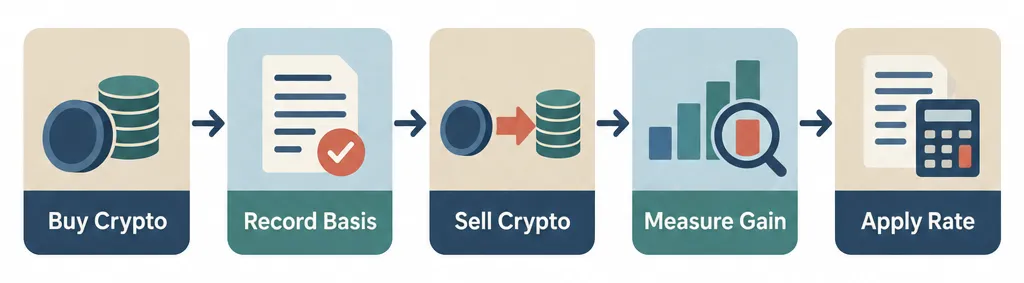
The method is the same for one sale or a hundred: find the basis, find the proceeds, sort by holding period, net gains against losses, then apply the rates.
- List every disposal for the year: sales, swaps and purchases made with crypto.
- Find the cost basis of each lot: purchase price plus fees, or the income value of earned coins.
- Find the proceeds: dollar value received minus selling fees.
- Label each lot short-term or long-term by its own purchase date.
- Net the results. Net short-term gains and losses together, then long-term gains and losses together, then the two totals against each other.
- Apply the loss limit. A net loss offsets up to $3,000 of other income ($1,500 if married filing separately), and the rest carries forward.
- Apply the rates: ordinary brackets to net short-term gain, 0%, 15% or 20% to net long-term gain (up to 28% for collectible NFTs), then the 3.8% tax if it applies.
- Report it. Each disposal goes on Form 8949, totals go on Schedule D, and you answer the digital asset question on Form 1040.
Cost basis for bought vs. earned crypto
Bought crypto has a basis equal to what you paid plus fees. Earned crypto (staking, mining, airdrops, pay) has a basis equal to the dollar value you reported as income when you received it.
Example: you receive 0.5 Ether as staking rewards when it is worth $1,500, and you report $1,500 of income. If you later sell it for $2,000, the gain is $500, not $2,000. Keep a record of each reward’s value on the day you received it, because without that record you risk paying tax twice on the same money.
Using losses to offset gains
Under IRS Topic 409, capital losses first cancel capital gains. Up to $3,000 of any loss left over can reduce your other income, and the rest carries forward to future years with no time limit.
Example: a single filer has a $6,000 long-term gain on Bitcoin and an $11,000 short-term loss on another token. The loss wipes out the gain, offsets $3,000 of wages and leaves $2,000 to carry into 2027. A coin that has lost most of its value still has to be sold or otherwise disposed of before the loss counts.
How to legally avoid or reduce capital gains tax on crypto
You can’t avoid crypto tax entirely on a profitable sale, but you can legally lower it by holding over a year, harvesting losses, selling in a low-income year or donating appreciated coins. Each method has a trade-off.
| Method | Typical effect | Main trade-off |
|---|---|---|
| Hold more than one year | Ordinary rate falls to 0%, 15% or 20% | Price risk while you wait |
| Sell in a low-income year | More of the gain fits in the 0% band | Depends on timing you may not control |
| Tax-loss harvesting | Losses cancel gains, plus up to $3,000 of other income | A pending bill could bring wash sale rules |
| Donate to a 501(c)(3) | No capital gains tax, possible deduction | You give the value away |
| Gift to a lower-bracket relative | Future gain taxed at their rate | Your basis carries over, and kiddie tax rules apply |
Holding past one year
For most sellers this is the biggest legal saving. The quick-reference table shows $700 to $1,800 saved on a $10,000 gain, and the cost is price risk while you wait.
Selling in a low-income year
A year between jobs, early retirement or graduate school can put long-term gains in the 0% bracket. Spreading sales over two tax years can keep more of the gain under each year’s ceiling, especially with the higher 2027 thresholds.
Tax-loss harvesting and the wash sale question
Selling a coin at a loss locks in a deduction against gains. The wash sale rule in 26 U.S.C. 1091 currently applies to stock and securities, and because crypto held directly is property, under current law you can generally buy the coin back right away.
That could change. The Digital Asset Tax Certainty Act (H.R. 10357), approved by the House Ways and Means Committee on September 16, 2026, would extend the wash sale rule to traded digital assets other than qualifying US dollar stablecoins. Advisers at Forvis Mazars warn that the change could reach sales already made in 2026 if it is enacted as written. Spot crypto ETF shares are securities, so treat them as subject to the wash sale rule now.
Donating or gifting crypto
Giving long-held crypto directly to a 501(c)(3) charity avoids the capital gains tax, and if you itemize, it can also give you a deduction for the fair market value. The IRS requires a qualified appraisal for deductions above $5,000.
Gifting coins to a family member in a lower bracket moves the future gain to them, along with your basis. Watch the kiddie tax rules for children.
Form 1099-DA, unpaid bills, ETFs and pending bills in brief
These topics affect what you report and how you pay, but they don’t change the rates above. Each gets a short summary here and fuller treatment in its own guide on the site.
Form 1099-DA and CP2000 notices
US custodial platforms such as Coinbase and Fidelity Crypto now report digital asset sales on Form 1099-DA, and from 2026 they must report cost basis only for “covered” coins bought on or after January 1, 2026 and kept in the same account. Coins bought earlier or moved in from another wallet often show a blank basis, which you correct on Form 8949 with your own purchase records; check that tax software didn’t import it as $0. A CP2000 notice that follows a mismatch is a proposal, not a bill, and you answer it by the date on the notice with your Form 8949 and records.
If you can’t pay the bill
File on time even if you can’t pay, because the failure-to-file penalty (5% of the unpaid tax a month, up to 25%) is ten times the failure-to-pay penalty (0.5% a month). IRS short-term plans of up to 180 days and long-term installment agreements usually cost less than a credit card or cash advance, and a debt payoff calculator can show how a plan fits next to your other balances. After a big 2026 gain, the last estimated payment for the year is due January 15, 2027.
Crypto ETFs, stocks and futures
Spot crypto ETFs and crypto company shares are taxed like other securities at the same 0%, 15% and 20% long-term rates, but they’re reported on Form 1099-B. Regulated futures such as CME bitcoin futures are Section 1256 contracts, taxed 60% long-term and 40% short-term regardless of holding period and reported on Form 6781. Holding spot ETFs in an IRA defers the tax, and qualified Roth IRA withdrawals are tax-free.
Pending bills
As of November 2026, no new crypto tax bill has been signed into law, so today’s rates apply to every sale. H.R. 10357 cleared Ways and Means 38 to 5 and awaits a House floor vote, while Senate proposals such as Sen. Cynthia Lummis’s $300-per-transaction exclusion haven’t passed. The one recent change already in law is the 2025 Congressional Review Act repeal of the IRS rule that would have made many DeFi platforms report as brokers.
The official rules that apply
Every figure on this page comes from the primary sources below, listed by their official names and checked in November 2026.
- IRS Notice 2014-21: crypto is property, so the general tax rules for property apply.
- Revenue Ruling 2019-24: airdrops and hard forks that deliver new coins are ordinary income.
- Revenue Ruling 2023-14: staking rewards are income when you gain dominion and control.
- IRS Notice 2023-27: the look-through test for NFTs treated as collectibles.
- 26 U.S.C. 1(h): the 0%, 15% and 20% long-term capital gains rates, and the 28% collectibles rate in 1(h)(4).
- 26 U.S.C. 1222: the more-than-one-year test for long-term gains.
- 26 U.S.C. 1211 and 26 U.S.C. 1212: the $3,000 loss limit and carryforward, explained in IRS Topic 409.
- 26 U.S.C. 1091: the wash sale rule for stock and securities.
- 26 U.S.C. 1411: the 3.8% Net Investment Income Tax.
- 26 U.S.C. 6045 and the Instructions for Form 1099-DA: broker reporting of proceeds and covered-asset basis.
- Revenue Procedure 2025-32: the 2026 brackets, thresholds and standard deduction.
- Revenue Procedure 2026-35: the 2027 figures.
- Instructions for Form 8949 and Schedule D: how to report each disposal.
- California Franchise Tax Board 540 tax rate schedules and October 2026 Tax News: California’s rates and 2026 indexing.
- Washington Department of Revenue capital gains tax notices: the 7% and 9.9% tiers and the standard deduction.
Every bracket and threshold comes from the IRS’s own Revenue Procedures 2025-32 (2026) and 2026-35 (2027), checked November 27, 2026.
FAQ
How much tax do I pay on crypto?
Short-term gains are taxed at your ordinary rate of 10% to 37%. Long-term gains are taxed at 0%, 15% or 20%, and higher earners add 3.8%. With the calculator’s defaults, a $5,000 long-term gain on $60,000 of taxable income costs $750, an effective rate of 15%.
Will I be taxed on $1,000 of crypto profit?
Yes. It is taxable and reportable, but the tax may be small or zero. A single filer with $40,000 of taxable income pays $0 if the gain is long-term and $120 if it is short-term. At $75,000 the figures are $150 and $220.
How much capital gains tax do I pay on $100,000?
For a single filer in 2026 with $40,000 of other taxable income, a long-term $100,000 gain costs $13,582.50. Short-term it costs $21,646. At $120,000 of income, the long-term figure is $16,371.80, including $1,371.80 of the 3.8% tax.
How much capital gains tax on $300,000?
A single filer with $80,000 of taxable income pays $52,451.80 on a long-term $300,000 gain: $45,000 at 15% plus $7,451.80 of the 3.8% tax. Short-term, the same gain costs $96,909.05.
What is the short-term crypto tax rate?
It’s your ordinary income rate: 10%, 12%, 22%, 24%, 32%, 35% or 37% in 2026, applied slice by slice as the gain stacks on your other income. Add 3.8% if your MAGI is above the threshold.
What is the long-term capital gains tax rate on crypto for 2026?
The rates are 0%, 15% and 20%. For single filers, 0% applies up to $49,450 of taxable income and 15% up to $545,500. For joint filers the limits are $98,900 and $613,700, and for heads of household $66,200 and $579,600.
What are the 2027 capital gains brackets?
For 2027, Revenue Procedure 2026-35 sets the 0% rate up to $51,050 single, $102,100 joint and $68,350 head of household, compared with $49,450, $98,900 and $66,200 for 2026 under Revenue Procedure 2025-32. The 15% rate applies up to $563,200, $633,600 and $598,400 respectively. The 20% rate applies above those levels.
How can I avoid capital gains tax on cryptocurrency?
On a profitable sale you can’t avoid it completely, but you can shrink it legally. Hold more than one year, sell in a year when your income is low enough for the 0% band, offset gains with realized losses, or donate appreciated coins to a 501(c)(3) charity. Moving coins between your own wallets or “holding in a wallet” doesn’t make a sale tax-free.
Are NFTs taxed at a higher rate than Bitcoin?
Some are. Under IRS Notice 2023-27, an NFT that represents a collectible such as art or a gem is treated as a collectible, and long-term gains on collectibles are taxed at up to 28% instead of 15% or 20%. NFTs tied to things that aren’t collectibles, such as virtual land, get the normal rates.
Does the wash sale rule apply to crypto?
Not under current law for coins held directly, which are property rather than securities. H.R. 10357 would change that, and it could reach sales made earlier in 2026, but as of November 2026 it has not passed the House. Spot crypto ETFs are securities, so the rule already applies to them.
Is crypto-to-crypto trading taxable?
Yes. Swapping Bitcoin for Ether, or Ether for USDC, is a disposal of the first coin at its fair market value. You report a gain or loss on Form 8949 even though you never received dollars.
Are staking rewards taxed as income, even if I never sold them?
Yes. Under Revenue Ruling 2023-14, rewards are ordinary income at their fair market value when you gain control of them. That value becomes your cost basis, so a later sale is taxed only on any increase.
How is crypto taxed in California?
California taxes crypto gains as ordinary income at 1% to 12.3%, plus 1% on income above $1 million, according to the Franchise Tax Board. It gives no long-term discount, so holding longer lowers only the federal bill.
Does Washington state tax crypto gains?
Only large long-term gains. The Washington Department of Revenue taxes long-term capital gains above the standard deduction ($278,000 for 2025) at 7%, and at 9.9% on the part over $1 million. Short-term gains and wages aren’t taxed by the state.
My 1099-DA shows proceeds but no cost basis. Am I going to be taxed on the whole amount?
No, as long as you report your basis. Enter the proceeds and your documented cost basis on Form 8949 under the checkbox for sales where basis wasn’t reported. If an imported form shows the basis as $0, correct it before filing.
Will a big crypto gain push all my income into a higher bracket?
No. Your other income keeps its rates, and only the part of the gain above each threshold is taxed at the higher rate. The gain can raise your MAGI enough to trigger the 3.8% tax, which the calculator includes.
Before you sell
Run the calculator twice before you sell, once with Held for set to short and once set to long, and then check the purchase dates on your exchange statement. If the gap is large and your lot is weeks from the one-year mark, the date may matter more than the price. Put the estimated tax aside in cash on the day you sell, so the money is still there when the bill comes.
Guides that use this calculator
- How to fill out IRS Form 8949 for crypto
- Form 1099-DA explained for crypto investors
- PnL meaning in trading and how it is calculated
- Self-custody and decentralized wallets: are they right for you?
- Phantom income in crypto: taxed without selling
- What is bitcoin? A plain-language guide for beginners
Laws and regulations referenced
- IRS Notice 2014-21 (virtual currency is property)
- IRS Revenue Ruling 2019-24 (hard forks and airdrops)
- IRS Revenue Ruling 2023-14 (staking rewards)
- IRS Form 1099-DA, Digital Asset Proceeds From Broker Transactions
- IRS Form 8949, Sales and Other Dispositions of Capital Assets
- IRS Schedule D (Form 1040), Capital Gains and Losses
- Wash sale rule, 26 U.S.C. 1091
Links go to the official text on government sites.
Sources
- IRS Revenue Procedure 2025-32 eitc.irs.gov · official source
- IRS Instructions for Form 1099-DA irs.gov · official source
- California FTB 2025 540 tax rate schedules ftb.ca.gov · official source
- IRS: Payment plans and installment agreements irs.gov · official source
- IRS: Options for taxpayers who need help paying their tax bill irs.gov · official source
- Kiplinger: IRS updates capital gains tax thresholds kiplinger.com
- Thomson Reuters Checkpoint: Key 2026 figures tax.thomsonreuters.com
- Tax Foundation: 2026 tax brackets taxfoundation.org
- CNBC: 2027 capital gains tax brackets cnbc.com
- 2027 capital gains tax brackets structuredsales.org
- KPMG: Rev. Proc. 2026-35 inflation adjustments for 2027 kpmg.com
- Capital Gains Tax Rates 2027 ustax.tools
- IRS Tax Brackets 2027 ustax.tools
- Kiplinger: 2027 tax brackets are set kiplinger.com
- 2027 Capital Gains Tax Brackets and NIIT thresholds ourtaxpartner.com
- Forvis Mazars: Form 1099-DA covered vs. noncovered digital assets forvismazars.us
- Bloomberg Law: Crypto broker tax forms news.bloomberglaw.com

Marcus covers credit scores, credit reports and getting out of debt: consolidation, nonprofit counseling, settlement and what debt collectors may and may not do. He works from the federal laws that apply, CFPB guidance and the credit bureaus' published rules.
Ruth is US Financer's standards editor. Every article goes through her checks before and after it is published: each rate, fee, cap, deadline and rule is matched against its primary source, every law named is linked to its official text, and anything that cannot be…
What changed
- Nov 27, 2026 First published.
Comments are closed