


Crypto can lose all of its value and is not protected by FDIC or SIPC insurance. This is education, not investment advice.
PnL stands for profit and loss. It is the gain or loss on a business, a trade or a whole portfolio over a set period. You will see it written as P&L, PNL or P/L. It turns up in three places: on a company’s income statement, in the PnL column of a trading or crypto app, and in the daily reports of a bank’s trading desk. The number on your screen is not always the money you keep. Fees, funding, how the price is measured and taxes all sit between the two.
SCAM ALERTRelated consumer alert, Nov 13, 2026
FBI warns crypto users of fake Zoom and Teams calls from hijacked contactsRun the numbers
Key takeaways
- PnL means profit and loss. A business P&L is its income statement, and a trading PnL is the gain or loss on your positions.
- Unrealized PnL is a paper figure that moves with the price. Only realized PnL, after fees, comes close to money you actually have.
- How fees and funding appear in displayed PnL varies by platform. Many exchanges leave them out of unrealized PnL, so a position can show green and still close at a loss.
- In the US, most investors pay tax on crypto and stock gains only when they are realized, though some traders, such as those who elect mark-to-market accounting, recognize gains and losses each year. For 2026, long-term rates are 0%, 15% or 20%, and net losses offset up to $3,000 of other income a year.
- Brokers must report cost basis on Form 1099-DA for covered crypto bought from January 1, 2026. For older holdings, keeping track of basis is your job.
Fact-checked
We checked these key facts against the sources named, on November 13, 2026:
- Example: with $2,000 of gains and $9,000 of losses, your net loss is $7,000 (source: irs.gov)
- The Financial Accounting Standards Board (FASB) issued ASU 2024-03 on November 4, 2024 (source: fasb.org)
- A $50 gain on a $10,000 position is 0.5%, but if you posted only $1,000 of margin, the same gain shows as 5% ROE (source: finra.org)
- If a figure on the form is wrong, the 2026 filing guidance on 1099-DA says you correct it on Form 8949 rather than copying the error (source: irs.gov)
- They are marked to market at year-end, so open positions are taxed as if sold on December 31, under a 60% long-term, 40% short-term split (source: irs.gov)
What does PnL mean?
PnL means profit and loss: what you earned minus what you spent or lost over a period. A positive PnL is a profit and a negative PnL is a loss. Who is using the term tells you what is being measured.
- In business, the P&L is the profit and loss statement, also called the income statement. It runs from revenue at the top to net income at the bottom.
- In your trading or crypto app, PnL is the gain or loss on your positions, split into realized (closed) and unrealized (still open).
- On a trading desk, PnL is the daily change in the market value of the desk’s positions, known as mark-to-market PnL.
PnL, P&L, PNL: same thing
The spellings all mean the same thing. Accountants and job postings usually write “P&L”, so a role with “P&L responsibility” means you answer for a unit’s revenue and costs, and therefore its bottom line. Crypto exchanges and trading apps tend to use “PnL” or “PNL”. Older brokerage statements sometimes show “P/L”.
Positive vs negative PnL
A positive PnL, often shown in green, means the position or business is ahead. A negative PnL, often shown in red with a minus sign, means it is behind. For an open trade, negative PnL is a loss you haven’t locked in yet. It becomes a realized loss when you close the trade.
PnL in business: the profit and loss statement
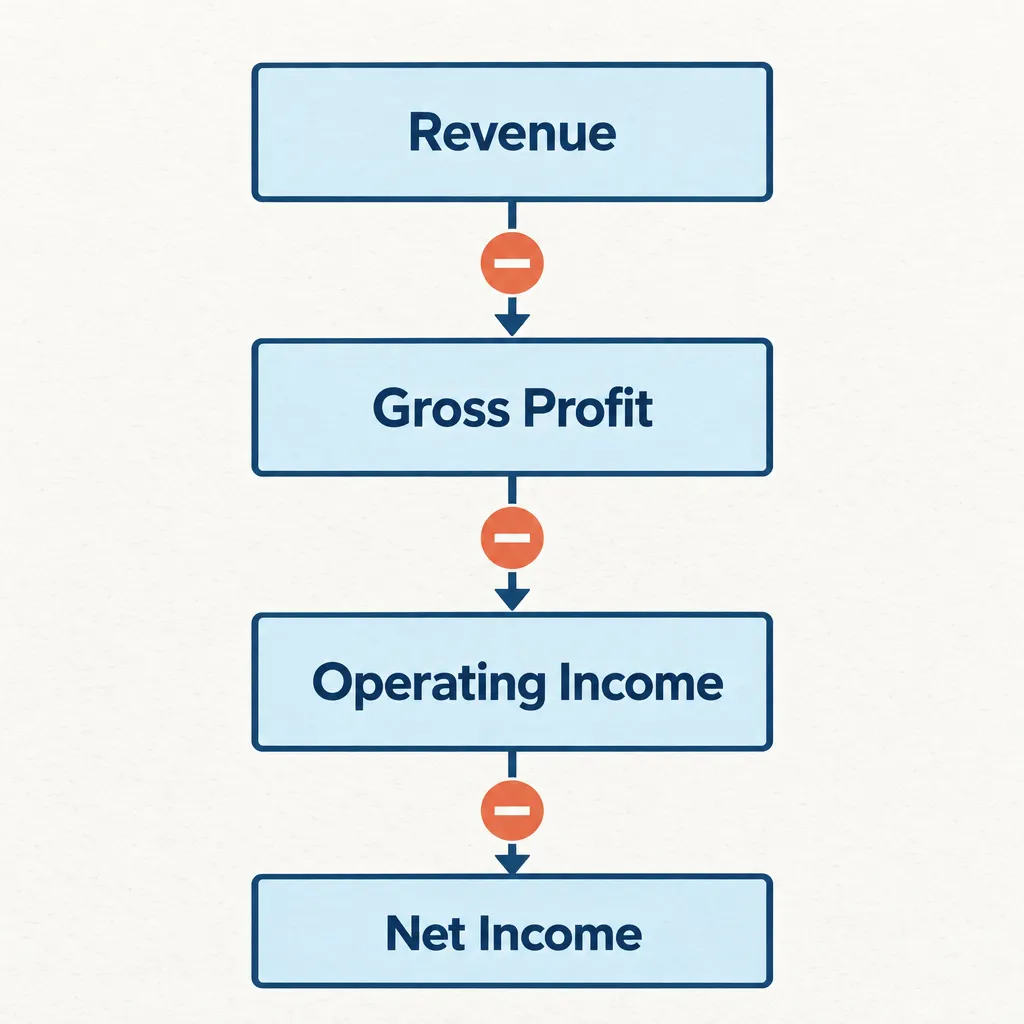
A business P&L statement shows whether a company made or lost money over a period, such as a month, quarter or year. Investopedia’s definition puts it alongside the balance sheet and the cash flow statement as one of the three core financial statements. Public companies publish all three every quarter and every year.
Line by line: revenue, COGS, gross profit, operating expenses, net income
Every P&L reads from top to bottom and subtracts as it goes:
- Revenue (the top line): total sales for the period.
- Cost of goods sold (COGS): the direct cost of what you sold, such as materials or inventory.
- Gross profit: revenue minus COGS.
- Operating expenses: rent, software, advertising, wages and other costs of running the business.
- Operating income: gross profit minus operating expenses.
- Interest, other income and taxes: non-operating items.
- Net income (the bottom line): what is left after everything.
Here is a sample P&L for a one-person side business that sells handmade candles online. The figures are illustrative.
| Line item | Amount | What it means |
|---|---|---|
| Revenue | $18,000 | Everything customers paid for candles in the year |
| Cost of goods sold | −$6,500 | Wax, wicks, jars, fragrance |
| Gross profit | $11,500 | $18,000 − $6,500 |
| Marketplace and payment fees | −$1,400 | Selling platform and card processing |
| Advertising | −$900 | Paid social and marketplace ads |
| Software | −$300 | Design and bookkeeping tools |
| Shipping supplies | −$800 | Boxes, labels, packing material |
| Total operating expenses | −$3,400 | Sum of the four lines above |
| Net profit | $8,100 | $11,500 − $3,400 |
Cash vs accrual method
The accounting method decides when revenue and expenses show up on the P&L. With the cash method, income counts when you receive the money and expenses count when you pay them. With the accrual method, income counts when you earn it and expenses count when you incur them, whatever day the cash moves. Most freelancers and small sellers use the cash method because it is simpler. Public companies report on an accrual basis under US generally accepted accounting principles.
P&L vs balance sheet vs cash flow statement
Each statement answers a different question:
- P&L (income statement): did the business make a profit over the period?
- Balance sheet: what does it own and owe at a single point in time?
- Cash flow statement: how much cash actually came in and went out?
A company can show a healthy P&L and still run short of cash, for example when customers pay late under accrual accounting. That is why analysts read all three.
Your side hustle’s P&L is Schedule C
If you run a sole proprietorship or side business, the IRS already asks you for a P&L. You file it on Schedule C. The IRS’s Schedule C and Schedule SE guidance also says that if your net self-employment earnings from all businesses are $400 or more, you must figure self-employment tax on Schedule SE. In the candle example, $8,100 of net profit goes on Schedule C, and because it is above $400, Schedule SE applies too.
Did you know?
The IRS form that sole proprietors file, Schedule C, is officially titled “Profit or Loss From Business.” In other words, it is a P&L statement filed with your Form 1040.
What changes for public company P&Ls
Large companies’ income statements are about to get more detailed. The Financial Accounting Standards Board (FASB) issued ASU 2024-03 on November 4, 2024. The standard is known as DISE (disaggregation of income statement expenses). It requires public business entities to break expense lines down in the notes into categories such as inventory purchases, employee compensation and depreciation. Deloitte’s summary says it applies to annual periods in fiscal years beginning after December 15, 2026. ASU 2025-01 clarified that interim reporting follows a year later. For investors, this means clearer answers from 2027 annual reports about where a company’s costs actually go.
PnL in trading and crypto apps
In a brokerage or crypto app, PnL is the dollar gain or loss on your positions. Apps split it into realized PnL (closed trades), unrealized PnL (open trades) and summary figures such as total, daily and percentage PnL. The table below compares the main types side by side.
| Type | What it measures | When it changes | Includes fees? | Taxed? |
|---|---|---|---|---|
| Realized PnL | Gain or loss on positions you closed or sold | When you close or sell | Usually, on exchanges (check the app) | Yes, in the year realized |
| Unrealized PnL | Paper gain or loss on open positions | Every price move | Usually not | No, with rare exceptions |
| Total PnL | Realized plus unrealized, as the app defines it | Continuously | Varies by app | Only the realized part |
| Daily PnL | Change since the day’s reset or prior close | Resets daily | Varies by app | No, it is a reporting view |
| PnL % / ROE | PnL relative to cost or to margin | With PnL | Varies by app | Not separately |
| Business net income | Revenue minus all expenses for a period | Each reporting period | Yes, all expenses | Yes, as business income |
| Desk MTM PnL | Daily change in market value plus cash flows | Daily | Depends on firm | At the firm level |
Realized PnL
Realized PnL is the profit or loss you lock in when you close all or part of a position. Selling 1 of your 3 coins realizes the PnL on that 1 coin only. On most crypto derivatives platforms, realized PnL is shown net of trading fees and funding payments. BingX’s perpetual futures documentation, for example, says realized PnL includes trading and funding fees.
Unrealized (paper or floating) PnL
Unrealized PnL, also called paper or floating PnL, is what you would gain or lose if you closed the position right now. It changes with every price tick. Kraken’s help pages say unrealized PnL counts toward your account equity but doesn’t change your actual balance until the position is closed.
Total PnL and daily PnL
Total PnL usually adds realized and unrealized PnL over a period or across the life of an account. Each app defines it a little differently. Daily PnL shows how much your positions gained or lost over the current day. Many crypto platforms reset it at a fixed time, often 00:00 UTC, while stock brokers usually measure from the previous market close.
Long vs short formulas
The core formulas are simple:
- Long position: PnL = position size × (exit price − entry price)
- Short position: PnL = position size × (entry price − exit price)
Kraken’s PnL documentation uses the same structure for unrealized PnL. For a long it is position size times the current price minus the average entry price, and for a short the two prices swap places.
PnL % and ROE on leveraged positions
PnL % = (final value ÷ starting value − 1) × 100. On a leveraged position, exchanges often show ROE (return on equity), which divides PnL by the margin you posted rather than by the full position size. Leverage makes the percentages look bigger. A $50 gain on a $10,000 position is 0.5%, but if you posted only $1,000 of margin, the same gain shows as 5% ROE. A loss scales up in the same way.
How to calculate PnL (with worked examples)
To calculate PnL, multiply your position size by the price change in your favor, then subtract every fee and funding payment. The examples below use made-up prices to show the math. Each one has been checked line by line.
Worked example: a stock trade
You buy 50 shares at $40 ($2,000) and sell them at $46 ($2,300), with no commission.
- PnL = 50 × ($46 − $40) = $300
- PnL % = ($2,300 ÷ $2,000 − 1) × 100 = 15%
Gross vs net PnL
Gross PnL is the price move alone. Net PnL subtracts trading fees, spread, slippage and, on derivatives, funding. Net is the figure that matters, because net is what reaches your account.
Say you buy 2 units of a coin at $3,000 each ($6,000) on a platform that charges 0.4% per trade, then sell at $3,100.
| Item | Calculation | Amount |
|---|---|---|
| Buy cost | 2 × $3,000 | $6,000.00 |
| Buy fee (0.4%) | $6,000 × 0.004 | $24.00 |
| Sale proceeds | 2 × $3,100 | $6,200.00 |
| Sell fee (0.4%) | $6,200 × 0.004 | $24.80 |
| Gross PnL | 2 × ($3,100 − $3,000) | $200.00 |
| Net PnL | $200 − $24 − $24.80 | $151.20 |
| Net PnL % | $151.20 ÷ $6,024 total cost | 2.51% |
Fees took about a quarter of the gross gain. This is why a scalping trading strategy, with many small trades, is so sensitive to fees: the smaller the price move you target, the bigger the share fees take.
Worked example: a short trade
You short 10 units at $50. If you buy back at $44, PnL = 10 × ($50 − $44) = +$60 before fees. If the price instead rises to $57 and you close there, PnL = 10 × ($50 − $57) = −$70. A short has no ceiling on losses, because the price has no ceiling.
Cost basis and average cost
Cost basis is what you paid for an asset, including purchase fees. If you buy several times, most apps show an average cost. For example, 1 unit at $100 plus 1 unit at $140 gives an average of $120. That works for an app display, but US tax rules for crypto use first-in, first-out (FIFO) or specific identification of the units you sold, not a blended average. Your tax gain can therefore differ from the app’s PnL even when the sale price is the same.
Worked example: losing money on a “green” trade after fees
This is one of the most common complaints: the position showed green unrealized PnL, yet the trade history says you lost money. Take a leveraged perpetual futures position with a $20,000 notional size, 0.05% taker fees on each side and one funding payment.
| Item | Calculation | Amount |
|---|---|---|
| Entry notional | Position opened | $20,000.00 |
| Exit notional | Price up 0.05% | $20,010.00 |
| Unrealized PnL shown before close | $20,010 − $20,000 | +$10.00 |
| Entry fee | $20,000 × 0.0005 | −$10.00 |
| Exit fee | $20,010 × 0.0005 | −$10.01 |
| Funding paid (0.01%) | $20,000 × 0.0001 | −$2.00 |
| Realized PnL | $10 − $10 − $10.01 − $2 | −$12.01 |
The screen showed +$10 while the trade was open. Closing it booked a $12.01 loss, because the entry fee, exit fee and funding never appeared in unrealized PnL.
Did you know?
BingX’s perpetual futures documentation explains that a position can show positive unrealized PnL and still post a realized loss, because realized PnL includes trading and funding fees while unrealized PnL does not.
Is PnL your profit? Why the app number isn’t what you keep
Only realized PnL, net of all fees, is close to profit you actually have, and taxes still come out of it. Unrealized PnL can vanish with the next price move. “Total PnL” on many apps also mixes in effects that have nothing to do with trading skill. Five gaps explain most mismatches.
Check the label first
Before judging a trade, check whether the PnL figure is realized or unrealized and whether it includes fees. If the app doesn’t say, compare it with your trade history or a transaction export.
Mark price vs last price
The last price is the most recent trade on that exchange. Mark price is a fair-value estimate. Derivatives platforms usually base it on an index of spot prices from several venues, though each exchange sets its own method, and some Kraken pages describe using the best bid for longs and best ask for shorts. Exchanges use mark price for unrealized PnL and liquidation so that one sudden trade on a single order book can’t wipe out positions. In a fast market the two prices can be far apart. Your PnL can then look different from the chart, and your actual exit price can differ from both.
Fees and funding
As the worked example shows, many platforms charge the entry fee to your balance when you open the position and keep funding payments separate. Kraken’s documentation says both stay out of unrealized PnL. Funding is the periodic payment between long and short holders on perpetual futures. Depending on the funding rate, it can add to or subtract from your result each funding period.
Deposits, transfers and missing cost basis
“Total PnL” often fails to match what you deposited and withdrew. Apps treat transfers differently. If you move coins in from another exchange or a cold wallet, the receiving platform may not know what you paid. It may assign a zero basis, or use the price on the day the coins arrived. Either way, the PnL it shows for those coins is wrong. Deposits and withdrawals in the middle of a period also distort percentage returns. The fix is to compare your net cash in and out with your current balance, using your own records.
Leverage: unrealized losses and liquidation
Unrealized PnL counts toward your margin, and unrealized losses can get you liquidated. On a $10,000 position opened with $1,000 of margin (10x leverage), a 5% price drop creates a $500 unrealized loss and halves your equity to $500. A drop of just under 10% would erase the margin entirely. Exchanges liquidate before that point, when equity falls to the maintenance margin requirement. A liquidation turns the paper loss into a realized one, often with an extra liquidation fee.
Before you trade with leverage
Crypto can lose all its value, and leverage multiplies losses as quickly as gains. Crypto held on an exchange is not FDIC or SIPC insured, so if the platform fails, your balance has no government backstop.
Know which price triggers liquidation
For leveraged positions, find out whether the exchange uses mark price or last price for unrealized PnL and liquidation. The two can diverge sharply during fast moves.
How PnL turns into taxes (US, 2026)
The IRS treats crypto as property, so realized PnL from selling, swapping or spending crypto is a capital gain or loss. Unrealized PnL is not taxed while you hold. The tax rate depends on how long you held the asset and on your taxable income.
Short-term vs long-term
Under IRS Topic No. 409, gains on assets held more than one year are long-term. Assets held one year or less produce short-term gains, which are taxed at your ordinary income rates. The holding period starts the day after you acquire the asset.
One exception matters for traders. Regulated futures contracts on US exchanges, including CME bitcoin futures, are Section 1256 contracts. They are marked to market at year-end, so open positions are taxed as if sold on December 31, under a 60% long-term, 40% short-term split. Offshore perpetual futures do not get that treatment.
2026 capital gains brackets
Rev. Proc. 2025-32 sets the 2026 long-term capital gains thresholds, based on taxable income:
| Filing status | 0% up to | 15% up to | 20% above |
|---|---|---|---|
| Single | $49,450 | $545,500 | $545,500 |
| Married filing jointly | $98,900 | $613,700 | $613,700 |
| Head of household | $66,200 | $579,600 | $579,600 |
| Married filing separately | $49,450 | $306,850 | $306,850 |
The single-filer 0% ceiling was $48,350 for 2025, so the brackets rose about 2.3%. On top of these rates, the 3.8% net investment income tax (NIIT) applies to the lesser of your net investment income or the amount your modified adjusted gross income exceeds $200,000 (single or head of household), $250,000 (married filing jointly) or $125,000 (married filing separately).
Did you know?
According to Kiplinger, the 3.8% NIIT thresholds have not been adjusted for inflation since the tax began in 2013, even though the capital-gains brackets rise every year.
Watch the one-year line
Holding a profitable asset for more than one year moves the gain from short-term (ordinary rates) to long-term (0%, 15% or 20%). Count from the day after you acquired it.
Using losses: the $3,000 rule
Negative realized PnL still has value at tax time. Capital losses first offset capital gains in full. If losses exceed gains, IRS Topic No. 409 lets you deduct up to $3,000 of the excess against other income ($1,500 if married filing separately), and the rest carries forward to future years. Example: with $2,000 of gains and $9,000 of losses, your net loss is $7,000. You deduct $3,000 this year and carry $4,000 forward.
Form 1099-DA, Form 8949 and Schedule D
Form 1099-DA is the new broker form for digital asset sales. You report each sale on Form 8949 and carry the totals to Schedule D. What brokers must report depends on the year of the trade:
| Tax year of the trade | Gross proceeds | Cost basis | Form arrives |
|---|---|---|---|
| 2025 | Required | Voluntary | Early 2026 |
| 2026, covered assets | Required | Required, with acquisition date | Early 2027 |
| 2026, noncovered assets | Required | Voluntary | Early 2027 |
The IRS’s Form 1099-DA instructions define a covered asset as one acquired after 2025. In general it must also be held in the same broker account from purchase to sale.
A 1099-DA that shows proceeds but no cost basis does not mean you owe tax on the whole amount. You owe tax on the gain, and you show your real basis on Form 8949. If a figure on the form is wrong, the 2026 filing guidance on 1099-DA says you correct it on Form 8949 rather than copying the error.
Coins bought before 2026: you track your own basis
Crypto bought before January 1, 2026, is generally noncovered. Coins moved onto a platform from elsewhere can be treated as covered only when the broker receives the required transfer statement and other requirements are met. Under the transition rules, brokers generally are not required to report basis for digital assets acquired before January 1, 2026, so you need your own records: purchase date, amount paid, fees, and every transfer between accounts.
Keep your own basis records
Save purchase dates and cost basis for any crypto bought or transferred before January 1, 2026. When a Form 1099-DA arrives, compare it line by line with your records.
Trading-desk PnL: mark-to-market and “PnL explained”
At banks and trading firms, PnL means the daily change in the value of a desk’s positions, plus any cash received or paid. If you see “PnL” in a finance job posting, such as a product control or risk role, this is usually the sense intended.
Daily mark-to-market
The industry convention is: daily PnL = mark-to-market (MTM) value today − MTM value yesterday + cash flows received today. The cash flows are added back because receiving a scheduled payment doesn’t create profit. The value just moves from “future cash flow” into cash.
Example: a portfolio was marked at $1,000,000 yesterday. Today a $5,000 coupon was paid out, and the portfolio is marked at $1,007,000. Daily PnL = $1,007,000 − $1,000,000 + $5,000 = $12,000.
PnL attribution and “unexplained” PnL
Risk teams then break the day’s PnL into causes, a process called PnL attribution or “PnL explained.” Whatever their models can’t account for is labeled unexplained PnL:
| Source | Amount |
|---|---|
| New trades | $3,000 |
| Time and carry | $1,500 |
| Interest rate moves | $6,000 |
| Currency moves | $1,000 |
| Unexplained | $500 |
| Total daily PnL | $12,000 |
The parts must add up to the total. When they don’t, the cause is either a missing risk factor or simple arithmetic error. Persistent unexplained PnL is a red flag for risk managers, which is why desks investigate it daily.
Other meanings of PNL
If you searched for PNL and none of this sounds right, you may want one of two other meanings. PNL is a French rap duo formed by the brothers Ademo and N.O.S. The name is short for “Peace N’ Lovés.” In French, PNL is also the abbreviation for programmation neuro-linguistique, known in English as NLP or neuro-linguistic programming. Neither has anything to do with profit and loss.
FAQ
What does PnL mean in business?
In business, PnL (usually written P&L) is the profit and loss statement, also called the income statement. It lists revenue, subtracts cost of goods sold and operating expenses, and ends with net income for the period.
How is PnL calculated?
For a long trade, PnL = position size × (exit price − entry price). For a short, PnL = size × (entry price − exit price). Subtract trading fees, spread and funding to get net PnL. For a business, it is revenue minus all expenses.
Is PnL your profit?
Only partly. Realized PnL after fees is close to the profit you actually have. Unrealized PnL is a paper figure that can reverse, and taxes still come out of realized gains.
What does PnL mean in crypto?
In crypto apps, PnL is the gain or loss on your coins or derivatives positions, shown as realized, unrealized, total and daily figures. Derivatives exchanges often calculate it with mark price instead of the last traded price.
What is the difference between realized and unrealized PnL?
Realized PnL comes from positions you have closed and is final. Unrealized PnL is the current paper gain or loss on open positions and changes with every price move.
Is PnL the same as P&L or the income statement?
Yes. PnL, P&L, PNL and P/L are the same abbreviation. In accounting, the P&L statement and the income statement are the same document.
Do I pay taxes on unrealized PnL?
No. Under US rules, you are taxed on crypto and stocks when you sell, swap or otherwise dispose of them. The main exception is Section 1256 contracts, such as regulated futures, which are marked to market at year-end.
What does negative PnL mean?
It means a loss. On an open position it is an unrealized loss. Once you close, it becomes a realized loss, which can offset gains and up to $3,000 of other income a year.
What is daily PnL?
Daily PnL is the gain or loss over one day. Crypto apps often reset it at a fixed time such as 00:00 UTC, while trading desks calculate it as today’s mark-to-market value minus yesterday’s, plus cash flows.
What is a good PnL ratio?
The PnL ratio usually means your average winning trade divided by your average losing trade. No single number counts as good, because it depends on your win rate. The break-even win rate is 1 ÷ (1 + ratio). With a 2:1 ratio, you need to win just over 33% of trades to come out ahead before fees. Every fee you pay raises that bar.
Next time a PnL figure looks better or worse than expected, check three things in order: whether it is realized, whether it includes fees and funding, and what cost basis it uses. Those three answers explain most of the gap between the number on your screen and what you will actually keep and report to the IRS.
Laws and regulations referenced
- IRS Form 1099-DA, Digital Asset Proceeds From Broker Transactions
- IRS Form 8949, Sales and Other Dispositions of Capital Assets
- IRS Schedule D (Form 1040), Capital Gains and Losses
Links go to the official text on government sites.
Sources
- Topic no. 409, Capital gains and losses (IRS) irs.gov · official source
- Instructions for Form 1099-DA (IRS) irs.gov · official source
- Topic no. 559, Net investment income tax (IRS) irs.gov · official source
- Net Investment Income Tax (IRS) irs.gov · official source
- Schedule C & Schedule SE FAQ (IRS) irs.gov · official source
- IRS Form 1099-DA: Digital Asset Proceeds Reported by Your Crypto Broker greenbacktaxservices.com
- Form 1099-DA noncovered digital assets (Gordon Law) gordonlaw.com
- Form 1099-DA guide (Koinly) koinly.io
- 2026 Inflation Adjustments: Revenue Procedure 2025-32 Analysis currentfederaltaxdevelopments.com
- Capital Gains Tax Rates for 2026 ustax.tools
- IRS Updates Capital Gains Tax Thresholds for 2026 (Kiplinger) kiplinger.com
- FASB clarifies effective date of ASU 2024-03 (Deloitte DART) dart.deloitte.com
- Profit and Loss (P&L) Statement (Investopedia) investopedia.com
- PnL Calculations (Kraken Support) support.kraken.com
- PnL Calculations, US margin (Kraken Support) support.kraken.com
- Perpetual Futures PnL Calculations Explained (BingX) bingxservice.zendesk.com
- PnL Explained FAQ pnlexplained.com

Owen explains how crypto works for US readers: coins and tokens, buying and selling, wallets and self-custody, staking and DeFi. He sticks to how things work and what they cost, never price calls, and checks platform fees and licensing against the companies' own disclosures.
Ruth is US Financer's standards editor. Every article goes through her checks before and after it is published: each rate, fee, cap, deadline and rule is matched against its primary source, every law named is linked to its official text, and anything that cannot be…
What changed
- Nov 13, 2026 First published.
Comments are closed