

General information, not financial advice. Check the official program rules or your bank's terms before you act.
At the Q3 2026 average boat loan rate of 8.52%, a $50,000 loan costs about $493 a month over 15 years and adds $38,732 in interest. Your own payment depends on five numbers: the amount financed, the APR, the term, your down payment, and the tax and fees you roll in. The tables and formula below let you estimate it before you talk to a dealer or lender.
WARNINGRelated consumer alert, Nov 12, 2026
Pennsylvania AG warns veterans who paid Trajector to consider bankruptcy claimsRun the numbers
Key takeaways
- At 8.52%, every $10,000 borrowed costs about $124 a month over 10 years, $99 over 15 and $87 over 20.
- On a $50,000, 15-year loan, fair credit costs about $98 a month more than very good credit, or $17,722 over the life of the loan.
- Moving a $50,000 loan from 10 to 20 years cuts the payment by $186 but adds $29,836 in interest.
- If you put nothing down on a 20-year loan, you can owe more than the boat is worth for about 16 years.
- Expect maintenance, insurance and storage to cost about as much each month as the loan payment.
Fact-checked
We checked these key facts against the sources named, on November 14, 2026:
- At 8.52%, a $20,000 loan costs about $248 a month over 10 years (source: lendingtree.com)
- Over 15 years, interest adds $38,732, so the boat costs you $88,732 in total (source: bankrate.com)
- Bankrate puts the total yearly cost to own and maintain a boat at $5,000 to $8,000 (source: bankrate.com)
- Financing $3,500 of tax and fees at 8.52% over 15 years adds $34.51 to each payment (source: bankrate.com)
- A $30,000 loan costs $372.28 a month over 10 years, $295.77 over 15 and $260.73 over 20 (source: lendingtree.com)
Quick answer: what a boat loan payment costs right now
A $50,000 boat loan at 8.52% APR costs about $620 a month over 10 years, $493 over 15 years and $435 over 20 years. That rate is the average offered to LendingTree users in Q3 2026. The averages by credit tier were 7.81% for very good credit, 9.14% for good and 11.08% for fair.
All payments on this page use the standard amortization formula. That formula assumes a fixed rate, equal monthly payments and no balloon payment. The rates are as of Q3 2026, and lender quotes were checked in November 2026.
Before you borrow
A long boat loan with little down can leave you owing more than the boat is worth for most of the term. If money gets tight and you have to sell, the sale price may not pay off the loan.
Monthly payment tables for common boat loan amounts
To estimate a payment at today’s average rate, find your loan amount in the table below. For example, a $30,000 loan at 8.52% costs $372.28 a month over 10 years or $295.77 over 15 years. The last column shows how much interest you pay over a 15-year term.
| Loan amount | 10 years (120 mo) | 15 years (180 mo) | 20 years (240 mo) | Total interest at 15 years |
|---|---|---|---|---|
| $20,000 | $248.19 | $197.18 | $173.82 | $15,493 |
| $25,000 | $310.23 | $246.48 | $217.27 | $19,366 |
| $30,000 | $372.28 | $295.77 | $260.73 | $23,239 |
| $50,000 | $620.46 | $492.96 | $434.54 | $38,732 |
| $65,747 (Q3 2026 average) | $815.87 | $648.21 | $571.40 | $50,930 |
| $100,000 | $1,240.93 | $985.91 | $869.09 | $77,464 |
Fixed 8.52% APR, the Q3 2026 average offered to LendingTree users. No fees are included.
$20,000 and $25,000 boat loan payments
At 8.52%, a $20,000 loan costs about $248 a month over 10 years. A $25,000 loan costs about $310. Smaller loans like these, including loans for a personal watercraft (PWC), often don’t qualify for the longest terms. Lenders usually keep 15- and 20-year terms for larger balances and newer boats, so plan around the 10-year column.
$30,000 boat loan payment
A $30,000 loan costs $372.28 a month over 10 years, $295.77 over 15 and $260.73 over 20. Payment calculators often disagree on this amount, mostly because they use different default rates. Calculator.net, for example, defaults to 7%, which is below the 8.52% average. A low default rate makes every payment look smaller than you are likely to be quoted.
$50,000 boat loan payment
A $50,000 loan costs $620.46 a month over 10 years, $492.96 over 15 and $434.54 over 20. Over 15 years, interest adds $38,732, so the boat costs you $88,732 in total. That’s before tax, fees, insurance or upkeep.
$100,000 boat loan payment
A $100,000 loan costs about $1,241 a month over 10 years, $986 over 15 and $869 over 20. Over 15 years, interest comes to $77,464. Loans this large are also above the 2026 Truth in Lending Act coverage limit of $73,400, which the “Your rights” section below explains.
Did you know?
According to LendingTree, the average boat loan offered to its users in Q3 2026 was $65,747. That is more than twice the $28,000 example many online calculators use by default.
How your credit score changes the payment
Credit tier has a bigger effect on cost than almost anything else you control. On the same $50,000 loan over 15 years, fair credit costs about $98 a month more than very good credit. Over the full term, that’s about $17,700 more in interest.
Boat loan rates by credit tier (Q3 2026)
| Credit tier | Score range | Average APR (Q3 2026) | Monthly payment ($50k, 15 yrs) | Total interest |
|---|---|---|---|---|
| Very good | 740–799 | 7.81% | $472.36 | $35,024 |
| Good | 670–739 | 9.14% | $511.31 | $42,035 |
| Fair | 580–669 | 11.08% | $570.81 | $52,746 |
Rates are LendingTree’s Q3 2026 averages of offers to its users.
Rates for weaker credit have risen faster than the overall average. In Q4 2025, LendingTree’s overall average was 8.40% and fair credit averaged 9.70%. By Q3 2026, the overall average had moved only to 8.52%, but fair credit had jumped to 11.08%. If your score is below 670, use the fair-credit row for your estimate, not the headline average.
According to LendingTree, there is no set minimum credit score for a boat loan, and some lenders go as low as 550. Being approved at that level is not the same as getting an affordable loan, though. At 11.08% or more, a 20-year term costs far more in interest than the payment suggests.
Advertised “as low as” rates vs. averages
The low rates in lender ads assume excellent credit and often a short term or a new boat. As of November 2026, lenders’ own rate pages showed:
| Lender | Advertised starting APR | Conditions stated by lender |
|---|---|---|
| Navy Federal Credit Union | 6.95% new, 7.45% used | Terms up to 36 months, excellent credit (rates as of Nov 13, 2026) |
| APG Federal Credit Union | 5.99% new | 97 to 180 months, $25,000 example loan |
| South Carolina Federal Credit Union | 7.49% new, 7.99% used | Terms up to 60 months |
All three are credit unions, and each requires membership. Navy Federal, for example, limits membership to people with military or Department of Defense ties and their families. If you don’t belong to a credit union yet, our guide on credit union membership explains how joining works.
Use your tier's rate, not the ad rate
Run your estimate at the average for your credit tier: 7.81%, 9.14% or 11.08% in Q3 2026. An “as low as” rate assumes excellent credit and often a 3- to 5-year term.
How to estimate your own payment step by step
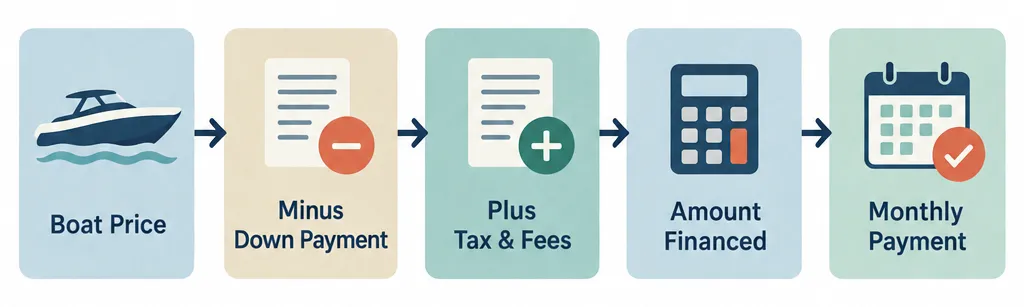
To estimate a boat loan payment, work out the amount financed. Then turn the APR into a monthly rate and put both into the formula M = L × r ÷ (1 − (1 + r)^−n). In that formula, L is the amount financed, r is the monthly rate and n is the number of monthly payments.
How to estimate a boat loan payment
- Start with the negotiated price of the boat, motor and trailer.
- Add sales tax, documentation, registration and title fees.
- Subtract your trade-in value and your down payment. The result is L.
- Divide the APR by 12 to get r. Count the months in the term to get n.
- Put L, r and n into the formula, or use the matching row in the tables above.
- Multiply the payment by n and subtract L to see the total interest.
Working out the amount financed
The amount financed is the price, plus tax and fees, minus your trade-in and down payment. Take a $45,000 boat in a state with a 6% sales tax and $800 in dealer and registration fees. You put 10% down and have no trade-in.
| Item | Amount |
|---|---|
| Boat price | $45,000 |
| Sales tax at 6% | +$2,700 |
| Dealer, documentation and registration fees | +$800 |
| Down payment (10% of price) | −$4,500 |
| Amount financed (L) | $44,000 |
Converting APR to a monthly rate
Divide the APR by 12, then write it as a decimal. At the good-credit average of 9.14%, r = 0.0914 ÷ 12 = 0.0076167. For a 15-year term, n = 180.
Here is the full calculation:
- (1 + 0.0076167)^180 = 3.9189
- 1 ÷ 3.9189 = 0.2552, and 1 − 0.2552 = 0.7448
- L × r = $44,000 × 0.0076167 = $335.13
- $335.13 ÷ 0.7448 = about $450 a month
Over 180 payments you repay about $80,991. That means $36,991 in interest on a $44,000 loan.
Strictly speaking, the payment is calculated from the loan’s note rate. The APR also includes certain finance charges, so using the APR can put your estimate a few dollars off. For planning, that gap doesn’t matter. Our explainer on credit card APR covers the same rate-versus-APR distinction.
Checking a lender’s quote
Before you sign, a lender must give you a Truth in Lending disclosure for most consumer loans. It lists the amount financed, the finance charge, the APR, the payment schedule and the total of payments. Run that amount financed, APR and term through the formula. If your result is lower than the quoted payment, ask what was added. Common extras are service contracts, add-on insurance and fees you didn’t expect.
Loan term: 10 vs. 15 vs. 20 years
A longer term lowers the monthly payment but sharply raises the total interest. On $50,000 at 8.52%, going from 10 years to 20 cuts the payment by $186 but adds $29,836 in interest.
| Term | Monthly payment | Total paid | Total interest | Interest vs. 10 years |
|---|---|---|---|---|
| 5 years (60 mo) | $1,026.31 | $61,578 | $11,578 | $12,877 less |
| 10 years (120 mo) | $620.46 | $74,455 | $24,455 | baseline |
| 15 years (180 mo) | $492.96 | $88,732 | $38,732 | $14,277 more |
| 20 years (240 mo) | $434.54 | $104,291 | $54,291 | $29,836 more |
$50,000 at 8.52% APR. In practice, a longer term may carry a higher rate, which would widen these gaps.
LendingTree reports that boat loans typically run 10 to 20 years. Lenders set their own minimums too. U.S. Bank, for example, requires a 12-month minimum term.
When a 20-year term makes sense and when it doesn’t
A 20-year term makes sense only if three things are true: the boat is new or nearly new, the loan is large, and you plan to keep the boat for a long time. It makes little sense for a boat you might sell in five years. It also makes little sense if the lower payment is the only way the boat fits your budget.
Many owners ask whether a 15- or 20-year loan means being underwater for nearly the whole term. Our numbers say often, yes. The table below models a $50,000 boat at 8.52%. It assumes the boat loses 10% of its value in year one and 7% a year after that, a rule of thumb published by Texas Farm Bureau Insurance. Actual resale values vary a lot by brand, size and condition.
| Scenario | Years you’d owe more than the boat’s estimated value |
|---|---|
| 10 years, $0 down | About years 1 to 3 |
| 15 years, $0 down | About years 1 to 10 |
| 20 years, $0 down | About years 1 to 16 |
| 20 years, 20% down | About years 4 to 15 |
| 15 years, 20% down | Not underwater in this model |
One thing stands out. Even 20% down doesn’t keep a 20-year loan above water, because the balance falls more slowly than the boat loses value. Pairing a 20% down payment with a 15-year term does. Rolling sales tax and fees into the loan would make every row worse.
Many readers ask whether to buy used and let the first owner take the depreciation hit. The math supports it. A used boat has already lost its steepest year of value. Keep in mind that lenders often charge more for used boats and cap their age. Navy Federal’s used rate was 0.50 points above its new rate, and U.S. Bank finances boats only up to 7 model years old.
Paying extra and prepayment penalties
You can take a 20-year term and pay it like a 15-year loan if the contract has no prepayment penalty. On $50,000 at 8.52%, paying $492.96 a month instead of $434.54 clears the loan in 15 years. That saves you about $15,500 in interest.
This works only if you actually make the extra payment every month. It also assumes the 20-year rate is no higher than the 15-year rate. If the longer term costs more, part of the saving disappears.
Under Regulation Z, the closed-end credit disclosure must say whether a penalty may apply if you pay the loan off early. Read that line before you sign.
Get prepayment terms in writing
Before signing, ask in writing whether the loan has a prepayment penalty. Without one, you can pay a long-term loan off on a shorter schedule whenever money allows.
Down payment, sales tax and fees that change the amount you borrow
Your down payment, the sales tax and the closing fees set the amount you borrow, and that number drives the payment. On a $50,000 boat at 8.52% over 15 years, each extra 10% down lowers the payment by about $49 a month.
| Down payment | Amount financed | Monthly payment (15 yrs) | Total interest |
|---|---|---|---|
| $0 | $50,000 | $492.96 | $38,732 |
| 10% ($5,000) | $45,000 | $443.66 | $34,859 |
| 20% ($10,000) | $40,000 | $394.37 | $30,986 |
Tax and fees are excluded so the effect of the down payment is clear.
Rolling tax and fees into the loan costs more than it seems. Financing $3,500 of tax and fees at 8.52% over 15 years adds $34.51 to each payment. It also adds $2,712 in interest on money that never bought you any boat.
State boat sales tax caps
Several states cap the sales tax on a boat. In a state with a cap, a price above a certain level adds no more tax at all. Florida has the clearest rule. Its total sales or use tax on a boat is capped at $18,000, including county surtax. At 6%, the cap is reached at a price of about $300,000.
| State | Rate | Maximum tax | Source |
|---|---|---|---|
| Florida | 6% plus county surtax | $18,000 | Florida Department of Revenue, TIP 10A01-07 |
| Louisiana | State and local sales tax | $20,000 | Dealer-reported; confirm with the state |
| Maryland | Vessel excise tax | $15,000 | Dealer-reported; confirm with the state |
| North Carolina | 3% | $1,500 | Dealer-reported; confirm with the state |
| Virginia | 2% | $2,000 | Dealer-reported; confirm with the state |
| Alabama | 2% | No cap | Dealer-reported; confirm with the state |
Only Florida’s figure comes from the state’s own guidance. The rest come from a Gulf Coast yacht dealer, so confirm them with the state’s revenue or boat titling agency before you budget.
Many readers ask whether they have to pay sales tax on a boat bought in another state. Usually your home state collects use tax when you register or title the boat there, and many states give credit for sales tax already paid elsewhere. Call your state’s revenue agency before you buy, not after.
Did you know?
Under Florida Department of Revenue guidance, total sales tax on a boat is capped at $18,000. That makes every dollar of price above about $300,000 free of state sales tax.
Fees to expect at signing
Fees at closing commonly include a dealer documentation fee, state title and registration, and sometimes a lien recording fee. On a used or larger boat, the lender may also want a marine survey. Ask for an itemized buyer’s order and add every line to your amount financed before you estimate.
The real monthly cost of owning a boat
The loan payment is often only half of what a boat costs each month. Bankrate estimates maintenance at about 10% of the boat’s price per year. Insurance typically runs 1% to 5% of the boat’s value a year. Storage or a slip, fuel and registration come on top of both.
Depreciation and owing more than the boat is worth
Depreciation doesn’t show up on any bill, but you pay for it when you sell. Under the Texas Farm Bureau Insurance rule of thumb, a $50,000 boat is worth about $33,700 after five years and about $23,400 after ten. Your loan balance needs to fall faster than that, or the sale won’t cover what you owe.
A worked monthly budget
Here is a $50,000 boat with 10% down, financed at 8.52% for 15 years:
| Cost | Monthly |
|---|---|
| Loan payment ($45,000 financed) | $443.66 |
| Maintenance (10% of price per year) | $416.67 |
| Insurance (1% to 5% of value per year) | $41.67 to $208.33 |
| Subtotal before storage and fuel | $902 to $1,069 |
Storage, slip fees and fuel vary too much by location to average, so add your local quotes. This explains the advice owners often give new buyers: budget about another thousand a month on top of the payment. Bankrate puts the total yearly cost to own and maintain a boat at $5,000 to $8,000. Larger boats can run well past that.
Working backward from a payment you can afford
Readers often ask how much they can spend on a boat on their income. Start with your total monthly boat budget, not the loan payment. One rough rule comes from our model: with 10% down, 15 years at 8.52%, 2% insurance and 10% maintenance, every $10,000 of boat price costs about $189 a month before storage and fuel. On that basis, a total budget of $800 a month supports a boat of roughly $42,000.
If you only want the most you can borrow for a given payment, use this table.
| Loan size you can borrow for each $100 of monthly payment | 10 years | 15 years | 20 years |
|---|---|---|---|
| At 8.52% APR | $8,058 | $10,143 | $11,506 |
At the fair-credit average of 11.08%, each $100 of payment supports only $8,759 over 15 years.
Cheaper options first
Build a $1,000 emergency fund before taking on a boat payment, then save a larger down payment.
Renting or joining a boat club lets you test real costs first.
A credit union loan secured by the boat usually costs less than a credit card or an unsecured loan.
Where boat loans come from and their limits
Boat loans come from banks, credit unions, specialist marine lenders and dealers. Dealers arrange financing through partner lenders. Each source sets its own limits on loan size, boat age, term and type of seller.
U.S. Bank is a typical example. Its boat loans have a $10,000 minimum amount and a 12-month minimum term, cover boats up to 7 model years old, and are for dealer purchases only. Credit unions often offer the lowest advertised rates, but only to members. Some limit lending to certain counties.
The market background matters for price talks. The National Marine Manufacturers Association (NMMA) reports that U.S. new powerboat retail sales fell 8.8% in 2025, to 215,237 units. Sales were down another 5.6% through March 2026, to 38,052 units. When fewer boats are selling, buyers usually have more room to negotiate. A lower price cuts every number in this article.
Secured boat loans vs. unsecured personal loans
A secured boat loan uses the boat as collateral. That usually earns a lower rate and a longer term. Lenders also cap the loan relative to the boat’s value, a measure called loan-to-value (LTV). That cap is why older boats can be hard to finance.
An unsecured personal loan isn’t tied to the boat, so the boat is easier to buy from anyone. The trade-off is that rates usually span a wider range and run higher for most borrowers, and terms are shorter. Interest on an unsecured loan can’t qualify for the second-home deduction described below.
Buying from a private seller
Some lenders, including U.S. Bank, finance only dealer sales. Others do finance private-party purchases. Before they lend, they may require a title check, a lien search and sometimes a survey. Ask about these before you agree on a price with the seller.
State availability
Boat loans are legal in every state, but no single lender lends everywhere. Membership rules, branch areas and boat-type limits narrow your choices. States also license non-bank consumer lenders and regulate dealer-arranged financing in different ways. To confirm that a non-bank lender is licensed, search NMLS Consumer Access or your state financial regulator’s license lookup.
Your rights when you finance a boat
The Truth in Lending Act and Regulation Z (12 CFR 1026) require lenders to disclose the APR, the finance charge, the amount financed and the total of payments before you sign. In 2026, these rules generally apply to consumer credit of $73,400 or less, according to the Federal Reserve and the CFPB. Above that amount, they apply only if the loan is secured by real property or by property used as your principal dwelling. On a larger boat loan, ask for the same figures in writing anyway.
Other federal laws also protect you:
- Equal Credit Opportunity Act: lenders can’t discriminate against you on protected grounds. They must also tell you why they turned you down.
- Fair Credit Reporting Act: if a credit report affected the decision, you’re entitled to a free copy of that report and the right to dispute errors.
- Servicemembers Civil Relief Act: it can cap interest at 6% on debts taken on before active duty.
- Military Lending Act: it generally does not cover a purchase loan secured by the boat itself. It does cover many unsecured personal loans.
If you have a problem with a lender, file a complaint with the CFPB. You can also contact your state attorney general or financial regulator. If you later can’t keep up with payments, the steps in our guide on what to do if you can’t afford your car payment work much the same way for a boat. Call the lender early and ask about hardship options before you miss a payment.
Can you deduct boat loan interest?
Sometimes. IRS Publication 936 counts a boat as a qualified home if it has sleeping, cooking and toilet facilities. Interest on a loan secured by that boat may then be deductible as mortgage interest on a second home.
Conditions apply:
- The loan must be secured by the boat. Interest on an unsecured personal loan doesn’t qualify.
- You can treat only one home as your second home in a year, alongside your main home.
- You must itemize deductions, and the overall mortgage debt limits in Pub. 936 apply.
- Pub. 936 doesn’t define each facility in detail, so check the current edition or ask a tax professional before you claim it.
For many buyers, the standard deduction is worth more than itemizing. In that case, the deduction saves nothing.
Interest rates in late 2026: what’s moving them
On October 28, 2026, the Federal Reserve’s FOMC held its target range at 3.75% to 4.00% in a 10–2 vote. Governors Lisa Cook and Beth Hammack dissented in favor of a hike. The U.S. prime rate has stayed at 7.00% since the quarter-point hike in September 2026. If the Fed raises rates in December, prime would most likely rise to 7.25%.
Most boat loans have fixed rates, so a Fed move doesn’t change a loan you already have. It does change the rates offered on new loans and on variable-rate products, which are often tied to prime. That’s why rate quotes carry a date and expire. Navy Federal’s rates, for example, are posted “as of” a specific day. Once you lock a rate, ask how long the lock lasts.
The useful thing you can do right now is to run your numbers at your tier’s rate, then add 0.25 points as a cushion. If the boat only works at the lowest advertised rate, it doesn’t fit your budget.
Compare total interest, not just the payment
On $50,000 at 8.52%, moving from 10 to 20 years cuts the payment by about $186 but adds about $30,000 in interest.
FAQ
How much will I pay per month for a $100,000 boat?
If you finance the full $100,000 at the Q3 2026 average of 8.52%, you’ll pay about $1,241 a month over 10 years, $986 over 15 or $869 over 20. With 20% down, the 15-year payment drops to about $789.
What is the monthly payment on a $30,000 boat loan?
At 8.52%, a $30,000 loan costs $372.28 a month over 10 years, $295.77 over 15 and $260.73 over 20. Over 15 years, total interest is $23,239.
How much is a $50,000 boat loan payment?
At 8.52%, it’s $620.46 over 10 years, $492.96 over 15 and $434.54 over 20. With fair credit at 11.08%, the 15-year payment rises to $570.81.
What is the average monthly payment for a boat loan?
No agency publishes an official average payment. On LendingTree’s Q3 2026 average loan of $65,747 at 8.52%, the payment is about $648 a month over 15 years or $571 over 20.
What is a $20,000 boat loan payment?
At 8.52%, it’s about $248 a month over 10 years and $197 over 15. Smaller loans are less likely to qualify for 15- or 20-year terms.
What is a $25,000 boat loan payment?
At 8.52%, it’s about $310 a month over 10 years, $246 over 15 and $217 over 20.
What are boat loan rates right now?
LendingTree’s Q3 2026 average was 8.52%. By credit tier, it was 7.81% for very good credit, 9.14% for good and 11.08% for fair. As of November 2026, some credit unions advertise starting rates between 5.99% and 7.49% for borrowers with top credit.
How long can you finance a boat?
Typical terms run 10 to 20 years, according to LendingTree. The longest terms usually go to larger loans on newer boats. Minimums vary by lender; U.S. Bank’s is 12 months.
Are 20-year boat loans a good idea?
For most buyers, no. On $50,000 at 8.52%, a 20-year term adds $29,836 in interest compared with 10 years. With nothing down, you could also owe more than the boat is worth for about 16 years.
Should I take the 20-year term for a lower payment and just pay extra?
It can work, but only if three conditions hold. The loan must have no prepayment penalty, the rate must match the shorter-term rate, and you must make the extra payment every month. If you’re likely to skip extra payments when money is tight, take the shorter term.
Can I get a boat loan with fair or bad credit?
Yes. LendingTree reports no set minimum score, and some lenders go as low as 550. Fair-credit offers averaged 11.08% in Q3 2026. Expect higher rates below that tier, and possibly a larger required down payment.
How much down payment do you need for a boat?
It depends on the lender and your credit. In our depreciation model, 20% down on a 15-year term was the only combination that kept the loan below the boat’s estimated value the whole time.
Laws and regulations referenced
- Truth in Lending Act, 15 U.S.C. 1601
- Regulation Z, 12 CFR Part 1026
- Fair Credit Reporting Act, 15 U.S.C. 1681
- Equal Credit Opportunity Act, 15 U.S.C. 1691
- Military Lending Act, 10 U.S.C. 987
- Servicemembers Civil Relief Act, 50 U.S.C. 3901
Links go to the official text on government sites.
Check, verify or complain
Sources
- Federal Reserve: 2026 Regulation Z and M exemption threshold ($73,400) federalreserve.gov · official source
- Navy Federal Credit Union: Rates navyfederal.org
- APG Federal Credit Union: Loan rates apgfcu.com
- South Carolina Federal Credit Union: Boat loan rates scfederal.org
- U.S. Bank: Boat payment calculator and loan terms usbank.com
- CNBC: Fed interest rate decision, October 2026 cnbc.com
- U.S. prime rate continues at 7.00% primerate.fedprimerate.com
- Florida Department of Revenue: TIP 10A01-07, boat sales tax cap floridarevenue.com
- Murray Yacht Sales: Gulf Coast states sales and use tax on vessels murrayyachtsales.com
- NMMA: 2025 new powerboat retail sales nmma.org
- Marine Fabricator: New boat sales declined 5.6 percent in March marinefabricatormag.com
- Bankrate: Cost of owning a boat bankrate.com
- Bankrate: Buy or rent a boat bankrate.com

Elena writes about getting through a money emergency, assistance programs, budgeting on a tight income, banking basics and borrower rights. Her guides list the cheaper options first and link the agency or program that can actually help.
Ruth is US Financer's standards editor. Every article goes through her checks before and after it is published: each rate, fee, cap, deadline and rule is matched against its primary source, every law named is linked to its official text, and anything that cannot be…
What changed
- Nov 14, 2026 First published.
Comments are closed