

We do not lend money or arrange loans. Rates and rules change and differ by state, so check the lender's own disclosure before you sign.
A $15 fee on a $100 payday loan looks like 15%. Repaid in two weeks, the Consumer Financial Protection Bureau (CFPB) puts it at an APR of almost 400%. Short-term loans go from that end of the market down to credit union loans capped at 28%, so the option you pick can change your cost by hundreds of dollars on the same $1,000.
Run the numbers
Key takeaways
- Over the same term, a credit union payday alternative loan (PAL) or a 36% APR installment loan costs a fraction of a payday loan.
- Compare offers by total dollars repaid and by APR. A low payment or the phrase “no interest” tells you little about the cost.
- “Guaranteed approval” and upfront fees are scam signals. Legitimate lenders don’t charge you before the loan is funded.
- Payday loans are banned or capped in many states, and federal payday rules are only partly in force in 2026.
- If you can’t repay, call the lender before the due date and stop repeated debits through your bank.
Fact-checked
We checked these key facts against the sources named, on November 13, 2026:
- At 36% APR, $1,000 over three months costs about $61 in total (source: nclc.org)
- Payday and car title loans cost the most, at roughly 300% to 400% APR (source: consumerfinance.gov)
- A one-month PAL on $500 costs about $32 including the maximum $20 fee (source: ecfr.gov)
- A $500 PAL repaid in one month costs about $11.67 in interest plus the $20 fee (source: ecfr.gov)
- At the same 36% APR, $1,000 costs about $61 over 3 months but $205 over 12 months (source: mbc.upstart.com)
Short-term loans in 60 seconds
A short-term loan is a small loan, usually $100 to $2,500, that you repay within two weeks to about 18 months. The cheapest widely available option is a federal credit union PAL at a maximum of 28% interest plus an application fee of up to $20. Small installment loans at up to 36% APR come next. Payday and car title loans cost the most, at roughly 300% to 400% APR.
The math behind those numbers is simple. The CFPB says payday fees run from $10 to $30 per $100 borrowed, depending on state law. At the common $15 per $100, a $300 loan costs $345 to repay two weeks later, which works out to about 391% APR. If you borrow the same $300 from a federal credit union at 28% and repay it over three months, the interest is about $14, plus the application fee.
Before you borrow
The biggest risk with payday and title loans is reborrowing. CFPB research found that almost 70% of payday borrowers take out a second payday loan within a month, so a two-week loan often turns into months of fees.
What counts as a short-term loan
What counts as “short-term” depends on who’s selling the loan. Payday lenders mean two to four weeks. Online installment lenders mean 3 to 18 months. Some banks, Citi among them, call 12-to-36-month personal loans short-term because their regular loans run up to five years or more. Most people searching for a short term loan want a few hundred to a couple of thousand dollars, repaid within a year.
Short-term credit comes in several forms. Most products pay a lump sum, though a credit card cash advance draws on an existing line of credit. Most are unsecured. Title and pawn loans are secured by your car or by an item you hand over, so you can lose the collateral if you don’t repay.
Short-term loan vs personal loan
A standard personal loan from a bank or credit union usually runs 12 to 60 months and often starts at $1,000 or more. It’s priced by your credit score. The Federal Reserve’s G.19 Consumer Credit release reported an average rate of 11.90% (preliminary) on 24-month personal loans at commercial banks for August 2026, up from 11.14% a year earlier. The Fed builds that figure from each bank’s most common rate in the first week of the middle month of each quarter.
Short-term lenders serve people the banks often turn away, so they charge more. If your credit qualifies you for a regular personal loan, a longer bank loan repaid early will almost always cost less than a payday-style product.
Installment vs single-payment (balloon) loans
There are two repayment structures, and they carry different risks. A single-payment loan, such as a payday or classic title loan, is due in full on one date. An installment loan is repaid in several scheduled payments that each cover interest and principal. Our article on what an installment loan is and how it works covers that structure in more detail.
Single-payment loans fail more often. Fitting the whole balance plus the fee into one paycheck is hard, so borrowers roll the loan over and pay the fee again. The CFPB’s 2016 study of single-payment auto title loans found that more than 80% were renewed on the day they were due.
Every type of short-term loan, compared
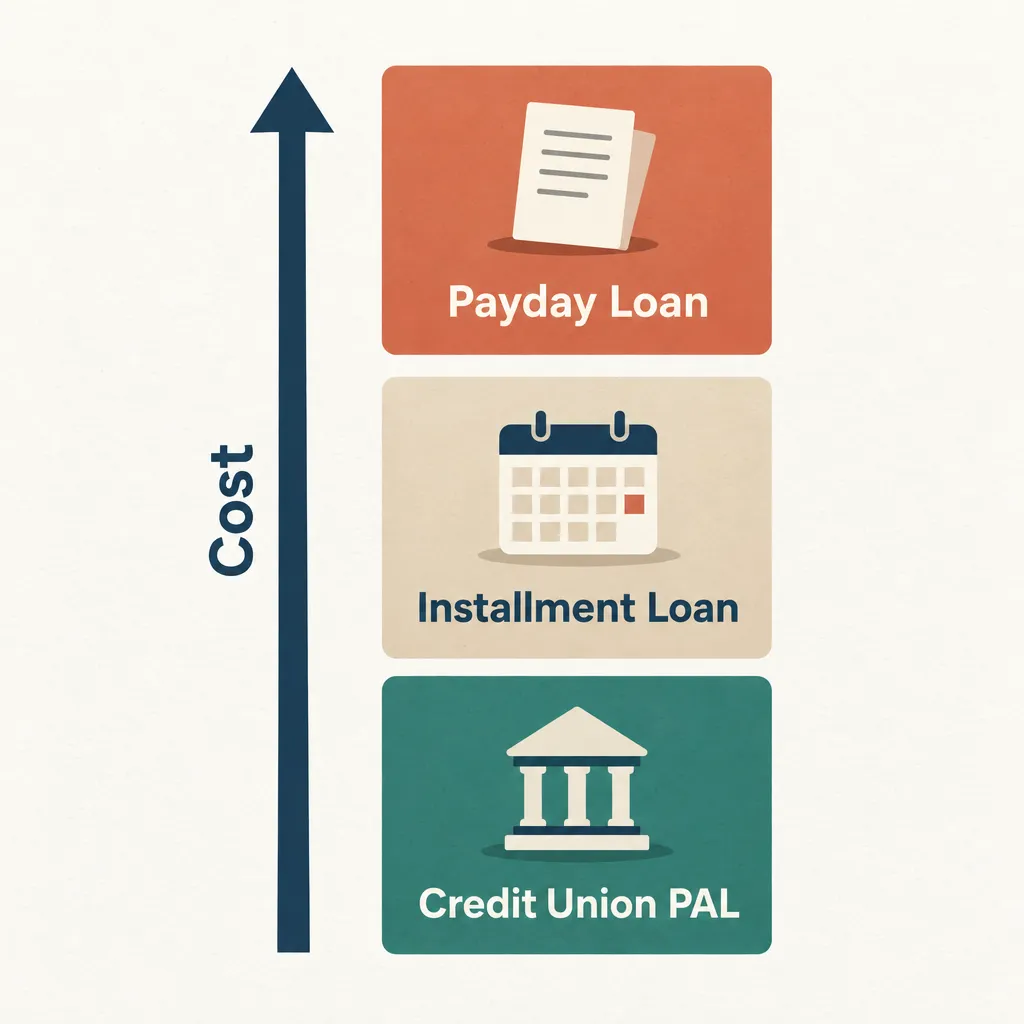
The table below sets the main short-term lenders and products side by side using figures from regulators and lenders’ own disclosures, as of November 2026.
| Option | Typical amount | Typical term | Cost / rate cap | Credit check | Speed | Main risk |
|---|---|---|---|---|---|---|
| Credit union PAL I | $200 to $1,000 | 1 to 6 months | Max 28% + up to $20 fee | Credit union review, often income-focused | Days, sometimes same day | Must be a member for 1 month first |
| Credit union PAL II | Up to $2,000 | 1 to 12 months | Max 28% + up to $20 fee | Credit union review | Days, sometimes same day | Only one PAL at a time |
| Small installment loan (e.g. Upstart Relief Loan) | $200 to $2,500 | 3 to 18 months | Up to 36% APR | Soft pull to check rate | Often instant or next business day | Not available in every state |
| Cash advance and EWA apps | Small, tied to pay | To next payday | Subscriptions, expedite fees, tips | Usually no hard pull | Instant with a fee | Fees add up with repeat use |
| Payday loan | Usually $500 or less | 2 to 4 weeks | $10 to $30 per $100 (about 400% APR at $15) | Bank account and income | Same day | Rollovers |
| Car title loan | About $700 on average | Often 30 days | About 300% APR | Car title, little credit review | Same day | 1 in 5 single-payment borrowers lost the car |
| Pawn loan | Set by item value | Short, set by state law | Fees set by state law | None | Same visit | You lose the item |
| Credit card cash advance | Up to your cash limit | Revolving | Cash advance fee + usually a higher APR | None (existing card) | Immediate | Interest starts on day one |
Credit union payday alternative loans (PALs)
Federal credit unions make PALs under rules set by the National Credit Union Administration (NCUA). In most cases they are the cheapest short-term loan available to someone with weak credit. There are two versions. PAL I loans run from $200 to $1,000 over one to six months, and you have to have been a member for at least a month. PAL II loans go up to $2,000 over one to twelve months with no membership waiting period, which makes them the better choice if you only just joined.
The rate cap is tied to a broader NCUA rule. Federal credit unions normally can’t charge more than 15%, but the NCUA has kept a higher 18% ceiling in place and extended it through September 10, 2027. Under 12 CFR 701.21(c)(7), PALs can charge that ceiling plus 10 percentage points, which is 28%. PALs also can’t be rolled over, the payments must fully pay off the loan, and the credit union can only have one type of PAL open with you at a time.
Did you know?
The 28% PAL cap moves with the NCUA’s general ceiling. According to the NCUA, without the extension the ceiling would have gone back to 15% on March 10, 2026, which would have pulled the PAL cap down with it.
There’s one catch. The application fee of up to $20 comes on top of the 28%, so on a small loan repaid quickly, the APR can go above 36%. A $500 PAL repaid in one month costs about $11.67 in interest plus the $20 fee. That’s $31.67, or roughly 76% APR. In dollars it’s still far below a payday loan on the same $500 for the same month ($150 at $15 per $100).
Small-dollar installment and relief loans (up to 36% APR)
Several online lenders sell small installment loans priced at or under 36% APR. That’s the same ceiling the Military Lending Act sets for service members. Upstart’s Relief Loan is a well-known example. According to Upstart’s disclosure, it lends $200 to $2,500 over 3 to 18 months with an APR of up to 36%, and the cost is charged as an origination fee rather than as interest.
The fee works the same way interest does, which is why “no interest” marketing can mislead you. Upstart’s own example: $1,000 over 12 months carries a $205 fee, a 35.95% APR, and 12 payments of $100.44. The loan isn’t offered in every state, so check the lender’s state list before you count on it.
App-based lenders such as Possible Finance sit between this tier and payday loans. They make smaller loans repaid in several installments, with fees that vary by state. Check each company’s own state rate table, because its prices differ from state to state.
Cash advance apps and earned wage access
Cash advance apps let you draw a small amount against your next paycheck. Earned wage access (EWA) is the employer-connected version, where you take wages you’ve already earned before payday. Most of these apps advertise no interest. They make their money from monthly subscriptions, “expedite” fees for instant transfers, and optional tips.
The fees are small in dollars but large as an APR. In a July 2024 data spotlight on employer-partnered EWA, the CFPB found that more than 90% of workers paid at least one fee, mostly expedite fees. It calculated an illustrative APR of 109.5% for a typical transaction. That beats a payday loan. It doesn’t beat a free employer advance or a PAL.
So are cash advance apps cheaper than a payday loan once you add tips and express fees? Usually yes. The exception is when you pay for instant delivery every pay period and stack advances from several apps. If you use the standard, slower transfer and skip the tip, many apps cost nothing at all.
Payday loans
A payday loan is a single-payment loan, generally $500 or less, due on your next payday. The CFPB says fees run $10 to $30 per $100 depending on state law. You usually need a bank account, proof of income and ID, and the lender takes a post-dated check or permission to debit your account.
The danger is the rollover. When you can’t repay the full amount, many lenders let you pay just the fee and extend the loan, and the principal doesn’t go down. The CFPB found that almost 70% of payday borrowers take a second loan within a month. That’s how a $75 fee becomes $450 in fees over three months on the same $500.
Car title loans
A title loan uses your car’s title as collateral. The CFPB’s study of nearly 3.5 million single-payment title loans found an average loan of about $700, a typical APR of around 300%, and that about one borrower in five had their vehicle seized. If you’re already behind on a car payment, a title loan stacks a second claim on the same car. Our guide on what to do if you can’t afford your car payment covers options that don’t put the car at risk.
Pawn loans
At a pawn shop, you hand over an item and get a loan for part of its value. There’s no credit check, and if you don’t repay, the shop keeps and sells the item. Your credit report isn’t affected. State law sets pawn fees and terms, so costs vary a lot. Pawn loans make the most sense for something you could afford to lose.
Credit card cash advances
A cash advance from your credit card is fast and needs no application. It’s rarely cheap, though. Most issuers charge a separate cash advance fee, apply a higher APR than for purchases, and start charging interest the day you take the cash, with no grace period. Repaid within a few weeks, it can still cost much less than a payday loan.
Bank and credit union small-dollar loans
Some banks and many credit unions offer small-dollar loans to existing customers, often priced well below payday rates and decided using your account history. Amounts and rules vary by institution. Ask your own bank or credit union directly, since these products are often not advertised widely.
What $1,000 really costs: the dollar comparison
The table below shows the total cost of borrowing $500, $1,000 and $2,000 for one, three and twelve months across four price levels. The payday column assumes $15 per $100 with the fee paid every two weeks and the principal rolled over, which is how rollovers work. Installment columns use standard amortization (each payment covers the interest due plus part of the balance), and the bank column uses the Fed’s 11.90% benchmark.
| Amount and term | Payday at $15 per $100 (renewed every 2 weeks) | PAL at 28% + $20 fee | 36% APR installment loan | Bank personal loan at 11.90% |
|---|---|---|---|---|
| $500, 1 month | $150 | $32 | $15 | $5 |
| $500, 3 months | $450 | $44 | $30 | $10 |
| $500, 12 months | $1,950 | $99 | $103 | $33 |
| $1,000, 1 month | $300 | $43 | $30 | $10 |
| $1,000, 3 months | $900 | $67 | $61 | $20 |
| $1,000, 12 months | $3,900 | $178 | $205 | $66 |
| $2,000, 1 month | $600 | $67 | $60 | $20 |
| $2,000, 3 months | $1,800 | $114 | $121 | $40 |
| $2,000, 12 months | $7,800 | $336 | $411 | $131 |
These are illustrative costs, not quotes. Many states cap payday loans well below $1,000, and Upstart’s Relief Loan has a three-month minimum term. Banks rarely make one-month personal loans, and you need fair to good credit to get anything close to the 11.90% average. The 36% figures for 3 and 12 months match Upstart’s own published examples ($30 on $500 over 3 months, $205 on $1,000 over 12 months).
The pattern holds at every amount. A payday loan kept going for three months costs more than ten times as much as a PAL or a 36% loan for the same period.
APR vs fee per $100
To turn a fee into an APR, divide the fee by the amount borrowed, multiply by 365, and divide by the loan term in days. For a $15 fee on $100 over 14 days: 15 ÷ 100 = 0.15, times 365 = 54.75, divided by 14 = 3.91, or 391% APR.
The Truth in Lending Act and its Regulation Z (12 CFR 1026) require lenders to show you the APR and the total finance charge in dollars before you sign. Read both numbers. The APR lets you compare loans of different lengths, and the finance charge tells you what you will actually pay.
Compare the whole cost, not the payment
At the same 36% APR, $1,000 costs about $61 over 3 months but $205 over 12 months. A lower monthly payment over a longer term can cost you more in total.
Why “no interest” can still mean 36% APR
Under Regulation Z, an origination fee counts as a finance charge and goes into the APR. So when a lender says it charges “no interest” but takes a $205 fee on a $1,000 loan repaid over a year, the loan costs about as much as one with 36% interest. Look at the APR on the Truth in Lending disclosure, not at the headline claim.
Can you get a short-term loan for 1 month or 3 months?
Yes to both, but different products fit each term.
For one month, the options are payday loans (two to four weeks), cash advance and EWA apps (until your next payday), pawn loans, credit card cash advances, and PALs, which can run as short as one month. A one-month PAL is the cheapest of these if you can get one. It’s usually the only one-month loan that charges a capped interest rate.
For three months, the options are PALs and small installment loans. Upstart’s Relief Loan starts at three months, and PAL I and PAL II both allow it. A payday loan isn’t a three-month product. Keeping one for three months means rolling it over five or six times.
The first payment on an installment loan usually comes due about a month after funding. The exact date is set in your loan agreement, so check it against your payday. If they don’t line up, ask the lender to move the due date before you sign.
Short-term loans with bad credit, and the “no credit check” trap
You can get short-term loans with bad credit, because many lenders look at your income and bank account activity instead of relying on your score. “No credit check” usually means no hard pull from the three major credit bureaus. It doesn’t mean the lender skips checking you. Lenders that ask fewer questions usually make up for the extra risk with higher prices. Our article on no credit check loans and how they work goes into the pricing in more detail.
“Guaranteed approval” is a different matter. The Federal Trade Commission (FTC) warns that legitimate lenders don’t guarantee a loan before reviewing your application. A guarantee, especially one paired with an upfront fee, is a classic advance-fee loan scam.
Soft pull vs hard pull
A soft pull lets a lender see a version of your credit report without affecting your score. Many online lenders use one to show you a rate before you apply. A hard pull happens when you accept an offer and move forward, and it can lower your score a few points for a while. You can check rates with several lenders using soft pulls and only allow one hard pull, for the offer you choose.
What lenders check instead of a score
Instead of a score, lenders often check:
- Regular income, shown on pay stubs or as direct deposits
- How your checking account runs: how long it’s been open, overdrafts, and how much is left after bills
- Your existing debts and how much you already owe to other short-term lenders
- At credit unions, your membership and history with them
- For title and pawn loans, the value of the collateral
How to get $1,000 or $2,000 fast with bad credit (without a payday loan)
For $1,000 or $2,000 with bad credit, try these in order, cheapest first:
- Ask a federal credit union about a PAL II, which goes up to $2,000 with no membership waiting period.
- Check your rate with small installment lenders that keep their APR at 36% or less, using soft-pull prequalification.
- Ask your employer about a free paycheck advance, or use an EWA app’s standard (no-fee) transfer for part of the amount.
- Ask the company you owe money to for a payment plan, which may shrink the amount you need to borrow.
Cheaper options first
Ask a local credit union about a PAL: the cost is capped at 28% interest plus a $20 application fee.
Ask your employer about a free pay advance before you use any app.
Call the company you owe and ask for a payment plan before you borrow at all.
How fast can you get the money?
Payday, title and pawn loans usually pay the same day in a store. Online installment loans often fund instantly or by the next business day. PALs can take from the same day to several days, depending on the credit union.
How fast the money arrives depends on when you accept the loan and on your bank. Lenders that send money by ACH generally pay out on the next business day if you accept before their daily cutoff. Instant funding usually needs a debit card or a bank that supports real-time payments. Upstart reports that 68% of funded borrowers got their money instantly in the first quarter of 2026, the latest period it has published.
Fast funding shouldn’t decide which loan you take. An offer that pays tomorrow at 36% APR beats one that pays today at 400%.
How to get a short-term loan safely
Get your documents together before you apply and compare at least two offers on total cost. If you follow the steps below, you should end up with a loan from a licensed lender at a known total cost, with a repayment schedule that fits your pay dates.
What you need:
- A government-issued photo ID
- Your Social Security number or ITIN
- Proof of income (recent pay stubs, benefit letters or bank deposits)
- An active checking account in your name
- Your monthly budget, so you know what payment you can afford
How to get a short-term loan safely
- Work out the smallest amount that covers the need, and the payment you can afford each month.
- Ask a credit union about a PAL and ask your employer about a pay advance.
- Check the lender’s license with your state banking regulator or on NMLS Consumer Access.
- Prequalify with soft pulls and write down each offer’s APR, finance charge and total repaid.
- Read the Truth in Lending disclosure and check the first payment date against your payday.
- Accept one offer, then set a calendar reminder a few days before each payment.
Common mistakes to avoid:
- Comparing only the monthly payment and ignoring the total repaid
- Taking the full amount offered instead of the amount you need
- Applying with many lenders at once and setting off several hard pulls
- Agreeing to automatic debits without knowing you can stop them later
- Rolling over a payday loan “just once”
Your rights as a borrower in 2026
Federal law requires full cost disclosure and caps rates for some borrowers. Most price limits, though, come from states, so where you live largely decides which loans you can get and at what cost.
| Rule | Who it covers | Limit | Status as of November 2026 | Source |
|---|---|---|---|---|
| Truth in Lending Act / Regulation Z | Consumer lenders | Must disclose APR and finance charge before you sign | In force | CFPB |
| NCUA general rate ceiling | Federal credit unions | 18% | Extended through Sept 10, 2027 | NCUA |
| PAL rate cap, 12 CFR 701.21(c)(7) | Federal credit union PALs | 28% plus up to $20 application fee | In force through Sept 10, 2027 | NCUA |
| Military Lending Act | Active-duty service members and dependents | 36% Military APR, including most fees and insurance | In force | Department of Defense, CFPB |
| CFPB Payday, Vehicle Title and Certain High-Cost Installment Loans Rule (12 CFR 1041), payment provisions | Payday, title and certain high-cost installment lenders | New authorization required after two failed debit attempts in a row | In effect since March 30, 2025; CFPB not prioritizing enforcement | CFPB |
| Electronic Fund Transfer Act / Regulation E | Lenders debiting your bank account | Can’t make automatic debits a condition of a loan; you can stop them | In force | CFPB |
| CFPB EWA advisory opinion | Covered employer-partnered EWA | Not treated as credit under TILA | Issued Dec 23, 2025 | CFPB |
Federal rules
Only part of the CFPB payday rule is in force. Its underwriting requirements were repealed before taking effect. Its payment provisions took effect on March 30, 2025: once two debit attempts in a row fail, a lender needs your new permission to try again. The CFPB said it wouldn’t prioritize enforcing those provisions. Its 2026 regulatory agenda lists a proposal to reconsider them, but no proposal had been published as of mid-October 2026.
The Military Lending Act gives the strongest federal rate protection. Covered service members and their dependents can’t be charged more than a 36% Military Annual Percentage Rate on most consumer credit, including payday, title and installment loans, and the cap includes most fees and credit insurance.
State rate caps and payday bans
Payday lending is legal in some states and effectively banned in others. New York’s usury laws keep storefront payday lenders out, and Colorado voters capped payday loans at 36% APR in 2018. Many other states ban the loans or cap them at about 36%. Others set fees per $100 and limit loan size or how often you can renew.
Before you borrow, check with your state’s banking or financial regulator. Its website lists which loan types are legal, the maximum fees, and every licensed lender. An online lender that isn’t licensed in your state is a red flag in itself.
Rules for cash advance apps
Rules for cash advance apps are still being written. The CFPB’s December 23, 2025 advisory opinion says covered employer-partnered EWA is not credit under the Truth in Lending Act, and it withdrew the CFPB’s 2024 proposal that would have treated many fees and tips as finance charges. Rules differ from state to state. Indiana, for example, has required EWA providers to be licensed since January 1, 2026.
At the federal level, the House Financial Services Committee voted 31-23 on July 1, 2026 to advance an EWA bill that would limit states’ ability to apply lending laws to qualifying products. That is a bill, not law. It still needs votes in both chambers and a signature.
Red flags: how to spot predatory and scam loans
The surest sign of a scam is any demand for money before you get the loan. The FTC says it’s illegal for companies doing business by phone in the US to promise you a loan and ask you to pay before they deliver it. Real lenders take their fees out of the loan proceeds or add them to the balance.
So if a lender asks for a fee upfront before releasing the loan, that isn’t normal. Walk away. Watch for these warning signs:
- An upfront “processing,” “insurance,” “verification” or “first payment” fee
- Payment requested by gift card, wire transfer, crypto, or a P2P app such as Cash App or Zelle (scammers increasingly send victims to a crypto ATM, which our article on how crypto ATMs work explains)
- “Guaranteed approval” or approval promised before you’ve applied
- Pressure to sign today, or a lender that won’t show you the APR in writing
- No physical address, or no license with your state regulator or on NMLS Consumer Access
- A lender that offers to roll your loan over instead of setting up a payment plan
- Contact out of the blue by text, phone or social media
Never pay to get a loan
Don’t pay an upfront fee by gift card, crypto or a payment app. Report the lender to the FTC instead.
Report scams to the FTC at ReportFraud.ftc.gov or by phone at 877-382-4357. Report online fraud to the FBI’s Internet Crime Complaint Center (IC3). Send complaints about a licensed lender to the CFPB’s complaint portal and to your state banking regulator.
Borrowing from strangers on Reddit communities such as r/borrow carries its own risks. Those loans are usually between private individuals, so you lose the licensing, disclosure and complaint routes that come with a regulated lender. You also hand personal information to people you can’t verify.
If you can’t repay
Contact the lender before the payment is due. Lenders generally report a payment to the credit bureaus as late once it’s 30 days past due, and before that point you usually have more options. Ask about a hardship plan, a lower payment, or a new due date. Get any agreement in writing, and ask how the change will show up on your credit report.
If repeated debits are draining your account, the Electronic Fund Transfer Act lets you revoke your authorization. Notify the lender, and tell your bank at least three business days before the next scheduled debit. Stopping the debit doesn’t cancel what you owe, but it does stop overdraft fees from piling up while you sort out a plan.
To break a payday rollover cycle, ask whether your state requires lenders to offer an extended payment plan (several states do). Look at whether a PAL could pay off the payday balance. You can also call a nonprofit credit counseling agency, which can review your budget at little or no cost. If a debt goes to collection, the Fair Debt Collection Practices Act protects you from harassment and gives you the right to ask the collector to validate the debt.
Alternatives worth checking first
Often the cheapest short-term loan is one you don’t take. Many utilities, landlords, medical providers and lenders have hardship programs that cut or delay a payment. Asking for one takes a phone call and costs nothing.
- Payment plans with the creditor. Most utilities, hospitals and many landlords will split a bill into installments.
- Employer pay advances. Some employers advance wages at no cost. Ask HR.
- Credit union membership. Joining now gets you access to PAL II right away and PAL I after a month.
- Local and federal assistance. Dialing 211 connects you to local help with rent, utilities and food. LIHEAP helps with energy bills.
- Family or friends. Put the amount and repayment dates in writing so there’s no confusion later.
- 0% intro APR cards. With good credit, a card with an introductory 0% APR on purchases can cover a planned expense, if you repay before the promotion ends.
- Pay in 4 plans. For a single purchase, splitting the cost into four interest-free payments can beat a loan. Our guide to pay in 4 apps covers late fees and other drawbacks.
There’s a fair case for short-term loans, too. A 36% loan that keeps you from losing a job or a car can be worth the cost, and $61 to borrow $1,000 for three months is cheaper than many overdraft fees. The risk is the same with any of these products: the second loan you take to repay the first. For more on borrowing in a crisis, see our guide to emergency loans.
FAQ
What is a short-term loan?
A short-term loan is a small loan, usually $100 to $2,500, that you repay within two weeks to about 18 months. The category runs from credit union PALs capped at 28% to payday and title loans at roughly 300% to 400% APR.
Can I get a short-term loan for 1 month?
Yes. Payday loans, cash advance apps, pawn loans and credit card cash advances usually last about a month or less, and a credit union PAL can be as short as one month. A one-month PAL on $500 costs about $32 including the maximum $20 fee. A payday loan rolled over once to reach a month costs $150.
Can I get a short-term loan for 3 months?
Yes. Credit union PALs and small installment loans such as Upstart’s Relief Loan both offer three-month terms. At 36% APR, $1,000 over three months costs about $61 in total.
How do I get $2,000 fast with bad credit?
Start with a PAL II from a federal credit union, which goes up to $2,000 with no membership waiting period. Then use soft-pull prequalification with installment lenders that cap APRs at 36%. Avoid title loans: the CFPB found that one in five single-payment title borrowers lost their car.
Are there short-term loans with guaranteed approval?
No. The FTC warns that legitimate lenders don’t guarantee approval before reviewing your application. A guarantee, especially one paired with a request for an upfront fee, is a common sign of an advance-fee scam.
Can I get a short-term loan online with no credit check?
Some online lenders skip the hard credit pull and look at your income and bank activity instead. Those loans usually cost more. Make sure the lender is licensed in your state and compare the APR before you accept.
Can I get a short-term loan the same day?
Often, yes. Payday, title and pawn loans usually fund the same day, and many online installment lenders fund instantly or by the next business day. Same-day funding at 400% APR is still worse than next-day funding at 36%.
What is the cheapest short-term loan?
For borrowers with fair to poor credit, it’s usually a federal credit union PAL, capped at 28% interest plus a $20 application fee. With good credit, a bank or credit union personal loan near the Fed’s 11.90% average costs less still. A free employer pay advance costs nothing.
Does a short-term loan hurt my credit score?
Checking your rate with a soft pull doesn’t affect your score. A hard pull when you accept a loan can lower it slightly for a while. Many installment lenders report your payments to the credit bureaus, so on-time payments can help your credit and payments 30 or more days late can hurt it. Many payday lenders don’t report unless the debt goes to collection.
Are payday loans legal in my state?
It depends on where you live. Some states allow payday loans with set fees, while others, including New York, effectively ban them, and Colorado caps them at 36% APR. Your state banking regulator’s website lists which loans are legal and which lenders hold a license.
Can I get a loan from a credit union if I just joined?
Yes. PAL II loans have no membership waiting period, so a federal credit union can lend you up to $2,000 right after you join. PAL I loans require one month of membership.
How do I get out of a payday loan rollover cycle?
Stop renewing. Ask the lender whether your state requires an extended payment plan, and look into replacing the balance with a PAL. Revoke automatic debits through your bank if they’re causing overdrafts, and call a nonprofit credit counselor for help with a budget.
Will a short-term loan show up on my credit report?
Many installment loans and all credit union loans can appear on your report. Payday and pawn loans usually don’t, unless an unpaid payday balance is sold to a collector. Collection accounts can stay on your report for up to seven years under the Fair Credit Reporting Act.
Laws and regulations referenced
- Truth in Lending Act, 15 U.S.C. 1601
- Regulation Z, 12 CFR Part 1026
- Fair Debt Collection Practices Act, 15 U.S.C. 1692
- Fair Credit Reporting Act, 15 U.S.C. 1681
- Electronic Fund Transfer Act, 15 U.S.C. 1693
- Regulation E (electronic transfers), 12 CFR Part 1005
- Military Lending Act, 10 U.S.C. 987
- CFPB payday lending rule, 12 CFR Part 1041
Links go to the official text on government sites.
Check, verify or complain
Sources
- What is a payday loan? | CFPB consumerfinance.gov · official source
- CFPB finds payday and deposit advance loans can trap consumers in debt consumerfinance.gov · official source
- Permissible Loan Interest Rate Ceiling Extended | NCUA ncua.gov · official source
- Payday Alternative Loans | CDFI Fund cdfifund.gov · official source
- Payday Alternative Loans final rule, 84 FR 51942 govinfo.gov · official source
- Federal Reserve G.19 Consumer Credit release federalreserve.gov · official source
- CFPB proposes interpretive rule on paycheck advance products (2024 data) consumerfinance.gov · official source
- CFPB finds one in five auto title loan borrowers have vehicle seized consumerfinance.gov · official source
- What is covered under the Military Lending Act? | CFPB consumerfinance.gov · official source
- Military Lending Act (MLA) | CFPB consumerfinance.gov · official source
- Michigan AG: Advance Fee Loan Scams michigan.gov · official source
- Comparing PALs I and PALs II Loans americascreditunions.org
- Finance Rate on Personal Loans at Commercial Banks, 24 Month Loan | FRED fred.stlouisfed.org
- Rule on bounced payday and high-cost loan payments now in effect | NCLC library.nclc.org
- CFPB's 2026 regulatory agenda tees up NPRM to reconsider payday lending rule legal500.com
- CFPB brings clarity to earned wage access products consumerfinanceinsights.com
- House Financial Services Committee advances federal earned wage access bill consumerfinancemonitor.com
- Upstart Relief Loans upstart.com
- What is Cash Advance APR? | Chase chase.com
- Citi: What is a Short-Term Personal Loan? citi.com
- Advance America: 8 Short-Term Loan Options If You Have Bad Credit advanceamerica.net

Dana writes US Financer's guides to payday loans, personal and installment loans, bad credit borrowing and cash advance apps. Every piece starts from what a loan really costs, works the numbers in a table, and checks what the lender's own disclosure and your state's rules…
Ruth is US Financer's standards editor. Every article goes through her checks before and after it is published: each rate, fee, cap, deadline and rule is matched against its primary source, every law named is linked to its official text, and anything that cannot be…
What changed
- Nov 13, 2026 First published.
Comments are closed