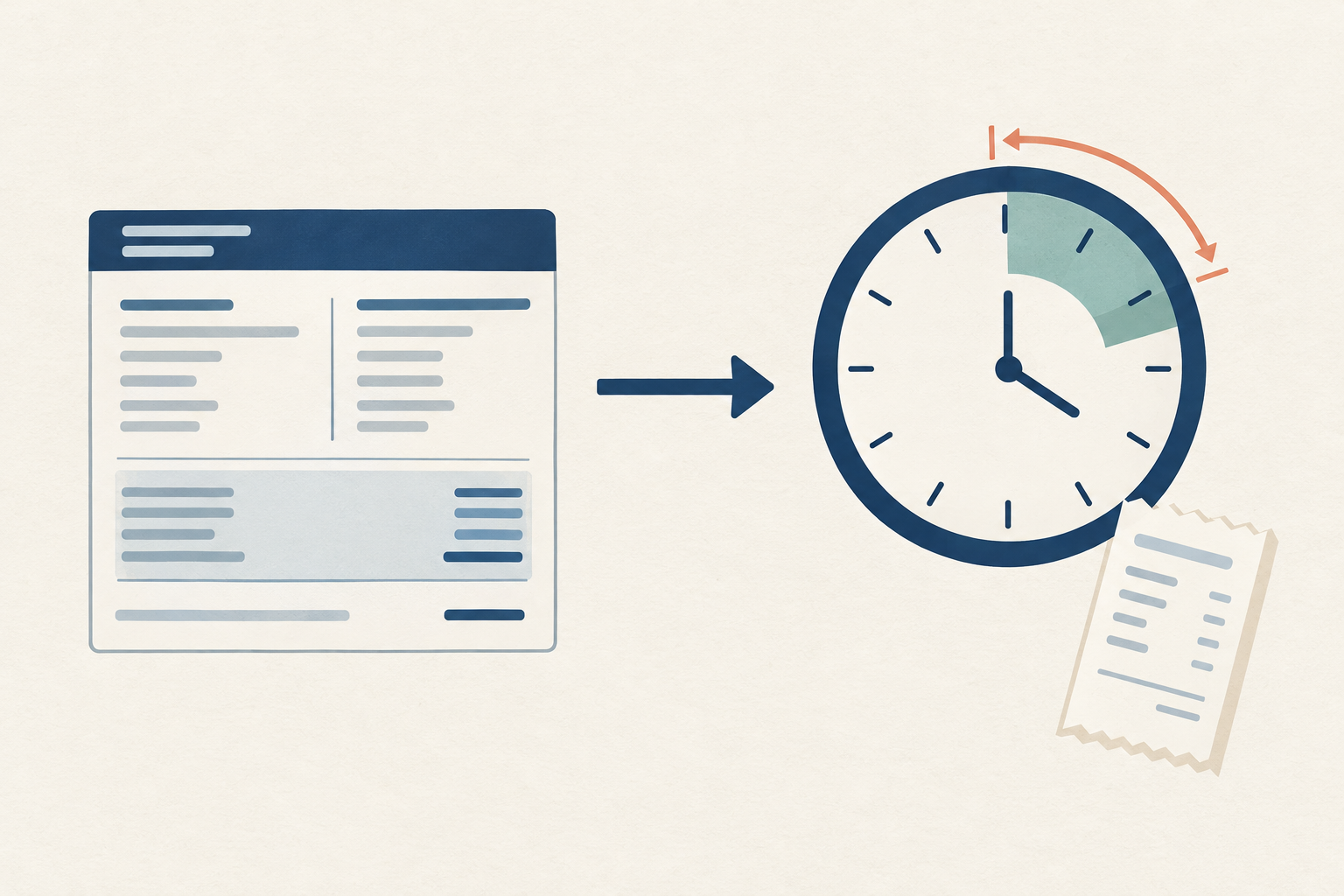
We do not lend money or arrange loans. Rates and rules change and differ by state, so check the lender’s own disclosure before you sign.
A payday advance is a small, short-term loan, usually $100 to $500, that you repay in full from your next paycheck along with a flat fee. That fee typically runs $10 to $30 per $100 borrowed, which the CFPB notes works out to nearly 400% APR on a two-week loan. Before you sign, it helps to know exactly what the agreement commits you to and where the law stands behind you.
What a payday advance actually is
The names change from storefront to storefront. Payday advance, cash advance, payday loan advance, advance payday loans, deferred deposit transaction, check advance. In almost every state they describe the same product: a lender gives you cash now, you give the lender a postdated check or permission to debit your bank account, and the lender cashes it on your payday.
Two things set this apart from other small loans. The whole balance comes due at once, and the price is a flat fee rather than interest that builds over months. That flat fee feels modest in dollars and looks enormous once you convert it to an annual rate, which the lender is legally required to do for you.
If you want a deeper comparison with installment loans, credit cards and cash advance apps, our “payday loan” explainer walks through each one. This page focuses on the contract itself.
How this differs from a pay advance or earned wage access
“Pay advance loans” and “advance credit” sometimes refer to something else: an employer or an app letting you draw wages you have already earned. Those products often charge a subscription or an optional tip instead of a loan fee, and the CFPB has said that mandatory fees and tips on these advances should be disclosed like finance charges. They are generally cheaper than a storefront payday advance, but they are not free, and they still leave you short on the next payday. Do not assume an app advance and a payday advance follow the same rules.
What you agree to when you sign
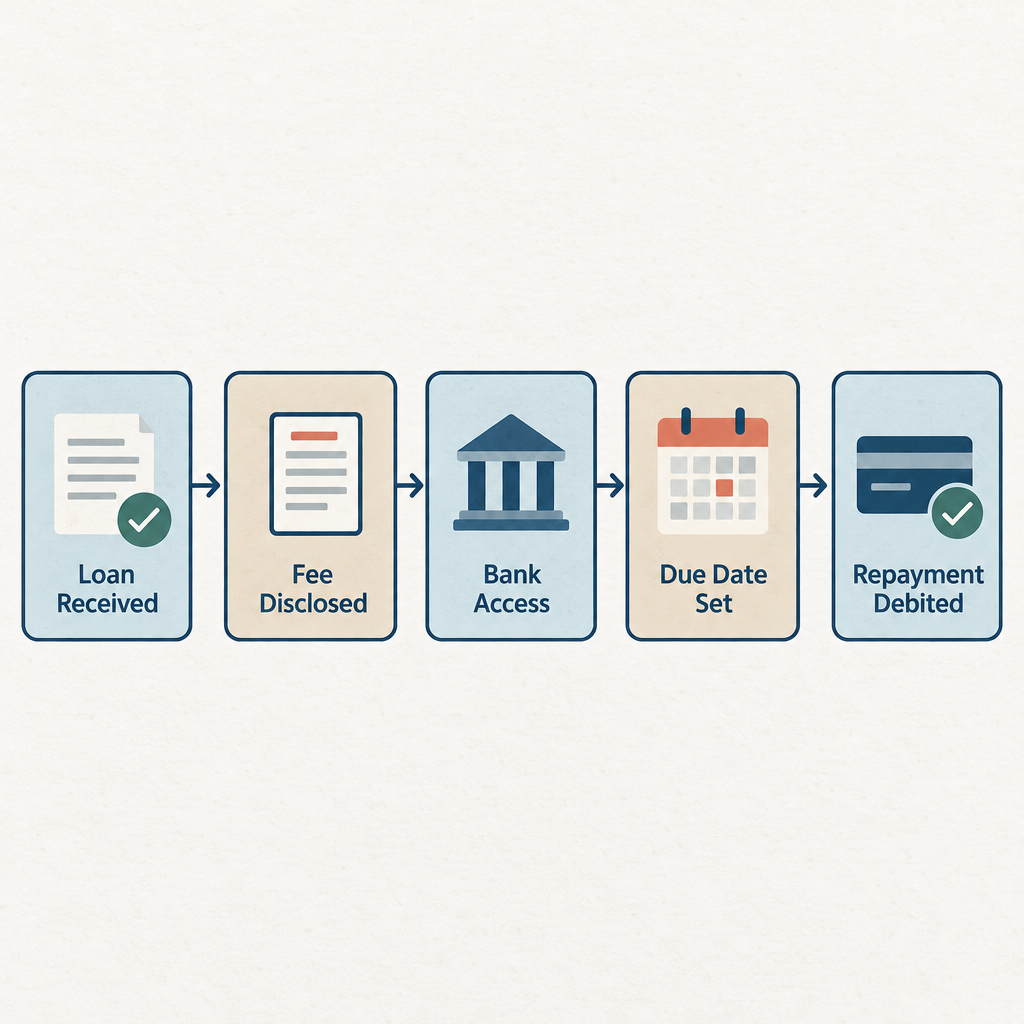
A payday advance agreement is short, but every line matters. Here is what you are committing to in a typical contract.
A finance charge and APR. Under the Truth in Lending Act and Regulation Z (12 CFR 1026), the lender must show you the dollar finance charge and the annual percentage rate before you are bound. If a storefront or website will not show the APR until after you commit, that is a problem.
Access to your bank account. You hand over a postdated check or sign an ACH authorization. That authorization is the lender’s main collection tool. Under the Electronic Fund Transfer Act and Regulation E (12 CFR 1005.10(e)), a lender cannot make repayment by preauthorized electronic transfer a condition of getting the loan, though in practice most borrowers sign one anyway.
A single due date. The full principal plus the fee comes out on your next payday. Nothing is spread out unless your state requires an extended payment plan.
Rollover or renewal terms. In states that allow it, you can pay only the fee on the due date and push the balance to the next pay period. Each rollover costs another full fee. The CFPB’s 2014 analysis of lender data found that four out of five payday loans were rolled over or followed by a new loan within 14 days.
Returned payment fees. If the debit bounces, the lender may charge its own NSF fee on top of your bank’s fee, and it may keep trying.
Arbitration and class action waivers. Most agreements require you to settle disputes through private arbitration and give up the right to join a class action. You can sometimes opt out within 30 to 60 days by sending a written notice; check the clause.
Collection and reporting language. The contract spells out what happens if you default, including referral to a “debt collector” and possible reporting to specialty credit bureaus.
What a payday advance really costs
The APR math is simple once you see it. Divide the fee by the amount borrowed, divide by the number of days in the term, then multiply by 365. On a $300 loan with a $45 fee for 14 days: $45 ÷ $300 = 0.15; 0.15 ÷ 14 × 365 = 3.91, or 391% APR.
| Scenario | Amount borrowed | Fee | Term | Total repaid | APR |
|---|---|---|---|---|---|
| Typical two-week advance | $300 | $45 ($15 per $100) | 14 days | $345 | 391% |
| Higher-fee state | $500 | $100 ($20 per $100) | 14 days | $600 | 521% |
| California maximum | $255 | $45 (15% of $300 face) | 14 days | $300 | 460% |
| $300 rolled over three times | $300 | $45 × 4 = $180 | 56 days | $480 | 391% |
The last row is where most of the damage happens. Pew Charitable Trusts research found the average borrower takes out about eight loans of roughly $375 a year and pays around $520 in fees, spending about five months of the year in payday debt. The product is marketed as a two-week fix. The data says it rarely works that way.
Before you borrow
The biggest risk is not the first fee. It is paying that fee again every two weeks because the lump-sum repayment leaves you short, until the fees exceed what you originally borrowed.
Where payday advances are legal, capped or banned
This is not a nationwide product with one price. State law decides whether a payday advance exists at all and what it can cost.
- Banned or capped at 36% APR or lower: Arizona, Arkansas, Colorado, Connecticut, Georgia, Illinois, Maryland, Massachusetts, Montana, Nebraska, New Hampshire, New Jersey, New Mexico, New York, North Carolina, Pennsylvania, South Dakota, Vermont, West Virginia and the District of Columbia. In several of these states, general “usury laws” make the typical payday fee a crime for the lender.
- Allowed with limits: California caps loans at $300 face value, fees at 15% and terms at 31 days under the California Deferred Deposit Transaction Law, overseen by the Department of Financial Protection and Innovation. Florida caps loans at $500, fees at 10% plus a $5 verification fee, bans rollovers and requires a 24-hour cooling-off period between loans, tracked in a statewide database.
- Lightly regulated: Texas lets “credit access businesses” arrange loans with no meaningful cap on fees, so APRs above 500% are routine there.
If an online lender offers you a payday advance in a state that bans them, it is either unlicensed or operating under a tribal or out-of-state claim that your state regulator may not recognize. Either way, you lose most of your protections.
Who a payday advance can make sense for
We would be lying if we said never. A payday advance can be rational when all of the following are true: the amount is small, you have a specific one-time gap, your next paycheck covers the full repayment plus your normal bills, and every cheaper option on the list below is genuinely unavailable. The avoided cost also has to be real. Paying $45 to avoid a $35 overdraft fee is not a win. Paying $45 to avoid a $150 utility reconnection fee or a car repossession might be.
If you are reading this because of a sudden expense, our “loans emergency” guide covers the full range of options by speed and cost.
Cheaper options first
A credit union payday alternative loan: $200 to $2,000, APR capped at 28% by NCUA rules.
Your employer’s advance program or a no-fee app advance.
A hardship plan from the biller itself, or help from 211, LIHEAP or a nonprofit credit counselor.
Your rights with a payday advance
Federal law gives you a floor of protection, and some states add more.
Disclosure. The Truth in Lending Act requires the APR and finance charge in writing before you sign. Missing or wrong disclosures give you grounds for a complaint.
Limits on repeated debits. The CFPB’s Payday Lending Rule (12 CFR 1041), with payment provisions in effect since March 30, 2025, bars a lender from making a third consecutive attempt to debit your account after two failed attempts unless you give new authorization. The lender must also notify you before an unusual withdrawal.
Revoking authorization. Under Regulation E, you can revoke an ACH authorization by notifying the lender and your bank. That stops the debits. It does not erase the debt.
Military borrowers. The Military Lending Act (32 CFR 232) caps the total cost of consumer credit at a 36% Military APR for active-duty service members and their dependents, which effectively shuts them out of conventional payday advances.
Collection. The Fair Debt Collection Practices Act covers third-party collectors, not the original lender. A collector cannot threaten you with arrest, call before 8 a.m. or after 9 p.m., or discuss your debt with your employer. A bounced check on a payday advance is a civil matter in nearly every state, despite what some collectors imply.
Extended payment plans. Florida, Washington and several other states require lenders to offer a no-cost extended plan if you cannot repay. Members of the Community Financial Services Association also promise one. Ask before the due date, not after.
How to check a payday lender
- Search the company name in NMLS Consumer Access to see its state licenses.
- Confirm the license on your own state regulator’s lookup, such as California’s DFPI.
- Read the lender’s complaints in the CFPB consumer complaint database.
- Make sure the APR appears on the agreement before you sign anything.
- Report problems to the CFPB complaint portal, your state regulator or FTC ReportFraud.
FAQ
Is a payday advance the same as a payday loan?
Yes. Lenders use payday advance, cash advance, deferred deposit and check advance interchangeably for the same two-week lump-sum loan. The word “advance” does not change the legal product or the fee.
Will a payday advance help my credit score?
Almost never. Most payday lenders do not report on-time payments to Equifax, Experian or TransUnion, so there is no upside. Defaults can be sold to collectors who do report, so the downside is real.
What happens if I cannot repay on the due date?
Ask about an extended payment plan first if your state or the lender offers one. If the debit bounces, expect NSF fees from both the lender and your bank. After two failed attempts, the lender needs fresh authorization to keep trying. Do not take a second advance to cover the first.
Can I cancel a payday advance after signing?
Many states give you until the end of the next business day to return the money and cancel at no cost. California and Texas both require this rescission right. Check your agreement for the exact deadline and whether cancellation must be in writing.
Are online payday advances safe?
Only if the lender is licensed in your state. Unlicensed online lenders are the source of most complaints about repeated unauthorized debits and threats of arrest. Verify the license before you share your bank details, not after.
Laws and regulations referenced
- Truth in Lending Act, 15 U.S.C. 1601
- Regulation Z, 12 CFR Part 1026
- Fair Debt Collection Practices Act, 15 U.S.C. 1692
- Electronic Fund Transfer Act, 15 U.S.C. 1693
- Regulation E (electronic transfers), 12 CFR Part 1005
- Military Lending Act, 10 U.S.C. 987
- Military Lending Act rule, 32 CFR Part 232
- CFPB payday lending rule, 12 CFR Part 1041
Links go to the official text on government sites.
Check, verify or complain
Sources
- flofr.gov › education › consumer resources › lists › consumer resources › payday lenders … flofr.gov · primary source
- consumerfinance.gov › ask cfpb › what is a payday loan en 1567 consumerfinance.gov · primary source
- consumerfinance.gov › rules policy › regulations › 1005 › 10 consumerfinance.gov · primary source
- lendingtree.com › personal › payday alternative loan lendingtree.com
- pew.org › en › research and analysis › reports › 2012 › 07 › 19 › who borrows where they bo… pew.org

Dana writes US Financer's guides to payday loans, personal and installment loans, bad credit borrowing and cash advance apps. Every piece starts from what a loan really costs, works the numbers in a table, and checks what the lender's own disclosure and your state's rules…