

General information, not legal advice. Laws change, so confirm with the official statute, your state regulator or a licensed attorney before you act.
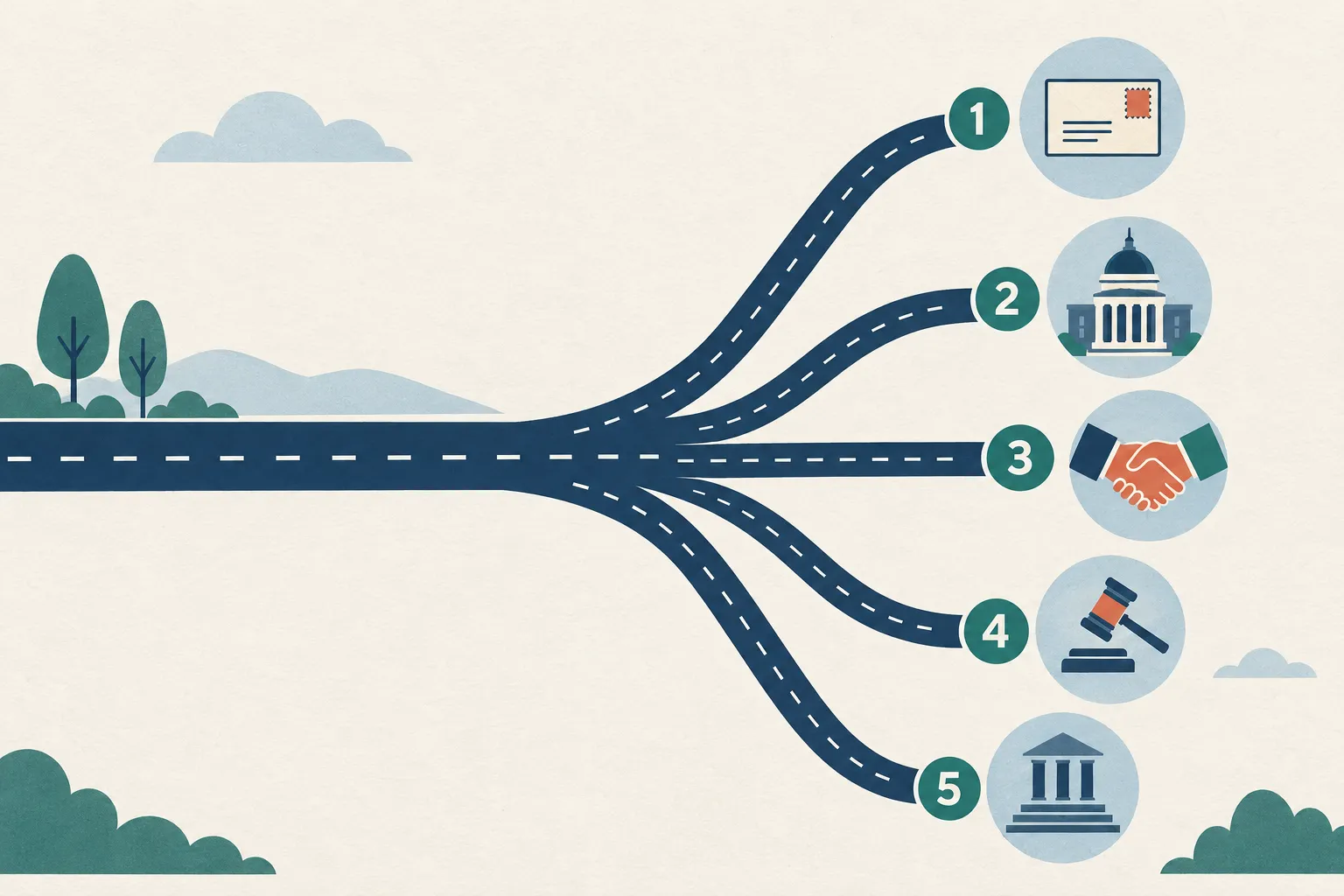
Financial dispute resolution covers every way to settle a money disagreement short of a full trial: a written complaint, a complaint to a regulator, private mediation, binding arbitration and small claims court. For most borrowers, the cheapest and fastest route is a dated written dispute under the law that covers the product. If the company stonewalls, file a complaint with the Consumer Financial Protection Bureau. Arbitration and court come last because they cost time and money, and your loan contract often decides which of the two you can use.
Run the numbers
Key takeaways
- A written dispute under the right federal law costs nothing and starts a legal deadline for the company.
- CFPB complaints get a first company response within 15 days. For credit report complaints, the CFPB portal now asks you to confirm you disputed with the bureau first.
- At the American Arbitration Association, the consumer’s filing fee in a consumer arbitration is capped at $225. The business generally pays the arbitrator’s compensation and administrative fees.
- Small claims limits range from $5,000 to $20,000 in the 10 most populous states, and California and Michigan don’t allow lawyers at all.
- Brokerage disputes go to FINRA, where you generally have six years to file.
| Route | Cost to you | Binding? | Typical timeline | Lawyer needed? | Best for |
|---|---|---|---|---|---|
| Written dispute | $0 plus postage | No, but the law forces a response | 30 to 90 days, depending on the law | No | Billing errors, credit report errors, collection claims, mortgage servicing errors |
| Regulator complaint | $0 | No | First response within 15 days, final response within 60 days | No | Companies that ignore your written dispute |
| Mediation | Free at community centers; private mediators bill by the hour | No, unless you sign a settlement | One or more sessions, set by scheduling | No | Disputes where both sides want a deal |
| Arbitration | Consumer share capped at $225 at AAA; FINRA fees scale with the claim | Yes, and courts overturn awards only on narrow grounds | FINRA average of 13.8 months in 2026 | Optional; useful for large claims | Contracts with an arbitration clause, investment disputes |
| Small claims court | Filing fees of about $15 to $300 | Yes, it ends in a judgment | Set by the local court calendar | No; not allowed in California or Michigan | Claims under the state limit with no arbitration clause |
What counts as a financial dispute
A financial dispute is any disagreement about money you owe, or money owed to you, with a lender, bank, card issuer, servicer, debt collector or broker. Common borrower cases include:
- fees the contract never disclosed
- payments applied late or lost
- a loan reported inaccurately to the credit bureaus
- a collector chasing a balance you already paid or never owed
The amount at stake is usually small, which is why the process you choose matters. Here is a typical disputed loan.
| Amount | Fee or APR | Term | Total repaid |
|---|---|---|---|
| $500 payday loan | $75 fee, about 391% APR | 14 days | $575 |
| Same loan, rolled over twice | $225 in fees | 42 days | $725 |
The APR is the 15% two-week fee ($75 on $500) multiplied by the roughly 26 two-week periods in a year. If the lender rolled the loan over without your consent, the extra $150 in fees is what’s in dispute. That figure should decide how much time and money you spend getting it back.
Check your contract for an arbitration clause
Most loan and card contracts contain a mandatory arbitration clause that waives your right to sue in court or join a class action. Look for one before you sign. Also check whether the contract lets you opt out in writing within 30 to 60 days.
Route 1: A written dispute under the law that applies
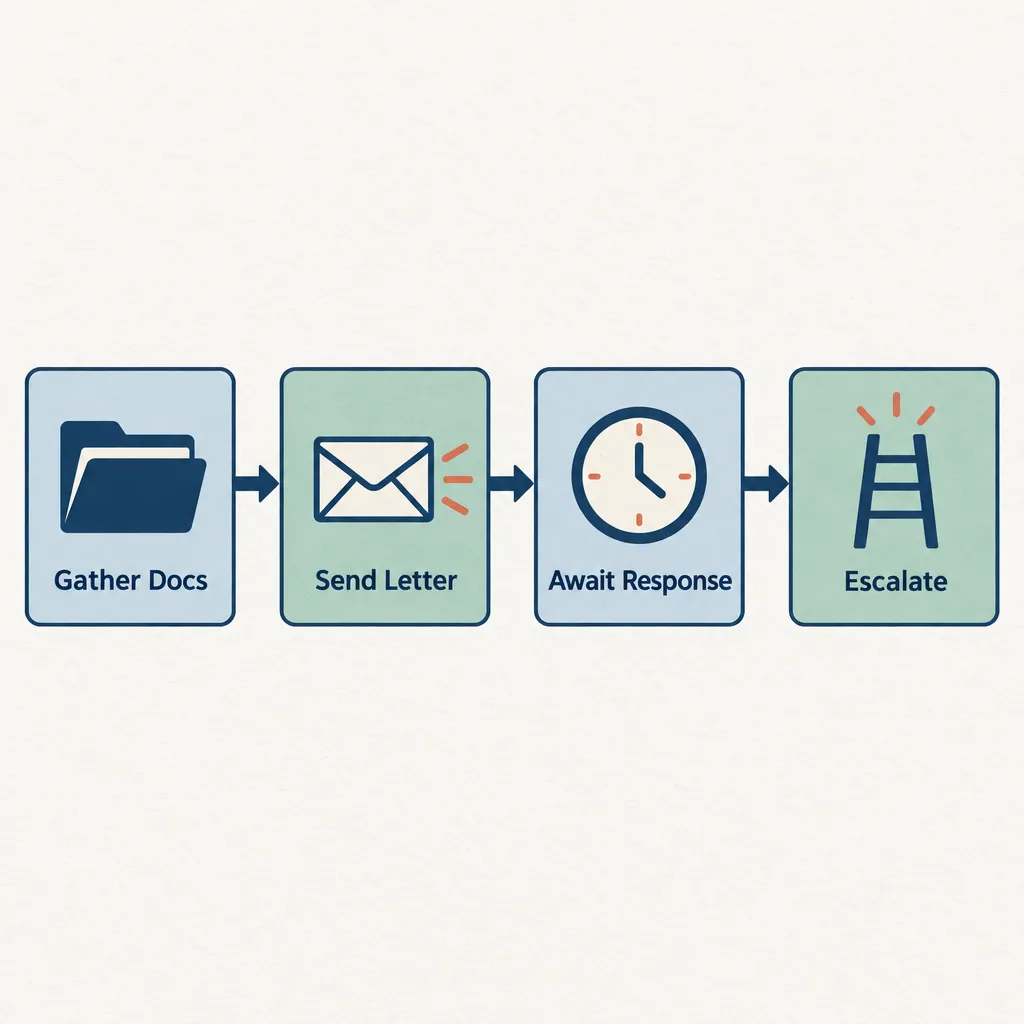
Federal consumer law sets deadlines that force a company to respond, and you don’t need a lawyer to use them.
- Credit card billing errors: Under the Fair Credit Billing Act, write to the issuer within 60 days of the statement. The issuer must acknowledge your letter within 30 days and resolve the error within two billing cycles, and never more than 90 days.
- Unauthorized or wrong electronic payments: Under the Electronic Fund Transfer Act and Regulation E (12 CFR 1005), report the problem within 60 days. The bank generally has 10 business days to investigate, or it must give you provisional credit while it keeps looking.
- Credit report errors: Under the Fair Credit Reporting Act, the bureau must investigate within 30 days, or 45 days if you send extra information during that time.
- Collection claims: Under the Fair Debt Collection Practices Act and Regulation F, dispute in writing within 30 days of the validation notice. The collector must then stop collecting until it verifies the debt.
- Mortgage servicing errors: Under Regulation X, 12 CFR 1024.35, send a written notice of error to the address the servicer designates for errors. Errors include a misapplied payment, a wrong escrow charge or a wrong payoff figure.
- Servicer deadlines: The servicer must acknowledge your notice within 5 business days. It must correct the error, or explain in writing why there was none, within 30 business days. It can extend that once by 15 business days if it tells you.
- Faster deadlines for payoff and foreclosure errors: A wrong payoff balance must be fixed within 7 business days. An error tied to a foreclosure sale must be handled before the sale date or within 30 business days, whichever comes first. If your notice arrives 7 or fewer days before the sale, the servicer doesn’t have to follow those deadlines, so send it early. For 60 days after receiving your notice, the servicer can’t report a late payment tied to the disputed amount to the credit bureaus.
Send every dispute by a method that gives you proof of delivery. Keep copies of statements, contracts and screenshots, and date everything. Those documents become your case file for every later step.
A dispute letter you can copy
One letter format works under all of these laws. Only the statute and the deadline change.
[Your full name]
[Your street address, city, state and ZIP code]
[Date][Company name]
[Company’s dispute or notice-of-error address]Re: Account number [Account number]
I am writing to dispute [Disputed amount] on the account above. The charge, entry or debt is wrong because [One or two sentences explaining the error, with dates].
I am disputing this under [Law cited]. Please correct the error and confirm the correction in writing, or explain in writing why you believe there is no error, by [Response deadline].
Copies of [List of enclosed documents] are enclosed. Please do not report this disputed amount as delinquent while the dispute is open.
This letter was sent by [Delivery method and tracking number].
Sincerely,
[Your signature]
[Your full name]
| Problem | What to write in [Law cited] | Deadline to put in [Response deadline] |
|---|---|---|
| Credit card billing error | The Fair Credit Billing Act, 15 U.S.C. 1666 | Two billing cycles, no more than 90 days |
| Collection of a debt you dispute | The Fair Debt Collection Practices Act and Regulation F, 12 CFR 1006 | Collection must pause until the debt is verified, if you dispute in writing within the 30-day validation period |
| Error on your credit report | The Fair Credit Reporting Act, 15 U.S.C. 1681i | 30 days from receipt, with a possible 15-day extension in some cases |
| Mortgage servicing error | Regulation X, 12 CFR 1024.35 | 30 business days from receipt, subject to limited extensions |
Send it so you can prove it
Certified mail with a return receipt gives you a dated record. If you use a company’s online dispute form, save a screenshot of the confirmation page with the date showing.
Route 2: Regulator complaints
A regulator complaint is free and usually gets a written answer within weeks. The CFPB complaint portal forwards your complaint to the company, which is expected to respond within 15 days. The company can say its response is still in progress, but it is expected to send a final response within 60 days of receiving the complaint.
Since the CFPB’s June 2026 changes to complaint intake, credit reporting complaints come with an extra step. The portal asks you to confirm that you have already disputed the error with the credit bureau, and to attest that your information is true. Send the bureau dispute from Route 1 first.
Which regulator to use depends on who the company is:
- Banks: the Office of the Comptroller of the Currency, the Federal Reserve or the FDIC.
- Credit unions: the National Credit Union Administration.
- Licensed lenders: your state regulator. Its license lookup also tells you whether the company is legally operating at all.
- Brokers and investment accounts: FINRA and the Securities and Exchange Commission.
- Federal student loans: the Federal Student Aid Ombudsman Group. Contact it after you have tried to fix the problem with your loan servicer.
- Insurance claims and premiums: your state insurance commissioner. The National Association of Insurance Commissioners’ Consumer Insurance Search tool shows an insurer’s license status and complaint record by state.
Route 3: Mediation
Mediation is voluntary and non-binding. A neutral mediator helps both sides reach a settlement but doesn’t rule on who is right. FINRA runs a mediation program for investor disputes, the American Arbitration Association offers consumer mediation, and many counties have community mediation centers that charge little or nothing. If no deal comes out of it, you lose only time and keep every other option.
Mediation suits disputes where the company has some reason to settle, such as a fee it can’t easily defend or a servicer error that keeps growing. It’s a poor fit when the company has ignored your written dispute entirely. In that case a regulator complaint puts more pressure on it.
Route 4: Arbitration
Arbitration is private and binding. An arbitrator hears both sides, reviews the documents and issues an award. Under the Federal Arbitration Act, a court will enforce that award. It will vacate the award only on narrow grounds such as fraud or arbitrator misconduct, so you get one real chance to present your evidence.
The American Arbitration Association’s Consumer Arbitration Rules cap the consumer’s filing fee at $225. The business pays $375 to file, or $500 if three arbitrators hear the case. It is also generally responsible for the arbitrator’s compensation and the remaining administrative fees. AAA also offers fee waivers for consumers who qualify.
Two groups keep their court rights no matter what the contract says. The Military Lending Act bans mandatory arbitration for active-duty servicemembers and their dependents. The Servicemembers Civil Relief Act adds protections on interest rates and default judgments.
Disputes with a broker or investment firm
Disputes over a brokerage account almost always go to FINRA Dispute Resolution Services, because customer agreements require it and FINRA rules bind its member firms. A claim is generally eligible for arbitration if it’s filed within six years of the event that caused it, under FINRA Rule 12206.
Filing fees under FINRA Rule 12900 scale with the size of the claim. They start at $50 for claims of $1,000 or less and rise in steps, with the highest fee charged on claims over $5 million. FINRA can defer all or part of the fee if you show financial hardship. You ask your case administrator in writing and back the request with documents such as your last two tax returns or recent pay stubs. FINRA also offers payment plans.
Claims of $50,000 or less go through a simplified process decided on documents alone, with no hearing. FINRA’s statistics through September 2026 show how long cases take:
| Case type | Average time to close |
|---|---|
| All cases | 13.8 months |
| Decided on documents (paper decisions) | 5.2 months |
| Decided after a hearing | 16.4 months |
FINRA reports that about 69% of customer cases settle between the parties and about 18% go all the way to an award.
Not every problem with a broker needs arbitration. FINRA’s Investor Complaint Center takes complaints about firms and brokers for regulatory review, at no cost. The FINRA Securities Helpline for Seniors helps older investors and their families with account problems and concerns about possible fraud.
Did you know?
FINRA’s dispute resolution statistics show that only about 18% of all its arbitration cases end in an arbitrator’s award. Most end in a settlement between the investor and the firm.
Route 5: Small claims court
Small claims court is for borrowers whose contract has no arbitration clause, who opted out of it, or who are being sued. Lawyers are usually optional. Filing fees and dollar limits vary widely by state. Fees run from roughly $20 to $60 in Kentucky to $42 to $300 in Tennessee once local litigation taxes are added, and the limit ranges from about $2,500 in Kentucky to $25,000 in Tennessee.
Judges here will also apply state usury laws. That’s why a lender that charged an illegal rate often settles rather than defend it.
Small claims limits in the 10 most populous states
| State | Small claims limit (individual) | Filing fee range | Lawyers allowed? |
|---|---|---|---|
| California | $12,500 | $30 to $75 | No |
| Texas | $20,000 (justice court) | About $54, plus service costs | Yes |
| Florida | $8,000 | $55 to $300 | Yes |
| New York | $10,000 in NYC, $5,000 in other city courts, $3,000 in town and village courts | $15 to $20 in NYC | Yes |
| Pennsylvania | $12,000 | Varies by county | Yes |
| Illinois | $10,000 | Varies by county | Yes |
| Ohio | $6,000 | Varies by court | Yes |
| Georgia | $15,000 (magistrate court) | About $45 to $75 | Yes |
| North Carolina | $5,000 to $10,000, set by county | Set by the court’s cost schedule | Yes |
| Michigan | $7,000 | $25 to $65 | No |
Fees usually rise with the size of the claim, and serving the other side costs extra in most counties. Before you file, check the exact figures on your county court’s website.
Does state law help your dispute?
Often it does. State lending laws can make a high-cost loan void or uncollectable, and state courts enforce them. A payday loan is banned or capped at 36% in roughly 20 states and the District of Columbia, so a lender collecting payday fees in those places has a weak position in any forum.
Courts will generally strike an arbitration clause that explicitly waives your rights under state lending law. Arbitration can still limit what you recover in practice, though. Clauses can bar class actions, cap damages or restrict remedies, and arbitrators aren’t always bound to apply state law the way a judge would.
Cheaper options first
Start with a free written dispute and a CFPB complaint before you pay any filing fee. Nonprofit credit counseling agencies and legal aid offices handle borrower disputes at no cost. Your state attorney general’s consumer office mediates many lender complaints for free.
How to escalate a borrower dispute
- Send a dated written dispute citing the law that applies and keep proof of delivery.
- File a CFPB complaint if the deadline passes without a real answer.
- Report the company to the state regulator and check its license.
- Offer mediation in writing.
- Choose arbitration or small claims court based on the contract and the amount at stake.
If you searched for FDR in a divorce or on a bank statement
“FDR” usually means one of two things: a stage in English divorce proceedings, or the name of a debt settlement company. Neither is the consumer dispute process covered above.
In England and Wales, the Financial Dispute Resolution appointment is the second of three court stages in a divorce money case. It comes after the First Directions Appointment and before the final hearing. At the FDR, the judge tells the couple how they would likely divide income, capital and pensions if the case went to trial. That view isn’t binding. Many couples settle on the day, and the rest go on to a final hearing before a different judge. Couples can also pay a barrister to run a “private FDR” outside court.
The US has no FDR stage. The closest equivalents are divorce mediation and court-ordered settlement conferences. Many family courts require mediation or a settlement conference with a judge or volunteer panel before trial. Private divorce mediators usually bill by the hour, commonly about $250 to $500 an hour for attorney-mediators and $100 to $350 for non-attorney mediators. Some charge flat packages instead. If “FDR” shows up as a debit on your bank statement, it’s the debt settlement firm, and the checks in the next section apply.
Other options worth a look
A few more free or low-cost routes are worth knowing:
- State attorney general consumer offices: many run informal mediation programs for lender and collector complaints.
- The Federal Trade Commission’s ReportFraud site: use it for scams and deceptive practices. It doesn’t resolve individual disputes, but it feeds law enforcement cases.
- Legal aid offices: they take consumer debt cases for people who qualify by income, including defending collection lawsuits.
- Debt settlement and debt relief companies: check their license with your state regulator first. Under the FTC’s Telemarketing Sales Rule, they generally can’t charge fees before settling at least one of your debts.
Laws and regulations referenced
- Fair Credit Billing Act
- Electronic Fund Transfer Act and Regulation E (12 CFR 1005)
- Fair Credit Reporting Act
- Fair Debt Collection Practices Act and Regulation F (12 CFR 1006)
- Real Estate Settlement Procedures Act and Regulation X (12 CFR 1024), including the notice of error rule at 12 CFR 1024.35
- Federal Arbitration Act
- Military Lending Act
- Servicemembers Civil Relief Act
- FINRA Rules 12206 and 12900
FAQ
What are the three types of dispute resolution?
Negotiation, mediation and arbitration. In negotiation, the two sides talk directly. Mediation adds a neutral person who helps but doesn’t decide. Arbitration adds a neutral person who issues a binding decision. Going to court is the fourth, formal option.
What happens after a dispute resolution hearing?
The arbitrator issues a written award. FINRA generally requires the award within 30 business days of the record closing. The losing side must pay or comply. Under the Federal Arbitration Act, you have three months to ask a court to vacate the award, and only on limited grounds.
How much does it cost to hire a private FDR?
“FDR” is mostly a UK family-court term. A private FDR there means paying a barrister to give a neutral view on a divorce settlement. In the US, private mediators bill by the hour and the parties usually split the cost. Community mediation centers and regulator programs are often free. Who pays consumer arbitration fees depends on the forum’s rules and your agreement. At AAA, for example, the business generally pays the arbitration costs and the consumer’s filing fee is capped at $225.
What is a financial dispute?
It’s any disagreement over money with a lender, bank, servicer, collector or broker, from an undisclosed fee to a wrong entry on your credit report. Most are resolved with a written dispute under federal consumer law. Only a minority reach arbitration or court.
Do I need a lawyer for financial dispute resolution?
Not for most borrower disputes. Written disputes, regulator complaints, mediation and small claims court are all designed for people without lawyers, and California and Michigan don’t allow lawyers in small claims hearings at all. A lawyer is worth considering for large arbitration claims, investment losses or a foreclosure. Legal aid offices may represent you for free if your income qualifies.
Can I file a CFPB complaint about a credit report error right away?
Dispute with the credit bureau first. Since the CFPB’s June 2026 changes, the portal asks you to confirm that you already disputed the error with the bureau before you can file a credit reporting complaint. The bureau then has 30 days to investigate under the Fair Credit Reporting Act.
How long do I have to bring a claim against my broker?
Generally six years from the event that caused the dispute, under FINRA Rule 12206. Court deadlines under state or federal law can be shorter. Write down the date you first spotted the problem and file promptly.
What if my mortgage servicer ignores my notice of error?
Under Regulation X, the servicer must acknowledge your notice within 5 business days and respond within 30 business days. If it misses those deadlines, file a CFPB complaint and attach a copy of your notice and your proof of delivery. Violations of the notice of error rule can also support a lawsuit under the Real Estate Settlement Procedures Act.
Your next step is to find the statement, notice or credit report entry you disagree with. Then match it to a law in the Route 1 table and send the letter with proof of delivery. That date starts the legal deadline for the company to answer.
Laws and regulations referenced
- Fair Debt Collection Practices Act, 15 U.S.C. 1692
- Regulation F (debt collection), 12 CFR Part 1006
- Fair Credit Reporting Act, 15 U.S.C. 1681
- Electronic Fund Transfer Act, 15 U.S.C. 1693
- Regulation E (electronic transfers), 12 CFR Part 1005
- Fair Credit Billing Act, 15 U.S.C. 1666
- Military Lending Act, 10 U.S.C. 987
- Servicemembers Civil Relief Act, 50 U.S.C. 3901
Links go to the official text on government sites.
Check, verify or complain
Sources
- law.cornell.edu › uscode › text › 9 › 10 law.cornell.edu
- library.nclc.org › article › getting court initiating arbitration library.nclc.org

Elena writes about getting through a money emergency, assistance programs, budgeting on a tight income, banking basics and borrower rights. Her guides list the cheaper options first and link the agency or program that can actually help.
Ruth is US Financer's standards editor. Every article goes through her checks before and after it is published: each rate, fee, cap, deadline and rule is matched against its primary source, every law named is linked to its official text, and anything that cannot be…
What changed
- Nov 25, 2026 Updated.
- Oct 15, 2026 First published.
Comments are closed