

Payday lending is illegal in Georgia. Under the Payday Lending Act, O.C.G.A. § 16-17-1 et seq., making small short-term loans without a license and above Georgia’s usury limits is a crime. That includes the typical two-week, $15-per-$100 payday loan. Unlicensed lenders are capped at 16% simple annual interest on loans of $3,000 or less under O.C.G.A. § 7-4-2. Car title pawns and licensed installment loans are legal and carry their own separate limits.
NEW RULERelated consumer alert, Oct 21
OCC final rule keeps issuer yield ban, reviews stablecoin rewards case by caseRun the numbers
Payday and short-term loans in Georgia
The General Assembly passed the Payday Lending Act in 2004. Its legislative findings in O.C.G.A. § 16-17-1 describe payday lending as harmful to Georgia consumers. Section 16-17-2 makes it unlawful to make loans of $3,000 or less unless the lender is a bank, a credit union, a licensee under the Georgia Industrial Loan Act or another lender authorized by state law, and the loan complies with Georgia’s interest limits. A violation is a misdemeanor of a high and aggravated nature and can also be treated as racketeering activity.
The borrower is protected even after the fact. Under O.C.G.A. § 16-17-3, a lender that violates the chapter is barred from collecting the debt. It is also liable to the borrower for three times the interest and charges. Because payday lending is banned outright, Georgia has none of the fee schedules, rollover limits, cooling-off periods or loan databases found in states that license these lenders. Florida payday loan laws, Alabama payday loan laws and Tennessee payday loan laws, for example, all permit storefront payday lending under caps. Georgia does not.
The table compares a typical payday loan with what Georgia law permits an unlicensed lender to charge.
| $300 loan, 14 days | Fee | APR | Total repaid |
|---|---|---|---|
| Typical payday loan elsewhere ($15 per $100) | $45.00 | about 391% | $345.00 |
| Georgia unlicensed cap (16% simple, § 7-4-2) | $1.84 | 16% | $301.84 |
The APR math works like this. A $45 fee on $300 is 15% for two weeks. Multiply that by 26 two-week periods in a year and you get roughly 391%. Separately, O.C.G.A. § 7-4-18 makes it a criminal offense to charge more than 5% per month, which works out to 60% a year, on most loans.
Georgia title loans
Title loans in Georgia are legal, but only as “title pawns” under the Georgia Pawnshop Act, O.C.G.A. § 44-12-130 et seq. Pawnbrokers are licensed by the county or city where they operate. Under O.C.G.A. § 44-12-131, the pawnshop charge on a vehicle title pawn can reach 25% of the principal per 30-day period for the first three periods, then 12.5% per period after that. If you do not pay or renew, the pawnbroker can repossess and sell your vehicle.
| $1,000 title pawn | Charges paid | Still owed |
|---|---|---|
| Repaid after 30 days | $250 | $0 (total $1,250) |
| Fees only for 90 days | $750 | $1,000 |
| Fees only for 6 months | $1,125 | $1,000 |
A 25% charge every 30 days is equal to about 304% APR (25% × 365 ÷ 30).
Installment loans in Georgia
Most Georgia installment loans of $3,000 or less come from consumer finance companies licensed under the Georgia Industrial Loan Act, O.C.G.A. § 7-3-1 et seq. These companies are supervised by the Industrial Loan Commissioner, a role held by the state’s Commissioner of Insurance and Safety Fire. The Act and the Commissioner’s rules limit the interest, loan fees and maintenance charges these lenders can collect. The Act also limits credit insurance add-ons. Above $3,000, O.C.G.A. § 7-4-2 lets parties agree in writing to a simple-interest rate, subject to the criminal usury limit.
The table below shows illustrative rates for a $1,000 loan repaid over 12 months. Your actual rate will depend on the lender and your credit.
| $1,000 for 12 months | APR | Monthly payment | Total repaid |
|---|---|---|---|
| Credit union PAL (plus up to $20 fee) | 28% | $96.51 | $1,158 |
| Example finance company rate | 36% | $100.46 | $1,206 |
| Example at criminal usury ceiling | 60% | $112.82 | $1,354 |
Be cautious with ads for loans no credit check Georgia. In practice, these lenders run a soft check, check your bank account or use alternative data, and they charge more for the extra risk.
Online and tribal lenders
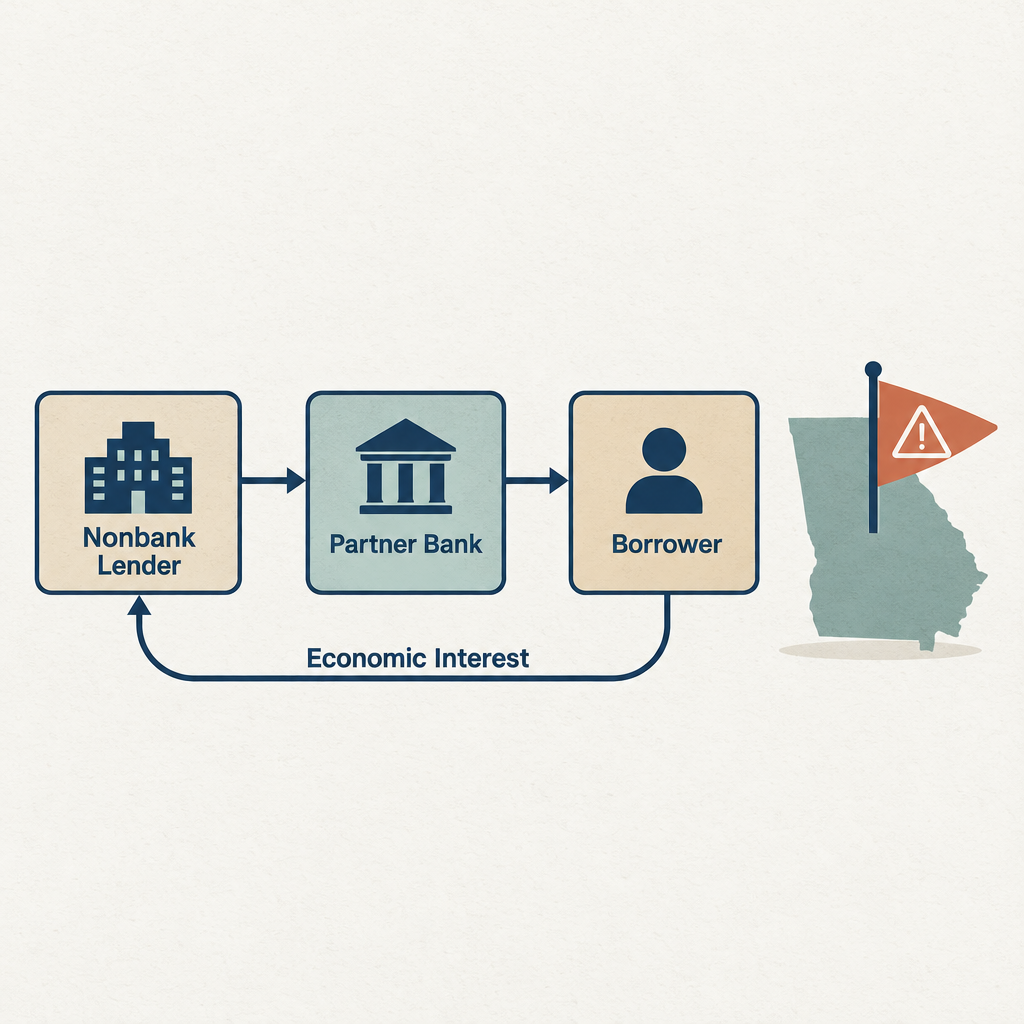
Section 16-17-2 applies to lenders that reach Georgia residents over the internet or by mail, wherever the lender is based. It also targets “rent-a-bank” arrangements, where a nonbank partners with an out-of-state bank but keeps most of the economic interest in the loans. A site offering payday loans online same day in Georgia at triple-digit rates is very likely operating outside Georgia law.
Some lenders claim that tribal sovereign immunity exempts them from state law. Georgia’s position is that its law applies to loans made to Georgia residents. Before you deal with any lender, check its license with the Industrial Loan Commissioner or the Department of Banking and Finance.
Debt collection and wage garnishment
Collectors must follow the federal Fair Debt Collection Practices Act and Georgia’s Fair Business Practices Act, O.C.G.A. § 10-1-390 et seq. Under O.C.G.A. § 18-4-5, wage garnishment for ordinary consumer debt is limited to the lesser of two amounts:
- 25% of your weekly disposable earnings, or
- the amount by which your disposable earnings exceed 30 times the federal minimum wage. At $7.25 an hour, that threshold is $217.50 a week.
For example, if you take home $500 a week, a creditor can garnish no more than $125. Social Security and many other federal benefits are generally exempt. Georgia’s statute of limitations is six years for written contracts (O.C.G.A. § 9-3-24) and four years for open accounts (O.C.G.A. § 9-3-25).
Federal rules that apply everywhere
The Truth in Lending Act and Regulation Z (12 CFR 1026) require lenders to disclose the APR and the total cost before you sign. The Military Lending Act caps most credit to active-duty service members and their dependents at a 36% military annual percentage rate. That matters to families at Fort Stewart, Kings Bay and Georgia’s other installations.
Under the Electronic Fund Transfer Act, a lender cannot require automatic debits as a condition of a loan, and you can revoke a debit authorization. Regulation F also limits collectors to seven call attempts in seven days about a single debt.
Help that costs less
Cheaper options first
Credit union PAL I loans run $200 to $1,000 at up to 28% APR.
Call 211 for Georgia financial assistance with rent, utilities and food.
Ask creditors for a hardship plan before you borrow.
Under NCUA rules at 12 CFR 701.21(c)(7)(iii), federal credit union payday alternative loans (PALs) carry a maximum 28% APR and an application fee of no more than $20. PAL II loans go up to $2,000 for terms of up to 12 months.
Several public and nonprofit programs can also help:
- Food, cash and health coverage: Georgia’s Division of Family and Children Services handles SNAP, TANF and Medicaid through Georgia Gateway.
- Utility bills: Local community action agencies run LIHEAP energy assistance.
- Legal help: Georgia Legal Services Program and the Atlanta Legal Aid Society give free advice on illegal loans and collection lawsuits.
- Debt management: Nonprofit credit counselors can set up debt management plans that lower interest and fees.
For emergency loans in Georgia, ask your employer or your bank about small-dollar options before turning to a pawnbroker.
How to check a lender and complain
How to check a Georgia lender
- Confirm a consumer finance license with the Industrial Loan Commissioner.
- Check bank, mortgage and money transmitter licenses with the Department of Banking and Finance.
- Search NMLS Consumer Access for nationally registered lenders.
- Report illegal payday lending to the Attorney General’s Consumer Protection Division.
- File a federal complaint with the CFPB.
You can also report fraud to the FTC at ReportFraud and report online scams to the FBI’s IC3.
Before you borrow
In Georgia, the biggest risk is a title pawn that keeps renewing. You can pay more than the loan amount in fees and still lose your car.
FAQ
Is it illegal to take out a payday loan in Georgia?
No. The law targets the lender, not you. Making the loan is a crime under O.C.G.A. § 16-17-2, and taking one out is not.
Do I have to repay an illegal payday loan?
O.C.G.A. § 16-17-3 bars an unlicensed lender from collecting and lets you recover three times the interest you paid. Talk to legal aid before you stop paying, so you understand your options.
Can a payday lender have me arrested in Georgia?
No. The FDCPA forbids collectors from threatening arrest over an unpaid debt. Report any lender or collector that makes this threat to the Attorney General and the CFPB.
Are same day loans legal in Georgia?
Speed is not the issue. Same day loans in Georgia are legal when a licensed lender makes them within state rate limits.
How much can a title pawn charge in Georgia?
A title pawn can charge up to 25% per 30-day period for the first 90 days, then 12.5% per period after that, under O.C.G.A. § 44-12-131.
Laws and regulations referenced
- Truth in Lending Act, 15 U.S.C. 1601
- Regulation Z, 12 CFR Part 1026
- Fair Debt Collection Practices Act, 15 U.S.C. 1692
- Regulation F (debt collection), 12 CFR Part 1006
- Electronic Fund Transfer Act, 15 U.S.C. 1693
- Military Lending Act, 10 U.S.C. 987
Links go to the official text on government sites.
Check, verify or complain
Sources
- dbf.georgia.gov › pawnshops title pawn dbf.georgia.gov · primary source
- ncua.gov › files › agenda items › AG20190919Item4b.pdf ncua.gov · primary source
- law.justia.com › codes › georgia › 2020 › title 7 › chapter 4 › article 1 › section 7 4 18 law.justia.com
- jgwentworth.com › resources › what is the 7 7 7 rule in collections jgwentworth.com
- opploans.com › oppu › payday loans › what is a payday alternative loan how can you get o… opploans.com
- codes.findlaw.com › ga › title 44 property › ga code sect 44 12 131 codes.findlaw.com
- unicourt.github.io › cic code ga › transforms › ga › ocga › r81 › gov.ga.ocga.title.07 unicourt.github.io
- americascreditunions.org › blogs › compliance › comparing pals i and pals ii loans americascreditunions.org

Elena writes about getting through a money emergency, assistance programs, budgeting on a tight income, banking basics and borrower rights. Her guides list the cheaper options first and link the agency or program that can actually help.

Ruth is US Financer's standards editor. Every article goes through her checks before and after it is published: each rate, fee, cap, deadline and rule is matched against its primary source, every law named is linked to its official text, and anything that cannot be…
Comments are closed