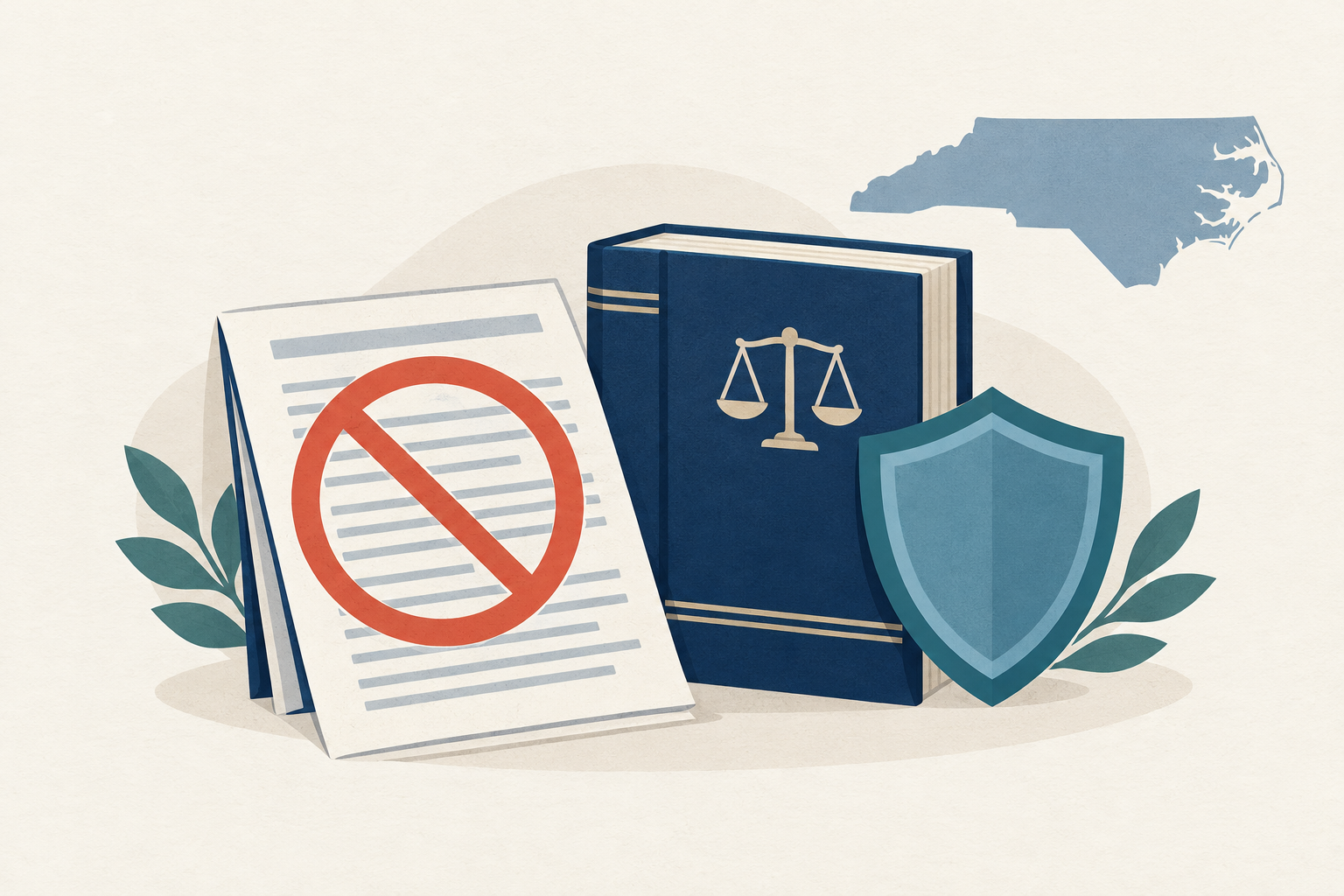
Payday loans are illegal in North Carolina. The law that briefly allowed them expired in 2001, and since then most small consumer loans have been capped at 16% a year unless the lender holds a state consumer finance license. Licensed lenders can charge more, but their ceiling is a tiered 33% a year on the first $4,000. Car title loans at triple-digit rates are also off the table for lenders operating in the state.
NEW RULERelated consumer alert, Oct 21
OCC final rule keeps issuer yield ban, reviews stablecoin rewards case by caseRun the numbers
North Carolina loan laws at a glance
North Carolina has some of the strictest small-loan rules in the country. Lawmakers did not write a special law banning each product. They let payday lending authority lapse and kept the general usury law in force, so any loan priced above it is illegal unless a specific statute authorizes it. The main statute that does authorize higher rates is the Consumer Finance Act, and it stops well short of payday or title loan pricing. The table below summarizes the main products and the rule that governs each one. Rules change when the General Assembly amends a statute, so treat this as a summary of the law on the books as of 2025 and check the current text if you are relying on it in a dispute.
| Product | Legal status in NC | Main rule | Citation |
|---|---|---|---|
| Payday (deferred deposit) loans | Banned | Check cashers may not hold a check for later deposit | N.C. Gen. Stat. § 53-281 |
| General loans of $25,000 or less | Allowed, capped | 16% a year maximum for most lenders | N.C. Gen. Stat. § 24-1.1 |
| Licensed consumer finance loans | Allowed, capped | Up to $15,000; tiered caps starting at 30% a year | N.C. Gen. Stat. §§ 53-166, 53-173 |
| Car title loans | Banned at typical title loan pricing | No statute authorizes them; usury and finance caps apply | N.C. Gen. Stat. §§ 24-1.1, 53-166 |
| Out-of-state and online loans to NC residents | Covered by NC caps in most cases | Overpriced loans unenforceable in NC | N.C. Gen. Stat. §§ 53-190, 24-2.1 |
| Usurious loans | Void as to interest | Borrower can recover twice the interest paid | N.C. Gen. Stat. § 24-2 |
Payday and short-term loans in North Carolina
How North Carolina ended payday lending
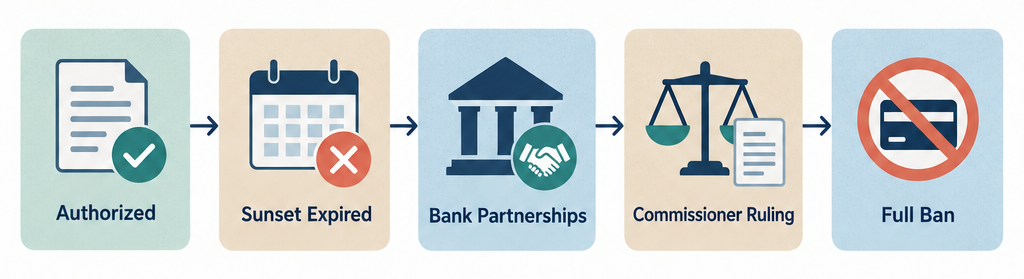
Payday lending was legal in North Carolina for only a few years. In 1997, the General Assembly authorized “deferred deposit” transactions through the check cashing law, letting stores take a postdated check and hold it until the borrower’s next payday. That authority came with a sunset date, and lawmakers declined to renew it. It expired on August 31, 2001.
Several large chains kept operating anyway by partnering with out-of-state banks, arguing that the bank was the real lender and could export its home-state interest rate. North Carolina’s Commissioner of Banks challenged that setup. In late 2005, the Commissioner ruled that Advance America’s North Carolina operation violated the Consumer Finance Act, and by early 2006 the major storefront chains had agreed to leave the state. There has been no legal storefront payday lending in North Carolina since. That is why you see pawnshops and check cashers in the state but not the payday storefronts common in neighboring Tennessee and South Carolina.
What the law says now
Two statutes do most of the work. First, N.C. Gen. Stat. § 53-281, part of the Check Cashing Act, prohibits licensed check cashers from deferring deposit of a check. A store can cash your check for a fee, but it cannot hand you cash today in exchange for a check it promises to hold until payday. That arrangement is the payday loan, and it is banned.
Second, North Carolina’s general usury statute, N.C. Gen. Stat. § 24-1.1, caps interest at 16% a year on most loans of $25,000 or less. A lender that wants to charge more on a small loan needs specific statutory authority, which in practice means a license under the Consumer Finance Act. Even then, the ceiling is far below the roughly 400% APR a typical payday loan carries. If a lender charges more than the law allows, N.C. Gen. Stat. § 24-2 says the lender forfeits all interest on the loan, and if you have already paid interest, you can recover twice that amount. That penalty is one reason North Carolina’s ban has held up for more than two decades.
Fees, loan size, term, rollovers and databases
The brief way to put this: North Carolina has no payday-specific fee cap, maximum payday loan amount, minimum term, rollover limit, cooling-off period or statewide borrower database. Those rules exist in states that permit payday lending and want to regulate it. North Carolina skipped that layer entirely by not allowing the product.
If you compare notes with a friend in another state, you will hear about things like “$15 per $100 borrowed” or “one rollover allowed.” None of that applies here. Our guides to Tennessee payday loan laws and Missouri payday loan laws show what a regulated payday market looks like, with fee schedules and database checks. In North Carolina, the relevant numbers are the 16% usury cap and the Consumer Finance Act tiers covered below. Any short-term loan offered to you in the state has to fit inside one of those frameworks.
A licensed consumer finance company can make you a small loan for a short term, but it has to price it under N.C. Gen. Stat. § 53-173, and on a two-week loan that produces interest measured in dollars, not tens of dollars. That math is the reason payday-style products are not commercially viable here, which is exactly what lawmakers intended.
What a payday or title loan would cost, compared with NC’s caps
The table below shows the cost of typical payday and title loans in states that permit them, next to what the same loan could cost under North Carolina’s 16% general cap. The payday fee of $15 per $100 borrowed is the typical charge the CFPB has described in its research. The 25% monthly title loan fee is the average the CFPB found in its 2016 study of single-payment vehicle title loans.
| Loan | Amount | Fee or interest | Term | Total repaid | APR |
|---|---|---|---|---|---|
| Typical payday loan (illegal in NC) | $500 | $75 fee | 14 days | $575 | About 391% |
| Same payday loan renewed 4 times (illegal in NC) | $500 | $375 in fees | 10 weeks | $875 | About 391% |
| Same $500 under NC’s 16% cap | $500 | $3.07 interest | 14 days | $503.07 | 16% |
| Typical car title loan (illegal in NC) | $1,000 | $250 fee | 30 days | $1,250 | About 304% |
| Same $1,000 under NC’s 16% cap | $1,000 | $13.15 interest | 30 days | $1,013.15 | 16% |
Here is the APR math in plain words. A $75 fee on $500 is 15% of the loan for two weeks. There are about 26 two-week periods in a year, so 15% times 26 comes to roughly 391% a year. For the title loan, a $250 fee on $1,000 is 25% for one month. Multiply by roughly 12.2 thirty-day periods in a year and you get about 304%. The renewal row shows why these loans hurt: the APR never changes, but each renewal adds another full fee while the $500 principal stays exactly where it started. CFPB research found that four out of five payday loans are rolled over or renewed within 14 days.
Check cashers and in-store “cash advances”
Check cashing stores are legal in North Carolina and are licensed by the Commissioner of Banks under the Check Cashing Act, Article 22 of Chapter 53 of the General Statutes. The statute caps the fees they can charge, with different limits depending on the type of check, and requires them to post their fees. What they cannot do is lend. If a store offers to give you money today and “hold” your personal check until Friday, it is offering a deferred deposit transaction prohibited by N.C. Gen. Stat. § 53-281. You can report that offer to the Commissioner of Banks.
Car title loans in North Carolina
North Carolina does not have a title loan statute, and that absence is the ban. A car title loan is simply a loan secured by your vehicle, so it falls under the same rules as any other loan: the 16% cap in N.C. Gen. Stat. § 24-1.1 for most lenders, or the tiered caps in N.C. Gen. Stat. § 53-173 for licensed consumer finance companies. At those rates, a one-month title loan built around a 25% monthly fee is impossible to offer legally. Search results for “title loans NC” or “car title loans North Carolina” often surface online brokers and out-of-state storefronts. That does not mean those lenders can legally lend to you here.
A legitimate secured loan using your car is still possible. A bank, credit union or licensed consumer finance company can take a lien on your vehicle as collateral for an installment loan, priced within state limits and repaid over months or years. The difference is cost and structure: a legal secured installment loan spreads repayment across a schedule, while a title loan demands the full amount plus a large fee in 30 days.
The risks are why North Carolina keeps title loans out. The CFPB’s 2016 study found that about one in five single-payment title loan sequences ended with the borrower’s vehicle being repossessed, and more than four in five title loans were renewed on the day they came due. For many households in a state with limited public transit outside its larger cities, losing the car means losing the way to get to work.
North Carolina residents near the state line sometimes drive into South Carolina or Tennessee to get a title loan in person. N.C. Gen. Stat. § 53-190 makes overpriced loans of $15,000 or less unenforceable in North Carolina, but the statute carves out loans where every step, from solicitation and signing to handing over the money, happens entirely outside the state. If you sign the papers and receive the cash at a store in another state, you may be outside North Carolina’s protection, and the lender may be able to repossess your car under the other state’s rules. If any part of the deal reached you in North Carolina, such as a mailer, a phone call or an online application, the carve-out is much harder for the lender to claim.
Installment loans and personal loans in North Carolina
Consumer Finance Act rate caps
Most legal small-dollar installment loans in North Carolina come from companies licensed under the North Carolina Consumer Finance Act, N.C. Gen. Stat. §§ 53-164 through 53-191. Under N.C. Gen. Stat. § 53-166, anyone in the business of lending $15,000 or less at rates higher than Chapter 24 allows needs this license from the Commissioner of Banks. The legislature raised the loan ceiling to $15,000 and restructured the rates in 2013. The current tiers in N.C. Gen. Stat. § 53-173(a) apply to slices of the unpaid principal balance, similar to how tax brackets work:
| Slice of unpaid principal | Maximum annual rate | Citation |
|---|---|---|
| First $4,000 | 33% | N.C. Gen. Stat. § 53-173(a) |
| $4,000.01 to $8,000 | 24% | N.C. Gen. Stat. § 53-173(a) |
| Above $8,000 (loan max $25,000; loans over $12,000 at origination carry a flat 18% on the whole balance) | 18% | N.C. Gen. Stat. § 53-173(a) |
Because the tiers apply to slices, larger loans have a lower blended rate. On a $6,000 balance, the lender can charge 33% on the first $4,000 ($110 a month) and 24% on the next $2,000 ($40 a month). That is $150 in the first month, which works out to a blended rate of about 30% a year. As you pay down the balance, more of it falls into the 33% tier, so the blended rate creeps up toward 33%.
The Consumer Finance Act also allows certain charges on top of interest, including a loan processing fee under N.C. Gen. Stat. § 53-176 and limited late charges, with caps set in the statute. Those charges count toward the finance charge, which is why the APR on your Truth in Lending disclosure can sit somewhat above the stated interest rate. If you are comparing offers, compare APRs and total repaid, not interest rates.
Here is what a typical small installment loan at the top of the first tier costs:
| Amount | Rate | Term | Monthly payment | Total repaid | Total interest |
|---|---|---|---|---|---|
| $1,000 | 33% a year | 12 months | $98.97 | $1,187.64 | $187.64 |
In plain words: 33% a year is 2.75% a month on whatever you still owe. In the first month, you pay $27.50 in interest on the full $1,000. As the balance falls, each payment covers less interest and more principal. Over 12 months, interest adds up to about $188, before any processing fee the lender is allowed to charge. Compare that with the $375 in fees from renewing a $500 payday loan four times in a state where that is legal.
Licensing: who needs one and who doesn’t
Not every lender you see in North Carolina holds a Consumer Finance Act license, and not every lender needs one. Banks and credit unions operate under their own charters. Federal law lets national banks charge the interest rate permitted in their home state (12 U.S.C. § 85), and state-chartered, FDIC-insured banks have similar rate exportation authority. That is why your credit card or a personal loan from an out-of-state bank can legally carry a rate higher than North Carolina’s caps.
Some online lenders build on this by partnering with a bank in a state with no rate cap. The bank technically originates the loan and then sells it or the receivables to the nonbank. Whether the nonbank is the “true lender,” and therefore subject to North Carolina’s caps, is a contested legal question. North Carolina’s regulator took this fight to the storefront payday chains in 2005 and won. At the federal level, the Office of the Comptroller of the Currency issued a rule in 2020 that would have made the bank the lender in most of these deals, but Congress repealed that rule in 2021 under the Congressional Review Act. A separate 2020 FDIC rule on whether a loan’s interest rate stays valid after a bank sells it remains in place. Practically, if an online lender quotes you an APR above 30% on a loan of $15,000 or less, ask who the actual lender is and check its license before going further.
Lawmakers periodically file bills to change the Consumer Finance Act’s rates or loan limits. Before relying on any figure in a dispute, check the current version of N.C. Gen. Stat. § 53-173 on the General Assembly’s website or ask the Commissioner of Banks.
Personal loans for bad credit in North Carolina
North Carolina’s caps do not guarantee anyone a loan. What they do is limit the price. Lenders that cannot profitably lend to a higher-risk borrower within those limits usually decline the application rather than offer a loan at 200% APR, which is the trade-off the state chose. With a low credit score, your realistic legal options look like this:
- Consumer Finance Act lenders. These licensed companies specialize in smaller installment loans and often accept lower scores. They typically pull your credit and verify income. Expect a rate at or near the 30% tier on smaller loans, plus permitted fees.
- Credit unions. Many will look at your relationship with them, not only your score. Payday alternative loans, covered below, are capped at 28% APR under federal rules.
- Secured options. A share-secured or certificate-secured loan from a credit union, or a secured credit card, uses your own deposit as collateral and usually comes with a much lower rate.
- Online lenders. Some are licensed in North Carolina and price within the caps. Others operate through bank partnerships or tribal entities and charge far more. Check the license before you share bank account details.
Be skeptical of “guaranteed approval” and “no credit check” ads. A legitimate lender checks something: your credit report, bank account history or income. Lenders that advertise no credit check often rely on alternative data and charge higher prices to cover the extra risk, and in North Carolina those prices may be illegal.
Retail installment contracts and pawnshops
Two other legal forms of credit come up often. Furniture, appliance and car purchases financed by the seller fall under the North Carolina Retail Installment Sales Act, Chapter 25A of the General Statutes, which has its own finance charge limits and disclosure rules. Pawnshops are legal and regulated under the Pawnbrokers and Cash Converters Modernization Act, Chapter 91A, which requires local licensing and caps the monthly charges a pawnbroker can collect. Pawn charges are high when expressed as an APR, but a pawn loan has one feature payday and title loans lack: if you cannot repay, you lose the item you pawned and owe nothing more. The pawnbroker cannot sue you or report the loan to collections.
Online and tribal lenders
North Carolina law reaches most online loans made to people who live here. N.C. Gen. Stat. § 53-190 says loans of $15,000 or less carrying charges above what the Consumer Finance Act allows cannot be enforced in North Carolina, and the statute specifically covers loans solicited in the state, including through the internet. Separately, N.C. Gen. Stat. § 24-2.1 treats a loan as made in North Carolina when a resident of the state applies for or receives it here, which brings the usury law and its double-interest penalty into play.
Tribal lenders claim they are arms of Native American tribes and therefore immune from state law. That claim has not fared well. In 2013, the North Carolina Attorney General sued Western Sky Financial, an online lender owned by a member of the Cheyenne River Sioux Tribe, and its servicer CashCall over high-cost loans to North Carolina residents. The Fourth Circuit, the federal appeals court whose rulings bind federal courts in North Carolina, has repeatedly refused to enforce tribal loan agreements designed to strip borrowers of their federal and state rights, most notably in Hengle v. Treppa in 2021. Courts generally distinguish between a tribe’s own government, which has immunity, and lending businesses run largely by outside investors, which often do not.
None of that means an illegal online lender will leave you alone. Many still debit bank accounts, call relentlessly and report to collection agencies. Your strongest protections are practical:
- Revoke the ACH authorization in writing with the lender, and tell your bank to stop the payments. Under Regulation E (12 CFR 1005.10(c)), your bank must stop preauthorized transfers if you notify it at least three business days before the scheduled payment.
- Keep records of the loan agreement, every payment and every collection call.
- Complain to the Commissioner of Banks, the North Carolina Attorney General’s Consumer Protection Division and the CFPB. Regulators have used complaint patterns to bring enforcement actions against online lenders.
- Talk to a lawyer or Legal Aid of North Carolina if a lender sues you. A usurious loan may give you a counterclaim under N.C. Gen. Stat. § 24-2.
Debt collection and wage garnishment in North Carolina
Who can collect and what they can’t do
North Carolina layers state protections on top of the federal Fair Debt Collection Practices Act. The North Carolina Debt Collection Act, N.C. Gen. Stat. §§ 75-50 through 75-56, applies to creditors collecting their own debts, a group the federal law largely does not cover. Third-party collection agencies fall under the Collection Agency Act, N.C. Gen. Stat. §§ 58-70-1 and following, and must hold a permit from the North Carolina Department of Insurance, not the Commissioner of Banks.
Both state laws prohibit threats, harassment, misrepresenting the amount or legal status of a debt and unfair collection methods. They include specific bans on threatening arrest, falsely claiming you will lose your job, and contacting your employer or family in ways designed to shame you. Violations can lead to actual damages and statutory civil penalties for each violation, and a violation of the state Debt Collection Act is treated as an unfair trade practice under Chapter 75.
Wage garnishment limits
North Carolina is one of a handful of states that largely bar wage garnishment for ordinary consumer debts. Under N.C. Gen. Stat. § 1-362, your earnings for personal services in the 60 days before a collection order are exempt when they are needed to support your family. In practice, a credit card company, medical provider, personal lender or debt buyer that wins a judgment against you generally cannot take money directly out of your paycheck.
That protection has exceptions. The table summarizes the main categories:
| Type of debt | Can wages be garnished in NC? | Source of the rule |
|---|---|---|
| Credit cards, personal loans, medical bills, debt buyers | Generally no | N.C. Gen. Stat. § 1-362 |
| Child support and alimony | Yes | State and federal support enforcement laws |
| Federal student loans | Yes, through administrative wage garnishment | Federal Higher Education Act rules |
| Federal and state taxes | Yes | Internal Revenue Code; state tax law |
| Certain debts owed to state or local government | In some cases | Specific state statutes |
Federal limits under Title III of the Consumer Credit Protection Act still cap how much can be taken when garnishment is allowed. For most debts, that cap is 25% of disposable earnings or the amount by which weekly disposable pay exceeds 30 times the federal minimum wage, whichever is less. Support orders can reach higher percentages.
Bank accounts and property
The wage protection does not make you judgment-proof. Once a creditor has a judgment, it can ask the sheriff to levy bank accounts and nonexempt property. North Carolina’s exemptions, listed in N.C. Gen. Stat. § 1C-1601, protect some equity in your home, a vehicle, household goods, tools of your trade and a limited wildcard amount, but you usually have to claim them. After a judgment, you should receive a notice of your right to claim exemptions under N.C. Gen. Stat. § 1C-1603. Return that form by the deadline on it. If you miss it, you can lose protections you were entitled to.
Federal benefits get extra protection. Under the Treasury rule at 31 CFR Part 212, your bank must automatically protect two months of directly deposited Social Security, SSI, VA and certain other federal benefits from a garnishment order.
Time limits on old debts
Under N.C. Gen. Stat. § 1-52, the statute of limitations for most contract debts, including credit cards and personal loans, is three years. After that, a collector can still ask you to pay but cannot win a lawsuit if you raise the deadline as a defense. North Carolina goes further than most states: N.C. Gen. Stat. § 58-70-115 prohibits collection agencies, including debt buyers, from suing or starting arbitration on a debt they know or should know is time-barred. Judgments last longer. A North Carolina judgment can be enforced for ten years under N.C. Gen. Stat. § 1-47 and can be renewed.
Debt relief programs in North Carolina
North Carolina restricts the for-profit debt relief industry more tightly than most states. The state’s debt adjusting law, N.C. Gen. Stat. §§ 14-423 through 14-426, makes it a misdemeanor to charge North Carolina residents for arranging to pay or settle their debts, and the definition covers debt settlement companies. The statute exempts some nonprofit credit counseling agencies, which can charge limited fees. Federally, the FTC’s Telemarketing Sales Rule (16 CFR 310.4(a)(5)) bans debt relief companies that sell by phone from collecting fees before they actually settle or change a debt.
That leaves three legitimate routes for most people:
- Nonprofit credit counseling and debt management plans. A counselor reviews your budget and may set up a plan that consolidates unsecured debts into one monthly payment, often with reduced interest rates negotiated with card issuers. Look for agencies affiliated with the National Foundation for Credit Counseling or the Financial Counseling Association of America.
- Hardship programs directly with creditors. Card issuers, utilities and lenders often have temporary payment reductions or deferrals that are never advertised. Call and ask for the hardship or recovery department.
- Bankruptcy. Chapter 7 or Chapter 13 can stop collection immediately through the automatic stay. North Carolina’s exemptions under § 1C-1601 apply. Legal Aid of North Carolina and some bar association programs can help you decide whether it makes sense.
If a company promises to “settle your debts for pennies” and wants a monthly fee from a North Carolina resident before it does anything, report it to the Attorney General’s Consumer Protection Division.
Federal rules that apply everywhere
A few federal laws protect you in North Carolina regardless of the state rules above.
- Truth in Lending Act and Regulation Z (12 CFR 1026). Lenders must disclose the APR, finance charge, amount financed and total of payments before you sign. Use these figures to compare loans.
- Military Lending Act (10 U.S.C. § 987; 32 CFR Part 232). Active-duty service members and their dependents cannot be charged more than a 36% Military Annual Percentage Rate, which includes most fees and add-on products. The law also bans mandatory arbitration and allotment requirements on covered loans. That matters in a state with Fort Bragg, Camp Lejeune and several other large installations.
- Servicemembers Civil Relief Act. Debts taken on before active duty can be capped at 6% interest during service.
- Fair Debt Collection Practices Act and Regulation F (12 CFR 1006). Third-party collectors must send a validation notice, stop collecting if you dispute in writing within the validation period until they verify the debt, avoid calls before 8 a.m. or after 9 p.m., and are presumed to violate the law if they call about a debt more than seven times in seven days.
- Electronic Fund Transfer Act and Regulation E. No lender can require you to repay by preauthorized electronic transfer as a condition of getting credit, and you can stop recurring debits through your bank.
- Equal Credit Opportunity Act. Lenders cannot discriminate based on race, sex, marital status, age, national origin, religion or receipt of public assistance.
Help that costs less: financial assistance in North Carolina
The cheapest money is the money you do not have to borrow, and the next cheapest usually comes from a credit union or an employer. Here are the options to check before any loan, roughly in order of cost.
Credit union payday alternative loans
Federal credit unions can offer payday alternative loans under NCUA rules at 12 CFR 701.21(c)(7). PAL I loans run from $200 to $1,000 over one to six months, and you need to have been a member for at least one month. PAL II loans go up to $2,000 over one to twelve months, with no membership waiting period. Both are capped at 28% APR, with an application fee of no more than $20. North Carolina’s large state-chartered credit unions, including the State Employees’ Credit Union, have offered their own low-cost salary advance products to members with direct deposit.
| Option | Amount | Rate or fee | Term | Total repaid |
|---|---|---|---|---|
| Credit union PAL I | $1,000 | 28% APR + $20 application fee | 6 months | $1,103.24 ($180.54 a month plus fee) |
| Consumer Finance Act loan | $1,000 | 30% a year | 12 months | $1,169.85 before permitted fees |
| Earned wage or cash advance app (example) | $100 | $5 express fee + $5 optional tip | 14 days | $110 (about 261% APR if you pay both) |
The app example is illustrative because pricing varies by company. The point is the math: $10 on $100 for two weeks is 10% times about 26 periods, or roughly 260% a year. If you wait for the free standard transfer and skip the tip, the cost can drop to zero, which makes these apps cheaper than any loan. If you pay for speed every pay period, they get expensive fast.
Military relief societies
Service members and their families in North Carolina can turn to Army Emergency Relief, the Navy-Marine Corps Relief Society or the Air Force Aid Society for interest-free loans and grants covering emergencies like car repairs, rent and travel. These programs are far cheaper than any civilian lender and are designed for exactly the situations that push people toward high-cost credit.
State and local financial assistance in North Carolina
For bills rather than one-time cash needs, public and nonprofit help often beats borrowing:
- NC 211. Dial 2-1-1 or use the United Way’s NC 211 service to find local rent, utility, food and emergency help in your county.
- County Department of Social Services. Your county DSS administers the Low Income Energy Assistance Program (LIEAP), the Crisis Intervention Program for heating and cooling emergencies, Food and Nutrition Services (North Carolina’s name for SNAP) and Work First cash assistance.
- NC Medicaid. North Carolina expanded Medicaid on December 1, 2023, so many working adults who did not qualify before now do. Coverage can stop medical bills from becoming collection accounts.
- Utility hardship funds. Major utilities, including Duke Energy through its Share the Light Fund, partner with local agencies to help with past-due bills. Ask your utility about payment arrangements before a shutoff date.
- Legal Aid of North Carolina. Free civil legal help for eligible residents facing eviction, debt lawsuits, illegal lending or collection abuse.
- Employer help. Some employers offer paycheck advances, hardship funds or emergency grants. Ask HR before going elsewhere.
Cheaper options first
Ask your creditor for a hardship plan or due-date change before borrowing.
Check a credit union PAL, capped at 28% APR.
Call NC 211 for rent, utility and food help in your county.
How to check a lender’s license and file a complaint
The North Carolina Office of the Commissioner of Banks licenses consumer finance lenders, check cashers, money transmitters and mortgage lenders. Its website has a license search, and many of its licenses are also managed through NMLS Consumer Access. If a company is lending $15,000 or less at more than 16% a year and you cannot find a North Carolina license, a bank charter or a credit union charter, treat that as a serious warning sign.
How to check a lender in North Carolina
- Get the lender’s full legal name and any license number from its website or loan agreement.
- Search the Commissioner of Banks license lookup and NMLS Consumer Access for that name.
- If it claims to be a bank, confirm it with the FDIC’s BankFind tool.
- Compare the APR on its Truth in Lending disclosure with NC’s caps.
- Search the CFPB complaint database for the company’s complaint history.
- Walk away if it is unlicensed, demands upfront fees or cannot name the actual lender.
If something has already gone wrong, match the problem to the right agency. You can file with more than one.
| Problem | Where to complain |
|---|---|
| Unlicensed or overpriced lender, check casher offering payday-style advances | North Carolina Office of the Commissioner of Banks |
| Scams, illegal online lenders, debt settlement companies, unfair practices | NC Attorney General’s Consumer Protection Division, 1-877-566-7226 |
| Abusive third-party collection agency | NC Department of Insurance (collection agency permits) |
| Any lender, collector or bank, nationwide | CFPB complaint portal |
| Fraud and impostor scams | FTC ReportFraud |
| Internet-based fraud | FBI Internet Crime Complaint Center (IC3) |
| Service member lending issues | Your installation’s legal assistance office |
Common red flags include a lender that asks for an upfront “insurance” or “processing” fee before releasing a loan, insists on gift cards or wire transfers, has no physical address, will not name the company that actually funds the loan, or pressures you to sign the same day. Legitimate lenders take fees out of the loan proceeds or bill them on the schedule. They never ask you to pay to receive money.
Before you borrow
Any lender offering a North Carolina resident a payday or car title loan at triple-digit rates is operating outside state law, and dealing with it can still cost you your bank balance or your car. Check the license, read the APR and total of payments, and try a credit union or a hardship plan first.
FAQ
Are payday loans legal in North Carolina?
No. North Carolina’s authority for deferred deposit lending expired on August 31, 2001, and N.C. Gen. Stat. § 53-281 prohibits check cashers from holding checks for later deposit. Most loans of $25,000 or less are capped at 16% a year under N.C. Gen. Stat. § 24-1.1, and licensed consumer finance lenders are limited to tiered rates starting at 30% a year.
Can I get a title loan in North Carolina?
Not a typical one. No North Carolina statute authorizes title loans, so a loan secured by your car must fit within the 16% usury cap or the Consumer Finance Act tiers. A bank, credit union or licensed lender can make a legal installment loan using your vehicle as collateral, but the 25%-a-month title loans common in other states cannot be offered legally to North Carolina residents.
What happens if I took out an illegal online payday loan?
Under N.C. Gen. Stat. § 53-190, an overpriced loan of $15,000 or less solicited in North Carolina is unenforceable here, and under § 24-2 you may be able to recover twice the interest you paid. Revoke the lender’s ACH authorization, tell your bank to stop payments, keep records, and file complaints with the Commissioner of Banks, the Attorney General and the CFPB. If you are sued, contact Legal Aid of North Carolina or a consumer attorney.
Can a debt collector garnish my wages in North Carolina?
For most consumer debts, no. N.C. Gen. Stat. § 1-362 exempts earnings from the previous 60 days when they are needed to support your family. Wages can still be garnished for child support, alimony, taxes, federal student loans and some government debts, and a creditor with a judgment can try to levy your bank account, subject to the exemptions you claim under § 1C-1601.
What is the highest interest rate a lender can charge in North Carolina?
For most lenders on loans of $25,000 or less, 16% a year under N.C. Gen. Stat. § 24-1.1. Licensed consumer finance companies can charge up to 33% on the first $4,000 of principal, 24% on the next $4,000 and 18% above $8,000 on loans up to $12,000 at origination, and a flat 18% on larger loans up to the $25,000 maximum, under § 53-173. Banks and credit cards can charge more because federal law lets banks use their home state’s rates.
Is debt settlement legal in North Carolina?
For-profit debt adjusting, including most debt settlement services, is a misdemeanor under N.C. Gen. Stat. §§ 14-423 through 14-426, with an exemption for qualifying nonprofit credit counseling agencies. If a company wants upfront fees to settle your debts, report it to the Attorney General’s Consumer Protection Division and look for a nonprofit credit counselor instead.
Laws and regulations referenced
- Truth in Lending Act, 15 U.S.C. 1601
- Regulation Z, 12 CFR Part 1026
- Fair Debt Collection Practices Act, 15 U.S.C. 1692
- Regulation F (debt collection), 12 CFR Part 1006
- Equal Credit Opportunity Act, 15 U.S.C. 1691
- Electronic Fund Transfer Act, 15 U.S.C. 1693
- Regulation E (electronic transfers), 12 CFR Part 1005
- Military Lending Act, 10 U.S.C. 987
- Military Lending Act rule, 32 CFR Part 232
- Servicemembers Civil Relief Act, 50 U.S.C. 3901
- FDIC deposit insurance
Links go to the official text on government sites.
Check, verify or complain
Sources
- ecfr.gov › current › title 32 › subtitle A › chapter I › subchapter M › part 232 ecfr.gov · primary source
- ncleg.gov › enactedlegislation › statutes › html › bysection › chapter 24 › gs 24 1.1 ncleg.gov · primary source
- ncleg.net › EnactedLegislation › Statutes › PDF › ByArticle › Chapter 53 › Article 15.pdf ncleg.net

Elena writes about getting through a money emergency, assistance programs, budgeting on a tight income, banking basics and borrower rights. Her guides list the cheaper options first and link the agency or program that can actually help.

Ruth is US Financer's standards editor. Every article goes through her checks before and after it is published: each rate, fee, cap, deadline and rule is matched against its primary source, every law named is linked to its official text, and anything that cannot be…
Comments are closed