Payday lending is still legal in Illinois, but since March 23, 2021 every payday, car title and consumer installment loan made by a non-bank lender has been capped at 36% APR under the Predatory Loan Prevention Act (815 ILCS 123). A loan that charges more than that is void under state law, and the lender has no right to collect it. That one rule reshaped the whole small-loan market in the state, and it is the first thing to know before signing anything.
Run the numbers
What changed in 2021 and why it matters
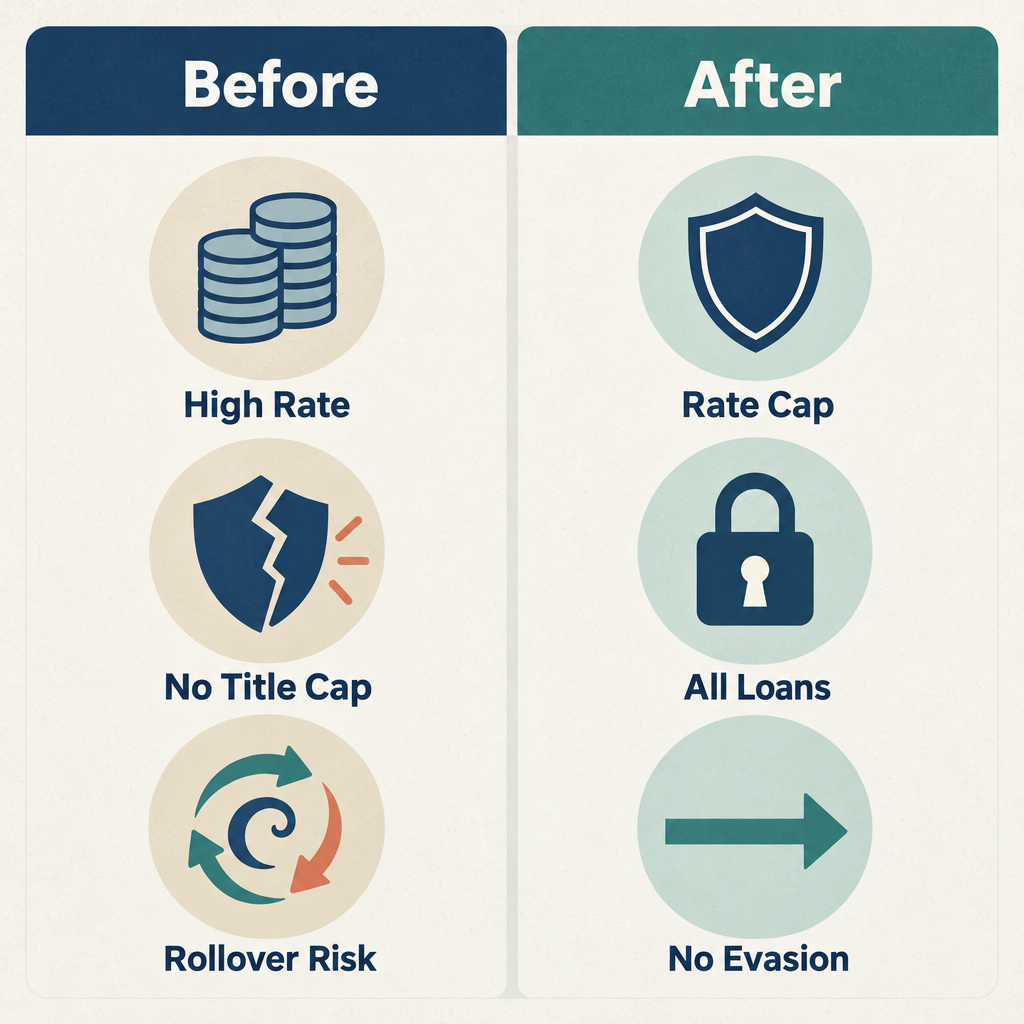
For about 15 years, Illinois ran a two-track system. The Payday Loan Reform Act (815 ILCS 122) let storefront lenders charge up to $15.50 per $100 borrowed on a payday loan, which works out to roughly 404% APR on a 14-day loan. The Consumer Installment Loan Act (205 ILCS 670) allowed up to 99% APR on “small consumer loans” under $4,000. Title loans had no rate cap at all, and triple-digit APRs were normal.
Senate Bill 1792, signed by Governor J.B. Pritzker as Public Act 101-0658, replaced all of that with a single ceiling. The Predatory Loan Prevention Act (PLPA) says a lender may not contract for or receive charges above a 36% annual percentage rate on any consumer loan, and 815 ILCS 123/15-5-10 defines how that rate is calculated. The statute borrows the “military annual percentage rate” method from the federal Military Lending Act, which means most fees count toward the 36%, including application fees, credit insurance and add-on products. Lenders cannot dodge the cap by relabeling interest as a “fee.”
Banks, savings banks, savings and loan associations, credit unions and insurance companies are exempt from the PLPA because they are regulated under other state and federal laws. Everyone else making consumer loans to Illinois residents is covered, including online lenders based in other states. The Act’s anti-evasion section (815 ILCS 123/15-5-15) also reaches arrangements where a non-bank lender claims to be merely “servicing” a loan that a bank nominally made. If the non-bank party holds the predominant economic interest in the loan, Illinois treats it as the real lender.
The practical result: most storefront payday and title lenders stopped offering those products in Illinois after 2021, because the old business model does not work at 36%. Advocates at the Woodstock Institute had estimated that Illinois borrowers were paying more than $500 million a year in fees on payday, title and high-cost installment loans before the cap. Whatever small-dollar lending remains has to fit under the new ceiling.
Payday and short-term loans in Illinois
The Payday Loan Reform Act is still on the books, so its structural rules remain in force alongside the PLPA’s price cap. Here is what the statute currently says a payday lender can and cannot do.
Maximum loan amount
Under 815 ILCS 122/2-5, a lender cannot make a payday loan if the payments due within the first month of the loan, combined with the borrower’s other outstanding payday loans, exceed the lesser of $1,000 or 25% of the borrower’s gross monthly income. For “installment payday loans” (a longer-term version defined in the Act) the income limit is 22.5% of gross monthly income. A borrower earning $2,800 a month gross, for example, cannot be lent more than $700 on a standard payday loan regardless of what the lender wants to approve.
Fees and rates
The Payday Loan Reform Act’s old $15.50 per $100 figure is now a dead letter. The PLPA’s 36% cap overrides it. On a $500 loan due in 14 days, 36% APR produces about $6.90 in finance charges. The same loan under the old rule cost $77.50.
| Loan terms | Pre-2021 payday loan | Payday loan under the PLPA |
|---|---|---|
| Amount borrowed | $500 | $500 |
| Fee or interest | $77.50 ($15.50 per $100) | About $6.90 |
| Term | 14 days | 14 days |
| APR | About 404% | 36% |
| Total repaid | $577.50 | About $506.90 |
The APR math works like this: divide the finance charge by the amount borrowed, then multiply by the number of 14-day periods in a year (about 26). $77.50 divided by $500 is 0.155, times 26.07 equals roughly 4.04, or 404%. At 36% APR the finance charge for two weeks is $500 times 0.36 times 14/365, which is $6.90.
Term limits
A payday loan in Illinois must run at least 13 days. Installment payday loans must have a term between 112 and 180 days and must be repaid in substantially equal installments. Lenders cannot structure a loan to be due the day after your paycheck arrives if that falls short of the minimum.
Rollovers, limits on open loans and the database
Illinois prohibits rollovers outright. A payday lender cannot refinance or renew a payday loan, and cannot take a new payday loan to pay off an old one with the same lender. The state also caps borrowers at two outstanding payday loans at any time.
To enforce those limits, 815 ILCS 122 requires every payday lender to check a state-certified consumer reporting service (a real-time database run by a vendor under contract with the Illinois Department of Financial and Professional Regulation) before making a loan. If you already have two loans open, or you are inside a cooling-off period, the database tells the lender no.
Cooling-off period and repayment plan
Once you have been in payday loan debt for 45 consecutive days, you cannot take another payday loan for seven days. That cooling-off rule is designed to break the cycle where a borrower pays off one loan and immediately takes another.
Separately, if you have had a payday loan outstanding for 35 consecutive days, you have the right to request an interest-free repayment plan. The lender must allow you to repay the balance in at least four equal installments over no fewer than 55 days, and cannot charge additional finance charges or fees during the plan. The lender also cannot make you a new payday loan while you are in a repayment plan.
Other borrower protections in the Payday Loan Reform Act
- Right to cancel: you can rescind a payday loan at no cost by returning the principal before the close of business on the second business day after the loan was made.
- Returned payment fees: a lender may charge no more than one fee, capped at $25, if your check or ACH debit bounces, no matter how many times the payment fails.
- No criminal threats: a lender cannot threaten you with criminal prosecution over a bounced check tied to a payday loan.
- No wage assignments: payday lenders cannot take an assignment of your wages as collateral.
- Plain disclosures: the lender must give you a written agreement in the language used to negotiate the loan, with the APR, fee schedule and your rights listed.
If you are comparing Illinois to its neighbors, the contrast is sharp. Our page on “missouri payday loan laws” covers a state where fees up to 75% of principal are still permitted, and “wisconsin payday loan laws” describes a market with no rate cap at all. Crossing the Mississippi or the state line to borrow can cost ten times as much.
Car title loans in Illinois
Title loans in Illinois have always been made under the Consumer Installment Loan Act and the IDFPR’s title-secured lending rules in the Illinois Administrative Code (38 Ill. Adm. Code 110). Those rules capped a title loan at $4,000, required monthly payments that did not exceed 50% of the borrower’s gross monthly income, and banned refinancing a title loan at more than the outstanding balance. What they never did, before 2021, was limit the interest rate. IDFPR data from that era showed title loan APRs commonly above 200%.
The PLPA closed that gap. A title lender in Illinois is now bound by the same 36% all-in rate as any other consumer lender, and a title loan priced above it is void. In practice, very few licensed lenders in Illinois still offer title loans because the product rarely pencils out at that rate once you add the cost of appraising and recording a lien.
| Loan terms | Pre-2021 title loan (200% APR example) | Title loan under the PLPA |
|---|---|---|
| Amount borrowed | $1,000 | $1,000 |
| Term | 6 monthly payments | 6 monthly payments |
| Monthly payment | About $276 | About $184.60 |
| Total repaid | About $1,658 | About $1,107.60 |
| Finance charge | About $658 | About $107.60 |
What this means for you: if an Illinois storefront or website offers a loan against your car title at anything resembling the old prices, it is operating outside state law. If you still hold an older title loan made before the PLPA took effect, that contract is governed by the law in force at the time, so the 36% cap does not retroactively rewrite it. Repossession rules for those loans follow the Illinois Uniform Commercial Code (810 ILCS 5/9-609 and following), which allows a lender to repossess after default without a court order as long as it does not breach the peace, and requires notice before the vehicle is sold.
Installment and personal loans in Illinois
This is where most legal small-dollar borrowing in Illinois now happens. The Consumer Installment Loan Act (205 ILCS 670) requires any non-bank making consumer installment loans of $40,000 or less to hold an IDFPR license. The Act used to allow 99% APR on loans under $4,000 and a lower rate on larger loans. Since 2021, the PLPA’s 36% cap applies to every loan under the Act, regardless of size.
A few points about how installment loans work in Illinois today:
- Licensing is mandatory. A consumer installment lender must be licensed by IDFPR under 205 ILCS 670 unless it is a bank or credit union. Licensed lenders are listed on IDFPR’s license lookup and, for most, on the Nationwide Multistate Licensing System’s Consumer Access site.
- The 36% is all-in. Because the PLPA uses the Military Lending Act’s calculation method, origination fees, monthly “maintenance” fees and sold-with-the-loan insurance all count. A lender advertising 29.99% interest plus a $150 origination fee on a $1,000 six-month loan has blown through the cap.
- Payment ability. For small consumer loans, the Act limits monthly payments to a share of gross monthly income (22.5% for small consumer loans) so a lender cannot schedule a payment you clearly cannot afford.
- Prepayment. Illinois lets you prepay a consumer installment loan at any time without a penalty.
Here is a worked example comparing an installment loan at the old 99% ceiling with the same loan at 36%:
| Loan terms | Small consumer loan at 99% APR (pre-2021) | Installment loan at 36% APR (current cap) |
|---|---|---|
| Amount borrowed | $2,000 | $2,000 |
| Term | 12 monthly payments | 12 monthly payments |
| Monthly payment | About $268.82 | About $200.92 |
| Total repaid | About $3,225.84 | About $2,411.04 |
| Finance charge | About $1,226 | About $411 |
Thirty-six percent is not cheap. It is roughly the ceiling that most federal regulators treat as the line between mainstream credit and predatory credit, and it still means paying hundreds of dollars in interest to borrow $2,000 for a year: about $411 on a 12-month amortizing loan like the one in the table, and about $720 if the full $2,000 stayed outstanding for the entire year. Compared to the alternatives below, it is the most expensive legal option in the state.
Installment loans for bad credit in Illinois
Lenders that market “installment loans for bad credit” or “personal loans in Illinois for bad credit” are subject to the same 36% rule as anyone else. What usually changes with a weaker credit profile is not the rate ceiling but the loan size, the term and the odds of approval. Some licensed Illinois lenders use alternative data (bank account cash flow, rent and utility payment history) instead of a FICO score. That is a soft check in many cases, but it is still underwriting. “No credit check” and “guaranteed approval” are marketing phrases, not legal categories, and no licensed Illinois lender can promise approval before reviewing your application.
Same-day and online installment loans in Illinois
Illinois law does not forbid same-day funding. A licensed lender can approve an online application and send money by ACH the same business day. What the law requires is that the lender hold an IDFPR license (or be a bank or credit union) and price the loan at or under 36% APR. If a website promises same-day cash to Illinois residents at a rate it refuses to disclose until after you apply, treat that as a warning sign. The Truth in Lending Act requires the APR to appear in the loan disclosure before you are bound, and Illinois law requires it in the contract.
Online and tribal lenders: does Illinois law apply?
Yes. The PLPA applies to any consumer loan made to an Illinois resident, whether the lender sits in Chicago, Delaware or offshore. The anti-evasion provision in 815 ILCS 123/15-5-15 specifically targets the “rent-a-bank” model where an online lender partners with an out-of-state bank to claim the bank’s exemption. If the non-bank partner markets the loan, funds it indirectly or holds most of the economic risk, Illinois considers it the lender.
Tribal lenders are the hard case. Some online lenders owned by or affiliated with federally recognized tribes argue that sovereign immunity exempts them from state usury laws. The Illinois Attorney General and IDFPR have taken the position that loans made to Illinois residents above 36% are void regardless of the lender’s tribal status, and that the state can act against the non-tribal companies that service, collect or market those loans. Courts in other states have split on these questions, and litigation is ongoing nationally. The safe assumption for a borrower is this: a tribal online loan at 300% APR is almost certainly unenforceable in an Illinois court, but you may still face aggressive collection attempts and ACH debits, and you may have to fight to stop them.
A few practical checks before borrowing from any online lender:
- Search the company name on IDFPR’s license lookup. A legitimate Illinois consumer lender appears as a Consumer Installment Loan Act licensee or Payday Loan Reform Act licensee.
- Search NMLS Consumer Access for the company and confirm “Illinois” appears among its licensed states.
- If the site claims to be a bank or credit union, verify it through the FDIC BankFind or NCUA credit union locator tools. Fintech brands are rarely banks themselves.
- Look for the APR in the disclosure. If it is missing or above 36%, the loan is not legal in Illinois.
If you have already taken an illegal online loan, you can revoke ACH authorization with your bank. Under the Electronic Fund Transfer Act and Regulation E (12 CFR 1005.10), you have the right to stop preauthorized transfers by notifying your bank at least three business days before the next scheduled debit. The CFPB’s payday lending rule (12 CFR 1041), whose payment provisions took effect March 30, 2025, also bars covered lenders from making a third attempt to debit an account after two consecutive failed attempts without a fresh authorization from you.
Debt collection and wage garnishment limits in Illinois
Who regulates collectors
Collection agencies operating in Illinois must be licensed under the Illinois Collection Agency Act (225 ILCS 425), which IDFPR administers. The Act bars collectors from using threats, profanity, false statements about the amount owed, and contact with your employer beyond what is needed to verify employment or garnish wages. The Illinois Consumer Fraud and Deceptive Business Practices Act (815 ILCS 505) gives the Attorney General and private plaintiffs a second tool against deceptive collection conduct.
Statute of limitations on debt
Under 735 ILCS 5/13-206, a creditor has 10 years to sue on a written contract. Under 735 ILCS 5/13-205, the limit for oral contracts and unwritten accounts is 5 years. Illinois appellate courts have treated some credit card debts as unwritten because the full agreement was never signed, which pushes those cases toward the 5-year limit, but that depends on the paperwork in your specific account. A debt past the limitations period can still be collected voluntarily, and a payment or written acknowledgment can restart the clock, so get advice before paying anything on an old account.
A judgment, once entered, can be enforced for 7 years and revived for up to 20 years under 735 ILCS 5/12-108. Since January 1, 2020, consumer debt judgments of $25,000 or less accrue post-judgment interest at 5% a year instead of the general 9% rate (735 ILCS 5/2-1303).
Wage garnishment limits
Illinois protects more of a paycheck than federal law does. Under 735 ILCS 5/12-803, the maximum a creditor can take from your wages for a consumer debt is the lesser of two figures: 15% of your gross weekly wages, or the amount by which your weekly disposable earnings exceed 45 times the greater of the federal or Illinois minimum wage. The Illinois minimum wage reached $15.00 an hour on January 1, 2025, so the protected floor is $675 per week in disposable earnings as of 2026.
| Scenario (weekly pay) | Illinois limit (735 ILCS 5/12-803) | Federal limit (15 U.S.C. 1673) |
|---|---|---|
| Gross $1,000, disposable $800 | Lesser of $150 (15% of gross) or $125 (disposable minus $675) = $125 | Lesser of $200 (25% of disposable) or $582.50 (disposable minus $217.50) = $200 |
| Gross $800, disposable $650 | $0 (disposable is below $675 floor) | $162.50 |
| Gross $2,000, disposable $1,600 | Lesser of $300 or $925 = $300 | Lesser of $400 or $1,382.50 = $400 |
Those limits apply to ordinary creditors like lenders and collectors. Child support, federal tax levies and defaulted federal student loans follow their own rules and can take more. A creditor also must obtain a court judgment and then a wage deduction order before an Illinois employer can withhold anything. Payday lenders cannot garnish wages without going through that same court process, and the Payday Loan Reform Act bars them from taking wage assignments as a shortcut.
Bank accounts and property
If a creditor levies your bank account, Illinois gives you a $4,000 “wildcard” exemption for personal property under 735 ILCS 5/12-1001(b) that you can apply to cash, plus a $2,400 motor vehicle exemption and a $15,000 homestead exemption (735 ILCS 5/12-901). Social Security, SSI, unemployment, TANF and other public benefits are exempt entirely. You have to assert exemptions at a court hearing, so respond to any citation or levy notice promptly.
Debt relief in Illinois: rules and fee caps
Illinois regulates the companies that promise to make debt go away. Two statutes matter.
The Debt Settlement Consumer Protection Act (225 ILCS 429) requires for-profit debt settlement companies to hold an IDFPR license. It caps the enrollment fee at $50 and caps the settlement fee at 15% of the amount by which a debt is reduced, and that fee can only be charged after the settlement is actually completed. A company that asks for large monthly fees up front, before any creditor has agreed to anything, is violating Illinois law. The federal Telemarketing Sales Rule (16 CFR 310.4(a)(5)) adds a nationwide ban on advance fees for debt relief sold over the phone.
The Debt Management Service Act (205 ILCS 665) covers nonprofit credit counseling agencies that run debt management plans. These agencies also need an IDFPR license and face fee limits set in the Act and IDFPR rules. Nonprofit counselors affiliated with the National Foundation for Credit Counseling or the Financial Counseling Association of America typically offer a free first session and a plan that lowers credit card interest rates through creditor agreements rather than settlement.
Bankruptcy remains the formal route. Illinois has opted out of the federal exemption list, so Illinois filers use the state exemptions described above. A Chapter 7 case can discharge payday loans, installment loans and most unsecured debt. The Legal Aid Chicago, Prairie State Legal Services and Land of Lincoln Legal Aid networks handle consumer debt and bankruptcy matters for income-eligible residents at no charge.
Help that costs less than a loan
Cheaper options first
A federal credit union payday alternative loan runs 28% APR or less with a $20 maximum fee.
Township General Assistance and IDHS emergency programs provide cash or bill help without repayment.
Dial 211 for a live referral to local rent, utility and food assistance in your county.
Credit union payday alternative loans
Federal credit unions can offer two kinds of payday alternative loans under NCUA rules at 12 CFR 701.21(c)(7)(iii) and (iv). A PAL I runs $200 to $1,000 for one to six months; a PAL II runs up to $2,000 for up to 12 months with no minimum membership period. Both are capped at 28% APR with an application fee of no more than $20. Illinois is home to dozens of federally chartered and state-chartered credit unions, many with low-income designations and community charters that let you join based on where you live or work.
| Loan terms | Federal credit union PAL II (28% APR) | Illinois installment loan (36% APR cap) |
|---|---|---|
| Amount borrowed | $1,000 | $1,000 |
| Term | 6 monthly payments | 6 monthly payments |
| Monthly payment | About $180.57 | About $184.60 |
| Fees | $20 application fee max | None allowed above the 36% all-in rate |
| Total repaid | About $1,103.42 | About $1,107.60 |
The gap looks small on a six-month loan, but PALs build a credit union relationship, report to credit bureaus and sit inside a federally insured institution with a complaint process through NCUA.
Illinois financial assistance programs that exist
- LIHEAP (Low Income Home Energy Assistance Program): run by the Illinois Department of Commerce and Economic Opportunity through local community action agencies. Pays a portion of heating and electric bills and offers reconnection assistance. Applications open in the fall each year, with priority periods for seniors, people with disabilities and households with young children.
- Township General Assistance: Illinois townships are required by the Illinois Public Aid Code (305 ILCS 5/Article VI) to run a General Assistance program for adults without children who do not qualify for other aid. Benefit levels and rules vary by township, so contact your township supervisor’s office.
- IDHS programs: the Illinois Department of Human Services administers SNAP food benefits, TANF cash assistance for families with children, and Emergency Assistance for families facing eviction or utility shutoff. Apply through the ABE (Application for Benefits Eligibility) portal or a local Family Community Resource Center.
- Rental help: the Illinois Housing Development Authority runs the Court-Based Rental Assistance Program for tenants with an active eviction case in participating counties. The large pandemic-era rental programs have closed, so check IHDA’s current program list rather than old news articles.
- 211: United Way of Illinois operates the 211 line statewide. A specialist can point you to food pantries, utility funds, medication assistance and transportation help in your area.
- Legal aid: Illinois Legal Aid Online publishes free guides and court forms for debt cases, wage deduction hearings and bankruptcy.
Other lower-cost moves
Ask your utility for a deferred payment arrangement; Illinois Commerce Commission rules require regulated gas and electric utilities to offer them. Ask your employer whether it provides a no-fee payroll advance or an earned wage access benefit with no mandatory charge. Call your hospital’s financial assistance office before paying a medical bill, since nonprofit hospitals in Illinois must have charity care policies under the Hospital Uninsured Patient Discount Act (210 ILCS 89). None of these show up on a credit report, and none charge 36%.
Federal rules that apply in Illinois too
Three federal laws sit on top of Illinois law for every borrower in the state.
The Truth in Lending Act and its Regulation Z (12 CFR 1026) require every lender to disclose the APR, finance charge, amount financed and total of payments before you are obligated. If those numbers are missing or wrong, you may have a claim for statutory damages.
The Military Lending Act (10 U.S.C. 987, with rules at 32 CFR 232) caps the all-in rate at 36% MAPR for active-duty service members and their dependents nationwide, bans mandatory arbitration clauses in covered loans and prohibits using a vehicle title as collateral in most cases. Illinois borrowed the MLA’s rate calculation for its own cap, so service members and civilians in Illinois now get essentially the same price protection. The Servicemembers Civil Relief Act separately lets active-duty members cap interest on pre-service debts at 6%.
The Fair Debt Collection Practices Act (15 U.S.C. 1692 and following) governs third-party collectors everywhere. It bans calls before 8 a.m. or after 9 p.m., contacting you at work when the collector knows your employer forbids it, false threats of arrest, and continued contact after you dispute a debt in writing until the collector verifies it. Regulation F (12 CFR 1006) adds a presumption that more than seven calls in seven days about a single debt is harassment. The Fair Credit Reporting Act gives you the right to dispute inaccurate collection accounts on your credit report.
How to check a lender’s license and file a complaint
Illinois consumer lenders are licensed and examined by the Illinois Department of Financial and Professional Regulation’s Division of Financial Institutions, whose website is idfpr.illinois.gov. The Illinois Attorney General’s Consumer Protection Division enforces the Consumer Fraud Act and the PLPA alongside IDFPR.
How to check an Illinois lender
- Get the lender’s exact legal name from its loan agreement or website footer, not just the brand name.
- Search that name in IDFPR’s License Lookup and confirm an active Consumer Installment Loan Act or Payday Loan Reform Act license.
- Cross-check on NMLS Consumer Access, where Illinois appears under the company’s state licenses if it holds one.
- Read the loan disclosure for the APR. Anything above 36% is void under 815 ILCS 123.
- If the lender claims to be a bank or credit union, verify it on FDIC BankFind or the NCUA credit union locator.
- Search the CFPB’s public complaint database for the company to see the pattern of past complaints.
If something goes wrong, you have several places to complain, and filing with more than one is normal:
- IDFPR Division of Financial Institutions: for licensed payday, installment, title or collection agency conduct, and for unlicensed lending.
- Illinois Attorney General Consumer Protection Division: for deceptive practices, illegal online loans, tribal lender collection, and debt settlement violations.
- CFPB complaint portal: for any lender, collector or credit reporting dispute. The CFPB forwards the complaint to the company and requires a response, usually within 15 days.
- FTC ReportFraud: for scams, fake lenders and advance-fee loan schemes.
- FBI IC3: for online fraud where money was stolen.
Keep copies of every contract, text message, email and bank statement. In an Illinois court, a void loan under the PLPA means you owe nothing, including principal, but you need the paperwork to prove the rate.
Before you borrow
Even at the legal 36% cap, a $2,000 one-year installment loan costs about $411 in interest, and an illegal online or tribal loan can cost ten times that while draining your bank account through repeated debits. Check the license and the APR first, and exhaust free assistance before any loan.
FAQ
Are payday loans legal in Illinois right now?
Yes, but only at 36% APR or less. The Payday Loan Reform Act (815 ILCS 122) still sets the structural rules, including the $1,000 maximum, the two-loan limit and the 45-day cooling-off trigger. The Predatory Loan Prevention Act (815 ILCS 123) caps the price. Because that price is a fraction of what payday lenders charged before 2021, most storefronts in Illinois no longer offer payday loans, and the ones advertising online at higher rates are operating illegally.
What happens if I took a loan above 36% APR in Illinois?
The PLPA says a loan that violates the cap is null and void. You are not legally obligated to repay the principal or the interest, and the lender cannot collect it in an Illinois court. The lender may still try to debit your account or sell the debt to a collector. You can revoke ACH authorization with your bank under Regulation E, dispute the debt in writing with any collector, and file complaints with IDFPR, the Illinois Attorney General and the CFPB.
Can a payday lender in Illinois garnish my wages or have me arrested?
Not without a court judgment, and never for a bounced check connected to a payday loan. The Payday Loan Reform Act bars lenders from threatening criminal prosecution and from taking wage assignments. If a lender does sue and win, Illinois wage deduction law (735 ILCS 5/12-803) limits withholding to the lesser of 15% of gross wages or the amount of weekly disposable pay above $675 as of 2026.
Are car title loans still available in Illinois?
They are legal only under the 36% cap, which the title loan industry generally cannot operate under, so very few licensed Illinois lenders offer them anymore. Any lender advertising a title loan to Illinois residents at triple-digit rates is breaking state law. Title loans made before March 23, 2021 remain governed by the rules in force when they were signed.
How do I know if an online installment lender is licensed in Illinois?
Search the company’s legal name in the IDFPR License Lookup and on NMLS Consumer Access. A licensed Illinois lender will show an active Consumer Installment Loan Act license, and its loan disclosure will state an APR of 36% or less. Banks and credit unions are exempt from the state license but must appear in FDIC or NCUA records. If none of those checks turn up the company, do not borrow from it.
Can I get same-day money in Illinois without paying 36%?
Often, yes. Many Illinois credit unions fund payday alternative loans within a day for existing members at 28% APR or less. Employer payroll advances, utility deferred payment plans and township General Assistance can cover an emergency without any interest at all. Dialing 211 connects you to local emergency funds the same day, and those do not have to be repaid.
Laws and regulations referenced
- Truth in Lending Act, 15 U.S.C. 1601
- Regulation Z, 12 CFR Part 1026
- Fair Debt Collection Practices Act, 15 U.S.C. 1692
- Regulation F (debt collection), 12 CFR Part 1006
- Fair Credit Reporting Act, 15 U.S.C. 1681
- Electronic Fund Transfer Act, 15 U.S.C. 1693
- Regulation E (electronic transfers), 12 CFR Part 1005
- Military Lending Act, 10 U.S.C. 987
- Military Lending Act rule, 32 CFR Part 232
- Servicemembers Civil Relief Act, 50 U.S.C. 3901
- CFPB payday lending rule, 12 CFR Part 1041
Links go to the official text on government sites.
Check, verify or complain
Sources
- weltman.com › publication illinois governor signs the consumer fairness act taking … weltman.com
- federalstatelaw.com › questions › wage garnishment limits il federalstatelaw.com
- debthammer.org › illinois payday loan laws debthammer.org
- hysliplegal.com › blog › can medical debt collectors garnish wages illinois hysliplegal.com
- law.justia.com › codes › illinois › 2013 › chapter 815 › act 815 ilcs 122 › article 2 law.justia.com
- elitepersonalfinance.com › best loans il elitepersonalfinance.com
- ustatesloans.org › law › il ustatesloans.org
- codes.findlaw.com › il › chapter 815 business transactions › il st sect 815 122 2 5 codes.findlaw.com

Elena writes about getting through a money emergency, assistance programs, budgeting on a tight income, banking basics and borrower rights. Her guides list the cheaper options first and link the agency or program that can actually help.

Ruth is US Financer's standards editor. Every article goes through her checks before and after it is published: each rate, fee, cap, deadline and rule is matched against its primary source, every law named is linked to its official text, and anything that cannot be…
Comments are closed