Payday loans are legal in Delaware. The state caps the size of a short-term loan at $1,000 and limits each borrower to five such loans in any 12-month period, but it sets no limit on the interest or fees a licensed lender can charge. That combination makes Delaware one of the more expensive states for small-dollar borrowing, so knowing the few protections that do exist matters.
Run the numbers
How Delaware regulates small loans
Delaware does not have a separate “payday loan act.” Instead, payday lenders, title lenders and installment lenders all operate under the same law: Title 5, Chapter 22 of the Delaware Code, titled “Licensed Lenders.” Anyone in the business of lending money to Delaware consumers needs a license from the Office of the State Bank Commissioner unless they are a bank, credit union or another exempt institution (5 Del. C. § 2202).
The single most important fact about this chapter is what it does not contain. Under 5 Del. C. § 2229, a licensed lender may charge interest “at such daily, weekly, monthly, annual or other periodic percentage rate or rates as the agreement governing the loan provides.” In plain words, the contract sets the rate. Delaware’s general usury statute (6 Del. C. § 2301) ties the default legal rate to 5 percentage points above the Federal Reserve discount rate, but licensed lenders are not bound by that ceiling. If you want background on how that compares to the rest of the country, our explainer on usury laws walks through which states cap rates and which, like Delaware, largely do not.
What Delaware did instead of a rate cap was limit how often a person can borrow. House Bill 289, signed by Governor Jack Markell in June 2012 and effective January 1, 2013, added the five-loans-per-year rule and a statewide database that lenders must check before every loan. Those amendments live in 5 Del. C. § 2235A and § 2235B. We have found no later Delaware law that raised or lowered these limits, and the General Assembly has not enacted a rate cap on short-term loans since.
Payday and short-term loans in Delaware
Delaware law never uses the phrase “payday loan.” The legal term is “short-term consumer loan,” defined in 5 Del. C. § 2227 as a loan of $1,000 or less, made to an individual borrower, that charges interest or fees and has a stated repayment period of less than 120 days. Any loan that fits that definition, including an online loan or a loan secured by a post-dated check, falls under the short-term rules.
Maximum amount and term
The ceiling is $1,000. Before the 2013 changes, the definition covered loans of $500 or less with terms under 60 days, so the 2012 law widened the category on purpose to pull more products under the loan-count limit. The term must be shorter than 120 days to count as a short-term consumer loan. Lenders can and do write longer contracts, but at 120 days or more the loan becomes an ordinary licensed-lender loan and the five-loan limit no longer applies.
Fees and interest
There is no fee cap and no APR cap. Section 2229 lets a licensee charge whatever rate the written agreement states, and the law also permits agreed-upon fees. The Truth in Lending Act still requires the lender to disclose the finance charge and the APR in writing before you sign (Regulation Z, 12 CFR 1026.18), so you will see the number. You just cannot rely on Delaware law to keep it low.
Here is what common pricing looks like in dollars. We use the $15 per $100 example the CFPB cites in its payday lending research, plus a higher tier that storefront and online lenders in no-cap states often charge. The APR math is simple: divide the fee by the amount borrowed, then multiply by the number of loan periods in a year.
| Loan amount | Fee | Term | Total repaid | APR (how we got it) |
|---|---|---|---|---|
| $300 | $45 ($15 per $100) | 14 days | $345 | 15% × 26.07 periods = 391% |
| $500 | $100 ($20 per $100) | 30 days | $600 | 20% × 12.17 periods = 243% |
| $1,000 | $250 ($25 per $100) | 30 days | $1,250 | 25% × 12.17 periods = 304% |
| $500 rolled over 4 times at $75 each | $375 in fees | 10 weeks total | $875 | Borrower still owes the $500 principal |
That last row shows the real risk. Each rollover pays only the fee, so after four rollovers the borrower has paid $375 and still owes the original $500.
Rollovers and the five-loan limit
Two separate rules in 5 Del. C. § 2235A work together:
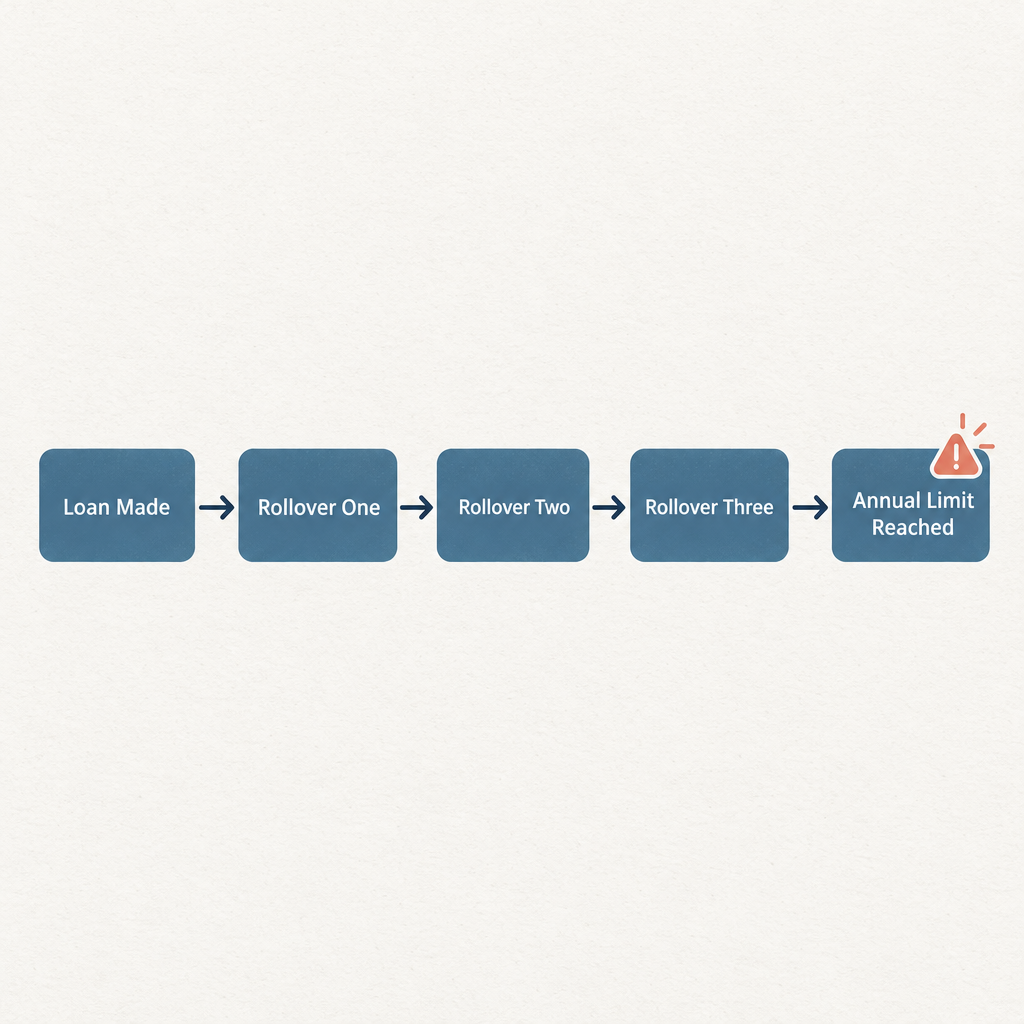
- A licensee may not roll over a short-term consumer loan more than four times.
- A licensee may not make a short-term consumer loan that would leave the borrower with more than five short-term consumer loans in any 12-month period. Rollovers, refinancings and loans made under a repayment plan all count toward the five.
So the practical maximum is five transactions a year, however they are structured. A borrower who takes one loan and rolls it over four times has used all five. A borrower who repays five separate loans in full has also used all five, and a sixth cannot legally be made by any Delaware licensee until the 12-month window has moved on.
The statewide database
Section 2235B directed the State Bank Commissioner to set up a database so lenders can verify a borrower’s loan count in real time. The Commissioner’s regulations in Title 5 of the Delaware Administrative Code spell out how licensees must query the system before funding a loan and record each loan, rollover and payoff. Every licensed storefront and online lender serving Delaware residents is supposed to check it. A lender that skips the database check and makes a sixth loan is violating state law, which is useful leverage if you end up in a dispute.
Cooling-off periods
Delaware has no cooling-off period between loans. Some states require a day or more after a certain number of consecutive loans; Delaware relies entirely on the annual count. There is also no state-mandated extended payment plan of the kind Florida and Washington require, so a borrower who cannot repay has to negotiate directly with the lender.
Same-day loans in Delaware
Searches for same day loans in Delaware mostly turn up the same licensed short-term lenders described above, plus cash advance apps and online installment lenders. Speed does not change the legal category. A $400 loan funded in an hour and due in two weeks is a short-term consumer loan, counts toward your five, and must appear in the database. Be especially cautious with any site promising same-day money with “no credit check” and “guaranteed approval.” Those are marketing phrases, not legal terms. What usually happens behind them is a soft credit pull or alternative data check, a higher price to offset the risk, and in the worst cases an unlicensed lender operating outside Delaware’s rules.
Car title loans in Delaware
Title loans are legal in Delaware and have their own set of rules inside the Licensed Lenders chapter. Delaware added a title loan subchapter to 5 Del. C. Chapter 22 in 2010 (5 Del. C. § 2250 and following). As with payday loans, the legislature chose procedural limits over a price cap.
What the title loan law requires
- The lender must hold a Delaware license and must actually take possession of the vehicle’s title as security; the borrower keeps driving the car.
- The total term of a title loan, including any rollover or renewal, cannot exceed 180 days.
- Before repossessing a vehicle after default, the lender must offer the borrower a workout agreement that spreads the balance over a series of payments. Repossession is allowed only after the borrower declines or fails to perform the workout.
- If the lender repossesses and sells the car, any surplus above the debt and reasonable costs belongs to the borrower.
There is no interest rate ceiling for title loans. Lenders typically price them monthly, and a rate of 25% per month (about 300% APR) is common in states without caps. The 180-day rule stops the loan from rolling indefinitely, but six months at that pricing still costs more than the original loan.
| Title loan amount | Monthly interest | Months before payoff | Interest paid | Total repaid |
|---|---|---|---|---|
| $1,000 | 25% ($250) | 1 | $250 | $1,250 |
| $1,000 | 25% ($250) | 3 | $750 | $1,750 |
| $1,000 | 25% ($250) | 6 (the legal maximum) | $1,500 | $2,500 |
| $2,500 | 20% ($500) | 6 | $3,000 | $5,500 |
These figures are illustrations, since Delaware law does not set a rate. The point is that a title loan is a contract that can cost two to three times the amount borrowed within its legal term, and the collateral is a car you probably need to get to work.
Repossession in practice
Because the lender holds the title, it does not need to sue you first. Delaware’s workout requirement is your main protection, so put any request for a workout in writing and keep a copy. If a lender repossesses without offering one, that is a licensing violation you can report to the State Bank Commissioner. After a sale, ask for a written accounting showing the sale price, the costs deducted and any surplus owed to you.
Installment and personal loans in Delaware
Installment loans in Delaware, meaning loans repaid in a series of scheduled payments over months or years, come from banks, credit unions and licensed lenders under Chapter 22. The licensing rule is the same: a non-bank lender needs a Delaware license under 5 Del. C. § 2202, and § 2229 lets the contract set the rate.
That means a Delaware installment loan can carry anything from a credit union’s 12% APR to an online lender’s 150% APR or more. The lender’s Truth in Lending disclosure is the only reliable place to compare them. Look for the APR, the finance charge in dollars, the total of payments and the payment schedule, all of which Regulation Z requires on the disclosure before you sign.
| $2,000 loan, 12 monthly payments | APR | Monthly payment | Total repaid | Finance charge |
|---|---|---|---|---|
| Credit union personal loan | 18% | $183 | $2,201 | $201 |
| Mid-cost licensed lender | 36% | $201 | $2,411 | $411 |
| High-cost online installment loan | 99% | $269 | $3,226 | $1,226 |
| Very high-cost installment loan | 150% | $330 | $3,965 | $1,965 |
The 36% row matters for two reasons. First, it is the ceiling federal law imposes for active-duty service members and their dependents under the Military Lending Act. Second, it is the line many consumer advocates and 18-plus states use as the dividing point between a credit product and a debt trap. Delaware draws no such line for civilians. Readers who have looked at our ohio payday loan laws page will recall that Ohio moved to a 28% rate plus capped fees in 2019; Delaware made the opposite choice and kept its contract-rate rule.
Retail installment contracts
Financing a purchase through a store, including furniture, appliances and some auto dealers, is governed separately by Delaware’s retail installment sales law in Title 6 of the Delaware Code. Those contracts still require Truth in Lending disclosures, and the same Attorney General consumer protection rules apply if a seller misrepresents the terms.
Online and tribal lenders: does Delaware law apply?
Delaware law applies to any lender making loans to Delaware residents, no matter where the lender sits. A company in Texas or Nevada that advertises to people in Wilmington or Dover needs a Chapter 22 license, must count loans against the five-per-year limit, and must use the database. Because Delaware has no rate cap, a large number of online lenders are in fact licensed here, so “online” by itself is not a warning sign. “Unlicensed” is.
Two categories deserve extra caution:
Tribal lenders. Some online lenders are owned by or affiliated with Native American tribes and claim sovereign immunity from state law. Federal courts have split on how far that immunity reaches, and the CFPB and several state attorneys general have brought cases against lenders that used tribal affiliation as a shield. From a borrower’s seat, the practical problems are that the lender may ignore the five-loan limit, may not appear in the Delaware database, and may be difficult to sue or complain about. A tribal lender that holds no Delaware license is not something the State Bank Commissioner can fully police.
Lenders with no license anywhere. These are the real danger. Delaware law requires a written agreement and licensure, so a loan from an unlicensed lender is, at minimum, a violation the Commissioner can act on. Unlicensed operations are also where most of the fraud lives: advance-fee “processing” charges, fake collection threats and unauthorized bank debits.
How to check a lender's license in Delaware
- Get the lender’s exact legal name and NMLS ID number. Licensed lenders print it on their website footer and loan documents.
- Search that name or ID on NMLS Consumer Access. The record should show an active Delaware license issued by the Office of the State Bank Commissioner.
- Cross-check against the licensee lists published on the Commissioner’s site at banking.delaware.gov. The two should match.
- If the lender appears on neither, treat the offer as unlicensed and do not share bank account details.
The license check works for online lenders, storefronts and title lenders alike. A lender that says it “doesn’t need a license because it’s online” or “operates under tribal law” has told you something important about how it will behave when you fall behind.
Debt collection and wage garnishment in Delaware
If a payday, title or installment loan goes unpaid, three sets of rules shape what can happen next: the federal Fair Debt Collection Practices Act for third-party collectors, Delaware’s Consumer Fraud Act for deceptive practices by anyone, and Delaware’s court rules on judgments and garnishment.
What collectors cannot do
The Fair Debt Collection Practices Act (15 U.S.C. § 1692 and following) applies to collection agencies, debt buyers and attorneys collecting consumer debts for others. It does not apply to the original lender collecting its own loan, though the CFPB can still act against lenders for unfair or deceptive practices. Under the FDCPA and the CFPB’s Regulation F (12 CFR 1006), a third-party collector cannot:
- Call before 8 a.m. or after 9 p.m. in your time zone, or call more than seven times in seven days about one debt.
- Threaten arrest or criminal prosecution over an unpaid consumer loan. Nonpayment of a payday loan is a civil matter, not a crime, in Delaware.
- Contact your employer about the debt beyond confirming your employment and address, or tell third parties you owe money.
- Continue contacting you after you send a written request to stop, except to confirm it will stop or to notify you of a specific legal action.
- Collect fees or interest the original contract and Delaware law do not allow.
Within five days of first contacting you, a collector must send a validation notice stating the amount, the creditor’s name and your right to dispute. If you dispute in writing within 30 days, collection must pause until the collector mails verification.
Delaware does not have its own fair debt collection act for private collectors, so the FDCPA is the main tool. The Delaware Consumer Fraud Act (6 Del. C. § 2511 and following) fills some gaps by banning deception in connection with the sale or advertisement of merchandise, which Delaware courts have read to include credit. The Attorney General’s Consumer Protection Unit enforces it.
Statute of limitations
Delaware’s general limitations period for a claim based on a contract or promise is three years (10 Del. C. § 8106). A lender or debt buyer that sues more than three years after your last payment or default faces a limitations defense, though you have to raise it; the court will not do it for you. Making a small payment or acknowledging the debt in writing can restart the clock, so get advice before paying anything on an old account.
Wage garnishment
This is where Delaware is stricter than most states. Federal law under Title III of the Consumer Credit Protection Act (15 U.S.C. § 1673) lets a judgment creditor take up to 25% of disposable earnings. Delaware’s statute, 10 Del. C. § 4913, exempts 85% of wages from attachment and execution, which leaves at most 15% for an ordinary creditor. A collector must first sue, win a judgment in Justice of the Peace Court, Court of Common Pleas or Superior Court, and then obtain a writ before an employer can withhold anything.
| Collection issue | Delaware rule | Source |
|---|---|---|
| Garnishment limit for consumer debt | 15% of wages (85% exempt) | 10 Del. C. § 4913 |
| Federal garnishment ceiling | 25% of disposable earnings | 15 U.S.C. § 1673 |
| Time limit to sue on a contract debt | 3 years | 10 Del. C. § 8106 |
| Criminal charges for an unpaid payday loan | Not permitted; civil debt only | FDCPA § 1692e |
| Collector call frequency | 7 calls in 7 days per debt | 12 CFR 1006.14 |
Bank account debits
Most payday and online installment lenders collect through automatic ACH debits. Two federal protections matter here. The Electronic Fund Transfer Act and Regulation E (12 CFR 1005.10(e)) prohibit a lender from making repayment by preauthorized electronic transfer a condition of getting the loan, and they give you the right to revoke an authorization by notifying your bank at least three business days before the next scheduled debit. Separately, the CFPB’s payday lending rule (12 CFR Part 1041), whose payment provisions took effect March 30, 2025 after years of litigation, bars covered lenders from trying to pull a payment a third time after two consecutive attempts have failed, unless you sign a new authorization. Repeated failed debits are what generate the stack of $30-plus overdraft fees that often cost more than the loan itself.
Help that costs less than a payday loan
Because Delaware sets no price ceiling, the gap between a payday loan and the next-cheapest option is wider here than in a capped state. Every one of the resources below exists and serves Delaware residents.
Cheaper options first
A federal credit union payday alternative loan caps the APR at 28% and the fee at $20.
Delaware 2-1-1 connects callers to emergency rent, utility and food programs with no repayment.
A written hardship or payment plan with the original creditor usually beats a new loan to pay an old bill.
Credit union payday alternative loans
Federal credit unions can offer two products under NCUA rules (12 CFR 701.21(c)(7)(iii) and (iv)). A PAL I loan runs from $200 to $1,000 over one to six months, with an APR capped at 28% and an application fee of no more than $20; you must have been a member for at least a month. A PAL II loan goes up to $2,000 over as long as 12 months with the same rate and fee caps and no waiting period. On a $1,000 loan repaid over six months at 28%, the interest comes to roughly $84 plus the fee, against $250 or more per month on a comparably priced payday or title loan. Delaware has several community-chartered credit unions, including Del-One Federal Credit Union and Dover Federal Credit Union, and Stepping Stones Community Federal Credit Union in Wilmington is a certified community development financial institution built for lower-income borrowers. Not every credit union offers PALs, so ask about small-dollar or “emergency” loans by name.
State and local assistance
- Delaware 2-1-1 (Delaware Helpline) is the statewide referral line for emergency financial help, run through United Way of Delaware.
- $tand By Me, a partnership between the state and United Way of Delaware, offers free one-on-one financial coaching, including help building a budget and negotiating with creditors.
- Delaware Division of Social Services administers SNAP, TANF cash assistance and General Assistance, and can screen you for all three in one application.
- Low Income Home Energy Assistance Program (LIHEAP), administered in Delaware through Catholic Charities, pays toward heating and cooling bills and can prevent the utility shutoff that often triggers a payday loan.
- Delaware State Housing Authority runs the Delaware Emergency Mortgage Assistance Program for homeowners who have fallen behind because of a job loss or medical event.
- Delaware Community Reinvestment Action Council (DCRAC) provides free financial counseling and tax preparation, and is the organization behind Stepping Stones.
Other lower-cost routes
Nonprofit credit counseling agencies that belong to the National Foundation for Credit Counseling can set up a debt management plan that lowers card interest without a new loan. Many hospitals in Delaware have financial assistance policies that are required by federal tax law for nonprofit hospitals (26 U.S.C. § 501(r)), so a medical bill should never be paid with a payday loan before asking about charity care. Employer-based earned wage access with no fee, or a cash advance app’s no-fee standard transfer, costs less than any licensed short-term loan in Delaware, though the “optional tips” and express fees on some apps can push the effective APR back into triple digits.
Federal rules that apply in Delaware
A handful of federal laws sit on top of Delaware’s rules and apply to every lender in the state:
- Truth in Lending Act and Regulation Z (12 CFR 1026) require a written disclosure of the APR, finance charge, amount financed and total of payments before you become obligated. A lender that hides the APR or quotes only a “fee” has violated federal law.
- Military Lending Act (10 U.S.C. § 987, 32 CFR Part 232) caps the military annual percentage rate at 36% for loans to active-duty service members and their dependents, and bans mandatory arbitration and vehicle title security in those loans. Dover Air Force Base families are covered, and a Delaware lender’s lack of a state rate cap changes nothing for them.
- Servicemembers Civil Relief Act (50 U.S.C. § 3937) limits interest to 6% on debts a service member took on before entering active duty, once the member gives written notice.
- Fair Debt Collection Practices Act (15 U.S.C. § 1692) governs third-party collectors as described above.
- Fair Credit Reporting Act (15 U.S.C. § 1681) gives you the right to dispute inaccurate loan information on your credit reports and requires the furnisher to investigate.
- Equal Credit Opportunity Act (15 U.S.C. § 1691) bars lenders from denying credit based on race, sex, age, marital status, receipt of public assistance and other protected characteristics, and requires a written statement of reasons for a denial.
How to check a lender’s license and file a complaint
Delaware splits enforcement between two agencies. Lending and licensing questions go to the Office of the State Bank Commissioner, which licenses and examines every non-bank lender under Chapter 22. Deceptive advertising, fake collectors and scams go to the Consumer Protection Unit of the Delaware Department of Justice, which enforces the Consumer Fraud Act. The CFPB takes complaints about both lenders and collectors nationwide and forwards them to the company, which must respond, usually within 15 days.
| Problem | Where to go | What they can do |
|---|---|---|
| Lender exceeded 5-loan limit, skipped database, or is unlicensed | Office of the State Bank Commissioner, Dover (banking.delaware.gov) | Examine, fine, suspend or revoke the license |
| Title lender repossessed without offering a workout | Office of the State Bank Commissioner | Enforce 5 Del. C. Chapter 22 title loan rules |
| Deceptive ads, fake “legal” threats, advance-fee loan scams | Delaware DOJ Consumer Protection Unit | Investigate under the Consumer Fraud Act |
| Collector harassment, false threats, debits you did not authorize | CFPB complaint portal (consumerfinance.gov/complaint) | Require a company response; feed enforcement data |
| Internet loan fraud, identity theft tied to a loan application | FBI IC3 (ic3.gov) and FTC ReportFraud (reportfraud.ftc.gov) | Track and investigate fraud networks |
| Unlicensed lender operating in Delaware | State Bank Commissioner and CFPB (both) | State license action plus federal review |
When you complain, include the loan agreement, the Truth in Lending disclosure, screenshots of the lender’s website and any texts or call logs. For a database or five-loan dispute, list the dates and amounts of every short-term loan you took in the previous 12 months. The Commissioner can pull the database record to confirm.
Delaware’s complaint record shows a pattern worth knowing. The CFPB’s public complaint database, searchable by state and product, shows that Delaware consumers’ complaints about payday, title and personal loans most often involve lenders charging fees or interest the borrower did not expect and problems with unauthorized withdrawals, which mirrors national patterns for no-cap states.
How Delaware compares with its neighbors
Delaware’s choice to regulate frequency rather than price stands out sharply against the states around it. Pennsylvania effectively bans payday lending by capping small-loan charges under its Consumer Discount Company Act and Loan Interest and Protection Law, and it has no licensed storefront payday lenders. Maryland caps interest on small loans at 33% per year under its Consumer Loan Law, and New Jersey’s 30% criminal usury ceiling keeps payday lenders out entirely. That is why Delaware storefronts cluster near the Pennsylvania and Maryland lines and draw borrowers across them.
| State | Payday lending | Rate or fee cap | Loan-frequency limits |
|---|---|---|---|
| Delaware | Legal | None | 5 loans per 12 months; 4 rollovers |
| Pennsylvania | Effectively banned | Small-loan rate cap under CDCA | Not applicable |
| Maryland | Effectively banned | 33% APR on small loans | Not applicable |
| New Jersey | Effectively banned | 30% criminal usury cap | Not applicable |
Borrowers who live in Delaware but work in Maryland or Pennsylvania sometimes ask which law applies. The answer is the law of the state where the lender is licensed and where the loan is made. A Delaware-licensed lender lending to a Delaware resident is governed by Delaware law, regardless of where the borrower’s paycheck comes from. Delaware is not alone in this approach: our texas payday loan laws page describes a state that also has no effective rate cap and relies on local ordinances and disclosure rules instead.
Pending changes to watch
As of the most recent legislative session we reviewed, no bill to impose a rate cap on short-term consumer loans or title loans had passed either chamber of the Delaware General Assembly. Rate-cap bills have been introduced in prior sessions and died in committee. The 2012 amendments remain the last significant change to Delaware’s small-loan rules. At the federal level, the CFPB’s 2017 ability-to-repay requirements for payday loans were rescinded in 2020 and never took effect; only the payment-withdrawal provisions survived and are now in force. Any reader relying on this page for a specific transaction should confirm the current text of 5 Del. C. Chapter 22 on the Delaware General Assembly’s website, since statutes change and we update these pages on a schedule rather than in real time.
Before you borrow
Delaware caps how many short-term loans you can take, not what they cost. A $500 loan at the common $20-per-$100 rate costs $100 every 30 days, and a title loan can legally run six months at pricing that doubles the debt. Exhaust the no-cost and 28%-capped options first, and never give bank account access to a lender you cannot find on NMLS Consumer Access.
FAQ
Are payday loans legal in Delaware?
Yes. Delaware allows short-term consumer loans of up to $1,000 with terms under 120 days from lenders licensed by the Office of the State Bank Commissioner under 5 Del. C. Chapter 22. The state caps each borrower at five such loans, including rollovers, in any 12-month period, but it does not cap the interest rate or fees.
How many payday loans can I have in Delaware?
Five in a rolling 12-month period, under 5 Del. C. § 2235A. Rollovers, refinancings and repayment-plan loans all count toward the five, and a single loan cannot be rolled over more than four times. Lenders must check the state database before each loan, so a sixth loan from a licensed lender should be refused. You can hold more than one loan at a time as long as the annual count stays at five or fewer.
What is the maximum interest rate on a loan in Delaware?
For licensed lenders there is none. Section 2229 of Title 5 allows the rate the written agreement states, and that applies to payday, title and installment loans alike. The only hard ceilings are federal: 36% MAPR for active-duty military under the Military Lending Act and 6% on pre-service debts under the Servicemembers Civil Relief Act.
Are car title loans legal in Delaware?
Yes, from licensed lenders, under the title loan subchapter of 5 Del. C. Chapter 22. The total term including renewals cannot exceed 180 days, the lender must offer a workout agreement before repossessing, and any surplus from a sale belongs to the borrower. There is no cap on the interest rate.
Can a payday lender garnish my wages in Delaware?
Only after suing you and winning a judgment. Once it has one, Delaware law (10 Del. C. § 4913) exempts 85% of your wages, so the most an ordinary creditor can take is 15%, well below the 25% federal maximum. A lender or collector that claims it can garnish you without a court judgment, or threatens arrest, is violating the Fair Debt Collection Practices Act.
How do I know if an online lender is licensed in Delaware?
Search the lender’s name or NMLS ID on NMLS Consumer Access and confirm it shows an active Delaware license from the Office of the State Bank Commissioner, then compare it with the licensee lists on banking.delaware.gov. If the lender appears on neither, do not provide bank account information, and report the offer to the Commissioner and to the CFPB.
Laws and regulations referenced
- Truth in Lending Act, 15 U.S.C. 1601
- Regulation Z, 12 CFR Part 1026
- Fair Debt Collection Practices Act, 15 U.S.C. 1692
- Regulation F (debt collection), 12 CFR Part 1006
- Fair Credit Reporting Act, 15 U.S.C. 1681
- Equal Credit Opportunity Act, 15 U.S.C. 1691
- Electronic Fund Transfer Act, 15 U.S.C. 1693
- Regulation E (electronic transfers), 12 CFR Part 1005
- Military Lending Act, 10 U.S.C. 987
- Military Lending Act rule, 32 CFR Part 232
- Servicemembers Civil Relief Act, 50 U.S.C. 3901
- CFPB payday lending rule, 12 CFR Part 1041
Links go to the official text on government sites.
Check, verify or complain
Sources
- consumerfinance.gov › rules policy › final rules › debt collection practices regulation f consumerfinance.gov · primary source
- militaryonesource.mil › financial legal › legal › servicemembers civil relief act militaryonesource.mil · primary source
- experian.com › blogs › ask experian › what is payday loan alternative experian.com
- nolo.com › legal encyclopedia › delaware wage garnishment laws nolo.com
- ustatesloans.org › law › de ustatesloans.org
- recordinglaw.com › us laws › debt collection › delaware debt collection laws recordinglaw.com
- consumerfinancemonitor.com › 2020 › 07 › 07 › cfpb issues final rule rescinding payday loan rule ability… consumerfinancemonitor.com
- delawarepublic.org › 2012 06 13 › delaware moves to limit payday loans delawarepublic.org

Elena writes about getting through a money emergency, assistance programs, budgeting on a tight income, banking basics and borrower rights. Her guides list the cheaper options first and link the agency or program that can actually help.

Ruth is US Financer's standards editor. Every article goes through her checks before and after it is published: each rate, fee, cap, deadline and rule is matched against its primary source, every law named is linked to its official text, and anything that cannot be…
Comments are closed