Runs in your browser. Nothing you type is sent or saved.
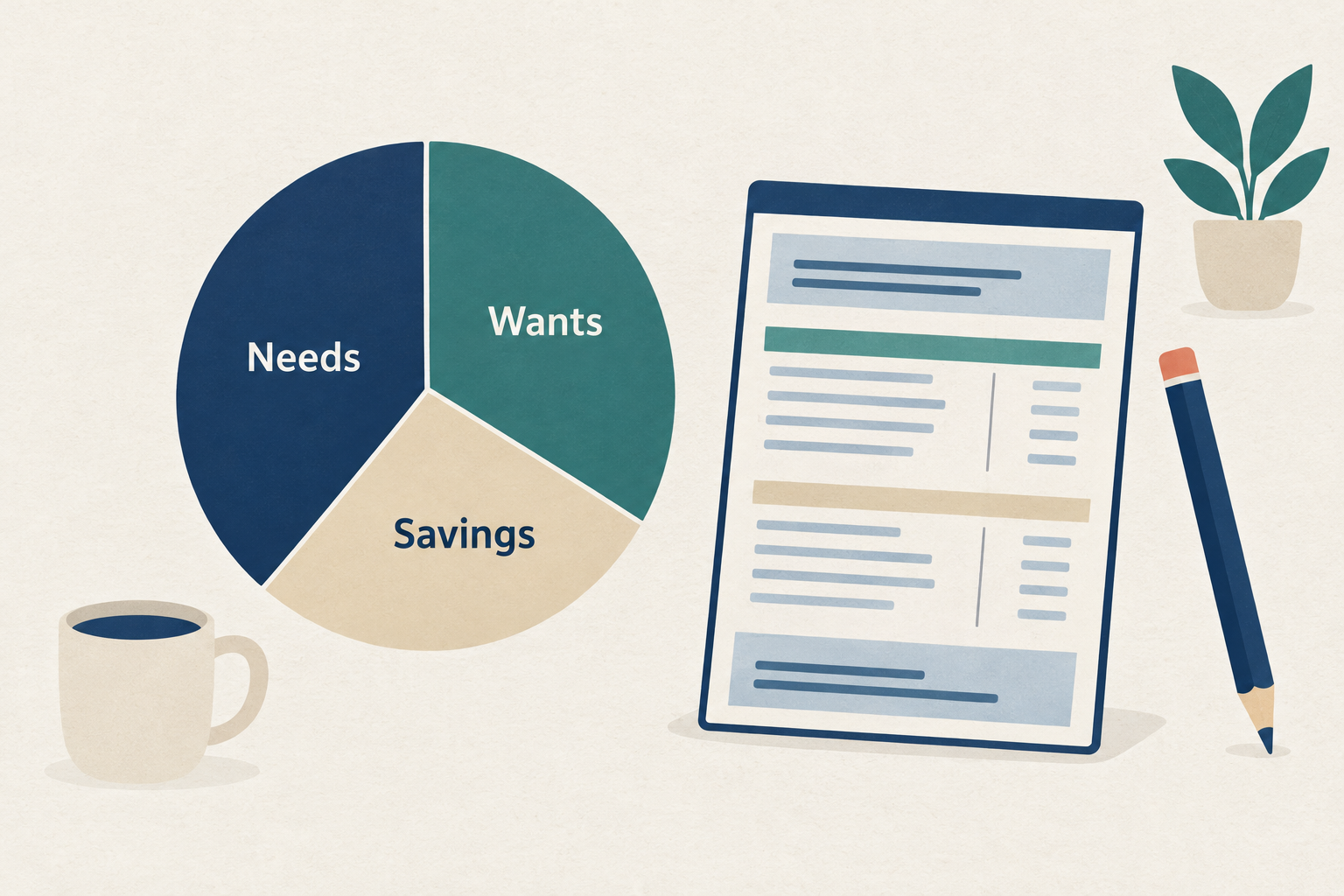
This budget calculator splits your monthly take-home pay into the 50/30/20 shape (half for needs, 30% for wants, 20% for savings and extra debt payments) and then shows how far your real spending sits from that target. You need three numbers: what hits your bank account each month after taxes, what you spend on needs, and what you spend on wants. The result is a dollar figure, the gap between what you have left and the 20% savings goal, which is far more useful than a vague feeling that money is tight.
How to use the calculator
- Find your monthly take-home pay on your pay stub (the “net pay” line) and multiply by the number of paychecks you get in a typical month. Use the amount after taxes, health insurance and 401(k) deductions.
- Add up last month’s needs from your bank and credit card statements: rent or mortgage, utilities, groceries, insurance, transportation to work, child care and the minimum payment on every loan and card. The minimum payment is printed on each statement or loan offer.
- Add up last month’s wants from the same statements: dining out, streaming, shopping, hobbies, travel and anything you could stop paying next month without real harm.
- Enter the three numbers in the fields marked Monthly take-home pay, Spent on needs now and Spent on wants now.
- Read the gap line. A positive gap is the extra you would need to free up each month to reach 20%. A zero or negative gap means you already meet the target.
- Change one field at a time (a cheaper phone plan, a lower rent after a move) to see how each decision moves the gap.
What each field means and the mistakes that throw off the result
The calculator only has three inputs, but each one has a trap. Put the wrong number in and the percentages come out looking better or worse than your real life.
Monthly take-home pay ($)
This is money that actually lands in your account. Gross salary is the wrong number here because the 50/30/20 rule was written around after-tax income. If you are paid every two weeks, you get 26 checks a year, which averages 2.17 per month. Most people budget on two checks and treat the two extra checks a year as bonus months. Either approach works as long as the needs and wants you enter cover the same period.
Self-employed readers and gig workers should enter what is left after setting aside estimated taxes. The IRS expects quarterly estimated payments from people whose tax is not withheld, so money you owe to the IRS in April is not take-home, it is a bill with a deadline. A reasonable approach is to average the last three to six months of net deposits and use the low end if your income swings.
Common mistakes:
- Entering gross pay from the job offer instead of net pay from the stub.
- Counting a one-time tax refund or a bonus as monthly income.
- Forgetting that a 401(k) contribution already came out before take-home. That money is savings, so if you count it toward the 20% target you are effectively saving more than the calculator shows. We cover how to handle this below.
Spent on needs now (housing, food, bills, minimum debt payments) ($)
Needs are the costs that would cause real harm if you stopped paying them within a month: you would lose your home, your car, your job, your insurance, or your credit would take a hit. The usual list is rent or mortgage principal and interest, property tax and homeowners or renters insurance, electricity, gas, water, trash, internet if you need it to work, basic phone service, groceries, prescriptions and health insurance premiums not already taken from your check, child care, gas or transit fare to get to work, car insurance and the minimum payment on every debt.
Only the minimum payment on each debt belongs here. Anything you pay above the minimum is a choice, and the 50/30/20 rule counts it in the 20% bucket with savings. Keeping the two separate is what makes the gap number honest.
Common mistakes:
- Putting the full credit card payment under needs when only the minimum is required.
- Leaving out insurance, car registration or other bills that arrive once or twice a year. Divide the annual amount by 12 and add it.
- Counting the full grocery bill as a need when a third of it is snacks, alcohol and convenience food. A rough split is fine, but be honest.
Spent on wants now ($)
Wants are everything you could cancel or cut next month without losing your housing, transportation, health or job. Restaurants and takeout, streaming subscriptions, gym memberships, clothing beyond basics, hobbies, gifts, vacations, upgraded phone plans, rideshares when transit would work.
The hardest judgment calls sit at the border. A car payment is a need if you need the car to work, but the difference between a $350 payment on a basic used car and a $750 payment on a new one is a want. The same logic applies to housing: the rent on a safe place within reach of work is a need, the extra $400 for the unit with the pool and the view is a want. You do not have to split hairs. Put the whole payment under needs if that is simpler, and just know your needs number is carrying some lifestyle cost.
Common mistakes:
- Entering zero for wants because nothing felt frivolous last month. Check the statements. Small recurring charges add up.
- Double counting. If a cost is in needs, it does not also go in wants.
- Forgetting cash spending. If you withdraw $200 a month at the ATM and cannot say where it went, it is a want.
The 50/30/20 formula, written out
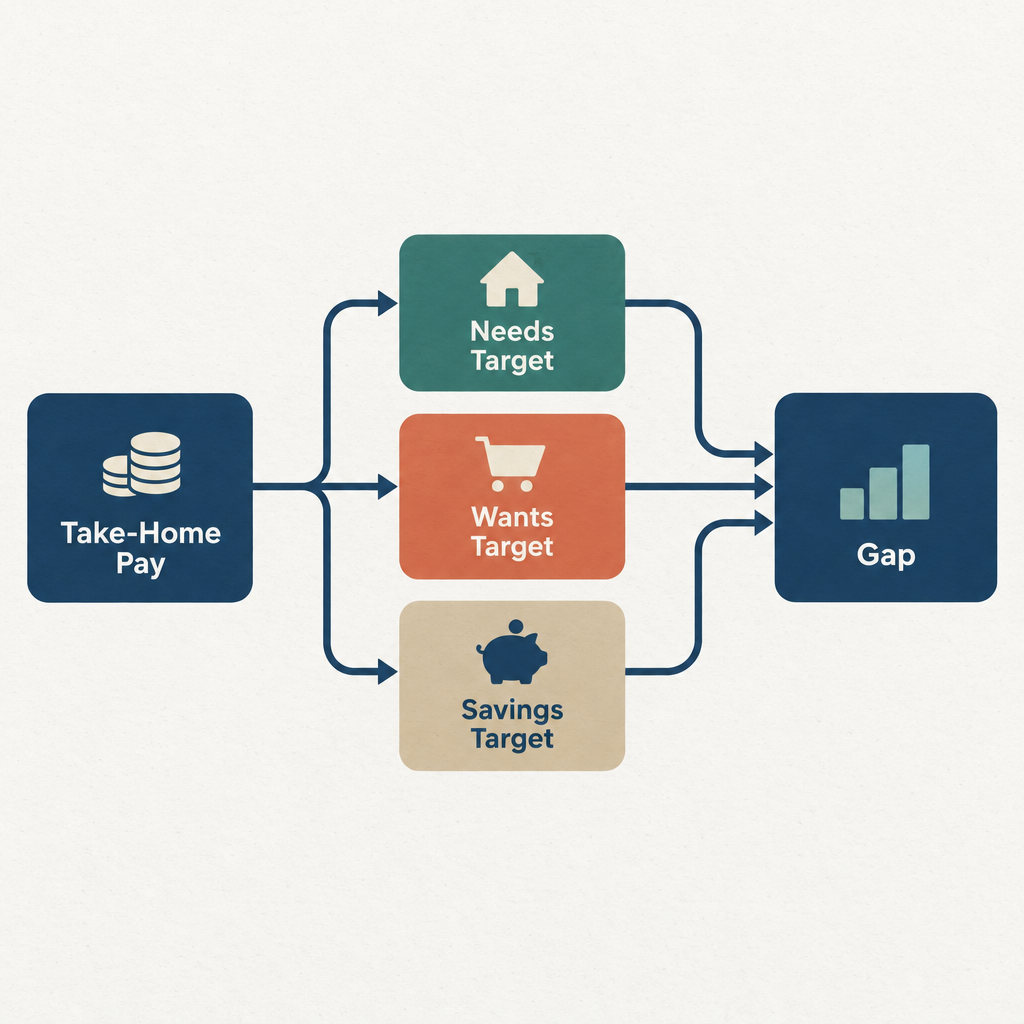
The calculator runs four short calculations on your three inputs.
Targets. Needs target = take-home × 0.50. Wants target = take-home × 0.30. Savings and extra debt payments target = take-home × 0.20.
Your current percentages. Needs now ÷ take-home, and wants now ÷ take-home, each shown as a whole percentage.
Left for savings and extra debt payments. Take-home − needs now − wants now. This is simply what is not spent on the first two categories.
Gap to the 20% target. Savings target − what is left. A positive number means you fall short by that many dollars each month. Zero means you hit the target exactly. A negative number means you already save more than 20%.
The default example, step by step
The calculator loads with $4,000 take-home, $2,300 on needs and $1,100 on wants. Here is every line.
- Needs target: $4,000 × 0.50 = $2,000.00.
- Wants target: $4,000 × 0.30 = $1,200.00.
- Savings target: $4,000 × 0.20 = $800.00.
- Needs now: $2,300 ÷ $4,000 = 0.575, shown as 58%. That is $300 over the target.
- Wants now: $1,100 ÷ $4,000 = 0.275, shown as 28%. That is $100 under the target.
- Left for savings and extra debt payments: $4,000 − $2,300 − $1,100 = $600.00, which is 15% of take-home.
- Gap: $800 − $600 = $200.00.
So this household saves $600 a month, which is real progress, but it sits $200 short of the 20% mark. The percentages tell you where the pressure comes from: wants are already under budget, so the problem is a needs number that eats 58% of pay. That is a housing or debt problem, not a dining-out problem, and the fix is different.
A second example with higher pay and a higher rent
Take a household with $5,600 in monthly take-home, $3,250 in needs and $1,500 in wants. The same four steps:
| Line | Arithmetic | Result |
|---|---|---|
| Needs target (50%) | $5,600 × 0.50 | $2,800.00 |
| Wants target (30%) | $5,600 × 0.30 | $1,680.00 |
| Savings target (20%) | $5,600 × 0.20 | $1,120.00 |
| Needs now | $3,250 ÷ $5,600 = 0.5804 | $3,250.00 (58%) |
| Wants now | $1,500 ÷ $5,600 = 0.2679 | $1,500.00 (27%) |
| Left for savings | $5,600 − $3,250 − $1,500 | $850.00 (15%) |
| Gap to 20% target | $1,120 − $850 | $270.00 |
Higher income, same shape. Needs run 8 points over, wants run 3 points under, and the savings rate lands at 15% again. The dollar gap is bigger ($270 instead of $200) because 20% of a bigger paycheck is a bigger number. This is a useful reminder that the rule scales: a raise does not fix the ratio unless your needs stay flat while pay grows.
A third example where the gap includes overspending
Now a tighter case: $3,200 take-home, $2,100 needs, $1,300 wants.
- Needs target: $1,600. Needs now: $2,100 ÷ $3,200 = 65.6%, roughly 66%.
- Wants target: $960. Wants now: $1,300 ÷ $3,200 = 40.6%, roughly 41%.
- Savings target: $640.
- Left: $3,200 − $2,100 − $1,300 = −$200.
- Gap: $640 − (−$200) = $840.
A negative “left” figure means this person spends $200 more than they bring in every month, which has to be coming from a credit card, a cash advance or a shrinking savings balance. The gap of $840 is the full distance to the target: $200 to stop the bleeding plus $640 to reach 20%. When the gap is bigger than the savings target, the first job is closing the deficit, and the second job is saving.
Quick reference: the 50/30/20 split at common take-home levels
Every row uses the same multiplication the calculator runs. Find the row closest to your pay to sanity-check what you see on screen.
| Monthly take-home | Needs (50%) | Wants (30%) | Savings and extra debt (20%) |
|---|---|---|---|
| $2,000 | $1,000 | $600 | $400 |
| $2,500 | $1,250 | $750 | $500 |
| $3,000 | $1,500 | $900 | $600 |
| $3,500 | $1,750 | $1,050 | $700 |
| $4,000 | $2,000 | $1,200 | $800 |
| $4,500 | $2,250 | $1,350 | $900 |
| $5,000 | $2,500 | $1,500 | $1,000 |
| $6,000 | $3,000 | $1,800 | $1,200 |
| $7,500 | $3,750 | $2,250 | $1,500 |
| $10,000 | $5,000 | $3,000 | $2,000 |
The second table shows what happens to the gap as needs creep up while wants stay exactly at 30%. It is built on the $4,000 default, so the savings target is $800 in every row.
| Needs as share of take-home | Needs in dollars | Left after 30% wants | Gap to $800 target |
|---|---|---|---|
| 50% | $2,000 | $800 | $0 |
| 55% | $2,200 | $600 | $200 |
| 60% | $2,400 | $400 | $400 |
| 65% | $2,600 | $200 | $600 |
| 70% | $2,800 | $0 | $800 |
| 75% | $3,000 | −$200 | $1,000 |
Each 5-point rise in needs costs $200 of monthly savings at this income. Past 70%, there is nothing left even if wants are perfectly disciplined, which is why people in high-rent cities often find the rule impossible without changing housing or income.
Reading your result: what a high or low number looks like
The gap is the headline, but the two percentages under it tell you what kind of problem you have.
When needs run high
Needs above 50% is the most common result, and above 60% is where things get hard. Housing is almost always the cause. Federal housing policy has long used 30% of income as the threshold for being “cost burdened” (the Department of Housing and Urban Development uses this definition in its affordable housing programs), and a rent that takes 35% or 40% of take-home leaves very little room for everything else in the needs bucket.
Debt minimums are the second driver. Three credit cards, a car loan and a student loan can easily absorb 15% to 20% of take-home on minimums alone. Student loan borrowers on income-driven repayment plans can often lower that figure, since those plans tie the payment to discretionary income rather than the balance. If your student loan servicer has you on a standard plan, the Department of Education’s loan simulator shows what other plans would charge before you switch.
What to compare: your rent against 30% of take-home, and your total debt minimums against 10% of take-home. If either is well over, that is where the dollars are.
When wants run high
Wants above 30% is the easier problem to fix and the one most budgeting advice focuses on, which is why it gets more attention than it deserves. Pull the statements, sort by merchant, and the top five usually account for most of the excess. Subscriptions are worth a hard look because they renew silently. Several banks now show recurring charges in their apps, and the Federal Trade Commission has rules under the Restore Online Shoppers’ Confidence Act requiring online sellers to make cancellation simple, so a subscription that is hard to cancel is worth a complaint.
When the gap is zero or negative
A negative gap means you already clear 20%. That is the point where the question shifts from “how much” to “where.” The usual order is a starter emergency fund of a few hundred to a thousand dollars, then any debt charging more than about 10% APR, then a full emergency fund of three to six months of needs, then retirement and other goals. Credit card balances at 20% to 30% APR beat almost any savings account, so paying them down is the better use of the 20% bucket once a small cushion exists.
Cheaper and safer options before you borrow to close the gap
A positive gap tempts people toward a quick fix: a cash advance app, a payday loan, a card with a promotional rate. Each of those turns a budgeting problem into a debt problem with a fee attached. Look at these first.
Cheaper options first
Call each lender and ask for a hardship plan before you miss a payment; most card issuers have one and it usually lowers the rate.
Check your utility company for budget billing and low-income assistance programs such as LIHEAP for heating and cooling bills.
A nonprofit credit counselor approved by the Department of Justice can set up a debt management plan with reduced card rates for a small monthly fee.
Other places to look: your employer may offer a no-fee earned wage access benefit, which beats any third-party advance app. Federal credit unions can offer Payday Alternative Loans under NCUA rules, which cap the rate at 28% APR and the application fee at $20. State and county assistance programs for rent, food and child care often go unclaimed because people assume they do not qualify. And if the gap is small and temporary, picking up extra hours or short-term work is cheaper than any loan. We keep a separate guide to legitimate ways to earn money fast, including options that pay the same day.
Before you borrow
A loan does not close a budget gap, it moves the gap into next month and adds a fee. If your needs plus wants already exceed take-home, borrowing to cover the difference means the same shortfall returns with interest on top.
To make that concrete, here is what two ways of covering a $500 shortfall cost, using the fee structure the Consumer Financial Protection Bureau cites for a typical storefront payday loan and the maximum terms allowed for a credit union Payday Alternative Loan.
| Option | Amount | Fee or APR | Term | Total repaid |
|---|---|---|---|---|
| Storefront payday loan | $500 | $15 per $100 borrowed (about 391% APR) | 14 days | $575 |
| Payday Alternative Loan (PAL I) | $500 | 28% APR plus $20 application fee | 6 months | about $562 |
| Card hardship plan at reduced rate | $500 existing balance | lender sets, often under 10% | varies | depends on plan |
The payday APR math in plain words: $75 on $500 is 15% for two weeks. There are roughly 26 two-week periods in a year, so 15% × 26 comes to about 391% a year. The PAL figure comes from a standard amortizing payment of about $90 a month for six months, which totals about $542 in principal and interest, plus the $20 fee. Both options cost money, but one costs $75 for two weeks and the other costs about $62 for six months.
Handling the two things the calculator leaves out
The calculator reads one month. Two things do not fit neatly into that frame.
Irregular bills: car insurance paid every six months, property tax, annual subscriptions, holiday spending. Add up a year of these, divide by 12, and either include the result in needs or wants as appropriate, or treat the monthly share as a transfer to a separate “sinking fund” account that counts toward your 20%. The second approach is cleaner because the money is set aside before the bill arrives.
Pre-tax savings: a 401(k) contribution comes out before take-home pay. If you contribute 6% of gross and your employer matches, you are already saving a meaningful share. Some readers count that toward the 20% and aim for a smaller after-tax savings target. Others ignore it and treat the 20% as a separate after-tax goal. Either is fine, as long as you know which one you chose. The one thing not to do is stop the 401(k) to make the calculator look better, because an employer match is money you give up by stopping.
Where the 50/30/20 budget calculator fits with the rules that protect you
A budget is private math, but several federal and state rules shape the numbers that go into it, especially on the debt side.
Truth in Lending Act and Regulation Z
The Truth in Lending Act, implemented by Regulation Z (12 CFR 1026), requires lenders to disclose the annual percentage rate and the finance charge before you sign, in a standard format so offers can be compared. This matters for the needs field because the minimum payment on a loan is set by the loan terms, and the APR tells you how much of that minimum is interest rather than principal. Regulation Z also requires credit card statements to show how long it would take to pay off the balance making only minimum payments, and what it would cost to pay it off in three years. That minimum payment warning is a quick way to see why minimum payments belong in needs and extra payments belong in the 20% bucket. A credit card payoff calculator does the same arithmetic for any balance, rate and payment you choose.
State rate caps
The cost of closing a gap with a small loan depends almost entirely on where you live. The Center for Responsible Lending counts roughly 20 states plus the District of Columbia that cap small-dollar loan rates at or around 36% APR, which effectively bans the two-week payday product. Other states allow it with fee caps, and a few allow nearly unlimited cost. Texas is the clearest example of the loose end of the range, because lenders there operate as credit access businesses and charge fees on top of the interest cap, and our separate piece on Texas payday loan laws walks through what that means in dollars. Before taking any loan to cover a gap, check the lender’s license on NMLS Consumer Access or with your state’s financial regulator.
Military Lending Act
Active-duty service members and their dependents are covered by the Military Lending Act (10 U.S.C. 987 and the Department of Defense rule at 32 CFR 232), which caps the Military Annual Percentage Rate on most consumer credit at 36%, including most fees. It also bans mandatory arbitration and certain allotment-based repayment on covered loans. If you are covered, a payday or title loan priced above 36% MAPR is illegal, and the Servicemembers Civil Relief Act separately lets you reduce the rate on debts taken on before active duty to 6%. These protections change the debt lines in your needs field, so it is worth knowing them before you accept a minimum payment as fixed.
Savings, insurance and crypto in the 20% bucket
Money in the 20% bucket should sit somewhere safe until it has a job. Deposits at FDIC-insured banks are protected up to $250,000 per depositor, per bank, per ownership category, and the National Credit Union Administration provides the same coverage at federally insured credit unions. Cryptocurrency is not covered by either, and it can lose all of its value. If any part of your savings goes into crypto, the IRS treats it as property under IRS Notice 2014-21, which means every sale, swap or purchase with crypto is a taxable event you must report. We cover crypto on this site as education only, and it has no place in an emergency fund.
Making the 50/30/20 split work month after month
The calculator gives you a target. Hitting it is a separate problem.
Automate the 20% first
The rule’s original framing, from Elizabeth Warren and Amelia Warren Tyagi’s book on household finance, was that savings should come out before discretionary spending, not after. In practice that means a scheduled transfer on payday into a separate savings account, sized to whatever you can manage now (even $50), and increased each time you close part of the gap. If you wait until the end of the month to save what is left, there is rarely anything left.
Track the two percentages, not every dollar
Zero-based budgets and envelope systems work for people who enjoy them. The 50/30/20 approach is for people who do not. You need two numbers each month: what went to needs, what went to wants. Most banks categorize transactions automatically, and a monthly ten-minute review of the categories is enough to keep the percentages honest. Re-run the calculator each month with the fresh totals and watch the gap move.
Attack needs with big moves, wants with small ones
Needs above 50% rarely yield to small cuts because the big items are fixed. The moves that work are structural: a roommate, a cheaper apartment at the next lease renewal, refinancing a car loan with a lower rate (a car payment calculator will show the monthly difference), consolidating cards into a personal loan at a lower APR (check the full cost with a personal loan calculator before assuming it saves money), or moving student loans to an income-driven plan. Each of these can shift the needs line by $100 to $500 a month in one step.
Wants above 30% yield to the opposite approach. Cancel the three subscriptions you forgot about, set a weekly takeout number, and move the difference to savings the day you make the change.
Know when the rule does not fit
The rule is a benchmark, not a law. It assumes a middle income in a moderately priced area. At $2,000 a month in take-home, 50% for needs is $1,000, which does not cover rent in most US metros, and the useful version of the rule becomes “cover needs, keep wants as low as possible, save anything at all.” At $10,000 a month, 30% for wants is $3,000, and most households at that level should push savings well past 20%, especially if retirement savings started late.
High-interest debt also changes the picture. If you carry card balances at 25% APR, the 20% bucket should go almost entirely to that debt until it is gone, because the return on paying it off is the APR itself. An interest calculator shows how much that debt grows each month it sits there. The 50/30/20 shape stays the same; the label on the 20% changes from “savings” to “extra debt payments” for a while.
FAQ
Should I use gross or take-home pay in a budget calculator?
Take-home pay, meaning the net amount on your pay stub after taxes, insurance and retirement deductions. The 50/30/20 rule was built around after-tax income, and using gross pay would make all three targets too high. If you have pre-tax savings coming out already, you can count it toward your 20% or treat the 20% as an additional after-tax goal, but decide which and stay consistent.
Do minimum debt payments count as needs or savings?
Minimum payments count as needs, because missing them causes real harm: late fees, credit damage and, for secured loans, repossession or foreclosure. Anything you pay above the minimum counts in the 20% bucket with savings. Splitting the payment this way is what lets the calculator show whether your savings gap is caused by required costs or by choices.
What does a positive gap mean on the result?
A positive gap is the number of extra dollars you would need to free up each month to reach the 20% savings target. In the default example, the household saves $600 against an $800 target, so the gap is $200. If the gap is larger than the savings target itself, your needs plus wants exceed your take-home pay and you are running a monthly deficit that has to be closed first.
Is 50/30/20 realistic if rent takes half my pay?
Not in its standard form. If rent alone takes 50% of take-home, needs will land at 65% or higher once utilities, food, insurance and debt minimums are added. The rule still works as a diagnostic: it tells you the problem is housing and that no amount of trimming wants will fix it. The realistic fixes are structural, such as a roommate, a cheaper unit at renewal, or a higher income, and in the meantime the goal becomes saving anything at all rather than hitting 20%.
Where does an emergency fund fit in the formula?
In the 20% bucket. The savings and extra debt payments target is meant to cover an emergency fund, retirement contributions and debt paydown beyond the minimums. Most planners suggest a small starter fund first (a few hundred to a thousand dollars), then high-rate debt, then three to six months of needs. Keep the fund in an FDIC- or NCUA-insured account, not in crypto or anything that can lose value.
How do I handle bills that come once a year?
Add up every irregular bill for the year (car insurance, property tax, registration, annual subscriptions, holiday spending), divide by 12, and either add the monthly share to the matching field or set it aside in a separate savings account each month and count that transfer toward your 20%. Leaving annual bills out is the most common reason a budget that looks balanced on the calculator falls apart in a month when a big bill arrives.
Can I count my 401(k) contribution toward the 20%?
Yes, many people do, and it is a reasonable choice because retirement savings are exactly what the 20% bucket is for. The calculator cannot see the contribution because it comes out before take-home pay, so your true savings rate is higher than what the screen shows. Add it mentally when you read the result. What you should not do is pause the contribution to make the after-tax numbers look better, since any employer match is money you lose by stopping.
What is the fastest way to close a $200 gap?
Start with the wants field: a few cancelled subscriptions and one less takeout night a week often cover $200 at a $4,000 income. If wants are already under 30%, the gap is in needs, and the honest answer is a bigger move such as lower housing cost, a refinanced car loan, an income-driven student loan plan or a hardship rate on a credit card. Borrowing to cover the gap does not close it; it adds a fee and brings the same gap back next month.
Comments are closed