

We do not lend money or arrange loans. Rates and rules change and differ by state, so check the lender's own disclosure before you sign.
The CFPB says a typical payday loan costs $15 for every $100 you borrow. Over a two-week term, that works out to an annual percentage rate of almost 400%. Applying usually takes a few minutes. Before you fill in any form, you need to know what it asks for, what really happens to your data, what the loan will cost and which cheaper options to try first.
Run the numbers
Key takeaways
- A $300 payday loan at the typical fee costs $45 for two weeks, about 391% APR.
- No licensed lender can guarantee approval. “No credit check” usually means no hard pull from the big three bureaus, not no check at all.
- Many “apply online” sites are lead generators that sell your application to lenders or other buyers.
- Payday loans are banned or capped at about 36% in a large group of states, so where you live decides what is legal.
- A credit union payday alternative loan, a hardship plan or a no-fee employer advance costs far less.
What a payday loan application asks for
Most payday applications ask for four things: proof that you are at least 18, a government ID, proof of regular income and an open checking account. The CFPB lists these as the usual requirements. Lenders rarely ask about your other debts or monthly expenses in any depth, and that gap is the main reason these loans become hard to repay.
On a typical online form you will be asked for:
- Your full name, date of birth, address and Social Security number
- Your employer, pay frequency and next payday, or your benefits income
- Your bank routing and account numbers
- Permission to debit your account on the due date, or a signed or postdated check at a storefront
Your bank details and Social Security number together are enough to open the door to fraud. So the most important question before you apply is who receives the form.
Direct lender or lead generator
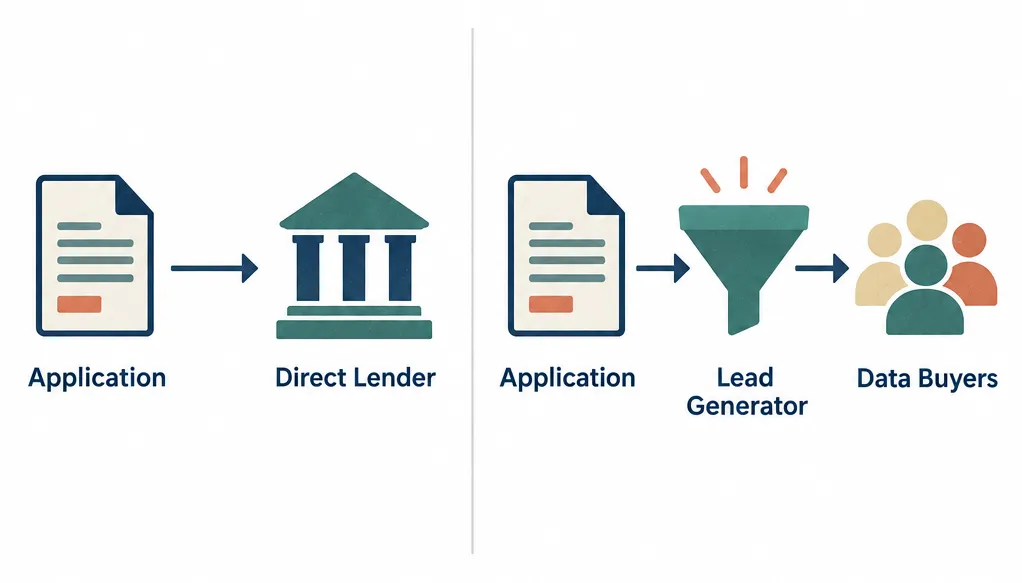
A direct lender makes the loan with its own money and must hold a license in your state where one is required. A lead generator only collects applications and sells them, often through an automated auction called a “ping tree”, to whoever pays most for your profile.
The Federal Trade Commission has sued payday lead generators over this practice. In its 2017 case against Blue Global Media, the FTC alleged that the company told applicants it would match them with lenders, then sold or shared their applications with buyers who were not lenders at all, including people who used the data to debit accounts without permission. The old version of this very page belonged to a site of that type, built around an application form and “one of our direct lenders will be in touch.”
To spot a lead generator, look at the fine print. Phrases such as “we are not a lender”, “we may share your information with our network of lenders and partners” or “subject to lender’s requirements” mean your data will be passed on.
Did you know?
In a 2016 case against LeapLab, the FTC alleged that data brokers bought payday loan applications containing Social Security and bank account numbers, then sold them to non-lenders that used the details to take money from consumers’ accounts.
What “guaranteed approval” and “no credit check” really mean
Neither phrase describes a real loan promise. They are marketing claims. A licensed lender has to check that you exist, that you have income and that your account is real. It also has to follow state limits on loan size and on how many loans you can have open, so nobody can guarantee approval before seeing your application.
The FTC’s guidance on advance-fee loan scams puts it plainly: legitimate lenders do not guarantee a loan before you apply, and they do not ask for a fee upfront to “secure” approval. A site that promises approval and then asks you to pay first by gift card, wire transfer or crypto is running a scam.
How payday lenders actually check you
“No credit check” usually means no hard inquiry at Equifax, Experian or TransUnion, so the application does not show up on your main credit report. Lenders still check other things:
- Specialty consumer reporting agencies. These track subprime and payday borrowing. Clarity Services (part of Experian) and FactorTrust (part of TransUnion) are two examples.
- Bank account data. This shows your deposits, balances and past returned payments.
- State loan databases. Several states run these so lenders can see whether you already have an open payday loan that would put you over the legal limit.
These checks are covered by the Fair Credit Reporting Act. If a lender turns you down because of something in a consumer report, it must say so. You are then entitled to a free copy of that report from the agency, and you can dispute errors. Under the Equal Credit Opportunity Act, you are also entitled to the reasons for a denial.
The trade-off is price. Lenders that check less charge more, because higher fees cover their losses.
What a payday loan costs: worked example
A payday loan charges a flat fee per $100 borrowed. The CFPB says that fee usually runs from $10 to $30 depending on state law, with $15 per $100 being typical. The Truth in Lending Act and Regulation Z (12 CFR 1026) require the lender to show you the finance charge and the APR in writing before you sign. Use those two numbers to compare offers.
| Option | Amount | Fee or rate | Term | Total cost | Total repaid | APR |
|---|---|---|---|---|---|---|
| Payday loan, repaid on time | $300 | $15 per $100 | 14 days | $45 | $345 | about 391% |
| Same loan, rolled over twice | $300 | $45 per rollover | 6 weeks | $135 | $435 | about 391% |
| Credit union PAL (federal) | $300 | 28% APR, plus up to $20 application fee | 3 months | about $14 interest + up to $20 fee | about $334 | 28% plus fee |
| Covered military borrower (MLA cap) | $300 | 36% MAPR maximum | 14 days | about $4.14 max | about $304 | 36% max |
The APR math in plain words. The $45 fee is 15% of $300. A 14-day term fits about 26 times into a year (365 ÷ 14 = 26.07). Multiply 15% by 26.07 and you get about 391% a year. The rate stays the same when you roll the loan over, but each rollover adds another $45 while the $300 principal stays unpaid. After two rollovers you have paid $135 in fees and still owe the full $300, the pattern the CFPB describes in its own $300 example.
The PAL row assumes three equal monthly payments of about $104.71 at 28%. The military row shows the most a lender can charge a covered borrower: $300 × 36% × 14 ÷ 365.
Before you borrow
The real risk is the next paycheck, not the first fee. If repaying $345 in one lump sum leaves you short again, a rollover or a new loan follows, and fees pile up without reducing what you owe.
Cheaper options to try before you apply
For most people, a payday loan is the most expensive legal way to cover a short gap. Try these first, starting with the cheapest:
Cheaper options first
Ask the company you owe for a due-date change or hardship plan, which often costs nothing.
Ask your employer for a pay advance, or use an employer earned-wage program with no fee.
Call your credit union about a payday alternative loan capped at 28% APR.
Credit union payday alternative loans
Payday alternative loans (PALs) are small loans that federal credit unions can offer under National Credit Union Administration rules. The rate is capped at 28% APR, and the application fee can be no more than $20.
| PAL I | PAL II | |
|---|---|---|
| Loan size | $200 to $1,000 | Up to $2,000 |
| Term | 1 to 6 months | 1 to 12 months |
| Membership wait | At least 1 month | None |
| Rate cap | 28% APR | 28% APR |
| Application fee | Up to $20 | Up to $20 |
You can hold only one PAL at a time, and not every credit union offers them. Many state-chartered credit unions run similar small-loan programs under their own names.
Other lower-cost routes
- Hardship plans. Utilities, landlords, medical providers and card issuers often agree to a payment plan if you call before the due date.
- Nonprofit credit counseling. Agencies affiliated with the National Foundation for Credit Counseling can review your budget and, if it fits, set up a debt management plan.
- Local and federal aid. Dialing 211 connects you to local emergency help. The Low Income Home Energy Assistance Program (LIHEAP) helps with energy bills.
- Cash advance apps. These are often cheaper than payday loans, but expedited-transfer fees and “tips” can still add up to a high APR on a small advance. Do the same fee-to-APR math before you use one.
State rules decide whether you can apply at all
Payday lending is governed mostly by state law, so the same online application can be legal in one state and void in the next. Each state sets its own maximum fee, loan size, term and rollover rules, and some states ban the product outright.
According to the National Conference of State Legislatures, Connecticut, Maryland, Massachusetts, New Jersey, New York, Pennsylvania, Vermont and West Virginia have no payday lending statute, or require lenders to follow general consumer-loan rate caps. In practice, that keeps typical payday loans out. Georgia, Arkansas, North Carolina and the District of Columbia also block them through bans or low caps. Voters or legislatures have set 36% caps in South Dakota (2016), Colorado (2018), Nebraska (2020), Illinois (2021), New Mexico (2023) and Minnesota (2024). In its 2023 count, the Center for Responsible Lending found 19 states plus DC with caps of 36% or less, while triple-digit rates were still allowed in many of the rest.
Two consequences matter for anyone applying online:
- The website does not decide what is legal. An online lender making loans to residents of a state with a rate cap generally has to follow that state’s law. Some lenders claim exemptions through tribal or out-of-state affiliations, and state regulators have challenged those claims in court.
- Your state regulator is the authority. Its website lists the current fee caps and the lenders licensed to make loans to residents, and it takes complaints.
How to check a payday lender
- Find the lender’s full legal name and license number in the loan agreement or website footer.
- Search that name on NMLS Consumer Access, which many states use for consumer lender licenses.
- Check your state financial regulator’s license lookup if the lender is not listed there.
- Confirm the license covers payday or small-dollar loans in your state, not just another business line.
- Search the CFPB complaint database for the company name to see how it has handled complaints.
Your rights once you apply and borrow
Federal law gives every payday borrower several protections, and your state may add more. These are the ones you are most likely to need.
Automatic withdrawals
Under the Electronic Fund Transfer Act and Regulation E, a lender cannot require you to agree to recurring automatic debits as a condition of the loan. You can also revoke a debit authorization later, by telling both the lender and your bank or credit union. Your bank must act on a stop-payment order for a preauthorized debit even if you first give it by phone, though it can ask for written confirmation.
The payment provisions of the CFPB’s Payday Lending Rule (12 CFR 1041) took effect on March 30, 2025. They say that after two withdrawal attempts in a row fail for insufficient funds, the lender cannot try again without your new authorization. They also require notice before certain withdrawals. Two days before that date, the CFPB said it would not prioritize enforcement of these provisions. Its 2026 regulatory agenda then listed a plan to reconsider the rule. The rule remains in force, but with less federal enforcement, state regulators and your own bank are your most practical backstops. The rule’s original ability-to-repay underwriting requirements were rescinded in 2020, so federal law does not require a payday lender to check whether you can afford the loan.
Military borrowers
The Military Lending Act caps the Military Annual Percentage Rate at 36% for active-duty service members, their spouses and covered dependents. The MAPR includes most fees, which rules out a typical triple-digit payday loan. The law also bars lenders from requiring a military allotment or an arbitration clause.
Debt collection
If a payday debt goes to a third-party collector, the Fair Debt Collection Practices Act applies. Collectors cannot threaten arrest, harass you or misrepresent what you owe. Failing to repay a loan is a civil matter, not a crime.
Where to complain
- CFPB complaint portal: for lenders, collectors and banks that ignore a stop-payment request
- Your state financial regulator or attorney general: for unlicensed lenders and fees above state caps
- FTC ReportFraud: for lead generators, fake lenders and advance-fee scams
- FBI IC3: if money was taken through an online scam
If you cannot repay on the due date
Contact the lender before the due date and ask in writing what options your state requires. Several states require lenders to offer an extended payment plan at no extra cost, which turns the balance into installments. Many states also limit or ban rollovers.
Then protect your bank account. If you cannot cover the debit, revoke the authorization with the lender and your bank instead of letting repeated attempts trigger overdraft or returned-item fees. Revoking does not cancel the debt, so work out a payment arrangement you can actually keep.
Avoid taking a second payday loan to pay off the first. The CFPB’s research found that most payday loan volume comes from borrowers caught in long sequences of repeat loans. If you already hold several high-cost loans, a nonprofit credit counselor can help you rank them and contact lenders.
FAQ
How fast is a payday loan application approved?
Decisions are often automated and come within minutes. Funding usually arrives by ACH transfer the next business day, and storefronts may hand over cash the same day. Weekends and federal holidays delay ACH transfers. A promise of “instant” money does not change what the loan costs.
Does applying for a payday loan hurt your credit score?
An application usually does not create a hard inquiry with Equifax, Experian or TransUnion. Many payday lenders also do not report on-time payments, so repaying will not build your credit either. If you default and the debt goes to collections, the collection account can appear on your main credit reports and lower your score.
Can you get a payday loan with no bank account?
Some storefront lenders accept a prepaid card account. Most online payday lenders require a checking account because they repay themselves by debiting it. Without a bank account, a credit union PAL or a local assistance program is usually a better place to start.
Can you get a payday loan on unemployment or benefits?
Some lenders accept Social Security, disability or unemployment income as proof of income. A lump-sum repayment taken out of fixed benefits leaves very little margin, though. A hardship plan with the bill you are trying to pay is usually safer.
Is it legal to apply for an online payday loan in a state that bans them?
The lender, not you, breaks the law by making an illegal loan. In several states, loans that violate the state rate cap are void or uncollectible. If an online lender charged you more than your state allows, report it to your state regulator and the CFPB.
What should you do if a payday site sold your information?
Expect more calls and offers. Watch your bank account for debits you did not authorize, and dispute them with your bank promptly under Regulation E, where reporting time limits apply. Consider a credit freeze at all three bureaus, which is free, and report the site to FTC ReportFraud.
The next step that costs nothing
Before you start any payday loan application, make two free phone calls. First, call the company you owe and ask for more time or a payment plan. Second, call a credit union about a payday alternative loan. If you still need a payday loan after that, confirm that the lender is licensed in your state and work out the APR from its written disclosure. Agree to the loan only if you can pay back the whole amount on your next payday and still cover your other bills.
Laws and regulations referenced
- Truth in Lending Act, 15 U.S.C. 1601
- Regulation Z, 12 CFR Part 1026
- Fair Debt Collection Practices Act, 15 U.S.C. 1692
- Fair Credit Reporting Act, 15 U.S.C. 1681
- Equal Credit Opportunity Act, 15 U.S.C. 1691
- Electronic Fund Transfer Act, 15 U.S.C. 1693
- Regulation E (electronic transfers), 12 CFR Part 1005
- Military Lending Act, 10 U.S.C. 987
- CFPB payday lending rule, 12 CFR Part 1041
Links go to the official text on government sites.
Check, verify or complain

Dana writes US Financer's guides to payday loans, personal and installment loans, bad credit borrowing and cash advance apps. Every piece starts from what a loan really costs, works the numbers in a table, and checks what the lender's own disclosure and your state's rules…
Ruth is US Financer's standards editor. Every article goes through her checks before and after it is published: each rate, fee, cap, deadline and rule is matched against its primary source, every law named is linked to its official text, and anything that cannot be…
What changed
- Nov 13, 2026 First published.
Comments are closed