

General information, not financial advice. Check the official program rules or your bank's terms before you act.
A record on ChexSystems or Early Warning Services stays on file for five years, but you don’t have to go without a bank account for all that time. Second chance bank accounts are checking accounts for people turned down for regular checking, and the cheapest cost $5 a month or nothing. This guide covers who offers second chance bank accounts, compares six of them using each institution’s own disclosures, works out what each costs over a year, and explains how to check and clear the record that got you denied.
WARNINGRelated consumer alert, Nov 12, 2026
Pennsylvania AG warns veterans who paid Trajector to consider bankruptcy claimsKey takeaways
- A second chance account is checking for people denied because of past banking problems. Many charge no overdraft fees, though account terms and overdraft settings differ.
- The Bank On certified accounts at Wells Fargo, Regions and PNC cost $5 a month ($60 a year), though some fees can be waived if you meet certain conditions. OneUnited’s U2 E-Checking costs $20 a month ($240 a year).
- ChexSystems and Early Warning Services are separate agencies. A clean report at one doesn’t mean a clean report at the other.
- Negative records last five years. You can get each report free every 12 months and after any denial, and you can dispute errors under the Fair Credit Reporting Act.
- These accounts don’t build credit. Six to 12 months in good standing can get you moved up to regular checking.
Fact-checked
We checked these key facts against the sources named, on November 13, 2026:
- That’s down from 4.5% in 2021 and 8.2% in 2011 (source: fdic.gov)
- Annualized (180% ÷ 3 days × 365 days), that’s roughly 21,900% (source: consumerfinance.gov)
- Request your ChexSystems report through the ChexSystems consumer website, by phone at 800-428-9623, or by mail (source: chexsystems.com)
- Go $20 over, pay a $36 fee, and cover the gap three days later: you paid 180% of the amount ($36 ÷ $20) for three days (source: consumerfinance.gov)
- OneUnited’s U2 E-Checking costs $20 a month ($240 a year). – ChexSystems and Early Warning Services are separate agencies (source: oneunited.com)
Second chance bank accounts: the short answer
A second chance bank account is basic checking for people a bank would normally turn down, usually because of an unpaid overdraft or an account the bank closed. You can expect a flat monthly fee (often $5, up to $20 at some banks), no overdraft or NSF fees, and a debit card that is declined when your balance is too low. Many let you move up to regular checking after a stretch in good standing.
“Second chance” is a marketing label, not a legal category. No federal law defines it, and banks rename these accounts often. PNC’s fee schedule file is still called “Foundation_Checking_Fees.pdf”, but the document inside is now titled PNC Simple Checking. That’s why older lists naming “Foundation Checking” or “Wells Fargo Opportunity Checking” are out of date.
Why you were denied: ChexSystems and Early Warning Services
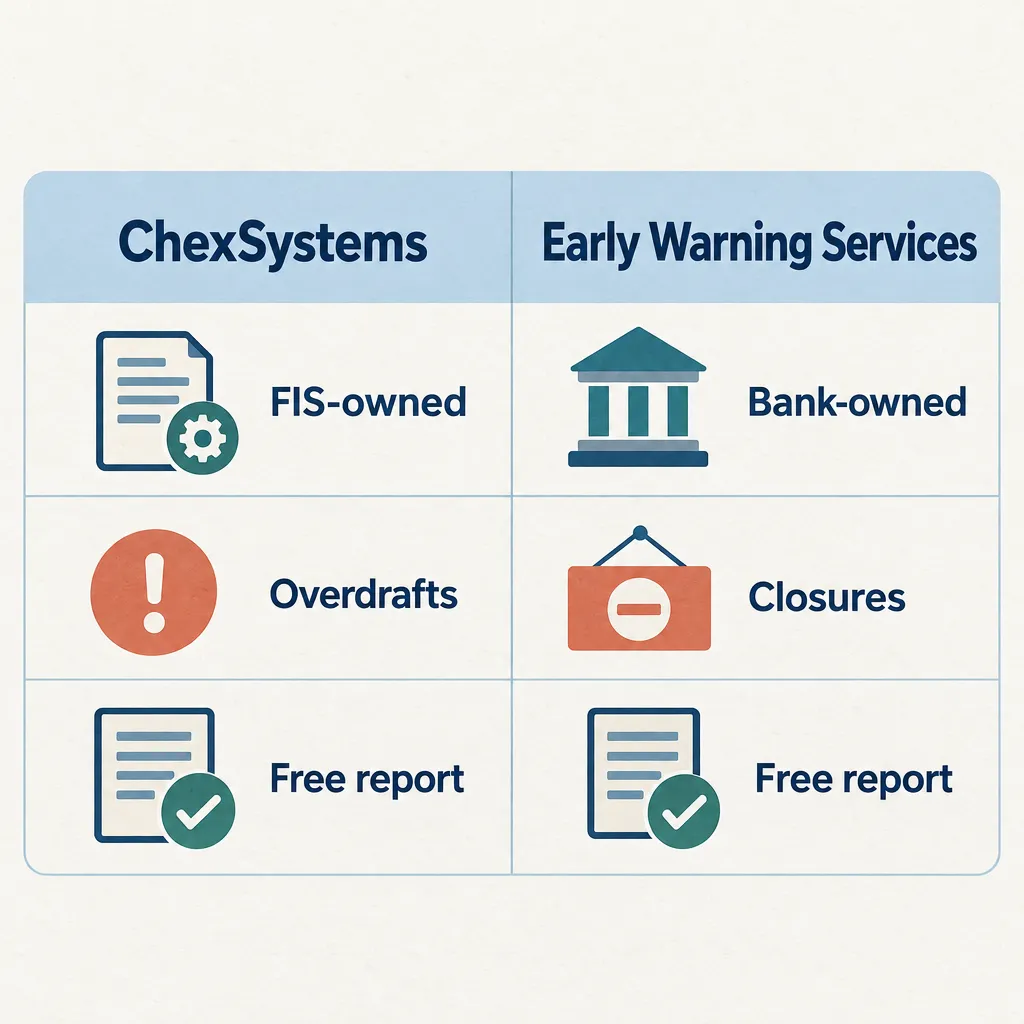
Most banks turn applicants down because of a checking account consumer report, not a credit score. Two agencies produce most of these reports: ChexSystems and Early Warning Services (EWS). Both are covered by the Fair Credit Reporting Act (FCRA).
What ChexSystems records
ChexSystems is a consumer reporting company owned by the payments firm FIS. Banks and credit unions report problems to it: overdrafts never repaid, accounts the bank closed with money still owed, bounced checks and suspected fraud. When you apply somewhere new, that bank checks your file before deciding to open the account. The Consumer Financial Protection Bureau (CFPB) includes ChexSystems in its list of consumer reporting companies you can request a file from.
Early Warning Services: the other report banks check
Early Warning Services is a separate agency owned by a group of large banks, including Wells Fargo, Bank of America, JPMorgan Chase and PNC. It also runs Zelle. Some big banks check EWS instead of ChexSystems, and some check both.
That explains a common question: why was I denied when my ChexSystems report is clean? The bank may have checked EWS, and the record may be there.
| ChexSystems | Early Warning Services | |
|---|---|---|
| Owned by | FIS | A group of large U.S. banks |
| What it records | Unpaid overdrafts, accounts closed for cause, bounced checks, suspected fraud | Account history, closures, suspected fraud, check activity |
| How long negative records last | 5 years | 5 years |
| Free report | Every 12 months, plus after a denial | Every 12 months, plus after a denial |
| How to request | ChexSystems consumer website, phone 800-428-9623, or mail to Chex Systems, Inc., Attn: Consumer Relations, P.O. Box 583399, Minneapolis, MN 55458 | EWS consumer website, or phone (800) 325-7775, Monday to Friday, 8 a.m. to 5 p.m. Mountain Time |
| Related business | Payments technology | Also operates Zelle |
How long a record lasts
HelpWithMyBank.gov, the consumer site of the Office of the Comptroller of the Currency (OCC), says negative information stays on ChexSystems and EWS reports for five years, then should drop off. A record from early 2022 should be gone by early 2027. If yours is a few months from that date, waiting can cost less than paying a high monthly fee in the meantime.
Unpaid balance vs suspected fraud: why it matters
Second chance accounts are mostly designed for people who owe an old bank money. A record that says “suspected fraud” or “account abuse” gets much harsher treatment, and many second chance programs still decline it, because the bank is now worried about risk rather than a missing $200.
If your denial came from a fraud flag, get the report and check whether the flag is accurate. A wrong flag is worth disputing before you try any account. If it’s accurate, fintech accounts and prepaid cards (covered below) are often the realistic choices until the record ages off.
Best second chance bank accounts compared: who offers them
The best second chance bank accounts for most people are the $5 Bank On certified accounts from Wells Fargo, Regions and PNC, because they cap fees and ban overdraft charges. OneUnited Bank and Credit Union 1 run accounts built for people with ChexSystems records, and Chime is a fintech option that says it doesn’t use ChexSystems.
How we picked: we included accounts from licensed banks, a credit union and one large fintech, each of which either markets itself for second chance banking or is a Bank On certified low-cost account offered to people with past account problems. We weighed total yearly cost first, then overdraft exposure, Bank On certification, a clear path to regular checking, and ease of opening. Figures come from each institution’s own account page, fee schedule or Truth in Savings disclosure. Fees checked November 2026.
| Account | Institution type | Monthly fee | Fee waiver | Opening deposit | Overdraft/NSF fees | Bank On certified | Upgrade path | Where to read the terms |
|---|---|---|---|---|---|---|---|---|
| Wells Fargo Clear Access Banking | National bank | $5 | Owner age 13–24; $250+ qualifying electronic deposits; qualifying military direct deposit | $25 or less (Bank On limit) | None | Yes | Ask the bank | Clear Access Banking page and account fee summary, 2026 |
| Regions Now Checking | Regional bank | $5 | None published | $10 | None | Yes | Ask the bank | Regions Now Checking page; second chance article, May 29, 2026 |
| PNC Simple Checking | National bank | $5 | Owner under 25, plus others on the schedule | $25 or less (Bank On limit) | None | Yes | Ask the bank | PNC fee schedule, effective Feb 22, 2026 |
| OneUnited Bank U2 E-Checking | Black-owned bank | $20 | None in the disclosure summary | Confirm with the bank | Check the disclosure | No | Essential ($10) or Basic ($0) Checking | OneUnited Truth in Savings disclosure, Sept 24, 2026 |
| Credit Union 1 Second Chance Checking | Credit union (Illinois) | $0 | Not needed | $25 | Check the disclosure | No | Free or High Yield Checking after 6 months (see profile) | Second Chance Checking page and Truth in Savings disclosure, 2026 |
| Chime Checking | Fintech (partner banks) | $0 | Not needed | $0 | Check the terms | No | None needed | Chime second chance banking page and account agreement, 2026 |
Bank On certified $5 accounts (Wells Fargo, Regions, PNC)
These three are the strongest default choice for most readers. They’re cheap, they come from large banks with branches across many states, and they meet a national fee and overdraft standard.
Wells Fargo Clear Access Banking
- Pros: $5 a month, or $0 if the primary owner is 13 to 24, you receive $250 or more in qualifying electronic deposits, or you have a qualifying military direct deposit. No overdraft fees. Zelle included. Accepts a Consular ID.
- Cons: Wells Fargo is an owner of Early Warning Services, so an EWS record can still count against you. Age stops counting as a waiver once the primary owner turns 25.
- View the account on Wells Fargo’s site: the Clear Access Banking page and its “Quick view of account fees” summary list the current fee and waivers.
Regions Now Checking
- Pros: $5 a month, $10 to open, no overdraft or NSF fees, Bank On certified. Regions lists online and mobile banking, Bill Pay and Zelle among the features.
- Cons: Regions’ published summary shows no fee waiver, and the fee is charged up front on the first business day of each statement period. Branches are concentrated in the South and Midwest.
- View the account on Regions’ site: the Now Checking page and Regions’ second chance banking article (published May 29, 2026) set out the fee and opening deposit.
PNC Simple Checking
- Pros: $5 a month, $0 for account holders under 25, with other waivers on the fee schedule effective February 22, 2026. PNC promotes Zelle in its mobile app.
- Cons: PNC’s account page doesn’t use the words “second chance”, so ask whether a past closure will disqualify you before you apply. PNC is also an EWS owner.
- View the account on PNC’s site: the Simple Checking page and the PNC Simple Checking fee schedule dated February 22, 2026.
Accounts built for ChexSystems records (OneUnited U2, Credit Union 1)
OneUnited Bank U2 E-Checking
- Pros: Made for people with ChexSystems records. OneUnited is a Black-owned bank with branches in Boston, Los Angeles and Miami. Its other checking accounts can give you a possible next step.
- Cons: $20 a month is four times the $5 Bank On price. OneUnited’s checking page doesn’t say how long you must wait before moving to Basic Checking, so get that answer in writing.
- View the account on OneUnited’s site: the checking page and the Truth in Savings disclosure dated September 24, 2026.
Credit Union 1 Second Chance Checking
- Pros: No monthly fee and a $25 minimum to open, according to the account page. The product page says you can move to Free or High Yield Checking after six months in good standing.
- Cons: CU1’s Truth in Savings disclosure requires Digital Banking and eStatements and at least $1,000 in total deposits each calendar month, and says the credit union can close the account if you miss that minimum. That’s a high bar for part-time workers or anyone paid in cash. The account pays no dividends. Zelle and outside transfers open up only after the upgrade, and one CU1 education article gives 12 months, not six, for the upgrade, so confirm the timeline. You must qualify for membership in this Illinois-based credit union, which is separate from Alaska’s credit union of the same name.
- View the account on Credit Union 1’s site: the Second Chance Checking page and its Truth in Savings disclosure.
Fintech accounts that say they don’t use ChexSystems (Chime and others)
Chime Checking
- Pros: Chime’s second chance page says there is no ChexSystems check, no credit check and no monthly fees, and there is no opening deposit. You open it online.
- Cons: Chime says it is “not a bank”. Your money is held at The Bancorp Bank, N.A. or Stride Bank, N.A. You get less in-person help, and recovering funds if the fintech itself fails depends on its recordkeeping.
- View the account on Chime’s site: the second chance banking page and the deposit account agreement.
What a second chance account costs over a year
A $5 account costs $60 a year (5 × 12), and a $20 account costs $240 (20 × 12). Under-25 waivers at Wells Fargo and PNC can bring the cost to $0. A traditional account can cost more than either once overdrafts start.
| Option | Monthly fee | 12-month cost | Overdraft risk |
|---|---|---|---|
| Wells Fargo Clear Access (owner 25+, no waiver) | $5 | $60 | None: purchases you can’t cover are declined |
| Wells Fargo Clear Access (owner 13–24) | $0 | $0 | None |
| Regions Now Checking | $5 | $60 | None |
| PNC Simple Checking (owner 25+) | $5 | $60 | None |
| PNC Simple Checking (under 25) | $0 | $0 | None |
| OneUnited U2 E-Checking | $20 | $240 | Check the disclosure |
| Credit Union 1 Second Chance | $0 | $0 (if you meet the $1,000 monthly deposit rule) | Check the disclosure |
| Typical traditional checking | $8–$18 if waiver missed | $96–$216 | Up to $36 per overdraft or NSF item |
Worked example: second chance account vs overdrafts at a regular account
Suppose you keep about $300 in your account and go over your balance twice a year. Here’s 12 months of cost, using Regions’ 2026 comparison of traditional accounts (monthly fees often $8 to $18, overdraft and NSF fees up to $36 an item):
| Scenario | Amount at stake | Fee | Term | Total paid |
|---|---|---|---|---|
| $5 Bank On account, two declined purchases | $0 overdrawn | $5 a month | 12 months | $60 |
| $20 second chance account | $0 overdrawn | $20 a month | 12 months | $240 |
| Traditional account, $12 fee not waived, two $36 overdrafts | $40 overdrawn in total | $12 a month + $72 | 12 months | $216 |
An overdraft fee behaves like a very expensive short-term loan, and you can price it the same way. Go $20 over, pay a $36 fee, and cover the gap three days later: you paid 180% of the amount ($36 ÷ $20) for three days. Annualized (180% ÷ 3 days × 365 days), that’s roughly 21,900%. An account that simply declines the purchase avoids that cost.
Before you open one
The biggest avoidable cost is paying $20 a month when a $5 or free account would have accepted you. Check your ChexSystems and EWS reports first, then start with the cheapest account you’re likely to qualify for.
How to pull, dispute and clear your record
You have the right to see what banks see. Under the Fair Credit Reporting Act you can get a free copy of your ChexSystems and EWS reports every 12 months, plus another free copy after you’re denied an account, and you can dispute anything wrong. The agency generally has 30 days to investigate.
How to check and clear your banking record
- Request your ChexSystems report through the ChexSystems consumer website, by phone at 800-428-9623, or by mail.
- Request your EWS report through the Early Warning Services consumer website or at (800) 325-7775 (weekdays, 8 a.m. to 5 p.m. Mountain Time).
- Read every entry: the reporting bank, the date, the reason and the amount.
- Dispute anything inaccurate with the agency and with the bank that reported it.
- For debts you really owe, pay or settle and get a written paid-in-full letter.
- Ask the former bank to update its report, then pull your report again to confirm.
Request your free reports
Ask for both reports before your next application. When a bank denies you because of a consumer report, the FCRA requires an adverse action notice naming the agency it used. That notice entitles you to a free report from that agency if you request it within 60 days. If you’ve already been denied, use that free report first.
Dispute errors
Common errors include a debt you already paid, an account that isn’t yours, a wrong amount, or a fraud flag caused by identity theft. File with the agency (ChexSystems takes disputes online through its consumer assistance pages or by mail to the same P.O. box) and attach copies of your proof. You can also dispute directly with the bank that reported the item. If the agency can’t verify the entry, it must be corrected or removed.
Paying off what you owe: get it in writing
Paying a debt does not automatically remove a ChexSystems entry. Usually the entry is updated to show it was paid, which banks see as a better risk, but it can stay for the full five years. Before you pay, ask the bank in writing whether it will request removal or only mark the entry paid. Keep the paid-in-full letter. If the report isn’t updated within about a month, dispute it and attach the letter.
When to wait out the 5 years
If the record is accurate, the debt is paid and the five years end within a few months, waiting can be cheaper than a $20 account. If the end date is years away, open the cheapest account that will accept you and build a clean history while the record ages off.
What to do if no bank will accept you
If you owe an old bank money and every application comes back denied, work down this list from cheapest and safest to last resort. Most people get an account at step one or two.
| Option | Checks ChexSystems/EWS? | Typical cost | Main drawback |
|---|---|---|---|
| 1. Bank On certified second chance account | Usually, but accepts many past problems | $0–$5 a month | Fraud flags can still lead to a denial |
| 2. Local credit union or CDFI | Often, but more flexible | Often $0–$10 a month | Membership rules; may need to live or work nearby |
| 3. Fintech account held at a partner bank | Chime says it doesn’t use ChexSystems | Often $0 | Not a bank itself; less in-person help |
| 4. Prepaid card | Usually not | Monthly, reload and ATM fees vary | No checks, fewer features, fees add up |
Credit unions are often more willing to take a chance on a member, and many run their own second chance programs. Our guide to credit union membership explains how eligibility by employer, location or association works. Community development financial institutions (CDFIs), certified by the U.S. Treasury’s CDFI Fund, serve low-income areas and are worth asking too.
Prepaid cards come last because their fees can exceed a $5 account. They do carry protection: under the Electronic Fund Transfer Act and the prepaid rule in Regulation E, registered cards are covered against unauthorized transactions and must disclose fees up front.
Once any account is open, even $20 a week into savings helps. A small cushion keeps a declined purchase from turning into a payday loan, and our guide to starting a $500 or $1,000 emergency fund shows how to build one.
Is Chime a second chance bank?
No. Chime describes itself as a financial technology company, not a bank, and its accounts are held at The Bancorp Bank, N.A. and Stride Bank, N.A., both FDIC members. Its second chance page says it doesn’t use ChexSystems, doesn’t run a credit check and charges no monthly fees.
Is your money safe there? Deposits can be FDIC insured up to $250,000 per depositor, per insured bank, per ownership category. That coverage comes through the partner bank and protects you if the partner bank fails. If the fintech itself fails, getting your money back depends on how well its records show what belongs to you, and that can take time. For a paycheck-to-paycheck account, that risk is real but manageable. For large savings, an account held directly at an FDIC-insured bank or NCUA-insured credit union is safer.
Other fintechs make similar “no ChexSystems” claims. Read their terms before relying on one: some still check EWS or run their own identity and fraud screening.
What you need to open one
Most second chance accounts ask for what regular checking asks for: a Social Security number or ITIN, government ID and a residential address. They differ on age rules, accepted ID and the opening deposit.
| Requirement | What to expect |
|---|---|
| Identification | Government-issued ID. Wells Fargo Clear Access also accepts a Consular ID. |
| Taxpayer number | SSN required at Wells Fargo Clear Access. Ask other banks about ITINs. |
| Address | A residential address, not just a P.O. box. |
| Age | Wells Fargo: 13 and up. Under 18 must open at a branch, and ages 13–16 need an adult co-owner. |
| Online vs branch | Wells Fargo allows online opening at 18+. Chime is online only. |
| Opening deposit | $0 at Chime, $10 at Regions, $25 at Credit Union 1, $25 or less on any Bank On certified account. |
Can you open a second chance account online?
Often, yes. Wells Fargo takes online applications from adults, and fintechs like Chime are online only. No institution promises “instant” approval, though: the bank still verifies your identity and usually checks a consumer report before the account goes live.
What if you have no money for an opening deposit?
Some accounts need little or nothing. Chime has no opening deposit, Regions asks for $10, and Bank On standards cap the opening deposit at $25.
Is there a credit check?
Usually not. Most second chance accounts check ChexSystems or EWS rather than your credit report, and opening a checking account generally doesn’t affect your credit score. That’s different from “no credit check” loans, where the phrase usually signals a higher price.
Finding a second chance account in your state
No state has a special “second chance banking” law, so your options come down to which institutions serve your area. Use each bank’s branch locator to confirm a branch near you before relying on in-person help: Regions, for example, is concentrated in the South and Midwest, and OneUnited has only three branches. State-chartered credit unions often run their own second chance programs, so ask the ones whose membership rules you meet. The national Bank On site lists certified accounts, which helps you spot local banks and credit unions with $5-or-less options. If a state-chartered bank or credit union treats you unfairly, your state banking regulator takes complaints; the Conference of State Bank Supervisors (CSBS) keeps a directory of every state’s regulator.
Ask three questions before you open
How many months until I can upgrade? What deposits do I need each month to keep or upgrade the account? Will you check ChexSystems or EWS again when I upgrade? Write the answers down with the date and the employee’s name.
Moving up to a regular checking account
Most second chance accounts expect six to 12 months in good standing before an upgrade. Good standing usually means no negative balance, regular deposits and no returned items.
Credit Union 1 is one of the few to publish its rules: its product page says six months in good standing, at least $1,000 a month in direct deposit and eStatements, after which you can move to Free or High Yield Checking with Zelle and outside transfers. A CU1 education article gives 12 months, so confirm which applies. At banks that don’t publish upgrade rules, use the three questions in the tip above. If a bank won’t commit to anything, a $5 Bank On account is a better place to wait than a pricier one.
Will this help your credit score? No. Checking accounts aren’t reported to the credit bureaus, so a second chance account doesn’t build credit. It does build a clean banking record and gives you a place for direct deposit, which lenders and landlords look for. Building credit takes a credit product such as a secured card; our guide to how credit card APR and interest work explains how to avoid interest charges if you go that route.
What Bank On certification means
Bank On certification is the quickest way to spot a safe, low-cost account. The Cities for Financial Empowerment Fund (CFE Fund) runs the program and administers the Bank On National Account Certification process, which checks accounts against the Bank On National Account Standards. The standards cap the monthly fee at $5, allow either no minimum opening deposit or a minimum of up to $25, and ban overdraft and NSF fees.
The current standards cover 2025–2026. The CFE Fund updates them every two years and has said it will contact institutions with certified accounts toward the end of 2026 to start recertification, so check that an account is still listed once the next cycle begins. Certification is free for banks and credit unions, and account validation takes about two weeks. As of September 2025, about 500 accounts at banks and credit unions holding over two-thirds of the national deposit market were certified. The Federal Reserve Bank of St. Louis tracks use through its Bank On National Data Hub, which in February 2026 reported that 45 financial institutions had voluntarily reported 2024 usage data.
Certification doesn’t guarantee approval. Banks still screen applicants, and a fraud flag can still lead to a denial. What it does guarantee is the price cap and the absence of overdraft fees.
Your rights when applying or banking
Federal law protects you whichever account you choose:
| Law or protection | What it gives you |
|---|---|
| Fair Credit Reporting Act | A bank that denies you based on a ChexSystems or EWS report must name the agency. You get a free report and the right to dispute errors. |
| Truth in Savings Act (Regulation DD, 12 CFR 1030) | The bank must give you its fees and terms in writing before you open the account. |
| Electronic Fund Transfer Act (Regulation E) | Limits your liability for unauthorized debit card and electronic transactions if you report them promptly. |
| Deposit insurance | FDIC-insured banks and NCUA-insured credit unions protect up to $250,000 per depositor, per institution, per ownership category. |
If something goes wrong, you can file with the CFPB’s complaint portal. For national banks such as Wells Fargo and PNC, you can also go to HelpWithMyBank.gov at the OCC. For federal credit unions, use the NCUA. For state-chartered institutions, contact your state banking regulator.
Who is unbanked in the U.S.
The FDIC’s 2023 National Survey of Unbanked and Underbanked Households (released November 2024, the latest available) found that 4.2% of U.S. households, about 5.6 million, had no bank or credit union account. That’s down from 4.5% in 2021 and 8.2% in 2011. The gaps between groups are wide:
| Household group | Unbanked rate, 2023 |
|---|---|
| American Indian or Alaska Native | 12.2% |
| Black | 10.6% |
| Hispanic | 9.5% |
| White | 1.9% |
| All U.S. households | 4.2% |
Did you know?
According to the FDIC’s 2023 household survey, another 14.2% of U.S. households (19.0 million) were underbanked: they had an account but still used services such as check cashers or payday loans.
Second chance accounts and Bank On certification exist largely because of these gaps. Without an account, cashing a check or paying a bill costs extra, and people often end up with costly emergency loans and fees they could otherwise avoid.
FAQ
What should I do if no bank will accept me?
Pull your ChexSystems and EWS reports and dispute errors, then work down the list: a Bank On certified account, a local credit union or CDFI, a fintech account, and a prepaid card last. The section on what to do if no bank will accept you covers each option.
Is Chime a second chance bank?
Chime is a fintech, not a bank; its accounts are held at The Bancorp Bank, N.A. and Stride Bank, N.A. It says it doesn’t use ChexSystems and charges no monthly fees.
Which second chance banks don’t use ChexSystems?
Most banks check ChexSystems, EWS or both. Chime says it doesn’t use ChexSystems, and bank second chance accounts usually check a report but accept many past problems tied to unpaid balances.
Where can I get a bank account if I’m in ChexSystems?
Wells Fargo Clear Access Banking, Regions Now Checking and PNC Simple Checking are $5 Bank On accounts, and OneUnited U2 E-Checking and Credit Union 1 Second Chance Checking are built for ChexSystems records. Local credit unions often run their own programs.
Can I open a second chance checking account online?
Yes, at many institutions. Wells Fargo lets adults apply online and Chime is online only, but identity checks still apply.
Do second chance bank accounts require a credit check?
Usually not. Most check ChexSystems or EWS instead, and opening checking generally doesn’t affect your credit score.
Is there a second chance bank account with no opening deposit?
Chime has no opening deposit, and Regions Now Checking lists no minimum opening deposit. Bank On standards cap the opening deposit at $25.
Is there a second chance bank account with Zelle?
Wells Fargo Clear Access Banking and Regions Now Checking include Zelle, and PNC promotes Zelle in its app. At Credit Union 1, Zelle becomes available only after you upgrade.
How long does ChexSystems keep a record?
Five years, and HelpWithMyBank.gov says the same for Early Warning Services. Paying the debt updates the entry but doesn’t always remove it early.
Does a second chance account help my credit score?
No. Checking accounts aren’t reported to the credit bureaus, so building credit takes a credit product.
How do I move to a regular checking account?
Stay in good standing, usually for six to 12 months, and ask your bank for its exact rules in writing. The section on moving up to regular checking lists what to ask.
Are second chance accounts a rip-off?
Some charge more than they need to: $20 a month is $240 a year, against $60 for a $5 Bank On account with no overdraft fees. Compare the yearly cost before you open one.
The next step
Before your next application, request your reports from the ChexSystems and Early Warning Services consumer websites, or call 800-428-9623 and (800) 325-7775. Note which agency holds the record, what it says and when it expires. That tells you which account you can realistically get. For most people it’s a $5 Bank On account, and six to 12 clean months there can get you into regular checking.
Laws and regulations referenced
- Fair Credit Reporting Act, 15 U.S.C. 1681
- Electronic Fund Transfer Act, 15 U.S.C. 1693
- Regulation E (electronic transfers), 12 CFR Part 1005
- FDIC deposit insurance
Links go to the official text on government sites.
Check, verify or complain
Sources
- HelpWithMyBank.gov: ChexSystems and Early Warning Services reports helpwithmybank.gov · official source
- CFPB: What is ChexSystems? consumerfinance.gov · official source
- CFPB: How do I get a copy of the report banks use to decide whether to let me open a checking account? consumerfinance.gov · official source
- CFPB consumer reporting companies list: Chex Systems consumerfinance.gov · official source
- FDIC 2023 National Survey of Unbanked and Underbanked Households content.govdelivery.com
- ABA Banking Journal: FDIC percentage of unbanked households dropped slightly in 2023 bankingjournal.aba.com
- Regions: Second chance accounts regions.com
- OneUnited Bank checking accounts oneunited.com
- Wells Fargo Clear Access Banking wellsfargo.com
- Wells Fargo: How to avoid the monthly service fee for Clear Access Banking wellsfargo.com
- PNC Simple Checking fee schedule pnc.com
- Credit Union 1 Second Chance Checking creditunion1.org
- Credit Union 1 Second Chance Checking enrollment join.creditunion1.org
- Chime: Second chance banking chime.com
- Chime: What is Chime? Is Chime a bank? chime.com
- nbkc bank press release on Bank On certification nbkc.com

Elena writes about getting through a money emergency, assistance programs, budgeting on a tight income, banking basics and borrower rights. Her guides list the cheaper options first and link the agency or program that can actually help.
Ruth is US Financer's standards editor. Every article goes through her checks before and after it is published: each rate, fee, cap, deadline and rule is matched against its primary source, every law named is linked to its official text, and anything that cannot be…
What changed
- Nov 13, 2026 First published.
Comments are closed