

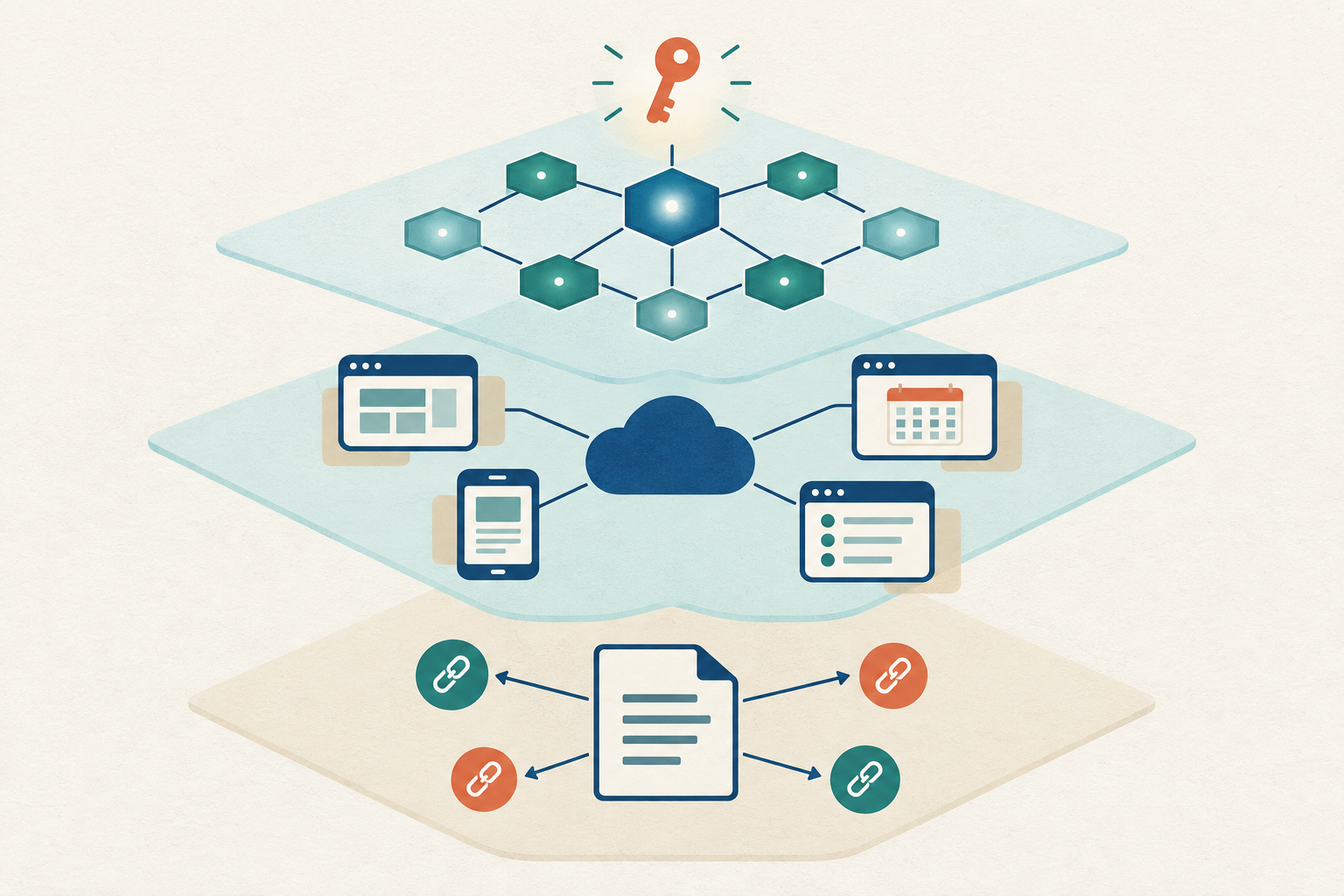
Crypto can lose all of its value and is not protected by FDIC or SIPC insurance. This is education, not investment advice.
Web 3.0 refers to the next stage of the internet. Two different ideas share the name: Tim Berners-Lee’s “Semantic Web,” where machines understand data, and the blockchain-based “Web3,” where users hold their own data, identity and money. Today’s internet (Web 2.0) runs mostly on platforms owned by large companies.
NEW RULERelated consumer alert, Oct 21
OCC final rule keeps issuer yield ban, reviews stablecoin rewards case by caseWhat Web 3.0 means, in plain words
The “3.0” is a version number for the internet. Web 1.0 was the read-only web of the 1990s. Web 2.0 is the read-and-write web you use today, built around social media, apps and cloud services. Web 3.0 is the proposed next version.
The trouble is that people mean different things by it.
Most people who say “Web3” today are talking about a version of the internet built on distributed blockchain networks. In that model, no single company controls the data. You log in with a crypto wallet instead of a username and password. Apps run on code called smart contracts. Digital items, including money, can be owned directly by you rather than stored in a company’s database.
That is the meaning this article focuses on. It also explains the older “semantic” meaning, because the two often get mixed together.
Web 3.0 vs Web3: two ideas with one name
| Semantic Web (Web 3.0) | Blockchain Web3 | |
|---|---|---|
| Who proposed it | Tim Berners-Lee, James Hendler and Ora Lassila | Gavin Wood, Ethereum co-founder |
| When | Scientific American article, May 2001 | Blog post and talks, 2014 |
| Main goal | Make web data readable by machines | Remove central gatekeepers from data and money |
| Key tools | Linked data, RDF, metadata standards | Blockchains, tokens, wallets, smart contracts |
| Needs crypto? | No | Usually yes |
| Status today | Parts are used widely (search results, structured data) | Live networks exist; mainstream use is still limited |
The semantic idea is about meaning. It asks web pages to label their information so software can understand it. For example, a page can mark up that “July 4” is a date and “Chicago” is a city. Search engines already use this kind of structured data to show recipe cards, event times and product ratings.
Berners-Lee, who invented the World Wide Web, has publicly said blockchain Web3 is not the web at all in his view. His own current project, Solid, aims to give people control of their data through personal “pods,” without a blockchain.
So if you see the two terms used as if they were the same thing, they aren’t. Context tells you which one someone means.
Web 1.0 vs Web 2.0 vs Web 3.0
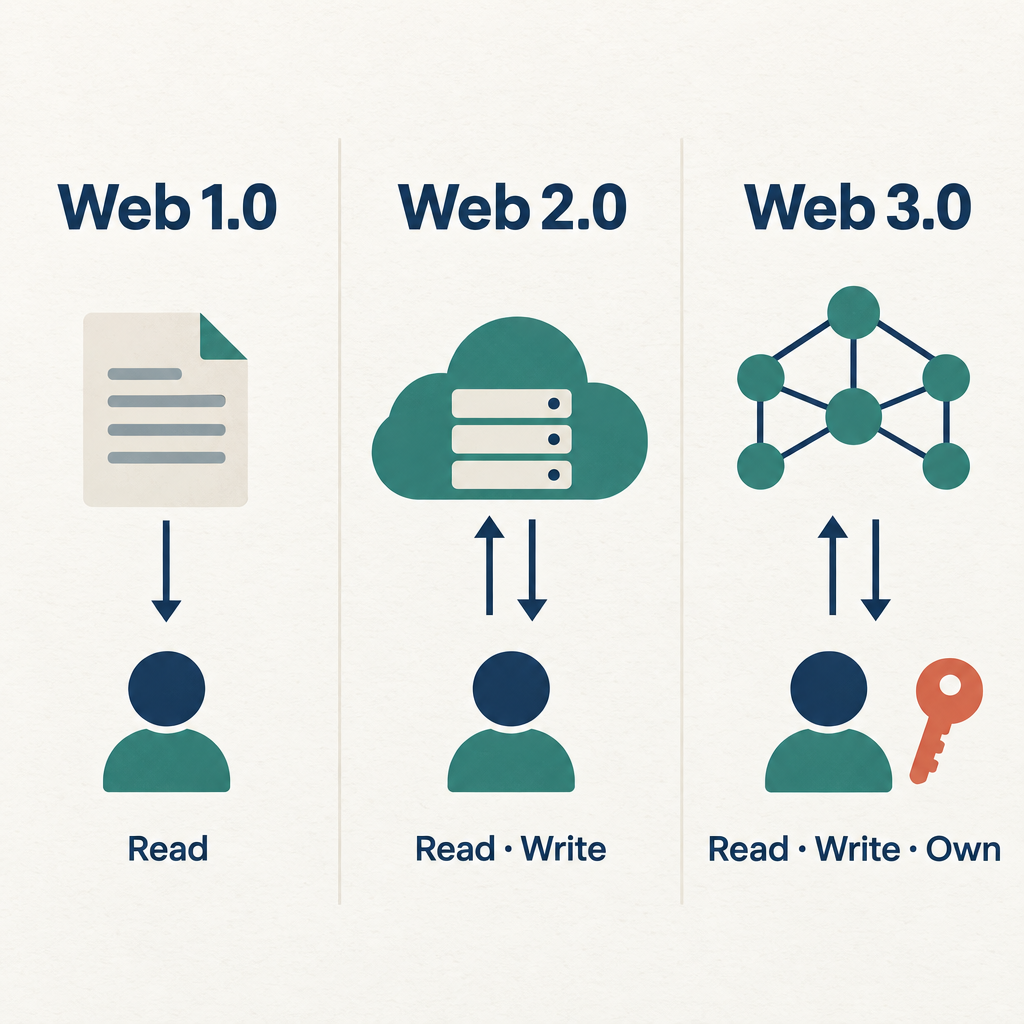
Here is how the three eras compare.
| Web 1.0 | Web 2.0 | Web 3.0 (Web3) | |
|---|---|---|---|
| Rough period | 1991 to about 2004 | About 2004 to today | Emerging since about 2015 |
| How you use it | Read | Read and write | Read, write and own |
| Typical sites | Static pages, directories, GeoCities | Facebook, YouTube, Google, Amazon | Ethereum apps, decentralized exchanges, ENS names |
| Who holds data | Site owners | Large platform companies | Users and public blockchains |
| How it makes money | Banner ads, little else | Targeted advertising, subscriptions | Tokens, transaction fees |
| How you log in | Rarely needed | Email or social login | Crypto wallet |
Web 1.0: the static web
The first website went live at CERN in 1991. Early sites were static: text, a few links, maybe a pixelated logo and some simple graphics. Most people only read. Building a page meant writing HTML by hand. Personal home pages lived on services like GeoCities.
Web 2.0: the platform web
The term Web 2.0 took off after a 2004 conference organized by Tim O’Reilly. This is the web of user posts, comments, videos and apps. Facebook launched in 2004, YouTube in 2005 and the iPhone in 2007.
Web 2.0 made the internet easy to use. It also concentrated power. A handful of companies store your photos, messages and search history. They decide what you see, and they can close your account. Your data is their product, sold to advertisers in the form of targeting.
Web 3.0: the ownership web
Web3 supporters argue that people should own their information and digital assets directly. Instead of trusting one company, you trust open-source code running on thousands of computers. If one app shuts down, your assets stay on the blockchain and you can take them to another app.
That’s the pitch. The reality, covered below, is messier.
How blockchain Web3 works
Web3 relies on a few connected technologies. You don’t need to master them, but knowing the basics helps you spot hype.
Blockchains
A blockchain is a shared record of transactions, copied across many computers. Bitcoin launched the first one in 2009. New entries are added in blocks, and changing old entries is extremely hard. Ethereum, launched in July 2015, added the ability to run programs on its blockchain. That made it the foundation for most Web3 apps.
Networks agree on what’s true through a “consensus” method. Bitcoin uses proof of work, which burns large amounts of electricity. Ethereum switched to proof of stake in September 2022, an upgrade known as the Merge. The Ethereum Foundation says the switch cut the network’s energy use by about 99.95%.
Smart contracts
A smart contract is a program stored on a blockchain. It runs automatically when certain conditions are met. For example, a contract can swap one token for another without a broker in the middle. Smart contracts power decentralized finance (DeFi), digital collectibles (NFTs) and many other Web3 apps.
Once deployed, many contracts can’t easily be changed. A bug becomes permanent, and attackers can exploit it.
Wallets and tokens
Your wallet is your Web3 identity. It holds private keys, which are long secret codes that prove you own an address. When you “connect” a wallet to an app, you’re letting it see your address and request transactions.
Tokens represent value or rights on a blockchain. They can be currencies, voting rights or digital items. Whoever controls the private key controls the tokens. There is no password reset.
Storage and naming
Blockchains are poor at storing large files. Web3 apps usually keep images and pages on separate networks like IPFS (InterPlanetary File System) or Filecoin. Services such as the Ethereum Name Service (ENS) let you replace a long wallet address with a readable name ending in “.eth.”
Blockchain websites: can a site really run on a blockchain?
Searches for blockchain websites and blockchain for websites usually come from one question: can you host a normal site on a blockchain? Partly.
A typical Web3 app has three layers:
- Front end: the page you see. It can be stored on IPFS, but many projects still host it on ordinary cloud servers.
- Back end: smart contracts on a blockchain handle the logic and money.
- Connection layer: your wallet talks to the blockchain, often through a company that runs blockchain servers (called nodes) for you.
That last layer is the weak spot. In a widely read 2022 blog post, Signal co-founder Moxie Marlinspike pointed out that most Web3 apps reach the blockchain through a few large providers. That reintroduces the central gatekeepers Web3 promised to remove.
Speed is another limit. Ethereum’s main network is commonly cited at around 15 transactions per second, far below card networks. Most activity has shifted to “layer 2” networks that bundle transactions to cut fees.
Viewing a “.eth” site also isn’t as simple as typing a URL. You usually need a browser that supports it, such as Brave, a browser extension or a gateway service.
Web 3.0 examples you can see today
These are real, working uses. Listing them is not a recommendation to use or fund any of them.
- Decentralized exchanges, such as Uniswap, let people swap tokens through smart contracts instead of a company’s order book.
- Stablecoins, such as USDC, are tokens designed to track the US dollar. They are now covered by a federal law, the GENIUS Act, signed in July 2025.
- Domain names: ENS names work as both a wallet address and a website name.
- Decentralized storage: IPFS and Filecoin store files across many machines.
- Browsers with crypto features: Brave includes a built-in wallet and rewards users with its own token for viewing ads.
- Multi-chain networks: Polkadot, created by Gavin Wood, connects separate blockchains. It is run by the Web3 Foundation’s ecosystem.
Semantic Web 3.0 is also in daily use, just quietly. Every time a search result shows star ratings or event dates pulled from a page’s structured data, you’re seeing it.
Risks you need to understand
Before you put money into Web3
Crypto assets can lose all of their value, and they are not protected by FDIC or SIPC insurance. If a token collapses, an app is hacked or you lose your keys, there is usually no one to refund you.
Web3 removes middlemen. That also removes the safety nets middlemen provide, like fraud reversals, deposit insurance and customer service.
| Event or data point | Amount | Source |
|---|---|---|
| Crypto-related fraud losses reported in 2024 | About $9.3 billion | FBI IC3 2024 Internet Crime Report |
| Bybit exchange hack, February 2025 | About $1.5 billion | FBI attributed it to North Korea |
| FTX exchange collapse | November 2022 | Customers locked out of funds; founder later convicted of fraud |
The main risks:
- Price swings: tokens can drop sharply in days. Sharp sell-offs, sometimes called capitulation, wipe out late buyers.
- Smart contract bugs: code flaws have drained hundreds of millions of dollars from DeFi apps.
- Lost keys: if you lose your private key or recovery phrase, your assets are gone. Some people use a cold wallet to keep keys offline, but that shifts the risk to physical loss.
- Scams: fake airdrops, phishing sites and “wallet drainer” links trick you into signing harmful transactions. Any Web3 scheme that promises money fast is a red flag.
- Custody risk: if an exchange holds your crypto for you, its failure can trap your money, as FTX showed.
Never fund crypto with borrowed money. Using a payday loan or a credit card cash advance to buy tokens stacks a high, certain cost on top of an uncertain asset.
Safer ways to explore Web3
Try apps on a test network, which uses free practice tokens with no value.
Read about how wallets work before connecting one to any site.
Never share a recovery phrase with anyone, including “support” staff.
US rules and taxes for Web3 activity
What is law and what is still proposed
There is no single US law covering Web3. Several agencies share oversight:
- The SEC oversees tokens that qualify as securities.
- The CFTC treats bitcoin and ether as commodities.
- FinCEN registers crypto exchanges and similar businesses as money services businesses.
- The GENIUS Act, signed in July 2025, is law. It sets federal rules for payment stablecoins, including reserve requirements.
- The CLARITY Act passed the House in July 2025. It would divide oversight of crypto markets between the SEC and CFTC. Until the Senate passes it and the president signs it, it is a bill, not law. Check its current status before relying on it.
How the IRS taxes crypto
Under IRS Notice 2014-21, the IRS treats crypto as property, not currency. That means many ordinary Web3 actions create a taxable event. Form 1040 also asks every filer whether they received or disposed of digital assets.
| Action | Taxable? | How it is treated |
|---|---|---|
| Buying crypto with dollars and holding it | No | Basis starts at what you paid |
| Moving crypto between your own wallets | No | Not a sale |
| Selling crypto for dollars | Yes | Capital gain or loss |
| Swapping one token for another | Yes | Treated as selling the first token |
| Paying for goods with crypto | Yes | Treated as a sale at market value |
| Receiving staking rewards | Yes | Ordinary income when you gain control (Rev. Rul. 2023-14) |
| Receiving an airdrop | Yes | Ordinary income when received (Rev. Rul. 2019-24) |
Assets held more than one year get long-term capital gains rates. Shorter holdings are taxed at your ordinary income rate. Gains and losses go on Form 8949. Crypto brokers now report sales to the IRS on the new Form 1099-DA, starting with transactions in 2025.
How to check a Web3 company before you use it
How to check a Web3 company
- Search FinCEN’s MSB registrant search for the company’s legal name.
- Check your state regulator’s license lookup or NMLS Consumer Access for a money transmitter license.
- If it offers investments, search the SEC’s records and FINRA BrokerCheck.
- Read its terms to see who holds your keys and what happens if it fails.
- Report fraud to the FBI’s IC3, FTC ReportFraud or the CFPB complaint portal.
A fully decentralized app may have no company to check. That is precisely why the risk sits with you.
FAQ
What is Web 3.0 meaning?
Web 3.0 is the proposed next version of the internet. Most people use it to mean a blockchain-based web where users control their own data, identity and digital assets. It can also mean Tim Berners-Lee’s Semantic Web, where machines understand the meaning of online data.
What is Web3 for dummies?
Web 1.0 let you read. Web 2.0 lets you read and post, but companies own the platforms. Web3 aims to let you read, post and own, using blockchains instead of company databases. You log in with a crypto wallet, and apps run on public code.
How to start Web3 as a beginner?
Start by learning, not spending. Read how wallets, private keys and smart contracts work. Use a test network with free practice tokens to see how apps behave. Learn the IRS rules before you trade. Never share a recovery phrase, and never invest money you can’t afford to lose entirely.
Is Web3 good or bad?
It’s neither by default. Web3 offers real ideas: open ownership, fewer gatekeepers and payments that work across borders. It also carries real costs: scams, hacks, volatile prices, slow networks and no deposit insurance. Much of today’s Web3 still depends on a few central providers. Judge each app on its risks, not the label.
Do blockchain websites replace normal websites?
No. Most Web3 apps still use ordinary web hosting for their front end. The blockchain handles ownership and transactions, while the regular web handles everything you see. The two work side by side.
Laws and regulations referenced
- IRS Notice 2014-21 (virtual currency is property)
- IRS Revenue Ruling 2019-24 (hard forks and airdrops)
- IRS Revenue Ruling 2023-14 (staking rewards)
- IRS Form 1099-DA, Digital Asset Proceeds From Broker Transactions
- IRS Form 8949, Sales and Other Dispositions of Capital Assets
- GENIUS Act (stablecoins), Public Law 119-27 (S. 1582)
- Digital Asset Market Clarity Act, H.R. 3633 (a bill, check its current status)
Links go to the official text on government sites.
Check, verify or complain
Sources
- irs.gov › irb › 2014 16 IRB%20(IRS%20Notice%202014 21%20established%20that%20virt… irs.gov · primary source
- greenbacktaxservices.com › knowledge center › form 1099 da digital asset reporting greenbacktaxservices.com
- guinnessworldrecords.com › world records › 696249 first blockchain guinnessworldrecords.com
- ethereum.org › ethereum history founder and ownership ethereum.org
- ethereum.org%20(the%20ethereum%20foundation%20has%20published%20this%20~99.95%%20figure%20for%20the%20merge's%20energy%20reduction) ethereum.org%20(the%20ethereum%20foundation%20has%20published%20this%20~99.95%%20figure%20for%20the%20merge's%20energy%20reduction)

Owen explains how crypto works for US readers: coins and tokens, buying and selling, wallets and self-custody, staking and DeFi. He sticks to how things work and what they cost, never price calls, and checks platform fees and licensing against the companies' own disclosures.

Ruth is US Financer's standards editor. Every article goes through her checks before and after it is published: each rate, fee, cap, deadline and rule is matched against its primary source, every law named is linked to its official text, and anything that cannot be…
Comments are closed