

General information, not legal advice. Laws change, so confirm with the official statute, your state regulator or a licensed attorney before you act.
Payday loans are legal in Wyoming. The law treats them as “post-dated check” transactions under the Wyoming Uniform Consumer Credit Code. Under W.S. 40-14-363, a lender can charge up to 20% of the amount advanced per month, with a $30 minimum charge for each month or portion of a month, and the loan can run for no more than one month. Wyoming sets no dollar limit on the loan size, gives you until 5:00 p.m. the next business day to cancel, and lets you switch to a no-penalty extended payment plan once every 12 months.
Run the numbers
Your money, in brief
- The fee cap is $30 or 20% of the principal per month, whichever is larger. The law caps the fee and does not set an APR, so a short loan can carry an APR above 500%.
- The lender earns the whole fee on the day you borrow, so paying early gets you no refund.
- A lender cannot make a new loan to repay, refinance or consolidate an existing payday loan (W.S. 40-14-364).
- Once every 12 months you can switch to an extended payment plan of at least four equal installments (W.S. 40-14-366).
- Active-duty service members and their dependents are covered by the federal 36% cap under the Military Lending Act.
Fact-checked
We checked these key facts against the sources named, on November 27, 2026:
- A $1,000 loan can legally cost $200 for one month (source: wyoleg.gov)
- Compare it with a $1,000 payday loan, which can cost $200 for one month (source: wyoleg.gov)
- Below $150, the $30 floor takes over, and above it the 20% figure is higher (source: wyoleg.gov)
- On $100, the law lets the lender keep $30, which is 30% of what you borrowed (source: wyoleg.gov)
Wyoming payday loan laws at a glance (2026)
Five sections of the Wyoming Uniform Consumer Credit Code, W.S. 40-14-362 through 40-14-366, cover Wyoming payday lending. The Wyoming Division of Banking licenses and examines the lenders. The 2026 Title 40 text on the Legislature’s site contains all of them. These rules were last checked November 27, 2026.
| Rule | What the law says | Statute | Common misinformation |
|---|---|---|---|
| Legal status | Legal as a “post-dated check or similar arrangement” | W.S. 40-14-362 | “Payday loans are banned in Wyoming” |
| License | Lender needs a post-dated check casher license from the Division of Banking | Wyoming Uniform Consumer Credit Code | “Licensed under a Wyoming Small Loan Act” |
| Fee cap | Greater of $30 or 20% per month on the principal | W.S. 40-14-363 | “$100 maximum fee” or “Wyoming sets a max APR” |
| When the fee is earned | Fully earned on the day the loan is made | W.S. 40-14-363 | “Pay early and save” |
| Maximum term | One calendar month (payment plans excepted) | W.S. 40-14-363 | “10 weeks with rollovers” |
| Loan amount | No statutory dollar maximum | W.S. 40-14-362 to 366 | “$500 maximum loan” |
| Refinancing | No repaying, refinancing or consolidating with a new check from the same casher | W.S. 40-14-364 | “Rollovers allowed” |
| Cancellation | You can rescind by 5:00 p.m. by returning the principal | W.S. 40-14-365 | Rarely mentioned at all |
| Extended payment plan | At least 4 equal installments, once every 12 months, prepay without penalty | W.S. 40-14-366 | Rarely mentioned at all |
| Military borrowers | 36% Military Annual Percentage Rate cap | Military Lending Act (32 CFR Part 232) | “State law is the only limit” |
What Wyoming law calls a payday loan
Wyoming’s code does not use the term “payday loan.” It regulates “post-dated check or similar arrangement” transactions. In one, you write a check (or sign an electronic debit authorization) dated for a later day, and a business hands you cash now and holds the check until then. The “similar arrangement” wording reaches electronic versions too, so moving from a paper check to an ACH authorization doesn’t let a lender escape the rules.
The code calls the business a “casher,” and its fee is a “post-dated check finance charge.” Your contract and the Division of Banking’s license list will use these terms.
Which statutes apply: W.S. 40-14-362 to 40-14-366
Each section does one job:
- W.S. 40-14-362: definitions, including what counts as a post-dated check transaction.
- W.S. 40-14-363: the fee cap, the rule that the fee is fully earned on day one, and the one-month term limit.
- W.S. 40-14-364: the ban on paying off, refinancing or consolidating with a new check from the same casher.
- W.S. 40-14-365: your right to rescind (cancel) the transaction.
- W.S. 40-14-366: the extended payment plan.
How much a Wyoming payday loan can cost
A Wyoming payday lender can charge up to the greater of $30 or 20% of the principal per month, under W.S. 40-14-363. The cap applies to the fee itself and is not an annual percentage rate. That is why one loan can be “legal” at an APR of 782% while another sits at 243%.
The $30 minimum and the 20%-per-month rule
Under the “greater of” wording, $30 is the lowest maximum fee on any loan. Twenty percent of $150 is exactly $30. Below $150, the $30 floor takes over, and above it the 20% figure is higher.
The floor makes small loans the most expensive in percentage terms. On $100, the law lets the lender keep $30, which is 30% of what you borrowed. On $1,000, the 20% rule limits the fee to $200. In dollars that’s more, but relative to the money you get it’s a lower rate.
The tables below assume the lender charges the full one-month maximum, even on a two-week loan, which is the most a borrower could be asked to pay.
Did you know?
Because of the $30 floor in W.S. 40-14-363, a $100 Wyoming payday loan can legally cost $30 even over two weeks. That’s about 782% APR, a higher rate than the same lender could charge on $500.
Why paying early doesn’t cut the fee
Under W.S. 40-14-363, the finance charge is “fully earned” on the day the post-dated check or similar arrangement is made. If you take $300 on the 1st and repay on the 5th, you still owe the full $60. Wyoming payday loans don’t come with the pro-rata refund you’d get on many installment loans.
Repaying early still has a point: it stops any later bounced-check or bank fees. It just doesn’t reduce the lender’s fee.
APR examples: why you see 782%, 521% and 261% quoted
The Truth in Lending Act and Regulation Z (12 CFR 1026) require the lender to disclose the finance charge and the APR as separate items. You can check that number yourself:
- Divide the fee by the amount borrowed.
- Multiply the result by 365.
- Divide by the number of days in the loan term.
For a $300 loan with a $60 fee over 14 days: $60 ÷ $300 = 0.20. Then 0.20 × 365 = 73. Then 73 ÷ 14 = 5.21, which is about 521% APR.
What a Wyoming payday loan costs at the legal maximum
| Amount borrowed | Max fee (greater of $30 or 20%/month) | Total to repay | APR if 14 days | APR if 30 days |
|---|---|---|---|---|
| $100 | $30 | $130 | 782% | 365% |
| $150 | $30 | $180 | 521% | 243% |
| $300 | $60 | $360 | 521% | 243% |
| $500 | $100 | $600 | 521% | 243% |
| $1,000 | $200 | $1,200 | 521% | 243% |
The 261% figure you’ll see on other pages comes from a 20% fee over a 28-day term: 0.20 × 365 ÷ 28 = 2.61. Over a 31-day month, the same fee works out to about 235%. None of those numbers is a legal APR cap. They are just the fee cap converted to an annual rate for different terms.
Do the math before you sign
Take the fee, divide by the amount you get, multiply by 365 and divide by the number of days until the due date. If your answer is higher than the APR printed on the disclosure, ask the lender why before you sign anything.
Loan amount, term and the rollover question
Wyoming’s post-dated check statutes set no maximum loan amount. They do cap the term at one calendar month, and they bar the same lender from paying off your loan with a new post-dated check. A number of the limits published online for Wyoming were copied from other states or invented.
Is there a maximum loan amount in Wyoming?
W.S. 40-14-362 through 40-14-366 set no dollar ceiling. The lender’s own underwriting and your income decide how much you can get. There’s also no statewide database tracking how many loans you have open, and no required waiting period between loans.
The current statute has the 20% formula and no balance cap.
The missing cap matters because the fee grows with the loan. A $1,000 loan can legally cost $200 for one month. Nothing in Wyoming law stops a lender from writing a loan bigger than you can repay from one paycheck. Before you take a large loan, check whether the amount fits your next pay period.
Did you know?
Wyoming sets its payday fee as a monthly charge, not an APR. That is why the APR on the same legal fee runs from about 243% on a 30-day loan to 782% on a $100 two-week loan.
Can I roll over or renew a payday loan in Wyoming?
You can’t roll over a payday loan. W.S. 40-14-364 prohibits a lender from making a new loan to a customer to pay or refinance an existing payday loan. Paying a new fee to push back the due date, the classic rollover, is not allowed under that section.
Wyoming law also bars a new payday loan made to pay or refinance an existing one. Even where a second loan slips through, each new loan carries its own fee. If you borrow $300 from Lender B to pay off $360 owed to Lender A, you’ll owe Lender B $360 on the next due date, or $432 if you borrowed the full $360. Every round adds a new fee, and the debt itself stays the same or grows.
If you’re asking how to get out of the cycle with more than one payday loan, start with the extended payment plan described below. Use it with the lender whose due date comes first, then deal with the others one at a time. A new loan to cover an old one doesn’t get you out.
Don't stack lenders
W.S. 40-14-364 bars a new loan made to pay or refinance an existing payday loan, and any loan taken out to pay the first one just adds another full fee. Ask the first lender for the extended payment plan instead.
Common myths about Wyoming payday law, corrected
Several of the limits quoted for Wyoming online don’t hold up against the statute. If two websites give you different limits, the statute is the one to trust:
- “$500 maximum loan, $100 maximum fee.” Nothing in W.S. 40-14-362 through 366 sets either figure. The fee rule is the greater of $30 or 20% per month, with no dollar ceiling.
- “Up to 10 weeks with rollovers.” That describes Utah. Wyoming’s term limit is one calendar month, and W.S. 40-14-364 bans refinancing with the same lender.
- “Wyoming sets a maximum APR.” Wyoming caps the fee. The APR depends on the loan size and how many days it runs.
- “The CFPB payday rule is expected soon.” Parts of the federal rule were repealed in 2020, and the payment provisions took effect March 30, 2025. The federal section below covers where it stands now.
Your rights before and after you sign
Under Wyoming law you can cancel a payday loan by 5:00 p.m. on the deadline the statute sets, and every lender must hold a Division of Banking license. Federal law requires the lender to disclose the cost in writing before you’re committed. Check those rights before you hand over a check or your bank login.
Cancelling a payday loan: the 5:00 p.m. rescission right
W.S. 40-14-365 lets you rescind a post-dated check transaction on or before 5:00 p.m. Mountain Time on the next business day. You return the full amount advanced in cash or certified funds, and the transaction is undone at no cost to you. The lender must give you written instructions on how to rescind with every loan.
Here’s how it works in practice. Say you borrow $400 on a Tuesday afternoon and then realise a family member can cover the bill. If you bring back the $400 before the deadline, you owe no fee and the lender returns your check.
Cancel with proof
If you change your mind, return the full principal before the 5:00 p.m. deadline and get a dated, timed receipt. Keep a photo of the receipt in case your check is deposited anyway.
How to check if a lender is licensed in Wyoming
The Wyoming Division of Banking, part of the Wyoming Department of Audit, licenses “Post-Dated Check Casher” businesses as their own license type. It is separate from the licenses for consumer lenders and sales finance companies. The Division publishes a list of Uniform Consumer Credit Code licensees that anyone can search.
How to check a lender
- Note the lender’s full legal name and any trade name from its contract or website footer.
- Search the Wyoming Division of Banking’s UCCC licensee list for that name and the post-dated check casher license type.
- If the lender says it uses a nationwide license number, also search NMLS Consumer Access.
- If the name doesn’t appear, don’t give it your bank account details, and report it to the Division of Banking.
Online and tribal lenders
Online lenders that aren’t on the Wyoming list are the biggest gray zone. They are also the hardest for a borrower to pursue when something goes wrong.
Some online lenders say they are owned by a Native American tribe and that state law doesn’t apply to them. Federal courts have rejected that defence in several cases where the tribe was not the real lender, most notably in the CFPB’s lawsuit against CashCall. You don’t need to settle the legal question yourself. If a lender isn’t licensed in Wyoming, charges far above the 20% formula, or demands repeated rollovers, report it to the Division of Banking and the Consumer Financial Protection Bureau.
So is it legal for an online lender outside Wyoming to charge more than the cap? If it’s lending to you in Wyoming without a Wyoming license, regulators treat that as a red flag no matter where the company is based. Keep every email, the loan agreement and your bank statements before you file.
Can’t repay? The Wyoming extended payment plan, step by step
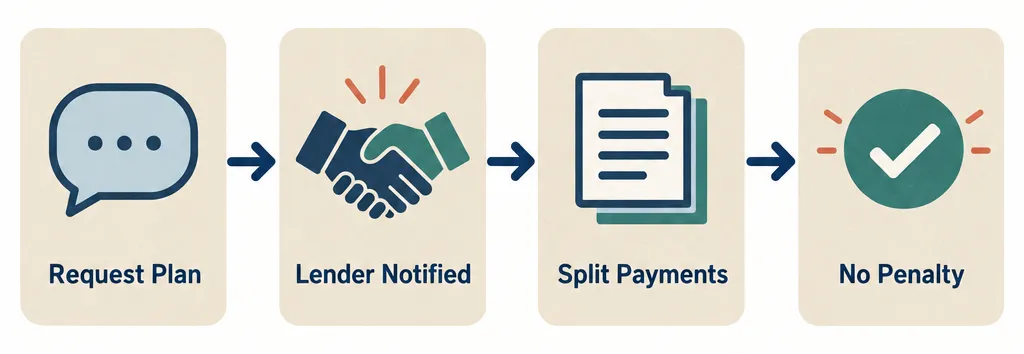
If you can’t pay a Wyoming payday loan when it’s due, ask for the extended payment plan in W.S. 40-14-366. It splits what you owe into at least four substantially equal installments. You can use it once every 12 months, and you can pay it off early at any time without penalty. It’s the strongest tool a struggling borrower has under state law.
Payday loan vs. credit union PAL vs. extended payment plan
| Option | Amount | Term | Cost cap | Key condition |
|---|---|---|---|---|
| Wyoming payday loan | No statutory maximum | Up to one calendar month | Greater of $30 or 20%/month (W.S. 40-14-363) | Fee fully earned on day one |
| Extended payment plan | Your existing payday balance | At least 4 equal installments | Default interest capped at WSJ prime + 6% | Once every 12 months (W.S. 40-14-366) |
| Credit union PAL I | $200 to $1,000 | 1 to 6 months | 28% APR, application fee up to $20 | Credit union member for at least 1 month |
| Credit union PAL II | Up to $2,000 | 1 to 12 months | 28% APR, application fee up to $20 | No waiting period after joining |
How to request the plan
- Ask before the due date. W.S. 40-14-366(b) says you must ask before 5:00 p.m. Mountain Time on the last business day before the due date and sign an amendment to your loan agreement that sets out the plan. The plan must run at least 60 days, with each installment due on or after a payday.
- Ask in writing. An email, a letter you deliver yourself, or a form signed at the store all leave a record. Keep a copy.
- Use plain language. For example: “I am requesting the extended payment plan available under W.S. 40-14-366 for my loan number [Account number], dated [Loan date]. Please confirm the installment amounts and due dates in writing. [Your full name], [Date].”
- Get the schedule. Confirm the number of installments (at least four), the amount of each and every due date.
- Pay off early if you can. The statute allows prepayment in full at any time without penalty.
If the lender refuses, says the plan doesn’t exist, or tries to sell you a new loan, write down the date and the employee’s name. Then file a complaint with the Wyoming Division of Banking. A licensed casher that won’t follow W.S. 40-14-366 is a possible violation you can report to the Division.
Ask in writing first
If you can’t pay on the due date, request the Wyoming extended payment plan in writing before that date and keep a copy. You can use it once in any 12 months, so save it for a real emergency.
What happens if you miss an installment
If you default on the plan, W.S. 40-14-366 lets the casher charge interest at 6% plus the Wall Street Journal prime rate as of January 1 of the year of default. That’s an annual rate, far below the 243% to 782% APR range of the original fee. Interest on unpaid installments is a real cost, but it grows far more slowly than a fresh payday fee every month.
What happens if you don’t pay a payday loan in Wyoming
If you don’t pay, the lender will try to cash your check or debit your account, then move to collections, and it may eventually sue. You can’t be jailed for owing a payday loan, but ignoring a court case can lead to a judgment and wage garnishment. Events usually unfold in this order:
- The check or debit is presented. On the due date, the lender deposits your post-dated check or starts the ACH debit.
- Bank fees. If the money isn’t there, your bank may charge an overdraft or returned-item fee, and the lender may add a returned-payment fee if your contract allows one.
- More withdrawal attempts. Since March 30, 2025, the CFPB payday rule bars a lender from trying again without your new consent after two consecutive failed withdrawal attempts.
- Collections. The lender’s staff or a third-party collection agency contacts you. Third-party collectors must follow the Fair Debt Collection Practices Act.
- A lawsuit. The lender or a debt buyer can sue, usually in Wyoming circuit court.
- Judgment and garnishment. If the court rules against you, the creditor can seek to garnish your wages, within the limits explained below.
Can you go to jail for not paying a payday loan?
No. Article 1, Section 5 of the Wyoming Constitution bars imprisonment for debt except in cases of fraud. A post-dated check you give a licensed lender is, by design, a check both of you know isn’t good yet. A missed payday loan is a civil debt and not a criminal one.
Courts can still act if you ignore them. If you’re sued, answer the summons. If you don’t, the lender can get a default judgment, and failing to obey a court order is a separate problem from the debt. A collector that threatens arrest over an ordinary missed payday loan is making a false threat. The FDCPA forbids that for third-party collectors.
Wage garnishment limits in Wyoming
For debts from consumer credit, W.S. 40-14-505 limits garnishment to the lesser of 25% of your weekly disposable earnings or the amount by which those earnings exceed 30 times the federal minimum hourly wage. At the federal minimum of $7.25, the general threshold is $217.50 per week, and the protection is calculated from your disposable earnings and the applicable workweek. W.S. 1-15-511 applies the same limit in general garnishment cases.
| Weekly disposable earnings | 25% of earnings | Amount over $217.50 | Maximum garnishment |
|---|---|---|---|
| $250 | $62.50 | $32.50 | $32.50 |
| $400 | $100.00 | $182.50 | $100.00 |
| $700 | $175.00 | $482.50 | $175.00 |
Federal benefits such as Social Security get separate protection: under 31 CFR Part 212, banks must shield up to two months of directly deposited benefits from garnishment. Federal law (15 U.S.C. 1674) also bars your employer from firing you over garnishment for one debt.
How long can a lender come after you in Wyoming?
Under W.S. 1-3-105(a)(i), a lender has 10 years to sue on a written contract, and a payday loan agreement is a written contract. The limit for unwritten contracts is 8 years. A debt can be collected for a long time, but a lawsuit filed after the deadline can be beaten if you raise the time limit as a defence.
Be careful with old debts. A partial payment or a written acknowledgment can affect how the limitation period is counted. If a collector asks for a “good faith” payment on a loan that’s many years old, contact Legal Aid of Wyoming first. On credit reports, the Fair Credit Reporting Act limits most collection accounts to seven years from the original delinquency. A payday loan that goes to collections can therefore hurt your credit even if the lender never reported your on-time payments.
Stopping automatic withdrawals
If the lender keeps pulling from your account and causing overdraft fees, you can stop it. Under the Electronic Fund Transfer Act and Regulation E (12 CFR 1005.10), you can stop a preauthorized debit by telling your bank at least three business days before it’s scheduled. Your bank may ask for written confirmation within 14 days. Also send the lender a written notice revoking its authorization.
Stopping the withdrawals doesn’t cancel what you owe. It does stop the fee spiral while you set up the extended payment plan or another arrangement. For a paper post-dated check, ask your bank about a stop-payment order and its fee.
Federal rules that apply in Wyoming (2025-2026 status)
Three federal laws apply to every Wyoming payday loan: the Truth in Lending Act (cost disclosure), the Military Lending Act (a 36% cap for service members) and the Fair Debt Collection Practices Act (collector conduct). The CFPB’s payday rule now covers only payment withdrawals, and its future is uncertain.
Federal rules that affect Wyoming borrowers (status November 2026)
| Rule | What it does | Status |
|---|---|---|
| Truth in Lending Act / Regulation Z | Lender must disclose the finance charge and APR in writing | In force |
| CFPB 2017 Payday Lending Rule: underwriting | Required lenders to check your ability to repay | Rescinded in 2020 |
| CFPB 2017 Payday Lending Rule: payment provisions | Notice before withdrawals; no further attempts after two consecutive failures without new consent | In effect since March 30, 2025; enforcement deprioritized |
| Military Lending Act (32 CFR Part 232) | 36% Military Annual Percentage Rate cap and other protections | In force |
| Fair Debt Collection Practices Act / Regulation F | Limits on third-party collector conduct | In force |
| Electronic Fund Transfer Act / Regulation E | Right to stop preauthorized debits | In force |
CFPB payday rule: what’s actually in force
The payment provisions of the CFPB’s 2017 rule took effect March 30, 2025. Lenders must give notice before withdrawals, and after two consecutive failed attempts they need your new consent to try again. Just before that date, the Consumer Financial Protection Bureau said it would not prioritize enforcement or supervision of these provisions. The rule text has not changed, so the payment protections still apply. Mention them in any complaint about repeated withdrawals.
Military Lending Act protections for service members
The Military Lending Act caps the Military Annual Percentage Rate at 36% for active-duty service members and their covered dependents. The cap includes most fees. It also bans mandatory arbitration and prepayment penalties. A typical Wyoming payday loan costs well over 36% APR, so a lender can’t legally make one to a covered borrower. Families at F.E. Warren Air Force Base in Cheyenne and Wyoming National Guard members on active orders should check their status. Military relief societies such as the Air Force Aid Society offer emergency help with no interest.
How Wyoming compares with other states
Wyoming is one of the states that allow payday lending with a fee cap and no APR cap. Several of its neighbours have gone much further. Colorado, Montana, South Dakota and Nebraska have each adopted a 36% annual rate cap that has pushed out traditional payday lending, while Idaho and Utah allow the loans without a fee cap.
| State | Payday status | Main limit |
|---|---|---|
| Wyoming | Allowed with limits | Greater of $30 or 20%/month; one-month term |
| Colorado | 36% APR cap | Rate cap adopted by 2018 ballot measure |
| Montana | 36% APR cap | Rate cap adopted by 2010 ballot measure |
| South Dakota | 36% APR cap | Rate cap adopted by 2016 ballot measure |
| Nebraska | 36% APR cap | Rate cap adopted by 2020 ballot measure |
| Idaho | Allowed | No fee cap; loan size tied to income |
| Utah | Allowed | No fee cap; 10-week limit |
The National Conference of State Legislatures keeps a 50-state list of payday statutes. Which states have banned payday loans? States that prohibit them or cap rates low enough to end the business include New York, New Jersey, Pennsylvania, Maryland, Georgia, North Carolina, Arkansas and Arizona. Our guides on Idaho payday loan laws and New Jersey payday loan laws go through two of those systems in detail.
Installment loans and car title loans in Wyoming
Most consumer installment loans in Wyoming face a finance charge cap of 36% a year on the first $1,000 of unpaid principal and 21% a year on the rest. The cap is in W.S. 40-14-310. Wyoming has no separate title loan statute, so a car title loan made as a consumer loan falls under the same Uniform Consumer Credit Code rules and the same Division of Banking licensing.
Rate caps and licensing for installment loans
A 2021 law (Laws 2021, ch. 14) repealed the old supervised loan sections, including W.S. 40-14-348. Older pages that cite that section for the 36%/21% cap describe the pre-2021 setup; the cap now sits in W.S. 40-14-310. The rule is applied using the actuarial method, and it also allows a small minimum finance charge.
Here’s an example at the top of the cap. A $1,000 loan at 36% APR repaid over 12 months works out like this.
| Amount borrowed | APR | Term | Monthly payment | Total repaid | Total finance charge |
|---|---|---|---|---|---|
| $1,000 | 36% | 12 months | $100.46 | $1,205.54 | $205.54 |
The math: 36% a year is 3% a month. Spread over 12 equal payments on a declining balance, that comes to about $100.46 a month. Compare it with a $1,000 payday loan, which can cost $200 for one month. The installment loan’s full year of interest costs about the same as a single month on the payday loan.
Car title loans
Wyoming law has no title-loan chapter and no title-loan permit. A lender that takes your car title as security for a consumer loan needs a Division of Banking license, and the consumer loan caps apply. The extra risk is repossession. If you default, the lender can take the car you need to get to work. Wyoming’s Uniform Consumer Credit Code includes default and cure provisions before repossession, so ask the lender for its written default notice process before you hand over your title.
Wyoming stablecoin and the Wyoming Stable Token Commission
The Wyoming stablecoin, FRNT (the Frontier Stable Token), is a dollar-linked digital token issued by the state. It is not a loan, a credit product or a benefit program. It is run by the Wyoming Stable Token Commission, created under the Wyoming Stable Token Act and chaired by the governor.
The token is designed to be redeemable for $1.00 and backed by reserves the state holds. Check the commission’s own site for current reserve reports before relying on any third-party description.
A state-issued token still carries risks you should understand:
- Not insured. Crypto, stablecoins included, is not FDIC or SIPC insured. A stablecoin can lose its dollar value, and crypto in general can lose all of its value.
- Custody risk. If an exchange or wallet provider fails, or you lose your keys, you can lose access to your tokens.
- Taxes. The IRS treats digital assets as property under IRS Notice 2014-21. Selling, swapping or spending them can be a taxable event that you report.
- Federal law. The GENIUS Act, signed in July 2025, created a federal framework for payment stablecoins. Federal regulators are still writing many of the detailed rules.
- Scams. Fake tokens and “state stablecoin loan” offers that borrow the Wyoming name are a predictable fraud. The commission does not lend money to residents. Report impersonators to FTC ReportFraud and the FBI’s IC3.
None of this is a reason to buy or avoid FRNT. It’s background, so you don’t confuse a state crypto project with consumer credit.
Lower-cost options in Wyoming
Before you take a payday loan, check whether you can get the money more cheaply. In Wyoming the realistic options are federal credit union payday alternative loans (capped at 28% APR), hardship plans from the companies you owe, nonprofit credit counseling, and state programs that cut the bill you’re trying to cover.
Cheaper options first
Ask a credit union about a PAL loan, which is capped at 28% APR under NCUA rules.
Call the utility, landlord or medical billing office and ask for a hardship or payment plan.
Call Wyoming 2-1-1 for local emergency help with rent, food and utilities.
- NCUA Payday Alternative Loans. Federal credit unions can make PAL I loans of $200 to $1,000 for 1 to 6 months and PAL II loans of up to $2,000 for 1 to 12 months. The NCUA rule for federal credit union payday alternative loans (12 CFR 701.21(c)(7)(iii)) caps both at 28% APR with an application fee of no more than $20. A $400 PAL repaid over three months costs a small fraction of a $400 payday loan’s $80 monthly fee.
- Hardship plans. Utilities, hospitals and many landlords would rather set up a plan than chase a default. Ask in writing and get the terms on paper.
- Wyoming state programs. The Wyoming Department of Family Services runs SNAP food assistance and the Low Income Energy Assistance Program (LIEAP) for heating bills. If you lost your job, the Wyoming Department of Workforce Services handles unemployment insurance. In Cheyenne, Casper and elsewhere, Wyoming 2-1-1 can point you to local charities and emergency funds.
- Nonprofit credit counseling. Agencies accredited by the National Foundation for Credit Counseling can review your budget. Some can set up a debt management plan with creditors that agree to one.
- Employer advances. Some employers will advance pay you’ve already earned at no cost. Ask payroll before you go to a store.
Are there charities that pay off payday loans? Few pay a lender directly. Help from SNAP or LIEAP frees up money you’d otherwise borrow, and that usually has the same effect. Our Idaho and Nevada loan law guides cover the same options in other western states.
How to file a complaint about a Wyoming payday lender
Complaints about a licensed payday lender go to the Wyoming Division of Banking. It investigates consumer complaints against businesses that extend credit when there’s evidence of a possible violation. You can also file with the Wyoming Attorney General’s Consumer Protection and Antitrust Unit for deceptive practices, and with the CFPB for any lender or collector.
- Wyoming Division of Banking. Use it for fee overcharges, refused payment plans, refinancing with the same casher, rescission problems or unlicensed lending.
- Wyoming Attorney General’s Consumer Protection and Antitrust Unit. You can file online or with a PDF form, or call (307) 777-8962 or (307) 777-6397. The mailing address is 109 State Capitol, Cheyenne, WY 82002. The Attorney General represents the state and can’t act as your private lawyer.
- Consumer Financial Protection Bureau. The CFPB complaint portal forwards your complaint to the company and tracks its response. It’s useful for withdrawal problems and collector conduct.
- Fraud. Report fake lenders and advance-fee scams to FTC ReportFraud and the FBI’s IC3.
Gather these documents before you file:
- The loan agreement and the Truth in Lending disclosure.
- Receipts, including any rescission or payment-plan receipt.
- Bank statements showing withdrawals and overdraft fees.
- Copies of written requests and the lender’s replies.
- Notes of calls with dates, times and names.
Before you borrow
A Wyoming payday loan can legally cost 243% to 782% APR, and the whole fee is earned the day you sign. If you can’t repay the full amount within a month, the extended payment plan or a credit union loan will cost far less than a second payday loan.
FAQ
Are payday loans legal in Wyoming?
Yes. Wyoming allows payday loans as “post-dated check or similar arrangement” transactions under the Wyoming Uniform Consumer Credit Code, W.S. 40-14-362 through 40-14-366. The lender must hold a post-dated check casher license from the Wyoming Division of Banking.
How much can a payday lender charge in Wyoming?
Under W.S. 40-14-363, the maximum is 20% of the amount advanced per month, with a $30 minimum charge for each month or portion of a month the loan is outstanding. On a $300 loan, that’s $60. The fee is fully earned on the day you borrow, so repaying early doesn’t reduce it.
What is the maximum payday loan amount in Wyoming?
Wyoming’s payday statutes set no dollar maximum. Ignore any “$500 cap” you see online, because it doesn’t come from the statute. The lender decides the amount based on your income and its own policies.
Can you roll over a payday loan in Wyoming?
You can’t roll over a payday loan. W.S. 40-14-364 bars a lender from making a new loan to pay or refinance an existing payday loan. Any new loan used to pay an old one adds another full fee.
Can I get a payment plan for a payday loan in Wyoming?
Yes. W.S. 40-14-366 gives you an extended payment plan of at least four equal installments, once every 12 months. You can prepay it at any time without penalty. If you default on the plan, interest is capped at the Wall Street Journal prime rate plus 6%.
How long can a payday lender come after you in Wyoming?
The lender has 10 years from the default to sue on a written contract under W.S. 1-3-105(a)(i). It can’t have you jailed for the debt. If you’re sued, answer the summons, and talk to Legal Aid of Wyoming before you make a payment on a very old debt.
Laws and regulations referenced
- Wyoming Statutes Title 40, Chapter 14 (Wyoming Uniform Consumer Credit Code), including W.S. 40-14-362 to 40-14-367 (post-dated check cashers)
- Truth in Lending Act, 15 U.S.C. 1601
- Regulation Z, 12 CFR Part 1026
- Fair Debt Collection Practices Act, 15 U.S.C. 1692
- Regulation F (debt collection), 12 CFR Part 1006
- Fair Credit Reporting Act, 15 U.S.C. 1681
- Electronic Fund Transfer Act, 15 U.S.C. 1693
- Regulation E (electronic transfers), 12 CFR Part 1005
- Military Lending Act, 10 U.S.C. 987
- Military Lending Act rule, 32 CFR Part 232
- CFPB payday lending rule, 12 CFR Part 1041
- IRS Notice 2014-21 (virtual currency is property)
- GENIUS Act (stablecoins), Public Law 119-27 (S. 1582)
Links go to the official text on government sites.
Check, verify or complain
Sources
- Wyoming Legislative Service Office issue briefing on payday lending (2005) wyoleg.gov · official source
- 2021 HB0008 summary, Wyoming Legislature wyoleg.gov · official source
- Wyoming Division of Banking rulemaking notice on HB0008 and supervised loans wyoleg.gov · official source
- Wyoming Judicial Branch: Garnishment wyocourts.gov · official source
- Wyoming AG Consumer Protection and Antitrust Unit Complaints ag.wyo.gov · official source
- 2014 HB0088, Wyoming Legislature wyoleg.gov · official source
- 2013 HB0231, Wyoming Legislature wyoleg.gov · official source
- Wyoming Division of Banking: License and Registration wyomingbankingdivision.wyo.gov · official source
- Wyoming Division of Banking: UCCC notification forms and PDCC annual report wyomingbankingdivision.wyo.gov · official source
- Wyoming Division of Banking: Licensee list wyomingbankingdivision.wyo.gov · official source
- Wyoming Division of Banking: How to file a complaint wyomingbankingdivision.wyo.gov · official source
- Wyoming Statutes 40-14-310 Consumer loan finance charges (2024 text) law.justia.com
- Wyoming Statutes 40-14-505 garnishment limits law.counselstack.com
- Royal v. Walsh (Wyo. 2004) law.justia.com
- Wyoming issues first state-backed stablecoin (The Block) theblock.co
- Wyoming adopts Chainlink Proof of Reserve for FRNT coinalertnews.com
- Wyoming Stable Token Commission migrates to Chainlink CCIP prnewswire.com
- Wyoming Statutes 40-14-363 post-dated check finance charges law.counselstack.com
- NCLC: Rule on bounced payday and high-cost loan payments now in effect library.nclc.org
- Orrick InfoBytes: CFPB will not enforce payday lending rule infobytes.orrick.com
- CFPB releases 2026 regulatory agenda consumerfinancialserviceslawmonitor.com
- 2022 Wyoming Statutes 40-14-363 (Justia) law.justia.com
- Wyoming Uniform Consumer Credit Code, Chapter 14 (Justia) law.justia.com

Elena writes about getting through a money emergency, assistance programs, budgeting on a tight income, banking basics and borrower rights. Her guides list the cheaper options first and link the agency or program that can actually help.
Ruth is US Financer's standards editor. Every article goes through her checks before and after it is published: each rate, fee, cap, deadline and rule is matched against its primary source, every law named is linked to its official text, and anything that cannot be…
What changed
- Nov 27, 2026 First published.
Comments are closed