

General information, not legal advice. Laws change, so confirm with the official statute, your state regulator or a licensed attorney before you act.
Lenders can’t legally make a typical payday loan in Connecticut. A $15 fee on $100 for two weeks works out to about 391% APR, and state law caps licensed small-loan lenders at 36% APR, with fees counted, on loans of $50,000 or less. Most other lenders are held to the 12% usury limit. If a lender that isn’t exempt makes you a small loan without a Connecticut license, the loan is void and nobody can legally collect it.
Run the numbers
Key takeaways
- Licensed small-loan lenders can charge at most 36% APR, and fees and “tips” count toward it (P.A. 23-126, since Oct. 1, 2023).
- A small loan made by a non-exempt lender in violation of the licensing requirements is void and unenforceable under CGS 36a-558, and the lender has no right to collect principal, interest or charges.
- Cash advance apps now face licensing and fee limits under P.A. 25-155, in effect since Oct. 1, 2025.
- You can’t be arrested for an unpaid loan. A lawful creditor has 6 years to sue on a written contract (CGS 52-576).
- Check a lender’s license on NMLS Consumer Access before you borrow, and send complaints to the Department of Banking and the CFPB.
Last checked November 23, 2026, against the Connecticut General Statutes, Office of Legislative Research summaries and Connecticut Department of Banking guidance.
Fact-checked
We checked these key facts against the sources named, on November 23, 2026:
- On $500 for two weeks, the most is about $6.90 (source: portal.ct.gov)
- If an online lender offers a Connecticut resident a loan above 36% APR, it’s operating outside state law (source: portal.ct.gov)
- If it is $50,000 or less and priced above 12% APR, the lender needs a small loan license and can’t go over 36% APR (source: cga.ct.gov)
- Under the Electronic Fund Transfer Act and Regulation E (12 CFR 1005.10), you can stop preauthorized withdrawals from your account (source: ecfr.gov)
- Under those rules, PAL I loans run $200 to $1,000 over one to six months, and PAL II loans go up to $2,000 over as long as 12 months (source: experian.com)
The rules that apply: a 12% usury cap and a 36% small-loan ceiling
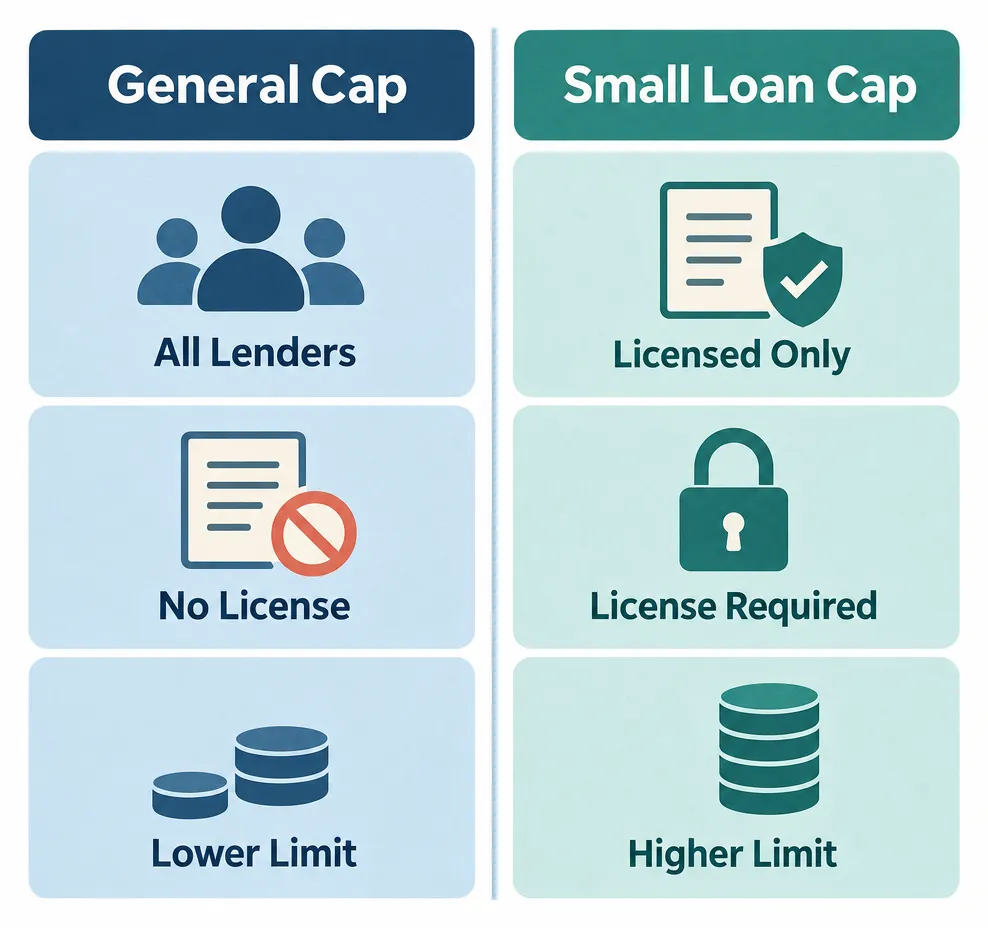
Connecticut uses two layers of rules. Under CGS 37-4, the general usury law limits interest to 12% a year for any lender that isn’t specifically exempt. The Small Loan Lending and Related Activities Act (CGS 36a-555 et seq.) then lets licensed lenders charge more on smaller consumer loans, but never more than 36% APR.
The Act covers consumer loans of $50,000 or less where the APR, with all finance charges counted, is above 12%. To make one of those loans, a lender needs a small loan license from the Connecticut Department of Banking’s Consumer Credit Division, unless it is exempt. CGS 36a-563 and P.A. 23-126 set the 36% ceiling. The Department’s consumer complaint page puts it plainly: Small Loan licensees can charge up to 36% a year, and unlicensed lenders aren’t entitled to that rate.
| Rule | Limit | Applies to | Source |
|---|---|---|---|
| General usury cap | 12% a year | Lenders that aren’t exempt | CGS 37-4 |
| Small loan APR ceiling | 36% APR, fees and tips counted | Licensed lenders, loans of $50,000 or less | CGS 36a-563; P.A. 23-126 |
| License requirement | Required above 12% APR | Non-exempt lenders, including online lenders | CGS 36a-555 et seq. |
| Unlicensed small loans | Void, nothing collectible | Non-exempt lenders without a license | CGS 36a-558 |
| Wage assignments | Banned as loan security | Small loans | CGS 36a-568 |
| Earned wage access fees | $4 per advance, $30 per month | Advances under $750 | P.A. 25-155 |
| Deadline to sue | 6 years | Written contracts | CGS 52-576 |
| Wage garnishment | Lesser of 25% of disposable pay or the amount above 40 times minimum wage | Court-ordered wage executions | CGS 52-361a |
| Service members | 36% MAPR | Covered active-duty members and dependents | Military Lending Act |
What changed on October 1, 2023
Public Act 23-126 rewrote the small loan rules. Many websites still describe the old version, so the outdated numbers are still in circulation. According to the Department of Banking’s industry guidance of September 11, 2023, the act:
- raised the small-loan limit from $15,000 to $50,000;
- adopted the APR definition from the Military Lending Act, so fees and other charges count toward the 36% ceiling;
- let the Department treat voluntary payments such as tips and donations as finance charges when it calculates APR.
That replaced the old fee schedule, which allowed closed-end charges per $100 borrowed plus a separate open-end rate. If you read about “$17 per $100” or a “$15,000 limit,” the source predates 2023. Since then the law has had one ceiling, and every fee counts toward it.
Why a two-week $15-per-$100 loan breaks the cap
APR shows what a fee costs once it is spread over a year. A $15 fee on $100 for 14 days is 15% for two weeks. A year has about 26 two-week periods (365 ÷ 14 = 26.07), so 15% × 26.07 comes to roughly 391% a year as a simple, non-compounded annualized rate.
Turn it around: at Connecticut’s 36% ceiling, the most a licensed lender could charge for $100 over 14 days is about $1.38 ($100 × 0.36 × 14 ÷ 365). On $500 for two weeks, the most is about $6.90. A payday storefront can’t make money on those numbers, and that’s why licensed payday lending doesn’t exist in the state.
Turn any fee into an APR
Divide the fee by the amount you borrow. Multiply by 365, divide by the number of days in the loan, then multiply by 100. On a covered small loan of $50,000 or less, anything above 36% from a non-exempt lender breaks Connecticut law.
Who must be licensed, and who is exempt
A non-exempt lender needs a Connecticut small loan license to lend $50,000 or less at more than 12% APR. Based on the Department of Banking’s complaint guidance and the Office of Legislative Research’s summary of the law, these lenders are outside the licensing requirement:
- banks and credit unions, including federally chartered ones, which follow their own charter rules;
- pawnbrokers, who are regulated separately;
- lenders that stay at or under 12%.
A license from another state doesn’t count. Neither does a claim of tribal ownership or a website based outside Connecticut. If the borrower lives in Connecticut, the Department’s position is that Connecticut law applies.
Wage assignments are banned
Under CGS 36a-568, a small loan can’t be secured by an assignment of your wages. A lender can’t get you to sign over part of your future paycheck as collateral. The only way a lender can lawfully take your wages is through a court judgment followed by a wage execution, and Connecticut limits that as well (see the debt collection section below).
Car title loans in Connecticut
Connecticut has no title-loan license. Lenders can’t legally make the typical car title loan, which is a short loan at triple-digit rates with your car’s title as collateral. A loan secured by your car is still a consumer loan. If it is $50,000 or less and priced above 12% APR, the lender needs a small loan license and can’t go over 36% APR.
The Department of Banking’s payday and title loan complaint page warns that title loans from non-exempt, unlicensed lenders are void and unenforceable, the same as payday loans. That page also lists separate APR caps for vehicle financing: 15% for a new car, 17% for a used car less than two years old and 19% for an older used car. If an online lender offers “title loans CT” at 100% APR or more, it’s operating outside the law.
The big risk is the same as in any state: you could lose the car you need to get to work. If a lender that isn’t licensed in Connecticut holds your title or is threatening to repossess, file a complaint with the Department before you pay anything more.
Installment and personal loans for bad credit in CT
Licensed installment lenders, banks and credit unions can legally lend to Connecticut borrowers with low credit scores. For non-bank lenders, the same 36% APR ceiling applies, and every fee counts toward it. A lender advertising personal loans for bad credit in CT has to hold a small loan license if the loan is $50,000 or less and priced above 12%.
How the 36% ceiling works on a real loan
A 36% APR is a monthly rate of 3% on the balance you still owe. Here is a $500 loan repaid over six months:
| Loan | APR | Term | Monthly payment | Total repaid | Total cost |
|---|---|---|---|---|---|
| $500 licensed small loan | 36% (the maximum) | 6 months | $92.30 | $553.80 | $53.80 |
| $500 credit union PAL I | 28% (federal maximum) | 6 months | $90.27 | $541.62 plus up to a $20 application fee | $41.62 to $61.62 |
| $500 unlicensed payday loan, rolled over every two weeks | About 391% | 6 months (13 periods) | $75 every two weeks, principal still owed | $1,475 | $975 |
The payday row shows how rollovers add up. Paying a $75 fee every two weeks for 26 weeks comes to $975, and you’d still owe the $500 at the end. That loan is also void in Connecticut, which the next section covers.
Lenders that advertise “no credit check”
“No credit check” usually means the lender skips a hard inquiry at one of the three bureaus. It still screens you some other way: a soft check, your bank account history or a specialty consumer reporting agency. Those lenders charge more to cover the risk, and in Connecticut they can’t charge more than 36% APR. If a lender quotes you more than that, it’s either unlicensed or breaking the terms of its license.
Online, offshore and tribal lenders that still lend to CT residents
Online lenders still reach Connecticut borrowers through search ads and lead-generation sites, many of them claiming out-of-state or tribal status. The Connecticut Department of Banking’s position is that payday loans made to Connecticut consumers by non-exempt, unlicensed lenders are void and unenforceable, wherever the lender is based.
Connecticut has enforced that position against tribal lenders too. In 2014 and 2015, the Department of Banking acted against online lenders affiliated with the Otoe-Missouria Tribe, including Great Plains Lending, over illegal loans to state residents. The commissioner held that tribal sovereign immunity didn’t shield the lenders from the state’s licensing law, and the penalties totaled $800,000.
Did you know?
A July 11, 2022 consent order from the Connecticut Department of Banking says Connecticut-licensed consumer collection agencies may not collect on small loans made by unlicensed, non-exempt lenders. That includes lenders affiliated with tribes.
That 2022 order matters in practice. If a collector licensed in Connecticut calls about a high-rate online loan from an unlicensed lender, the collector is breaking the Department’s rules. You can report it.
The Department has kept enforcing these rules. In a September 2025 consent order, it treated a litigation-funding company’s cash advances to Connecticut residents as small loans, and the company agreed to stop making or collecting small loans in the state without a license. On February 10, 2026, the Department fined a collection agency $100,000 and ordered it and two control persons to cease and desist over alleged violations of state consumer collection laws.
“The tribal lender says Connecticut law doesn’t apply to them. Is that right?”
No, not according to Connecticut’s regulator. The Department of Banking ruled against that argument in the Otoe-Missouria case. Its current guidance treats loans from unlicensed tribal lenders to Connecticut residents as void. Lenders still put tribal-law and arbitration clauses in their contracts, and courts around the country haven’t all agreed on how far immunity reaches. Don’t accept the lender’s word on it. A Department complaint or a legal aid office can tell you where your loan stands.
How to check a lender's Connecticut license
- Get the lender’s full legal name and NMLS ID number. Licensed lenders have to show it.
- Search that name or number on NMLS Consumer Access.
- Make sure the record shows an active Connecticut Small Loan Company license, not only licenses from other states.
- If the lender isn’t listed, call the Department of Banking’s Consumer Credit Division to confirm before you sign anything.
Red flags of an unlicensed lender
- It offers a loan to a Connecticut address above 36% APR, or it quotes a flat fee per $100 instead of an APR.
- It has no NMLS ID, or its NMLS record shows no Connecticut license.
- It says it’s governed by tribal law, foreign law or “the laws of the state where we are located.”
- It wants ACH access to your bank account before giving you a full Truth in Lending disclosure.
- It promises “guaranteed approval.” No legitimate lender can promise that.
Already have a payday loan? What you owe and what you can do
If your loan came from a non-exempt lender with no Connecticut small loan license, CGS 36a-558 says the loan “shall be void.” No one has the right to collect or receive any principal, interest, charge or other consideration on it. Anyone who tries anyway faces penalties under CGS 36a-570.
That answers a common question: “I live in CT and took an online loan at 600% APR. Do I actually have to pay it back?” Under the statute, the lender has no legal right to collect, not even the original amount. A lender will often dispute that, and an outside lender can still pull money from your account if you gave it access. So the first job is protecting your bank account.
Step-by-step: stopping automatic withdrawals
Under the Electronic Fund Transfer Act and Regulation E (12 CFR 1005.10), you can stop preauthorized withdrawals from your account. Tell your bank at least three business days before the scheduled debit. The bank can ask you to confirm in writing within 14 days.
- Write to the lender and say you are revoking its authorization to debit your account. Keep a copy, and send it by email and by mail.
- Ask your bank for a stop-payment order on the lender’s debits. Give the lender’s name exactly as it shows on your statement.
- Send your bank a copy of the revocation letter and ask the bank to block any further debits.
- Check your account every day for a few weeks. If a debit you didn’t authorize gets through, dispute it with your bank right away.
- If the lender keeps getting through, ask your bank whether you should close the account and open a new one.
The CFPB’s payday rule adds federal protection. Its payment provisions took effect March 30, 2025. Once a covered lender has failed twice in a row to withdraw money from your account, it can’t try again without getting new authorization from you. The CFPB has said it won’t prioritize penalties under this part of the rule, so a stop-payment order and a revocation letter protect you more directly.
Keep a contact log
Write down the date, time, caller’s name, company and phone number for every call or text. Save every email and letter. A Department of Banking complaint, a CFPB complaint or a lawyer will all ask for this.
Filing a complaint with the CT Department of Banking
The Connecticut Department of Banking has a complaint form for payday and title loans on its official website, portal.ct.gov/dob. It has a separate form for licensed small loan companies. Include:
- the loan agreement, or screenshots of the website and the offer;
- bank statements showing each debit;
- your contact log;
- any messages from collectors.
You can file the same complaint with the Consumer Financial Protection Bureau, which sends it to the company and tracks the response. The Connecticut Attorney General’s office also handles questions about payday lending.
When to get legal help
Get legal help as soon as you’re served with court papers, if a lender claims it can sue under another state’s or a tribe’s law, or if money is still being taken from your account after you revoked authorization. Statewide Legal Services of Connecticut offers free advice to people who qualify by income. Never ignore a lawsuit, even over a loan you believe is void. If you don’t respond, the court can enter a default judgment against you.
Can you get in trouble for not paying a payday loan in Connecticut?
You can’t be arrested or jailed in Connecticut for not paying a consumer loan. Under the Fair Debt Collection Practices Act, a collector can’t threaten arrest or criminal charges it can’t bring or doesn’t intend to bring. A lawful creditor can sue you, win a judgment and then ask a court to garnish part of your wages.
So when a collector says, “You’ll be arrested for check fraud if you don’t pay,” that’s a classic FDCPA violation. Not being able to repay a loan isn’t fraud. Write down the call and report it to the CFPB and the Department of Banking.
How long can they come after you?
Under CGS 52-576, a creditor has six years from the date the claim accrues to sue on a written contract. A payment you make or authorize can restart that clock. That’s one reason a small “good faith” payment on an old debt is risky. If the lender was unlicensed, the debt is void from the start, and the clock doesn’t matter.
What a collector cannot do
| Collector action | Legal? | Rule |
|---|---|---|
| Threaten arrest or jail | No | FDCPA, 15 U.S.C. 1692e |
| Call you at work after you say your employer forbids it | No | FDCPA, 15 U.S.C. 1692c |
| Sue you in a far-away court | No, for third-party collectors | FDCPA venue rule, 15 U.S.C. 1692i |
| Collect for an unlicensed small lender, if the collector is CT-licensed | No | DOB consent order, July 11, 2022 |
| Garnish your wages without a court judgment | No | CGS 52-361a |
| Take more than the state limit from your paycheck | No | CGS 52-361a |
A third-party debt collector has to sue you where you live or where you signed the contract. Under CGS 52-361a, a wage execution can take no more than the lesser of two amounts: 25% of your weekly disposable earnings, or what you earn above 40 times the higher of the federal or Connecticut minimum wage.
Connecticut’s minimum wage is $16.94 an hour in 2026, so 40 times the minimum wage comes to $677.60 a week, and a creditor can only reach the lesser of 25% of your disposable earnings or the amount above that figure. In 2026, if you take home $900 a week, 25% would be $225, and the amount above $677.60 is $222.40. The lower figure applies, so the most a creditor could take is $222.40 a week. The minimum wage rises to $17.48 on January 1, 2027, and the threshold goes up to $699.20, so on the same $900 paycheck the most a creditor could take would be $200.80 a week.
Cash advance and earned wage access apps in Connecticut (2025 law)
Cash advance apps are legal in Connecticut, but Public Act 25-155 (SB 1396) sets limits on them. Gov. Ned Lamont signed it on July 8, 2025, and it took effect October 1, 2025. Earned wage advances under $750 count as small loans. Providers need a license, and fees are capped at $4 per advance and $30 a month.
The Office of Legislative Research’s summary says these advances are exempt from the 36% APR test, and the flat-dollar caps apply instead. The reason is simple math. A $4 fee on a $100 advance repaid in two weeks already works out to about 104% APR, even though it costs only $4.
Did you know?
According to the Connecticut General Assembly’s summary of Public Act 25-155, “optional” tips on paycheck-advance apps count toward the $4-per-advance and $30-per-month fee cap.
Fee caps in plain numbers
| What you do | Most a provider can charge |
|---|---|
| One $100 advance | $4 |
| Five $100 advances in one month | $20 |
| Ten advances in one month | $30 (the monthly cap) |
| Late repayment | No late fees or interest allowed |
| Overdraft the provider causes | Provider must refund it |
Payments Dive and the legal summaries of the law report that the act also requires disclosures, bars late fees and interest, and requires providers to offer at least one free way to get each advance. Apps must also include a link for complaints to the Department of Banking. According to the Connecticut Department of Labor, employers can’t share in the fees.
That explains why some apps changed in late 2025. If you’re asking, “Why did my cash advance app stop working or change its fees in Connecticut?”, the app most likely changed its fees, removed its tip prompt or stopped serving the state rather than get licensed under the new law. The fintech trade group American Fintech Council opposed the law and called the fee limits too strict. Consumer groups argued the opposite. For borrowers, the effect is cheaper advances from fewer apps.
What to check before using an app
Set any tip to $0. Use the free option if there is one, and accept slower delivery to avoid an instant-transfer fee. At the end of the month, add up everything you paid. If you paid more than $4 on any advance or more than $30 in total, the provider exceeded Connecticut’s cap, and you can file a complaint with the Department of Banking.
Legal ways to get emergency cash in Connecticut
The cheapest options cost little or nothing. Start with a payment plan from the company you owe, an advance from your employer or help from a public program. After that, a credit union small-dollar loan is usually next cheapest. A licensed installment loan at no more than 36% APR comes after that. Here is how the legal options compare for someone asking, “I need $500 by Friday and my credit is bad. What’s legal in CT?”
Cost comparison on $500
| Option | Max APR or fee | Typical term | Estimated total cost | Legal in CT? |
|---|---|---|---|---|
| Payment plan with the creditor you owe | Often $0 | Varies | Often $0 | Yes |
| Employer paycheck advance | Often $0 | Next payday | Often $0 | Yes |
| EWA app, five $100 advances | $4 each, $30 a month | Next payday | Up to $20 | Yes, licensed providers |
| Credit union PAL I | 28% APR plus up to $20 fee | 1 to 6 months | About $42 to $62 over 6 months | Yes |
| Licensed small loan | 36% APR, all fees in | 6 months | About $54 | Yes |
| Credit card cash advance | Card’s cash APR plus fee | Revolving | Depends on card agreement | Yes |
| Pawn loan | Set by pawn rules | Short | Varies; you can lose the item | Yes, licensed pawnbrokers |
| Payday loan at $15 per $100, rolled over | About 391% APR | 6 months | $975 in fees | No, void if unlicensed |
The PAL figures come from the National Credit Union Administration’s rules for federal credit unions. Under those rules, PAL I loans run $200 to $1,000 over one to six months, and PAL II loans go up to $2,000 over as long as 12 months. Both cap the APR at 28%, and the application fee can’t be more than $20.
Credit union loans and licensed installment loans have real drawbacks. They take longer to approve than an app, you may have to join the credit union before you can borrow, and a 36% loan is still expensive debt. The upside is a set end date. A payday loan that rolls over every two weeks never has one.
Cheaper options first
Ask the company you owe for a hardship plan before you borrow to pay it.
Dial 2-1-1 for Connecticut’s free help line for rent, utility and food assistance.
A nonprofit credit counseling agency can set up a debt management plan at low cost.
Help that costs nothing
- CT 2-1-1, run by United Way of Connecticut, refers callers to local emergency help with rent, utilities, food and shelter, around the clock.
- The Connecticut Energy Assistance Program helps eligible households with heating costs.
- Nonprofit credit counseling agencies can review your budget for free and negotiate lower rates on credit card debt.
- Statewide Legal Services of Connecticut gives free legal advice to people who qualify by income, including on debt lawsuits.
Connecticut vs. neighboring states
Payday lending is largely shut out of southern New England and New York. Rhode Island is the exception for now. Its legislature ended the state’s payday lending exemption in 2025, but the 36% cap doesn’t take effect until January 1, 2027.
| State | Payday loans allowed? | Rate cap | Regulator |
|---|---|---|---|
| Connecticut | No, unless at 36% or less by a licensee | 12% usury; 36% APR for licensees | Department of Banking |
| New York | No | 16% civil usury; 25% criminal usury | Department of Financial Services |
| Massachusetts | No, in practice | 23% a year plus a $20 fee, loans under $6,000 | Division of Banks |
| Rhode Island | Yes, until Jan. 1, 2027 | 36% APR from Jan. 1, 2027 | Department of Business Regulation |
If you’ve moved to Connecticut from New Jersey or Maryland, things will look familiar. Both states keep payday lending out with rate caps, and our guides to New Jersey’s and Maryland’s payday loan laws explain those rules. Remember that the law where you live applies. A Rhode Island storefront can’t send a 260% loan to you in Hartford.
Timeline of Connecticut payday and small-loan law
| Year | Change | Effect on borrowers |
|---|---|---|
| Long-standing | 12% general usury cap (CGS 37-4) | Most lenders without a license can’t charge more |
| 2014 to 2015 | Otoe-Missouria tribal lenders penalized $800,000 | Tribal status doesn’t protect unlicensed lenders |
| July 11, 2022 | Consent order on collection agencies | CT-licensed collectors can’t collect unlicensed loans |
| Oct. 1, 2023 | P.A. 23-126 takes effect | 36% APR ceiling with all fees counted; limit raised to $50,000 |
| Mar. 30, 2025 | CFPB payday rule payment provisions take effect | Lenders must stop after two failed withdrawals |
| Oct. 1, 2025 | P.A. 25-155 takes effect | EWA fees capped at $4 per advance and $30 a month |
| Feb. 10, 2026 | $100,000 fine against a collection agency | Shows the Department is still enforcing collection rules |
Federal rules that also protect Connecticut borrowers
Federal law adds protections on top of Connecticut’s caps. Some apply to every borrower and some only to service members.
- The Military Lending Act caps consumer credit to covered active-duty service members and their dependents at a 36% Military Annual Percentage Rate, which includes most fees. Connecticut based its own APR definition on this federal measure.
- The Truth in Lending Act and Regulation Z (12 CFR 1026) require lenders to disclose the APR, the finance charge and the total of payments before you sign.
- The Fair Debt Collection Practices Act bans threats, harassment and false statements by third-party collectors.
- The CFPB’s 2017 Payday Lending Rule now consists mainly of the payment provisions in force since March 30, 2025. The CFPB’s 2026 regulatory agenda, released July 6, 2026, lists a proposed rule to reconsider the rest of it. That is only a planned proposal, not a change in the law.
Before you borrow
If an online lender offers a Connecticut resident a loan above 36% APR, it’s operating outside state law. Once it has access to your bank account, it can still take money faster than you can stop it. Check the license first. If you’re already in that situation, revoke the debit authorization before the next payday.
FAQ
Are payday loans legal in CT?
Not as they’re usually offered. Licensed lenders can charge at most 36% APR with fees included (CGS 36a-563, P.A. 23-126), and a typical payday loan runs near 400%. If a lender that isn’t exempt makes a payday loan to a Connecticut resident without a license, the loan is void under CGS 36a-558.
What is the maximum interest rate on a loan in Connecticut?
Most lenders are limited to 12% a year (CGS 37-4). Licensed small-loan lenders can charge up to 36% APR on loans of $50,000 or less. Banks and credit unions follow their own charter rules, and federal credit union PALs are capped at 28%.
Do I have to pay back an online payday loan in Connecticut?
If the lender had no Connecticut small loan license and isn’t exempt, the law says no one may collect the principal, interest or fees. If the lender is licensed and stayed within 36%, you owe the debt under its terms. Check the license on NMLS Consumer Access, and don’t ignore any court papers.
How long can they come after you for a payday loan in Connecticut?
A lawful creditor has six years to sue on a written contract under CGS 52-576, and a payment can restart that period. A void loan from an unlicensed lender isn’t legally collectible at any point.
Can they sue me in another state over a loan I got in Connecticut?
A third-party debt collector has to sue where you live or where you signed the contract, under the FDCPA’s venue rule. Some lenders put out-of-state or tribal forum clauses in their contracts. If you’re served with papers from another state, contact legal aid right away.
Are tribal loans legal in Connecticut?
Not when the lender is unlicensed and charges more than state law allows. Connecticut fined Otoe-Missouria-affiliated lenders $800,000 and rejected their sovereign-immunity argument. Since 2022, Connecticut-licensed collectors have been barred from collecting these loans.
Laws and regulations referenced
- Connecticut General Statutes, Sections 36a-555 to 36a-573 (Small Loan Lending and Related Activities)
- Connecticut General Statutes, Section 36a-558 (Prohibitions re Small Loans, including the 36 percent APR limit)
- Truth in Lending Act, 15 U.S.C. 1601
- Regulation Z, 12 CFR Part 1026
- Fair Debt Collection Practices Act, 15 U.S.C. 1692
- Electronic Fund Transfer Act, 15 U.S.C. 1693
- Regulation E (electronic transfers), 12 CFR Part 1005
- Military Lending Act, 10 U.S.C. 987
- CFPB payday lending rule, 12 CFR Part 1041
Links go to the official text on government sites.
Check, verify or complain
Sources
- File a Payday Loans-Title Loan Complaint – Connecticut Department of Banking portal.ct.gov · official source
- Department Issues Industry Guidance Regarding P.A. 23-126 – Connecticut Department of Banking portal.ct.gov · official source
- DOB Issues Consent Order Against Consumer Collection Agency (July 11, 2022) portal.ct.gov · official source
- File a Small Loan Company Complaint – Connecticut Department of Banking portal.ct.gov · official source
- OLR Public Act Summary, PA 25-155 (SB 1396) prdext3.cga.ct.gov · official source
- CT DOL Notice to Employers Utilizing Earned Wage Access Products portal.ct.gov · official source
- OLR Report 2013-R-0084: Payday Lending cga.ct.gov · official source
- Governor Lamont Announces Minimum Wage Will Increase portal.ct.gov · official source
- CT DOL Wage and Workplace Standards portal.ct.gov · official source
- Office of the State Comptroller Memorandum 2010-02 (wage garnishments) osc.ct.gov · official source
- Rhode Island General Assembly press release on payday lending law rilegislature.gov · official source
- 209 CMR 26.00 Small Loans Regulatory Board – Massachusetts mass.gov · official source
- NYDFS press release on illegal online payday lending dfs.ny.gov · official source
- Payday loans – New York Attorney General ag.ny.gov · official source
- Connecticut enacts earned wage access law – Payments Dive paymentsdive.com
- Connecticut Enacts Law Regulating Earned Wage Access Services – Goodwin goodwinlaw.com
- Connecticut banking regulator fines tribal payday lenders – Orrick InfoBytes infobytes.orrick.com
- Connecticut DOB issues consent order to unlicensed small loan company – Orrick InfoBytes infobytes.orrick.com
- Connecticut regulator fines collection agency and control persons – Orrick InfoBytes infobytes.orrick.com
- CFPB announces it will not enforce its payday lending rule – Orrick InfoBytes infobytes.orrick.com
- CFPB's 2026 regulatory agenda tees up NPRM to reconsider payday lending rule – Sheppard Mullin sheppard.com
- Connecticut General Statutes § 36a-558 law.justia.com
- Connecticut General Statutes § 52-576 law.justia.com
- Connecticut ordered a paycheck-advance app (Tapcheck) to refund getoutofdebt.org

Elena writes about getting through a money emergency, assistance programs, budgeting on a tight income, banking basics and borrower rights. Her guides list the cheaper options first and link the agency or program that can actually help.
Ruth is US Financer's standards editor. Every article goes through her checks before and after it is published: each rate, fee, cap, deadline and rule is matched against its primary source, every law named is linked to its official text, and anything that cannot be…
What changed
- Nov 23, 2026 First published.
Comments are closed