
General information, not legal advice. Laws change, so confirm with the official statute, your state regulator or a licensed attorney before you act.
Payday loans are legal in Minnesota, but only with strict limits. Since January 1, 2024, a licensed lender can charge no more than 50% APR, with every fee counted in that figure. Any loan priced above 36% APR also has to pass an ability-to-repay review under Minn. Stat. 47.603. The rest of this page covers title loans, installment loans, online and app lenders, collection rights and lower-cost help, with the rules as of November 2026.
Run the numbers
Key takeaways
- No Minnesota payday loan can cost more than 50% APR, and no fees can be added on top.
- A loan above 36% APR is legal only if the lender first checks that you can afford it.
- Small loans top out at $350 for 30 days, and short-term loans top out at $1,000.
- Online, tribal and out-of-state lenders still need a Minnesota license to lend to you.
- A lender has to sue you and win before it can garnish your wages, so answer any lawsuit within 20 days.
Fact-checked
We checked these key facts against the sources named, on November 22, 2026:
- Governor Tim Walz signed the change in May 2023 as part of SF 2744 (2023 Minn (source: mn.gov)
- Between 36% and 50%, a lender may lend only after it decides you can afford to repay (source: americanbanker.com)
- The suit alleges Brigit has operated as an unlicensed, unregistered small-loan and short-term lender in Minnesota since 2019, with APRs regularly above 300% (source: ag.state.mn.us)
- The Military Lending Act caps most consumer credit at a 36% Military Annual Percentage Rate for active-duty service members and their dependents, so the 36% to 50% band is closed to them (source: consumerfinance.gov)
Minnesota payday loan laws in 2026: the short answer
Minnesota allows two kinds of payday loans, both capped at 50% APR with all charges included. Both are licensed and supervised by the Minnesota Department of Commerce. The table below lists the rules that apply to loans made on or after January 1, 2024.
| Rule | Consumer small loan | Consumer short-term loan | Statute |
|---|---|---|---|
| Maximum amount | $350 | $1,000 | Minn. Stat. 47.60; 47.601 |
| Maximum term | 30 calendar days | Short-term repayment schedule | Minn. Stat. 47.60; 47.601 |
| Maximum APR | 50% | 50% | Minn. Stat. 47.60; 47.601 |
| Extra fees on top | Not allowed | Not allowed | Minn. Stat. 47.60; 47.601 |
| Ability-to-repay check | Required above 36% APR | Required above 36% APR | Minn. Stat. 47.603 |
| License or filing with Commerce | Required | Required | Minn. Stat. 47.60; 47.601 |
The words “no other charges or payments are permitted or may be received by the lender” in Minn. Stat. 47.60 matter more than anything else here. Interest and fees charged in connection with the loan generally count toward the 50% ceiling, so a lender can’t simply split a loan’s cost into pieces to hide it.
What changed on January 1, 2024
Minnesota went from fee schedules that typically worked out to about 200% APR to a 50% annual-rate cap on interest and fees. Governor Tim Walz signed the change in May 2023 as part of SF 2744 (2023 Minn. Laws c 57). It applies to loans originated on or after January 1, 2024. In its announcement, the Minnesota Department of Commerce said the law set “a maximum cap for loan finance charges and fees of 50% APR” and requires lenders to check a borrower’s ability to repay.
| Item | Before 2024 | Since January 1, 2024 | Source |
|---|---|---|---|
| Loans up to $350 | Tiered flat fees plus a $5 administrative fee | 50% APR maximum, no other charges | Minn. Stat. 47.60 |
| Loans $350.01 to $1,000 | 33% annual interest plus a $25 administrative fee | 50% APR maximum, no other charges | Minn. Stat. 47.601 |
| Affordability review | Not required | Required for any loan above 36% APR | Minn. Stat. 47.603 |
| Average APR on licensed loans | 198% (2021), 214% (2022) | Above 50% is illegal | Minnesota Department of Commerce annual report |
The old fee schedule
Under the old Minn. Stat. 47.60, the fee on a loan between $250.01 and $350 was $17.50 plus 10% of the amount over $250, plus an administrative fee of up to $5. Here is what that meant for a $350 loan due in 14 days:
- Fee: $17.50 plus 10% of $100 ($10), plus $5 = up to $32.50.
- Cost per day borrowed: $32.50 ÷ $350 ÷ 14 days.
- Annualized: ($32.50 ÷ $350) × (365 ÷ 14) = about 242% APR.
The fees looked small, but borrowers kept taking new loans. Exodus Lending’s analysis of 2018 Commerce data found licensed lenders averaged 218% APR. It also found that 59% of borrowers took five or more loans that year and 35% took more than 10. Minnesotans paid more than $9 million in interest and fees.
Did you know?
According to Exodus Lending’s review of 2018 Minnesota Commerce data, 10% of Minnesota payday borrowers took out more than 20 payday loans in a single year.
The new 36% and 50% structure
The 2023 law sets two thresholds. A loan priced at 36% APR or less needs no special review. Between 36% and 50%, a lender may lend only after it decides you can afford to repay. Anything above 50% is banned. The Center for Responsible Lending (CRL) counts Minnesota among the states that have effectively capped payday lending at 36%, because the 36% to 50% band comes with conditions.
Why storefront payday loans largely disappeared
If you can’t find payday loan stores in Minneapolis or St. Paul anymore, the 2024 cap is why. Storefront payday lending ran on triple-digit APRs, and at 50% most of those lenders left. In January 2026, CRL and Exodus Lending published Escape from the Debt Trap: Relief for Minnesotans After State Ends Payday Lending. Its focus groups found storefront payday loans are gone, that former borrowers found other ways to cope, and that they strongly support keeping the rules.
The two kinds of payday loans Minnesota law allows
Minnesota divides payday lending by size. Loans up to $350 fall under Minn. Stat. 47.60, and loans up to $1,000 fall under Minn. Stat. 47.601. The 50% ceiling and the no-extra-fees rule apply to both.
Consumer small loans: up to $350
A consumer small loan is a cash advance or principal of $350 or less, with a term of no more than 30 calendar days. The lender can charge up to 50% APR, and nothing else may be charged or collected. Above 36% APR, the loan also has to meet the ability-to-repay rule in Minn. Stat. 47.603.
Consumer short-term loans: up to $1,000
A consumer short-term loan covers principal or a credit-line advance of up to $1,000 with a short repayment schedule. Lenders file with or are licensed by Commerce. Minn. Stat. 47.601 sets the same 50% APR limit and requires ability-to-repay compliance above 36%. Subdivisions 6 and 7 of that section set out borrower remedies and state enforcement when a lender breaks the rules.
Neither statute lets a lender charge rollover or renewal fees outside the APR. If a lender “extends” your loan for a fee, that fee counts toward the 50% cap, and in most cases it would push the loan over the limit.
The ability-to-repay rule for loans above 36% APR
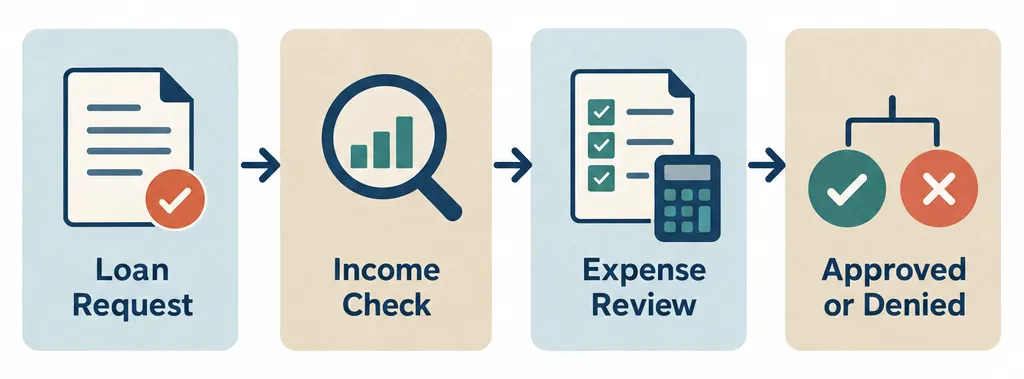
Before making any payday loan above 36% APR, the lender has to decide whether you can afford it, and the decision has to be reasonable. A lender that skips this step faces penalties under Minn. Stat. 47.601, subdivisions 6 and 7, and can lose its license or filing.
What a lender has to check
Under Minn. Stat. 47.603, the determination is reasonable only if your debt-to-income ratio for the loan period shows you can pay all three of the following:
- Your major financial obligations, such as rent or mortgage, child support and other debt payments.
- Every payment on the new loan as it comes due.
- Your basic living expenses through 30 days after the loan is repaid.
The 30-day window after repayment is the part that matters most. It targets the cycle where you repay one loan on payday and are short again a week later.
Why “no credit check” payday loans are a red flag in Minnesota
If you search for loans in MN for bad credit or with no credit check, keep in mind that a legal lender can still lend to you with poor credit. What it can’t do above 36% APR is skip a look at your income and bills. A loan advertised with “no credit check” or “instant approval” above 36% APR is either breaking Minn. Stat. 47.603 or coming from an unlicensed lender. A bad credit score doesn’t disqualify you. A lender that never asks what you earn and owe is the warning sign.
Check the math yourself
To estimate APR, divide the total cost by the amount borrowed, divide by the number of days, then multiply by 365. If the result is above 50%, or the lender adds fees on top of interest, the loan breaks Minnesota law.
What a legal Minnesota loan actually costs
A legal $350 loan for 30 days costs no more than about $14 in total charges at the 50% cap. At the 2022 average of 214% APR, the same loan would have cost about $62 in simple interest. The calculation for every row is simple interest: amount × APR × (days ÷ 365).
| Loan | Term | 36% APR cost | 50% APR cost | Old ~214% APR cost |
|---|---|---|---|---|
| $350 | 30 days | $10.36 | $14.38 | $61.56 |
| $1,000 | 30 days | $29.59 | $41.10 | $175.89 |
| $1,000 | 60 days | $59.18 | $82.19 | $351.78 |
Here is the 50% figure for $350 worked out:
- $350 × 0.50 = $175 a year in interest.
- $175 × (30 ÷ 365) = $14.38 for 30 days.
- Total repaid: $364.38.
At the 2022 average of 214% APR, treated as a simple annual rate, the same loan would cost $350 × 2.14 × (30 ÷ 365) = $61.56, so you would repay $411.56, though an average APR doesn’t show what any specific loan cost under the old fee schedule. That is more than four times what the law now allows. The cap is a ceiling, not a target, and a lender can charge less.
Car title loans in Minnesota
Title loans are legal in Minnesota, but Minn. Stat. 47.602 allows only licensed lenders to make them. A lender that isn’t a pawnbroker and takes your vehicle title as collateral must hold a Commerce license as an industrial loan and thrift company (Minn. Stat. chapter 53) or as a regulated lender (Minn. Stat. chapter 56). It must also follow Minn. Stat. 325J.095.
Minnesota has no separate, higher rate for title loans. The lender is held to the rate rules of whichever license it holds, so the triple-digit title loans sold in some other states aren’t allowed here. The section doesn’t cover banks, credit unions, car dealers or transactions under chapter 53C.
For title loans in MN, the Department of Commerce tells borrowers to use its License Lookup to confirm the lender is licensed as an “industrial loan and thrift” or a “regulated lender.” Commerce also warns that the lender will put a lien on your vehicle title. If you fall behind, the lender can repossess the car under Minnesota’s version of the Uniform Commercial Code, Minn. Stat. 336.9-609, but only without a “breach of the peace.” That means no threats, no force and no entering a locked garage.
Installment and personal loans
Larger personal loans in Minnesota usually come from regulated lenders licensed under the Minnesota Regulated Loan Act (Minn. Stat. chapter 56), from industrial loan and thrift companies (chapter 53), or from banks and credit unions under Minn. Stat. 47.59. A lender needs a Commerce license before it can make these loans.
Minn. Stat. 56.131 sets the maximum rates and charges for regulated loans. It measures cost as a “loan yield,” calculated the same way as the APR under the federal Regulation Z (12 CFR 1026), and it requires a refund if you prepay and the yield would otherwise go over the limit. Small loans and short-term loans under these licenses stay bound by the payday rules in 47.60 and 47.601. A chapter 56 license doesn’t let a lender get around the 50% cap on loans of $1,000 or less.
Some dollar thresholds in Minnesota’s consumer credit statutes are indexed. Commerce adjusts them on July 1 of even-numbered years based on the Implicit Price Deflator for GDP, and the latest adjustment took effect July 1, 2026. Before you sign, compare the APR on the federal Truth in Lending disclosure with the rate quoted by the loan officer. The two should match.
Online, tribal and app-based lenders
Minnesota law follows the borrower, not the lender. Any company that makes payday-style loans to people in Minnesota must be licensed or filed with Commerce and follow the 50% cap, whether it operates from a storefront, a website, a reservation or another country.
Tribal and offshore lenders
If you’re wondering whether a loan is legal when the company is based on a reservation or overseas, the answer depends on the license, not the location. An online lender with no Minnesota license and an APR above 50% is lending illegally to Minnesotans, whatever its terms say about tribal law or foreign courts. The Department of Commerce has acted on this before. It issued a final order against Strategic Solution Services, which did business as Arrow Mountain Funding and Line of Credit Now, that voided every short-term consumer loan the company had made to Minnesotans and fined it $10,000 for lending without a license.
Cash advance and earned wage access apps
Whether apps such as Brigit or MoneyLion count as payday loans in MN is the main open question in Minnesota lending right now. As of November 2026, Minnesota has no earned wage access law. HF 2874, a 94th Legislature bill to license earned wage access providers, would have capped fees at $5 for advances of $75 or less and $7.50 for larger ones, and would have required a no-cost option. Commerce and the Attorney General’s office opposed it as too permissive, and it was laid over in committee. In testimony, the Attorney General’s office said a $25 advance with a $5 fee due in a week would not be allowed under current Minnesota law.
The Brigit lawsuit
On June 10, 2026, Minnesota Attorney General Keith Ellison sued Bridge It, Inc., which does business as Brigit. The suit alleges Brigit has operated as an unlicensed, unregistered small-loan and short-term lender in Minnesota since 2019, with APRs regularly above 300%. Brigit argues that its earned wage advances are non-recourse, meaning it doesn’t sue users who don’t repay, so Minnesota’s payday lending law doesn’t apply. The company told the Star Tribune it would fight the case. No ruling had been reported as of this update. Until a court decides, Ellison’s office treats fee-based app advances to Minnesotans as loans covered by state law.
Did you know?
According to the Minnesota Attorney General’s June 2026 complaint, some Brigit cash advances carried APRs above 700%, more than 14 times Minnesota’s 50% ceiling.
How to check whether a lender is licensed in Minnesota
Before you share bank details with a lender, check that it has a current Minnesota license or filing with the Department of Commerce. It takes a few minutes and is the quickest way to catch an illegal lender.
How to check a Minnesota lender
- Find the lender’s full legal name in its loan agreement or website footer, not just its brand name.
- Search that name in the Minnesota Department of Commerce License Lookup.
- Confirm the license type fits the product: consumer small loan or short-term lender, regulated lender, or industrial loan and thrift.
- Search Commerce Actions and Regulatory Documents (CARDS) for any enforcement orders against the company.
- Compare the APR in the federal Truth in Lending disclosure with the 50% cap, and look for fees listed separately.
Walk away if you see any of these: no Minnesota license, an APR above 50%, fees listed separately from interest, no questions about your income on a loan above 36%, a demand for an upfront “insurance” or “processing” payment, or contract terms that say only tribal or foreign law applies.
If your loan breaks Minnesota law
If your loan is above 50% APR, adds fees or comes from an unlicensed lender, report it to the Department of Commerce and the Attorney General’s office, and protect your bank account. Commerce has voided illegal loans before, as the Arrow Mountain Funding order shows.
File a complaint
You can file with the Minnesota Department of Commerce, which licenses lenders and can revoke licenses and void loans. You can also file with the Minnesota Attorney General’s Consumer Protection Division, which brought the Brigit case. The federal Consumer Financial Protection Bureau (CFPB) accepts complaints at its online portal and forwards them to the company for a response.
Keep the paper trail
Save every contract, screenshot, text message and bank statement that shows a withdrawal. Commerce and the Attorney General need these records to act on a complaint.
Stop automatic bank debits
If the lender keeps pulling money from your account every two weeks and the balance isn’t going down, you can withdraw your permission. Under the Electronic Fund Transfer Act and its Regulation E, you can stop a preauthorized recurring transfer by telling your bank at least three business days before the scheduled date. Tell the lender in writing as well. Stopping the debits doesn’t cancel a legal debt, but it puts you back in control of your money while a complaint is reviewed.
Get free legal help
LawHelpMN lists free civil legal aid programs across Minnesota by county and problem type. Legal aid can review whether your loan is void, help you answer a lawsuit and tell you what you may be able to recover under Minn. Stat. 47.601, subdivision 6.
If you can’t repay a payday loan in Minnesota
A lender can’t take your wages without going to court, and you can’t go to jail for an unpaid loan. You do have deadlines, though. The most important one is the 20-day window to answer a lawsuit.
Can a payday lender garnish my wages?
If a lender is threatening to garnish your wages, the answer depends on whether it has gone to court. The Minnesota Attorney General’s Credit Handbook explains that garnishment generally requires a civil lawsuit and a court judgment. The exception: garnishment can start before judgment if you don’t respond within 20 days after being served with the complaint. Minnesota allows a lawsuit to be served on you before it is filed with the court, so the clock starts when papers are handed to you, even if you can’t find the case online.
The current text of Minn. Stat. 571.922 sets the wage limits using a formula tied to the minimum wage. Weekly disposable earnings up to 40 times the applicable minimum hourly wage are fully protected. Above that, a creditor can generally take the lesser of 25% of disposable earnings or the amount by which weekly disposable earnings exceed 40 times the applicable minimum wage, and the law adds further protections for certain lower-income debtors. Older handouts describe the previous rule of 25% of net pay or a floor of 40 times the federal minimum wage. If you’re served, check which formula your employer is using. Public assistance and Social Security benefits have their own protections under state and federal law.
Answer within 20 days
If you are served with a lawsuit, file a written answer within 20 days, even if you owe the money. Answering stops a default judgment and gives you room to negotiate or raise defenses such as an illegal rate.
Can I go to jail?
No. Minnesota does not jail people for failing to repay a loan. A debt collector that threatens arrest or criminal charges over an unpaid payday loan is violating the federal Fair Debt Collection Practices Act. Ignoring a court order in a lawsuit is a separate matter, which is one more reason to respond to court papers.
Refinancing and nonprofit help
If you’re stuck in a cycle of loans and want to know whether anyone in Minnesota will refinance them, Exodus Lending is a Minnesota nonprofit that refinances payday loan debt at 0% interest and offers financial coaching. Nonprofit credit counselors, including Lutheran Social Service of Minnesota’s financial counseling program, can set up a debt management plan and negotiate with creditors.
Federal rules that apply everywhere
Three federal laws protect Minnesota borrowers on top of state law. The Truth in Lending Act and Regulation Z require a written disclosure of the APR, finance charge and total of payments before you sign. The Military Lending Act caps most consumer credit at a 36% Military Annual Percentage Rate for active-duty service members and their dependents, so the 36% to 50% band is closed to them. The Fair Debt Collection Practices Act bans third-party collectors from harassment, false threats and misrepresenting what you owe.
Lower-cost options in Minnesota
Several options cost less than even a capped payday loan, and some cost nothing. They are listed here for information, not as a recommendation to apply.
Cheaper options first
Federal credit union Payday Alternative Loans under NCUA rules cap APR at 28%, with an application fee of no more than $20.
Exodus Lending refinances existing payday debt at 0% interest.
Calling 211 connects you to county emergency assistance, energy assistance and food help.
- Credit union payday alternative loans: NCUA rules (12 CFR 701.21) allow PAL I loans of $200 to $1,000 over one to six months and PAL II loans of up to $2,000 over one to twelve months, both capped at 28% APR.
- Emergency assistance: County human services offices run Minnesota’s emergency assistance programs for rent, utilities and other urgent costs. The Department of Commerce runs the Energy Assistance Program for heating bills.
- Hardship plans: Utilities, landlords and medical providers often offer payment plans that cost less than a loan.
- Pawn loans: If you’re asking whether a pawn loan from Pawn America is the same as a payday loan, it isn’t. Pawn loans fall under Minnesota’s pawnbroker law (Minn. Stat. chapter 325J) and city licensing rules, not the payday statutes. If you don’t repay, you lose the item, but no collector comes after you and nothing goes to court.
| Problem | Agency or organization | What they do |
|---|---|---|
| Lender above 50% APR or unlicensed | Minnesota Department of Commerce | Licenses lenders, investigates, voids loans, fines |
| Deceptive or illegal lending, app advances | Minnesota Attorney General’s Office | Mediates complaints, sues lenders |
| Federal complaint about any lender | Consumer Financial Protection Bureau | Forwards complaints, tracks company responses |
| Lawsuit or garnishment | LawHelpMN legal aid programs | Free legal advice and representation |
| Stuck in repeat payday loans | Exodus Lending | 0% refinancing and coaching |
| Rent, utility or food emergency | County human services, 211 | Emergency and energy assistance |
| Service member borrowing costs | Military legal assistance offices | Military Lending Act help |
Before you borrow
In Minnesota, the biggest risk comes from unlicensed online and app lenders charging hundreds of percent APR outside the 50% cap, not from licensed loans. Check the license before you hand over bank access.
FAQ
Are payday loans legal in Minnesota?
Yes, with limits. Licensed lenders can make consumer small loans of up to $350 under Minn. Stat. 47.60 and consumer short-term loans of up to $1,000 under Minn. Stat. 47.601. Both are capped at 50% APR.
What is the maximum interest rate on a payday loan in Minnesota?
50% APR, with all fees included, for loans made on or after January 1, 2024. Above 36% APR, the lender also has to confirm you can repay under Minn. Stat. 47.603.
Can a payday lender charge fees on top of the 50% APR?
No. Minn. Stat. 47.60 says no other charges or payments are permitted beyond the capped rate, and Minn. Stat. 47.601 applies the same 50% all-in ceiling to short-term loans.
Do online payday lenders have to follow Minnesota law?
Yes. Any lender making payday-style loans to Minnesotans needs a Minnesota license or filing and must follow the 50% cap. Commerce voided all of Arrow Mountain Funding’s Minnesota loans for unlicensed lending.
Are cash advance apps legal in Minnesota?
The apps operate in Minnesota, but whether their fee-based advances are loans is being decided in court. Attorney General Keith Ellison’s June 2026 suit says Brigit’s advances are unlicensed loans. Minnesota has no earned wage access law, and HF 2874 stalled in committee.
Can I get a payday loan in Minnesota with bad credit or no credit check?
Bad credit alone doesn’t disqualify you. Above 36% APR, though, a legal lender has to review your income, debts and living expenses under Minn. Stat. 47.603. A “no credit check” offer at those rates is a warning sign.
The bottom line for Minnesota borrowers
Minnesota’s 2024 rules make a legal payday loan cheap enough that most of the harm now comes from lenders that ignore them. If a loan costs more than 50% APR, adds fees or comes from a company with no Commerce license, you have the right to stop the bank debits, file a complaint with Commerce and the Attorney General, and get free legal advice through LawHelpMN. If you’re already behind, the date to watch is the 20th day after you’re served with court papers.
Laws and regulations referenced
- Minnesota Statutes, Section 47.60 (Consumer Small Loans)
- Minnesota Statutes, Section 47.601 (Consumer Short-Term Loans)
- Truth in Lending Act, 15 U.S.C. 1601
- Regulation Z, 12 CFR Part 1026
- Fair Debt Collection Practices Act, 15 U.S.C. 1692
- Electronic Fund Transfer Act, 15 U.S.C. 1693
- Regulation E (electronic transfers), 12 CFR Part 1005
- Military Lending Act, 10 U.S.C. 987
Links go to the official text on government sites.
Check, verify or complain
Sources
- Minn. Stat. 47.601 Consumer Short-Term Loans (2025 Minnesota Statutes) revisor.mn.gov · official source
- Minn. Stat. 47.60 Consumer Small Loans (2025 Minnesota Statutes) revisor.mn.gov · official source
- Minn. Stat. 47.603 Payday Loans; Ability to Repay revisor.mn.gov · official source
- Minn. Stat. 47.602 Motor Vehicle Title Loans revisor.mn.gov · official source
- Minn. Stat. 56.131 Maximum Rates and Charges revisor.mn.gov · official source
- Minn. Stat. 571.922 Garnishment Limitations (2025) revisor.mn.gov · official source
- Minnesota Department of Commerce: new payday loan law mn.gov · official source
- Commerce voids loans by Arrow Mountain Funding / Line of Credit Now mn.gov · official source
- Minnesota Commerce: Auto Title Loans mn.gov · official source
- Minnesota Commerce: Consumer Credit Code Adjustments mn.gov · official source
- Attorney General Ellison sues to stop unlawful app-based lending ag.state.mn.us · official source
- Minnesota House Session Daily: Earned wage access bill HF 2874 house.mn.gov · official source
- Minnesota AG Credit Handbook: Debt collection and garnishment ag.state.mn.us · official source
- Minnesota AG Debt Collection Fact Sheet ag.state.mn.us · official source
- Minnesota AG - Payday Loans ag.state.mn.us · official source
- Star Tribune: Minnesota AG sues cash advance app Brigit startribune.com
- Hudson Cook: State Watch Summer 2026 hudsoncook.com
- Orrick InfoBytes: Minnesota further regulates payday loans infobytes.orrick.com
- CRL: Escape from the Debt Trap (January 2026) responsiblelending.org
- CRL: Minnesota governor signs interest rate cap on payday loans responsiblelending.org
- Star Tribune: Payday loans are rising in Minnesota startribune.com
- Exodus Lending: February 2020 Update exoduslending.org
- Earned Wage Access Laws by State: 2026 Tracker personalprofitability.com

Elena writes about getting through a money emergency, assistance programs, budgeting on a tight income, banking basics and borrower rights. Her guides list the cheaper options first and link the agency or program that can actually help.
Ruth is US Financer's standards editor. Every article goes through her checks before and after it is published: each rate, fee, cap, deadline and rule is matched against its primary source, every law named is linked to its official text, and anything that cannot be…
What changed
- Nov 22, 2026 First published.
Comments are closed