


Crypto can lose all of its value and is not protected by FDIC or SIPC insurance. This is education, not investment advice.
A crypto credit card is a regular bank-issued credit card that pays its rewards in cryptocurrency instead of cash or points. You spend dollars and repay dollars, and the issuer converts your cash back into bitcoin or another coin. This guide explains how these cards work, what they cost, the credit you typically need, and how the main options compare on fees and risk.
NEW RULERelated consumer alert, Oct 21
OCC final rule keeps issuer yield ban, reviews stablecoin rewards case by caseRun the numbers
Before you get a crypto card
Card interest above 20% erases a 1% to 4% reward within weeks if you carry a balance. The crypto you earn can also lose most or all of its value, and it is not FDIC or SIPC insured while it sits on an exchange.
What a crypto credit card is
A crypto credit card is an unsecured line of credit from a bank, running on the Visa, Mastercard or American Express network. You use it anywhere the network is accepted. The difference from a normal rewards card comes after the purchase: your rewards land in a crypto exchange account as a digital asset.
You never pay the merchant in crypto. The coffee shop gets dollars, your statement is in dollars, and your payment is in dollars. This matters for taxes and for risk, as later sections show.
People search for this product under many names: cryptocurrency credit card, crypto currency credit cards, crypto cc, and “crypto credit.” They all describe the same thing. A crypto rewards credit card is the clearest label, because the rewards are the only crypto part.
Two things a crypto credit card is not:
- A crypto debit card. A debit or prepaid card spends crypto you already own by selling it at checkout. That sale is a taxable event.
- A crypto loan. Some platforms lend dollars against crypto you deposit as collateral. That is a different, riskier product with liquidation rules.
How crypto credit cards work
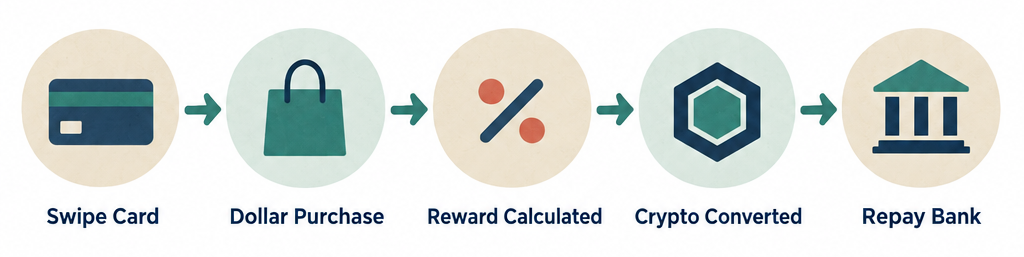
The mechanics are the same across issuers, even when the branding differs.
- A bank issues the card. The exchange or app partners with a chartered bank, which underwrites you, sets your credit limit and owns the debt. Gemini’s card is issued by WebBank, for example, and the Venmo Credit Card by Synchrony Bank.
- You spend dollars. Purchases post to your statement like any other card.
- Rewards are calculated in dollars. A $100 grocery purchase at 2% earns $2 in reward value.
- The issuer converts the reward. That $2 is used to buy crypto at the market price, sometimes within seconds, sometimes when the purchase settles or at month end.
- The crypto lands in your exchange account. You can usually hold it, sell it, or withdraw it to your own wallet.
- You repay the bank in dollars. Pay the full statement balance by the due date and you owe no interest. Carry a balance and the APR applies.
The bank side of the card follows the same federal credit rules as any other credit card. The crypto side sits with an exchange, under a separate and thinner set of protections.
Crypto credit cards vs debit and prepaid crypto cards
These products look alike in app stores, but they behave very differently.
| Feature | Crypto credit card | Crypto debit card | Crypto prepaid card |
|---|---|---|---|
| What you spend | Bank’s money (credit line) | Your crypto or cash balance | Funds loaded in advance |
| Credit check | Yes, usually a hard inquiry | Usually no | Usually no |
| Builds credit history | Yes, reported to bureaus | No | No |
| Taxable when you spend | No (you spend dollars) | Yes, if crypto is sold at checkout | Yes, if loaded from crypto |
| Interest risk | Yes, if you carry a balance | No | No |
| Federal credit card protections | Truth in Lending Act, Regulation Z, CARD Act | Electronic Fund Transfer Act for debit | Regulation E prepaid rules |
| Main crypto risk | Rewards lose value | Spending balance swings in value | Loaded value swings in value |
If the main goal is to spend bitcoin you already hold at places where a bitcoin payment is accepted, a debit card fits. If you want to collect small amounts of crypto from spending you already do, a credit card fits, as long as you pay it off.
How we ranked these crypto credit cards
There is no single best credit card for cryptocurrency. We judged each option on the criteria that decide what you actually keep:
- Total cost. Annual fee, any required paid membership, foreign transaction fees and the APR range.
- Reward value. The rate, any caps, and whether it applies to your everyday spending.
- Coin choice and control. Can you choose the coin, switch to cash, and withdraw to your own wallet?
- Issuer and licensing. Is the card issued by a chartered bank, and is the exchange licensed as a money transmitter or trust company?
- Concentration risk. Are you forced into one exchange token?
- Transparency. Are terms published clearly before you share personal data?
We only included cards issued by US banks and tied to platforms licensed in the US. Rates and terms below come from issuer disclosures and change often, so check the current pricing table (the “Schumer box” required under Regulation Z) before you decide anything.
Quick comparison of crypto credit cards
| Card | Network and issuer | Annual fee | Membership required | Rewards | Paid in |
|---|---|---|---|---|---|
| Gemini Credit Card | Mastercard, WebBank | $0 | No | 4% gas, EV charging, transit and rideshare (first $300/month, then 1%), 3% dining, 2% groceries, 1% other | Your choice of supported coins |
| Venmo Credit Card | Visa, Synchrony Bank | $0 | Venmo account | 3% top spending category, 2% second, 1% other (caps apply) | Cash, with optional auto-buy of select crypto |
| Coinbase One Card | American Express, issued via Cardless | $0 card fee | Yes, paid Coinbase One subscription | 2% to 4%, tied to assets held on Coinbase | Bitcoin |
| Crypto.com Visa Signature Credit Card | Visa, bank partner | Varies by tier | Level Up tier affects rewards | Rate depends on Level Up tier | CRO |
| Flat 2% cash-back card (benchmark) | Various banks | $0 on common examples | No | 2% on everything | Cash you can use for anything |
The 5 crypto credit card options, ranked
1. Gemini Credit Card: our top pick for most readers
The Gemini Credit Card gets our top spot because it is the only major crypto rewards card with no annual fee, no required subscription and a free choice of coins. It is a Mastercard issued by WebBank, and it charges no foreign transaction fees.
According to Gemini’s published terms, the card earns 4% back on gas, EV charging, transit and rideshares on up to $300 of that spending each month, then 1%. Dining earns 3%, groceries 2%, and everything else 1%. Rewards are deposited into your Gemini account in the crypto you choose from a long supported list, and you can change that choice.
In 2025 Gemini added an XRP Edition, built with Ripple, that pays rewards in XRP. It is the closest thing to a dedicated XRP credit card from a US bank-issued program.
Strengths:
- No annual fee and no membership cost to earn rewards
- You choose the coin and can change it, which reduces forced concentration
- Gemini is a New York-chartered trust company, a stricter regulatory setup than many exchanges
Weaknesses:
- The 4% category is capped at $300 a month, so most people earn far less than 4% overall
- 1% on general spending is below what flat cash-back cards pay
- Rewards held on Gemini are not FDIC or SIPC insured
- APR is variable and set by your credit profile, so expect a rate in typical credit card territory
2. Venmo Credit Card: best for flexibility
The Venmo Credit Card is a cash-back Visa issued by Synchrony Bank, with no annual fee. It earns 3% in your top eligible spending category each billing cycle, 2% in the second, and 1% on the rest, with spending caps on the boosted rates.
Its crypto angle is an optional feature called Cash Back to Crypto. If you turn it on, your cash back automatically buys one of a short list of coins, such as bitcoin or ether. You can switch it off and keep cash at any time.
That flexibility is the main reason it ranks second. You are never locked into crypto.
Strengths:
- Rewards default to cash, so crypto is a choice rather than a requirement
- Automatic category selection means no activation or tracking
- Backed by a large, established card issuer
Weaknesses:
- Coin selection is narrow
- Venmo’s crypto purchases include a spread or fee built into the price, which trims small reward amounts
- Boosted categories have caps, and crypto features are not available in every state
3. Coinbase One Card: high rate, with a catch
Coinbase launched the Coinbase One Card in 2025. It runs on the American Express network, is issued through the card platform Cardless, and pays rewards in bitcoin. Coinbase advertises a rate from 2% up to 4% back, depending on how much you hold on Coinbase.
The catch is the membership. You need a paid Coinbase One subscription to hold the card, and the highest reward tier requires large balances on the exchange. That ties both your rewards and your savings to one platform.
Strengths:
- Advertised rates of 2% to 4% on all spending, not only in categories
- Bitcoin-only rewards are simple to track
- Coinbase is a publicly traded US company with public financial reporting
Weaknesses:
- The subscription fee is a real annual cost you must subtract from rewards
- Higher tiers push you to keep more assets on an exchange, increasing custody risk
- American Express is accepted at fewer merchants than Visa or Mastercard, especially abroad
4. Crypto.com Visa Signature Credit Card: for committed Crypto.com users only
Crypto.com launched a Visa Signature credit card for US customers in 2025, issued through a bank partner rather than by Crypto.com itself. Rewards are paid in CRO, Crypto.com’s own token, and the reward rate depends on your Level Up tier in the Crypto.com app. Higher tiers raise the rate, and they come with their own costs or holding requirements.
We rank it last among the crypto cards because of concentration risk. Every reward lands in a single exchange token whose value depends heavily on one company.
Strengths:
- Visa Signature acceptance and card benefits
- Can make sense for people already paying for a higher Level Up tier
Weaknesses:
- Rewards paid only in CRO, so you take on single-token risk
- The best rates depend on paid tiers or holdings, which complicates the true cost
- Terms tied to app tiers can change, so read the current disclosures carefully
5. A flat 2% cash-back card, then buy crypto yourself
This is the benchmark the other four have to beat. Cards like the Wells Fargo Active Cash and Citi Double Cash pay 2% back on general spending with no annual fee. You can keep the cash, or move some of it to an exchange and buy crypto on your own schedule.
For many readers this works out better than a branded crypto card. It earns more than 1% on everyday spending, keeps rewards in insured bank dollars until you choose otherwise, and lets you pick any platform.
Strengths:
- Higher base rate than most crypto cards’ general rate
- No subscription and no single-exchange lock-in
- Cash rewards are not exposed to crypto prices unless you decide to buy
Weaknesses:
- Buying crypto yourself means paying exchange trading fees or spreads
- No automatic conversion, so it takes a manual step
- No crypto-specific perks
Fees: what a crypto credit card really costs
The sticker price of most crypto credit cards is $0. The real cost comes from four places.
Interest. This is the big one. The Federal Reserve’s G.19 consumer credit data has shown average APRs on credit card accounts assessed interest above 21% throughout 2025. Crypto cards price like other rewards cards. If you want credit card APR explained step by step, the short version is this: divide the APR by 12 to get a rough monthly rate, then apply it to your balance.
Memberships. Coinbase One and Crypto.com’s Level Up tiers can cost more each year than the rewards a typical spender earns.
Conversion spreads. When rewards buy crypto, the price can include a markup. On a $2 reward, even a small spread is a noticeable share.
Late and foreign fees. Late fees follow the Regulation Z safe harbor amounts. A 2024 CFPB rule that would have capped late fees at $8 for large issuers was vacated by a federal court in April 2025, so higher fees remain allowed. Gemini charges no foreign transaction fees; check each card’s pricing table for the others.
Worked cost example: paying in full vs carrying a balance
Here is what happens with $1,000 of spending on a card paying 2% in crypto, at a 26% variable APR.
| Scenario | Amount spent | APR | Repayment term | Interest paid | Total repaid | Reward earned |
|---|---|---|---|---|---|---|
| Pay full balance by due date | $1,000 | 26% | One statement | $0 | $1,000 | $20 in crypto |
| Pay about $95.53 a month | $1,000 | 26% | 12 months | about $146 | about $1,146 | $20 in crypto |
| Pay in full, crypto falls 50% | $1,000 | 26% | One statement | $0 | $1,000 | $20 earned, worth $10 |
The APR math in plain words: 26% a year divided by 12 is about 2.17% a month. On a $1,000 balance, that is roughly $21.67 in interest for the first month alone. That one month of interest already exceeds the entire $20 reward. Over 12 months of steady payments, you pay about $146 in interest to earn $20 of crypto that could be worth less by the time you check it.
Cheaper options first
If you already carry a balance, a nonprofit credit counselor (look for NFCC members) can review a debt management plan at low cost.
Credit unions offer lower-rate cards and payday alternative loans capped at 28% APR under NCUA rules.
Ask your current issuer about a hardship plan before taking on a new card.
If you are tempted to use a card to cover a gap between paychecks, compare that against pay in 4 apps, 0% APR credit cards with a defined intro period, or a credit union small-dollar loan. Each has its own costs, but none adds crypto price swings on top.
What credit score you need for a crypto credit card
Issuers do not publish a minimum score. In practice, crypto rewards cards are priced and marketed like mainstream rewards cards, which typically go to applicants with good to excellent credit. On the FICO scale, “good” runs 670 to 739 and “very good” 740 to 799.
Underwriting looks at more than the score:
- Payment history. Recent late payments hurt more than old ones.
- Credit utilization. Lower balances relative to limits help.
- Income and existing debt. Banks must consider your ability to pay under the CARD Act.
- Recent applications. Several new accounts in a short window can lead to a denial.
Most applications trigger a hard inquiry, which can lower your score by a few points for a time. Some issuers offer a preapproval check that uses a soft inquiry first, which does not affect your score.
If your credit is thin or damaged, a crypto card is unlikely to be the right first step. A secured card from a bank or credit union builds history at lower risk. Be wary of offers that promise approval with no credit check; like no credit check loans, they usually rely on alternative data and charge more for it.
Under the CARD Act, applicants under 21 must show independent income or have a cosigner.
Risks of crypto credit cards
Crypto can lose all its value. Rewards paid in bitcoin, XRP, CRO or any other coin can fall sharply and stay down. Some tokens have gone to near zero. Treat crypto rewards as money you could lose entirely.
Not FDIC or SIPC insured. FDIC insurance covers bank deposits, not crypto. SIPC covers securities at member brokerages, not most crypto. If the exchange holding your rewards fails, you may become an unsecured creditor in bankruptcy.
Platform failure is real, not hypothetical. BlockFi offered a bitcoin rewards credit card until it filed for bankruptcy in November 2022. The card program ended, and customer assets on the platform were frozen during the bankruptcy. Celsius and FTX failed the same year.
Spending psychology. Earning crypto on every purchase can nudge people to spend more. A 2% reward never justifies a purchase you would not otherwise make.
Concentration. Cards that pay only in an exchange’s own token tie your rewards to one company’s fortunes.
Program changes. Issuers can change rewards rates and coin lists. The CARD Act requires 45 days’ notice for significant changes to account terms like APR and fees, but rewards program changes are often handled under looser program terms.
Security. An exchange account holding your rewards is a target for account takeover. Use a strong unique password and app-based two-factor authentication, not SMS.
Your rights as a crypto credit card holder
Because the card itself is ordinary credit from a bank, the full set of federal credit card protections applies.
- Truth in Lending Act and Regulation Z (12 CFR 1026). The issuer must disclose APRs, fees and the grace period in a standard table before you open the account.
- CARD Act. Statements must be delivered at least 21 days before the due date. Payments above the minimum must go to the highest-APR balance first. Most rate increases need 45 days’ advance notice and generally cannot apply to existing balances, with limited exceptions such as a payment more than 60 days late.
- Fair Credit Billing Act. You can dispute billing errors, including charges for goods never delivered, in writing within 60 days of the statement date.
- Unauthorized use. Federal law caps your liability for unauthorized credit card charges at $50, and network zero-liability policies often reduce that to $0.
- Equal Credit Opportunity Act. The issuer cannot discriminate based on race, sex, marital status, age, national origin, religion, or receipt of public assistance. If you are denied, you are entitled to an adverse action notice explaining why.
- Fair Credit Reporting Act. You can check your reports free every week at AnnualCreditReport.com and dispute errors with the bureaus.
These protections cover the credit account. They do not cover the crypto rewards sitting in your exchange account. A falling bitcoin price is not a billing error, and an exchange freeze is not something your card issuer can fix.
US rules and IRS treatment of crypto rewards
What is law today
Under IRS Notice 2014-21, the IRS treats virtual currency as property, not currency. Selling, trading or spending crypto is a disposal that can trigger a capital gain or loss.
For credit card rewards, there is no IRS guidance specific to crypto. The IRS has long treated cash back earned from your own spending as a rebate on the purchase price, not as income. Many tax professionals apply the same view to crypto rewards from card purchases, so receiving the coin is generally not treated as income. Rewards earned without spending, such as a sign-up bonus paid for opening an account, may be treated differently.
What clearly is taxable is the later disposal. When you sell, trade or spend the crypto, you compare what you get against your cost basis. The common approach is to use the coin’s fair market value on the day you received it as your basis. Hold more than a year and the gain is long-term; hold a year or less and it is short-term, taxed at ordinary income rates.
| Event | Typically taxable? | What to record |
|---|---|---|
| Earn crypto rewards from card purchases | Generally treated as a rebate, not income | Date received and dollar value |
| Hold the rewards | No | Nothing new |
| Sell rewards for dollars | Yes, capital gain or loss | Sale date, proceeds, original basis |
| Trade rewards for another coin | Yes, capital gain or loss | Value of both sides at trade time |
| Spend rewards with a crypto debit card | Yes, capital gain or loss | Purchase date and value |
Final Treasury regulations require crypto brokers to report sales on the new Form 1099-DA. Gross proceeds reporting began with sales on or after January 1, 2025, and cost basis reporting applies to assets acquired on or after January 1, 2026, beginning with sales in 2026. Because small, frequent reward deposits create many tax lots, keep your exchange’s transaction export each year. For your specific situation, a tax professional is worth the fee.
What is law vs what is only proposed
The GENIUS Act, signed into law in July 2025, created a federal framework for payment stablecoins. It does not directly regulate crypto rewards cards. Broader crypto market-structure legislation, such as the CLARITY Act that passed the House in 2025, was still a bill rather than law as of our last update, so check its status before relying on any change it proposes.
At the state level, exchanges are licensed as money transmitters state by state, and New York requires a BitLicense or a state trust charter. That is why some crypto features are unavailable in certain states, even when the card itself is offered.
Red flags and how to verify a crypto card
Crypto’s popularity attracts imitators. Fake “crypto cards” are used to harvest personal data or upfront fees.
Watch for these warning signs:
- An application fee or “activation deposit” paid in crypto before approval
- Promises of guaranteed approval, or of fixed returns on rewards you hold
- No named issuing bank anywhere in the terms
- Pressure tactics, countdown timers, or contact through social media direct messages
- Rewards paid in an unknown token that only the card program sells
Fixed “returns” funded by new members’ money is the classic pattern of a Ponzi scheme, and several crypto schemes have used card programs as bait.
How to check a crypto card program
- Find the issuing bank’s name in the cardholder agreement or pricing table.
- Confirm the bank exists and is insured using the FDIC’s BankFind tool.
- Look up the exchange in NMLS Consumer Access and your state regulator’s license search.
- Check FinCEN’s MSB registrant search for the exchange’s money services business registration.
- Read the CFPB’s consumer complaint database for the issuer and the exchange.
If you spot a scam or lose money, report it to the CFPB complaint portal for card and exchange issues, the FTC at ReportFraud.ftc.gov, and the FBI’s Internet Crime Complaint Center (IC3) for online fraud. Scammers also run fake support numbers and send people to a crypto ATM to “verify” accounts; no legitimate card issuer will ever ask you to do that.
Who a crypto credit card makes sense for
A crypto rewards card can fit you if all of these are true:
- You pay your full statement balance every month, without exception
- You already want to hold a small amount of crypto and accept it could go to zero
- Your credit is in good shape and you are not planning a mortgage or car loan application soon
- The card’s reward rate on your actual spending beats a flat 2% cash-back card after any membership fee
Skip it if you carry a balance, are using credit to cover essential bills, or are hoping rewards will grow into savings. In those cases, a lower-rate credit union card, a hardship plan, or nonprofit credit counseling will do more for you than any crypto reward.
FAQ
Which crypto card is the best?
No card is best for everyone, but the Gemini Credit Card is our top pick for most readers. It has no annual fee, needs no paid membership, and lets you choose your coin. If your spending is mostly general purchases, a flat 2% cash-back card can out-earn it, and you can buy crypto with the cash yourself.
Is there an XRP credit card?
Yes. In 2025 Gemini launched an XRP Edition of its credit card, built with Ripple, that pays rewards in XRP. It is a Mastercard issued by WebBank with the same general reward structure as the standard Gemini card. XRP rewards carry the same risk as any crypto: their value can fall sharply or to zero.
How much does a crypto card cost?
Most crypto credit cards have a $0 annual fee, but the true cost depends on how you use one. Some require a paid exchange membership, rewards conversion may include a spread, and carrying a balance means paying interest that often exceeds 20% APR. Paying in full every month is the only way a crypto card costs nothing to use.
Which credit cards support crypto?
Cards that pay rewards in crypto include the Gemini Credit Card, the Coinbase One Card and the Crypto.com Visa Signature Credit Card. The Venmo Credit Card can automatically convert its cash back into select coins. Some traditional issuers block or restrict card purchases of crypto on exchanges, and those that allow it often code them as cash advances, with fees and immediate interest.
Does a crypto credit card affect my credit score?
Yes, exactly like any credit card. Applying usually causes a hard inquiry, the account is reported to the credit bureaus, and your payment history and utilization count toward your score. Using it responsibly can build credit; missed payments can damage it.
Can I withdraw my crypto rewards to my own wallet?
On most major programs you can, though rules vary by coin, state and platform, and network withdrawal fees may apply. Moving rewards to a wallet you control removes exchange failure risk but makes you fully responsible for your keys. Lose them and the crypto is gone.
Are crypto credit card rewards taxable?
There is no IRS guidance specific to crypto card rewards. Card rewards earned from your own spending are generally treated as a rebate rather than income, and many tax professionals apply that to crypto rewards. Selling, trading or spending the crypto later is a taxable disposal under IRS Notice 2014-21, so record the value on the day each reward arrives.
Laws and regulations referenced
- Truth in Lending Act, 15 U.S.C. 1601
- Regulation Z, 12 CFR Part 1026
- Fair Credit Reporting Act, 15 U.S.C. 1681
- Equal Credit Opportunity Act, 15 U.S.C. 1691
- Electronic Fund Transfer Act, 15 U.S.C. 1693
- Regulation E (electronic transfers), 12 CFR Part 1005
- Fair Credit Billing Act, 15 U.S.C. 1666
- IRS Notice 2014-21 (virtual currency is property)
- IRS Form 1099-DA, Digital Asset Proceeds From Broker Transactions
- GENIUS Act (stablecoins), Public Law 119-27 (S. 1582)
- Digital Asset Market Clarity Act, H.R. 3633 (a bill, check its current status)
- FDIC deposit insurance
Links go to the official text on government sites.
Check, verify or complain
Sources
- forbes.com › advisor › credit cards › reviews › gemini credit card forbes.com
- myfico.com › credit education › credit scores myfico.com
- investor.breadfinancial.com › news releases › news release details › cryptocom selects bread financial … investor.breadfinancial.com
- jdsupra.com › topics › final rules › administrative procedure act › credit cards jdsupra.com
- cryptocardhq.com › crypto cards › gemini card review cryptocardhq.com

Owen explains how crypto works for US readers: coins and tokens, buying and selling, wallets and self-custody, staking and DeFi. He sticks to how things work and what they cost, never price calls, and checks platform fees and licensing against the companies' own disclosures.

Ruth is US Financer's standards editor. Every article goes through her checks before and after it is published: each rate, fee, cap, deadline and rule is matched against its primary source, every law named is linked to its official text, and anything that cannot be…
Comments are closed