


Crypto can lose all of its value and is not protected by FDIC or SIPC insurance. This is education, not investment advice.
Phantom taxes are taxes on income you never received as cash. In crypto, staking rewards, mining payouts, airdrops and token-to-token swaps can all create a federal tax bill even if you never sold anything for dollars. The bill is still owed in real money, and the IRS does not reduce it if the tokens later lose value.
NEW RULERelated consumer alert, Oct 21
OCC final rule keeps issuer yield ban, reviews stablecoin rewards case by caseRun the numbers
What phantom taxes actually mean
“Phantom income” is not a legal term in the tax code. It is shorthand for any taxable income that does not arrive as spendable cash. Tax professionals used it long before crypto. Three common examples are a forgiven debt reported on Form 1099-C, a share of partnership profits reported on a K-1 that the partnership kept, and the yearly interest that accrues on a zero-coupon bond.
Crypto added new ways to get there. The IRS has treated virtual currency as property since IRS Notice 2014-21. Under that framework, receiving tokens as payment or reward counts as income, and getting rid of tokens counts as a disposal. Neither event requires a bank deposit.
One clarification, because search results mix them up: phantom taxes have nothing to do with the Phantom wallet. Holding crypto in Phantom or any other wallet, or moving it to a cold wallet you own, is not a taxable event by itself.
How phantom income works in crypto
Two ideas drive almost every crypto phantom tax bill.
Dominion and control. In Revenue Ruling 2023-14, the IRS said a cash-method taxpayer who receives staking rewards must include them in gross income in the year the taxpayer gains “dominion and control.” That means the point when you can sell, transfer or otherwise dispose of the rewards. The ruling covers staking directly on a proof-of-stake network and staking through an exchange.
Fair market value at receipt. You count the dollar value of the tokens at the moment you gain control. That value also becomes your cost basis. If the price later falls, you do not get to revise the income figure. You only get a capital loss when you eventually sell, swap or spend the tokens.
6 ways crypto creates phantom income
1. Staking rewards
Each reward is ordinary income at its value when you gain control. If you are paid daily, that means many small income events across the year.
2. Mining
Notice 2014-21 says mined coins are gross income at their fair market value on the date you receive them. If mining is a trade or business, the IRS also expects self-employment tax: 15.3% on net earnings up to the Social Security wage base, and 2.9% for Medicare on earnings above it (plus a 0.9% Additional Medicare Tax for high earners).
3. Airdrops and hard forks
Revenue Ruling 2019-24 says that when a hard fork is followed by an airdrop of new tokens you control, the value of those tokens is ordinary income. A hard fork with no new tokens landing in your account creates no income.
4. Crypto-to-crypto swaps
Trading one token for another is a disposal of the first token. You owe capital gains tax on any rise in value since you bought it, even though no dollars came out of the trade.
5. DeFi yield and lending rewards
Interest-style payouts from lending platforms and liquidity pool reward tokens are generally treated as income when you receive them. The IRS has not issued detailed guidance on many DeFi mechanics, which we cover below.
6. Spending crypto or getting paid in it
Paying for something with bitcoin is a disposal, so any gain since purchase is taxable. Being paid in crypto for work is ordinary income at its value when paid, just like wages or freelance pay. That matters to anyone using a bitcoin payment accepted merchant or invoicing clients in tokens.
A worked example: taxed on value that disappeared
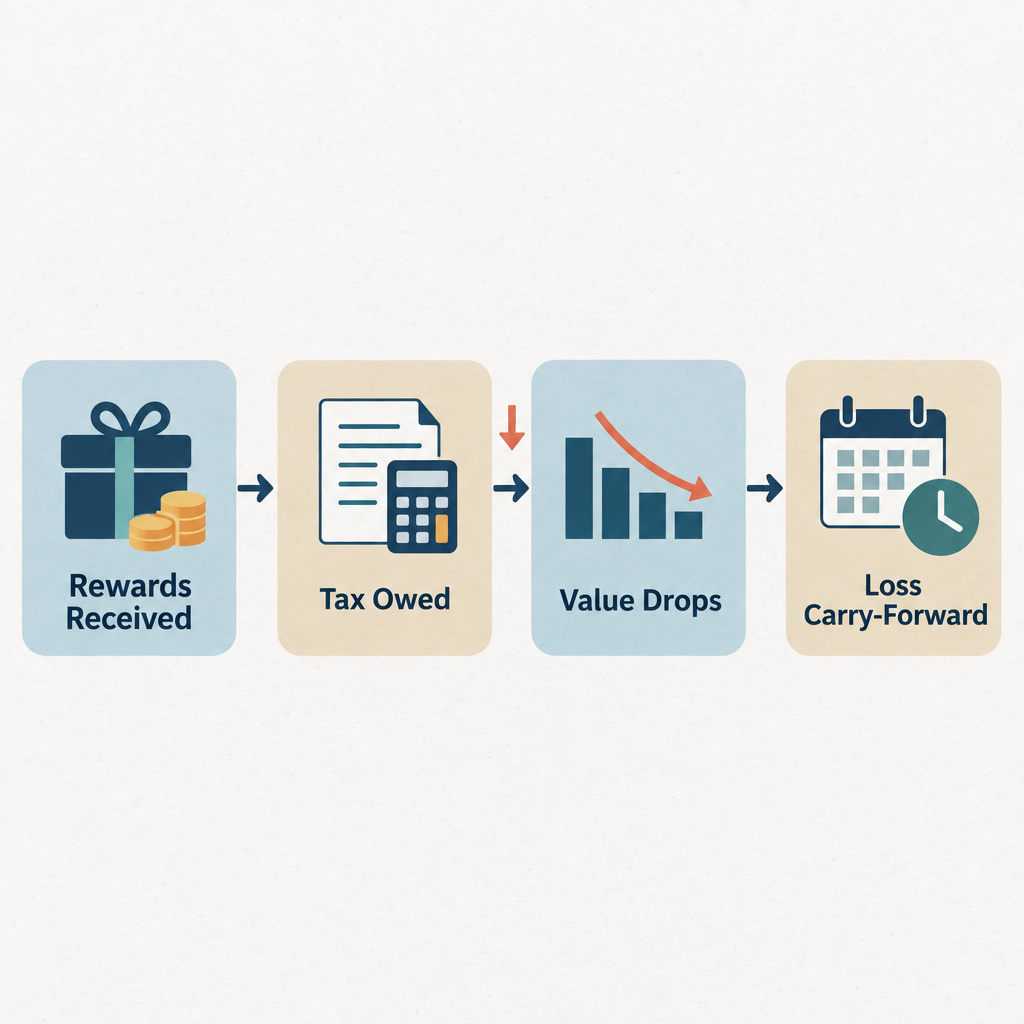
This hypothetical uses round numbers to show how the timing works. It is not a forecast for any token.
| Step | What happens | Dollar effect |
|---|---|---|
| During year 1 | You receive staking rewards worth $5,000 when you gain control | $5,000 ordinary income |
| Tax for year 1 | You are in the 24% federal bracket | $1,200 federal tax owed |
| Early year 2 | The token falls 70%, so your rewards are worth $1,500 | No change to year 1 tax |
| Year 2 | You sell the tokens for $1,500 | $3,500 capital loss |
| Year 2 tax return | Loss offsets other gains first, then up to $3,000 of ordinary income | Leftover $500 carries forward |
The math in plain words: you paid $1,200 in tax on $5,000 of income, but you only ever got $1,500 of cash. The loss eventually gives some of that tax back, though slowly. Without other gains, only $3,000 a year can reduce ordinary income ($1,500 if married filing separately), and the relief comes a year later than the bill. State income tax can make the gap larger.
Before you stake or farm for yield
Rewards are taxed at their value when you receive them, and a later price crash does not cancel that bill. Crypto can lose all of its value, and it is not protected by FDIC or SIPC insurance.
Risks to understand
- Price risk. Tokens can fall sharply between the day you receive them and the April tax deadline. A market capitulation can wipe out most of the value behind a tax bill you still owe.
- Liquidity risk. Some reward tokens are thinly traded or locked. You may owe tax on tokens you cannot sell at the value you reported.
- Custody risk. Exchanges can freeze withdrawals or fail. Coins held on a platform that goes bankrupt may not come back, and the income you already reported stays reported.
- Platform risk. High promised yields with no clear source of revenue are a classic red flag for a Ponzi scheme.
- Penalty risk. Underreporting rewards or skipping estimated payments can add IRS penalties and interest on top of the tax.
US rules, reporting and forms
Form 1040 asks every filer whether they received digital assets as a reward, award or payment, or sold, exchanged or otherwise disposed of any. Receiving staking rewards means checking “yes.”
Where the income goes depends on the activity. Hobby-level staking and airdrop income is usually reported as other income on Schedule 1. Mining or staking run as a business goes on Schedule C, with self-employment tax figured on Schedule SE. Sales and swaps go on Form 8949 and Schedule D.
Third-party forms help but do not cover everything. Brokers began issuing Form 1099-DA for sales on or after January 1, 2025, with cost basis reporting starting for assets acquired on or after January 1, 2026. Some exchanges send Form 1099-MISC for rewards of $600 or more. Congress repealed the rule that would have treated many DeFi platforms as brokers in April 2025, so most DeFi activity will not arrive on any form. You still owe tax on it.
Strategies to plan for phantom income
How to prepare for a phantom tax bill
- Record the date, token amount and dollar value of every reward when you receive it.
- Estimate the tax on each reward at your marginal rate and set that cash aside.
- Make quarterly estimated payments on Form 1040-ES if you expect to owe $1,000 or more.
- Track cost basis so later sales show the correct gain or loss.
- Use realized losses to offset gains in the same year.
For estimated taxes, the IRS generally waives the underpayment penalty if you pay at least 90% of this year’s tax or 100% of last year’s (110% if last year’s adjusted gross income topped $150,000). A crypto profit calculator can help you see gains and losses on individual lots before you decide anything, though tax tracking software built for multiple wallets is better for full-year records.
Some holders convert part of each reward to dollars to cover the tax. That is a personal choice with its own trade-offs: the conversion is itself a taxable disposal, and it is not advice to sell.
If you already owe more than you can pay
File on time even if you cannot pay, since the failure-to-file penalty is much larger than the failure-to-pay penalty.
The IRS offers short-term payment plans and longer installment agreements.
Low Income Taxpayer Clinics give free or low-cost help with IRS disputes if you qualify.
What the IRS has not settled
Several questions remain open. The best-known challenge, Jarrett v. United States, involved a Tennessee couple who argued newly created Tezos staking rewards should not be taxed until sold. The IRS refunded their tax, and the court dismissed the case as moot, so no court ruled on the core argument. Revenue Ruling 2023-14 came out afterward and states the IRS position plainly.
The IRS has also not issued specific guidance on wrapping tokens, depositing into liquidity pools or receiving LP tokens. Practitioners disagree on whether some of these are taxable swaps. Separately, the wash sale rule currently applies to stocks and securities, not to crypto treated as property. Bills to extend it, or to create a small-transaction exemption for crypto, have been proposed but are not law.
FAQ
Do I owe tax on staking rewards I never sold?
Yes, under Revenue Ruling 2023-14. Rewards count as ordinary income in the year you gain control of them, at their fair market value then.
What if my rewards lost value before I filed?
You still report the value at receipt. The drop becomes a capital loss only when you sell, swap or spend the tokens, and the yearly limit on deducting net losses against ordinary income is $3,000.
Is moving crypto between my own wallets taxable?
No. Transferring tokens between wallets you control is not a disposal. Keep records showing both wallets are yours, and note that network fees paid in crypto can raise their own reporting questions.
Will I get a tax form for staking income?
Possibly. Some exchanges issue Form 1099-MISC for rewards of $600 or more, and Form 1099-DA covers broker sales. Rewards earned through self-custody or DeFi usually come with no form, but they are still taxable.
Is crypto income taxed differently from the money I use for loans or credit?
The income itself is taxed like other income, but lenders treat it cautiously because it swings in value. If you plan to borrow, a debt to income ratio calculator built on your stable income gives a more realistic picture than one that counts volatile crypto rewards.
Laws and regulations referenced
- IRS Notice 2014-21 (virtual currency is property)
- IRS Revenue Ruling 2019-24 (hard forks and airdrops)
- IRS Revenue Ruling 2023-14 (staking rewards)
- IRS Form 1099-DA, Digital Asset Proceeds From Broker Transactions
- IRS Form 8949, Sales and Other Dispositions of Capital Assets
- IRS Schedule D (Form 1040), Capital Gains and Losses
- Wash sale rule, 26 U.S.C. 1091
Links go to the official text on government sites.
Sources
- numerisledger.com › blog › safe harbor rule explained numerisledger.com
- experian.com › blogs › ask experian › can you deduct capital loss on taxes experian.com
- journalofaccountancy.com › news › 2019 › oct › irs income cryptocurrency hard forks airdrops 201922209 journalofaccountancy.com
- ustax.tools › capital loss carryover calculator ustax.tools
- greenbacktaxservices.com › knowledge center › form 1099 da digital asset reporting greenbacktaxservices.com
- tscpatax.com › articles › form 1099 da tscpatax.com
- nationaltaxtools.com › calculators › estimated tax penalty calculator nationaltaxtools.com
- cooley.com › news › insight › 2025 › 2025 04 21 congress repeals digital asset regulatio… cooley.com
- thetaxadviser.com › issues › 2020 › jan › guidance cryptocurrency airdrops hard forks thetaxadviser.com

Nadia covers crypto taxes, scams and the rules around digital assets: IRS guidance, broker reporting, federal and state regulation, and how to spot and report fraud. She separates what is law from what is only proposed and links the official text.

Ruth is US Financer's standards editor. Every article goes through her checks before and after it is published: each rate, fee, cap, deadline and rule is matched against its primary source, every law named is linked to its official text, and anything that cannot be…
Comments are closed