

Crypto can lose all of its value and is not protected by FDIC or SIPC insurance. This is education, not investment advice.
Bitcoins are units of a digital currency recorded on a public, shared ledger that thousands of computers keep in sync. No bank, company or government runs that ledger. You can send bitcoin to anyone with an internet connection, but its price swings sharply, and nothing protects your balance if it falls, gets stolen or goes to the wrong address. This guide covers how bitcoin works, what it costs to buy and use, how the IRS taxes it, and the risks to weigh before you put in any money.
NEW RULERelated consumer alert, Oct 21
OCC final rule keeps issuer yield ban, reviews stablecoin rewards case by caseRun the numbers
Before you buy any bitcoin
Bitcoin has lost more than 75% of its value several times and could lose all of it. Your coins are not FDIC or SIPC insured, and stolen or mistakenly sent bitcoin is almost never recovered.
What bitcoins are, in plain words
Bitcoin is two things that share one name.
- Bitcoin (capital B) is the network: free, open-source software that thousands of computers run to keep one shared record of who owns what.
- bitcoin (lowercase b, ticker BTC) is the unit of money tracked on that record. People often say “bitcoins” when they mean several units.
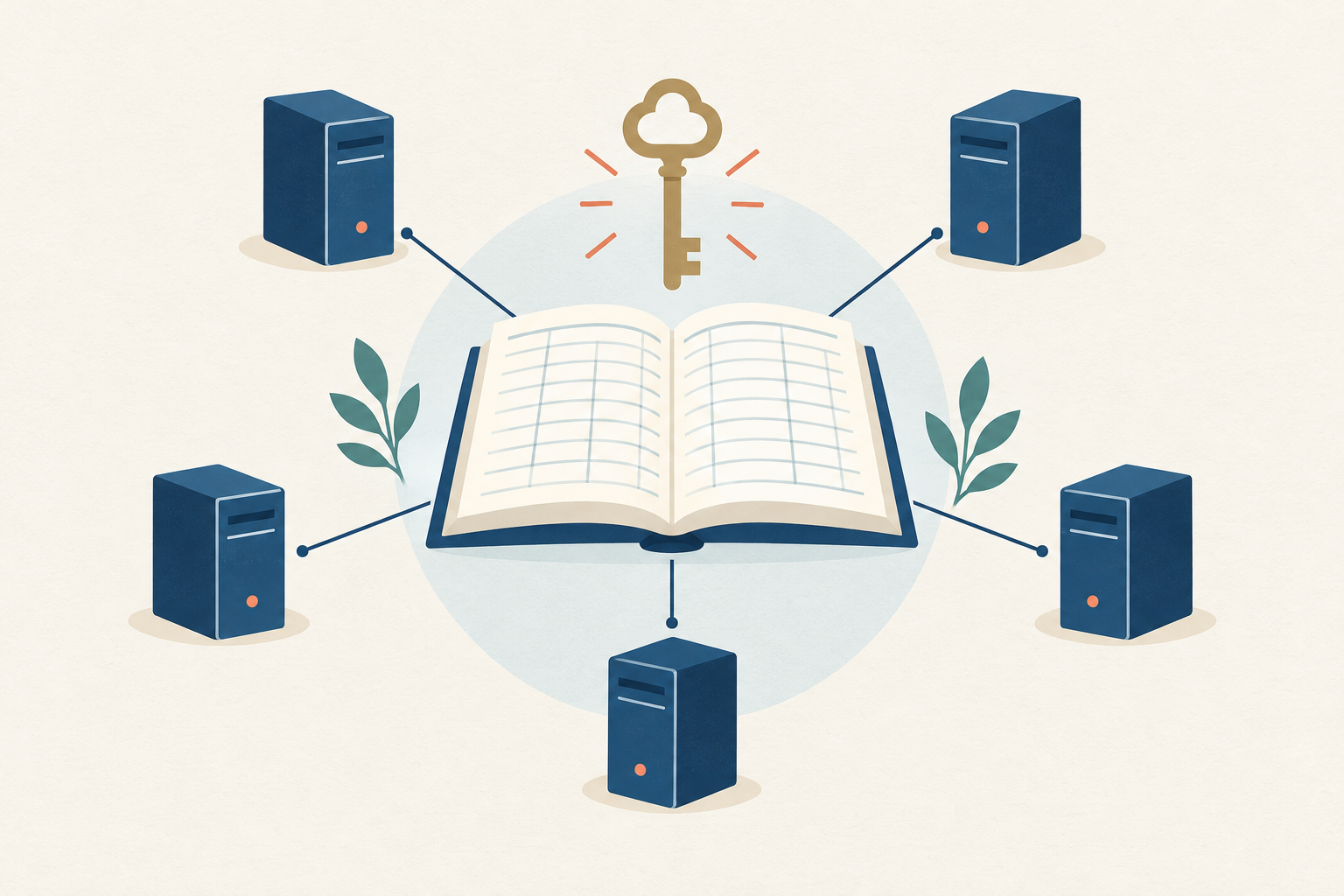
When people ask what bitcoins are, the simplest definition is this: a bitcoin is an entry on a public ledger. Only someone holding a matching secret code, called a private key, can move it. There is no coin, file or token sitting on your phone. Your wallet holds the keys that prove you control certain entries on the ledger.
No central authority issues bitcoin. The Federal Reserve creates dollars, but new bitcoins come from a fixed schedule written into the software. Nobody can change that schedule unless the people running the network agree to switch to new rules.
It also helps to know what bitcoin is not:
- It is not a company. You can’t buy shares in “Bitcoin,” and there’s no CEO, customer service line or headquarters.
- It is not a stock. Bitcoin pays no dividends and has no earnings. Its price depends only on what buyers and sellers agree on.
- It is not a bank account. No deposit insurance applies, and no institution reverses a payment you regret.
- It is not pegged. Stablecoins try to hold a fixed $1 value. Bitcoin floats freely against the dollar.
Where bitcoin came from
On October 31, 2008, someone using the name Satoshi Nakamoto published a nine-page paper titled “Bitcoin: A Peer-to-Peer Electronic Cash System.” It described a way for individuals to pay each other online without trusting a bank or payment company to keep the books.
The network went live on January 3, 2009, when the first block was created. That “genesis block” carries a newspaper headline from that day’s Times of London: “Chancellor on brink of second bailout for banks.” Many people read it as a comment on the 2008 financial crisis.
Nakamoto’s identity has never been confirmed. The account stopped communicating publicly around 2011, and development passed to volunteer programmers. Today the most widely run version of the software is called Bitcoin Core. Anyone can read its source code, suggest changes or copy it.
The first widely documented purchase came on May 22, 2010. A programmer named Laszlo Hanyecz paid 10,000 bitcoins for two pizzas. Fans now mark the date as Bitcoin Pizza Day. Those coins later became worth hundreds of millions of dollars, which shows how much the price has moved.
How Bitcoin works
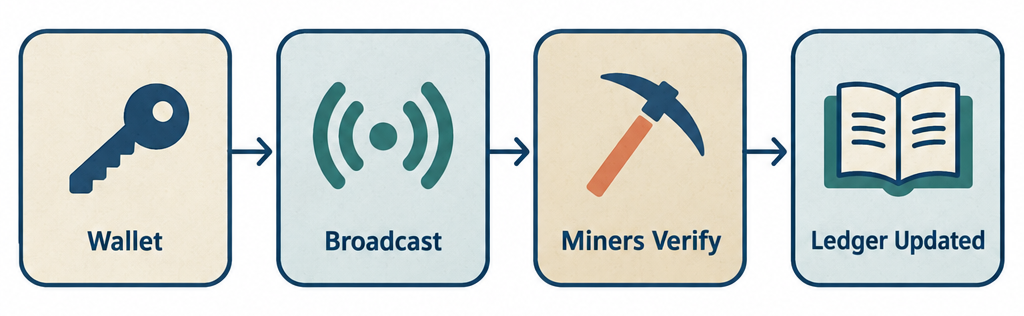
You don’t need to understand the cryptography to use bitcoin. You do need four ideas: the ledger, keys, mining and the supply cap.
The ledger, also called the blockchain
Every bitcoin transaction ever made sits in one public record called the blockchain. New transactions are grouped into blocks, and each block links to the one before it. That link makes old records very hard to rewrite without redoing an enormous amount of work.
Copies of the ledger are kept by computers called nodes, run by individuals, businesses and hobbyists worldwide. Each node checks every new transaction against the rules. A node rejects a transaction that tries to spend coins twice or spend coins it can’t prove it controls. Because so many independent copies exist, no single party can quietly edit the record.
Keys and addresses
Bitcoin ownership rests on a pair of linked codes:
- A private key works like a master password. Whoever has it can spend the coins.
- A public address is derived from the key, and you can share it to receive payments. It works roughly like an account number.
Most wallets back up your keys as a recovery phrase, usually 12 or 24 ordinary words. Anyone who sees that phrase can take your bitcoin. If you lose it and your device fails, your coins are gone for good.
Mining and proof of work: how new bitcoins are created
New bitcoins are created through mining. Miners run specialized machines that race to solve a math puzzle based on the SHA-256 hashing function. The first miner to find a valid answer adds the next block of transactions to the chain. That miner then collects a reward of newly created bitcoin plus the fees attached to the transactions in the block.
This system is called proof of work. The puzzle is hard to solve and easy for everyone else to check. To rewrite past blocks, an attacker would need to outpace the computing power of the rest of the network combined.
The network targets one new block about every 10 minutes. Every 2,016 blocks, roughly every two weeks, the software adjusts puzzle difficulty up or down to keep that pace as miners join or leave.
Mining takes a lot of electricity. The US Energy Information Administration estimated in early 2024 that crypto mining used between 0.6% and 2.3% of all US electricity. For an individual, mining at home with an ordinary computer won’t earn meaningful bitcoin today. Industrial operations with cheap power and purpose-built machines dominate it.
The halving and the 21 million cap
The block reward started at 50 bitcoins and drops by half every 210,000 blocks, about every four years. This “halving” is why the total supply can never exceed 21 million bitcoins.
| Period | Started | Block height | New bitcoins per block |
|---|---|---|---|
| 1 | January 3, 2009 | 0 | 50 |
| 2 | November 28, 2012 | 210,000 | 25 |
| 3 | July 9, 2016 | 420,000 | 12.5 |
| 4 | May 11, 2020 | 630,000 | 6.25 |
| 5 | April 2024 | 840,000 | 3.125 |
| 6 | Expected around 2028 | 1,050,000 | 1.5625 |
At 3.125 bitcoins per block and about 144 blocks a day, roughly 450 new bitcoins are created daily. More than 19.9 million had been mined by late 2025, about 95% of the total that will ever exist. The last fraction of a coin is expected around the year 2140. After that, miners would earn only transaction fees.
A fixed supply does not guarantee a rising price. Supply is only half of the picture. If demand drops, the price drops, however scarce the coins are.
Bitcoin units and key numbers
You don’t have to buy a whole bitcoin. Each one divides into 100 million smaller units called satoshis, or “sats,” named after the creator. Most apps let you buy as little as a few dollars’ worth.
| Unit | Equals | Common use |
|---|---|---|
| 1 bitcoin (BTC) | 100,000,000 satoshis | Quoting the price |
| 1 millibitcoin (mBTC) | 0.001 BTC | Rarely used today |
| 1 satoshi (sat) | 0.00000001 BTC | Small payments, fee rates |
| Fee rate | Satoshis per virtual byte | What you pay miners |
A bitcoin example: sending 0.01 BTC from start to finish
Here is a plain example of what happens when you send bitcoin to a friend.
- Your friend shares an address. It’s a long string of letters and numbers, often shown as a QR code. Many modern addresses start with “bc1.”
- You enter the amount. You type 0.01 BTC, or a dollar figure your wallet converts.
- You choose a fee. Your wallet suggests a fee in satoshis per virtual byte. A higher fee gets you into a block faster when the network is busy.
- Your wallet signs the transaction. It uses your private key to create a digital signature proving the coins are yours to spend. The key itself never leaves your wallet.
- The transaction is broadcast. Nodes check it and pass it along. It waits in a pool of unconfirmed transactions.
- A miner includes it in a block. That’s the first confirmation, usually within 10 to 30 minutes depending on your fee and congestion.
- More blocks pile on top. Each new block adds a confirmation. Many exchanges wait for several before crediting large deposits, since six confirmations take about an hour.
Two details surprise beginners. The fee depends on the size of the transaction in data, not the dollar amount. Sending $20 can cost the same as sending $20,000. Also, once confirmed, the payment is final. If you typed the wrong address, nobody can reverse it.
Fees move with demand. On quiet days a simple transaction can cost well under a dollar. During heavy traffic, such as the April 2024 halving, average fees briefly spiked past $100 per transaction.
How people get bitcoin
There are four main routes. Each comes with different costs, protections and risks.
Buying on a crypto exchange or app
Most Americans buy through a crypto exchange or a trading app that sells crypto. You link a bank account, verify your identity and place an order. Because these firms are money services businesses under federal rules, they must collect your ID under the Bank Secrecy Act. Most states also require them to hold a money transmitter license.
Watch for two costs: a stated fee and a spread. The spread is the gap between the price you pay and the market price, and it’s often folded into the quote. “Simple” buy buttons tend to cost more than an exchange’s advanced order screen.
Buying a spot bitcoin ETF through a brokerage
Since January 2024, when the SEC approved the first spot bitcoin exchange-traded products, you can get price exposure through an ordinary brokerage account. The fund holds bitcoin, and you own shares of the fund. Annual expense ratios ran from about 0.15% to 1.5% as of 2025.
You don’t hold keys and can’t send these shares on the Bitcoin network. Because the shares are securities, SIPC coverage applies if your brokerage fails and your shares go missing. SIPC never covers a drop in the fund’s value.
Bitcoin ATMs
Bitcoin ATMs, or crypto kiosks, sell bitcoin for cash. They’re convenient, but markups are often far higher than online, and scammers use them heavily (more on that below). Some states now regulate them. California, for example, caps how much one customer can put into a kiosk per day.
Earning or mining bitcoin
Some people get paid in bitcoin for freelance work or sell goods for it. A few employers pay part of wages in bitcoin through payroll services. Mining is the other route, but as covered above, it’s mostly an industrial business now. Any bitcoin you earn counts as income for tax purposes.
What buying really costs: a worked example
The table below shows how fees change what you actually get for $500. The fee levels are illustrative assumptions, not any one company’s prices. Always read the disclosure on the screen before you confirm.
| Route | Assumed cost | Cost on $500 | Bitcoin you get, in dollars | Price rise needed to break even* |
|---|---|---|---|---|
| Exchange advanced order | 0.4% fee | $2.00 | $498.00 | About 0.4% |
| App “buy” button | 1.5% fee + 0.5% spread | $10.00 | $490.00 | About 2% |
| Bitcoin ATM | 15% markup | $75.00 | $425.00 | About 17.6% |
| Spot bitcoin ETF | 0.25% a year, $0 commission | $1.25 per year | About $500 | About 0.25% after one year |
*Before the cost of selling, which usually adds a similar fee.
Here’s the break-even math in plain words. Suppose you pay $500 at a kiosk and get $425 of bitcoin. The price has to rise by $75 on top of $425 just for you to get back to $500. That’s $75 divided by $425, or about 17.6%. At a 0.4% fee, you need well under a 1% rise. Fees are the one part of the cost you control.
If you then move coins from an exchange to your own wallet, expect a withdrawal fee as well. Very short-term approaches, such as a scalping trading strategy, pay these costs over and over. That’s one reason most frequent traders lose ground.
Storing bitcoin: wallets and custody
A bitcoin wallet doesn’t hold coins. It holds the keys that let you move them. Your main choice is who holds those keys.
Custodial wallets
When you leave bitcoin on an exchange or app, the company holds the keys. You log in with a password and can reset it if you forget. That’s easier, but you’re trusting the company to stay solvent and honest.
History shows why that matters. Mt. Gox, once the largest bitcoin exchange, collapsed in 2014 after hundreds of thousands of customer bitcoins went missing. Creditors waited about a decade for partial repayments. In 2022, the crypto lender Celsius and the exchange FTX both filed for bankruptcy and froze customer funds. FTX founder Sam Bankman-Fried was convicted of fraud in 2023.
Self-custody wallets
With a self-custody wallet, you hold the keys yourself. There’s no company to fail, but no one to call either.
- Hot wallets are apps on your phone or computer. They’re convenient for small amounts and exposed to malware and phishing.
- Hardware wallets are small devices that keep keys offline and sign transactions inside the device. Many long-term holders use one for larger amounts.
- Paper wallets are keys printed on paper. They were popular in bitcoin’s early years and have fallen out of favor because they’re easy to damage, copy or mishandle.
The recovery phrase is your single point of failure. Write it down on paper or metal, store it somewhere safe and never type it into a website or share it with “support.” No legitimate company will ask for it.
Plan for the people who come after you
Lost keys are a bigger problem than most people realize. Blockchain analytics firm Chainalysis estimated in 2020 that about 20% of all mined bitcoin, around 3.7 million coins, appeared to be lost. If you hold bitcoin yourself, leave clear instructions in your estate plan so an heir can find and use your keys. A simple step is a sealed note with your attorney or in a safe-deposit box that says where the recovery phrase is kept. The note itself shouldn’t contain the phrase.
Using bitcoin to pay for things
Bitcoin was designed as electronic cash, but few Americans use it that way. Price swings, fees and tax paperwork all get in the way. Finding a merchant where a bitcoin payment is accepted takes some looking. Many businesses that advertise it use a payment processor that turns your bitcoin into dollars on the spot.
To make small payments faster and cheaper, developers built the Lightning Network. It’s a second layer that runs on top of Bitcoin. Payments move through channels between users and settle in seconds, often for a fraction of a cent. Only the opening and closing of channels gets recorded on the main blockchain. Lightning works well for small amounts. It also adds complexity, and wallets still differ in how easy they make it.
Outside the US, El Salvador made bitcoin legal tender in September 2021, the first country to do so. In early 2025, after an agreement with the International Monetary Fund, it amended the law so businesses no longer have to accept bitcoin.
One tax point catches many people off guard. In the US, every purchase you make with bitcoin counts as a sale of property. If the coins rose in value since you got them, a coffee bought with bitcoin can create a small taxable gain.
The risks you should weigh
Price swings and the chance of total loss
Bitcoin’s price has repeatedly collapsed and recovered, but past recoveries don’t promise future ones. These drawdowns are approximate, based on widely reported prices, and exact figures vary by exchange.
| Period | Approximate peak | Approximate low that followed | Drop from peak |
|---|---|---|---|
| 2011 | About $32 (June 2011) | About $2 (late 2011) | About 93% |
| 2013 to 2015 | About $1,150 (Dec. 2013) | About $170 (Jan. 2015) | About 85% |
| 2017 to 2018 | About $19,800 (Dec. 2017) | About $3,200 (Dec. 2018) | About 84% |
| 2021 to 2022 | About $69,000 (Nov. 2021) | About $15,500 (Nov. 2022) | About 77% |
The price passed $100,000 for the first time in December 2024 and set new highs above $120,000 in 2025. We don’t publish a live price here, because any figure would be out of date within minutes. That speed is itself part of the risk.
Bitcoin can lose all of its value. Unlike a company that owns buildings or earns profits, it has no assets or cash flow behind it. Its value rests entirely on people continuing to want it.
No insurance and no undo button
FDIC insurance covers deposits at insured banks up to $250,000 per depositor, per bank, per ownership category. It does not cover crypto, even crypto you buy through an app linked to a bank. SIPC protects securities and cash at failed member brokerages. It doesn’t cover bitcoin held directly. If an exchange fails, you’re usually a creditor in bankruptcy court.
Transactions also can’t be reversed. Credit card chargebacks and the Electronic Fund Transfer Act’s error rules give you a way to dispute bank and card payments. Once a bitcoin transaction confirms, nothing like that exists on the network.
Privacy is weaker than people assume
Bitcoin is pseudonymous, not anonymous. Addresses don’t show names, but every transaction is public forever. Analytics firms and law enforcement routinely trace funds, especially once coins touch an exchange that collected your ID.
Borrowing to buy
Never fund a bitcoin purchase with a credit card cash advance or a payday loan. If the price drops 30% while you’re paying 25% or more in interest, you lose twice. If your budget is already tight, bitcoin is the wrong place for money you’ll need soon.
Do these first
Build a small emergency fund in an FDIC- or NCUA-insured account.
Pay down high-interest credit card debt.
Collect any employer retirement match before putting money at risk.
Scams that use bitcoin
Criminals like bitcoin because payments are fast, global and final. The FBI’s Internet Crime Complaint Center reported $9.3 billion in cryptocurrency-related fraud losses in its 2024 report, the largest of any category. The FTC found that reported losses at Bitcoin ATMs topped $110 million in 2023. People 60 and older were more than three times as likely as younger adults to report a loss at one.
Red flags
- Anyone who tells you to pay in bitcoin. That includes callers claiming to be the IRS, police, a utility, tech support or your bank. A real debt collector in the US will not demand bitcoin or send you to a crypto ATM.
- Guaranteed or fixed returns. Promises like “2% a day” or “risk-free” are false. A platform paying old investors with new investors’ money is a Ponzi scheme, and many crypto versions collapse within months.
- Romance or friendship that turns to investing. A new online contact steers you to a trading site, shows fake profits and then demands “taxes” or “fees” before you can withdraw.
- Pressure to act now or to keep the deal secret from family or your bank.
- Lookalike websites and apps. Scammers register addresses using characters that look like normal letters, such as bıtcoın spelled with a Turkish dotless “ı.” Type addresses yourself, or use a bookmark you saved.
- Requests for your recovery phrase. No real wallet maker, exchange or support agent will ever ask for it.
- “Recovery” services that promise to get stolen crypto back for an upfront fee. These are often a second scam aimed at the same victim.
How to check a crypto company before you send money
- Search the company’s exact legal name in FinCEN’s MSB Registration Search.
- Look up its state licenses on NMLS Consumer Access or your state financial regulator’s site.
- For an ETF, fund or adviser, check the SEC’s records and FINRA BrokerCheck.
- Search the CFPB’s consumer complaint database and news reports for the name plus “scam” or “withdrawal.”
- Reach the company only through contact details you found yourself, never ones a caller or message gave you.
Where to report
If you lose money, report it quickly. Fast reports sometimes help exchanges freeze funds before a scammer cashes out. File with the FBI’s Internet Crime Complaint Center (IC3), with the FTC at ReportFraud, and with the CFPB if a licensed US company was involved. Also tell your state financial regulator and the exchange or ATM operator you used.
US rules: what’s law and what’s only proposed
US crypto regulation is a patchwork. These points describe the situation as of late 2025. Check the agency’s own site for anything newer.
What is already law or settled practice
- IRS: Since Notice 2014-21, the IRS has treated virtual currency as property, not currency. Capital gains rules apply.
- FinCEN: Under guidance issued in 2013 and 2019, businesses that exchange or transmit crypto for others are money transmitters under the Bank Secrecy Act. They must register with FinCEN, verify customers and report suspicious activity.
- CFTC: The Commodity Futures Trading Commission concluded in 2015 that bitcoin is a commodity. It oversees bitcoin futures and can pursue fraud and manipulation in the market.
- SEC: The SEC approved spot bitcoin exchange-traded products in January 2024. The fund shares are securities and follow securities rules.
- States: Most states require crypto firms that handle customer money to hold a money transmitter license or a crypto-specific license. New York’s BitLicense has applied since 2015. California’s Digital Financial Assets Law adds licensing and kiosk rules. Availability and limits differ by state, so a service you see advertised may not operate where you live.
- Stablecoins: The GENIUS Act, signed in July 2025, sets federal rules for payment stablecoins. It doesn’t regulate bitcoin itself.
What is executive action, a bill or a proposal
- Strategic Bitcoin Reserve: A March 2025 executive order set up a federal reserve built from bitcoin the government already owns through forfeitures. An executive order isn’t a statute, and a later administration can change it.
- BITCOIN Act: This bill would have the government acquire up to 1 million bitcoins over five years. It’s a proposal, not law.
- CLARITY Act: This market-structure bill would split oversight of crypto between the SEC and CFTC. It passed the House in July 2025 but wasn’t law as of late 2025.
- Small-purchase tax exemption: Bills have proposed exempting small crypto purchases from capital gains tax. None is law, so every purchase with bitcoin still counts.
How the IRS taxes bitcoin
Because bitcoin is property, tax depends on what you do with it and how long you held it. You answer a yes-or-no digital asset question on Form 1040 each year. You report sales and swaps on Form 8949 and Schedule D.
| What you do | Taxable? | How it’s taxed |
|---|---|---|
| Buy bitcoin with dollars and hold it | No | Nothing due until you dispose of it |
| Move bitcoin between your own wallets | No | Keep records to prove ownership |
| Sell bitcoin for dollars | Yes | Capital gain or loss |
| Trade bitcoin for another crypto | Yes | Treated as selling the bitcoin |
| Spend bitcoin on goods or services | Yes | Treated as selling the bitcoin |
| Get paid in bitcoin or earn it mining | Yes | Ordinary income at fair market value when received |
| Give bitcoin as a gift | Usually no for the giver | Gift tax rules apply above the annual exclusion ($19,000 per recipient for 2025) |
Key rules:
- Holding period: Hold a year or less and gains are taxed as ordinary income, at federal rates from 10% to 37%. Hold more than a year and long-term rates of 0%, 15% or 20% apply. Higher earners may also owe the 3.8% net investment income tax.
- Losses: Capital losses offset gains, and up to $3,000 a year ($1,500 if married filing separately) can offset other income. You carry forward the rest.
- Wash sale rule: Under current law, the wash sale rule covers stocks and securities, not bitcoin held directly. Proposals to extend it to crypto haven’t passed. Bitcoin ETF shares are securities, so the rule can apply to them.
- Mining as a business: If mining is a trade or business, self-employment tax can apply on top of income tax.
- Broker reporting: Brokers report gross proceeds on Form 1099-DA for sales on or after January 1, 2025. Cost basis reporting starts with assets acquired on or after January 1, 2026.
- Tracking basis: Starting in 2025, the IRS requires you to track cost basis separately for each wallet or account rather than pooling all your coins.
Keep a record of every purchase date, amount and price. Without it, proving your basis to the IRS gets much harder.
Who bitcoin can make sense for, and who should wait
Bitcoin can fit for someone who has an emergency fund, no high-interest debt, a long time horizon and a clear understanding that the money could fall 80% or vanish. Some people in that position keep it to a small share of their savings they could lose without changing their life.
You should probably wait if any of these apply:
- You’d need the money within the next few years.
- You’re carrying credit card balances or other high-cost debt.
- You’d be borrowing to buy.
- Someone you met online, or someone claiming authority, is urging you to buy.
- You don’t feel ready to protect a recovery phrase or check a company’s licenses.
Buying bitcoin is never required to understand it. You can learn how the network works, watch how the price behaves for a while, and decide later with a clearer head.
FAQ
Is bitcoin real money?
Bitcoin works as money for people who accept it, but it isn’t legal tender in the US. Businesses don’t have to take it, and the IRS treats it as property. Most Americans who own bitcoin hold it as a speculative asset rather than spending it.
Who controls bitcoin?
No single person or company does. Rules are enforced by the software that thousands of independent nodes run. Changing those rules requires broad agreement among node operators, miners and users. Developers can propose changes, but they can’t force anyone to adopt them.
How many bitcoins are there?
The software limits supply to 21 million. More than 19.9 million had been mined by late 2025. Millions of those are believed lost because their owners can no longer reach the keys.
Can I buy part of a bitcoin?
Yes. Each bitcoin divides into 100 million satoshis, and most apps let you buy small dollar amounts. Check the fee, since a flat minimum fee can eat a big share of a small purchase.
Can bitcoin go to zero?
Yes. Nothing backs its price except demand. It has survived several crashes of more than 75%, but there’s no guarantee it always will.
Is bitcoin anonymous?
No. Every transaction is public and permanent. Addresses don’t carry names, but exchanges collect identity documents, and analytics firms can often link addresses to people.
Is bitcoin legal in the United States?
Yes, owning and using bitcoin is legal. Companies that buy, sell or hold it for customers must register with FinCEN and usually need state licenses. Some services aren’t available in every state.
What happens if I send bitcoin to the wrong address?
In almost every case, the coins are gone. No one can reverse a confirmed transaction. If the address belongs to an exchange or a person you know, contacting them is your only real option. Always test with a small amount before sending a large one.
Where can I learn more about the technology?
The original 2008 white paper is short and readable. Community resources such as the Bitcoin Wiki and the developer documentation for Bitcoin Core explain the details. Treat any site that also sells you something with caution.
Laws and regulations referenced
- Electronic Fund Transfer Act, 15 U.S.C. 1693
- IRS Notice 2014-21 (virtual currency is property)
- IRS Form 1099-DA, Digital Asset Proceeds From Broker Transactions
- IRS Form 8949, Sales and Other Dispositions of Capital Assets
- IRS Schedule D (Form 1040), Capital Gains and Losses
- Wash sale rule, 26 U.S.C. 1091
- Bank Secrecy Act, 31 U.S.C. 5311
- GENIUS Act (stablecoins), Public Law 119-27 (S. 1582)
- Digital Asset Market Clarity Act, H.R. 3633 (a bill, check its current status)
- FDIC deposit insurance
Links go to the official text on government sites.
Check, verify or complain

Owen explains how crypto works for US readers: coins and tokens, buying and selling, wallets and self-custody, staking and DeFi. He sticks to how things work and what they cost, never price calls, and checks platform fees and licensing against the companies' own disclosures.

Ruth is US Financer's standards editor. Every article goes through her checks before and after it is published: each rate, fee, cap, deadline and rule is matched against its primary source, every law named is linked to its official text, and anything that cannot be…
Comments are closed