We do not lend money or arrange loans. Rates and rules change and differ by state, so check the lender’s own disclosure before you sign.
A payday loan is a small, short-term cash loan, usually $500 or less, that you repay in one lump sum on your next payday, typically within two to four weeks. Lenders charge a flat fee instead of monthly interest, and that fee works out to an annual percentage rate (APR) of roughly 400% on a typical two-week loan. Here is how the product works, what it costs next to other small loans, where it is legal, and which rules protect you if you borrow.
What a payday loan is
The Consumer Financial Protection Bureau (CFPB) describes a payday loan as a short-term, high-cost loan, generally for $500 or less, that is due on your next payday. The name comes from that timing. You borrow against the paycheck you have not received yet.
You will see the same product sold under a lot of labels: payday advance, cash advance, deferred deposit, check advance, or simply “pay day loan.” Storefront shops and online lenders both offer them. The mechanics are the same no matter what the sign says.
Two things set payday lending apart from a personal loan at a bank. First, you repay the whole balance at once, not in monthly installments. Second, the lender takes a post-dated check or an electronic authorization to pull the money from your bank account on the due date, so the lender gets paid before you decide what else to pay that week.
How a payday loan works
The process is simple, which is a large part of the appeal when rent is due Friday and payday is the following Monday.
You show proof of income (a pay stub or bank statements), a government ID and an open checking account. Most payday lenders do not pull your file from Equifax, Experian or TransUnion. Many do check specialty databases that track payday borrowing, and many states require the lender to check a state database so you cannot hold more loans than the law allows.
Once approved, you write a check for the loan amount plus the fee, dated for your next payday, or you sign an ACH authorization for the same amount. The lender hands you cash or deposits the money, often the same business day in a store and by the next business day online.
On the due date, the lender cashes the check or debits your account. If you cannot cover it, many states let you pay only the fee to “roll over” the loan for another pay period. That is where the trouble starts, and we come back to it below.
What a payday loan costs
Payday lenders quote fees per $100 borrowed, not an interest rate. The CFPB’s long-standing estimate is $10 to $30 for every $100, with $15 per $100 the most common price in states that allow it. Converting that to an APR shows why consumer regulators treat the product differently from a bank loan.
Here is the math in plain words. A $15 fee on $100 for 14 days is 15% for two weeks. There are about 26 two-week periods in a year, so 15% times 26 is 390%, which rounds to the 391% APR the CFPB cites once you use exact days.
| Loan amount | Fee | Term | Total repaid | APR |
|---|---|---|---|---|
| $300 | $45 ($15 per $100) | 14 days | $345 | 391% |
| $500 | $75 ($15 per $100) | 14 days | $575 | 391% |
| $500 | $150 ($30 per $100) | 14 days | $650 | 782% |
| $500 rolled over 4 times | $375 in total fees | 10 weeks | $875 | 391% each period |
That last row is the one to study. Four rollovers on a $500 loan cost $375 in fees, and you still owe the original $500 at the end. The lender has collected 75% of the principal in ten weeks without reducing your balance by a dollar.
Before you borrow
The biggest risk is not the first fee. It is paying that fee again every two weeks because your next paycheck cannot absorb a lump-sum repayment, which is how a $300 loan quietly turns into $900 in fees over a year.
Under the Truth in Lending Act and Regulation Z (12 CFR 1026), every payday lender must disclose the finance charge in dollars and the APR in writing before you sign. If a lender will not show you an APR, that alone is reason to walk away.
How payday loans differ from other small loans
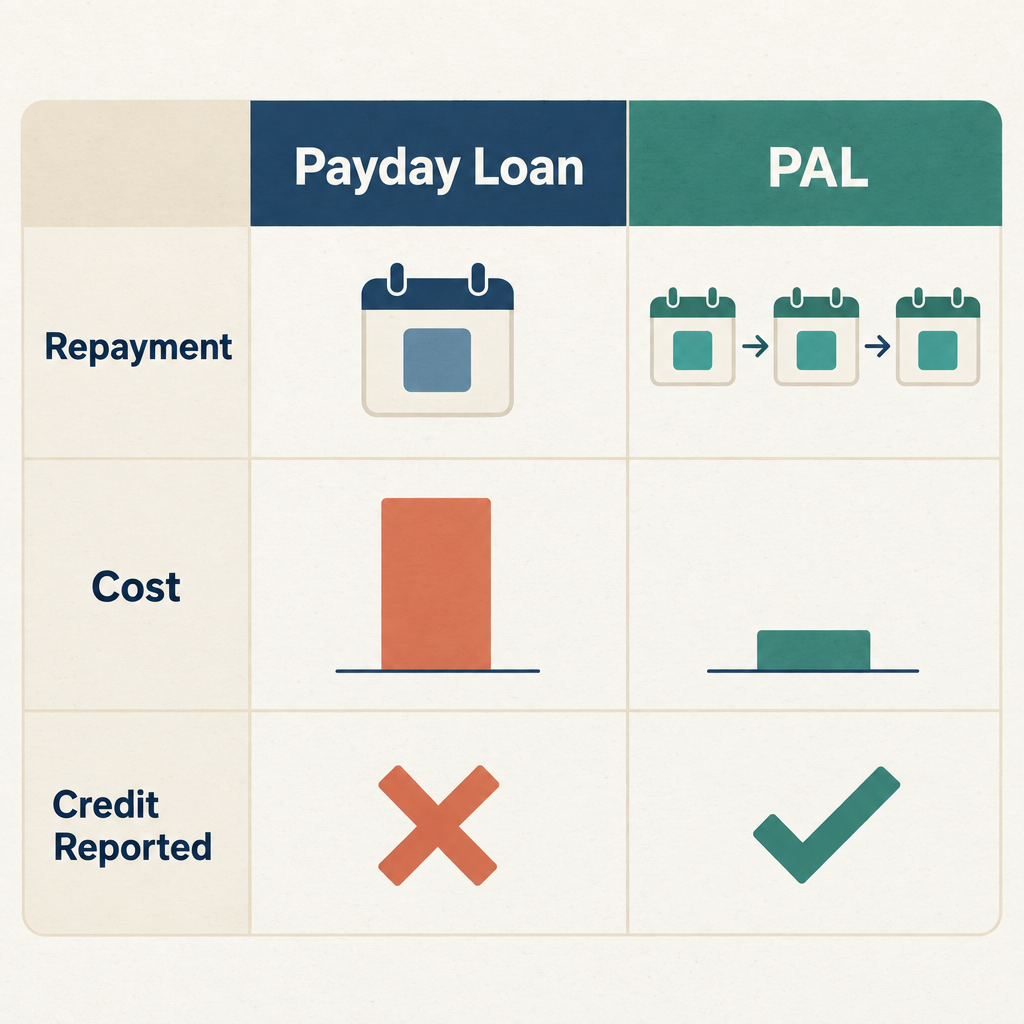
“Small loan” covers a wide price range. The table compares the main ways Americans borrow a few hundred dollars, using typical terms. Exact costs depend on your state and the lender’s own disclosure.
| Product | Typical size | Typical cost | Repayment | Credit reported? |
|---|---|---|---|---|
| Payday loan | $100 to $500 | $10 to $30 per $100, 300% to 700% APR | One lump sum in 2 to 4 weeks | Rarely, unless you default |
| High-cost installment loan | $500 to $5,000 | 100% to 300% APR in many states | Monthly payments over months or years | Often |
| Auto title loan | $100 to $5,000 | About 25% per month, around 300% APR | Lump sum in 30 days; car is collateral | Rarely |
| Pawn loan | $20 to a few hundred | Monthly fee set by state, often 20% to 25% | Redeem item or forfeit it | Never |
| Credit card cash advance | Up to your cash limit | 3% to 5% fee plus around 30% APR from day one | Minimum monthly payments | Yes |
| Cash advance app | $20 to $750 | $0 to $15 in tips and express fees | Debited next payday | Usually not |
| Credit union payday alternative loan (PAL) | $200 to $2,000 | 28% APR cap, up to $20 application fee | 1 to 12 monthly payments | Yes |
Installment loans
An installment loan spreads repayment over fixed monthly payments. That structure is easier to manage than a lump sum, but many payday lenders also sell installment loans at triple-digit APRs. A longer term at a high rate can cost more in total dollars than a single payday loan paid off on time. Compare the total repaid, not the monthly payment.
Auto title loans
Title loans use your car as collateral. Costs run close to payday rates, and the lender can repossess the vehicle if you miss the balloon payment. Losing the car you drive to work turns a $500 problem into a lost job.
Pawn loans
Pawn shops lend against an item you leave with them. If you cannot repay, you lose the item and nothing else. There is no debt collection, no bank debit and no credit damage, which makes pawn one of the lower-risk high-cost options even though the fees are steep.
Credit card cash advances
A cash advance on a card you already hold charges a 3% to 5% fee and interest from the day you withdraw, with no grace period. On a $500 advance held for a month at a 30% APR, the interest comes to about $12, so you repay roughly $512. Expensive by credit card standards, far cheaper than a payday loan.
Cash advance apps
Apps such as EarnIn, Dave and Brigit advance small amounts against your next paycheck and ask for optional tips or charge express delivery fees. A $5 fee on a $100 advance due in two weeks is a 130% APR, and the CFPB has found that most users do pay something. Still, the dollar cost is usually a fraction of a payday loan, and the apps generally cannot send you to collections.
Payday alternative loans from credit unions
Federal credit unions can offer PALs under NCUA rules (12 CFR 701.21). A PAL I runs $200 to $1,000 for one to six months; a PAL II runs up to $2,000 for up to 12 months. Both cap the APR at 28% and the application fee at $20. A $500 PAL repaid over six months at the 28% cap costs about $69 in interest, roughly $570 total before the application fee, against $575 for a two-week payday loan that you may need to roll over.
Where payday loans are legal
Availability depends entirely on your state. Around 20 states and the District of Columbia either ban payday lending outright or cap small-loan rates near 36% APR, which makes the two-week model unprofitable. That group includes New York, New Jersey, Pennsylvania, North Carolina, Georgia, Massachusetts, Connecticut, Maryland, Arizona, Arkansas, West Virginia, Vermont and Montana, plus states that voted or legislated caps more recently: South Dakota (2016), Colorado (2018), Nebraska (2020), Illinois (2021), New Mexico (2023) and Minnesota (2023).
Other states allow the product with limits. California’s Deferred Deposit Transaction Law caps loans at $300 face value, fees at 15% of that amount (so $45 on a $300 check, leaving you $255 in cash), and terms at 31 days, with lenders licensed by the Department of Financial Protection and Innovation. Ohio’s 2018 Fairness in Lending Act restructured payday lending into installment loans with a minimum 91-day term. Texas lets “credit access businesses” arrange loans with fees state law does not cap, which is why Texas borrowers routinely see APRs above 500%.
An online lender advertising nationwide “cash loans payday advance” does not override your state’s law. If your state bans payday loans, a loan made to you there is generally void or unenforceable, and the lender is operating illegally. Tribal lenders and offshore sites claim exemptions; state attorneys general and the CFPB have repeatedly sued them.
Who a payday loan can make sense for
We will be direct: the list is short. A payday loan can be a defensible choice only when all of these are true. You face a specific cost of overdraft fees, a utility shutoff or a late fee that is larger than the payday fee. You are certain the next paycheck covers the full repayment plus your normal bills. You have already ruled out the cheaper options below. And you will borrow once, not roll over.
CFPB research from its own supervisory data found that more than 80% of payday loans are rolled over or followed by a new loan within 14 days. Most borrowers do not fit the one-time profile, however they feel at the counter.
Why rollovers trap borrowers
The lump-sum structure is the problem. Someone borrowing $500 because they came up $500 short this month is unlikely to have $575 spare two weeks later. Paying the $75 fee to defer feels manageable. Doing it ten times over the year costs $750 and leaves the $500 unpaid.
Because the lender holds a check or ACH authorization, a missed payment also triggers bank consequences. Each failed debit can cost you an overdraft or returned-item fee from your bank on top of the lender’s returned-check fee. The CFPB’s payday lending rule, in effect since March 30, 2025, now bars lenders from attempting a third withdrawal after two consecutive failures without fresh authorization from you.
Payday loans also do nothing for your credit score. Most lenders do not report on-time payments to the three big bureaus, so repaying faithfully builds nothing. Defaults, on the other hand, are often sold to collectors who do report.
Cheaper options first
Ask your employer about a paycheck advance, or use a cash advance app with the free standard delivery option.
Check a local credit union for a payday alternative loan at 28% APR or a small personal loan.
Call the biller: utilities, landlords and medical offices often set up payment plans at no cost.
Call 211 or a nonprofit credit counselor approved by the National Foundation for Credit Counseling before borrowing at triple digits.
Several large banks now offer small-dollar loans of $100 to $1,000 to existing checking customers, repaid over three or four months for a flat fee far below payday pricing. Your own bank’s app is worth checking before a payday store.
Your rights as a payday borrower
Federal and state law gives you more protection than most storefronts mention.
The Truth in Lending Act and Regulation Z require written disclosure of the APR, the finance charge, the amount financed and the total of payments before you sign. The APR must be stated as a yearly rate even for a 14-day loan.
The Military Lending Act (32 CFR 232) caps the Military Annual Percentage Rate at 36% for active-duty servicemembers and their dependents and bans mandatory arbitration in their loan contracts. A payday loan above 36% made to a covered borrower is void.
The Electronic Fund Transfer Act and Regulation E (12 CFR 1005.10(e)) say a lender cannot require repayment by preauthorized electronic transfer as a condition of the loan. You can also revoke an ACH authorization by notifying the lender and your bank, which stops future debits, though it does not cancel the debt.
The Fair Debt Collection Practices Act covers third-party collectors who buy or service defaulted payday debt. They cannot threaten arrest, call before 8 a.m. or after 9 p.m., or contact your employer about the debt. Bouncing a post-dated check to a payday lender is a civil matter, not a crime, in the vast majority of cases, and threatening criminal charges is a common illegal collection tactic.
The Fair Credit Reporting Act lets you dispute a payday collection account on your credit report if it is inaccurate or unverifiable.
State law adds limits on loan size, fees, rollovers and the number of loans you can hold, plus licensing requirements. In many states a loan from an unlicensed lender is unenforceable.
How to check a payday lender
- Search the lender’s name on NMLS Consumer Access to see its license and the states it is licensed in.
- Confirm the license with your state regulator’s lookup, such as California’s DFPI or Texas’s OCCC.
- Read the Regulation Z disclosure and find the APR before you sign anything.
- Search the CFPB complaint database for the lender’s complaint record.
- Report illegal fees, threats or unlicensed lending to the CFPB complaint portal, FTC ReportFraud or your state attorney general.
FAQ
How much can you borrow with a payday loan?
Most payday loans are $500 or less, and state caps vary. California limits the check amount to $300. Some states allow up to $1,000, and a handful set no dollar cap at all.
Does a payday loan check your credit?
Most payday lenders skip the three major bureaus, which is why they advertise “no credit check.” They often use specialty databases such as Clarity or FactorTrust and state-mandated loan databases instead, so “no credit check” does not mean no screening.
Do payday loans build credit?
Almost never. On-time payments usually go unreported. Unpaid loans sold to collectors frequently do show up and hurt your score.
What happens if I cannot repay a payday loan?
The lender will try to cash your check or debit your account, which can trigger bank fees. Federal rules stop a third attempt after two consecutive failures. The debt may go to collections, and the lender can sue in civil court, but you cannot be jailed for owing a payday loan.
Can I cancel a payday loan after signing?
Many states give you until the end of the next business day to return the money fee-free. Check your contract and your state regulator’s rules for the exact window.
Are online payday loans different from storefront loans?
The product is the same, but online lenders are more likely to operate without a state license, charge higher fees and rely on ACH debits. Verifying the license on NMLS Consumer Access matters even more online.
What is the difference between a payday loan and a cash advance?
Many lenders use the terms interchangeably. A credit card cash advance, by contrast, is a separate product with a 3% to 5% fee plus card interest, usually far cheaper than a payday loan. Cash advance apps are a third category with small fees and no lender collection rights.
Laws and regulations referenced
- Truth in Lending Act, 15 U.S.C. 1601
- Regulation Z, 12 CFR Part 1026
- Fair Debt Collection Practices Act, 15 U.S.C. 1692
- Fair Credit Reporting Act, 15 U.S.C. 1681
- Electronic Fund Transfer Act, 15 U.S.C. 1693
- Regulation E (electronic transfers), 12 CFR Part 1005
- Military Lending Act, 10 U.S.C. 987
- Military Lending Act rule, 32 CFR Part 232
- CFPB payday lending rule, 12 CFR Part 1041
Links go to the official text on government sites.
Check, verify or complain

Dana writes US Financer's guides to payday loans, personal and installment loans, bad credit borrowing and cash advance apps. Every piece starts from what a loan really costs, works the numbers in a table, and checks what the lender's own disclosure and your state's rules…